Getting back on track, courtesy of a Peak Rail steam train

Foul weather was our constant companion from the start of 2024. It wore us down, the sombre grey sky, the biting wind, the constant rain. There was no pleasure to be had in going out, so we stayed at home, and as grim weeks ganged up to become relentlessly miserable months we started to go stir-crazy. So when, at last, conditions began to improve we quickly decided we deserved a treat, courtesy of our local heritage railway.
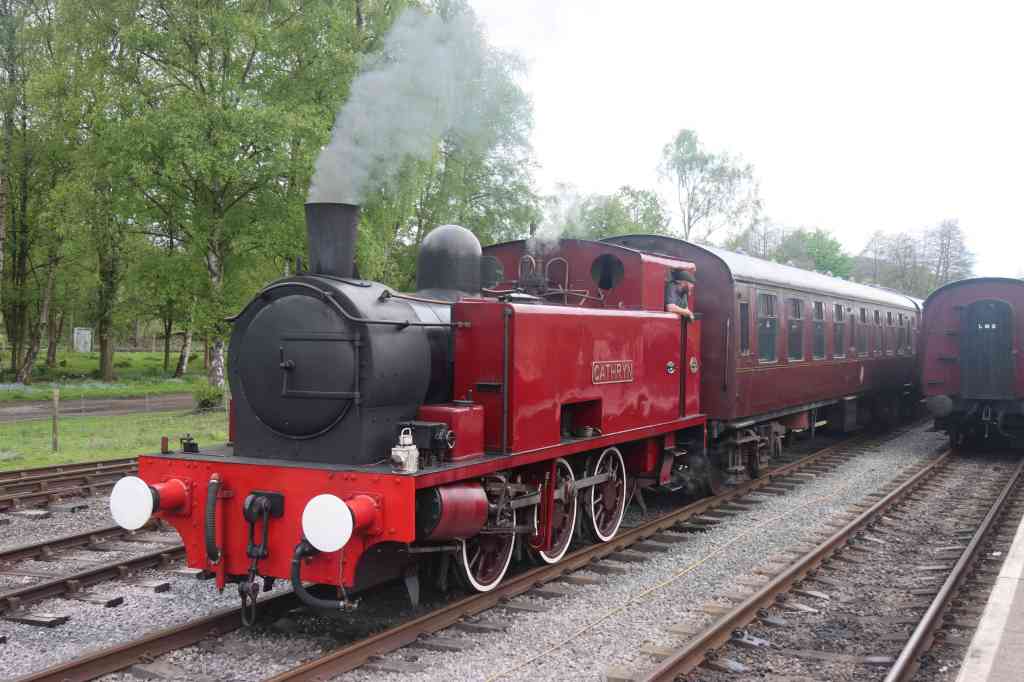
This is Peak Rail at its best…the sight, and the sounds and the smells of a gleaming, steaming locomotive! This loco was built in 1955.

We live in Derbyshire, on the edge of the Peak District. Famed for the natural beauty of its limestone hills and verdant dales, in 1951 the Peak District became the UK’s first national park. The railway that crossed it, running between Derby and Manchester, was a triumph of nineteenth century civil engineering. It was claimed by many to be Britain’s most scenic railway line.

Sadly I never got to find out in person if this claim was true. Much of the line was closed down in the 1960s, the victim of an efficiency drive shaped by the infamous “Beeching Report” of 1962. Accountants, politicians and British Rail bosses doubtless allowed themselves a glass of champagne to celebrate this “victory” for cost-effectiveness, but railway enthusiasts were dismayed. Their response was to band together to form the “Peak Railway Society” – later “Peak Rail Operations – with the aim of restoring the line for recreational and community use.

Half a century later, the dream lives on. Peak Rail has succeeded in re-opening around 4 miles (6.5 km) of track, between Rowsley South Station and Matlock, over which it operates a service featuring heritage steam and diesel locomotives. Here’s how Peak Rail describes its offer:

Whether it’s simply a nostalgic journey back to a bygone age or a discovery of the sights and sounds…of a steam or diesel locomotive[,] Peak Rail welcomes you to experience the thrill of our preserved railway whilst travelling through the delightful Derbyshire countryside…As well as our normal train journeys, there is something for everyone to enjoy, luxury dining is available on our Palatine Restaurant Car which offers Afternoon Teas and operates on various days during the year. [Source: Peak rail website, retrieved 14 May, 2024]

The reality, it must be said, proved to be more modest than the marketing hype. The part of Derbyshire through which the train travels is pleasant, but not exceptional (it’s on the edge of the national park rather than within it), and given that the line is just 4 miles long there’s not a huge amount to see. The locomotive that powered our train gleamed brightly in the welcome afternoon sunshine, but wasn’t by any stretch of the imagination remarkable in the context of other UK heritage steam trains. And the Afternoon Tea, while thoroughly enjoyable, didn’t align with my understanding of the words “luxury dining!”

But it’s important to remember that this is an organisation run by volunteers, and a service delivered almost entirely by volunteers. It’s not a commercial operation, so you have to adjust your expectations accordingly.

Peak Rail offers an opportunity to escape the rigours of the 21st century for a couple of hours, and to wallow in nostalgia. Back in the 1970s, dear old British Rail – the late, unlamented provider of the UK’s national rail network at the time – ran a series of commercials that sought to persuade motorists to abandon their cars in favour of rail travel. Its strapline was “let the train take the strain,” and that’s just what we did for a couple of hours, courtesy of Peak Rail.

Thanks to Peak Rail we were finally able to get back on track, after many months of meteorological misery. I’m pleased to report that a fine time was had by all

Concorde: up close and personal

I grew up in West London, within spitting distance of Heathrow Airport, and for 18 years the noise of aircraft taking off and landing was part of the soundtrack of my daily existence. In order to protect our sanity, we all trained ourselves to tune it out. In this way we could reduce the relentless roar of aircraft coming and going to mere muzak, simultaneously there and yet not there. But where Concorde was concerned, such mental gymnastics simply didn’t work. Concorde was SERIOUSLY LOUD.

Compare, if you will, the noise of a tabby cat miaowing and a lion roaring. You can experience only one of those sounds viscerally, as a physical sensation pulsing throughout your whole body. And it ain’t the tabby cat! It was just like that with Concorde, the undisputed roaring lion of the skies round my way, back in the day.

Concorde was, of course, the world’s first supersonic passenger-carrying aircraft, the product of a ground-breaking joint initiative between Great Britain and France. The name “Concorde” means “agreement,” and was an ironic reminder that the partners were in unfamiliar territory – over the centuries, the two nations had agreed on almost nothing, and had spent more time fighting than co-operating.

It all began in 1962 when the Brits and the French signed a treaty to share costs and risks in producing a supersonic passenger plane. Then the hard work started in earnest. Concorde made its maiden flight seven years later, but it was not until 1973 that the first transatlantic journey took place. The world’s first scheduled supersonic passenger services were launched three years later, in 1976.

Once development of Concorde was underway in the mid 1960s, some bright spark decided it would be a good idea to prepare the public for what might be in store for them. I distinctly remember, when I was ten or eleven years old, our teacher taking us out into the school playground one day so we could all experience our first sonic boom, courtesy of an air force jet the authorities brought in for that very purpose.

We all waited, hushed and expectant, for the miracle to happen. The appointed hour duly arrived, and so too did the RAF jet.

BOOM-BOOM went the soundwaves, echoing noisily around the neighbourhood.

“Oooh, aaah” squealed my schoolmates, frolicking excitedly around the playground.

“Enough of this rubbish, go back indoors and get on with some proper work” growled our teacher, trudging grumpily towards the classroom.

And, of course, it was rubbish. Concorde was never going to be breaking the sound barrier anywhere near us. It would be landing and taking off from an airport that was only a few minutes walk away from the school gates, and so would be many, many miles away before supersonic speeds could possibly be reached. It was therefore obvious to anyone with more than a couple of brain cells in working order that the sonic boom demo was totally pointless, but who cared, it got us out of lessons for a few minutes.

These memories of my own brief encounters with Concorde came flooding back last year, when Mrs P and I visited the Brooklands Museum of Motorsport and Aviation in Surrey. Amongst the museum’s collection is a Concorde, grounded of course, but perfect for an up close and personal inspection.

The plane on display still belongs to British Airways, but has been on loan to the museum since 2003. This particular aircraft never flew commercially, but was used in early testing and for certification. Later, from 1974-81, it was flown around the world to test new routes and to drum up sales to international airlines.

It was fascinating to finally get up close and personal with a Concorde. Its sleek, streamlined fuselage, the iconic delta-wing design and a nose that drooped during take-off and landing rendered the aircraft unmistakeable. And beautiful too. From outside you could gaze in wonder at a Concorde and think to yourself wow, if that’s the future of commercial air travel, bring it on NOW!

Cramped!

Inside however, as we discovered when we walked through the narrow cabin, things were rather different. With only around 100 seats – four per row, separated by a central aisle – and a low slung roof, it seems cramped, uncomfortable even. No amount of “free” champagne could disguise the fact that it feels like cattle class. But only the wealthiest of cattle ever got to fly in it.

Concorde’s advertised selling point was its unimaginably quick passage through the air, with a cruising speed that was over twice the speed of sound. A crossing from London or Paris to New York lasted approximately three and a half hours, less than half the time taken by subsonic aircraft.  Famously, in summer 1985, Phil Collins was able to perform at Live Aid concerts in both London and Philadelphia on the same day by hopping onto a Concorde after his set at Wembley for a transatlantic flight to the US!

Cockpit confusion!

But the other attraction of Concorde was its exclusivity. Tickets were prohibitively expensive, meaning that you could only afford to take a scheduled flight on this iconic aircraft if you were stinking rich. To have flown on Concorde became a badge of honour, an indicator that you’d inherited or otherwise made a fortune.

Ultimately, however, the Concorde project was doomed. Although aesthetically pleasing and technologically ground-breaking, operating costs and serious environmental concerns were its undoing. Astonishingly, given its iconic reputation, only 20 Concordes were ever built, and just 14 of these flew commercially.

This photo shows the iconic “droop nose” on a plane landing at Farnborough in 1974. IMAGE CREDIT: Steve Fitzgerald (GFDL 1.2 or GFDL 1.2), via Wikimedia Commons

The final nail was driven into Concorde’s coffin on 24 July, 2000, when Air France Flight 4590 crashed shortly after take-off from Paris. All 109 people on board and four others on the ground were killed. As a result, commercial Concorde services were suspended everywhere until November 2001. Less than two years later the plane was officially retired, 41 years after the Anglo-French treaty was signed and 27 years after commercial operations had begun.

Visiting Concorde at the Brooklands Museum was a fascinating experience. It was also rather nostalgic, oddly so given that although I’ve seen – and heard – it from afar on countless occasions, I’ve never actually flown on this aircraft. Indeed I’m neither that rich nor so environmentally naïve as to have ever contemplated such a thing. And I’ve absolutely no regrets on that score.

I’d like to believe that all thought of commercial supersonic air traffic has been abandoned forever. However in doing research for this post I’ve have read that greener options are currently being explored, including hydrogen-powered planes that could offer the prospect of “near-zero emissions.”

If this is really true I have to ask, why are we bothering? In my humble opinion, commercial supersonic air travel is folly at best, criminal at worst. The world is in big trouble right now. Surely there are better uses of our time, wealth and ingenuity than seeking to shave a few hours off the length of a transatlantic flight, a flight that is probably unnecessary anyway in the modern, digitally-enabled age? Sometimes I despair!

Our “Boarding Passes” for the Concorde at Brooklands Museum!

A jewel in the crown of the UK’s heritage railways

The Bluebell Railway is without doubt a gleaming jewel in the crown of the UK’s heritage railways. Its locomotives puffing serenely through 11 miles (18 km) of rolling countryside in the county of Sussex, the Bluebell is thought by many to be England’s best steam railway experience. So, when we were in the area earlier this year, we decided to check it out for ourselves.

Railway nostalgia is big business in the UK. There are, astonishingly, well over 200 “minor and heritage railways” operating across the country as a whole. According to the government’s Office of Rail and Road (ORR):

“Minor and heritage railways are ‘lines of local interest’, museum railways or tourist railways that preserve, recreate or simulate railways of the past, or demonstrate or operate historical or special types of motive power or rolling stock….Much of the rolling stock and other equipment used on these systems is original and is of historic value in its own right. Many systems deliberately aim to replicate both the look and operating practices of historic former railways companies.

Source: ORR website, retrieved 7 December 2023

The Bluebell Railway, which is named for the profusion of bluebells that flower in the area each spring, fits the ORR’s definition perfectly. It is Britain’s oldest preserved standard-gauge railway, and is run by the Bluebell Railway Preservation Society. The Society ran its first train in August 1960, less than three years after British Railways closed the line to “regular” rail traffic. A ride from one end of the line to the other takes around 40 minutes, but most passengers break their journeys to explore what each of the stations along the route have to offer.

The star attractions are, of course, the vintage steam locomotives. They seem to have personality, not something I would ever say about 21st century railway technology. And don’t you just love the sooty smell of a locomotive in full steam, a smell from another era that seems out of place in our sanitised modern age. The Bluebell Railway Preservation Society has more than 30 steam locos under its care, making this the second largest collection in the country after the National Railway Museum at York. We were pleased to see – and smell! – several in action during the course of our visit.

In addition to the wonderful locos there are nearly 150 carriages and wagons, most of them dating back to the first half of the twentieth century. As well as riding some of the rolling stock as it trundles along the Bluebell’s tracks, it’s also possible for visitors to get up close and personal with more examples in the huge loco sheds and carriage workshop.

But it’s not just the rolling stock that offers glimpses of a lost world. The stations have been restored to show how they would have looked at different stages in the line’s history: Sheffield Park Station reflects the 1880s, Horsted Keynes Station the mid-1920s and Kingscote Station the 1950s. As a result, the Bluebell Railway and its stations have been used as locations for scenes in movies including Muppets Most Wanted, and period TV dramas like Downton Abbey.

A souvenir of the Downton Abbey period tv drama!

In common with every other heritage railway, the Bluebell is dependent on volunteers. There are some paid staff, but most of the people keeping the show on the road do it for free, and presumably for fun.

The cynic in me says that the anachronistic steam locomotives are little more than “big boys’ toys,” while the guys (and it is, I think, mostly men) who dress up as train drivers, guards, signal operators and buffet car assistants are a bit like Peter Pan, kids who never quite managed to grow up!

But where’s the harm in that? The Bluebell has clear educational value, it boosts the local economy by attracting tourists and keeping them entertained, and enables ordinary people to play an active role in a wider community venture. Everyone’s a winner on the iconic Bluebell Railway.

Mural reveals village’s hidden history

Murals are springing up all over my home county of Derbyshire. A little while ago I wrote about a magnificent painting of a kingfisher that had suddenly appeared on the side of a house in our local town. And just a couple of weeks later we came across another unexpected mural, this one featuring a railway locomotive in full steam.

To be fair, the steam train mural has been there since 2021, but it’s in a part of the county we rarely visit. Driving through the village, Westhouses appears totally unremarkable, and my initial reaction was to question why anyone would choose to cover one wall of its abandoned social club with a painting of a long extinct mode of transport. All of which proves how little I knew about the history of that corner of Derbyshire!

It turns out that Westhouses owes its very existence to railways. The village is named after West House Farm, but there was little if any other habitation in the area until the middle of the nineteenth century when the Midland Railway company drove a line through it to serve numerous local collieries and ironstone pits. The company needed to put in place a range of support facilities, and so in the 1870s it set about the creation of a new village, including workers’ houses, a school and a church, as well as a big engine shed to stable and maintain its locomotives.

Once upon a time railways were the lifeblood of Westhouses, but not now. Both the engine shed and railway station closed decades ago, and it seems improbable that any local people are now employed in the railway industry. However, residents remain proud of their connection with that industry, and when organisers of a community arts project searched for topics to engage local interest it’s no surprise that a steam locomotive was amongst those chosen.

The mural was painted by two artists from Leicester-based spray art collective Graffwerk. It took them five days of spraying to finish the job, and local train enthusiasts – many of whom had family connections with the Stanier 8F steam locomotive that is pictured – were on hand to make sure they got all the details absolutely right!

Trawling through social media posts dating from immediately after the project was completed in 2021, it’s clear that local residents were blown away to have such a wonderful piece of art in their village. Murals that are well chosen and brilliantly executed clearly have enormous power to bring whole communities closer together.

They are also a reminder to casual visitors such as me that seemingly ordinary places may have hidden histories that are well worth celebrating. Before seeing that mural I would never have given Westhouses a second glance, but having stumbled across it I was curious to know how and why it came to be there. So, thanks to the mural – and then the internet! – I did some research, and discovered the extent of my earlier ignorance. It’s clear there’s much more to Westhouses than I would ever have guessed, thanks to its proud railway heritage.

Hidden history: the decline and fall of Cromford Canal

History is all around us, but you have to know where to look. Some relics of Derbyshire’s past are easy to spot: the monumental cotton mills, for example, now derelict or re-purposed, are remnants of the time when this area was at the forefront of the Industrial Revolution. And as you drive around the county you pass countless pit head winding wheels, preserved and brightly painted as proud reminders of a coal mining industry that once dominated the local economy.

Starvehim Valley Bridge, built 1792, a crossing point over the old Cromford Canal

But other aspects of our history are tucked away, hidden from view. Mrs P spent her teenage years in a village close to where we now live, and enjoyed walking along a nearby section of the abandoned Cromford Canal. However, although I’ve lived around here for almost 40 years, I was totally unaware that this relic of Derbyshire’s industrial past was within a short drive of home. So, when lockdown finally eased a few weeks ago, Mrs P suggested we check it out.

Cromford Canal was completed in 1794, built by prominent local industrialists William Jessop and Benjamin Outram to facilitate the easy transportation of coal, limestone, lead, iron ore and spun cotton. It ran for around 14 miles (23 km) from Cromford to Langley Mill, and included the impressive Butterley Tunnel burrowing over 3,000 yards (2,800 metres) through the Derbyshire hills. At Langley Mill it joined up with the Erewash and Nottingham Canals, which provided connectivity with the rest of the national waterways network.

Here the Cromford Canal has become shallow over the centuries (note the recent stepping stones!)

For a few decades Cromford Canal was busy: in 1802 over 150,000 tons (152,000 tonnes) of freight was carried, rising to nearly 300,000 tons (305,000 tonnes) by 1842. However, by the second half of the nineteenth century, competition from railways was taking its toll. This novel way of moving freight around the country was faster, cheaper and more reliable than the waterways network. By 1888 Cromford Canal’s annual trade had fallen to just 45,000 tons (46,000 tonnes).

With canal business in decline, maintenance of the infrastructure was an expense that was increasingly difficult to justify. When subsidence closed the Butterley Tunnel in 1899, Cromford Canal’s days were clearly numbered.

Here the canal is a little wider, but still very shallow. Note the reads and rushes blocking it on the left

On this occasion the Tunnel was repaired, but further subsidence in 1900 led to its permanent closure. Those parts of the canal that remained operable and connected to the national waterways network limped on until 1944, when most of it was abandoned. By 1962, Cromford Canal was dead.

Two hundred years ago Cromford Canal resounded to the cries of men urging on the heavy horses that plodded along the towpath, dragging behind them barges laden with the materials and products that shaped the Industrial Revolution. It was a hive of noisy, boisterous activity. But time has moved on, and tranquillity has descended again on this once frantic corner of Derbyshire. Today the great age of canals is just a distant, faded memory.

Another view of the Starvehim Valley Bridge, which was built by famed local industrialists William Jessop and Benjamin Outram.

In 2021 the line of the old canal is a great place for a walk, but no place to take a boat. Large stretches are now filled in, and where water remains it’s mostly clogged with vegetation, mud and silt. Cromford Canal is a haven for wildlife and a welcome change of scenery for recreational walkers, but serves no other significant purpose.

Perhaps the most surprising part of our walk was the Starvehim Valley Bridge. Built from local stone in 1792 as a crossing point on the new canal, it’s now in the care of Historic England and protected by law (Grade II Listed). Luckily a very short stretch of canal either side of the bridge still contains water, adding to its visual appeal. Hidden and little known, Starvehim Valley Bridge is wonderfully picturesque, and serves as a compelling memorial to the decline and fall of Derbyshire’s Cromford Canal.

Decline and fall: here the Cromford Canal has been entirely swallowed up by mud, silt and vegetation

Museums ain’t what they used to be

Museums ain’t what they used to be.  When I was a lad, back in the days when the UK had only had two television channels (both black-and-white) and England were good at soccer, museums were vehicles of the establishment.  They celebrated the political, military, architectural and cultural achievements of the great and the good. The lives of ordinary folk like me and my family never got a look in, but that was OK because we knew our place.

Trams and buses trundle Beamish’s cobbled streets

All that’s changed now.  Society recognises that, regardless of our backgrounds, every one of us has been on a journey and has a story to tell.  Beamish Open Air Museum in County Durham reflects this more inclusive approach. It is a “living, working museum that uses its collections to connect with people from all walks of life and tells the story of everyday life in the North East of England.”

Beamish offers snapshots of North-East life in the 1820, 1900s and 1940s, scattered across a 350 acres site.  Its latest project, underway at the time of our visit on our way back from Shetland in late June, is to reconstruct a 1950s town. 

Traditional apothecary / chemist / pharmacy

This is clearly a good thing.  Everything that surrounds us in our lives in 2019 will be history to future generations, and it’s great to see that Beamish Museum is continuing to add to and update its exhibits.  In creating its 1950s exhibit it will reflect a period that, for today’s oldest visitors – including the venerable Platypus Man – is still just within living memory.

Beamish is heavy with the atmosphere of another age.  Electric trams trundle along the cobbled streets of the 1900s exhibit, past historic buildings with period fittings.  Visitors can ride the trams, go into the shops, the dentist’s surgery and the solicitor’s office, and interact with friendly volunteers and staff in period costume. 

You can ride the trams around the Beamish site

There were lots of school groups on site at the time, and Beamish gave them a glimpse of an everyday life they have never experienced.  The sweet shop proved to be particularly popular, with youngsters able to watch confectionery being made the traditional way, and then to buy the resulting produce. 

At the bank they could learn about pounds, shillings and pence, which are part of my DNA but totally alien to today’s young people.  At the Co-Op store they were able to see what shopping was like in the era of ‘closed access’, when all the goods were kept behind the counter under the custodianship of the eagle-eyed shopkeeper.

Traditional grocery shop

Beamish offers a brilliant, immersive exploration of living history.  Even though some of the youngsters were more interested in their mobile phones than the museum, many more were clearly fascinated by this brief insight into the lost world of their grandparents.

As for me, I had a grand day out and loved every minute of it.  In the immortal words of Arnie ‘Terminator’ Schwarzenegger, “I’ll be back.” 

The tram shed

Reminiscence is good therapy for old fogeys, so long as we keep a sense of proportion and remember that life back then was, in most ways, much tougher than ours today. 

Bring back the shilling, the sixpence and the threepenny bit, that’s what I say!