Wordless Wednesday is a simple blog post featuring a photo. It seeks to convey a message or tell a story, but speaks for itself without using words. Mrs P took this photo of Polar Bears squabbling near Churchill in Manitoba, Canada in 2012.
During a recent trip to London our ambition to escape the familiar tourist treadmill led us to visit Leighton House, the former home of a prominent 19th century artist and lord of the realm. Frederic Leighton (1830-1896), the artist son of a Yorkshire doctor, was successful, well-travelled and wealthy, and in the mid-1860s he started work on a new house in the Holland Park area of the city. The result was spectacular.
The Arab Hall
Leighton’s intention was to build a house that would function as his artist’s studio, while also serving as a work of art in its own right. In so doing he was able to channel his creativity, to indulge his passions and to show off some of the more exotic items in his personal collection.
The Arab Hall
The undoubted star of the show at Leighton House is the Arab Hall, a space that was inspired by the architecture and gardens the artist had seen on his travels in North Africa, the Middle East and Sicily. The Arab Hall displays Leighton’s collection of tiles, most of which were made in Damascus between the late 16th and early 17th centuries, as well as works by contemporary artists he commissioned to help bring his vision to life.
The Arab Hall. In the bottom photo the Arab Hall is viewed from the Narcissus Hall. The statue is of Narcissus, who plainly fancies himself!
The Arab Hall was part of an extension added to the house in the 1870s. It was completed in 1882, and is said to have cost more than the whole of the original building. Money well spent, I think! Leighton is reported to have said of the Arab Hall that he wanted to create “something beautiful to look at”. Well, he succeeded, that’s for sure. It is simply stunning, all the more so for being so totally unlike anything you would ever expect to see in London.
Top Left: In the garden “A Moment of Peril”, a sculpture by Sir Thomas Brock created in 1881. Bottom Left: Rear view of Leighton House, from the garden. Right: View of Leighton House from the street; you would never guess what lurks within, would you?
Leighton was an eminent figure in the English arts scene in the latter half of the 19th century. He painted both portraits and landscapes, dabbled in sculpture and was a big player in the Aesthetic Movement, which championed “art for art’s sake,” prioritising beauty, sensuality, and visual pleasure over practical considerations.
The Silk Room was used to display paintings by artists who Leighton admired.
Frederic Leighton was highly respected in the artistic community, as demonstrated by the fact that in 1878 he became President of the Royal Academy of Arts, the prestigious, London-based institution that was founded in 1768 to promote visual arts through education and exhibitions.
Two paintings by Frederic Leighton.
Such was the esteem in which Leighton was held that on January 24th 1896 he was made a Lord, becoming Baron Leighton. It was a record-breaking elevation to the nobility as he was the first painter ever to have received a peerage. He probably felt pleased with himself, but sadly that did not last long. Just one day later, on 25 January 1896, Baron Leighton died, enabling Frederic to break another – and altogether more unwelcome record: nobody in the history of English nobility has ever held a peerage for less time than poor old Fred!
The Dining Room was mainly used for the display of pottery.
Baron Leighton therefore had no time in which build a reputation in the House of Lords as a formidable debater and champion of the arts. From that perspective he was – through no fault of his own, of course – a complete nonentity. But who really cares about that? The building of Leighton House, and particularly the creation of its Arab Hall, has secured Frederic, Baron Leighton’s legacy for all time.
Wordless Wednesday is a simple blog post featuring a photo. It seeks to convey a message or tell a story, but speaks for itself without using words. Mrs P took this photo of Mount Ngauruhoe in the North Island of New Zealand in 2019.
When we visited London a few months ago we made a conscious decision to avoid the tourist hotspots and instead have a look at some of the lesser known attractions. London definitely has a lot to offer, but St. Sophia’s Cathedral – more properly known as the Greek Orthodox Cathedral of the Divine Wisdom – was certainly not what I expected.
Surprisingly the first Greek Orthodox church in London opened way back in 1681, to serve a growing community of Greek origin. This influx was driven in part by the persecution of Christians under the Ottoman Empire, which ruled Greece at the time. In addition, some wealthy Greeks relocated to London to escape the political instability of their homeland, while others who worked in the shipping industry moved there to set up businesses moving goods between England and the eastern Mediterranean. The small Greek community thrived, and today the area of Soho in which they first settled is still known as Greek Street.
Although London’s Greek community prospered and grew, their original church did not. By the mid-19th century, demand amongst its members for an appropriate place of worship intensified, and it was this that ultimately led to the construction of a building large and grand enough to meet the spiritual needs of a community that was now numbered in the thousands. Work began on the construction of the Greek Orthodox Church of the Divine Wisdom in 1877, and it was formally consecrated in 1882. In 1922 it was designated as a Cathedral serving the needs of all Orthodox Christians in the British Isles and Malta.
Arriving at the Cathedral, the view from the street is unremarkable, and at first I wondered if our visit was worth the effort we’d made to get there. Crossing the threshold, however, I quickly learned that the ornate Byzantine interior boasts an impressive array of intricate mosaics and other beguiling features. This riot of gold leaf, multi-coloured marble and elaborately carved wood seemed strangely exotic, very un-British, not at all what I expected to see in London – nor, indeed, anywhere in the UK – and was all the more pleasing for that very reason.
The Greek Orthodox Cathedral of the Divine Wisdom in Bayswater, London, most definitely possesses the “wow factor”, and is a clear illustration of why visitors to London should occasionally break away from the well trodden tourist trail and seek out some of the capital’s less known architectural gems. Well worth a visit!
Wordless Wednesday is a simple blog post featuring a photo. It seeks to convey a message or tell a story, but speaks for itself without using words. Mrs P took this photo of a fishing hut at Prospect Bay in Nova Scotia, Canada in 2015
Last Monday, 2 February, was World Wetlands Day. A wetland is a transitional area between land and water, an area where water covers the soil – or is present at or near the surface – either permanently or seasonally. Mrs P and I love a good wetland: it’s a distinct ecosystem that is a great place for a spot of birdwatching, and is notable as the favoured habitat of the handsome heron family
Grey Herons were my Mum’s favourite bird. This one has just caught itself a tasty snack.
When my father died over 30 years ago we bought my mother a set of binoculars and started taking her out on our birdwatching expeditions. She soon declared the heron to be her favourite bird, attracted I suspect by its large size and a distinctive appearance that includes a dagger-like bill, long spindly legs and an improbably bendy neck. I imagine she was also intrigued by the birds’ hunting style, in which they stand motionless for lengthy periods before stabbing explosively at any prey item foolish enough to venture too close to them. Spotting a heron quickly became Mum’s ambition whenever we took her out, and because we chose our birdwatching sites carefully she was rarely disappointed.
The Grey Heron is the UK’s most common species of heron. As these images show, Mrs P’s been photographing them for many years.
The species that Mum got to know and love is the Grey Heron, by a long way the most common member of the heron family in the UK, with over 60,000 birds overwintering here. Standing nearly 1m high and with a wingspan approaching 2m, it is an impressive bird. It feeds primarily on fish, but also eats amphibians, ducklings and other small birds, and tiny mammals such as voles. Interestingly, Grey Herons sometimes temporarily leave their wetland habitats in favour of nearby agricultural fields which they scour for rodents in the immediate aftermath of the harvest.
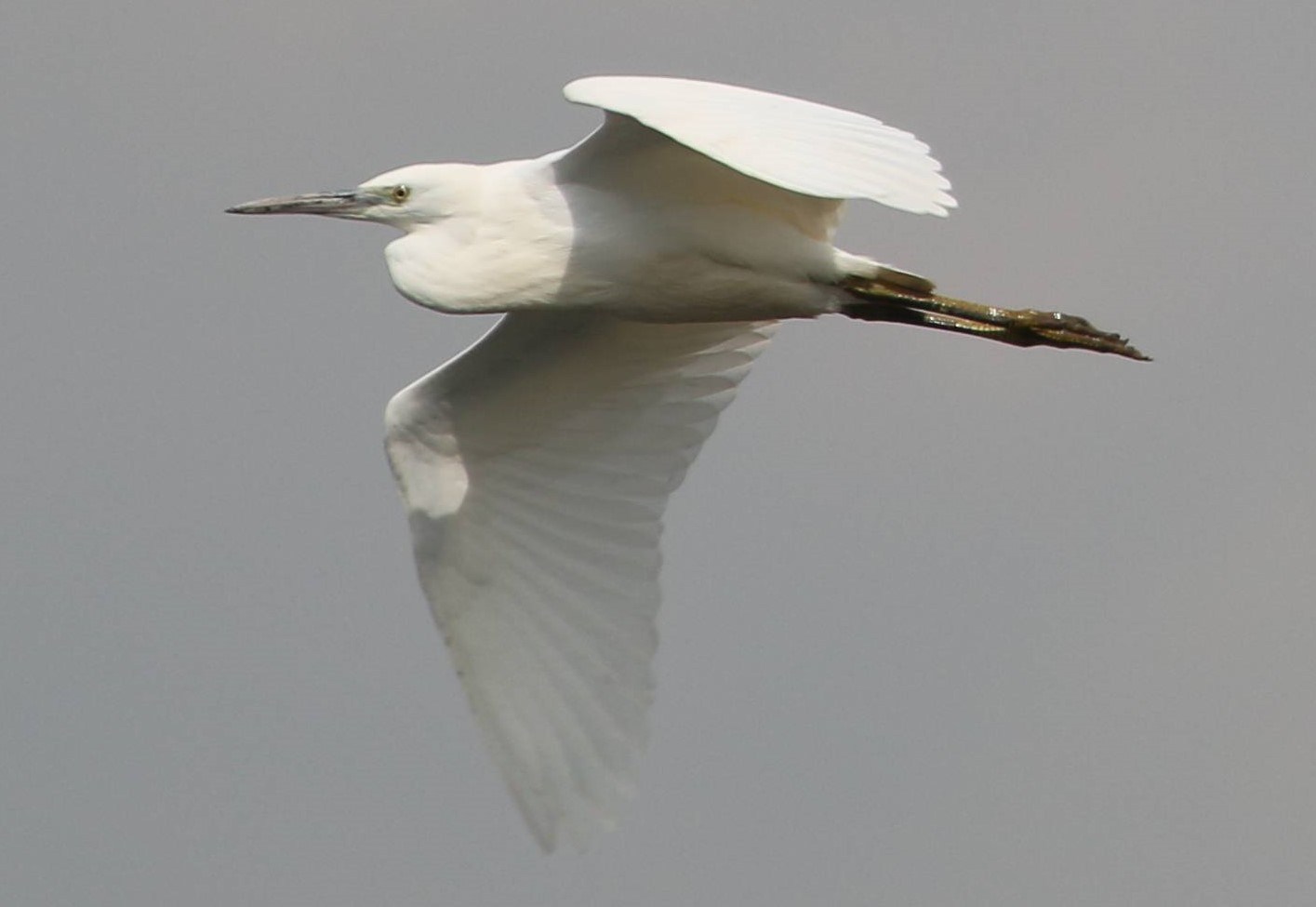
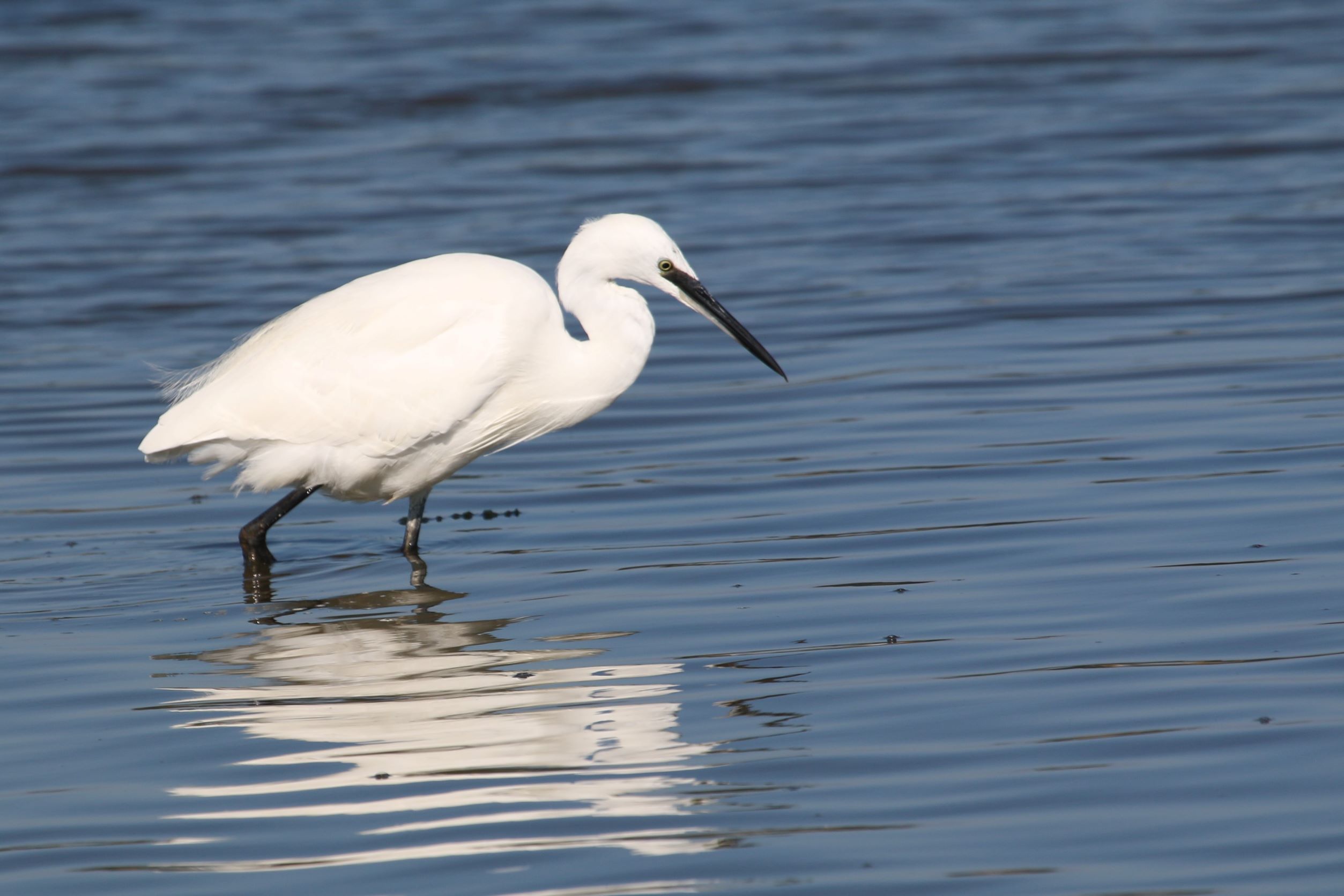
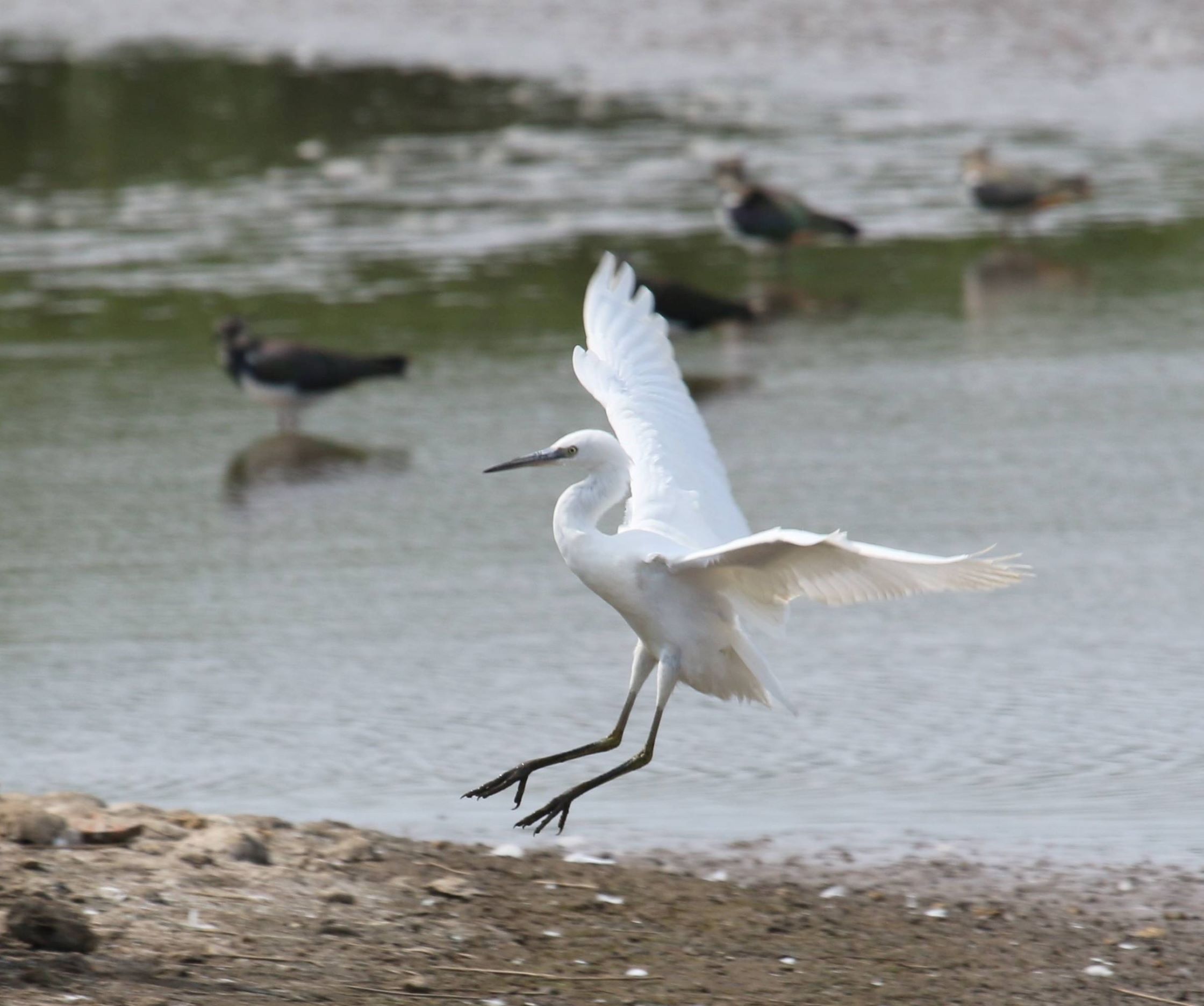
Little Egret.
The UK boasts several other members of the heron family, although none is very common. The Bittern is vanishingly rare; Mrs P and I have rarely seen one, and have never got a decent photograph. Little Egrets were once common here, but were wiped out over 100 years ago thanks to the insatiable demand of the fashion industry for the birds’ elegant feathers. I wrote about the decline and fall of the Little Egret, and the important consequences this had on bird conservation in the UK, in a post I wrote in 2024.
Great White Egret.
Little Egrets began recolonising the UK in the late 20th century, and these days we see them quite often. Sadly their return came too late for my Mum, as did the more recent arrival of the Great White Egret. She would have been thrilled, I’m sure, to see both egret species, though I suspect neither would have supplanted the Grey Heron in her affections.
Clockwise from Top Left: Green Heron (seen on Tobago in 2006); Great Blue Heron (Canada, 2014); Little Blue Heron (Costa Rica, 2008); White-Faced Heron (Tasmania, 2016); Galapagos Heron (Galapagos Islands, 1989); Bare-Throated Tiger Heron (Costa Rica, 2008); Great Blue Heron (Canada, 2015).
Across the whole world there are reckoned to be 75 separate species within the heron family, although some go under the names of egret or bittern. Herons’ solitary nature and their motionless hunting style have captured the imagination of cultures everywhere, often making them figures of mystery and deep spiritual significance as well as symbols of patience and wisdom. Every continent except Antarctica boasts resident species of heron, and as Mrs P’s photos show we’ve been privileged to see a number of these during our travels.
Clockwise from Top Left: Bare-Throated Tiger Heron (Costa Rica, 2008); Green Heron (Costa Rica, 2008); Bare-Throated Tiger Heron (Costa Rica, 2008); Indian Pond Heron (India, 2013); Little Blue Heron (USA, 2012); Great Blue Heron (Canada, 2012).
Almost all species of heron are closely associated with water, living and feeding as they mostly do on the margins of lakes, rivers, and swamps. They need wetlands, as do so many other species of birds, mammal and invertebrate, and it has been a pleasure to celebrate World Wetlands Day by featuring these magnificent birds here. My Mum, a heron lover until the very end, would definitely have approved!
Wordless Wednesday is a simple blog post featuring a photo. It seeks to convey a message or tell a story, but speaks for itself without using words. Mrs P took these photos of a colourful fishmarket in 2013, at the town of Diu in the Indian state of Gujarat.
In a previous post about our 2025 visit to London I described a journey downriver on the Thames from Westminster Bridge to Woolwich. On a different day we took another boat trip, this time heading upriver. The plan had been to visit the historic Hampton Court Palace, once the home of King Henry VIII. Sadly this proved impossible due to repair work being undertaken at Teddington lock, but nevertheless – despite the relentlessly gloomy weather – we decided to take the boat upriver to Kew to view this area of London from an unfamiliar angle.
The Vertrouwen is a Dutch barge dating from 1929. It is now moored at Dove Pier in Hammersmith.
In common with most cities, London is a mixture of the good, the bad and the ugly. Mostly ugly, of course, but the river journey did reveal a few interesting bridges, boats and buildings. Although I grew up in the capital, most of the sights were new to me, but a few – such as Hammersmith Bridge – were achingly familiar.
Hammersmith Bridge
An elegant suspension bridge that opened in 1827, Hammersmith Bridge is etched into my memory. Over half a century ago I attended school in this part of London, and can clearly remember our class being sent on “cross-country” runs – following a route that included crossing the bridge – by a teacher who was clearly allergic to teaching in the conventional sense. These days the bridge is closed to all motor traffic due to the appearance of cracks in its pedestals, but foot traffic (including, I imagine, cross-country runners!) can still cross here.
Hammersmith Bridge
One of the most recognisable buildings we saw during our trip upriver was Battersea Power Station. Built in two phases between 1929 and 1955, the coal-fired power station once produced a fifth of all the electricity used in London, keeping the lights on in buildings as illustrious as Buckingham Palace and the Houses of Parliament.
Battersea Power Station ceased operations in 1983, when the generating equipment began to wear out and oil, gas and nuclear fuels started to be preferred over coal for the generation of electricity. Demolition would have been the obvious next step, but the building’s iconic appearance on the London skyline resulted in it being given listed status in recognition its heritage value.
Battersea Power Station
For over 20 years the former power station remained unoccupied. It fell into disrepair, before plans were agreed to redevelop the site to include residential accommodation, bars, restaurants, offices, shops and entertainment spaces. When viewed from the Thames there is little indication today of what now lies within, but it’s easy to see why such an imposing structure captured the imagination of several generations of Londoners.
We had been fully expecting and were looking forward to seeing Battersea Power Station, but another nearby building took us totally by surprise. Just a few hundred metres upriver from the power station is the Peace Pagoda, one of around 80 similar structures built across the world since the end of the Second World War. They owe their origin to the Japanese Buddhist monk Nichidatsu Fujii (1885-1985), who devoted his life to promoting non-violence after an inspirational meeting with Mahatma Gandhi in 1931.
The Peace Pagoda in Battersea Park
The first Peace Pagoda, which was intended as a focus for people of all races and creeds to help unite them in their search for world peace, was inaugurated in the Japanese city of Kumamoto in 1954. The Battersea Peace Pagoda dates from 1985, and was built by a group of 50 volunteers who were members of the Japanese Nipponzan-Myohoji Buddhist order that had been founded by Fujii.
Taking off from London Heliport
Journeying through London on the Thames proved to be the perfect way to escape the chaos of the capital’s road network for a while, but travel by boat does not suit everyone. If you’re in a hurry, filthy rich and don’t give a damn about noise pollution, you can travel to and from central London by helicopter. London Heliport’s website proclaims that it offers “ultimate comfort and convenience” by acting as “the vertical gateway to London for VIPs and the business community for over 50 years.” Plainly it’s not for the likes of me and Mrs P, but we were interested to watch a helicopter taking off as our boat passed the heliport. It reminded us – as if we needed reminding! – why we would hate to live in London.
These images show a few of the other sights we witnessed during our upriver excursion. Top Left: “The Powerhouse”, a former power station converted into luxury apartments. Top Right: former Dutch barge the “Amethyst Atoll”, now moored at Dover Pier, Hammersmith. Middle Right (top): Kew Bridge. Middle Right (bottom): Unidentified boat moored at Chiswick. Bottom Right: Lambeth Bridge. Bottom Left: “Houses on the Strand” at Kew. All very interesting, but I definitely wouldn’t want to live here!
Wordless Wednesday is a simple blog post featuring a photo. It seeks to convey a message or tell a story, but speaks for itself without using words. Mrs P was clearly seeing double when she took this photo at Yellowstone National Park in September 2018.
The plan was simple – take a leisurely drive up to the west coast of Scotland, catch the ferry and then spend some quality time on the islands of Islay and Jura. We’d never visited either before, but they promised so much – beautiful scenery, bewitching wildlife, numerous whisky distilleries and, above all, a bit of peace and tranquillity, away from the hurly burly of our daily existence. Only it didn’t quite work out that way…
Red deer stag at Inverlussa, Jura – Such a handsome chap!
The drive north was uneventful, but things began to go wrong as soon as we arrived on Islay, the southernmost island of the Inner Hebrides. We had rented a cottage, and it didn’t live up to expectations. I’ll not bother you with the details, just believe me when I say we were not at all happy.
Kilchoman church, Islay – in the middle of nowhere!
But things were about to get a whole lot worse. After less than 48 hours on Islay a medical issue forced us to seek urgent advice. Our cottage was in a very remote location; there were no neighbours we could turn to for support, and we ended up speaking by phone to a doctor in Inverness, around 200 miles (320km) away. He diagnosed the problem, and referred us to the local hospital where we could pick up some medication. Up until this point I’d absolutely no idea there was a hospital on the tiny island of Islay!
Tarbert Bay, Jura
We set off after midnight, struggling to find our way in pitch darkness along roads that could have been in contention for the national “pothole of the year” award if such a thing existed. Eventually we found the hospital and picked up the medication.
The Paps of Jura
Fortunately the medication soon started to do its job. We took things fairly easy for the next couple of days while recovery was underway, and even managed a day trip to the nearby island of Jura. Islay and Jura were beginning to live up to their reputations, despite our discomfort.
Isla is famous for its distilleries that produce peaty, single-malt whisky. This is the Ardbeg Distillery
And then, just as we were picking up the pace again, we got a phone call. A family emergency had arisen, and we were needed back home as soon as possible. Frantic phone calls followed as we sought to cancel the other accommodation we had lined up for later in our trip, and to rearrange our ferry booking in order to get us back to the Scottish mainland as soon as possible. Luckily, everyone we spoke with was sympathetic and helpful. Although we needed to rise from our beds at 4.45am we did get safely back home to Derbyshire the next day, after around 17 hours travelling. What a nightmare!
Highland Cow at Sanaigmore Bay, Islay
Needless to say, in many ways it’s a holiday we’d rather forget. But having said that, both Islay and Jura appeared to have a lot to offer. They seemed like “our sort of place”, and in other circumstances our memories would doubtless be overwhelmingly positive. So we have tentatively agreed that we need to go back and to make some new memories, and thereby delete from our minds the nightmare that was Islay and Jura in 2025. Not this year, but probably before too much longer. Watch this space!




 Now I'm 64