Every evening we watch the 10pm news on the BBC, pinned to our armchairs by the latest tidal wave of torment. The rising death toll, the shattered lives, the financial crisis, the lost jobs, the missed targets, the missing PPE. It keeps on coming, misery piled upon misery. But it’s so horrible that it somehow seems unreal, resembling a dark soap opera with a scarcely believable plot and actors who appear to be making it up as they go along.
Of course we’re not totally immune to the impact of the pandemic. Mrs P – who is particularly vulnerable due to her asthma – hasn’t left our property for six weeks, while I venture out only on Wednesdays to shop for us and her parents. The queues at the supermarket are getting me down, the shortage of flour has been frustrating, and wearing a mask makes my glasses steam up and leaves me stumbling around blindly. I’m always pleased to get back to the safety and calm of Platypus Towers.
However, these are minor irritations. Life goes on, and so do we. We are healthy, comfortable and keeping busy with all-manner of in-house projects and activities. Covid-19 is undoubtedly a curse, but it felt like we were just playing bit parts, walk-on roles in a disaster movie that’s being acted out all around us.
But then Covid-19 got personal.
Pat, my second cousin, who – with her son, Mark – is my only living blood-relative, phoned from London on Sunday morning with shock news. She and her husband, and Mark and his wife, have all been sick with Covid-19. Worst still, her father Tommy – my “uncle” Tom – also caught the virus, but it got the better of him.
Dad passed away yesterday morning, Pat explains sadly.
Tommy had seemed indestructible. We all knew that he couldn’t go on forever, but it wasn’t meant to end like this. It feels like he, and we, have been cheated by that wretched virus.
He would have been 100 years old next month, and to celebrate the milestone Mark was in the process of arranging a family party. Covid-19 has turned that dream, and a million others across the world, to ashes.
Although we weren’t exceptionally close, I have many fond memories of Tommy. His was the first car I ever rode in – my parents didn’t drive – and when I was small it was a special treat to escape London for a while on a Sunday afternoon drive into the countryside with Tommy and his wife Ivy.
Years later, when I was at university, he used his position with the Post Office to get me on the list for a job at the local sorting office in the run up to Christmas, giving me a welcome opportunity to earn some much needed beer money! These, and countless other kindnesses, whirl around in my mind as I write this. He was a good man.
*
Excellent although they are, the BBC news broadcasts can never get across the full horror of this virus. It seems to me that only when Covid-19 gets personal does it fully make the transition from disaster movie to a real-life, real-time tragedy.
Mrs P and I last saw Tommy in August, at Mark’s wedding. He was in good health, albeit a touch grumpy. But at his age a certain irascibility is inevitable and forgiveable, and also rather endearing. Sure as hell Pat, Mark and the rest of us would give anything to witness his grumpiness again.
My last post lamented that a minority of my fellow citizens have refused to comply with the social distancing rules brought in to help control the spread of COVID-19, preferring instead to party. Regrettably one of the examples of such behaviour that made the national headlines was in my local area, just a few miles from Platypus Towers.
However it’s not all bad news around here, and I’m pleased to report that one of the most remarkable, selfless acts of social distancing also took place right here in my home county of Derbyshire. Not yesterday, not last week or even last month. No, this extraordinary act of self-sacrifice took place in the picturesque village of Eyam in 1666, an incredible 354 years ago!
The story began in London, in 1665, when the city was ravaged by bubonic plague. The epidemic lasted for 18 months, during which time it’s estimated that 100,000 people – one quarter of London’s population – lost their lives.
The traditional narrative of the so-called Great Plague tells us that the disease was transmitted by bites from infected fleas of the Black Rat. However, modern scholars question this, and argue instead that the bacterial infection was spread by human body lice or, perhaps, human fleas. Contact with excrement from those exoparasites may also have contributed to transmission.
In summer 1665 a consignment of cloth was despatched from London was to the remote village of Eyam in the Derbyshire Peak District, a journey north of around 160 miles taking perhaps 10 days. The cloth arrived damp, and tailor Alexander Hadfield instructed his assistant George Viccars to sort through and dry it. A few days later Viccars was the first Eyam resident to succumb to the plague, on 7 September 1665.
Recent studies suggest that in heat of summer human body lice and fleas could survive 10 days without feeding, particularly in the humidity of a damp bolt of cloth. Infected human parasites may therefore have passed on the plague to Viccars; alternatively he could have caught the disease from their excrement when sorting through the cloth. Either way, exposure to the bacteria was to prove fatal.
The plague had gained a foothold in Eyam and as time passed more villagers took ill and died, presumably via Viccars’ own body lice or fleas. By the end of 1665 over forty plague deaths had been recorded and the following year, as winter turned to spring, many villagers considered fleeing to somewhere – anywhere – else where they might be safe from the disease.
One of the “Plague Cottages” in use at the time of the epidemic
At this point local clergyman William Mompesson intervened. Recognising that if the villagers fled they could spread the contagion to the nearby towns of Manchester, Sheffield and Bakewell, he determined that the village should isolate itself from the rest of the country. And with that, social distancing and self-isolation – 1666 style – came to Eyam.
The rules of (dis)engagement that Mompesson persuaded villagers to accept were deceptively simple:
nobody was to enter or leave the village, for any reason
food supplies would be delivered to drop-off points at the village boundary. Here villagers would leave coins soaked in vinegar to pay for the food delivered by the Earl of Devonshire’s men and others.
church services would be held outdoors
the churchyard was to be closed, and the dead buried in fields at the edge of the village
families would bury their own dead
In effect, the people of Eyam locked themselves away from the rest of the world, and let the disease run its natural course. Without any scientific understanding the plague’s modus operandi, Mompesson had stumbled across a way of containing it and probably saved countless lives in towns and villages surrounding Eyam.
By the time the restrictions were lifted, some 260 villagers had died. The size of the village population before the plague arrived is unclear, but it’s likely that at least a third of its inhabitants – and perhaps a much bigger proportion – died during the lockdown. Sadly, rector Mompesson’s wife was one of the victims.
At the height of the outbreak – in August 1666 – a total of 78 people died. That month Elizabeth Hancock buried her husband and six of her seven children over a period of eight days. The spot where she interred them – in an unremarkable field on a hill some way out of the village – remains a poignant reminder of a time of unimaginable hardship for the people of Eyam.
The historical record is such that we can go beyond mere numbers, and understand the human cost of Eyam’s decision to isolate itself. The death of Mompesson’s wife and the tragedy of Elizabeth Hancock’s family are two examples. A third is the story 22-year-old Emmott Sydall, who was engaged to marry a lad from the next village.
A “Plague Grave,” dating from just before the closure of the churchyard
When the restrictions were imposed Emmot was no longer permitted to get up close and personal with her fiancé. Instead the two star-crossed lovers had to content themselves with rendezvousingat an agreed spot at the edge of the village, to stare lovingly into one another’s eyes from a safe distance. But one day the ritual ceased abruptly, and Emmott never went there again. The plague had taken her.
*
Mompesson lost his wife, but achieved his goal. Although Eyam was ravaged and achieved notoriety – even today it is known as the Plague Village – the outbreak did not spread beyond its boundaries to surrounding settlements. From the broader perspectives of history and epidemiology, Mompesson’s 17th experiment in social distancing can therefore be regarded as a success.
I doubt, however, that Elizabeth Hancock or Emmott Sydall’s fiancé saw it that way. There are losers, as well as winners, in any experiment with social distancing and self-isolation.
Every August, on the last Sunday of the month, Eyam holds a memorial service to recognise the sacrifices of those who died in 1666 so that others might continue living. They call it Plague Sunday.
I wonder how we, as a society, will remember those who have lost their lives in the fight against COVID-19?
A few days ago, the media reported on a “massive party” held in contravention of the UK’s emergency rules on social distancing, rules that have been introduced in response to the COVID-19 pandemic. I’m saddened to say that the party went down in Derby, just ten or so miles from Platypus Towers, although to be fair I guess it could have happened anywhere. Shortly afterwards there were reports of a pub holding a “lock-in” for regular drinkers at Sutton-in-Ashfield, also just a few miles from where I’m writing this, in flagrant disregard of the restrictions currently in place.
IMAGE CREDIT: Glen Carrie via Unsplash
While most of us are adapting to the current restrictions, a few of our fellows seem to feel that they’re being unfairly treated. They appear to believe that they’ve been singled out for what the Americans might call cruel and unusual punishment, and that they are therefore justified in continuing to do their own thing, regardless of the consequences for the rest of us. Their actions are making a clear statement: “these rules, these restrictions on personal liberty, don’t apply to us.”
*
When you’re in the midst of a crisis there’s a natural tendency to assume that your misery is unique, that no-one’s ever had it quite so bad before. But it ain’t necessarily so. COVID-19 isn’t the first pandemic in human history, nor, I’m certain, will it be the last. This should come as no surprise – after all, it is in the nature of bugs to mutate, just as it’s in the nature of our immune systems to adapt to those mutations. That battle is set to continue until the end of time.
The so-called “Spanish flu” of 1918/19 was by far the worst pandemic of the last century. It’s estimated that around 500 million people caught it, which amounted to about a third of the world’s population at that time. The death rate was huge:
The number of deaths [from Spanish flu] was estimated to be at least 50 million worldwide with about 675,000 occurring in the United States.
Source: Website of the CDC (The USA’s Centers for Disease Control and Prevention)
Meanwhile, at the time of writing (10am, 4 April 2020) Worldometer reports 1.1 million cases COVID-19 worldwide, and 59,247 deaths out of world population of 7.7 billion. Plainly, during an ongoing crisis any such numbers must be treated with a huge amount of caution; however the contrast between Spanish flu and COVID-19 is stark.
In quoting these figures I’m not seeking to minimise the current crisis, nor to underestimate the suffering of those affected, their families and wider communities. And it’s also plain that while Spanish flu is history, COVID-19 exists in the here and now: nobody knows when it will end, or just how the numbers will stack up when it does. However, the evidence is that humanity has been through something similar before, and had to find ways of coping. Maybe we can learn from history?
*
I’ve been vaguely aware of Spanish flu for as long as I can remember. As a student of history it’s one of those things I just picked up along the way. But not for its own sake: rather, it was merely a sad footnote to the history of World War 1, the ironically dubbed war to end all wars. It never occurred to me to look beyond the numbers, to question how society a century ago tried to cope with a rampant epidemic.
Trawling the Internet today I’m not surprised to learn that, here in the UK, we coped badly. Medical science was in its infancy and the disease was poorly understood. In any case the National Health Service did not exist, meaning that a co-ordinated strategy for dealing with the pandemic was impossible.
Moreover, the State had minimal ability to influence and control societal behaviour. A couple of weeks ago, before he himself went down with COVID-19, Prime Minister Boris Johnson appeared on television and ordered citizens to stay in their houses unless they had a reasonable excuse such as shopping for basic necessities, seeking or providing medical assistance, taking exercise (alone, or with other members of the household only), or travelling to or from work (but only when it is impossible to work from home).
It is inconceivable that, in 1918/19, Prime Minister Lloyd George could have envisaged such draconian measures – government’s willingness to reach into the day-to-day lives of its citizens was much more constrained a century ago. Communicating the need for “social distancing” would in any case have been fraught with difficulty without the broadcast media, Internet, and mobile phone technology that we take for granted today. And even had such restrictions been successfully communicated, enforcing them would have been all but impossible.
As the Spanish flu crisis deepened, responses to it were locally devised rather than nationally prescribed, and as a result were patchy. For example
In Rotherham, posters were displayed in prominent parts of the town, and health visitors and school nurses distributed leaflets from door to door, encouraging people to keep dirty handkerchiefs out of the reach of children. The Borough of Hackney recommended that victims stay isolated, go to bed the moment symptoms appeared, and gargle with potash and salt. In Keswick, Cumbria, the Medical Officer arranged for a free supply of “disinfectant mixture”. Every morning, formalin was sprinkled on the floor of Brighton’s public library and post office, and tramcars were fumigated in Doncaster.
Attempts at social distancing were at best half-hearted. At the height of the outbreak hundreds of elementary schools were closed, but only when staff absenteesim forced the issue. Secondary schools remained open throughout, and church services proceeded as usual. Factories continued to operate, and there was no ban on entertainments and public gatherings.
In short, there was no “lockdown,” as we now understand it, in the UK’s response to Spanish flu in 1918/19. Individuals, families and communities struggled on as best they could. The vast majority got through it, though it must have been a traumatic experience.
However, around 228,000 British citizens died as a result of the Spanish flu pandemic. And I’m sure that every last one of them would have put up with the temporary inconveniences caused by 2020-style social distancing, if they had believed doing so would give them – and their families, friends and neighbours – a better chance of survival.
If they’d been offered a simple trade, a lockdown or a life, they would have chosen life. Sadly they didn’t have that choice. We do.
*
Generally speaking I’ve been impressed by the way people have adapted to the COVID-19 crisis, supporting one another, putting differences aside and doing the right thing. But, as my opening paragraph illustrated, there are still some moaners, some selfish individuals who feel their right to party supersedes society’s short-term need for social distancing.
I get it, I really do. What we’re being asked to do is contrary to our custom and practice as citizens of a proud, free democracy. Moreover humans are primates, social animals. We’re hardwired for social interaction, not social distancing.
But now is not the time to stand on principle, to play at politics or to throw our toys out of the pram. Together, we need to hold our nerve, to do the right thing by our families, friends and neighbours, and to trust that our scientists and medical professionals will help us find a way through the crisis.
There will be time enough to party when all this is over.
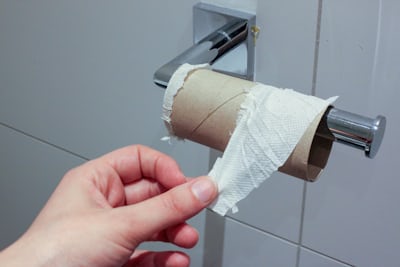
Dateline:Tuesday 17 March, 2020. Scene: Mrs P and I are walking across the car park towards our local supermarket, hoping to buy flour. Fat chance, but you have to try, don’t you? A woman emerges from the store and approaches us, beaming from ear to ear. She has a spring in her step, and looks as triumphant as a pauper who’s just won a fortune on the lottery. The cause of her joy? She’s carrying a twelve-pack of toilet rolls under each arm, clutching them to her ample body lovingly, like a B-list actress who’s just won an unexpected Oscar.
PHOTO CREDIT: Elly Johnson via Unsplash
Fast forward a few days. I phone Pat and Dave in London, and ask them how they’re coping as the COVID-19 crisis deepens. Dave replies, saying that a couple of days earlier at his local retail warehouse he’d been interrogated by the guy on the checkout. “Haven’t you forgotten something, mate?” was the mischievous question.
“No,” replies Dave, glancing down at a few random packs meat, fish and groceries in his shopping trolley, “I don’t think so.”
“What about toilet rolls then?” queries Checkout Man, giving Dave a conspiratorial wink.
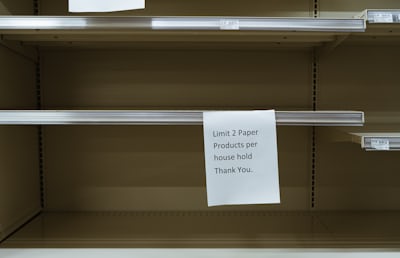
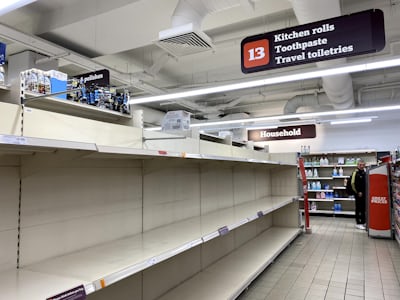
Dave lifts his head, and looks around him. The warehouse is rammed with shoppers, and all the other buggers have filled their trolleys with toilet rolls. The word’s out: this place has had a delivery, and is creaking at the seams with toilet paper. But not for much longer, obviously.
PHOTO CREDIT: Jasmin Sessler via Unsplash
Dave goes on to say that the next day, just 24 hours before the Prime Minister appeared on television and warned us all to behave responsibly or face the consequences, he and Pat attended a skittles evening at their local hostelry. He explains that they got knocked out early, but hung around until the end of the competition. The winner’s “mystery prize,” a bemused Dave observes, turned out to be a toilet roll tied up in a pretty silk bow.
So my question is this: how the hell have we managed to get here? It’s clear that, in the midst of a grave international crisis, vast numbers of our fellow citizens can think of nothing better to do than hoard toilet paper. Why, for god’s sake, are we so obsessed with the stuff?
*
Toilet paper is something we take for granted. Can’t imagine life without it, can we? But countless generations of our ancestors got by quite happily, doing the necessary with whatever else was to hand – shards of clay, a sponge on a stick, leaves, fur, stones, moss. Even corn cobs. The list goes on and on.
And as society developed, it wasn’t just natural alternatives that people turned to. When newspapers got going and started peddling fake news, their lies and deceits were given the treatment they deserved in privies throughout the developing world.
Yes, it’s true. You name it, we humans have used it in pursuit of enhanced personal hygiene. The 16th century French writer Rabelais even proposed “the neck of a goose, that is well downed, if you hold her head betwixt your legs.” Adds a whole new level of meaning to the practice of “goosing” someone, doesn’t it?
PHOTO CREDIT: Allie Smith via Unsplash
China is the source of all sorts of things. Pandas, for one. And COVID-19, of course. Paper is another of that nation’s gifts to the world. And given that they invented paper in the 2nd century BCE, it’s no surprise that the Chinese were also the first to come up with toilet paper.
By the 6th century CE the use of paper for the most intimate acts of bodily cleansing is said to have been common in China, but this wasn’t toilet paper as we know it. That first came along in 1391, made for the use of the Chinese Emperor, each sheet being perfumed to mask the noxious scents that inevitably result from consuming too many mung beans.
But it was a forward-thinking businessman in the Land of the Free who finally made toilet paper available to the masses. The game-changer was New Yorker Joseph Gayetty, who, in 1857, started selling commercially packaged toilet paper. He marketed his single, flat sheets – infused with aloe, and sold in packs of 500 – as “The greatest necessity of the age!” Promoted as a medical treatment to cure haemorrhoids, Gayetty is probably the first entrepreneur in history intent on making piles of money from piles.
Inexplicably, in perhaps the worst marketing initiative ever perpetrated by a profit-crazed American businessman, he insisted that his name be printed on every sheet of his “Medicated Paper.” Now, I know that many spirited entrepreneurs like to get down and dirty, but surely this was a step too far? Gayetty had hoped to be flushed with success, but his innovation turned out to be a commercial disaster. He and his product hit rock bottom.
However, Americans are a determined bunch, rarely shy when profits are at stake, and it should therefore come as no surprise that Gayetty’s vision was reworked into something that would sell. So it was that, in 1883, one Seth Wheeler of Albany patented rolled and perforated toilet paper. And the rest, as they say, is history.
PHOTO CREDIT: John Cameron via Unsplash
Or is it? While some historians (Americans, probably) subscribe to the sequence of events described above, others (British, I imagine) maintain that it was a Brit who invented the toilet roll. According to this revisionist interpretation of the history of bathroom stationery it was Walter J Alcock who, in 1879, first created toilet paper on a roll as an alternative to the standard flat sheets.
But to avoid falling out with our American cousins – we Brits need all the international friends we can get right now – let’s be charitable and say that toilet rolls were invented simultaneously in the USA and the UK around 1880. Standards of personal hygiene on both sides of the Pond undoubtedly improved as a result, although the quality of the experience must have been very different back in the latter part of the nineteenth century.
As proof of this assertion, it was as late as 1935 that a claim was made by the British Northern Tissue company to have manufactured the first splinter-free toilet tissue. The clear implication is that, before then, using the stuff was fraught with hazards that we would all wish to avoid. Is this why photographs from the early part of the 20th century generally show their subjects wearing pained expressions?
And it was not until 1942 that the first two-ply toilet paper came off the production line, courtesy of St. Andrew’s Paper Mill in England.
Yes, that’s right. Some of my countrymen took time off from defeating Hitler to do something they evidently perceived to be even more important: to immeasurably improve – and soften – the British sanitary experience. Given this extraordinary demonstration of societal priorities perhaps we shouldn’t be surprised that today, while the COVID-19 crisis rages all around them, so many people in the UK and across much of the wider world are fixated on the supply of toilet rolls.
PHOTO CREDIT: Jasmin Sessler via Unsplash
Toilet paper is clearly useful, making an awkward but necessary human activity more comfortable. But also, and perhaps more importantly, it’s a symbol of civilisation, an indication of how far we’ve progressed from our cave-dwelling days.
If you believe some of the stories circulating in the media and on the Internet, our very civilisation is currently under threat from COVID-19. Given this context, is it really so astonishing that millions of ordinary folk are desperate to ensure uninterrupted access to a product that is both a symbol and an embodiment of the benefits civilisation confers on its citizens?
And also, as any half-decent farmer will confirm, there just ain’t enough corn cobs to go round.
When campaigning about pollution, environmentalists currently focus much of their attention on CO2 emissions and plastics. While this is understandable, it’s important to remember that there’s plenty of other stuff that we should be concerned about. The movie Dark Waters, which is based on real events in a small town in West Virginia, reminds us of the devastating impact that pollution by the chemical industry can have on communities and individuals.
PHOTO CREDIT: Patrick Hendry @worldbetweenlines via Unsplash
The star of the show is lawyer Robert Billott. Billott takes up the case of small-time livestock farmer Wilbur Tennant, who has watched in horror as his herd of cattle succumbs to a range of illnesses. Tennant believes, and his lawyer finally proves, that the sickness amongst his stock is due to contamination of their drinking water by chemical corporate giant, DuPont.
But the damage isn’t limited to Wilbur’s herd. Billott discovers that DuPont dumped toxic waste at a local landfill site for many years, apparently without regard to the possible consequences and despite the fact that its own research warned of the dangers.
The pollutants released from the landfill are shown to have found their way into local water courses, with probable links eventually being identified between them and medical conditions including various cancers, thyroid disease, pre-eclampsia, ulcerative colitis and rotting teeth in humans and animals alike.
The movie homes in on Billott’s marathon David v. Goliath battle. The lawyer takes on DuPont, and many years later finally wins justice for his clients and the local community.
For me, this movie generates a huge sense of indignation, as well as real fear for the future of our planet. If you haven’t done so already I encourage you to watch the movie Dark Waters, and to read the lengthy New York Times Magazine article upon which it is based.
This is not a happy movie, and in a sense I took no great pleasure in watching it – it was too raw, too traumatic. But I’m glad that I did so, to be reminded that I should be vigilant and not take at face value those who glibly tell me that we can trust scientists, big business – and their lawyers – always to do the right thing.
*
And while we’re on the subject of chemical pollution, the Process Man (also known as the Chemical Worker’s Song and the ICI Song) tells another – equally horrifying – story. The song was written and recorded in 1964 by Ron Angel from Cleveland in the UK.
The economy of that part of north-east England has been dominated by the chemical industry for generations. The industry has provided employment for many thousands, but the human cost – as highlighted by Angel’s lyrics below – has been huge. The lyrics have been sourced from the Antiwar Songs website.
A process man am I and I’m telling you no lie. I’ve worked and breathed among the fumes. That trail across the sky. There’s thunder all around me and poison in the air. There’s a lousy smell that smacks of hell. And dust all in my hair.
But you go boys go. They time your every breath. And every day you’re in this place. you’re two days nearer death, but you go.
I’ve worked among the spinners I’ve breathed in the oil and smoke. I’ve shovelled up the gypsum till it nigh on makes you choke. I’ve stood knee deep in cyanide gone sick with a caustic burn. I’ve been working rough I’ve seen enough to make your stomach turn.
But you go boys go. They time your every breath. And every day you’re in this place. you’re two days nearer death, but you go.
There’s overtime there’s bonus opportunities galore. The young men like the money. Aye they all come back for mare. Ah but soon you’re knocking on. You look older than you should. For every bob made on this job you pay with flesh and blood.
You can listen to Ron Angel singing his song by following this link on YouTube.
At their best the arts, including music and film, are much more than simple entertainment: they are a repository of lessons that we forget at our peril. Songs like the Process Man are an important reminder that much of the prosperity we currently enjoy has been built upon the misery of the masses over many generations, while movies such as Dark Waters should serve as a warning that the profit motive continues to tempt organisations and individuals to do stuff we – and they, ultimately – will regret.
Pollution is an ever-present danger in our modern world. We owe it to the planet, to all creatures currently living on it, and to those who will come after us, to remain vigilant.
February was foul. It was the wettest February the UK has ever seen, and the fifth wettest UK month, of any month on record, ever. Large areas of the country experienced unprecedented floods, and although Platypus Towers escaped this particular fate – living halfway up a hill helps! – it was pretty damned miserable. But as George Harrison famously reminded us, all things must pass, and around 6 March the sun finally shows up, giving it large in a dazzling, clear blue sky.
To celebrate our change in fortunes, I decide to treat Attila the Bun to an enormous carrot. I’m standing at the door to his hutch, fondling his ears while he tucks in greedily, and out of the corner of my eye I catch sight of my first butterfly of the year.
The symbolism isn’t lost on me. The transformation of caterpillar into butterfly is one of Nature’s most dazzling tricks. It speaks of redemption, the possibility of change, and the enormous potential that lies within the most unpromising of subjects. Nothing is so ugly that it cannot re-fashion itself into a thing of beauty, nothing is so damaged that it cannot be made whole again, nothing is so stained that metamorphosis cannot restore it to purity.
The butterfly in question is a Small Tortoiseshell. She sits atop some pure white heather blossom, sucking up the nectar, soaking up the rays. Intent upon her business, she allows me to approach and stand so close I could reach out and touch her. The predominant colour of her wings is a foxy reddish-orange, decorated with a scatter of black and yellow splodges and an edging of tiny, bright blue spots. She is so delicate, so beautiful.
My butterfly has overwintered as an adult, hunkered down somewhere sheltered, perhaps a garden shed or a farm outbuilding. For months her metabolism has barely ticked over, but today she’s awake and has a job to do. Now is her time, and with temperatures rising and the days growing longer she must find a mate, and a patch of stinging nettles on which to lay her eggs.
Her children will take to the wing in June and July, and they in turn will produce another generation in late summer. It is that generation, the grandkids of the butterfly before me, that will emulate her by seeking out a sheltered hiding place in which to hibernate through the winter.
As with pretty much every species of butterfly in the UK, Small Tortoiseshells have declined massively in recent decades. Growing up in suburban London half a century ago I used to see them in abundance, and although not rare these days I wouldn’t describe them as plentiful. I don’t think I’ve ever seen one this early in the year so today’s sighting is definitely a bonus, as well as being a welcome indication that spring is waking from its slumber at last.
Eventually, my butterfly decides it’s time to share her ethereal beauty with another lucky soul. Sorrowfully I watch her leave, and wish her well on her journey. I will miss her. Butterflies are a symbol of hope, and god knows we need hope in these, the darkest of days.
Nearly two years have passed since I retired from work. People still ask me how I’m coping, and the truthful answer is that it’s going rather well. Actually, you can’t beat it: I have a good pension and a fairly modest lifestyle, so fortunately money’s not an issue. Yes, I do miss the company of some of the people I used to work with, and also the sense of purpose that comes with a responsible job. You know what I mean, those feel-good moments that result from being needed. But life moves on, and so have I.
No, the main problem with retiring is that I no longer have a bloody clue what day of the week it is.
You see, work imposed a structure on my life, mapping out my week in a meaningful way. And when it was gone it felt like I was at sea without a compass.
Before I retired my week was shaped by routines. To start with there was the framework of five days on – Monday to Friday – followed by two days off. The regular milestones of the working week added depth to the pattern: my boss Teflon Sal’s management team meetings on Tuesdays, my own team meetings every Wednesday, the Friday afternoon all-user email in which the great and the good desperately tried to convince the poor bloody infantry how well things were going while simultaneously demanding that we cut the crap and do better.
All of these things, and many more besides, were anchor points during the week. Routines keep me grounded, helping me make sense of the world around me. And when I retired these anchor points were ripped away overnight, leaving me drifting aimlessly.
But nature abhors a vacuum, and so it’s no surprise that new patterns have emerged. One of these is that on Sunday afternoons Mrs P and I play Scrabble, while keeping a close eye on the garden for a visit from Milky Bar and listening to a Newfoundland folk music radio show on the Internet.
Scrabble helps keep the brain active, which is a good thing now that I no longer have reports to write, managers to please or politicians to persuade. I should be good at it too: words have always been my currency of choice, my friends in adversity. I love them for their power and their beauty, which, I suppose, is one of the reasons for writing this blog.
All that counts for naught, however, in our weekly Scrabble games. We always get through four games over a period of around two and a half hours, and Mrs P always beats me by three games to one. Unless I’m having a really bad day, in which case I get thrashed four games to nil. Mrs P is very good at Scrabble, ruthless in fact!
And I love it, this weekly drubbing. It brings some welcome certainty to my confused post-working world, giving me a much needed anchor point in my otherwise shapeless existence.
If I’m getting thrashed again at Scrabble, at least I can be absolutely certain that it’s Sunday afternoon. Even more important, it reminds me that, the following morning, I won’t have go into the office to sort out the latest crisis and negotiate with a bunch of impossible politicians.
Last Friday I said goodbye to a dear friend, my constant companion for the last few months. My life feels empty without her. She’d been with me day in and day out, and in the darkness of the night I’d lie awake thinking about her. We shared so many stories, through the good times and the bad. Together we laughed a lot, and even cried a little when the news came through about White Island. But now we’re finished, and I need to move on.
She wasn’t my first, of course. There were three others before her, and today – as you must know, because you are reading this – I’m with someone else. But for a few brief months we were inseparable.
She was a harsh mistress, always wanting more. Every day she expected me to perform, even when I didn’t feel up to it. I totted it up, and in total we got it together 89 times. Sometimes she let me have a day off, but the next day I had to make amends, to come up with the goods twice in just a few hours.
There were moments when I hated her for her insatiable demands, but mostly I loved her for believing in me and for driving me on to do things I didn’t know I could do. She got under my skin, seduced me, cajoled me and always encouraged me to be the best I could be.
I’m sure most of my friends wondered why I bothered with her at all. I could see it in their eyes, sense the unasked question in their emails, what’s the bloody point, why waste your time locked up with her, glued to your laptop when you could be outside soaking up the rays, or maybe getting rat-arsed in a pub?
And my answer is simple. I wrote a blow-by-blow blog of our visit to New Zealand to prove that I could, to show that there’s still life in this old dog, to demonstrate that intellectual and creative atrophy is not an inevitable consequence of retirement.
Writing a travel blog also allows me – forces me, in fact – to experience things differently. Regardless of the blog I would still have seen the parrots on our porch. But without the imperative to write something that family, friends and followers could relate to it would have been just a fleeting, casual acquaintance, soon to be forgotten. Without my blog I would never have met Lady Kaka. Here’s part of what I wrote about her in early December 2019:
*
She’s perched on the railing that guards the edge of our veranda, or porch as they call it in North America, staring into our room through the full length glass sliding door. I’m looking back out at her, captivated by her audacity. We’re separated by no more than a couple of metres and a sheet of glass. The kaka can see me but is totally un-phased.
Even when I slide the door open and step closer she’s untroubled, and simply watches me calmly. She doesn’t need reassurance but I offer it anyway, whispering to her, telling her that I find her beautiful and won’t ever harm her. She tips her head to one side quizzically, weighing me up.
I can read her mind. Are you for real? she’s asking. Why do you people always act so weird around me? She’s plainly in charge of this encounter, which is like a thousand other meetings she’s had before with guests occupying our room.
I, however, haven’t read the script. I’m lost for words, unsure what to do next. Wild birds aren’t meant to be like this. Is she ill? Or mad? Or am I the crazy one, standing here in awe of this kaka, this big parrot with olive grey plumage, yellow sideburns and a bloody enormous bill?
I watch her intently, and she watches me back. It’s a Mexican standoff, and neither of us wants to make the first move. Finally she gets bored – I’ve obviously buggered up the audition – and utters a piercing, eardrum-exploding squawk as she flies off into a nearby tree. Lady Kaka has left the building
*
The Platypus Man in New Zealand was my fourth and most ambitious road-trip travel blog. It runs to over 61,000 words spread across 89 posts. Designing it, researching it, writing it, editing it and responding to comments about it has dominated my life for several months. It’s been a deep and meaningful relationship that has changed and developed me in all sorts of ways. But in the manner of most relationships it’s run its course, and now I have someone new in my life.
Now I’m 64 is my new Best Friend Forever, a fresh challenge to keep the brain active and the pulse racing.
So, farewell Lady Kaka, my dear old friend, and thank you for the good times. I promise I won’t ever forget you.
Museums ain’t what they used to be. When I was a lad, back in the days when the UK had only had two television channels (both black-and-white) and England were good at soccer, museums were vehicles of the establishment. They celebrated the political, military, architectural and cultural achievements of the great and the good. The lives of ordinary folk like me and my family never got a look in, but that was OK because we knew our place.
Trams and buses trundle Beamish’s cobbled streets
All that’s changed now. Society recognises that, regardless of our backgrounds, every one of us has been on a journey and has a story to tell. Beamish Open Air Museum in County Durham reflects this more inclusive approach. It is a “living, working museum that uses its collections to connect with people from all walks of life and tells the story of everyday life in the North East of England.”
Beamish offers snapshots of North-East life in the 1820, 1900s and 1940s, scattered across a 350 acres site. Its latest project, underway at the time of our visit on our way back from Shetland in late June, is to reconstruct a 1950s town.
Traditional apothecary / chemist / pharmacy
This is clearly a good thing. Everything that surrounds us in our lives in 2019 will be history to future generations, and it’s great to see that Beamish Museum is continuing to add to and update its exhibits. In creating its 1950s exhibit it will reflect a period that, for today’s oldest visitors – including the venerable Platypus Man – is still just within living memory.
Beamish is heavy with the atmosphere of another age. Electric trams trundle along the cobbled streets of the 1900s exhibit, past historic buildings with period fittings. Visitors can ride the trams, go into the shops, the dentist’s surgery and the solicitor’s office, and interact with friendly volunteers and staff in period costume.
You can ride the trams around the Beamish site
There were lots of school groups on site at the time, and Beamish gave them a glimpse of an everyday life they have never experienced. The sweet shop proved to be particularly popular, with youngsters able to watch confectionery being made the traditional way, and then to buy the resulting produce.
At the bank they could learn about pounds, shillings and pence, which are part of my DNA but totally alien to today’s young people. At the Co-Op store they were able to see what shopping was like in the era of ‘closed access’, when all the goods were kept behind the counter under the custodianship of the eagle-eyed shopkeeper.
Traditional grocery shop
Beamish offers a brilliant, immersive exploration of living history. Even though some of the youngsters were more interested in their mobile phones than the museum, many more were clearly fascinated by this brief insight into the lost world of their grandparents.
As for me, I had a grand day out and loved every minute of it. In the immortal words of Arnie ‘Terminator’ Schwarzenegger, “I’ll be back.”
The tram shed
Reminiscence is good therapy for old fogeys, so long as we keep a sense of proportion and remember that life back then was, in most ways, much tougher than ours today.
Bring back the shilling, the sixpence and the threepenny bit, that’s what I say!
Recently I’ve posted several pieces about birds and birding, and I guess the casual reader might have concluded I’m a twitcher. Nothing could be further from the truth. In day-to-day conversation most people use the words “twitcher” and “birdwatcher” interchangeably, but this is completely wrong. To be absolutely clear: I’m not, never have been, and never will be a twitcher. Neither is Mrs P. Capiche?
Twitchers may enjoy seeing wild a Eurasian crane, which is bouncing back in the UK after a reintroduction programme
So just what is a twitcher?
Twitching is … “the pursuit of a previously located rare bird.” …. The term twitcher, sometimes misapplied as a synonym for birder, is reserved for those who travel long distances to see a rare bird that would then be ticked, or counted on a list. … The main goal of twitching is often to accumulate species on one’s lists.
SOURCE: Wikipedia, retrieved 25 August 2019
Twitching is anathema to me. It sounds like a sad and lonely activity undertaken primarily by sad and lonely men who really need to get their priorities in order.
Sadly, no self-respecting twitcher would give this wood pigeon a second glance
Twitchers appear to care little for the bird itself, but are obsessed by the chase. For them it’s all about the quarry. Once a particular species has been seen and ticked off in the appropriate book or list they quickly lose interest and move on to the next challenge. It’s as if by seeing the bird it becomes their property, theirs to log and then ignore as they immediately consign it to history in favour of the next target.
Don’t get me wrong, it’s great to see a rarity, to get the chance to study in the flesh a bird that most birders have only read about. But it gives me just as much pleasure to spend a quiet moment watching an everyday bird like a wood pigeon or a bullfinch as it does to glimpse a rarity.
Sex and the City: peregrines mate on a ledge at a local disused cotton mill. Twitchers and peregrines in simultaneous ecstasy?
Even if it’s as common as muck, a bird is still a masterpiece of nature. Birds are tangible evidence of evolution in action, sculpted from bones and flesh and feathers. I love nothing more than to marvel at their very existence, to learn about their lives and to enjoy their antics as they go about the everyday business of living.
Twitchers, it seems to me, are doomed to a life of unhappiness: they have never seen enough birds, or the right birds, to bring them the satisfaction they crave. Mrs P and I, however, live in the moment, enjoying the starling or the sea eagle or whatever else comes our way, taking simple pleasure in the wonder of nature. This to me is what birding should be about, not pursuing a quarry species to the ends of the Earth and then all but forgetting it once it is seen.
Twitchers, please don’t dismiss the bullfinch just because it’s a common bird
There’s a book in here somewhere, Zen and the Art of Birding Contentment perhaps? My next project, maybe?





 Now I'm 64