Disneyesque fantasies, ancient timbers, knotted dachshunds – the diverse joys of Great Dixter

Most old buildings have a story to tell: you just have to know where to look. Great Dixter, in the county of East Sussex, is a case in point. In its present form it dates from 1910-12, the work of celebrated architect Sir Edwin Lutyens (1869-1944). Lutyens was famous for imaginatively adapting traditional architectural styles to the requirements of his era, so it should probably come as no surprise that Great Dixter is in fact three buildings – two of them medieval – in one.

Great Dixter – three houses in one.

The original building on the site was a house known simply as Dixter, and dates from the mid-15th century. When businessman Nathaniel Lloyd (1867-1933) bought it in 1909, he quickly decided that it didn’t meet his 20th century needs. However he was a wealthy man, thanks to his colour printing business, wealthy enough to be able to buy his way out of the problem.

The oldest part of Great Dixter was built between 1440 and 1454.

Lloyd’s solution was to purchase a 16th century Yeoman’s Hall, built in a similar style, from the adjoining county of Kent. This new acquisition was swiftly dismantled, loaded onto trucks and brought to Dixter for re-assembly. Lutyens was hired to renovate both buildings, and to design and construct a third, linking the two older structures together. The result was a single house, much larger than its individual components, that was given the name Great Dixter.

The Great Dixter we see today is, in effect, an early 20th century, sanitised re-imagining of medieval life. Eat your heart out, Walt Disney!

Probably the most significant room is the Great Hall. At 40ft (12m) long by 31ft (9.5m) high, it is one of the largest surviving medieval timber frame halls in the country. It looks wonderfully, romantically comfortable. Wow, we think to ourselves, didn’t they live well in the Middle Ages! But don’t be fooled, back in the day the Great Hall was altogether less agreeable than today’s visitor to Great Dixter might assume.

Originally the floor was nothing more than beaten earth, covered with rushes. The Great Hall was heated by an open fire in the centre of that floor, the smoke from which escaped through unglazed windows – which could only be closed off with wooden shutters – or via a louvre-capped hole in the roof. To this day the wooden roof beams are stained black, evidence of the smoky-choky environment the medieval occupants had to endure.

The Solar would have been the principal private apartment of the 15th century house.

Unsurprisingly, this was not a lifestyle that Lloyd intended to embrace. He and his family used the Great Hall as their living and dining room for around 20 years, and to give them a standard of living in line with their perceived position in society, they installed modern amenities, including electric lighting and central heating. Radiators are concealed beneath old oak chests specially adapted for the purpose, and there’s not a shuttered window or wisp of smoke in sight. Lloyd was in love with the romance of life in the Middle Ages, not its harsh realities.

In medieval times the Parlour was one of the other private room to which the family could escape.

Only four rooms at Great Dixter are open to the public, as most of the building is used as accommodation for international students of gardening who are based on the property. While none of the others is as special as the Great Hall, all are impressive. Courtesy of Edwin Lutyens, they conjure up cosy, sentimental notions of a lost medieval world. I’m sure the Lloyds must have been happy living in their Disneyesque fantasy world; I know I would.

This is part of the 16th century Yeoman’s Hall, which was dismantled and moved here from Kent. In the early 20th century Mr and Mrs Lloyd used it as their bedroom

But now I have a confession to make. Great Dixter is a fascinating building that simply oozes with history (real and imagined) and architectural charm (I just love those ancient timbers), but the thing I enjoyed seeing most of all during our visit was this delightfully witty little carving of a dachshund! Yes, I know, it seems like I’m trivialising an important, Grade I Listed piece of architecture. But that’s not the intention. Surely it’s no sin to make the most of an unexpected opportunity for a happy laugh in these troubled times?

Christopher Lloyd was clearly a dog lover with a mischievous sense of humour.

Christopher Lloyd, who was the youngest of Nathaniel Lloyd’s children and spent his whole life at Great Dixter, was mad-keen on dachshunds (aka wiener dogs or sausage dogs), and happily shared the property with these furry draft excluders. The presence of the carving hints at his love for these popular little dogs, and helps turn what could otherwise appear to be a sterile piece of architectural whimsy into a home lived in by a real person. Way to go, Christopher!

Way to go, Christopher!
A taste of Scotland by the sea – St Monans

We’ll soon be heading north to Scotland on our annual pilgrimage. The Scottish landscape and natural scenery are fabulous, but some of the little fishing villages are quaintly picturesque too. To me, born in London and resident for nearly 50 years in landlocked Derbyshire, the seaside seems like another world, so it’s always a treat whenever we go there.

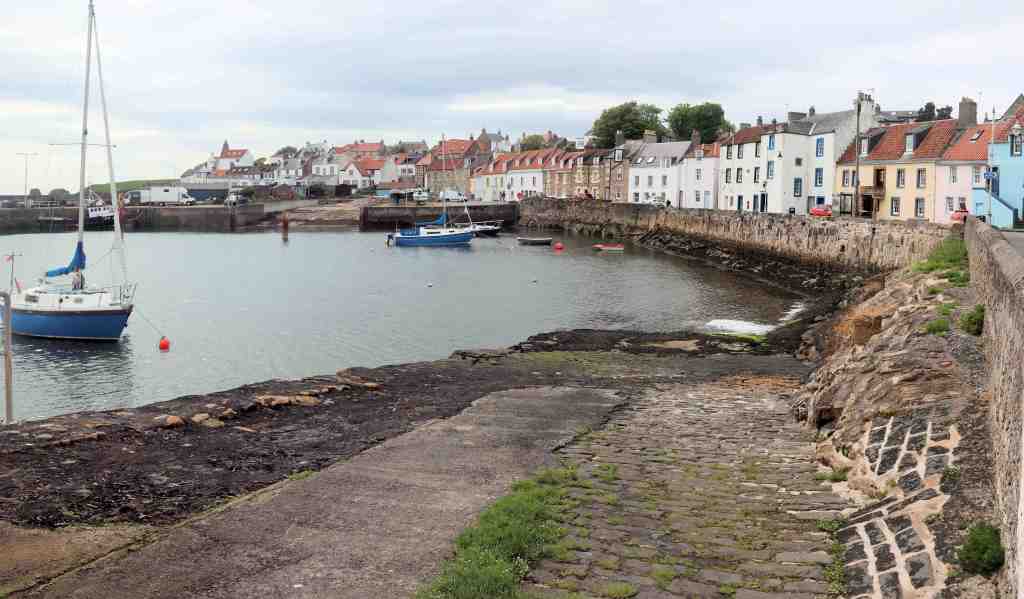
The picturesque harbour at St Monans

One of the fishing villages that caught our eye during our last trip to Scotland was St Monans in the county of Fife. The village is named for the eponymous 6th century saint who came from Ireland to Scotland to spread the teachings of Christianity.  At its heart is the harbour, overlooked by traditional fishermen’s cottages, some with white walls, others colourfully painted. They date predominantly from the 18th and 19th centuries, and although most have since been significantly altered, their origins are clear if you know how to read the signs.

Many of the cottages are roofed with distinctive red pantiles. This style, which is found widely in villages on the east coast of Scotland, originated across the North Sea in the Low Countries (the Netherlands and Belgium). The pantiles were used as ballast on trading ships returning from mainland Europe, and were then adopted as roofing materials when the ships were unloaded at St Monans.

To my eyes, the most striking feature of some of these cottages is the forestairs, an outdoor staircase leading to a door on the first floor. Fewer than ten examples survive today, but in the past they would have been much more common. They hark back to the heydays of the fishing industry, when living accommodation would often have been on the first floor, above a boat store, workshop and sail store on the ground floor.

Although it is the historic residential buildings that give St Monans its character, the church is also worthy of comment. It dates from 1369, and was originally founded by King David II of Scotland in gratitude for his having survived a shipwreck on the coast nearby. Originally built as a small house of Dominican friars, it was restored in the early 19th century and now serves as the local parish church. When viewed from most angles the church has the sea as its background. It is widely claimed to be the nearest to the sea of any church in Scotland.

Photo credit: By Jim Bain, CC BY-SA 2.0, https://commons.wikimedia.org/w/index.php?curid=9222537

A little further outside St Monans is the last remaining windmill in Fife, a relic of the salt industry. Large scale salt production began here in the late 18th century, and the windmill was used to pump seawater into the saltpans where it would be evaporated to reveal the finished product. The industry lasted only a few decades before closing down in 1825. The remains of the saltpans are unimpressive, little more than a few grassy mounds and depressions close to the shoreline. The windmill, however, has been restored and acts as a reminder of an industry that is unknown to most people today.

By no stretch of the imagination could St Monans be described as spectacular. But there’s lots to admire there, including glimpses of a world and a lifestyle that is a total mystery to those of us who live our lives a very long way from the sea. Definitely worth a visit, if you’re ever in that part of Scotland.

Getting back on track, courtesy of a Peak Rail steam train

Foul weather was our constant companion from the start of 2024. It wore us down, the sombre grey sky, the biting wind, the constant rain. There was no pleasure to be had in going out, so we stayed at home, and as grim weeks ganged up to become relentlessly miserable months we started to go stir-crazy. So when, at last, conditions began to improve we quickly decided we deserved a treat, courtesy of our local heritage railway.

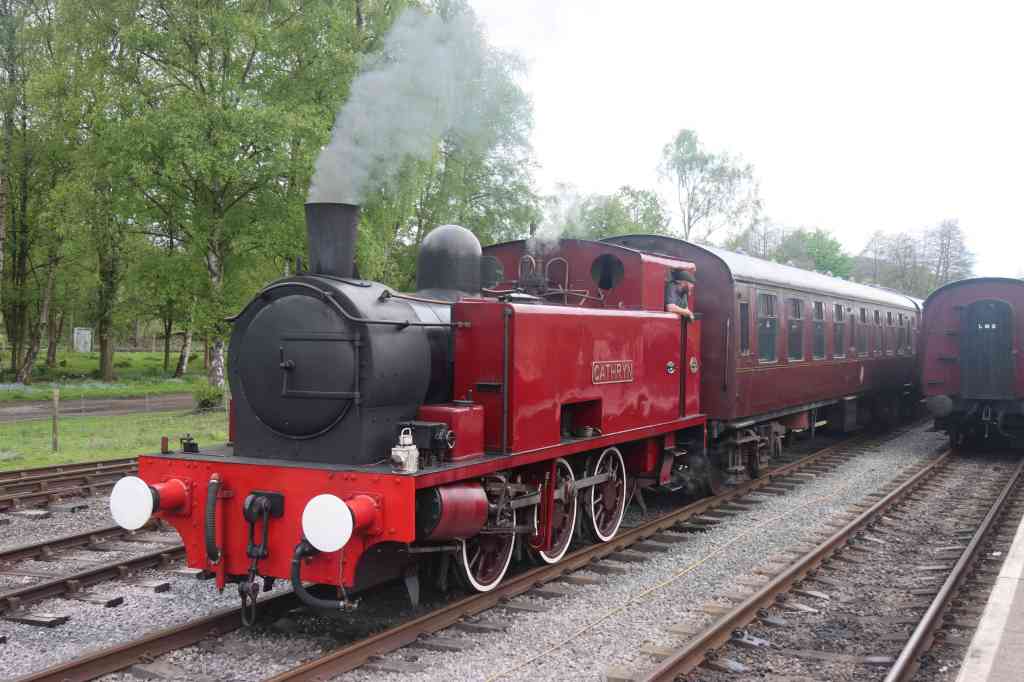
This is Peak Rail at its best…the sight, and the sounds and the smells of a gleaming, steaming locomotive! This loco was built in 1955.

We live in Derbyshire, on the edge of the Peak District. Famed for the natural beauty of its limestone hills and verdant dales, in 1951 the Peak District became the UK’s first national park. The railway that crossed it, running between Derby and Manchester, was a triumph of nineteenth century civil engineering. It was claimed by many to be Britain’s most scenic railway line.

Sadly I never got to find out in person if this claim was true. Much of the line was closed down in the 1960s, the victim of an efficiency drive shaped by the infamous “Beeching Report” of 1962. Accountants, politicians and British Rail bosses doubtless allowed themselves a glass of champagne to celebrate this “victory” for cost-effectiveness, but railway enthusiasts were dismayed. Their response was to band together to form the “Peak Railway Society” – later “Peak Rail Operations – with the aim of restoring the line for recreational and community use.

Half a century later, the dream lives on. Peak Rail has succeeded in re-opening around 4 miles (6.5 km) of track, between Rowsley South Station and Matlock, over which it operates a service featuring heritage steam and diesel locomotives. Here’s how Peak Rail describes its offer:

Whether it’s simply a nostalgic journey back to a bygone age or a discovery of the sights and sounds…of a steam or diesel locomotive[,] Peak Rail welcomes you to experience the thrill of our preserved railway whilst travelling through the delightful Derbyshire countryside…As well as our normal train journeys, there is something for everyone to enjoy, luxury dining is available on our Palatine Restaurant Car which offers Afternoon Teas and operates on various days during the year. [Source: Peak rail website, retrieved 14 May, 2024]

The reality, it must be said, proved to be more modest than the marketing hype. The part of Derbyshire through which the train travels is pleasant, but not exceptional (it’s on the edge of the national park rather than within it), and given that the line is just 4 miles long there’s not a huge amount to see. The locomotive that powered our train gleamed brightly in the welcome afternoon sunshine, but wasn’t by any stretch of the imagination remarkable in the context of other UK heritage steam trains. And the Afternoon Tea, while thoroughly enjoyable, didn’t align with my understanding of the words “luxury dining!”

But it’s important to remember that this is an organisation run by volunteers, and a service delivered almost entirely by volunteers. It’s not a commercial operation, so you have to adjust your expectations accordingly.

Peak Rail offers an opportunity to escape the rigours of the 21st century for a couple of hours, and to wallow in nostalgia. Back in the 1970s, dear old British Rail – the late, unlamented provider of the UK’s national rail network at the time – ran a series of commercials that sought to persuade motorists to abandon their cars in favour of rail travel. Its strapline was “let the train take the strain,” and that’s just what we did for a couple of hours, courtesy of Peak Rail.

Thanks to Peak Rail we were finally able to get back on track, after many months of meteorological misery. I’m pleased to report that a fine time was had by all

One of the good guys – Robert Owen at New Lanark

For most British people, the early decades of the Industrial Revolution were a grim time to be alive. Conditions were horrendous. Workers routinely had to labour for 12 to 14 hours per day in harshly managed and often dangerous factories, for which they received a pittance in pay that was barely enough to cover basic necessities. And when they got home from their workplaces things got no better, as these workers usually lived in cramped, cold and insanitary accommodation provided by bosses who were motivated solely by the pursuit of profit.

Mill 3 replaced an earlier mill destroyed by fire in 1819. It now houses the site’s main exhibitions, including working mill machinery.

Let’s be honest, some early captains of industry were monsters who cared nothing for the welfare of the men, women and children upon whose lives they impacted. But not all of them. New Lanark in Scotland was proof that there were workable alternatives to rampant, exploitative capitalism.

The “new buildings” were constructed by David Dale as millworker’s housing in 1798. Robert Owen enlarged them as the village size increased.

Founded in 1785, New Lanark is a village in southern Scotland clustered around several cotton mills that harnessed the power of the River Clyde. Under the direction of joint founder David Dale (1739 – 1806), this was an entirely new settlement, built as accommodation for the millworkers and their families. New Lanark thrived. Within a decade of its foundation the village was home to one of the largest and most important cotton mill complexes of its period, employing around 1,500 people.

Prior to his involvement with the New Lanark project, Dale was a prosperous Glasgow-based cloth merchant. He was also a man with a conscience, someone whose philanthropic tendencies tempered, to some degree, his capitalist instincts. This was evidenced by his treatment of the orphan apprentices who worked at his mills – Dale ensured they were taught to read and write, were well fed, and were provided with clothing and decent accommodation.

In 1799 Dale’s daughter Caroline married Robert Owen (1771 – 1858), a Welsh-born industrialist and social reformer. Soon after, David Dale sold New Lanark to his new son-in-law, who formally took over as mill manager in 1800. Owen was committed to continuing the philanthropic approach to industrial working that Dale had initiated, and under his management New Lanark became a model community, emphasizing social welfare and improved living conditions for workers.

Robert Owen was a Utopian social reformer, who aimed to create a perfect, harmonious society in which poverty and unemployment were eliminated. Owen’s abilities as a business manager were central to the success of his social experiment, for it was the profitability of the cotton mills that provided the cash needed to finance schemes designed to improve the lives of his workforce. A vibrant and resilient community was central to his thinking.

Robert Owen’s School for Children was completed in about 1818, providing spacious classrooms for its students. Punishment was not allowed, with strategies of encouragement and kindness being adopted instead.

Owen’s intentions can be discerned from the creation of the Institute for the Formation of Character. Opening in 1817, it was intended to provide educational and recreational facilities for the whole community. Amongst these were a library and reading room, classrooms and halls for concerts and dancing. It also accommodated what is thought to be the world’s first nursery school.

About a year after the opening of the Institute, work was completed on Robert Owen’s School for Children. Here’s what the New Lanark Trust has to say about this visionary initiative:

Owen spared no expense in building and equipping his school, and the curriculum included music, dancing and singing, as well as art, natural history, geography and world history. Punishment was not allowed. Instead, kindness, encouragement, and the fostering of children’s natural curiosity were deemed to be much more effective. [Source: New Lanark Heritage Trail – A guide to New Lanark’s Historic Buildings, 2008]

Owen’s idealism is also apparent from the way he set up his Village Store, which was completed in 1813. It effectively had a retail monopoly in the village, and many other industrialists used such arrangements to their financial advantage by providing poor quality goods at inflated prices. In contrast, Owen put the community’s welfare first, buying good quality food and household goods in bulk, and selling these to his workers at close to cost price. Any profits made were re-invested in the village, being put towards the running costs of the School.

Another view of Mill 3.

Robert Owen was clearly one of the good guys, and his enlightened methods attracted international attention. In 1824 he sold the New Lanark mills and moved to the USA, where where he planned to establish a Utopian Community or “Village of Unity and Mutual Cooperation” based upon the principles that had helped shape his grand Scottish project. However this experiment, based at the settlement of New Harmony in Indiana, proved largely unsuccessful and in 1828 he returned to the UK, financially much poorer but still optimistic that one day the rest of the world would come round to his way of thinking.

Owen’s legacy is now preserved by The New Lanark Trust, which was formed in 1974, six years after the final closure of the cotton mills. The village was one of the earliest examples of a planned settlement, where layout, housing design, and green spaces were carefully considered. Its architecture showcased a blend of practicality and aesthetics, emphasizing functionality while maintaining a pleasant environment. All of this can be enjoyed by visitors, who also have an opportunity to get up close to some of the machinery that drove the success of New Lanark’s cotton mills. Tourists can even visit Owen’s modest house, as well as examples of workers’ accommodation.

The Trust’s aim has been to restore the village as a living, working community, but one which also offers visitors tantalising glimpses of a lost world shaped by a remarkable man. A measure of its success was evident in 2001, when New Lanark was listed as a UNESCO World Heritage Site. The village and its cotton mills are now a major tourist attraction, and deserve to be visited by anyone with an interest in industrial history.

Waddesdon Manor – opulent, ostentatious and over the top

I have often written on this blog about our visits to some of the UK’s grand houses, houses that are hundreds of years old and oozing with history. You might assume that all our great domestic properties have a pedigree dating back many centuries, but you’d be mistaken. Some of them are much younger; Waddesdon Manor, at less than 150 years old, is one of the new kids on the block. Despite that – or maybe because of it – Waddesdon is one of the most opulent and ostentatious of them all. But it’s a bit over the top, in my humble opinion.

Rear view of Waddesdon Manor. The bedding plants on the parterre are changed each spring and summer.

Waddesdon Manor is located in the Buckinghamshire village of Waddesdon (no surprises there, I guess!), around 50 miles (80 km) north-west of London. It was constructed between 1874 and 1889 at the behest of Baron Ferdinand de Rothschild (1839-1898), a member of the enormously wealthy Austrian banking family.

The fountain at the centre of the parterre was originally made for an Italian palace in Colorno.

In 1874, Rothschild – known as “Ferdy” to his sister and close friends – bought the Waddesdon agricultural estate from the Duke of Marlborough, with money he’d inherited from his father. He’d come across it when fox-hunting in the area, and clearly saw its potential. The estate had no house, park or garden at that time, and therefore offered Rothschild a blank canvas upon which to impose his will.

Front elevation of Waddesdon Manor (sadly in shadow, but at least the more attractive rear view – including the parterre – was well lit!)

Said to be as much at home in Paris as in London, Ferdy was an ardent Francophile. His vision for Waddesdon was to build a magnificent mansion in the neo-Renaissance style, copying features from several of his favourite French chateaux. And he was also keen on giving Waddesdon an unforgettable garden, including a parterre (a symmetrical, formal garden design with intricate patterns), a colourful and fragrant rose garden, a serene water garden and an aviary of epic proportions.

Ferdy was very fond of birds. This cast iron aviary was erected in 1889 to house his collection.

Given his wealth, it is to be expected that Ferdy would spare no expense in fulfilling his dreams at Waddesdon Manor. More surprising, perhaps, is the fact that he never intended to live there permanently. His plan was to use Waddesdon simply as a summer weekend retreat, a place where he could entertain high-society guests and show off his vast, priceless collection of art and antiquities.

The Grey Drawing Room, to which lady guests retired after dinner!

Baron Rothschild was clearly an intelligent, well-educated man, and must have been familiar with concepts such as modesty, moderation and self-restraint. Plainly, however, he thought they shouldn’t apply to him!

Ferdy’s “Renaissance Museum” was once housed in this corner room

The great and the good – as they no doubt liked to think of themselves – were Ferdy’s guests at Waddesdon. Even Queen Victoria and the future king Edward VII spent time there, thus reassuring a man of Austrian heritage and born in France that he’d made the grade as a fully fledged English gentleman.

The Organ Clock is Dutch, and dates from c1775

After Ferdy’s death in 1898, Waddesdon passed through the hands of two other members of the Rothschild family before, in 1957, it was bequeathed to the National Trust. At last, some 83 years after the project was born, ordinary members of the public were able to visit the property, to view the stunning art collection, and to witness at first hand how the other half lives!

Unusually, unlike most National Trust properties, at Waddesdon the donor’s family continues to manage the house and to invest in it through the Rothschild Foundation. And it was through the financial support of the family that the stunning Wedding Cake art installation by Portuguese artist extraordinaire Joana Vasconcelos – which I wrote about in an earlier post – found its way to Waddesdon.

The dining room seats 24, just enough for one of Ferdy’s famous house parties

Waddesdon is extraordinary. The “three Os” sum it up perfectly – Opulent, Ostentatious and Over-the-top. I’m pleased we finally got around to visiting it last year. On the one hand it’s a truly magnificent creation, breath-taking, almost surreal. Definitely worth the entrance fee.

Automaton elephant clock, made in London in 1770

But on the other hand, Waddesdon is just a bit too much. It’s reminds me of being back at school, of that annoying kid sitting at the front of the classroom, the kid who was always waving their hand furiously in the air to attract teacher, making it abundantly clear that he (or she) was much, much better than the rest of us. You remember that kid, don’t you? Well, Waddesdon’s a bit like that, full of itself, boastful in the extreme, bling on steroids!

Hever Castle – Anne Boleyn was here too!

Last week I wrote about a visit to Pashley Manor, the estate where Anne Boleyn – the tragic, second wife of King Henry VIII – spent time as a child. However, she grew up primarily at Hever Castle, which is some 30 miles (48km) from Pashley. While Pashley Manor is quaintly picturesque, Hever Castle is altogether grander, as befitting the social status of Anne’s family.

Hever Castle’s origins lie in the 13th century, when it was simply a country house with a number of outbuildings. Its rebirth as a castle began in 1271 when the owner was granted a license to crenelate it, in other words to erect battlements in the style of a castle. In the 14th century the transformation continued with the construction of the walls, towers, a moat and a grand gatehouse.

The Boleyn family took possession of Hever in 1462, and in the decades that followed “modernised” it in accordance with the fashions of the age. Anne lived here from about 1500. However her family were ambitious for her, and so in 1513 they sent her abroad to the court of Archduchess Margaret in the Netherlands to learn the skills required by a successful royal courtier.

Upon her return Anne soon caught the eye of Henry VIII, who was notoriously randy and had a roving eye to match. Their courtship is thought to have taken place partly at Hever, where the King may even have stayed on occasions while chasing his dream. Eventually – inevitably, I suppose, given his royal status- Henry got his girl.

The courtyard

But, as history tells us, things did not work out as either party had hoped, and in 1536 Henry had Anne executed on what one strongly suspects were trumped-up charges. She was accused of satisfying her “frail and carnal appetites” by having sexual relationships with no fewer than five courtiers, including her brother, George Boleyn and the king’s good friend Sir Henry Norris . Anne was also accused of plotting with her lovers to have Henry killed.

“The Astor Wing” dates from the early 20th century, but was built to look much older

Anne’s father, Thomas Boleyn, continued to live at Hever until his death in 1539. His brother inherited the castle, but sold it to Henry VIII the following year. The King in turn gave it to Anne of Cleves – his fourth wife! – as part of her divorce settlement.

In the centuries that followed Hever passed through many hands until, in 1903, it was bought by William Waldorf Astor, reputedly the USA’s wealthiest man. By this time Hever Castle had fallen into disrepair, so Astor commissioned a major restoration project as well as the creation of new pleasure gardens. It was a huge, costly undertaking, employing 748 men to work on the castle itself, and a further 800 men to excavate a 38 acre (15ha) lake. The results were spectacular, creating the Hever that visitors see today.

IMAGE CREDIT: English school, Public domain, via Wikimedia Commons (The painting dates from 1550)

The Anne Boleyn connection is a key part of Hever Castle’s tourist offer to visitors, but would she even recognise the place? Although the moat and external views of the gatehouse and a couple of other buildings might look familiar, I suspect that on closer inspection she would feel like a stranger in a strange land. Hever is an amalgam of styles and fashions, its Tudor past sanitised and largely buried by Astor’s efforts and those of countless other owners.

Does this really matter? No, I guess not. Hever is a fascinating place in its own right, but is of limited help to history students seeking insights into the life and times of Anne Boleyn. Visitors should enjoy Hever for what it is, without falling into the trap of believing that it throws much light on the realities of life in Tudor England. It doesn’t!

____ ____ ____ ____ ____

Note for regular readers of this blog: Summer is fast approaching, although as I listen to the rain pummelling down outside it’s a bit difficult to believe right now! We already have two big trips to Scotland, planned for summer / early autumn, and no doubt we’ll think of a few other places to visit too. All this will provide me with lots more material to write about, while at the same time eating into the time I set aside for writing. So, for the next few months, my schedule will be to blog once every two weeks. I will aim to publish on alternate Wednesdays. Weekly posts should resume in November.

Pashley Manor Gardens and the ghost of Anne Boleyn

On its website, Pashley Manor Gardens in East Sussex claims to be “one of the finest gardens in England”. That may or may not be a bit of an exaggeration – I’m no expert on things horticultural! – but when we visited last autumn it seemed like a pleasant place to while away an afternoon. The flowers were colourful and the manor house was a picture of Tudor charm, but for my taste what raised Pashley to another level was the mix of modern sculptures scattered throughout the gardens. The most compelling of these depicts the tragic figure of Anne Boleyn.

“To the Show” by Helen Sinclair. The flower towering above her is Brugmansia or Angel’s Trumpets, a member of the nightshade family.

The current manor, which is not open to visitors, dates from 1550 and retains its classic Tudor half-timbered frontage. But this is not the estate’s original house, as prior to its construction there was a hunting lodge on another part of the grounds.

Pashley Manor House dates from 1550

The hunting lodge was owned by the Boleyn family, and it is believed that Anne Boleyn – King Henry VIII’s second wife, who was executed in 1536 – spent part of her childhood here. Appropriately, there is a sculpture of Anne near the spot where the hunting lodge once stood. This haunting work by local sculptor Philip Jackson is a moving tribute to a woman who married for love, and later died on the orders of her paranoid, brutal husband. The gardens that we see today bear little if any resemblance to what Anne would have witnessed 500 years ago, but clearly her ghost still walks the land.

Anne Boleyn by Philip Jackson

Following Anne’s execution, the fortunes of the entire Boleyn family went into freefall, and in 1540 the estate was sold to Sir Thomas May, who set about building the house that still stands today. In the centuries that followed the Pashley estate passed through the hands of several more families, who further developed it in accordance with the fashions of their age.

The manor house was unoccupied during the period 1922-45, and fell into disrepair. When the current owners, Mr and Mrs James Sellick, bought the property in 1981 the gardens had been long neglected, but the Sellicks were determined to restore them to their former glory. They opened Pashley Manor Gardens to the public for the first time in 1992. Just five years later the gardens won the Historic Houses Association / Christie’s Garden of the Year award, and in the decades since then work has continued to develop them further.

The Sellicks clearly spotted the growing popularity of sculpture parks and gardens, and calculated that a scattering of sculptures would enhance the Pashley offer. No doubt these sculptures, which range “from abstract to engagingly figurative” also generate a bit of extra income, as most of the pieces on display are for sale. The works on show are not as imposing or spectacular as those at, say, the Leonardslee Gardens and Sculpture Park, but the best of them are good fun.

Pashley Manor Gardens were definitely worth a visit. When we’re next in that part of the country I’d be pleased to call in again – perhaps earlier in the season, when a different range of flowers will be in bloom – to see how the Sellicks’ project is developing, and to spot some new sculptures. Hopefully the ghost of Anne Boleyn will still be in attendance.

Round tower churches – a picturesque part of the Norfolk landscape

Later this month, if things go according to plan, we’ll be off to Norfolk to spend a few days in one of our favourite parts of the country. Norfolk is a peaceful, rural county, a great place to get out into nature and enjoy some serious birdwatching. But it also boasts a distinctive – some would say quirky – style of church architecture.

St Margaret’s church, Burnham Norton, is one of the oldest of Norfolk’s round tower churches. It dates from the late Saxon period, around 1,000 years ago.

Although church attendance has plummeted in recent times the buildings themselves are mostly still there. Church towers, often topped off with a cone-shaped spire, remain a familiar part of the English landscape, particularly in rural areas.

St Mary’s church, Roughton. Again, the tower dates from the late Saxon period, around 1,000 years ago.

Historically speaking, church towers have been the tallest and most impressive structures in most long-established settlements. They typically housed bells that could be rung to mark important events, and to call the faithful to worship. The dominating presence and high cost of such towers was a source of local prestige, and emphasised the importance of the church within the community.

St Andrew’s church, West Dereham. The stone-built section of the round tower, which has the widest diameter of any in Norfolk, dates from C12. It is topped off by a brick-built bell section, which was added in C16.

In most parts of the country church towers are square. There are reckoned to be only around 180 English churches with round towers, nearly all of them in Norfolk (70%) and the neighbouring county of Suffolk (23%). Why round churches were built here in large numbers remains a matter of fierce debate.

St Andrew’s church, Ryburgh. The bulk of the tower is C12, with some evidence of earlier work. The octagonal bell section was added in C14.

Norfolk and Suffolk are on England’s east coast, and some experts argue that, because round towers are better able to resist attack than square structures, they were built to bolster local defences against Viking invaders. It’s a romantic notion, but implausible given that most round tower churches date from after the Viking invasions.

St Andrew’s church, Letheringsett. The lower part of the tower dates from C11, and the bell section was added in C14. When bell sections were added to round towers these were usually octagonal, but in this case it is round, matching the rest of the tower.

Another theory suggests that the round towers were an inevitable consequence of local geology, which meant that the stone available to church builders was not well suited for building load-bearing walls that joined at right angles. Again this seems fine until we recognise that other buildings in the same area dating from the same time were indeed constructed with walls that met at right angles.

St Mary, Beachamwell was one of Norfolk’s earliest round tower churches, dating from early C11. We visited in 2017, when we admired the tower and the fine thatched roof. Sadly, 5 years later, it was destroyed by fire.

Other experts suggest that it was simply a matter of fashion, and that visitors from mainland Europe who crossed the North Sea to Norfolk and Suffolk brought the design with them. Once more, the evidence for such an assertion is thin on the ground.

St Andrew’s church, East Lexham. This unsophisticated round tower is perhaps the oldest in Norfolk. It dates from the Saxon period, possibly around 850AD.

I guess we’ll never know for certain why Norfolk has so many round tower churches, although that won’t stop “experts” and other random nerds banging on about it ad nauseam. And does it it really matter anyway?

St Margaret’s church, Hales, a thatched building under the care of the Churches Conservation Trust. A detailed guide to Norfolk round tower churches by Lynn Stilgoe and Dorothy Shreeve says it “is probably the nearest one can get to the original appearance of an early round tower church.”

The fact is that the round towers are there, and are a picturesque addition to the local landscape. I guess most Norfolk residents take them for granted, but to visitors like Mrs P and I they are important, helping to give this part of the country its unique “feel.” When we drive past a round towered church, we know we’re on holiday!

Mrs P is so taken by Norfolk’s round tower churches that she has vowed to photograph every one of them. She still has lots more to track down, many of them in tiny, almost forgotten villages lost in the middle of nowhere in this remote rural county. It’ll take a couple more visits before we can finally declare the project to be completed; meanwhile, this post is illustrated by photos of a few of the more interesting examples that we’ve visited so far.

Missing hermits and Netflix blockbusters – the Painshill story

Painshill, in the county of Surrey, is regarded as one of the finest remaining examples of an 18th-century English landscape park. Having been rescued from oblivion by the local council, it has won awards and been used as a filming location for the Netflix blockbuster Bridgerton. In the past, however, Painshill struggled to hang on to its hermits!

The Woollett Bridge: installed in autumn 2022, replacing Hamilton’s original while copying its design

The creator of Painshill Park was Charles Hamilton (1704-86), the 14th child(!) of the 6th Earl of Abercorn. Although Hamilton was plainly not at the top his family’s pecking order, his father was wealthy enough to buy him a “classical” education and to pay for him to undertake two Grand Tours of Europe in 1725 and 1732. It was these tours that helped inspire him to abandon formal, geometric garden layout at Painshill, adopting instead a picturesque and more naturalistic landscape.

The Five Arch Bridge, with the Gothic Temple beyond

Hamilton’s vision was to create a pleasure park offering visitors a series of sinuous trails and scenic vistas, with a range of eye-catching follies – including a Crystal Grotto, a Temple of Bacchus, a Gothic tower, a Turkish tent and a mock-Gothic “ruined” abbey – scattered amongst them. It was a revolutionary approach to garden design, one that influenced a generation of landscape gardeners. Today, Painshill is regarded as one of the finest examples of the English Landscape Movement.

The Gothic Temple…it’s a folly!

Work began in 1738 and continued until 1773, at which point Hamilton was forced to sell up to cover his debts. Over the next two centuries Painshill passed through a number of owners. Some of them bought into Hamilton’s vision, most notably Sir William Cooper – the High Sheriff of Surrey – who installed a suspension bridge and a waterwheel, and planted an arboretum. But ultimately the dream began to fade, the Park became neglected and its features started to decay.

View from inside the Gothic Temple

Painshill was recued by Elmbridge Borough Council. In 1980 the council purchased 158 acres (64 ha) of Hamilton’s original estate, enabling work to start on the restoration of the Park and its features. The following year responsibility passed to the Painshill Park Trust, which was newly created with a remit “to restore Painshill as nearly as possible to Charles Hamilton’s Original Concept of a Landscaped Garden for the benefit of the public.”

An alternative angle on the Five Arch Bridge, with the Turkish Tent (another folly!) beyond

At the heart of the Painshill landscape is a man-made serpentine lake, fed by water pumped from the nearby River Mole. Eye-catching in its own right, the lake also enabled the creation of picturesque islands and gave Hamilton an excuse to build some pretty bridges. The Five Arch Bridge is particularly elegant, and featured prominently in an early episode of Bridgerton, a hit Netflix drama set at the start of the 19th century. 

Hidden in the trees, the Temple of Bacchus.Yes, it’s a folly!

Bridgerton is a story of upper class secrets, lies and love, in which the poor and the ordinary are notable by their absence. This was also true of the early days of Painshill, when it was only well-bred or otherwise prominent folk – including future US presidents Thomas Jefferson and John Adams – who were personally shown around by the head gardener. 

The reflections on the serpentine lake were superb on the day we visited, although the grass was brown and parched after a long period without much rain.

Luckily, these days Painshill Park is open to anyone prepared to pay the modest entrance fee. Mrs P and I visited last year, and loved the place. It’s incongruous, quirky but strangely appealing. Sadly the day of our visit was very hot, and we didn’t feel up to walking into the woods to find the Hermitage, another of Hamilton’s flights of fancy. 

The waterwheel – one of Sir William Cooper’s creations

Hamilton was clearly an eccentric, and had the resources to indulge his eccentricities. One of these was that his park should host an “ornamental hermit.” Unlike genuine hermits who locked themselves away from the outside world for devotional or spiritual reasons, ornamental hermits were employed by rich estate owners to live in a hermitage on their land and amuse guests by making appearances.

An advertisement was duly placed to secure the services of a hermit to live in Painshill’s purpose-built Hermitage for a period of seven years. The fee was 700 guineas, to be paid as a lump sum at the end of the contract period, but only if the hermit was still in residence at that time and had not broken any rules.

The rules were explained in an advertisement for the position, which advised that the successful applicant “shall be provided with a Bible, optical glasses, a mat for his feet, a hassock for his pillow, an hourglass for his timepiece, water for his beverage and food from the house.” He was not allowed to speak, to cut his hair or nails or to leave the grounds of the estate.

The Hermitage. IMAGE CREDIT: Rictor Norton & David Allen from London, United Kingdom, CC BY 2.0, via Wikimedia Commons

This appears onerous, but the fee was generous: 700 guineas is equivalent to around £135,000 (USD 170,000) in today’s money. It’s said, however, that the first resident hermit liked an immediate beer rather more than the prospect of a pot of cash in the distant future. He lost his job after just three weeks, having run away and been tracked down to a local pub, where he was found to be as drunk as a skunk!

The Hermitage eventually fell into disrepair and was finally demolished for firewood in the 1940s. It has since been rebuilt by the Painshill Park Trust, based on drawings of the original structure. Mrs P and I plan to make a return visit to the Park, and when we do we’ll be sure to track down the Hermitage. I may even take up residence…the prospect of living in splendid isolation, insulated from rantings of crazed politicians, random so-called “celebrities” and all their media cronies is strangely appealing!

Dunrobin – a fairy tale castle

No trip to Scotland is complete without visiting a castle. Last year, on our way north to Orkney, we did just that when we broke our journey at Dunrobin, which has been home to the Earls and Dukes of Sutherland since the 13th century. Boasting no fewer than 189 rooms, Dunrobin Castle is the largest great house in the Northern Highlands. It is also one of Britain’s oldest continuously inhabited houses, dating back to the 13th century.

Although vestiges of the early medieval castle remain, they are today buried deep within a much larger and grander structure. A series of extensions over the centuries have transformed the original fortified tower into something altogether different, something apparently straight out of a fairy tale.

One of the men most responsible for the Dunrobin we see today was architect Sir Charles Barry (1795 – 1860), who oversaw a massive remodelling exercise in the mid-19th century. Under Barry’s guidance, Dunrobin morphed into a grand house in the then-fashionable Scottish Baronial style, similar to that adopted at Queen Victoria’s Balmoral residence. 

Barry had a big national reputation. Amongst numerous other accomplishments, in 1836 he won a commission to design the new Palace of Westminster (Houses of Parliament) in London. The Duke of Sutherland’s great wealth and extensive social connections are clearly evidenced by his ability to secure Barry’s services at Dunrobin.

As it happens, that wealth was generated to some considerable degree through the forcible eviction of many thousands of estate tenants during the notorious Highland Clearances. This is something that should, I feel, give visitors pause for thought when they murmur appreciatively at Dunrobin’s undoubted magnificence. The cost of Dunrobin should properly be measured not just in financial terms, but in human terms too.

Dunrobin Castle had an eventful time in the 20th century. In 1915 much of the interior was destroyed by a huge fire, so what we see inside today is largely the work of Scottish architect, Sir Robert Lorimer (1864 – 1929) rather than Charles Barry. Despite the fire, parts of the castle were used as a naval hospital during the First World War, then, later in the century between 1965 and 1972, it was used as a boys’ boarding school. 

Today no trace of the school remains, and instead visitors are offered glimpses of an opulent lifestyle that is almost certainly beyond their reach. The formal gardens are also rather grand, and are another part of Sir Charles Barry’s legacy. They are arranged into two parterres, both laid out around circular pools where fountains playfully splash. The layout of the gardens has changed little since they were planted more than 150 years ago, although new plants are constantly being introduced.

Barry took his inspiration from the Palace of Versailles in Paris. That the Duke of Sutherland was prepared to commission and bankroll such a project in this remote, windswept corner of the Scottish Highlands speaks volumes about his cultural awareness and social ambitions. Visionary? Pretentious? Completely out to lunch? You’ll have to make up your own mind on that one!

Although Dunrobin Castle is impressive and its formal gardens are majestic, I have to confess that the most memorable part of our visit was the falconry display. Falconry is the ancient art of hunting with birds of prey, and for reasons that aren’t entirely clear Dunrobin puts a show every day. No actual hunting takes place, but the birds – including Peregrines, Gyr Falcons and Harris Hawks – are exercised on the Castle lawn, under the watchful eye of the resident and highly knowledgeable falconer. 

The birds are given the opportunity to fly around freely and do so with obvious pleasure, often whizzing just above the heads of an enthralled audience. In the end, however, the birds always return to the falconer, secure in the knowledge that he’ll be providing dinner once the show is over! It’s highly unusual to be able to get so close to birds of prey, and as they were bred in captivity and are plainly well cared for we had no qualms in watching and applauding the show.

_ _ _ _ _ _ _

What, then, is the overall verdict on our visit to Dunrobin Castle? Perched on a high terrace and bristling with fairy tale spires and turrets, the castle sits somewhat incongruously within the Scottish Highlands’ landscape. It is a relic of another age, an age when great wealth and all the opportunities that went with it was concentrated in just a few fortunate hands. The splendid gardens and the falconry display add to this other-worldly feeling, making a visit to Dunrobin a somewhat surreal experience. It’s a fascinating place to spend a few hours, but don’t make the mistake of thinking this place has anything to do with the real, 21st century world!