Roads less travelled – the Western Isles of Scotland

The Western Isles of Scotland are home to many more sheep than people, and are therefore officially my kind of place. We were last there 30 years ago and a return visit was long overdue, so earlier this year we booked tickets for the ferry, packed plenty of warm, water-proof clothing and set off on our travels. The islands themselves didn’t disappoint, though sadly the weather did.

No people. Several sheep. My kind of place!

Also known as the Outer Hebrides, the Western Isles lie at the extreme North-West edge of Scotland. By British standards they are very remote. Head due west from one of the beautiful beaches and your next landfall will somewhere on the northern tip of Labrador, Canada.

The string of islands that together make up the Western Isles stretches for over 100 miles (160 km). They are connected to one another by a series of causeways and ferries which allow tourists like Mrs P and I to island-hop along their entire length, passing scenic sea lochs, dramatic cliffs, rugged hills, sandy beaches, moody moorland and gloopy peat bogs on the way.

You’re never far from the sea on the Western Isles. For tourists the sea’s scenic value is enormous; for many islanders its fish and shellfish have long been an important source of sustenance and income. And when the fishing boats are too old and broken to be safely used, they are left to slowly decay on the shoreline where they give endless pleasure to Mrs P and her fellow photographers.

The islands echo to the sound of bird calls, while gangs of red deer patrol the hills and clusters of seals chill out on the shoreline. We were thrilled to catch a glimpse of a White-tailed Sea Eagle, although it refused to pose for a photo. So too did the Short-Eared Owls, which hunted audaciously along the roadside in broad daylight. Other birds were more accommodating, including a handsome Red-throated Diver. But perhaps the most memorable wildlife experience of our trip was to be able to stand at the kitchen window in our holiday cottage and watch Red Deer in the garden, grazing on shrubs and grasses.

Glimpses of the islands’ rich history are everywhere. The Western Isles were first settled by humans as the climate slowly warmed up after the last Ice Age, around 8,500 BCE. Some 5,000 years ago their descendants erected one of the most extraordinary prehistoric structures in Britain. Calanais (Calanish) is a cross-shaped setting of standing stones, the tallest of which is 16 feet (4.8m) tall. It was an important place for ritual activity for at least 2,000 years, and is believed to have been a rudimentary astronomical observatory.

Another picturesque feature of the Western Isles is the scattering of traditionally designed domestic buildings. Thick stone walls and tiny windows are a reminder of the inhospitable climate that local people have had to contend with over the centuries, while the thatched roofs conjure up (somewhat misplaced!) romantic notions of a cosy lost world.

With a resident population of just 22,000, peace and tranquillity are never far away on the Western Isles: these are indeed roads less travelled. It’s a truly magical place in which to escape the stresses and strains of 21st century urban life, even if the weather is sometimes a bit challenging!

Mine’s bigger than yours – top guys have huge dovecotes!

This may be difficult to believe, but dovecotes were once important status symbols. Yes, that’s right, dovecotes, those quirky structures that our ancestors built for pigeons. Back in the day, you could discern a man’s wealth and social status by the size of his pigeon house. Top guys had huge, sometimes ornate dovecotes, middling guys had plain, little dovecotes. Ordinary guys – a.k.a. commoners, like my ancestors – weren’t allowed to have a dovecote at all.

Sibthorpe Dovecote in Nottinghamshire is believed to date from the 14th century. It is 15 metres high by 10 metres in diameter and has 1,148 nesting chambers.

Why so much fuss about pigeons and the places in which they spent the night? Well, the thing about pigeons is that they were once an important source of meat. In the Middle Ages, before root vegetables were widely available and grown in Britain, keeping livestock such as pigs and cows alive over the winter months was a struggle.

Swainsley Dovecore, Staffordshire. Evidence here of human occupancy, as well as pigeons!

Pigeons, on the other hand, were much less of a challenge. Simply give them a safe place to roost overnight, to build nests and to raise their young, and they look after themselves. At daybreak the birds would fly off to forage for food, before returning to the dovecote as night began to fall. The owner therefore had ready access to fresh meat every day of the year, as well as a plentiful supply of guano with which to fertilise his fields, and even a few feathers if he felt the need to make an arrow or two.

Rendall Doocot is on one of the Orkney islands off the north coast of Scotland. It dates from the mid-1600s. The birds entered the doocot (dovecote) through a small hole in the roof and nested inside

Dovecotes were most probably introduced into Britain by the Norman invaders nearly 1,000 years ago. But the defeated Brits had to be kept in their place, so from the outset the right to keep doves was limited to the Norman aristocratic elite and their descendants. For this reason, early dovecotes were usually sited in or close to castles and great houses.

Tucked away in the far right of this photo, which features the 16th century Ford Green Hall in Staffordshire, is an early 18th-century brickwork dovecote. The windows suggest a later conversion for human occupancy.

Unsurprisingly, given our obsession with social status, dovecotes soon became a vehicle for one-upmanship. They were strategically located within estates, on approach roads or next to the main entrance, ensuring they could be seen easily by those whom the Lord wished to impress. And no expense was spared in the design of a dovecote – bigger was better, and hugely ornate was better still.

Dunster Dovecote in Somerset dates from the late 16th century

It is reckoned that, by the middle of the 17th century, there were over 25,000 dovecotes in England. At around that time a more relaxed attitude began to emerge; commoners, albeit commoners with a good deal of money, began to build modest pigeon dwellings of their own. This, in turn, destroyed the incentive for members of the elite to construct grand dovecotes – there was no longer any social status to be gained from pigeon houses if mere commoners were allowed to have one!

The final nail in the coffin of dovecotes came in the early 18th century, when root vegetables were introduced into British agriculture. From that point, farmed livestock could be overwintered in large numbers, eliminating the need for alternative sources of meat during the colder months. Dovecotes were no longer needed. They swiftly fell out of fashion and into disrepair.

Wichenford Dovecote in Worcestershire is timber-framed and dates from the 17th century. IMAGE CREDIT: Wichenford Dovecote by Chris Allen, CC BY-SA 2.0 <https://creativecommons.org/licenses/by-sa/2.0&gt;, via Wikimedia Commons

Today anyone can have a dovecote, but few of us bother. If you want it, fresh meat is available to buy in the shops all year round, and for those who care about such things social status is determined by the schools we attended, the jobs we do, the clothes we wear and the cars we drive.

A modern dovecote at Trent Lock, Nottinghamshire. Size clearly counts for less in the 21st century!

But as this post illustrates, over the years Mrs P and I have stumbled across numerous dovecotes scattered haphazardly across the British landscape. Some have been restored and adapted for modern use, while others stand abandoned in the countryside, memorials to a forgotten world in which size really mattered and pigeon pie helped keep the ruling elite well fed during the winter months.

My surprising discovery about Tufted Ducks

Tufted Ducks are a familiar sight at wetland habitats in our part of the UK. Although less plentiful than Mallards and Canada Geese, they are nevertheless a bird that I would expect to see whenever we visit local reservoirs, lakes and ponds. For me they are a fixture in our birding landscape. But, as I recently discovered to my surprise, that’s not quite true: Tufted Ducks, or “Tufties” as Mrs P and I prefer to call them, first arrived in this country less than 200 years ago.

Records suggest that Tufties started to colonise the UK in 1849. A few decades earlier the Zebra Mussel Dreissena polymorpha had been accidentally introduced into the country, and as this invasive species began to thrive Tufted Ducks followed in pursuit of a much-favoured source of food.

The number of resident Tufted Ducks in the UK grew steadily until at least the early 2000s, and it now breeds in most of England, as well as parts of lowland Scotland and localised areas of Wales and Ireland. The breeding population is around 18,000 pairs. In winter, numbers swell with the arrival of around 100,000 migrant birds from as far away as central Russia.

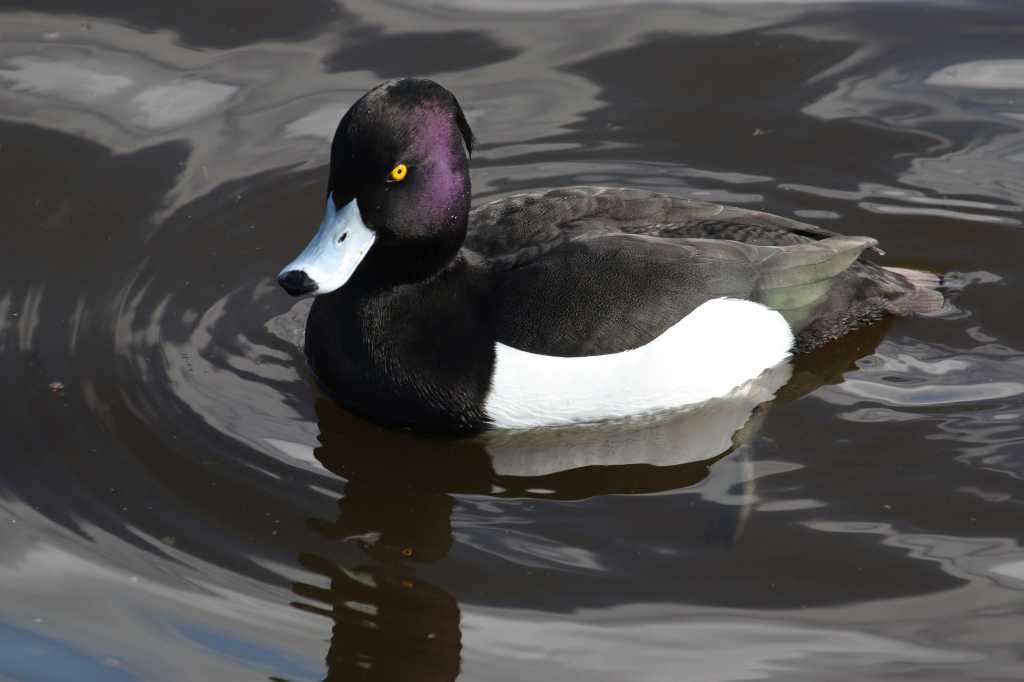
Male Tufties are handsome black-and-white birds, with a characteristic tuft and bright yellow eyes – totally memorable. Although the females also sport a tuft and yellow eyes, their drab buff-brown plumage renders them somewhat forgettable. Scouring Mrs P’s vast photographic archive, I discovered that nearly every photo that she’s ever taken of this species features the male. That, I think, tells you all you need to know about the differing visual appeal of male and female Tufted Ducks!

Tufties are fun to watch, busy little ducks that paddle swiftly across open stretches of water, before diving in pursuit of aquatic invertebrates and bivalve molluscs. It seems like they belong in this landscape and must therefore have been here forever, which makes it difficult to believe that British nature lovers at the start of Queen Victoria’s reign would have been denied the pleasure of their company.

The lesson to draw from this, I guess, is to remember that what we see today is just a snapshot in time. Species come and species go; it’s a natural process, although human activity speeds it up and can cause major instability. I wonder which birds species are entirely absent from the UK today, but will be taken for granted by British birders in the 22nd century?

Getting back on track, courtesy of a Peak Rail steam train

Foul weather was our constant companion from the start of 2024. It wore us down, the sombre grey sky, the biting wind, the constant rain. There was no pleasure to be had in going out, so we stayed at home, and as grim weeks ganged up to become relentlessly miserable months we started to go stir-crazy. So when, at last, conditions began to improve we quickly decided we deserved a treat, courtesy of our local heritage railway.

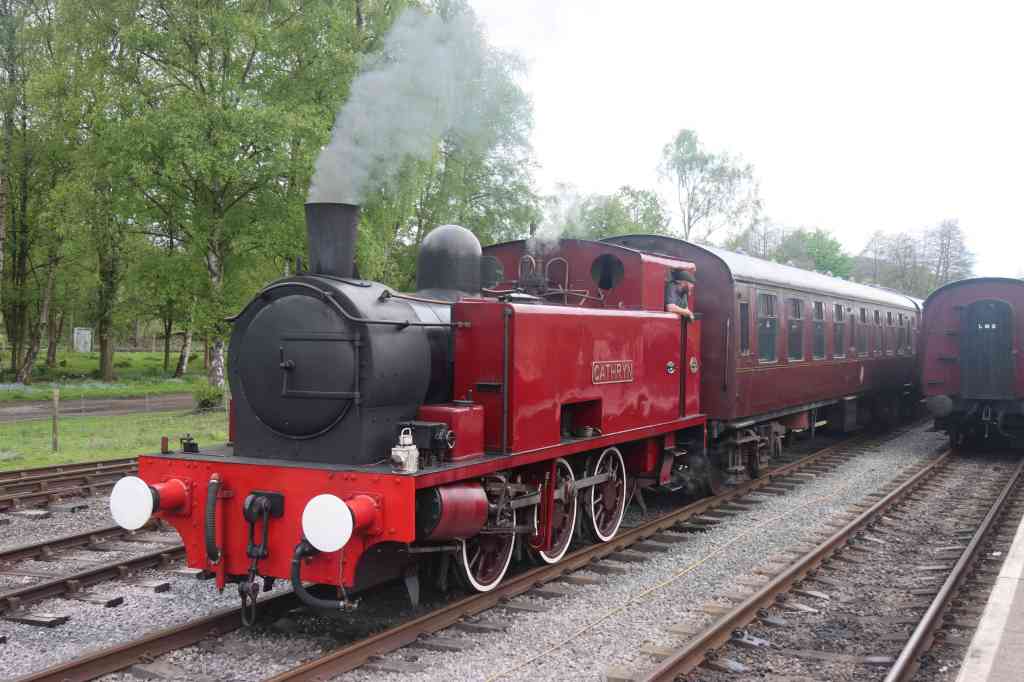
This is Peak Rail at its best…the sight, and the sounds and the smells of a gleaming, steaming locomotive! This loco was built in 1955.

We live in Derbyshire, on the edge of the Peak District. Famed for the natural beauty of its limestone hills and verdant dales, in 1951 the Peak District became the UK’s first national park. The railway that crossed it, running between Derby and Manchester, was a triumph of nineteenth century civil engineering. It was claimed by many to be Britain’s most scenic railway line.

Sadly I never got to find out in person if this claim was true. Much of the line was closed down in the 1960s, the victim of an efficiency drive shaped by the infamous “Beeching Report” of 1962. Accountants, politicians and British Rail bosses doubtless allowed themselves a glass of champagne to celebrate this “victory” for cost-effectiveness, but railway enthusiasts were dismayed. Their response was to band together to form the “Peak Railway Society” – later “Peak Rail Operations – with the aim of restoring the line for recreational and community use.

Half a century later, the dream lives on. Peak Rail has succeeded in re-opening around 4 miles (6.5 km) of track, between Rowsley South Station and Matlock, over which it operates a service featuring heritage steam and diesel locomotives. Here’s how Peak Rail describes its offer:

Whether it’s simply a nostalgic journey back to a bygone age or a discovery of the sights and sounds…of a steam or diesel locomotive[,] Peak Rail welcomes you to experience the thrill of our preserved railway whilst travelling through the delightful Derbyshire countryside…As well as our normal train journeys, there is something for everyone to enjoy, luxury dining is available on our Palatine Restaurant Car which offers Afternoon Teas and operates on various days during the year. [Source: Peak rail website, retrieved 14 May, 2024]

The reality, it must be said, proved to be more modest than the marketing hype. The part of Derbyshire through which the train travels is pleasant, but not exceptional (it’s on the edge of the national park rather than within it), and given that the line is just 4 miles long there’s not a huge amount to see. The locomotive that powered our train gleamed brightly in the welcome afternoon sunshine, but wasn’t by any stretch of the imagination remarkable in the context of other UK heritage steam trains. And the Afternoon Tea, while thoroughly enjoyable, didn’t align with my understanding of the words “luxury dining!”

But it’s important to remember that this is an organisation run by volunteers, and a service delivered almost entirely by volunteers. It’s not a commercial operation, so you have to adjust your expectations accordingly.

Peak Rail offers an opportunity to escape the rigours of the 21st century for a couple of hours, and to wallow in nostalgia. Back in the 1970s, dear old British Rail – the late, unlamented provider of the UK’s national rail network at the time – ran a series of commercials that sought to persuade motorists to abandon their cars in favour of rail travel. Its strapline was “let the train take the strain,” and that’s just what we did for a couple of hours, courtesy of Peak Rail.

Thanks to Peak Rail we were finally able to get back on track, after many months of meteorological misery. I’m pleased to report that a fine time was had by all

The LBJ, the app, and the frustrations of birdwatching

Mrs P and I have been birdwatching for nearly 40 years. It’s a great way to pass the time, one that allows us to escape temporarily from the pressures of modern living and instead get up close and personal with nature. But it’s not without its frustrations, of which the most frustrating thing of all is the LBJ. And in case any Americans reading this are wondering, that has nothing at all to do with Lyndon Baines Johnson – aka LBJ – the 36th president of the US!

For the uninitiated, in the British birding community LBJ stands for “little brown job”, which Wikipedia tells us is “an informal name used by birdwatchers for any of the large number of species of small brown passerine birds, many of which are notoriously difficult to distinguish.” The problem is compounded by the fact that your average LBJ never sits still for long, instead flitting hither and thither between bushes, briars and other forms of cover. As a rule, you only get a fleeting glimpse of an LBJ before it goes back into hiding. LBJs are a birder’s worst nightmare.

IMAGE CREDIT: “Cetti’s Warbler” by Mike Prince is licensed under CC BY 2.0. Sourced via Openverse

An alternative approach to identifying LBJs is via their songs. Unfortunately Mrs P and I haven’t been listening carefully enough over the last four decades, with the result that the number of species we can identify by their song alone can be counted on the fingers of one hand. But – much to my amazement – modern technology has come to the rescue, in the form of an app on my mobile phone.

A casual discussion with a bird enthusiast last year first brought the Merlin Bird ID app to our attention. It’s dead simple, which is fortunate as mobile phones aren’t my thing. When a bird is singing just fire up the app, which will analyse the song against its database and tell you which bird you’re (most probably) listening to. Simple but effective, as we discovered last week, when it led us to identify our first ever Cetti’s Warbler.

The Cetti’s was heard – and briefly seen – just a few metres from this spot. Unfortunately Mrs P was unable photograph it, and I’m grateful to Mike Prince for the image of the illusive LBJ at the top of this post

Mrs P and I were at Straw’s Bridge – aka Swan Lake – a local nature reserve that I first wrote about nearly three years ago. We go there mainly to enjoy the wildfowl, but were intrigued this time by glimpses of an LBJ that we couldn’t identify, moving between a series of bushes by the edge of the lake. It proved typically illusive, but just when we were about to give up and move on the bird started to sing in short, loud bursts. I whipped out my phone, and in a just a few seconds we learned its identity.

For confirmation I cross-checked with other information provided by the app. Its photo of the Cetti’s clearly matched the brief glimpses we’d had of the bird, and the textual description of its appearance and behaviour was bang on: a “dumpy and broad-tailed warbler, warm brown above and pale grayish below, with a narrow eyebrow…favours tangled vegetation near water, including reedy marshes with bushes and scrub. Often heard but rarely seen. Explosive, rich staccato song often draws attention.” Follow the link below to hear the song of the Cetti’s Warbler’s.

I found this recording of a singing Cetti’s Warbler on YouTube, courtesy of Birdfun.

The species is a new arrival in the UK, first breeding here – in the south-eastern county of Kent – in the early 1970s. Since then its range has slowly expanded northwards, but until our LBJ encounter last week we’d no idea the Cetti’s warbler had reached our home county of Derbyshire. Without the help of the bird identification app we would probably never have known.

In principle, I would rather leave the modern world behind when I’m out in nature. Mobile phones have their place, but a birdwatching trip isn’t one of them…or so I thought until Merlin Bird ID helped us identify our first Cetti’s Warbler. Having seen that 21st century technology can help us vanquish one of birdwatching’s biggest frustrations – the LBJ – I guess I might need to revise my opinion.

Highland Wildlife Park

For many years we had planned – but failed – to call in at the Highland Wildlife Park while driving north through Scotland on our way to visit the Orkney Islands, our favourite place in the whole world. At last, earlier this year, we finally got our act together and visited the Park for a few hours. And what a treat it turned out to be!

Red deer in the foreground, dwarfed by the landscape of the Cairngorms National Park

Highland Wildlife Park is located outside the town of Kincraig, in the Cairngorms National Park around 120 miles (193 km) north of Edinburgh, Scotland’s capital city. It was the brainchild of land-agent Neil Macpherson (1933-2017), who wanted to share the wildlife he encountered every working day in the north of Scotland with a wider audience.

Neil’s dream came to fruition in 1972, when the 260 acres (105 hectares) Park opened its gates to the paying public for the first time. It was a source of great pride and pleasure to him, but perhaps not as successful as he had hoped. In 1986 the ownership and operation of the Park passed to the Royal Zoological Society of Scotland, which also runs Edinburgh Zoo.

Controversially, in 2007 the Park’s theme was expanded from Scottish wildlife to focus instead on species from tundra and mountainous habitats around the world. So today, as well as animals from the local area – including Red Deer and the critically endangered Scottish Wildcat – visitors can enjoy views of a variety of more exotic fauna including Snow Leopards, Turkmenian Markhor, Przewalkski’s Horse and Vicuna.

The Royal Zoological Society of Scotland is a wildlife conservation charity whose vision is “a world where nature is protected, valued and loved.” Unsurprisingly, therefore, Highland Wildlife Park places a strong emphasis on education, as well as the captive breeding of endangered species.

When we visited we were particularly pleased to get good views of the Park’s five Snow Leopards, parents Animesh and Koshi, and their cubs – born in May 2022 – Maya, Padme and Yashin. Being almost exactly 12 months old when we saw them, the cubs had lost much of their kittenish “cuteness”, having matured into impressive animals with exceptional appetites!

In an ideal world the Highland Wildlife Park would be unnecessary. But our world is far from ideal, and it’s good to know that places like this exist to help protect species and spread positive messages about wildlife conservation. I’m sure we will call in again, next time we are on our way up to Orkney.

World Oystercatcher Day?

Today is NOT World Oystercatcher Day! Why not, I wonder? Just about every other worthy cause – and a few other causes too – have a day set aside to celebrate them. World Elephant Day, International Day for the Abolition of Slavery, World Breast Cancer Research Day, International Red Panda Day and International Talk Like a Pirate Day, to name just a few. So why not a World Oystercatcher Day?

OK, it’s confession time. I’ve been a keen birder for nearly 40 years, and the oystercatcher is my all time favourite bird. Now, not a lot of birdwatchers would ever admit that. Most would select as their favourite either a species that is exquisitely beautiful, or one that is vanishingly rare. Oystercatchers are neither of these things, but what the hell, I love ’em anyway.

Part of the attraction is that they’re unmistakeable. When you first take up birdwatching as a hobby, it can be very daunting to identify what’s right in front of you. Warblers in the UK, for example, are a bit of a nightmare – they all look pretty much the same unless you get up close and very personal with them – and US birders will know only too well the misery that is inherent in trying to distinguish between North America’s multiple species of sparrows. It’s all very confusing.

Not so with oystercatchers. It’s impossible to confuse a Eurasian Oystercatcher (aka the Common Pied Oystercatcher, or the Palaearctic Oystercatcher) with any other UK bird. A large, stocky, black and white wader with a long, orange-red bill and reddish-pink legs, its identity is beyond doubt.

But what I like most about these handsome birds is that they are unashamedly loud and proud. Oystercatchers boast an eardrum shattering ‘peep-ing’ call that is impossible to ignore. “Shy” and “self-effacing” are adjectives never used to describe an oystercatcher.

Of course, such vocal boisterousness isn’t popular with everyone. Mrs P doesn’t much like oystercatchers, and probably believes they should all be jailed for disturbing the peace. One day earlier this year, when we were birding in Orkney, I excitedly told her that in the small bay we were staking out I had just counted no fewer than 38 oystercatchers foraging for shellfish along the strandline. Mrs P observed dryly that, in her view, this was at least 37 too many. Huh!

New Zealand’s South Island Pied Oystercatcher looks remarkably similar to our own Eurasian Oystercatcher

In all, there are 12 separate species of oystercatcher across the world. They all look very similar, being either pied or plain black, with a red bill and pink legs. We’ve been lucky to see a few of these species over the years, and every encounter felt like a real privilege. New Zealand was particularly productive, enabling us to enjoy both the South Island Pied Oystercatcher, and the aptly named Variable Oystercatcher. What great birds they are (sorry Mrs P, but you’ve got to admit it, I’m right for once!)

In my view, every day should be World Oystercatcher Day!

Orkney’s tiny hidden gem – Primula Scotica

Orkney boasts various attractions both large and small, but none smaller than the Primula Scotica. Also known as the Scottish Primrose, this tiny flower can be found nowhere else in the world other than a few places on the north east coast of Scotland, including a handful of scattered locations on the Orkney Islands.

At the centre of Primula Scotica’s vivid purple petals is a white eye, with a bright yellow “pupil” at its heart. The photo above might suggest that these colourful blossoms are easy to spot in the landscape. Wrong! The flower is a mere 8 millimetres (0.31 in) in diameter, at the top of a stem that is itself just 4 centimetres (1.57 in) tall. It is more easily trodden upon than seen.

Primula Scotica is found only amongst coastal heath and grassland, normally within a few hundred metres of the sea where strong winds trim back taller plants that might otherwise out-compete it. Although it grows in areas of short turf, it’s so tiny that it is easily overlooked.

The biggest picture in the group above shows the view at Yesnaby, a coastal location on Mainland Orkney where Scottish Primroses are known to grow. We went there earlier this year hoping to see them, but struggled at first to “tune in” to precisely what we were searching for. We must have unknowingly walked right by countless specimens until, at last, we started to spot them lurking amongst the coastal turf. The other pictures in this group show just how small these flowers are. A cluster of four flowerheads would barely cover the nail on my index finger, and the blossoms are dwarfed by a British 50 pence coin. Never has the description “perfection in miniature” been more fitting!

Reclaiming the landscape: Poolsbrook Country Park

The eastern part of my home county of Derbyshire has a long association with coal mining. Limited production took place during the medieval period, but it wasn’t until the Industrial Revolution that large-scale mining began. When the coal industry was nationalised in 1947, there were 68 deep mines in Derbyshire. Now there are none, but their legacy lives on in a surprising way at Poolsbrook Country Park.

Great Crested Grebe

The area now occupied by the Park once consisted of farmland set in a rural landscape. Large-scale mining, which began in 1875, changed the place beyond recognition: mine shafts were sunk, massive colliery buildings were erected, and vast, ugly spoil heaps were dumped wherever seemed convenient at the time. When the Ireland Colliery finally closed for good in 1986, the whole area had been transformed into a bleak, dystopian eyesore that offered little of value either to local people or to the natural world.

Eurasian Bullfinch (male)

Luckily the local council had the vision to realise that with time, effort and resources, the site could be reborn as a valuable community amenity and wildlife habitat. Under its ambitious plans the mining infrastructure was dismantled and the old colliery spoil heaps were landscaped to mimic a natural lake/river valley, which was then planted with trees and wildflower seed.

Close-up of Mute Swan.

Mute Swan

Today, the 165 acre (67 ha) site is home to a mosaic of habitats including lakes, wet grassland, wildflower hay meadows, woodland and hedgerows, all carefully managed for the benefit of wildlife. Good visitor facilities are also provided, encouraging local people to abandon the stresses and strains of urban life for a while and instead explore a small corner Derbyshire’s magnificent countryside.

Grey Heron.

Grey Heron

So, rather than simply return the land to its pre-mining status as an unremarkable piece of farmland, the planners and environmentalists have significantly enhanced it. In doing so they have created a big attraction for lovers of the natural world, particularly birders like Mrs P and I. The photographs that illustrate this short post show just a few of the birds we’ve spotted at Poolsbrook Country Park since the easing of the Covid lockdown.

Casual visitors unfamiliar with its history would struggle to identify Poolsbrook Country Park as the site of a colliery that was in operation for over 100 years. This, in my view, is very encouraging, an illustration of just what can be achieved if we are ambitious about restoring our natural world. It offers real hope that with effort and resources we can put right at least some of the wrongs perpetrated by previous generations in the name of “progress.”

Horse power!

Although its primary focus is on the preservation and display of historic buildings from South-East England, the Weald and Downland Living Museum offers other fascinating insights into the lives of ordinary people in times past. A notable highlight of our visit last October was to be able to watch a team of horses ploughing a field that forms part of the Museum’s land. Only a few decades ago such a sight would have been totally unremarkable anywhere in rural England, but these days draught horses have little if any role in country life beyond their participation in ploughing competitions that hark back nostalgically to the pre-industrial world.

The term “draught” horse is derived from the Old English word dragan, meaning “to haul” or “to draw”. They are also referred to as carthorses, work horses or heavy horses. And these terms, I guess, tells us all we need to know. Back in the day, when heavy loads needed to moved or agricultural land had to be worked, the horse was England’s go-to beast of burden. Even as the Industrial Revolution started to kick in, horses toiled along towpaths hauling canal barges laden with raw materials and manufactured goods.

In these modern times, when internal combustion and diesel engines rule the roost, it’s difficult to imagine a moment when we depended not on them but instead on the humble horse. The Weald and Downland Living Museum’s mission is to celebrate and remind us of the world we have lost, and watching three magnificent horses going about their business did just that.

The Museum’s horses are Percherons, a breed of draught horse that originated in western France. Usually grey or black in colour, Percherons are sturdy animals known for their intelligence and willingness to work. They were originally bred as war horses, but later became sought-after animals for agricultural work and hauling heavy goods. As well as ploughing, the horses we encountered also help out with a number of other seasonal farming tasks. These include sowing, haymaking and harvesting, as well as timber-extraction from the Museum’s woodland.

The Museum’s Percherons seemed content in their work, and the guy leading them clearly cared deeply for their welfare. He was practising for a ploughing competition the next day, and although I’m no expert it seemed from what I saw that he and his horsey team were in with a good shout!

In addition to its draught horses, the Museum has several fine examples of historic horse-drawn vehicles. These include a spectacularly colourful gypsy caravan dating from the late 19th century, and a far more humble “living caravan” which would have been home to labourers who travelled the countryside in search of opportunities for paid work.

Like the rest of the exhibits on display at the Weald and Downland Living Museum, the Percherons and horse-drawn vehicles we saw there offered fascinating insights into a world that is almost beyond comprehension from our comfortable, 21st century perspective. I strongly recommend a visit!