Sometimes people disgust me: puffin trophy hunting

My last post described how puffins at Sumburgh Head were the highlight of an otherwise miserable visit to Shetland earlier this year.  I hope future generations will have the same opportunity to enjoy them, but the prospects are not good.  The Atlantic Puffin is now identified on the BirdLife International/International Union for Conservation of Nature’s Red List as a vulnerable species.   Massive population declines are projected over the next 50 years because of food shortages due to climate change, as well as pollution, predation by invasive species and adult mortality in fishing nets. 

Iceland is one of the puffin’s strongholds.  Mrs P and I have visited Iceland on a couple of occasions, and were impressed by the Icelanders’ ability to carve a decent living out of that bleak, inhospitable lump of rock in the North Atlantic.  To do so they had to use whatever nature offered, and therefore included seabirds as an important part of their diet. 

Harvesting and eating puffins is traditional in Iceland, and I can – reluctantly – forgive the locals for doing so, even though I myself would no more snack on a puffin than I would dine on broken glass.

But I cannot forgive Icelanders for allowing puffin trophy hunting.

The Metro newspaper reported recently that trophy hunters are paying to kill up to 100 puffins at a time.  Follow the link for photos of the gloating hunters and their “trophies”, but prepare yourself to be appalled.

Where, for god’s sake, is the sport in killing 100 puffins, not for food but simply for the “fun” of it?  All life is precious, and no creature should die simply to enable men – it’s usually men, isn’t it? – to show off their prowess with weapons.  There are times when people disgust me, and this is one of them.

What also disgusts me is that it’s legal to import puffin trophies into the UK.  Surely we, collectively as a modern, environmentally-aware society, and individually as responsible citizens of a fragile planet, should be better than that. 

It’s all about the puffins

I wish I could tell you we had great holiday in Shetland earlier this summer, but as the Platypus Man never tells porkies I’ll simply say that it was, sadly and for all the wrong reasons, an unforgettable experience.  We were there 17 days, and it rained on about 14 of those.  On several days it didn’t stop raining at all, while a bitter wind from the north made us wish we’d packed our thermals. 

Shetland is an island group at the northern extremity of the British Isles.  It’s much closer to Norway than to London, and it’s a different world up there.  We’ve been before, nearly 30 years ago, and when the sun’s out it’s strangely beautiful in a stark, barren, pared-back kind of way.  In June 2019, however, we barely spotted the sun at all.  Gloom and despondency settled upon the Platypus Man and Mrs P, and we bitterly regretted not going somewhere more congenial, like Antarctica, or maybe Everest base camp.

But of course every cloud has a silver lining, and in this case it was the puffins.  Shetland is one of the best places in the UK to see the Atlantic Puffin, and although their numbers are falling steadily due to the impact of climate change on the fish that make up their diet, they are still present in good numbers. 

Sumburgh Head, at the southern tip of Shetland, has an easily accessible puffin cliff.  We went twice, and on both occasions a miracle occurred: the rain stopped and the sun came out, though the wind buffeted us mercilessly, howling like a banshee and tugging roughly at our hair and coats like an old woman stroking a cat.

Mrs P and I are seasoned birders – bird-nerds, some might say – and enjoy nothing more than spending time watching birds of all types.  The average Brit is less keen, but I defy anyone not to be enchanted by puffins.  Some people call them sea parrots, others cliff-top clowns, but what’s in a name?  They are, quite simply, the most iconic and instantly recognisable of this country’s seabirds.

And they came in their droves to the cliffs at Sumburgh, ordinary folk who’ve probably never done a day’s birdwatching in their lives, to be captivated by the puffins.  Some of the birds are so close you can almost touch them, and they seem to pose for the camera.  It’s difficult not to take a good photo of a puffin.

Everyone loves a puffin, wants to see them, wants to get up close and personal with them, wants a selfie with them.  It was just the same when we visited Newfoundland a couple of years ago.  In coastal areas, wherever the birds were known to nest, the conversation between ordinary tourists was dominated by one subject: where is the best place to see a puffin? 

In coastal Newfoundland, as at Sumburgh Head in Shetland, one thing is beyond doubt: it’s all about the puffins.

The best man I ever knew

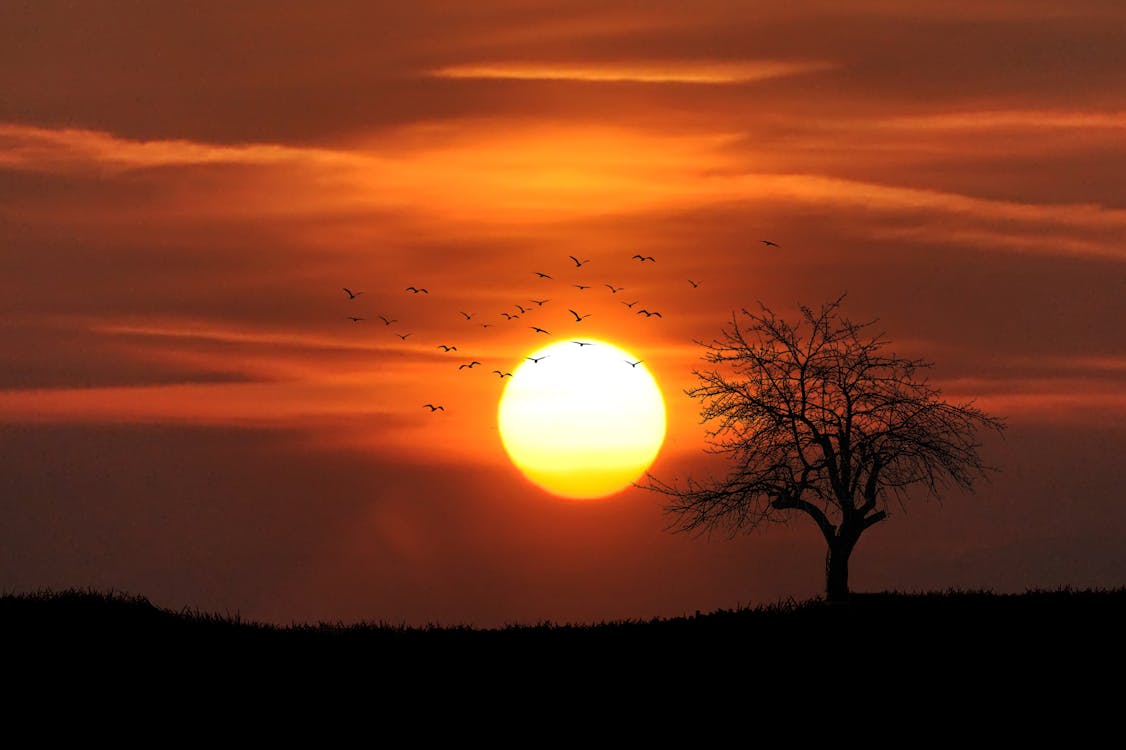
Flock of Birds Flying over Bare Tree Overlooking Sunset

PHOTO CREDIT: Flock of Birds Flying over Bare Tree Overlooking Sunset. From Pixabay via Pexels

The news came in a short, handwritten letter from his mother: Pete and his family had been involved in a terrible accident.  Their car had caught fire following a crash in London; his wife and baby son had died at the scene.  He could have got clear with only minor injuries, but went back into the inferno in a desperate but ultimately futile attempt to save Livy and Simon. 

In a critical condition, Pete was admitted to a hospital burns unit where he clung to life for a few weeks.  But in the end the fight was just too much for him, or maybe he knew somehow that Livy and Simon were gone, and that life without them would be pointless? 

When I learned that he was dead I felt that part of me had also died.  Pete was more alive than any person I’d ever met, and it seemed impossible that he’d passed over.

We’d met in our first week at secondary school, and we were like chalk and cheese.  Our backgrounds were so different, his parents comfortably middle class, mine ordinary working class.  He was a confident, outgoing Christian, I an awkward, reserved atheist.  His politics were naturally Tory, mine instinctively socialist.  His brain was wired for maths and science, while I favoured the arts and humanities.  He burned the candle at both ends, I saved my candles in case the lights went out one day.

It seemed inconceivable that two boys who were so different could become friends, and yet within days we were inseparable.  Was it because of our differences that we became so close?  Did each of us offer the other a new perspective on life, a chance to broaden our horizons and to gently challenge our own values and beliefs, but without undermining our own self-esteem and sense of self-worth?

Thomas J Watson Jr, an American businessman, is famously quoted as saying this about friendship:

‘Don’t make friends who are comfortable to be with. Make friends who will force you to lever yourself up.’

I can relate to this.  I know I am a more complete person for having known Pete, despite disagreeing with him on lots of things.  I like to think that he, were he still alive, would say the same about me. 

But I didn’t become his friend to ‘lever myself up,’ which suggests a degree of calculation that is totally alien to me.  I became his friend because despite – or perhaps because of – our many differences, he intrigued me, and the more I got to know him the more I realised that what separated us was less important than what we shared: kindness, generosity, good humour, thoughtfulness, loyalty and mutual support. 

The accident happened thirty years ago this summer, when Pete was just 33 years old.  His full name was Charles Peter Johnston Morris, and he was the best man I ever knew.

A different fly

So, at last, after what seems like months of posturing, we have a new Prime Minister.  Politicians, don’t you just love ‘em?  During the last decade of my career I had the dubious pleasure of spending a lot of time with politicians.  This was in local government, so their capacity to wreak mayhem and misery was geographically constrained, but it didn’t stop many of them having a damn good try.

Flies Reproducing Life

PHOTO CREDIT: “Flies Reproducing Life” by JC-canon is licensed under CC BY-NC-ND 2.0

To be fair, some of the politicians I had dealings with were capable, decent, well-meaning human beings, regardless of party affiliation.  The majority were, however, cut from an altogether different cloth, incompetent, totally lacking in self-awareness and less trustworthy than an alligator with terminal toothache.

Douglas Adams, one of the funniest British writers of the late 20th century, had the measure of politicians.  He wrote, in the Restaurant at the End of the Universe:

“The major problem – one of the major problems, for there are several – one of the many major problems with governing people is that of whom you get to do it; or rather of who manages to get people to let them do it to them.  To summarize: it is a well-known fact that those people who must want to rule people are, ipso facto, those least suited to do it.  To summarize the summary: anyone who is capable of getting themselves made President should on no account be allowed to do the job.”

Mark Twain’s masterpiece of pithy observation, written a century earlier, shows that – unsurprisingly, I suppose – the marriage of naked ambition and gross ineptitude is not a modern phenomenon.  He wrote:

“Reader, suppose you were an idiot. And suppose you were a member of Congress. But I repeat myself.”

In their separate ways, Adams and Twain highlight democracy’s greatest flaw: the people who get themselves elected to serve us.  But to put it another way, aren’t we the fatal weakness?  Us, the electorate, we gullible souls who put an ‘X’ next to the name of a person we’ve almost certainly never met and assume that he or she will do right by us?  We, who rarely ask the right questions or listen intelligently to the answers when we do.

I’ll leave the final words on this subject to Derbyshire folksinger / songwriter Lester Simpson.  The title of his song We Got Fooled Again is a clue to Simpson’s take on the political process, but if there’s any doubt the first two lines tell us all we need to know:

“In the name of progress we believe the lies
And get the same old shite, just different flies”

Couldn’t have put it better myself.

Painted Ladies … and insects for breakfast

At last, after a miserable soggy June, the sun appears, and to mark the occasion a Painted Lady pays us a visit. No, a Painted Lady isn’t a young woman of negotiable virtue.  Ours is a respectable town, and that sort of thing simply doesn’t happen here.  Honest. 

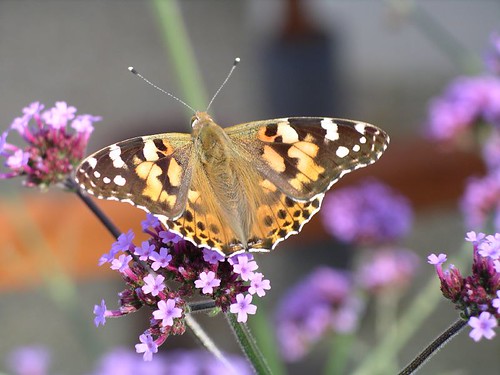
Rather, a Painted Lady is a butterfly, one of the few migratory butterflies seen in the UK.  They spend winter in North Africa, and successive generations then work their way north every spring and summer.  Significant numbers of Painted Ladies only make it to the UK in exceptional years, when the wind’s in the right direction, so we feel honoured that one has dropped by.

Painted Lady

PHOTO CREDIT: “Painted Lady” by Jaydee! is licensed under CC BY-NC-ND 2.0

However, she needs to take care, ‘cos Milky Bar’s on the prowl.  Milky Bar eats insects for breakfast, and for lunch, dinner and supper too, if he gets the chance.  He’s the apex predator in our suburban Serengeti, and everything else with a pulse needs to take care.

Have I told you about Milky Bar?  Milky Bar, or MB for short, is a cat who’s been visiting for 18 months or more.  He claims ownership of our garden, but graciously allows us to use it so long as we leave him in peace to pursue his hobbies.  MB’s hobbies include birdwatching, fishing and eating dragonflies.  I have no doubt that he is personally responsible for a shortage of dragonflies in our part of the county.

Milky Bar watches us through the window … butter wouldn’t melt in his mouth!

Our garden has lots to amuse the discerning cat.  Milky Bar enjoys scaling the bird table for a better view of his surroundings, and sitting for hours next to the pond, mesmerised by the fish rendered unattainable by the netting I have installed for just that purpose.

But at the end of the day MB is a just a typical moggy, so his favourite pastime is snoozing.  Under the weigela, under the bay tree, under the big red rhododendron … Milky Bar’s not fussy, pretty much anywhere shaded will do to while away the afternoon.

Milky Bar … waiting for insects

And although he may appear sound asleep the merest flicker of his eyelid, the minutest movement of an ear or that tiny twitch at the tip of his tail are all clues to his higher purpose.  At heart MB is a hunter, and insects of any shape, size or hue are his preferred quarry. Painted Ladies beware.

Toby doesn’t read the Guardian

It was our 35th wedding anniversary last week.  In so many ways it seems only yesterday that we did the deed, yet on the other hand it feels like another age altogether. Notwithstanding Margaret Thatcher – who was never my favourite person – back then it did appear that the world was getting better, that there were grounds for optimism, that things were generally moving in the right direction.  

Profile

PHOTO CREDIT: “Profile” by John Vela is licensed under CC BY-NC-SA 2.0

As Ian Dury told anyone who would listen, back in the day we had reasons to be cheerful.

It’s impossible to believe that now, I think.  Trump, Brexit, rampant populism, climate change, plastic pollution, neo-nicotinoids, xenophobia, terrorism, palm oil, habitat destruction, mass extinctions, obesity epidemics, modern slavery, housing shortages, sexual abuse, mental health crises, Boris Johnson … ain’t it just great to be alive in 2019?

Oh dear, I really must stop reading the Guardian.

Mrs P’s mum and dad were away last week, so we found ourselves on budgie duty.  Toby likes company but gets miserable when the house is quiet.  To counter this we went round to their place every morning to switch on the radio, so he could listen to Classic FM for a few hours.  Then in the evening we’d go back to feed and water him, and to bill-and-coo for a while.  

Toby’s a lovely, lively, cheerful soul, hopping madly from perch to perch, joyfully attacking his cuttlefish, celebrating life with his incessant bird-brained chatter.  He’s carefree and exuberant, and lives for the moment. 

Toby doesn’t read the Guardian.