Celebrating National Robin Day

The good folk at SongBird Survival (SBS), an independent charity which funds research into the declining numbers of Britain’s songbirds, have declared next Monday – 21 December – to be National Robin Day. And who can blame them? The instantly recognisable robin has an appeal that extends way beyond dedicated birders, so celebrating this bird table superstar is an inspired way of gaining more publicity for their worthy cause. To mark the day, I thought I’d share some random facts and folklore about this iconic bird.

1 Robins are British Christmas card icons

It’s no accident that the SBS chose mid-December as the best time to celebrate National Robin Day. In Britain robins have been associated with Christmas since the 19th century, when postmen were dubbed robin redbreasts because of their red tunics. The mail they delivered at Christmas brought happiness to householders across the country, and the link was quickly made between redbreasts and seasonal merriment. Robins soon started appearing on Christmas cards, and they’ve been there ever since.
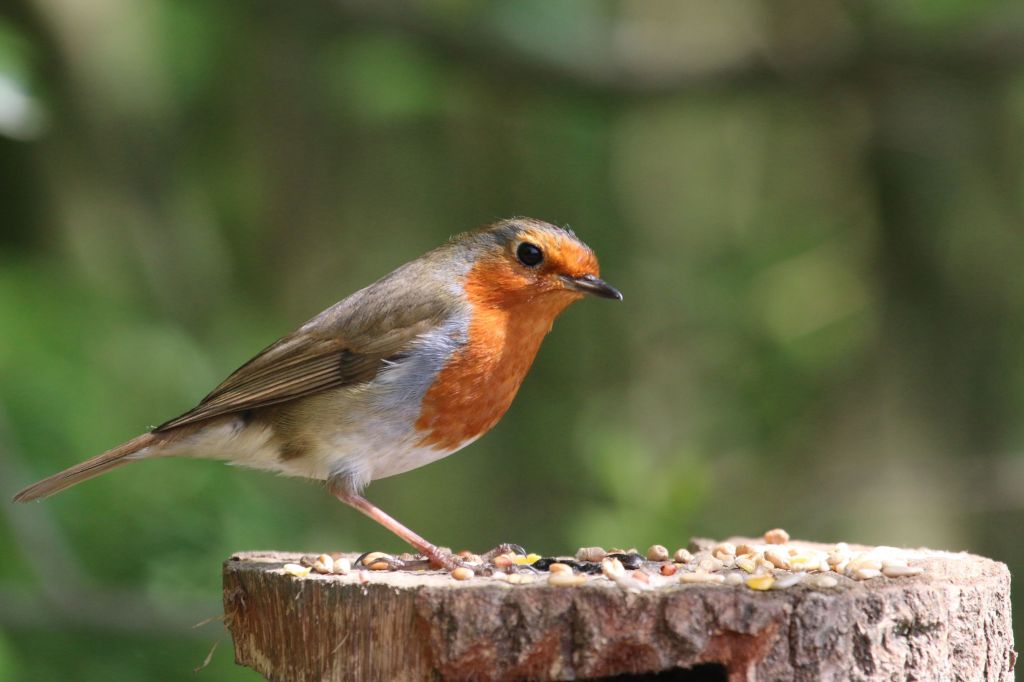
Worthy of a Christmas card

2 The naming of robins

The original English name for the robin was purely descriptive: our ancestors called it the redbreast. But they got it wrong. Even a cursory inspection in good light will reveal the bird’s breast to be orange, or perhaps an orangey-red, rather than pure red. The word orange, describing a colour, was unknown in English until the 16th century when it appeared as the name of the now-familiar citrus fruit. But by this time earlier generations had already adopted the next most appropriate word in the language – red – to describe the colour of the robin’s signature plumage.

The word robin, when applied to the bird, emerged in the 15th century when it became popular to give human names to familiar species. This new practice resulted in the birds becoming known as robin redbreast, which was eventually shortened to robin

3 The robin is Britain’s unofficial National Bird

In the 1960s the Times newspaper organised a poll of its readers to find Britain’s most popular bird, and the robin came out on top. Around half a century later, in 2015, popular birdwatcher and author David Lindo organised a similar survey. Over 200,000 people took part and the robin won again, having received 34% of votes cast, ahead of the barn owl (12%) and the blackbird (11%). Despite these public votes the UK government has remained on the fence and, for now at least, officially we don’t have a National Bird. Unofficially, however, the robin clearly takes the title.
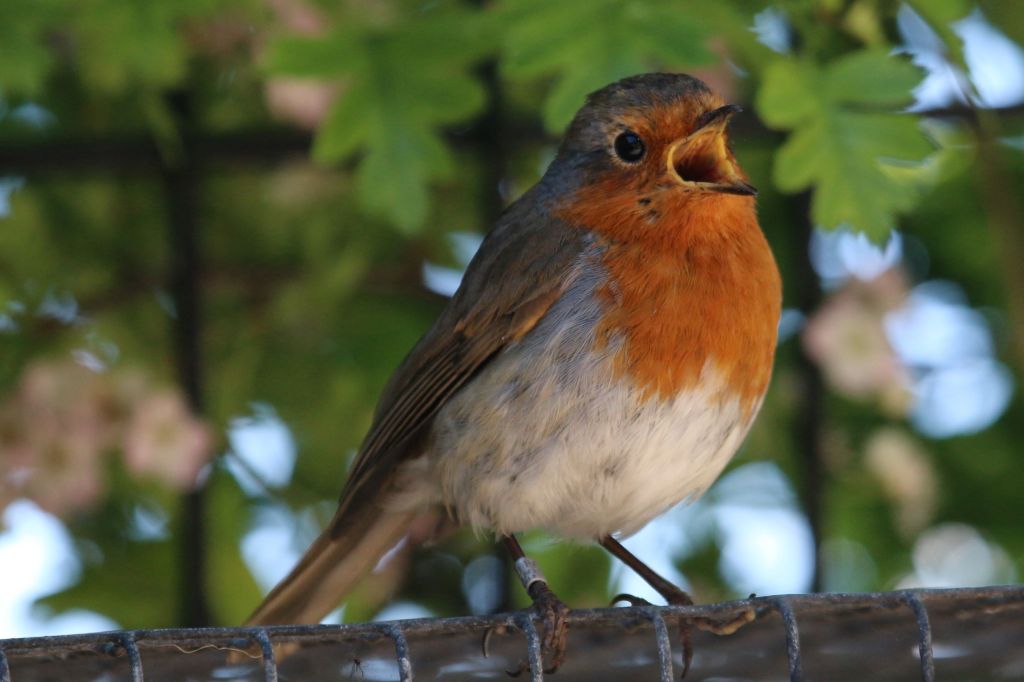
Britain’s unofficial National Bird sings out, warning others to keep clear of its territory

4 Robins are nestbuilding mavericks

When it comes to choosing a place to nest, robins aren’t fussy. Just about anywhere will do. Most commonly their nests can be found about two metres off the ground, within some kind of hollow or crevice and sheltered by vegetation. But others will nest on the ground, perhaps behind the overhang of a grassy tussock, or occasionally beneath fallen twigs covered by leaf litter.

However, radical freethinkers within the robin population choose to nest amongst the flotsam and jetsam of human life. Old teapots, discarded kettles, watering cans, coat pockets, wellington boots, farm machinery, flowerpots, hats, barbecues, an unmade bed and the body of a dead cat have all been selected by robins as a suitable place to bring up a family!

Although their nestbuilding strategy may seem bizarre, it delivers the goods. There are estimated to be 6,700,000 breeding territories in the UK. Since 1970 the robin population has increased by around 45 per cent.

5 Male and female robins both have vivid breast plumage

Robins are highly territorial, and – particularly in the breeding season – adult males like to show off their vividly coloured breasts in an attempt to intimidate other males. Although females are less competitive, they too have orangey-red breasts. The two sexes look very similar, and their brightly coloured breast plumage got them into trouble towards the end of the 19th century when robin skins were for a time a popular adornment for ladies’ hats.

It’s worth noting that juvenile robins have a speckled brown breast and don’t develop the species’ distinctive plumage until after their first moult. The youngsters therefore belong to the group that is the nemesis of birders everywhere: they are Little Brown Jobs.
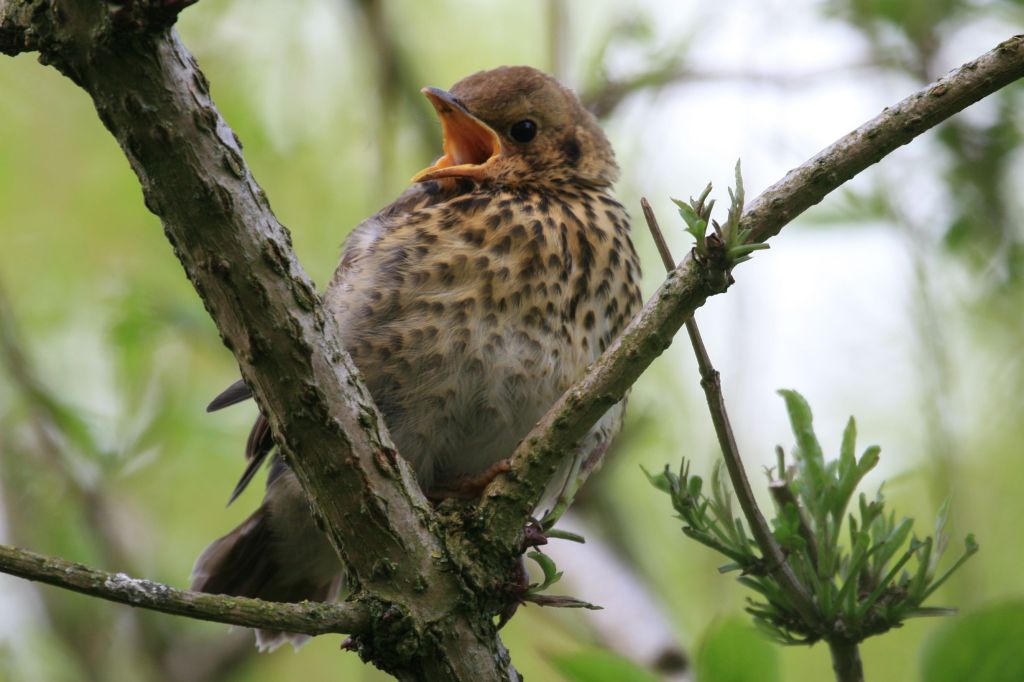
Juvenile robin (aka a Little Brown Job)

6 Robins sometimes fight to the death

You wouldn’t think it to look at them, but robins are aggressive little birds prone to acts of violence. It’s all about territory. It begins with a singing contest, males belting out their songs at one another while trying to get to a higher perch from which to flaunt their brightly coloured breasts. If one or the other doesn’t back down the dispute can become physical, resulting in injuries and even – on occasion – the death of one of the combatants. Shockingly, in some populations, up to 10 per cent of adult mortality is due to these avian turf wars.

7 Robins, friends to gardeners everywhere

Putting aside the connection with Christmas festivities, another reason for the robin’s popularity is its confiding nature. The robin presents as a friendly, trusting bird, more so than any other species that regularly visits British gardens.

Gardeners in particular often get up close and personal with robins. As ground feeders, robins enjoy nothing more than cheekily scavenging earthworms and other invertebrates dug up by gardeners going about their business. They’re also regular visitors to bird tables during the winter months, feisty feeders that aren’t shy about claiming their share of the feast.

Interestingly, robins are less confiding on continental Europe. This is thought to be because in many parts of the continent, particularly in the southern part of the robin’s range, the locals have the detestable habit of hunting small birds. It therefore pays the robin to keep its head down, skulking in the undergrowth, where hunters are less likely to find them. In Britain, where this horrible hunting tradition doesn’t exist, there is no evolutionary incentive for such caution.

The robin is a regular visitor to British bird tables

8 How the robin became

Unsurprisingly for a bird that associates so closely with humans, many stories have grown up to explain the robin’s distinctive colouring. One legend says that when Jesus was dying on the cross, a robin flew to his side and sang into his ear in order to comfort him. At this point the robin’s plumage was a dull, unremarkable brown colour. However the blood from Jesus’ wounds stained the robin’s breast. In that moment the world welcomed its first robin redbreast, and from that day onwards all robins bore the mark of Christ’s blood.

An alternative version of this tale tells us that one day an ordinary brown bird was flying high over Golgotha, near Jerusalem, when it looked at the ground below and spotted Christ suffering on the cross. Determined to ease Jesus’ torment it flew down and tried to remove His crown of thorns, but as it tugged in vain at the cruel affliction some of the Lord’s blood stained its breast. And this was how the robin became.

A third robin creation myth also makes a link between Jesus and the robin’s colouration. According to this story, shortly after Mary had given birth in the Bethlehem stable a small brown bird appeared and – in a noble attempt to keep the Christ Child warm – started to fan the flames of the dying fire. However, embers from the fire scorched its chest feathers, leaving the bird red-breasted. Mary saw what had happened and declared that the red breast was a sign of the bird’s devotion to the Lord. She went on to promise that the bird and all its descendants would forever onwards wear a red breast in memory of this selfless act of love.

9 Q: When is a robin not a robin? A: When it’s an American robin

The species of robin seen in British gardens is found all over Europe, extending as far east as Western Siberia and south to North Africa. Robins are also found in North America…or are they? Well, no, actually they’re not. The American Robin isn’t really a robin at all, and belongs instead to the thrush family. Early European settlers in the Americas, desperate for reminders of home, noticed its reddish coloured breast and named it after the bird they knew from back home. Ornithology plainly wasn’t their strong point as, other than the colour of the breast, the two species bear little resemblance.

Interestingly, in the 1964 movie Mary Poppins starring Julie Andrews, the director got the wrong bird. Despite Dick van Dyke’s laughable attempt at a London accent, Mary Poppins is clearly set in England. However the bird that lands on Mary’s finger during the song A Spoonful of Sugar is an American Robin rather a European robin. Why am I not surprised by Hollywood’s cavalier relationship with factual accuracy?
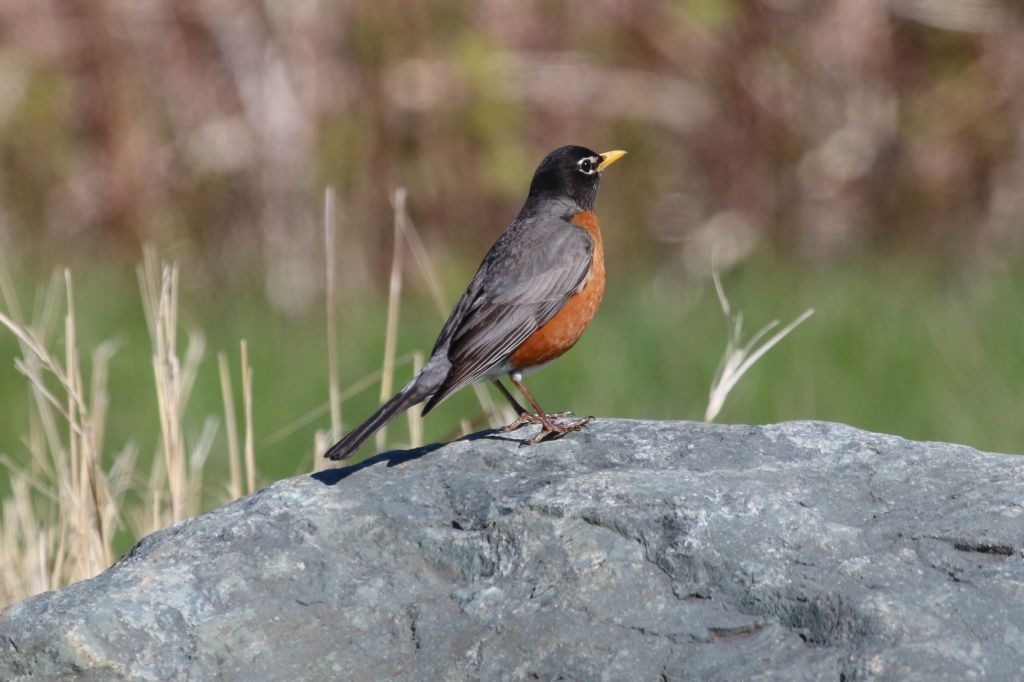
The American Robin…is not really a robin at all!

10 Who killed cock robin?

The robin appears in the well-known English nursery rhyme Who Killed Cock Robin?, a gruesome tale describing the murder and the funeral of a robin. The unfortunate redbreast is shot by a sparrow, and subsequent verses reveal who organises his funeral, who digs his grave and who plays the role of chief mourner. The person who concluded that such a verse constitutes suitable entertainment for children was clearly in need of therapy.

The nursery rhyme first appeared in print in 1744, in a volume entitled Tommy Thumb’s Pretty Song Book. However the story appears already to have been an established part of England’s oral tradition. A stained glass window dating from the 15th century and showing a robin killed by an arrow can be seen Buckland Rectory (Gloucestershire), while in the early 1500s John Skelton wrote and published a similar story called “Phyllyp Sparowe.”

There are now multiple versions of the nursery rhyme, some of which have been put to music. My favourite is by the American folk-singing duo Dana and Susan Robinson. They are brilliant performers – we’ve seen them perform on a couple of occasions in the UK – and for us Who Killed Cock Robin? is always the highlight of their gigs.

So, dear reader, as you reach the end of this little post, please join me in celebrating our National Robin Day by listening to Dana and Sue’s rendition of the tragic tale of one robin’s untimely end, courtesy of the YouTube link below.

Paradise lost? – Elvaston Castle and Gardens

Determined to make the most of the short respite between the end of the first Covid lockdown and the start of the second, we decided to take a trip to Elvaston Castle. Sounds rather grand doesn’t it, conjuring up romantic images of sturdy curtain walls, a moat and a portcullis, and maybe intrepid knights rescuing distressed damsels from dismal towers. But the reality is very different, and a good deal less glamorous.

File:Elvaston Castle - geograph.org.uk - 6393.jpg

PHOTO CREDIT: Chris J Dixon / Elvaston Castle / CC BY-SA 2.0

Situated on the edge of the city of Derby, Elvaston Castle is a castle in name only. It might more accurately be described as a grand country mansion in the Gothic Revival style, and was designed for the third Earl of Harrington in the early 19th century. Successive Earls of Harrington made their home at Elvaston until 1939, when the 11th man to bear that title finally left for good, relocating to his estates in Ireland.

During World War II, the mansion was turned into a teacher training college when the original college in Derby was evacuated. The college vacated the building in 1947, after which it remained mostly empty for the next two decades and fell steadily into disrepair. Although proposals for the mansion’s demolition – to enable the extraction of gravel – were rejected, a comprehensive rescue package proved elusive.

The Gothic Hall (photo taken 2015)

Such is its poor state of repair that it wasn’t possible for us to view the inside of Elvaston Castle when we visited this autumn. Luckily, we’d visited in 2015, during a rare open day event, and were able to see some of what it has to offer. Mrs P’s photos from that time reveal it to be impressive, a fine example of Gothic Revival design.

With the mansion itself off-limits, our visit this year was confined to Elvaston’s 300 acre (120 hectare) grounds. These offer formal gardens and a walled “Old English Garden,” as well as woodland, parkland and a picturesque lake. Part of the estate is designated as a Local Nature Reserve, offering the chance to spot a variety of wildlife.

The Gothic Hall (photo taken 2015

The gardens have an interesting history, and if you sniff the air attentively you may detect the faint whiff of impropriety, otherwise known as the scandal of the earl and the actress. The earl in question was Charles, 4th Earl of Harrington, a 19th century eccentric and trend-setting dandy, a friend of the Prince Regent who designed many of his own clothes and was addicted to snuff. He reputedly had 365 snuff boxes, one for each day of the year, although history is disappointingly silent on how he coped in leap years.

Towards the end of the 1820s, Charles fell madly in love with Maria Foote, an actress 17 years his junior who was also an unmarried mother.  By the standards of the day it was a dangerous liaison, and inevitably incurred the displeasure of ‘polite’ London society.  Doors slammed in their faces, and the couple retreated to Elvaston to lick their wounds and pursue their relationship out of the public gaze. 

The Moorish temple (built c1846)

To ensure a suitably romantic ambience, the Earl appointed William Barron as his Head Gardener, with a brief to design gardens that would be a “private and secluded oasis of great beauty” for himself and his true love. Leading a team of 90 gardeners Barron set about creating a series of themed gardens, including an Italian garden based on designs from Tuscany, and the Alhambra garden complete with a Moorish temple. 

In all Barron spent around 20 years working on Elvaston’s gardens, and even developed the practice of transplanting mature, fully grown trees to help hurry the job along. Some of the yews transplanted to Elvaston were already hundreds of years old, and were moved over distances of many miles to reach the estate.

The walled “Old English Garden”

Following the 4th Earl’s death in 1851, his brother, Leicester Stanhope, 5th Earl of Harrington, opened the gardens to the public. They became renowned as “a Gothic paradise” and received thousands of visitors, many of whom travelled to Elvaston on special excursion trains. However, like the mansion, the gardens became neglected once the 11th Earl left for Ireland.

In 1969 absentee owner William Stanhope, 11th Earl of Harrington, sold the estate – both house and gardens – to Derbyshire County Council. A year earlier the Countryside Act had proposed the creation of “country parks…for the enjoyment of the countryside by the public.” The Council duly opened the estate to the public in 1970, when Elvaston became England’s first Country Park.

The Council has now owned Elvaston castle for more than 50 years, and given the poor condition of the buildings and the somewhat neglected gardens that we witnessed a few weeks ago, it’s difficult not to conclude that they’ve been asleep on the job. They will maintain their innocence, of course, pointing to financial pressures and competing priorities…but Councils always do that, don’t they?

The decline and fall of Elvaston has been a locally controversial issue for decades, with lovers of the estate incensed and appalled by the Council’s failure to restore and protect a house and gardens that both enjoy Grade II* listed status from Historic England.

Finally, to help them get a grip, Derbyshire County Council established the Elvaston Castle and Gardens Trust to manage the estate on their behalf through a long-term lease agreement. In 2019 the Council and Trust agreed a revised Master Plan, and began touting it as the solution to Elvaston’s ills. Here’s what a Council spokesperson said at the time:

“Protecting, conserving and securing the estate’s heritage and biodiversity for future generations is at the heart of the new Master Plan which outlines proposals to revive and restore the estate to help bring in more visitors and increase revenue…Elvaston is a beautiful place to visit and enjoy and we are working with the Elvaston Castle and Gardens Trust to make sure this nationally important asset is secured for the future.”

Derbyshire County Council spokesperson, quoted in a report on the Derbyshire Live website, 15 July 2019, retrieved 3 December 2020

Sounds reasonable, I suppose, but are these fine words realistic in the context of the financial constraints ushered in by Covid-19? At the end of 2018, it was reported that the Council had identified a repairs backlog of £6.4m and annual running costs of £700,000. Those numbers were enormously challenging even before the pandemic; today I suspect they are unattainable.

I do hope the Council and the Trust will be able to deliver on their lofty ambitions. However I can’t help thinking that, before too long, Elvaston Castle and Gardens may be filed permanently under the heading of Paradise Lost.

Rise and fall, and rise again: Chesterfield Canal

Exploring places within a reasonable driving distance of home has become the norm in the year of Covid, so a few weeks ago we decided to take a walk along part of the Chesterfield Canal. It delivered exactly what we were looking for: a gentle, peaceful stroll in the countryside, with minimal risk of encountering someone bent on sharing their viral load with us

There was almost nobody else out of the towpath that morning and it was difficult to imagine that this waterway was once a bustling hive of activity, a superhighway of barges and narrowboats hauled by long-suffering workhorses.

Oneslide lock

Designed by the so-called “father of English canals” James Brindley, the canal was built in the 1770s between Chesterfield and the River Trent in Nottinghamshire, a distance of around 74 km (46 miles). The aim was to link the Derbyshire town and its hinterland with a growing network of canals and navigable rivers that criss-crossed a country in the early stages of the Industrial Revolution.

The Chesterfield Canal was an ambitious project. It had 65 locks, including some of the earliest staircase locks ever built, and two tunnels. The canal was a lifeline for the coal and steel industry in North Derbyshire, but also carried ale, pottery, lime and timber.

However the most impressive cargo carried on the the Chesterfield Canal was stone for the construction of the new Houses of Parliament. Between 1841-44 an average of 4,877 tonnes (4,800 tons) or 5,663 cubic metres (200,000 cubic feet) per annum made the journey.

Thorpe Low treble lock

Quarried at North Anston in Yorkshire, the stone was dragged overland two miles to Dog Kennels wharf, where it was loaded onto narrowboats for a journey along the canal to the River Trent. From here it was taken downriver to the sea, then south along the English coast before being moved up the River Thames. The average time from the stone leaving the quarry in Yorkshire to reaching the London building site was two weeks.

Coincidentally, we ended our walk along the canal at Dog Kennels, so named because the grand old Duke of Leeds once kept his hunting hounds there. Today, it’s difficult to imagine the connection between this unremarkable part of Nottinghamshire and the Houses of Parliament, one of the UK’s most iconic and instantly recognisable buildings.

Turnerwood, a “picture-perfect hamlet” on the canalside

In fact, at the time of the Houses of Parliament project the UK’s Canal Age was already drawing to a close. By the 1850s the country was in the grip of a railway fever. Canal transport was inevitably slow, constrained by the speed at which horses could haul their loads. Moreover canals were prone to freeze in winter and dry out in summer. Railways did not suffer these problems, and canal transport declined steadily in the face of their upstart competitor.

By the early 1900s the Chesterfield Canal had lost most trade in manufactured goods and sundries, and the cargoes which remained were low-value and high-bulk; coal, coke, stone, bricks, aggregates, timber and grain. In 1908 the Norwood tunnel collapsed, preventing traffic between Chesterfield and Shireoaks. After World War 1 other stretches became increasingly overgrown and neglected, and all traffic on the canal finally ceased in 1955.

Brown’s Lock, with Thorpe Low treble locks beyond

This might have been the end of the Chesterfield Canal, but times were changing. Post-war Britain could see the attraction of a revitalised canal network that offered opportunities for leisure and acted as a haven for beleaguered wildlife. Reflecting this new attitude, in 1976 the Chesterfield Canal Society was formed to promote the use of the canal and its eventual restoration.

After several decades of fund raising and countless thousand hours of back-breaking work, many miles of the canal have been reinstated. Today there are less than nine miles left to restore. The Chesterfield Canal Trust (successor to the Chesterfield Canal Society) has set itself a target 2027 for the completion of the restoration, as this would be a fitting way to mark the 250th Anniversary of the opening of the canal.

PHOTO CREDIT: Chesterfield Canal Trust website

Meanwhile, all 46 miles of the towpath are accessible to walkers on what is known as the Cuckoo Way. Although that’s good news for the fit and healthy it sounds a bit too much like hard work to me, so it’s encouraging to know that recreational cruises can be taken on several sections of the canal. Maybe, when things have settled down after Covid, we’ll give it a try!

Beyond amazing: Joana Vasconcelos at Yorkshire Sculpture Park

My last post described a recent visit to Yorkshire Sculpture Park. Some of the sculptures displayed there can be seen in traditional galleries while others are to be found in the open air, in a magnificent parkland landscape of hills, woodland, lakes and formal gardens. The undoubted highlight of our visit was Beyond, a temporary exhibition by celebrated Portuguese artist Joana Vasconcelos (b. 1971).

Here’s how the Park’s website describes Joana’s work:

Joana Vasconcelos creates vibrant, often monumental sculpture, using fabric, needlework and crochet alongside everyday objects from saucepans to wheel hubs. She frequently uses items associated with domestic work and craft to comment from a feminist perspective on national and collective identity, cultural tradition and women’s roles in society

Sounds a bit wild and wacky, doesn’t it? I’m happy to say that the exhibition fully lived up to its billing. Joana Vasconcelos’ creations are amazing, a true delight in a year that’s been painfully grim.

There was an early indication of what to expect as we drove up to the car park: a multi-coloured rooster towering nine metres above startled visitors. It’s called Pop Galo [Pop Rooster] and is inspired by the Barcelos Rooster (aka the Portuguese Rooster.)

I’ve never been to Portugal and the legend of the Barcelos Rooster had therefore passed me by, but research for this post tells me that it’s regarded as the embodiment of the Portuguese spirit and love for life. Always vividly coloured, the Barcelos Rooster is a cultural icon and the unofficial symbol of the nation.

In Portugal the Barcelos Rooster is traditionally rendered as a colourful piece of pottery. Vasconcelos has fashioned hers from no fewer than 17,000 glazed tiles, creating a monumental and unforgettable artwork. Stunning!

And while we’re on the subject of monumental artwork, Solitário [Solitaire], is also pretty damned impressive. Standing seven metres high, it comprises golden car wheel rims topped with a huge diamond crafted from crystal whisky glasses, all fashioned into a stridently ostentatious engagement ring.

The website explains that Solitaire shouldn’t be seen as a blingy blot on the landscape but is, rather, a piece of caustic commentary on modern societal values. It says: “representing the stereotypical ambition of our society to acquire wealth and material possessions, the work unites symbols of luxury – cars, jewellery and alcohol – which bridge social classes.” So now we know!

Joana Vasconselos was born in Paris but lives in Lisbon, and trained initially as a jeweller before becoming a sculptor. The change of direction has enabled her to develop her craftsmanship on an altogether grander scale. In her world big is most definitely beautiful, whether outdoors or in.

And moving along to one of the indoor galleries, another of Vasconcelos’ startling pieces is Marilyn, a pair of oversized silver stilettos made entirely from hundreds of stainless steel saucepans.

The work’s title references Marilyn Monroe and is, in the words of the website, “[a commentary] on social conventions [highlighting] the division between women’s traditional domestic and contemporary public roles.”

Another work to be seen in one of the indoor galleries is Red Independent Heart #3, based on the Heart of Viana, a well-known Portuguese emblem symbolising life, love, friendship, honesty and generosity. It stands over three metres high and hangs from the ceiling, slowly rotating. As it turns, expressive and melancholy Portuguese fado songs play in the background, speaking of love, loss and the conflict between emotion and reason.

The piece is made entirely from red plastic cutlery which have been shaped and manipulated until its individual components are barely recognisable.

I’m not sure how I feel about plastic sculptures – there’s way too much plastic in the world already. But let’s give Vasconcelos the benefit of the doubt, and assume the thousands of items making up her Red Independent Heart are recycled cutlery that were otherwise destined for the nearest dump.

Plastic features in another of the works that make up the Beyond exhibition. At four metres high, Tutti Frutti dominates views of the landscape in which it sits. It’s made from plastic moulds of apples, pears, strawberries and croissants – all suspended from a stainless steel frame. Portuguese children apparently use these moulds at the beach to make a local version of sandcastles.

Tutti Frutti is one of those sculptures that can’t fail to raise a smile – who can resist such garishly whimsical frivolity? But beneath it all is a serious message about modern society’s tendency towards overindulgence and superficiality. The artist proclaims that the seductive moulds beguile and captivate unwary onlookers, who fail to spot the hollowness at their heart.

Of course cynics might argue that this is a metaphor for all of Joana Vasconcelos’ work, but I say “to hell with cynics!”

And finally, take a look at I’ll Be Your Mirror. Standing over three metres high and composed of countless elegantly-shaped mirrors, this work presents the classic Venetian mask as we’ve never imagined it before.

Masks have traditionally offered a hiding place, and never more so than in this year of Covid-19. We all wear masks at the supermarket these days, and behind each I see someone just like me, lying low and hiding from the virus. Mirrors, mirrors, everywhere…

Joana Vasconcelos’ work will not be to everyone’s taste. Indeed you may find it crass, pretentious or even banal – this reviewer for one was clearly unimpressed.

I will admit that her sculptures don’t magically reveal the meaning of life. But for god’s sake, they’re fun aren’t they? And don’t we all need a bit of fun in these dark, dark days? For me these monumental pieces are genuinely joyful, they have a “wow factor” and – if you so choose – they can make you think about stuff in a slightly different way.

If this is art, then give me more. Joana Vasconcelos, you are beyond amazing.

Welcome to Yorkshire Sculpture Park

It’s been described as “Britain’s first and finest sculpture park,” an open-air gallery where works by many of the world’s most renowned sculptors are displayed in a magnificent parkland landscape of hills, woodland, lakes and formal gardens. It is a truly inspiring venture, and has without doubt been the highlight of our Covid year. Welcome to Yorkshire Sculpture Park.

Travel is one of our passions and we’ve always spent as much time as possible exploring other parts of the UK, and visiting countries on every continent bar Antarctica. However 2020 has been painfully different, courtesy of official travel restrictions and our own innate caution in the face of a cruel and unusual virus. This year we’ve not strayed far from home.

But there’s been one unexpected bonus of the Covid chaos: we’ve had both the time and the incentive to make day-trips to places within reasonable driving distance of Platypus Towers. Yorkshire Sculpture Park has been in our sights for several years, but we’ve never managed to squeeze in a visit. Finally, this year, we got around to it…and what a brilliant place it proved to be.

Bretton Hall dates from 1720

Yorkshire Sculpture Park opened in 1977 on the 500-acre (200 hectares), 18th-century Bretton Hall estate in West Yorkshire. The Palladian mansion at the heart of the estate dates from 1720. In 1948 its owner sold much of the estate to the local council, and a year later the mansion became a training college for teachers of art, music and drama.

Nearly 30 years later, in 1977, one of the lecturers at Bretton Hall College suggested siting sculpture in the estate’s grounds. The proposal was to open-up the Bretton estate landscape to the public for the first time, and provide artists with a canvas upon which to explore the challenges and opportunities inherent in mounting sculpture in a natural, open-air setting.

And thus was born Yorkshire Sculpture Park. The college is no more – the mansion is being converted into a luxury hotel – but the sculpture park goes from strength to strength.

Promenade by Anthony Caro, with Bretton Hall in the background

In addition to some permanent installations, Yorkshire Sculpture Park has a programme of world-class, year-round temporary exhibitions. Many of the pieces are displayed in the open air, while others are spread across six indoor galleries. 

Yorkshire Sculpture Park is an independent charitable trust and a registered museum. The website describes its mission in these terms:

YSP’s driving purpose for 40 years has been to ignite, nurture and sustain interest in and debate around contemporary art and sculpture, especially with those for whom art participation is not habitual or familiar. It enables open access to art, situations and ideas, and continues to re-evaluate and expand the approach to considering art’s role and relevance in society. 

SOURCE: Yorkshire Sculpture Park website, retrieved 11 November 2020

I’m all for widening participation, and our visit quickly showed us that Yorkshire Sculpture Park is working hard to deliver on its ambitions. It is a truly inspiring venture, and has without doubt been the highlight of our Covid year. In my next post we’ll take a look at a stunning temporary exhibition by Portuguese artist Joana Vasconcelos. Meanwhile, here’s some other stuff that caught my eye when we visited in September.

Buddha by Niki de Saint Phalle

Buddha, by Niki de Saint Phalle (1930-2002), is a monumental work standing over three metres high. It dates from around 2000 and is fashioned from a glittering mosaic of coloured tiles, glass, mirrors, and polished stones.

Saint Phalle was born in France, grew up in America and started out as a fashion model. She later studied theatre and acting in Paris, before giving it all up to become an artist. I’m tempted to say that if this is what a self-taught artist can achieve there’s still hope for me, but plainly I’m kidding myself. In my book, this is a decorative masterpiece.

Octopus by Marialuisa Tadei

And talking of mosaic masterpieces, what about Octopus by Italian artist Marialuisa Tadei (born 1962). Dating from 2011 and with a spread (leg-span?) of over five metres, it stands 1.3m high. The glorious beast seems to slither across the parkland, watching the visitors through twinkling, inscrutable eyes. It’s made from coloured, hand-cut glass affixed to a sturdy, stainless steel skeleton. Superb!

However Incongruous by the Raqs Media Collective

The third installation that particularly caught my eye is a rhinoceros rendered in the form of a carousel ride. It’s called However Incongruous, which sums it up nicely, a rhino wearing a yellow saddle apparently grazing contentedly on the lawn of an English country estate.

The Raqs Media Collective based its 2011 work on Albrecht Dürer’s 1515 woodcut of a rhino. The German painter and printmaker generated his creation from descriptions alone, without ever having seen the animal in the flesh. I wonder what he would have made of the Collective’s three dimensional reinterpretation of his woodcut?

Litter by Leo Fitzmaurice, and litter by a careless visitor!

The final work I want to feature on this whistle-stop tour is Litter by British artist Leo Fitzmaurice (born 1963). Its intentions are noble, to highlight the excessive debris and waste mankind discards on a daily basis. The Park’s website describes it as “a playful interpretation of rubbish bags with their handles tied in such a way that at a glance could be rabbits grazing.”

However what really made me chuckle – and shake my head sadly at the same time – was that amongst the enamelled, cast bronze rubbish bags was a real plastic bag, presumably discarded by a careless visitor. You can see it clearly in the photo above. Don’t they say that life imitates art?

* * *

So there we have it, a brief introduction to Yorkshire Sculpture Park. Having finally – some 40 years too late – made its acquaintance, I know we will be frequent visitors in the future. We barely scratched the surface of the collection this time, and are looking forward to finding some more masterpieces scattered throughout the picturesque pastureland, woods and trees, as well as re-visiting a few old friends.

I wonder if there will still be plastic bag lurking amongst the Litter when we next pay Yorkshire Sculpture Park a visit?

Touching the face of God – Belper’s Memorial Garden

Today, 11 November, is Armistice Day, when Britain remembers its fallen servicemen and women. Armistice Day was first observed in 1919 to commemorate the armistice agreement that came into effect on Monday, November 11 1918 – at precisely 11am – to formally end the First World War. To mark this anniversary a two-minute silence is observed each year at the eleventh hour of the eleventh day of the eleventh month.

In addition, services and ceremonies to remember those who lost their lives fighting for their country in all conflicts – not just the First World War – are held annually on Remembrance Sunday, which always falls on the second Sunday in November. In 2020 Remembrance Sunday was therefore on November 8, but events were scaled back drastically due to the Covid-19 crisis.

* * *

The First World War resulted in around 886,000 deaths of British military personnel. Unsurprisingly, society felt an urgent need to commemorate those who had lost their lives, and up and down the country war memorials were created as the focus for community remembrance. Memorials took many forms, including in some places a dedicated garden.

Although I’ve lived in Belper since 1983 I’m sorry to say that until a few weeks ago I had never visited its Memorial Garden. The Garden dates from 1921 and lies on land donated by George Herbert Strutt, a descendant of one the town’s most famous sons, cotton mill magnate Jedediah Strutt

The names of the dead servicemen are inscribed on a simple white granite obelisk, around 4.5 metres high, standing close to the northern boundary of the Garden. There are 225 names in total, including one W [Walter] Pepper.

When viewing war memorials it can be difficult to get beyond the list of names, and to understand something of the lives they represent. But in Walter’s case there are tantalising insights on the web.

The Belper in Wartime website tells us that Walter Pepper was born and lived much of his life within just a few hundred metres of the parcel of land which was to become the Memorial Garden. He worked as a fitter before the war, and later joined the 1st/5th Sherwood Foresters (Notts and Derby Regiment).

Walter was killed in action on the first day of the Battle of the Somme, on Saturday 1st July 1916. He was 38 years old. The night before he “went over the top” to his death, Walter wrote this moving letter to his wife:

“Dearest,

I could not rest without saying goodbye, happen for the last time…but I want you to cheer up and be brave for the children’s sake. We must put our trust in God and hope for the best – to come safely through. We go over in the morning and I am in the first line. They are giving them a terrific bombardment… It is simply hell upon earth here.

My last thoughts will be with you at home as we are stepping over the trenches. May God watch over me and guard me and bring me safely through.”


Source: Belper in Wartime website

* * *

Although the obelisk is the primary focus for ceremonies of remembrance, the whole Garden is dedicated to the fallen. Belper town has something of a reputation for its floral displays, and the Memorial Garden was a riot of colour when we visited in September.

The Garden’s generous scattering of benches gives visitors the chance to sit and rest awhile. Here, in this tranquil oasis, it’s easy to escape the hurly-burly of our busy little town, to contemplate and to reflect on the sacrifices others have made so that we may enjoy our comfortable lives today.

One of the Garden’s simple but striking features is the silhouette of an infantry soldier amongst the flowerbeds. Propped against his legs is a plaque bearing the legend “lest we forget.” It’s a poignant reminder of why this is place is here.

And towering over the south-western corner of the Garden is another reminder. Sacrifice depicts the face of Lance Corporal Jim Green, another Belper man who joined the Sherwood Foresters regiment and then perished on the first morning of the battle of the Somme.

Before joining the Army Jim Green worked as a coal hewer at nearby Denby Colliery, and was a popular soccer player. He lived in the Cow Hill area of Belper, within sight of the sculptural installation which now immortalises him. Green’s image is copied from an archive photograph, in which he poses proudly in his uniform tunic and cap.

Sacrifice was designed by local artist Andy Mayers, and is cunningly fashioned from 29 rods of corten steel. As you walk around it the view of the subject’s face is forever changing. From some angles you can almost forget you are looking at a face at all, but from other positions it’s unmistakeably a soldier in uniform. To me the symbolism of this installation is plain: the fallen are forever with us, even though we do not always see them clearly.

* * *

Belper’s Memorial Garden has one more surprise in store, a poem inscribed on a plaque discretely tucked away on one of the boundary walls. One of 20 poems that make up Beth’s Poetry Trail, High Flight was written by John Gillespie Magee, an Anglo-American aviator and poet who served in the Royal Canadian Air Force. He died in a mid-air collision over Lincolnshire in 1941.

Oh! I have slipped the surly bonds of Earth
And danced the skies on laughter-silvered wings;
Sunward I’ve climbed, and joined the tumbling mirth
Of sun-split clouds, – and done a hundred things
You have not dreamed of – wheeled and soared and swung
High in the sunlit silence. Hov’ring there,
I’ve chased the shouting wind along, and flung
My eager craft through footless halls of air…

Up, up the long, delirious burning blue
I’ve topped the wind-swept heights with easy grace
Where never lark, or ever eagle flew –
And, while with silent, lifting mind I’ve trod
The high untrespassed sanctity of space,
Put out my hand, and touched the face of God.

Magee has no obvious connection with Belper, and yet his words clearly belong here. He, like the other men whose names are recorded in the Belper Memorial Garden, gave his life in the service of his country, and in so doing touched the face of God.

The Devil is back! – Conservation programme enters new territory

The Tasmanian Devil is the world’s largest surviving marsupial predator. Once common throughout Australia, for thousands of years these iconic animals have been confined to the island of Tasmania. But even there they are now in big trouble due to a killer cancer known as Devil Facial Tumour Disease (DFTD). Conservation groups have been working tirelessly to protect the species, and a few weeks ago news began to circulate of a ground-breaking reintroduction programme in mainland Australia. The Devil is back!

* * *

Exactly four years ago we were at the start of our first and only visit to Australia. At the heart of our adventure was a road trip through Tasmania, where we spent five blissful weeks feasting our eyes on magnificent scenery and feisty wildlife. And the wildlife doesn’t come any feistier than the Tasmanian Devil, the island’s iconic marsupial predator.

tasmania-devilscradle-2016-16

Tasmanian Devil at the Devils@Cradle Sanctuary, November 2016

As well as visiting sanctuaries that are part of the captive breeding programme, we were privileged to see some truly wild Devils at the Mountain Valley Private Nature Reserve run by Len and Pat Doherty. Here’s how I described the experience in my blog of our Tasmanian road trip.

We are back in our cabins when Len arrives with a bucket full of chopped up wallaby, roadkill that is about to be recycled.  He spreads the meat about outside our cabin window.  A light on the porch means that lumps of flesh are illuminated and clearly visible from the cabin.  We settle down and wait for the action to begin. 

And wait … and wait.

At midnight we reluctantly decide to give up. Our quarry isn’t going to show tonight and, disappointed, we stumble off to bed.  However we leave the outside light on, and a floor-to-ceiling window means I can see the feeding area while laying in bed.

I’m soon asleep, but at 1.15am I wake up with a start.  Rubbing the sleep from my eyes I peer outside, and to my amazement glimpse the unmistakeable sight a Devil tucking into chopped up roadkill.

I nudge Mrs P, who is snoring softly in my ear’ole. “Devil,” I whisper urgently, “Devil!”

She grunts, but otherwise doesn’t respond.

“No, I’m not joking, there’s a Devil outside,” I say again, nudging her harder this time.

At last, it sinks in. Now she’s awake, creeping from the bed, groping silently in the dark for her camera. The light outside the cabin isn’t great for taking photos and flash is out of the question, but Mrs P does the best she can:

Encounter with the Devil: 1:15am, 23 November 2016

We watch, captivated, for about 15 minutes as the Devil systematically works his way through about 20 pieces of chopped up wallaby. Devils can eat 40% of their own bodyweight in a single night, so this is no more than a light snack.

The window is closed, of course. It’s bloody cold outside, and for that matter we’re bloody cold inside, halfway up a mountain in an unheated log cabin, clad only in our nightwear! But we ignore the discomfort, transfixed by the action just outside our window. And as we listen we can clearly hear our diabolical guest crunching ravenously on the bones, which he gobbles down together with the gory lumps of wallaby 

The next evening, the same thing happens. We go to bed at midnight and I’m woken shortly after 1:00am … only this time there are two Devils rather than just one.  They bicker and snarl at one another, battling over the spoils.

The light’s not great and flash is out of the question, but who cares? What an experience!

On the final evening of our stay at Mountain Valley three Devils turn up, thankfully a little earlier this time. We only ever see two at any one time, but we know there are three individuals as their size and white markings vary.

Again we relish watching the animals interact as they squabble, hurling abuse and grappling with one another over prime feeding rights.  They are feisty little things, and it’s great to see them going about their business blissfully unaware that every snap and snarl is being scrutinised.

* * *

Devils disappeared from mainland Australia around 3,000 years ago. The reasons are thought to be the introduction of dingoes, as well as other human activity and an increasingly arid climate. However they hung on in Tasmania, where there are no dingoes and the climate is more temperate.

When Europeans arrived in Tasmania they encountered a healthy population of Devils, which they named for their unearthly screams, snarls and growls. But peaceful co-existence between settlers and the Devils quickly proved impossible.

Sheep farming was big business amongst the settlers, and – although scavenging is their preferred way of getting a meal – the Devils were identified as sheep killers. Persecution followed, and Devil numbers plummeted.

Tasmanian Devil at the Devils@Cradle Wildlife Sanctuary, November 2016

Devils became very rare, and were seemingly heading for extinction. But in June 1941 they were given legal protection, and for the next 55 years numbers gradually recovered.

However in 1996 it became evident that the animals were again under threat, this time from Devil Facial Tumour Disease. DFTD is characterised by cancers, generally around the mouth and head. It is invariably fatal, and has resulted in a huge decline in Devil numbers.

In recent years the Tasmanian government has invested heavily in its Save the Tasmanian Devil Program, which includes advocacy, annual monitoring, captive breeding and active management of wild, disease-free populations on Maria Island and the Forestier-Tasman Peninsula.

* * *

Meanwhile, back on mainland Australia the conservation organisation Aussie Ark has been building an “insurance population” of Devils. It says

To date, more than 390 devils have been born and raised at Aussie Ark in a way that fosters natural behaviour in the animals, preparing them for release into the wild. Aussie Arks ‘Rewild Australia’ strategy is a key component, alongside Species and habitat recovery, in returning Australia to it pre-European state.

Aussie Ark website, retrieved 27 October 2020

During 2020 Aussie Ark have released 26 Devils into a 400-hectare (1,000-acre) sanctuary at Barrington Tops, around 120 miles north of Sydney in New South Wales. The animals won’t be living a completely wild existence: they will be confined within the boundaries of the sanctuary and receive supplementary feeding. Researchers will monitor them by remote cameras to learn more about how they adjust in their new environment.

However the long-term aim of the programme is to release Devils into targeted, non-protected areas in mainland Australia. Here it’s hoped they will contribute to keeping feral cat and fox populations under control, and thereby help protect native wildlife.

Tasmanian Devil at the Bonorong Wildlife Sanctuary, November 2016

This is a bold, ambitious programme, and has been compared with the project to return wolves to Yellowstone National Park in the USA. Over the past 12 months the wildlife news from Australia has been bleak, dominated by the huge losses that resulted from the devastating bushfires, so it was great to come across this inspiring good news story.

Having been privileged to see Tasmanian Devils in the wild, they will always have a special place in my heart. Let’s hope Aussie Ark’s project is successful, and they quickly make themselves at home on the mainland.

Essay for Black History Month: Emmett Till, Bob Dylan and the folk singer’s sacred duty

In August 1955 Emmett Till, a black teenager from Chicago, was brutally murdered in Mississippi after allegedly offending a white woman in her family’s grocery store. Two white men were tried for the crime but, despite overwhelming evidence of their guilt, were acquitted by an all-white jury.

The following year one of the men, now protected by the rules of double jeopardy, confessed their guilt. Till’s murder and his killers’ acquittal are now seen as a pivotal moment in the development of the Civil Rights Movement. In 1962, Bob Dylan described the outrage and his reaction to it in The Death of Emmett Till.

* * *

Although I spent a term studying American history as part of my undergraduate degree at Cambridge University, we never touched upon the Civil Rights Movement, let alone Emmett Till. But this was in the mid-1970s, so maybe historians had not yet fully processed the subject matter, transforming it from contemporary observation to historical scholarship?

Today, thankfully, things have moved on, and the Civil Rights Revolution is taught as part of an undergraduate paper on The History of the United States since 1865. However, my own formal education in American history ended with the Civil War and Reconstruction, and I owe my introduction to the life and death of Emmett Till to Bob Dylan.

Born in Duluth, Minnesota on 24 May 1941, Robert Allen Zimmerman attended the University of Minnesota in Minneapolis. While studying there he began performing folk and country songs at local cafés, initially taking the stage name “Bob Dillon.”

In 1960, Dylan dropped out of college and moved to New York, where he met ailing folksinger Woodie Guthrie and became a regular in the folk clubs and coffeehouses of Greenwich Village. He signed his first recording contract in 1961.

Dylan first performed The Death of Emmett Till in July 1962. It is not one of his most well known or highly regarded songs, and never appeared on any of his studio albums. However it began to circulate in various bootleg releases from the early 1960s. You can hear the song and read the lyrics in this YouTube presentation:

For me, part of folk’s appeal is that, skilfully executed, it paints vivid pictures of real lives and real issues. The anger, pain and emotion of folk songs brings to life the dirt-dry words of conventionally written history. The Death of Emmett Till may not be Dylan’s greatest composition, but it portrays graphically an injustice that should not be forgotten, and throws light on a dark corner of US history that some would prefer to remain hidden.

So, through his artistry and social conscience, Bob Dylan led me to a place that appeared not to be on Cambridge University’s radar in 1975. I don’t for a moment suppose or suggest that Dylan’s lyrics are in themselves a definitive history of Till’s murder, but in piquing my curiosity and leading me to ask the right questions they did their job.

The internet is loaded with accounts and analysis of Till’s murder and its aftermath, and I have consumed it greedily – but critically – in researching this post. The Wikipedia account is detailed and informative, but much more besides is readily available for anyone willing to look. The truth is out there…

Although it’s the best known of the songs about the Emmett Till murder, Dylan’s was not the first. An Essay on Bob Dylan by Jim Linderman reveals that this accolade belongs to A. C. Bilbrew, a long-time civil rights activist.

Bilbrew’s song is in two parts, each short enough to fit on one side of a 45 rpm vinyl single. It was released just months after Till’s death, sung by jazzman and entertainer Scatman Crothers, masquerading under the name of The Ramparts.

Sadly the song passed largely unnoticed “because [according to Jim Linderman] racist radio stations at the time wouldn’t play it.” However, thanks to the wonders of the internet and the generosity of YouTube, you can listen to Part 1 by clicking here. Part 1 describes events leading up to the murder, and Part 2 the crime itself and the subsequent – farcical – trial. Part 2 is available here.

Legendary folksinger Joan Baez, one time lover of Bob Dylan, has also recorded the A.C. Bilbrew song, combining the two parts into a single offering. You can listen to it by clicking below:

* * *

Three months after the unsuccessful trial of Till’s killers, Rosa Parks refused to give up her seat to a white man on a bus in Montgomery, Alabama. A tidal wave of protest followed. 

The Montgomery bus boycott lasted more than a year, resulting eventually in a US Supreme Court ruling that segregated buses were unconstitutional. Many years later Rosa Parks said “I thought of Emmett Till, and I just couldn’t go back [to the section of the bus reserved for non-whites].”

Emmett Till has become a posthumous icon of the Civil Rights Movement. The Emmett Till Interpretive Center helps keep his story alive, both physically and digitally. Any readers of this post wishing to know more about Till’s murder are encouraged to visit the centre’s website, which avows that “racial reconciliation begins by telling the truth.”

In a deliciously mischievous twist, the centre is based at the courthouse in Sumner, Mississippi, where the young man’s killers were acquitted. Fair-minded people – and I include myself here – desperately want to believe that things are getting better, and the existence and deliberately ironic location of the Emmett Till Interpretive Center might suggest that they are.

However, events over the last few months, and in particular killing of George Floyd in Minneapolis on 25 May 2020, must call into question how much progress has really been made.

It is not my place, as a white man living in the UK, to make judgments as to progress – or otherwise – towards racial justice in the US. I simply worry that things appear not to be what fair-minded people might wish them to be.

Nor do I suggest for one moment that this is specifically an American issue. There have been incidents in the UK over the last six months suggesting that racial injustice is alive and kicking here too.

However, one thing does seem abundantly clear: there is no room for complacency, in the US, the UK or, indeed, anywhere else.

And for me, there are three more lessons to be drawn from this brief foray into the story of Emmett Till:

  • History must not be hidden, and truths – even when they are deeply unsettling – must be told.
  • Great universities like Cambridge, my own alma mater, must be vigilant in ensuring that the history to which their students are exposed isn’t monochrome.
  • Folk singers must continue to fulfil their sacred duty: to protest, to rant, to rage and to roar about injustice, wherever they encounter it.

Bob Dylan ended The Death of Emmett Till with following words,

If you can’t speak out against this kind of thing, a crime that’s so unjust
Your eyes are filled with dead men’s dirt, your mind is filled with dust
Your arms and legs they must be in shackles and chains, and your blood
it must refuse to flow
For you let this human race fall down so God-awful low!

As the UK’s Black History Month 2020 draws to a close I’m pleased to record here my support for the line taken here by Dylan, and applaud him for standing tall in 1962, for adhering to the folk-singer’s sacred duty, and for saying what needed to be said.

Rest in Peace, Emmett Till.

Dovedale: an iconic Derbyshire attraction

Although Dovedale’s only a fairly short drive from Platypus Towers we don’t go there often. It’s just too popular, the jewel in Derbyshire’s crown, always heaving with tourists and therefore devoid of the very peace and tranquillity that would be our reason for visiting this spot in the first place. But maybe this year, with Covid-19 wreaking havoc in the travel sector, we’ll get the place to ourselves?

File:Ilamhall.jpg

Ilam Hall, illustration from Morris’s ”Country Seats,” 1880. Public domain via Wikimedia Commons

We park up at Ilam Hall, which is just over the border in Staffordshire, before heading off into Derbyshire to view the iconic Dovedale stepping stones.

“Ilam Hall” sounds grand, doesn’t it, but it’s a mere shadow of its former self. Although there’s been a hall on the site since Elizabethan times, the current building and adjacent Italianate garden date from the early 19th century. The mansion was built in the Gothic Revival style, and was a statement of wealth and power by the man who commissioned it, social-climber Jesse Watts-Russell.

The Italianate garden and the remains of Ilam Hall date from the 1820s

Ilam Hall was so highly thought of in its day that in 1880 it was featured in Volume 1 of the Rev. F.A.O Morris’ series County Seats of the Noblemen and Gentlemen of Great Britain and Ireland, an ambitious multi-volume tome describing what were reckoned to be the finest country houses of the time. 

However, by the 1930s the mansion had become derelict and was sold for demolition. But at the last moment a philanthropist – the flour magnate Sir Robert McDougal – stepped in.

Holy Cross church to the right, and the remains of Ilam Hall in the distance

McDougal purchased what was left of the house (the Great Hall, service wing, hall, and entrance porch) and gave it to the National Trust, on the understanding that it would be used as a Youth Hostel.

Close by the Hall is Holy Cross church, a Victorian rebuilding of a medieval church. The very first church on the site was built in Saxon times, and grew up around the shrine of St Bertram, a 6th-century hermit who took up a solitary life after his wife and child were killed by wolves, packs of which once roamed the local forests.

St Bertram’s Bridge

Just 100 metres from the church is the stone built, single span St Bertram’s Bridge, an impressive scheduled monument dating from no later than the eighteenth century.

But none of this is the reason for our visit today, and so we set off towards nearby Dovedale. On our way, we pass through the tiny estate village of Ilam, built in its present form by Jesse Watts-Russell.

Part of the Ilam estate village, designed by Sir George Gilbert Scott

Watts-Russell had originally been attracted to the area because it reminded him of the Swiss Alps. Really? – the man was clearly deluded! Whatever. Having bought the estate and commissioned a new Hall, he decided to indulge his Swiss fantasy by commissioning famous architect Sir George Gilbert Scott to design a new Ilam village in an Alpine-style. The scheme was designed around 1839, and still looks splendid today.

Leaving the village behind us we take a well-worn path across the hillside, and stroll for around 45 minutes before we reach the lower section of Dovedale. We know we’re in the right place because it’s chaos, cars piling into the car park and platoons of pedestrians marching gallantly towards the famous stepping stones. So much for having the place to ourselves!

Dovedale by Moonlight, c 1785. Joseph Wright of Derby, Public domain, via Wikimedia Commons

Long appreciated by poets and artists, Dovedale first became a significant tourist destination in the nineteenth century when the industrial revolution gave rise to a middle class with both the time and resources to take leisure breaks away from home.

The opening of a railway station at nearby Thorpe Cloud in 1899 made it more readily accessible, and visitor numbers increased. The station and the railway have long since been withdrawn from service, but the visitors keep on coming!

Thorpe Cloud, an instantly recognisable landmark

Dovedale lies in the White Peak, a limestone plateau that forms the central and southern part of the Derbyshire Peak District, and is the name given to the section of the Dove river valley between Milldale and Thorpe Cloud. It contains some of the most spectacular limestone gorge scenery to be found in the UK.

Today we’re not planning to explore the Milldale section, possibly the most scenic part of Dovedale. Instead we’ll walk upstream, in the shadow of Thorpe Cloud – the highest hill in these parts, and an instantly recognisable landmark – until we reach the the iconic stepping stones. Every man and his dog will want to cross the Dove here, and we’ll join them, before returning to our starting point on the opposite side of the river. That should be more than enough excitement for one day.

The stepping stones date from around 1890. It was then that some enterprising locals – who had presumably worked out that increasing the number of visitors to Dovedale would also improve their own chances of making a fast buck – decided to make it easier for casual walkers to cross the river.

A bridge was ruled out, perhaps because of the cost, but just as likely because stepping stones seemed a lot more romantic. If that was their thinking then they were absolutely right. Today everyone who visits Dovedale wants to cross the river via the 16 large flat rocks put there for just that purpose.

For over a century, many thousands of visitors made use of the stepping stones each year. Everyone had a good time, and very few of them fell in.

And even those who did take the plunge suffered little more more than wet shoes and a momentary loss of dignity, given that the river’s wide and very shallow at this point.

However in 2010 the local council decided that the stones were a potential hazard, and placed limestone caps on all but one of them. Health and Safety was – and is – alive and well in the fair county of Derbyshire.

Our visit today passes without wet feet or any other unwelcome incident. We simply have to queue for a while, waiting for countless day-trippers and the occasional dog to make the crossing before, finally, it’s our turn. A grand time is had by one and all.

It’s easy to see why this simple activity, undertaken in such a scenic location, captures the imagination of visitors from near and far. We all need a few simple pleasures in our lives, and crossing the Dovedale stepping stones is one of them.

Sadly, Dovedale’s future doesn’t look rosy. The historic woodlands that flank the lush, green valley are being ravaged by Ash Dieback, a fungal disease that originated in Asia. It probably arrived here thanks to the global trade in plants, and is wrecking ash woodland throughout the UK.

Note how the original stepping stones have been capped with limestone slabs. Health and Safety gone mad!

Conservationists at the National Trust, which manages Dovedale, say 80% of its ash trees are at risk of being wiped out. And four out of five of all the trees in Dovedale are ash.

Ash Dieback Disease is a disaster for such a well-loved Derbyshire landscape. The National Trust’s planned response is

to increase the diversity of tree species in the areas hit hardest by ash dieback, by planting native tree species and allowing areas with other species already present to set seed themselves

Source: National Trust website, retrieved 16 October 2020

Plainly, as Ash Dieback takes hold, Dovedale will never be quite the same again. But all landscapes change over time, and the National Trust should have the expertise at its disposal to ensure that this very special Derbyshire place remains special. Let’s hope so.

Brave New World or Paradise Lost? – Our town’s new library

Our town has a new library. It’s been open since early August, but the UK’s National Libraries Week (5 -10 October) seems like a good time to check it out. For years – no, decades – we’ve wished to see the old library replaced. Hopefully it will prove to be worth the wait.

* * *

The old library was a converted stone-built domestic property – The Hollies – dating from the first half of the 19th century. Located within the Belper Town section of the Derwent Valley Mills World Heritage Site, it had loads of character. But despite the best efforts of the staff it was a woefully inadequate public library, a hotchpotch of small, knocked-together rooms spread across two floors. “Compact” would be one way to describe it, but I prefer “cramped, uncomfortable and incapable of measuring up to 21st century expectations.”

The old library (photo taken 2005)

Ideally, Belper’s new library would have been purpose-built, but space for new-build projects is at a premium in the World Heritage Site area. And anyway, libraries aren’t seen as a priority these days, in a society which seems to believe that the Internet and mobile phones are the answer to everything. In the circumstances, I suppose we should be grateful that the project went ahead at all, albeit in another converted building.

The site of the new development is the former Castle Blouse factory, operated by the Nottingham Manufacturing Company for the production of blouses and hosiery. The building became a storage facility for Rolls-Royce engines during the Second World War and, in 1947, was taken over by the celebrated confectioner Thornton’s. Here, yummy chocolates and other confectionery goodies once rolled off the production lines in vast quantities. Thornton’s abandoned Belper many years ago, and a new use was required for their land and buildings.

The new library (ignore the frontage stretching into the far distance on the right!)

Cometh the hour, cometh the council. Parts of the factory were flattened, to be replaced by a relocated care home and a health centre. However the oldest factory building was retained, to be converted into the town’s new library.

* * *

As we approach the new library we take stock of its appearance and potential. Externally the architect has done a good job, broadly sympathetic to the building’s industrial past and in keeping with the spirit of the World Heritage Site. So far, so good. But what about inside?

A masked member of staff greets us as we enter, asking for our names and contact details as part of the government’s Covid-19 Test and Trace strategy. However there seems to be little chance of catching anything here. The place is almost deserted, just a couple more staff and one other member of the public who scuttles out soon after we arrive.

The timing of the new library’s opening is disastrous, and you’ve got to feel sorry for the management and local staff. This project has been in the pipeline for years, and nobody could have predicted it would come to fruition when the country is in the throes of a pandemic.

Computers wrapped in bin bags, and no chairs…not much chance of public internet access here today! Sexy curved shelving – but the “island” units interfere with sightlines.

Elsewhere in Derbyshire the county’s library service is working hard to extend and promote its digital offer – eBooks, online storytimes and the like. But here at Belper the team face a different challenge, to entice users to try out an unfamiliar library building which is currently unable to live up to its potential due to the Covid-19 restrictions.

It’s clearly not “business as usual” today. Covid-19 is still deterring many people from venturing into public spaces like this, the computers are wrapped up in what looks like bin-bags, and seating is limited. More disturbingly, all books returned to the library after being borrowed are set aside and quarantined for three days before they are put back on the open shelves.

Exposed rafters and beams, and bare brickwork, celebrate the building’s industrial past

So, through no fault of the staff our first visit here is not the relaxed, welcoming experience we’d hoped it would be. We have the place to ourselves as we start to explore the Brave New World of Belper Library

Although the positioning of the original windows tells us this was once a two-storey building, the first floor has been stripped out entirely. The roof soars high above us, revealing exposed rafters and beams. Combined with the bare brickwork, the underbelly of the roof pays due homage to the building’s industrial past.

White “island” shelving units, but wooden wall-mounted units. Why?

But, and it’s a big but, the place seems a bit small. In order to cram more books into the available space they’ve opted for head-high “island” shelving, which interferes with sightlines and counteracts the airy sense of space which should result from the soaring roofline. And where are the public meeting rooms, a vital resource for the modern public library, welcoming shared spaces where community groups can get together to explore culture, literature and learning?

But it’s the children’s section of the library that disappoints me the most. It’s not big enough, feels austere and clinical, and lacks both colour and character.

In my view the most important part of any public library is the children’s area. More than ever in this digital age we have a duty to encourage youngsters to explore and enjoy the written word, to develop their language skills, and to experience the power of story. I worry that the dazzling white shelves and uninspired furnishings will struggle to achieve this.

The children’s area: austere, clinical, lacking colour and character

Perhaps I’m being too harsh? The library is clearly an enormous improvement on what the town has had to put up with for the previous 80 years, and we’ve not seen it at its best. In the post-Covid environment (whenever that is!) I’m sure the staff will work hard to make it fly, and I wish them well in their endeavours.

But this was a once-in-a-generation opportunity to do something brilliant for culture and learning in Belper, to create a new, vibrant community venue, and it seems to have slightly missed the mark. I leave the library feeling a trifle underwhelmed, debating whether, when I write this post, I should somehow weave “Paradise Lost” into the title of the piece.

Sadly, I won’t be spending as much of my retirement in the library as I’d once imagined.