The life and times of the Christmas tree

Christmas is fast approaching, and to mark the festive occasion enterprising folk up and down the land have been getting out their chainsaws to chop down fir trees. And other people have been coughing up good money to buy those trees, with a view to decorating them with twinkly lights, sparkly decorations and shiny tinsel. But in just a few weeks time it will all be over, the dead trees will be unceremoniously dumped and the lights, decorations and tinsel will be packed away until next year. So just why is it that we feel the need to celebrate Christmas by butchering fir trees, bringing them into our homes and festooning them with random gaudy embellishments?

Christmas trees seen in the State Dining Room at Harewood House, 2024

Christmas marks the birth of Christ the Lord, but Christmas trees have their origins in pre-Christian, pagan times. Long before the birth of Jesus numerous civilisations, including the Egyptians and the Romans, used branches of evergreen fir trees to decorate their homes, thereby celebrating the endurance of life through hard times. Doing so symbolised hope, resilience, and the promise of spring, presumably lifting people’s spirits during the dark winter months. The practice survived in various forms for many centuries.

Seen at Castle Howard in 2025. The tree is 28 feet high, dressed with 3,000 decorative baubles and a 1km string of twinkling lights

In the 16th century German Christians began decorating trees in their homes. Legend has it that the Protestant reformer Martin Luther was the first to place candles on an evergreen. Inspired by the stars shining through the trees on a winter’s night, he is said by some to have created humanity’s first “Christmas lights.” While attributing to Martin Luther such a pivotal role in the evolution of the Christmas tree seems to me a bit fanciful, there is no doubt that the idea took off in Germany at around this time. And it is from Germany that the tradition of Christmas trees arrived in the UK.

Christmas at Harewood House, 2024

The first Christmas trees here in the UK were thanks to Charlotte, the wife of King George III. Having been born and raised in Germany, Christmas trees were clearly close to her heart, so it is no surprise that Charlotte sought to introduce the tradition to the British royal court.  The first recorded example in England was in December 1800, when she arranged for a large, decorated yew tree to be the centrepiece of a children’s party at Queen’s Lodge, Windsor. 

Festival of Trees at St Mary and All Saints church, (better known as the Crooked Spire), Chesterfield, 2021. Over 100 Christmas trees were on display, created by local groups and organisations. The white tree in the middle is by a local jewellers shop, whilst to its left is one by an alarm company and is decorated with PIR sensors!

Despite Charlotte’s best efforts, however, Christmas trees did not catch on, and it was left to Queen Victoria – George III’s granddaughter – to succeed where she had failed. Victoria and her husband Prince Albert were big fans of Christmas, and having been born in Germany the Prince would have been steeped in the tradition of placing decorated fir trees at the heart of the festive celebrations.

Festival of Trees, Chesterfield, 2021, The tree nearest the right is cleverly made to look like a wedding dress, with a lace bodice on top and the greenery below forming the skirt. Needless to say, it was created by a bridal shop. The one next to it is by a greengrocer, and so is decorated with fruit.

Thanks to their efforts Christmas trees were enthusiastically accepted by high society, from whence the practice filtered down to the masses. Initially the trees were used as table decorations, as they were quite small. But when it became possible to source bigger trees from overseas, or to rear them here in the UK, the practice began of standing them on the floor and arranging presents beneath them. Gathering around the tree became a big thing, a time when families united and enjoyed one another’s company.

Festival of Trees at Dronfield, 2025. This tree is made by Oaks Community Church using egg boxes as the spokes of the tree, decorated with fruit and vegetables.

Today Christmas trees can be found in huge numbers in both private homes and public spaces, but these days it’s not necessary to kill a living tree in order to join in the fun. Wooden, candle-lit tree-shaped pyramids were used by German Moravian settlers in colonial America in the 1700s. But the move towards artificial trees really began in late 19th century Germany as a response to deforestation. These were initially created from dyed goose feathers, which was great news for fir trees but perhaps not so great for geese!

Festival of Christmas Trees, Chesterfield, 2025. Decorations were by made by Banner Jones solicitors from knitted woolly (beanie) hats which will be passed on to 4 local charities.

Another big step forward took place in the USA in the 1930s, when the Addis Brush Company (USA) predicted the principles of recycling – and demonstrated a good eye for a business opportunity! – by using leftover brush bristles to create trees. A little later aluminium trees became popular, but by the end of the 20th century PVC plastic trees were the market leaders. So there, in a nutshell, we have the great 21st century Christmas tree dilemma – do we chop down living fir trees and contribute to deforestation, or do we make artificial trees out of a material that will litter the planet for centuries to come? We are, as the saying goes, between a rock and a hard place when it comes to the future of Christmas trees.

Festival of Christmas Trees, Chesterfield, 2021. This tree was created by the church bellringers, and features both the bell pull and bells.

But for now, Christmas trees – artificial or “real” – remain hugely popular. In recent years we’ve noticed an increase in the number of Christmas tree festivals, community events featuring hundreds of trees that are the work of local groups and organisations. Some of these are clearly motivated by commercial considerations, local businesses calculating that this is a cheap and effective way to advertise themselves and their wares. Others are the work of volunteer-led community organisations and public services seeking to promote their activities to a wider audience.

Festival of Christmas Trees, Chesterfield, 2021. This tree was created by the local cricket club.

Almost without exception these trees are artificial, but what makes them stand out is their unusual construction and decoration. One of the joys of Christmas tree festivals is the wacky inventiveness of the people who create the trees, such as the upside-down tree that was the brainchild of Chesterfield’s branch of Specsavers opticians. The Chesterfield branch is part of a multinational optical retail chain with the slogan “should have gone to Specsavers”, a chain whose long-running marketing campaign is centred around illustrating what misfortunes might come your way if you don’t get your eyesight tested…such as failing to notice that your Christmas tree is upside-down!

Festival of Christmas Trees, Chesterfield 2021. “Should have gone to Specsavers!”

In other examples from the Chesterfield Festival of Trees we have seen a Christmas tree made from golf clubs (yes, you guessed it, the organisation responsible was the local golf club!), a Christmas tree made out of copper pipes (courtesy of the plumbing course at a local college) and a little Christmas tree made out of empty egg cartons loaded with colourful fruit and vegetables for decoration. And we’ve even seen Christmas trees decorated with woolly (beanie) hats, church bell pulls, and cricket balls. Crazy!

I’m tempted to say that you couldn’t make it up, but clearly someone has! It’s easy to be cynical about the commercial aspects of the 21st century Christmas, but Christmas tree festivals counteract this by spreading good cheer at a time when most folk are feeling hugely stressed. Happy Christmas, everyone!
Here comes the sun – Helios and Diwali at Kedleston Hall

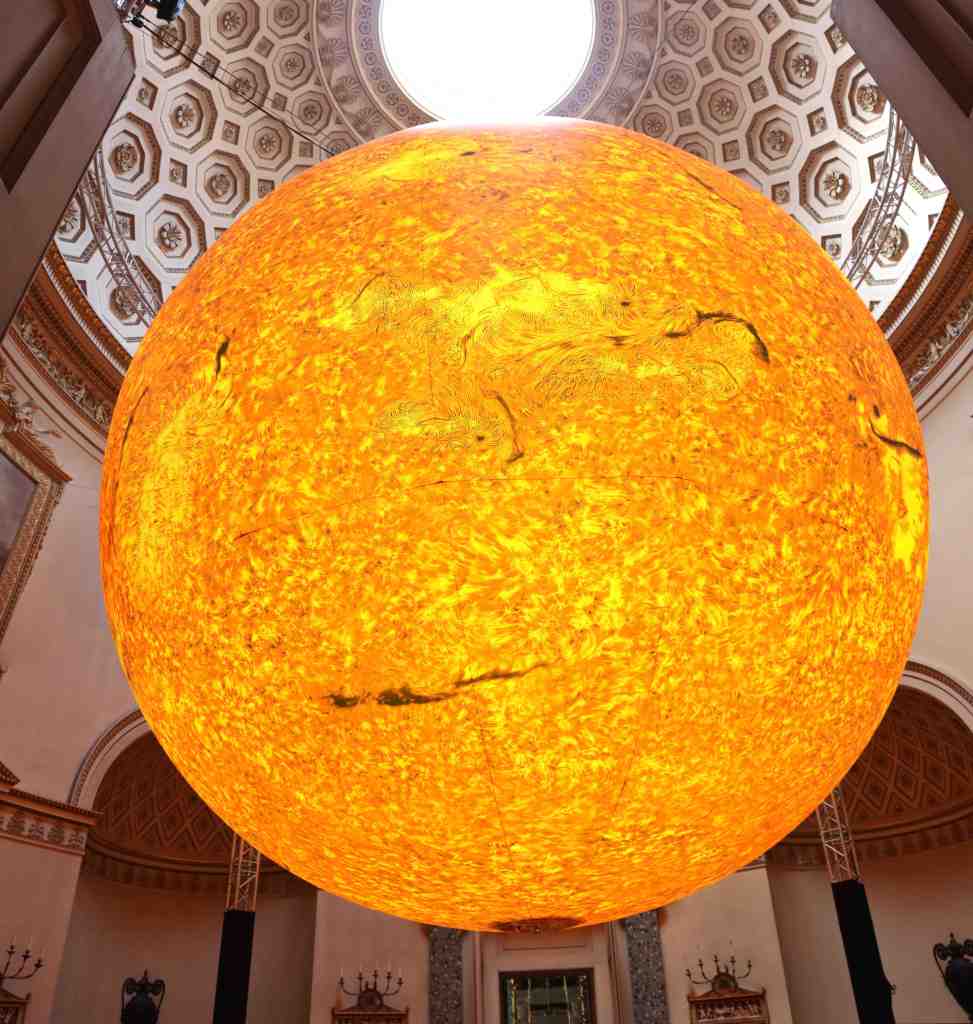
Last week we took a short trip to get up close and personal with the sun. Well not THE sun, obviously, but rather an art installation at nearby Kedleston Hall that portrays the surface of the sun in breathtaking detail, complete with sunspots and swirling solar winds. Helios is the work of artist Luke Jerram*, who based his creation on thousands of images of the sun collected by NASA and other astronomical organisations.

It’s easy to understand why Jerram was inspired to create Helios, which is named after the ancient Greek god of the sun. Did you know that our sun is 4.5 billion years old, and has about the same amount of time left until it runs out of gas? And it’s very, very hot! The surface of the sun is around 5,500°C, while its core has a mind boggling temperature of 15 million°C. Our sun has a diameter of 1.4 million kilometres (855,000 miles), but is just around average in size – some other stars are up to 100 times bigger. Wow!

Jerram’s brightly illuminated piece is 7 metres in diameter, and totally dominated the grand – 19 metres high – saloon hall in which it was suspended. The scale is mind-blowing, with one centimetre of the sculpture representing 2,000 kilometres of the real sun’s surface. Clearly, our sun is one really big dude. As if to make the point, displayed in an adjacent room and made to the same scale was a tiny model of the Earth. It really put us in our place; this planet, which to us seems impossibly huge, is a mere pimple when viewed from a cosmic perspective.

However, not everyone seemed convinced. Two other visitors, nerdy types – men, of course – were a bit agitated. They complained that although the representations of the Earth and the sun may have been made to the same scale, the distance between them had been miscalculated. According to their calculations, the model of the Earth should rightly have been positioned outside in the carpark, or maybe even half-way to the nearby city of Derby. I could barely stifle my yawns – why couldn’t they just appreciate Luke Jerram’s creativity, rather than droning on tediously about impenetrable mathematics? Life’s too short, guys!

Diwali Celebrations

Coinciding with the Helios exhibition at Kedleston Hall** was a celebration of Diwali, the Hindu festival of lights. This, I’m sure, was no coincidence. Diwali celebrates the victory of light over darkness, so programming an art installation with the sun at its very heart to run alongside a Diwali celebration was a stroke of genius.

This photo features Diwali decorations on the floor of the grand Marble Hall. Through the open door to the rear you can glimpse the lower part of Helios, suspended in the Saloon Hall.

This was the third consecutive year in which Kedleston has celebrated Diwali. Many Derby residents share a cultural heritage derived from the Indian sub-continent, and Diwali celebrations are therefore big in the city. Extending those celebrations a few miles north seems entirely appropriate, particularly in view of Kedleston’s historical links with India. Those links date back over a century to one of the stately home’s former owners – George Nathaniel Curzon, a.k.a. Lord Curzon (1859–1925) – who served as Viceroy of India between 1899 and 1905. Kedleston still displays many artefacts and artworks that Curzon brought back from his travels.

The Diwali celebrations introduced an unexpected splash of colour to Kedleston. At their heart were displays of hundreds of hand-crafted marigolds, which decorated several of the rooms. In Indian culture marigolds are used extensively in religious festivals, weddings and other ceremonies to symbolise purity, positivity and the divine, and they certainly brought a hint of the exotic to this traditionally English stately home. Other Diwali elements on display included clay oil lamps to light the way, and rangoli light projections.

Although fairly modest, Kedleston’s Diwali celebrations were good to see, and served as a potent reminder of the diverse population living within just a few miles of this grand building. I wonder what the old Viceroy would have made of them?

Remembering George Harrison

As we drove away from Kedleston Hall, having spent the afternoon in the company of the sun, and being inspired by the hope that is implicit in the Diwali festival, I found myself quietly singing a masterpiece by the late, sadly lamented George Harrison.

All four of the Beatles briefly embraced Indian culture following visits to that country in 1966 and 1968, but only George Harrison really got it. Much of George’s subsequent work was inspired directly or indirectly by Indian culture and religion, including I believe the wonderful “Here Comes the Sun” which appeared on the Beatles’ Abbey Road album in 1969. If you don’t know the song, or even if you do and would like to wallow in it one more time, listen to it here courtesy of YouTube.

* Postscript: Another work by Luke Jerram

A couple of years ago another work by Luke Jerram was exhibited at Derby Cathedral. On that occasion his chosen subject was the moon, suspended impressively above the nave. Clearly, he is fascinated by all things astronomical.

** Postscript: More on Kedleston Hall

My home county of Derbyshire is blessed with many grand stately homes. Kedleston is one of my favourites, and I have blogged about it before. You can read more about Kedleston Hall, and enjoy more of Mrs P’s photos, here and here.

A long way from home

At last, as the weather starts to improve, we take out first tentative steps back into nature. Poolsbrook Country Park, just a few miles from where we live, is a good place to start. Created on the site of a colliery that closed down in 1986, today Poolsbrook boasts a mosaic of habitats including lakes, wet grassland, wildflower hay meadows, woodland and hedgerows, all carefully managed for the benefit of wildlife. I have written previously about the Country Park’s history and key features.

We go to Poolsbrook quite often, and know what to expect. Our first visit of 2025 does not disappoint. All the usual suspects are on show, including Coot, Mallard, Great Crested Grebe and the inevitable Canada Geese. There are no rarities, but who cares – it’s just good to be out watching birds again after a long, miserable winter.

But what’s that? Cruising on the lake alongside a flotilla of Mallards is a duck we’ve never seen before. The head and neck are an iridescent blue-green colour, while the cheeks are white and the bill is bluish grey with a black tip. The breast is barred white and black, the flanks are orange-brown and the back is dark grey with white streaks.

We spend a lot of time watching birds in wetland habitats, and can readily identify most that we encounter. But this guy is a total mystery. Somehow it looks like a mixture of several other species, and we debate whether it’s some sort of weird hybrid. More research is clearly required, so as soon as we get back home we consult Professor Google.

The good professor reveals the truth. Our mystery bird is neither a natural hybrid nor the result of an unfortunate accident in a bio-lab. Instead, our investigation reveals it to be a Chiloé Wigeon. We learn that it is a very long way from home. Also known as the Southern Wigeon, the Chiloé Wigeon is native to southern parts of South America, its name coming from an archipelago lying off the coast of Chile.

Being relatively easy to care for, it appears that the Chiloé Wigeon is a popular bird in exotic wildfowl collections. The bird at Poolsbrook must be an escapee from one of these collections – it plainly has not arrived in this country naturally.

Further research reveals that the Poolsbrook bird has been in residence for well over a year. How did we miss it during all our previous visits, we wonder?

On reflection, I don’t know how I feel about seeing this unexpected bird on one of our local reserves. On the one hand, it is of course exciting to encounter a species that we will never see on its home territory, particularly as it is clearly thriving at the Country Park.

On the other hand, I can’t help thinking the bird might be better off back in South America, where it would be amongst its own kind and have the opportunity to breed. That, sadly, will not happen here and our Chiloé Wigeon will be unable to pass on its genes. Hopefully, however, it will continue to do well alongside its Mallard cousins at Poolsbrook. We’ll be sure to look out for it next time we visit.

Snowmen and snowdogs

It snowed overnight on Saturday. No surprise there, the forecasters had been banging on about the possibility for days, but there was not nearly as much “white stuff” as they predicted. Certainly not enough to build a snowman, but who cares – we had our fill of snowmen a few weeks ago, and spotted some snowdogs too, when we explored a couple of local sculpture trails organised by Wild in Art.

Eight Maids a-Milking, by Donna Newman

Both trails were inspired by the work of Raymond Briggs (1934 – 2022), a notable illustrator of children’s books. The Snowman was first published in 1978, and remains his most celebrated work. It is a story told entirely without words, relying instead upon a sequence of simple pencil crayon illustrations.

The Snowman is a magical tale of a boy who builds a snowman in his garden and is astonished when his creation comes to life at the stroke of midnight. Boy and snowman play together happily, but without making a sound to avoid waking the boy’s parents. Later, after a shared candlelit feast, the loveable snowman flies through the air above the snowclad English countryside with the entranced boy held tightly under his arm.

When their flight is over the pair return home, the boy to his bed and the snowman to the garden. Upon waking the next morning the boy rushes into the garden to re-join his new best friend, but a thaw has set in and the snowman is little more than a pile of slush. It’s a sad end, a reminder that nothing is forever and that all things must pass, but the abiding memory is of the cheerful, chubby, larger-than-life character of the snowman.

Such was the impact of Briggs’ enchanting story that in 1982 it was adapted into a 30 minutes long animated film for television. The film caught viewers’ imagination and brought The Snowman story to a whole new audience. It has been repeated regularly ever since.

Today the loveable snowman is a Christmas icon, recognised by one and all, so it was no surprise to see Briggs’ creation starring in a sculpture trail at Clumber Park, Nottinghamshire, during the final weeks of 2024. The trail featured a series of sculptures of our hero, his ample body covered with designs inspired by the ever-popular festive song “The Twelve Days of Christmas”.

As I’ve written previously about similar Wild in Art sculpture trails that we’ve followed in recent years, this one wasn’t about sophisticated art or high culture. It was nevertheless a great way to get into the Christmas spirit, to throw off the miseries that Covid had inflicted upon us just a couple of weeks earlier, and to have some much-needed fun.

* * * * *

The impact of the original snowman film was so great that canny television executives craved a sequel. It duly came to pass in 2012. Raymond Briggs gave The Snowman and the Snowdog his blessing, although he was not personally involved in the project. The story introduces a brand new character, a snowdog, who enjoys a series of magical adventures alongside the snowman and the boy.

Ru Dog, by Donna Newman

The snowdog inspired his own sculpture trail in October 2024, in the elegant Derbyshire town of Buxton. If I’m honest, this one was not quite up to the standard of the snowman trail that we visited a few weeks later, with several of the designs seeming a little lacklustre. Nevertheless tracking down the snowdog sculptures was a good excuse for a day out, free entertainment in a part of Derbyshire that we really should try to visit more often. Later in the year, maybe…

Well Dressing – a quaint Derbyshire tradition

Water, in the right quantity, is essential for the survival and well-being of our species. Too much or too little and we’re in big trouble. But rainfall is, of course, totally outside of human control, so our ancestors decided that, just to be on the safe side, it would be prudent to keep on the right side of the water gods. And thus was born the quaint Derbyshire tradition of well dressing.

Well dressing in the Derbyshire village of Taddington in 2022

Well dressing is the art of decorating wells, springs and other water sources with natural objects – particularly flower petals, leaves and seeds – to create vibrant pictures and designs. Its origins are uncertain. Some people assert that the practice was introduced by the Romans around 2,000 years ago, but others believe it to be even older. According to this theory, Celtic tribes that pre-dated the arrival of the Romans decorated sources of fresh water to give thanks for past supplies, and to encourage these supplies to carry on flowing in the future.

The tradition of well dressing is almost entirely confined to my home county of Derbyshire and surrounding areas of the Peak District. Why this is so remains uncertain. Clearly, reliable supplies of drinking water are essential everywhere, and so practices giving thanks for it can also reasonably be expected to happen in every corner of the country.

One of Belper’s well dressings in 2023.

There are suggestions that the ancient Celtic practice had indeed died out everywhere, but was revived in Tissington in the mid-14th century when the Derbyshire village was reportedly spared the ravages of the plague by the purity of its spring water. Alternatively, it is proposed that Tissington was saved from the great drought of 1615 by the reliability of its springs, and the villagers sought to give thanks by reviving the tradition of well dressing.

Either, or both, of these theories could be true, but ultimately this is of little importance. The fact is that the tradition is flourishing, with around 80 towns and villages in Derbyshire and the Peak District now having annual well dressings. Some of these don’t even have a proper well or spring, but such is the enthusiasm to participate in a traditional, community-focused activity that another local landmark is chosen to show off their floral creations.

Well-dressing begins with the construction – close to the well, spring or other chosen location – of a large wooden frame upon which the image will be created. Clay is then collected from the local environment, and strenuously worked until it’s soft and malleable. The worked clay is packed into the wooden frame, and smoothed out until it has produced a totally flat surface upon which the image can be created. To allow several teams to work on different parts of the well dressing at the same time the frame may comprise several separate panels, which are brought together only when they have been decorated.

A sketch of the proposed design of the Chadkirk well dressing, to help guide the team working on its creation.

An outline of the intended image is sketched on to a large sheet of paper. The design is applied to the smooth surface of the clay by pricking through with a sharp instrument and the paper is removed.

Now the real fun begins! Teams of makers from the local community “paint” the design onto the clay surface, using natural materials to create a stunning, colourful mosaic. The can take up to a week to complete, and the picture thus created lasts only a few days until the clay starts to dry and crack.

Writing nearly 30 years ago, a prominent local historian noted that well dressings are invariably blessed in a religious service, and suggested that around 75% of well dressings have a religious theme. However, my own observations lead me to believe that images are increasingly focused on the natural world rather than Christianity, reflecting perhaps a more modern approach to spirituality.

Some communities make arrangements for visitors to watch their well dressings being created. Mrs P and I did just that last year when we visited the little village of Chadkirk, which lies on the edge of the Peak District, within the neighbouring county of Cheshire. It was fascinating to watch the painstaking efforts of the volunteers working on various panels, where nature rather than religion was at the forefront of the design.

Sadly we never got to see the finished well dressing, which was not ready until several days after our visit, But Mrs P’s photos of the work in progress are a good indication of what the final result must have looked like. Chadkirk’s well dressing, and dozens of others scattered through towns and villages of Derbyshire and the Peak District, celebrate a tradition that is deeply embedded within our local culture. Long may it continue!

Getting back on track, courtesy of a Peak Rail steam train

Foul weather was our constant companion from the start of 2024. It wore us down, the sombre grey sky, the biting wind, the constant rain. There was no pleasure to be had in going out, so we stayed at home, and as grim weeks ganged up to become relentlessly miserable months we started to go stir-crazy. So when, at last, conditions began to improve we quickly decided we deserved a treat, courtesy of our local heritage railway.

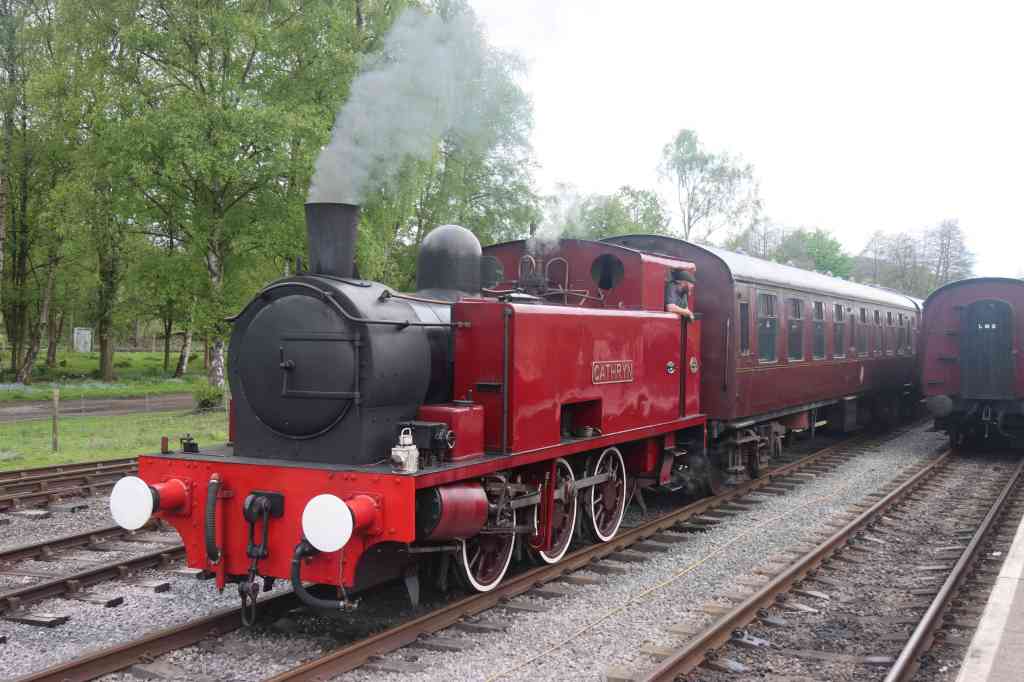
This is Peak Rail at its best…the sight, and the sounds and the smells of a gleaming, steaming locomotive! This loco was built in 1955.

We live in Derbyshire, on the edge of the Peak District. Famed for the natural beauty of its limestone hills and verdant dales, in 1951 the Peak District became the UK’s first national park. The railway that crossed it, running between Derby and Manchester, was a triumph of nineteenth century civil engineering. It was claimed by many to be Britain’s most scenic railway line.

Sadly I never got to find out in person if this claim was true. Much of the line was closed down in the 1960s, the victim of an efficiency drive shaped by the infamous “Beeching Report” of 1962. Accountants, politicians and British Rail bosses doubtless allowed themselves a glass of champagne to celebrate this “victory” for cost-effectiveness, but railway enthusiasts were dismayed. Their response was to band together to form the “Peak Railway Society” – later “Peak Rail Operations – with the aim of restoring the line for recreational and community use.

Half a century later, the dream lives on. Peak Rail has succeeded in re-opening around 4 miles (6.5 km) of track, between Rowsley South Station and Matlock, over which it operates a service featuring heritage steam and diesel locomotives. Here’s how Peak Rail describes its offer:

Whether it’s simply a nostalgic journey back to a bygone age or a discovery of the sights and sounds…of a steam or diesel locomotive[,] Peak Rail welcomes you to experience the thrill of our preserved railway whilst travelling through the delightful Derbyshire countryside…As well as our normal train journeys, there is something for everyone to enjoy, luxury dining is available on our Palatine Restaurant Car which offers Afternoon Teas and operates on various days during the year. [Source: Peak rail website, retrieved 14 May, 2024]

The reality, it must be said, proved to be more modest than the marketing hype. The part of Derbyshire through which the train travels is pleasant, but not exceptional (it’s on the edge of the national park rather than within it), and given that the line is just 4 miles long there’s not a huge amount to see. The locomotive that powered our train gleamed brightly in the welcome afternoon sunshine, but wasn’t by any stretch of the imagination remarkable in the context of other UK heritage steam trains. And the Afternoon Tea, while thoroughly enjoyable, didn’t align with my understanding of the words “luxury dining!”

But it’s important to remember that this is an organisation run by volunteers, and a service delivered almost entirely by volunteers. It’s not a commercial operation, so you have to adjust your expectations accordingly.

Peak Rail offers an opportunity to escape the rigours of the 21st century for a couple of hours, and to wallow in nostalgia. Back in the 1970s, dear old British Rail – the late, unlamented provider of the UK’s national rail network at the time – ran a series of commercials that sought to persuade motorists to abandon their cars in favour of rail travel. Its strapline was “let the train take the strain,” and that’s just what we did for a couple of hours, courtesy of Peak Rail.

Thanks to Peak Rail we were finally able to get back on track, after many months of meteorological misery. I’m pleased to report that a fine time was had by all

The LBJ, the app, and the frustrations of birdwatching

Mrs P and I have been birdwatching for nearly 40 years. It’s a great way to pass the time, one that allows us to escape temporarily from the pressures of modern living and instead get up close and personal with nature. But it’s not without its frustrations, of which the most frustrating thing of all is the LBJ. And in case any Americans reading this are wondering, that has nothing at all to do with Lyndon Baines Johnson – aka LBJ – the 36th president of the US!

For the uninitiated, in the British birding community LBJ stands for “little brown job”, which Wikipedia tells us is “an informal name used by birdwatchers for any of the large number of species of small brown passerine birds, many of which are notoriously difficult to distinguish.” The problem is compounded by the fact that your average LBJ never sits still for long, instead flitting hither and thither between bushes, briars and other forms of cover. As a rule, you only get a fleeting glimpse of an LBJ before it goes back into hiding. LBJs are a birder’s worst nightmare.

IMAGE CREDIT: “Cetti’s Warbler” by Mike Prince is licensed under CC BY 2.0. Sourced via Openverse

An alternative approach to identifying LBJs is via their songs. Unfortunately Mrs P and I haven’t been listening carefully enough over the last four decades, with the result that the number of species we can identify by their song alone can be counted on the fingers of one hand. But – much to my amazement – modern technology has come to the rescue, in the form of an app on my mobile phone.

A casual discussion with a bird enthusiast last year first brought the Merlin Bird ID app to our attention. It’s dead simple, which is fortunate as mobile phones aren’t my thing. When a bird is singing just fire up the app, which will analyse the song against its database and tell you which bird you’re (most probably) listening to. Simple but effective, as we discovered last week, when it led us to identify our first ever Cetti’s Warbler.

The Cetti’s was heard – and briefly seen – just a few metres from this spot. Unfortunately Mrs P was unable photograph it, and I’m grateful to Mike Prince for the image of the illusive LBJ at the top of this post

Mrs P and I were at Straw’s Bridge – aka Swan Lake – a local nature reserve that I first wrote about nearly three years ago. We go there mainly to enjoy the wildfowl, but were intrigued this time by glimpses of an LBJ that we couldn’t identify, moving between a series of bushes by the edge of the lake. It proved typically illusive, but just when we were about to give up and move on the bird started to sing in short, loud bursts. I whipped out my phone, and in a just a few seconds we learned its identity.

For confirmation I cross-checked with other information provided by the app. Its photo of the Cetti’s clearly matched the brief glimpses we’d had of the bird, and the textual description of its appearance and behaviour was bang on: a “dumpy and broad-tailed warbler, warm brown above and pale grayish below, with a narrow eyebrow…favours tangled vegetation near water, including reedy marshes with bushes and scrub. Often heard but rarely seen. Explosive, rich staccato song often draws attention.” Follow the link below to hear the song of the Cetti’s Warbler’s.

I found this recording of a singing Cetti’s Warbler on YouTube, courtesy of Birdfun.

The species is a new arrival in the UK, first breeding here – in the south-eastern county of Kent – in the early 1970s. Since then its range has slowly expanded northwards, but until our LBJ encounter last week we’d no idea the Cetti’s warbler had reached our home county of Derbyshire. Without the help of the bird identification app we would probably never have known.

In principle, I would rather leave the modern world behind when I’m out in nature. Mobile phones have their place, but a birdwatching trip isn’t one of them…or so I thought until Merlin Bird ID helped us identify our first Cetti’s Warbler. Having seen that 21st century technology can help us vanquish one of birdwatching’s biggest frustrations – the LBJ – I guess I might need to revise my opinion.

Mural reveals village’s hidden history

Murals are springing up all over my home county of Derbyshire. A little while ago I wrote about a magnificent painting of a kingfisher that had suddenly appeared on the side of a house in our local town. And just a couple of weeks later we came across another unexpected mural, this one featuring a railway locomotive in full steam.

To be fair, the steam train mural has been there since 2021, but it’s in a part of the county we rarely visit. Driving through the village, Westhouses appears totally unremarkable, and my initial reaction was to question why anyone would choose to cover one wall of its abandoned social club with a painting of a long extinct mode of transport. All of which proves how little I knew about the history of that corner of Derbyshire!

It turns out that Westhouses owes its very existence to railways. The village is named after West House Farm, but there was little if any other habitation in the area until the middle of the nineteenth century when the Midland Railway company drove a line through it to serve numerous local collieries and ironstone pits. The company needed to put in place a range of support facilities, and so in the 1870s it set about the creation of a new village, including workers’ houses, a school and a church, as well as a big engine shed to stable and maintain its locomotives.

Once upon a time railways were the lifeblood of Westhouses, but not now. Both the engine shed and railway station closed decades ago, and it seems improbable that any local people are now employed in the railway industry. However, residents remain proud of their connection with that industry, and when organisers of a community arts project searched for topics to engage local interest it’s no surprise that a steam locomotive was amongst those chosen.

The mural was painted by two artists from Leicester-based spray art collective Graffwerk. It took them five days of spraying to finish the job, and local train enthusiasts – many of whom had family connections with the Stanier 8F steam locomotive that is pictured – were on hand to make sure they got all the details absolutely right!

Trawling through social media posts dating from immediately after the project was completed in 2021, it’s clear that local residents were blown away to have such a wonderful piece of art in their village. Murals that are well chosen and brilliantly executed clearly have enormous power to bring whole communities closer together.

They are also a reminder to casual visitors such as me that seemingly ordinary places may have hidden histories that are well worth celebrating. Before seeing that mural I would never have given Westhouses a second glance, but having stumbled across it I was curious to know how and why it came to be there. So, thanks to the mural – and then the internet! – I did some research, and discovered the extent of my earlier ignorance. It’s clear there’s much more to Westhouses than I would ever have guessed, thanks to its proud railway heritage.

An unexpected mural

Our town is recognised by UNESCO as part of the Derwent Valley Mills World Heritage Site. The cotton mills erected along the Derwent Valley in the late 18th century witnessed the birth and establishment of the modern factory system that helped shape the world in which we live today. Belper is therefore rich in history, but in other respects is fairly ordinary, not exactly a cultural desert but boasting little of interest to the casual visitor.

So, imagine our surprise when we discovered that a large, eye-catching mural had suddenly appeared along the main road passing through the town.

Driving along Chapel Street about a month ago we were puzzled to see what appeared to be random splatterings of paint on the gable end wall of one of the houses that front the road. We assumed artistically-challenged vandals had been at work, and thought no more of it.

A few days later, we were amazed to discover the unfathomable daubings had morphed into a magnificent mural of a kingfisher. As well as the brightly-coloured bird, the mural also features magnolia blossom and a waterwheel, the latter being a reference to Belper’s industrial heritage.

The mural is the brainchild of the house owner, Steph Walsh, who thought her local area needed a boost. She told the local radio station “”When you drive into Belper and you see that expanse of grey wall, it’s screaming out for a mural…I think it will be a positive thing for Belper – it will be the first thing you see as you drive in.”

Viewed from the other direction there’s no hint of Belper’s new, exciting mural!

Steph showed great initiative by raising the money for the mural through crowdfunding. When enough had been generated she commissioned artist Sarah Yates to get her spray-paints out and do the business. Sarah has been spray-painting for 15 years, and specialises in producing spectacular murals of birds and animals. The portfolio of street art on her website shows her to be a rare talent.

So, respect and thanks to Steph for an initiative that definitely succeeds in brightening up her part of Belper, and well done to Sarah for turning Steph’s dream – which she says she’s had for 15 years – into reality. Well-executed street art clearly improves the urban environment and raises the spirits of all who see it, so let’s hope their great little project will encourage Belper to go mural-mad.

Reclaiming the landscape: Poolsbrook Country Park

The eastern part of my home county of Derbyshire has a long association with coal mining. Limited production took place during the medieval period, but it wasn’t until the Industrial Revolution that large-scale mining began. When the coal industry was nationalised in 1947, there were 68 deep mines in Derbyshire. Now there are none, but their legacy lives on in a surprising way at Poolsbrook Country Park.

Great Crested Grebe

The area now occupied by the Park once consisted of farmland set in a rural landscape. Large-scale mining, which began in 1875, changed the place beyond recognition: mine shafts were sunk, massive colliery buildings were erected, and vast, ugly spoil heaps were dumped wherever seemed convenient at the time. When the Ireland Colliery finally closed for good in 1986, the whole area had been transformed into a bleak, dystopian eyesore that offered little of value either to local people or to the natural world.

Eurasian Bullfinch (male)

Luckily the local council had the vision to realise that with time, effort and resources, the site could be reborn as a valuable community amenity and wildlife habitat. Under its ambitious plans the mining infrastructure was dismantled and the old colliery spoil heaps were landscaped to mimic a natural lake/river valley, which was then planted with trees and wildflower seed.

Close-up of Mute Swan.

Mute Swan

Today, the 165 acre (67 ha) site is home to a mosaic of habitats including lakes, wet grassland, wildflower hay meadows, woodland and hedgerows, all carefully managed for the benefit of wildlife. Good visitor facilities are also provided, encouraging local people to abandon the stresses and strains of urban life for a while and instead explore a small corner Derbyshire’s magnificent countryside.

Grey Heron.

Grey Heron

So, rather than simply return the land to its pre-mining status as an unremarkable piece of farmland, the planners and environmentalists have significantly enhanced it. In doing so they have created a big attraction for lovers of the natural world, particularly birders like Mrs P and I. The photographs that illustrate this short post show just a few of the birds we’ve spotted at Poolsbrook Country Park since the easing of the Covid lockdown.

Casual visitors unfamiliar with its history would struggle to identify Poolsbrook Country Park as the site of a colliery that was in operation for over 100 years. This, in my view, is very encouraging, an illustration of just what can be achieved if we are ambitious about restoring our natural world. It offers real hope that with effort and resources we can put right at least some of the wrongs perpetrated by previous generations in the name of “progress.”