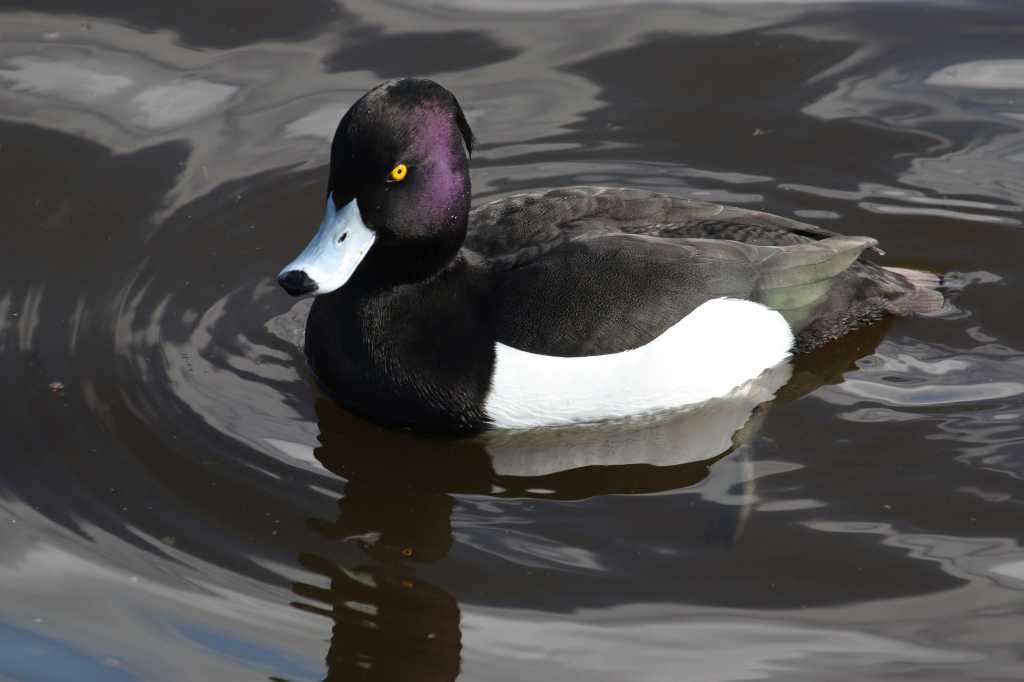
Tufted Ducks are a familiar sight at wetland habitats in our part of the UK. Although less plentiful than Mallards and Canada Geese, they are nevertheless a bird that I would expect to see whenever we visit local reservoirs, lakes and ponds. For me they are a fixture in our birding landscape. But, as I recently discovered to my surprise, that’s not quite true: Tufted Ducks, or “Tufties” as Mrs P and I prefer to call them, first arrived in this country less than 200 years ago.
Records suggest that Tufties started to colonise the UK in 1849. A few decades earlier the Zebra Mussel Dreissena polymorpha had been accidentally introduced into the country, and as this invasive species began to thrive Tufted Ducks followed in pursuit of a much-favoured source of food.
The number of resident Tufted Ducks in the UK grew steadily until at least the early 2000s, and it now breeds in most of England, as well as parts of lowland Scotland and localised areas of Wales and Ireland. The breeding population is around 18,000 pairs. In winter, numbers swell with the arrival of around 100,000 migrant birds from as far away as central Russia.
MaleFemale
Male Tufties are handsome black-and-white birds, with a characteristic tuft and bright yellow eyes – totally memorable. Although the females also sport a tuft and yellow eyes, their drab buff-brown plumage renders them somewhat forgettable. Scouring Mrs P’s vast photographic archive, I discovered that nearly every photo that she’s ever taken of this species features the male. That, I think, tells you all you need to know about the differing visual appeal of male and female Tufted Ducks!
Tufties are fun to watch, busy little ducks that paddle swiftly across open stretches of water, before diving in pursuit of aquatic invertebrates and bivalve molluscs. It seems like they belong in this landscape and must therefore have been here forever, which makes it difficult to believe that British nature lovers at the start of Queen Victoria’s reign would have been denied the pleasure of their company.
The lesson to draw from this, I guess, is to remember that what we see today is just a snapshot in time. Species come and species go; it’s a natural process, although human activity speeds it up and can cause major instability. I wonder which birds species are entirely absent from the UK today, but will be taken for granted by British birders in the 22nd century?
We’ll soon be heading north to Scotland on our annual pilgrimage. The Scottish landscape and natural scenery are fabulous, but some of the little fishing villages are quaintly picturesque too. To me, born in London and resident for nearly 50 years in landlocked Derbyshire, the seaside seems like another world, so it’s always a treat whenever we go there.
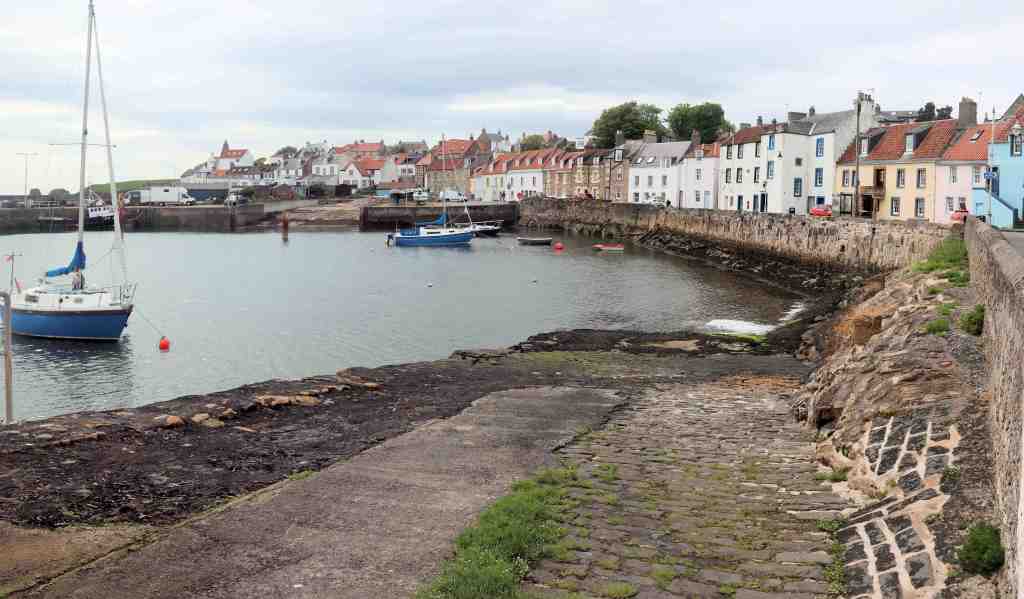
The picturesque harbour at St Monans
One of the fishing villages that caught our eye during our last trip to Scotland was St Monans in the county of Fife. The village is named for the eponymous 6th century saint who came from Ireland to Scotland to spread the teachings of Christianity. At its heart is the harbour, overlooked by traditional fishermen’s cottages, some with white walls, others colourfully painted. They date predominantly from the 18th and 19th centuries, and although most have since been significantly altered, their origins are clear if you know how to read the signs.
More harbour views…seems like another world born in London and resident for nearly 50 years in landlocked Derbyshire!
Many of the cottages are roofed with distinctive red pantiles. This style, which is found widely in villages on the east coast of Scotland, originated across the North Sea in the Low Countries (the Netherlands and Belgium). The pantiles were used as ballast on trading ships returning from mainland Europe, and were then adopted as roofing materials when the ships were unloaded at St Monans.
Pantiles can be seen on several of these cottages. Note also, on some of the roofs, the “crow-stepped” gables that are believed to have been developed to break up the airflow and protect the tiles from being blown off in a gale.
To my eyes, the most striking feature of some of these cottages is the forestairs, an outdoor staircase leading to a door on the first floor. Fewer than ten examples survive today, but in the past they would have been much more common. They hark back to the heydays of the fishing industry, when living accommodation would often have been on the first floor, above a boat store, workshop and sail store on the ground floor.
The outdoor staircases (forestairs) leading to doors on the first floor are an echo of the time when the residents of these cottages were fishermen.
Although it is the historic residential buildings that give St Monans its character, the church is also worthy of comment. It dates from 1369, and was originally founded by King David II of Scotland in gratitude for his having survived a shipwreck on the coast nearby. Originally built as a small house of Dominican friars, it was restored in the early 19th century and now serves as the local parish church. When viewed from most angles the church has the sea as its background. It is widely claimed to be the nearest to the sea of any church in Scotland.
A little further outside St Monans is the last remaining windmill in Fife, a relic of the salt industry. Large scale salt production began here in the late 18th century, and the windmill was used to pump seawater into the saltpans where it would be evaporated to reveal the finished product. The industry lasted only a few decades before closing down in 1825. The remains of the saltpans are unimpressive, little more than a few grassy mounds and depressions close to the shoreline. The windmill, however, has been restored and acts as a reminder of an industry that is unknown to most people today.
The (reconstructed) windmill, and the (barely visible) humps and bumps in the grass between it and the sea, are all that remains of a salt production industry that closed down 200 years ago.
By no stretch of the imagination could St Monans be described as spectacular. But there’s lots to admire there, including glimpses of a world and a lifestyle that is a total mystery to those of us who live our lives a very long way from the sea. Definitely worth a visit, if you’re ever in that part of Scotland.
Foul weather was our constant companion from the start of 2024. It wore us down, the sombre grey sky, the biting wind, the constant rain. There was no pleasure to be had in going out, so we stayed at home, and as grim weeks ganged up to become relentlessly miserable months we started to go stir-crazy. So when, at last, conditions began to improve we quickly decided we deserved a treat, courtesy of our local heritage railway.
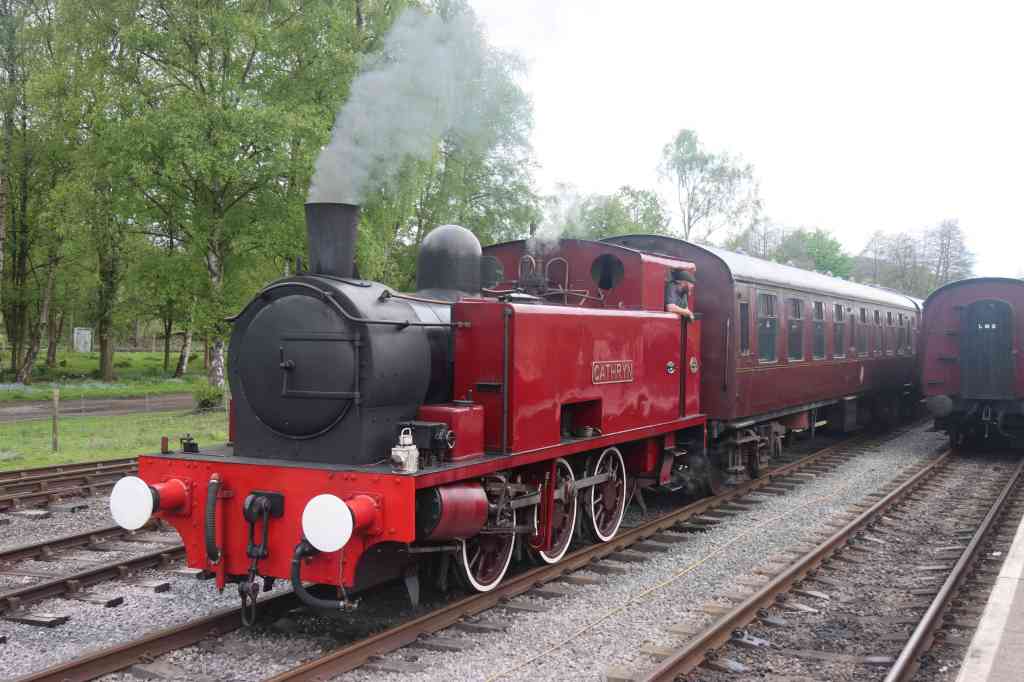
This is Peak Rail at its best…the sight, and the sounds and the smells of a gleaming, steaming locomotive! This loco was built in 1955.
We live in Derbyshire, on the edge of the Peak District. Famed for the natural beauty of its limestone hills and verdant dales, in 1951 the Peak District became the UK’s first national park. The railway that crossed it, running between Derby and Manchester, was a triumph of nineteenth century civil engineering. It was claimed by many to be Britain’s most scenic railway line.
Sadly I never got to find out in person if this claim was true. Much of the line was closed down in the 1960s, the victim of an efficiency drive shaped by the infamous “Beeching Report” of 1962. Accountants, politicians and British Rail bosses doubtless allowed themselves a glass of champagne to celebrate this “victory” for cost-effectiveness, but railway enthusiasts were dismayed. Their response was to band together to form the “Peak Railway Society” – later “Peak Rail Operations – with the aim of restoring the line for recreational and community use.
This is the little steam locomotive that pulled our restaurant car. It dates from 1946.
Half a century later, the dream lives on. Peak Rail has succeeded in re-opening around 4 miles (6.5 km) of track, between Rowsley South Station and Matlock, over which it operates a service featuring heritage steam and diesel locomotives. Here’s how Peak Rail describes its offer:
Whether it’s simply a nostalgic journey back to a bygone age or a discovery of the sights and sounds…of a steam or diesel locomotive[,] Peak Rail welcomes you to experience the thrill of our preserved railway whilst travelling through the delightful Derbyshire countryside…As well as our normal train journeys, there is something for everyone to enjoy, luxury dining is available on our Palatine Restaurant Car which offers Afternoon Teas and operates on various days during the year. [Source: Peak rail website, retrieved 14 May, 2024]
Views from the train hint at the picturesque charms of Derbyshire’s rural landscape
The reality, it must be said, proved to be more modest than the marketing hype. The part of Derbyshire through which the train travels is pleasant, but not exceptional (it’s on the edge of the national park rather than within it), and given that the line is just 4 miles long there’s not a huge amount to see. The locomotive that powered our train gleamed brightly in the welcome afternoon sunshine, but wasn’t by any stretch of the imagination remarkable in the context of other UK heritage steam trains. And the Afternoon Tea, while thoroughly enjoyable, didn’t align with my understanding of the words “luxury dining!”
But it’s important to remember that this is an organisation run by volunteers, and a service delivered almost entirely by volunteers. It’s not a commercial operation, so you have to adjust your expectations accordingly.
Not the best Afternoon Tea we’ve ever had, but the setting makes it a memorable treat
Peak Rail offers an opportunity to escape the rigours of the 21st century for a couple of hours, and to wallow in nostalgia. Back in the 1970s, dear old British Rail – the late, unlamented provider of the UK’s national rail network at the time – ran a series of commercials that sought to persuade motorists to abandon their cars in favour of rail travel. Its strapline was “let the train take the strain,” and that’s just what we did for a couple of hours, courtesy of Peak Rail.
Thanks to Peak Rail we were finally able to get back on track, after many months of meteorological misery. I’m pleased to report that a fine time was had by all
For most British people, the early decades of the Industrial Revolution were a grim time to be alive. Conditions were horrendous. Workers routinely had to labour for 12 to 14 hours per day in harshly managed and often dangerous factories, for which they received a pittance in pay that was barely enough to cover basic necessities. And when they got home from their workplaces things got no better, as these workers usually lived in cramped, cold and insanitary accommodation provided by bosses who were motivated solely by the pursuit of profit.
Mill 3 replaced an earlier mill destroyed by fire in 1819. It now houses the site’s main exhibitions, including working mill machinery.
Let’s be honest, some early captains of industry were monsters who cared nothing for the welfare of the men, women and children upon whose lives they impacted. But not all of them. New Lanark in Scotland was proof that there were workable alternatives to rampant, exploitative capitalism.
The “new buildings” were constructed by David Dale as millworker’s housing in 1798. Robert Owen enlarged them as the village size increased.
Founded in 1785, New Lanark is a village in southern Scotland clustered around several cotton mills that harnessed the power of the River Clyde. Under the direction of joint founder David Dale (1739 – 1806), this was an entirely new settlement, built as accommodation for the millworkers and their families. New Lanark thrived. Within a decade of its foundation the village was home to one of the largest and most important cotton mill complexes of its period, employing around 1,500 people.
Prior to his involvement with the New Lanark project, Dale was a prosperous Glasgow-based cloth merchant. He was also a man with a conscience, someone whose philanthropic tendencies tempered, to some degree, his capitalist instincts. This was evidenced by his treatment of the orphan apprentices who worked at his mills – Dale ensured they were taught to read and write, were well fed, and were provided with clothing and decent accommodation.
Although the accommodation it provided was decent by the standards of the day, in the early years of New Lanark whole families lived in a single room.
In 1799 Dale’s daughter Caroline married Robert Owen (1771 – 1858), a Welsh-born industrialist and social reformer. Soon after, David Dale sold New Lanark to his new son-in-law, who formally took over as mill manager in 1800. Owen was committed to continuing the philanthropic approach to industrial working that Dale had initiated, and under his management New Lanark became a model community, emphasizing social welfare and improved living conditions for workers.
Robert Owen was a Utopian social reformer, who aimed to create a perfect, harmonious society in which poverty and unemployment were eliminated. Owen’s abilities as a business manager were central to the success of his social experiment, for it was the profitability of the cotton mills that provided the cash needed to finance schemes designed to improve the lives of his workforce. A vibrant and resilient community was central to his thinking.
Robert Owen’s School for Children was completed in about 1818, providing spacious classrooms for its students. Punishment was not allowed, with strategies of encouragement and kindness being adopted instead.
Owen’s intentions can be discerned from the creation of the Institute for the Formation of Character. Opening in 1817, it was intended to provide educational and recreational facilities for the whole community. Amongst these were a library and reading room, classrooms and halls for concerts and dancing. It also accommodated what is thought to be the world’s first nursery school.
These two photos offer a glimpse the types of mill machinery in use at New Lanark.
About a year after the opening of the Institute, work was completed on Robert Owen’s School for Children. Here’s what the New Lanark Trust has to say about this visionary initiative:
Owen spared no expense in building and equipping his school, and the curriculum included music, dancing and singing, as well as art, natural history, geography and world history. Punishment was not allowed. Instead, kindness, encouragement, and the fostering of children’s natural curiosity were deemed to be much more effective. [Source: New Lanark Heritage Trail – A guide to New Lanark’s Historic Buildings, 2008]
Owen’s idealism is also apparent from the way he set up his Village Store, which was completed in 1813. It effectively had a retail monopoly in the village, and many other industrialists used such arrangements to their financial advantage by providing poor quality goods at inflated prices. In contrast, Owen put the community’s welfare first, buying good quality food and household goods in bulk, and selling these to his workers at close to cost price. Any profits made were re-invested in the village, being put towards the running costs of the School.
Another view of Mill 3.
Robert Owen was clearly one of the good guys, and his enlightened methods attracted international attention. In 1824 he sold the New Lanark mills and moved to the USA, where where he planned to establish a Utopian Community or “Village of Unity and Mutual Cooperation” based upon the principles that had helped shape his grand Scottish project. However this experiment, based at the settlement of New Harmony in Indiana, proved largely unsuccessful and in 1828 he returned to the UK, financially much poorer but still optimistic that one day the rest of the world would come round to his way of thinking.
Owen’s legacy is now preserved by The New Lanark Trust, which was formed in 1974, six years after the final closure of the cotton mills. The village was one of the earliest examples of a planned settlement, where layout, housing design, and green spaces were carefully considered. Its architecture showcased a blend of practicality and aesthetics, emphasizing functionality while maintaining a pleasant environment. All of this can be enjoyed by visitors, who also have an opportunity to get up close to some of the machinery that drove the success of New Lanark’s cotton mills. Tourists can even visit Owen’s modest house, as well as examples of workers’ accommodation.
Although larger and grander than the homes of his workers, Robert Owen’s house is refreshingly modest for the owner of such a large and successful mill complex.
The Trust’s aim has been to restore the village as a living, working community, but one which also offers visitors tantalising glimpses of a lost world shaped by a remarkable man. A measure of its success was evident in 2001, when New Lanark was listed as a UNESCO World Heritage Site. The village and its cotton mills are now a major tourist attraction, and deserve to be visited by anyone with an interest in industrial history.
Yorkshire Wildlife Park opened in 2009 on the site of a former riding school and petting zoo, and has grown steadily ever since. We aim to visit several times each year, to check up on old friends and to look out for new kids on the block. And I’m delighted to report that thanks to a couple of old friends getting it together there is indeed a new kid on the block, in the form of Carlos, a beautiful young Venezuelan Red Howler Monkey.
Carlos was born on 29 April 2023. He was exactly 5 months old when this photo was taken.
This species of howler monkey is native to the western Amazon basin, in parts of Venezuela, Colombia, Ecuador, Peru and Brazil, where they live in the tree canopy. Their diet consists largely of leaves, supplemented with a mixture of nuts, fruits, seeds, flowers and small animals. Howlers are named for the ear-splitting guttural roar that males produce to mark their territory and warn off potential intruders.
Venezuelan Red Howlers can live up to 20 years in the wild, but have become increasingly rare due to hunting and habitat destruction. Collections in zoos and conservation centres are therefore an important insurance policy helping to support the long-term future of the species. Yorkshire Wildlife Park is home to England’s only Venezuelan Red Howlers, and the good news is that the adult monkeys who live there have been doing their bit to boost numbers.
Carlos was born at the end of April 2023, the second child of mum Tila and dad Geronimo. Their first offspring was born in October 2021, and Yorkshire Wildlife Park was understandably proud that this ground-breaking birth of a Venezuelan Red Howler Monkey had taken place on their turf. Within a few days the Park was sharing Tila and Geronimo’s news with the world, telling anyone who cared to listen that their son was to be named Pablo.
Interestingly, Pablo is now called Pabla and is referred to as Carlos’s big sister. Oops! Media releases in the days following the birth of baby Carlos were quick to point out that “It’s still too early to tell the sex of the baby”, implying that keepers may have been a bit too eager to do just that when the first youngster was born. It wasn’t until nearly three months after his birth that Carlos’s gender and name were revealed on Facebook, accompanied by a piece of video footage clearly showing him to be a very well endowed young man – no mistakes this time!
The top left and middle left photos were taken on 6 July 2023, when Carlos was just 68 days old! He was almost 12 months old when he was pictured hanging upside down (top right). In the remaining two photos he is 5 months old.
The name Carlos was apparently chosen to reflect the monkey’s Hispanic heritage, while at the same time marking the fact he was born just a few days before the UK’s new king was crowned. But whether King Charles III is amused to have a red-haired, prehensile-tailed, ballsy baby monkey named after him must forever remain a mystery.
Mrs P and I first encountered Carlos in early July 2023, just a few days before his gender and name were announced to the world. Although he clearly wanted to remain close to his mum most of the time, he was already demonstrating an adventurous spirit when he set off to explore the trees growing in his enclosure. His agility was plain to see, as was his burgeoning manhood – check it out by following the link to my short video on YouTube.
When we visited Yorkshire Wildlife Park again two weeks ago Carlos had clearly grown in both size and confidence. As my video shows, he strutted arrogantly about the place like a teenager of our own species, fearlessly challenging himself to scuttle along – and dangle precariously from – ropes that are strung across the Red Howlers’ enclosure. What a great guy he’s become.
Watching Carlos’s performance, as well as the antics of his parents and sister, is a real joy. I wonder what new monkey business they’ll be up to when we next pay them a visit?
I have often written on this blog about our visits to some of the UK’s grand houses, houses that are hundreds of years old and oozing with history. You might assume that all our great domestic properties have a pedigree dating back many centuries, but you’d be mistaken. Some of them are much younger; Waddesdon Manor, at less than 150 years old, is one of the new kids on the block. Despite that – or maybe because of it – Waddesdon is one of the most opulent and ostentatious of them all. But it’s a bit over the top, in my humble opinion.
Rear view of Waddesdon Manor. The bedding plants on the parterre are changed each spring and summer.
Waddesdon Manor is located in the Buckinghamshire village of Waddesdon (no surprises there, I guess!), around 50 miles (80 km) north-west of London. It was constructed between 1874 and 1889 at the behest of Baron Ferdinand de Rothschild (1839-1898), a member of the enormously wealthy Austrian banking family.
The fountain at the centre of the parterre was originally made for an Italian palace in Colorno.
In 1874, Rothschild – known as “Ferdy” to his sister and close friends – bought the Waddesdon agricultural estate from the Duke of Marlborough, with money he’d inherited from his father. He’d come across it when fox-hunting in the area, and clearly saw its potential. The estate had no house, park or garden at that time, and therefore offered Rothschild a blank canvas upon which to impose his will.
Front elevation of Waddesdon Manor (sadly in shadow, but at least the more attractive rear view – including the parterre – was well lit!)
Said to be as much at home in Paris as in London, Ferdy was an ardent Francophile. His vision for Waddesdon was to build a magnificent mansion in the neo-Renaissance style, copying features from several of his favourite French chateaux. And he was also keen on giving Waddesdon an unforgettable garden, including a parterre (a symmetrical, formal garden design with intricate patterns), a colourful and fragrant rose garden, a serene water garden and an aviary of epic proportions.
Ferdy was very fond of birds. This cast iron aviary was erected in 1889 to house his collection.
Given his wealth, it is to be expected that Ferdy would spare no expense in fulfilling his dreams at Waddesdon Manor. More surprising, perhaps, is the fact that he never intended to live there permanently. His plan was to use Waddesdon simply as a summer weekend retreat, a place where he could entertain high-society guests and show off his vast, priceless collection of art and antiquities.
The Grey Drawing Room, to which lady guests retired after dinner!
Baron Rothschild was clearly an intelligent, well-educated man, and must have been familiar with concepts such as modesty, moderation and self-restraint. Plainly, however, he thought they shouldn’t apply to him!
Ferdy’s “Renaissance Museum” was once housed in this corner room
The great and the good – as they no doubt liked to think of themselves – were Ferdy’s guests at Waddesdon. Even Queen Victoria and the future king Edward VII spent time there, thus reassuring a man of Austrian heritage and born in France that he’d made the grade as a fully fledged English gentleman.
The Organ Clock is Dutch, and dates from c1775
After Ferdy’s death in 1898, Waddesdon passed through the hands of two other members of the Rothschild family before, in 1957, it was bequeathed to the National Trust. At last, some 83 years after the project was born, ordinary members of the public were able to visit the property, to view the stunning art collection, and to witness at first hand how the other half lives!
Left: The Red Drawing Room. Centre: The East Gallery. Right: The Baron’s Room.
Unusually, unlike most National Trust properties, at Waddesdon the donor’s family continues to manage the house and to invest in it through the Rothschild Foundation. And it was through the financial support of the family that the stunning Wedding Cake art installation by Portuguese artist extraordinaire Joana Vasconcelos – which I wrote about in an earlier post – found its way to Waddesdon.
The dining room seats 24, just enough for one of Ferdy’s famous house parties
Waddesdon is extraordinary. The “three Os” sum it up perfectly – Opulent, Ostentatious and Over-the-top. I’m pleased we finally got around to visiting it last year. On the one hand it’s a truly magnificent creation, breath-taking, almost surreal. Definitely worth the entrance fee.
Automaton elephant clock, made in London in 1770
But on the other hand, Waddesdon is just a bit too much. It’s reminds me of being back at school, of that annoying kid sitting at the front of the classroom, the kid who was always waving their hand furiously in the air to attract teacher, making it abundantly clear that he (or she) was much, much better than the rest of us. You remember that kid, don’t you? Well, Waddesdon’s a bit like that, full of itself, boastful in the extreme, bling on steroids!
Last week I wrote about a visit to Pashley Manor, the estate where Anne Boleyn – the tragic, second wife of King Henry VIII – spent time as a child. However, she grew up primarily at Hever Castle, which is some 30 miles (48km) from Pashley. While Pashley Manor is quaintly picturesque, Hever Castle is altogether grander, as befitting the social status of Anne’s family.
Hever Castle’s origins lie in the 13th century, when it was simply a country house with a number of outbuildings. Its rebirth as a castle began in 1271 when the owner was granted a license to crenelate it, in other words to erect battlements in the style of a castle. In the 14th century the transformation continued with the construction of the walls, towers, a moat and a grand gatehouse.
The Boleyn family took possession of Hever in 1462, and in the decades that followed “modernised” it in accordance with the fashions of the age. Anne lived here from about 1500. However her family were ambitious for her, and so in 1513 they sent her abroad to the court of Archduchess Margaret in the Netherlands to learn the skills required by a successful royal courtier.
Upon her return Anne soon caught the eye of Henry VIII, who was notoriously randy and had a roving eye to match. Their courtship is thought to have taken place partly at Hever, where the King may even have stayed on occasions while chasing his dream. Eventually – inevitably, I suppose, given his royal status- Henry got his girl.
The courtyard
But, as history tells us, things did not work out as either party had hoped, and in 1536 Henry had Anne executed on what one strongly suspects were trumped-up charges. She was accused of satisfying her “frail and carnal appetites” by having sexual relationships with no fewer than five courtiers, including her brother, George Boleyn and the king’s good friend Sir Henry Norris . Anne was also accused of plotting with her lovers to have Henry killed.
“The Astor Wing” dates from the early 20th century, but was built to look much older
Anne’s father, Thomas Boleyn, continued to live at Hever until his death in 1539. His brother inherited the castle, but sold it to Henry VIII the following year. The King in turn gave it to Anne of Cleves – his fourth wife! – as part of her divorce settlement.
Some grand rooms, but not at all Tudor (William Waldorf Astor was here!)
In the centuries that followed Hever passed through many hands until, in 1903, it was bought by William Waldorf Astor, reputedly the USA’s wealthiest man. By this time Hever Castle had fallen into disrepair, so Astor commissioned a major restoration project as well as the creation of new pleasure gardens. It was a huge, costly undertaking, employing 748 men to work on the castle itself, and a further 800 men to excavate a 38 acre (15ha) lake. The results were spectacular, creating the Hever that visitors see today.
IMAGE CREDIT: English school, Public domain, via Wikimedia Commons (The painting dates from 1550)
The Anne Boleyn connection is a key part of Hever Castle’s tourist offer to visitors, but would she even recognise the place? Although the moat and external views of the gatehouse and a couple of other buildings might look familiar, I suspect that on closer inspection she would feel like a stranger in a strange land. Hever is an amalgam of styles and fashions, its Tudor past sanitised and largely buried by Astor’s efforts and those of countless other owners.
Astor was here too! The Italian Garden that visitors enjoy at Hever today was commissioned by him.
Does this really matter? No, I guess not. Hever is a fascinating place in its own right, but is of limited help to history students seeking insights into the life and times of Anne Boleyn. Visitors should enjoy Hever for what it is, without falling into the trap of believing that it throws much light on the realities of life in Tudor England. It doesn’t!
____ ____ ____ ____ ____
Note for regular readers of this blog: Summer is fast approaching, although as I listen to the rain pummelling down outside it’s a bit difficult to believe right now! We already have two big trips to Scotland, planned for summer / early autumn, and no doubt we’ll think of a few other places to visit too. All this will provide me with lots more material to write about, while at the same time eating into the time I set aside for writing. So, for the next few months, my schedule will be to blog once every two weeks. I will aim to publish on alternate Wednesdays. Weekly posts should resume in November.
On its website, Pashley Manor Gardens in East Sussex claims to be “one of the finest gardens in England”. That may or may not be a bit of an exaggeration – I’m no expert on things horticultural! – but when we visited last autumn it seemed like a pleasant place to while away an afternoon. The flowers were colourful and the manor house was a picture of Tudor charm, but for my taste what raised Pashley to another level was the mix of modern sculptures scattered throughout the gardens. The most compelling of these depicts the tragic figure of Anne Boleyn.
“To the Show” by Helen Sinclair. The flower towering above her is Brugmansia or Angel’s Trumpets, a member of the nightshade family.
The current manor, which is not open to visitors, dates from 1550 and retains its classic Tudor half-timbered frontage. But this is not the estate’s original house, as prior to its construction there was a hunting lodge on another part of the grounds.
Pashley Manor House dates from 1550
The hunting lodge was owned by the Boleyn family, and it is believed that Anne Boleyn – King Henry VIII’s second wife, who was executed in 1536 – spent part of her childhood here. Appropriately, there is a sculpture of Anne near the spot where the hunting lodge once stood. This haunting work by local sculptor Philip Jackson is a moving tribute to a woman who married for love, and later died on the orders of her paranoid, brutal husband. The gardens that we see today bear little if any resemblance to what Anne would have witnessed 500 years ago, but clearly her ghost still walks the land.
Anne Boleyn by Philip Jackson
Following Anne’s execution, the fortunes of the entire Boleyn family went into freefall, and in 1540 the estate was sold to Sir Thomas May, who set about building the house that still stands today. In the centuries that followed the Pashley estate passed through the hands of several more families, who further developed it in accordance with the fashions of their age.
The manor house was unoccupied during the period 1922-45, and fell into disrepair. When the current owners, Mr and Mrs James Sellick, bought the property in 1981 the gardens had been long neglected, but the Sellicks were determined to restore them to their former glory. They opened Pashley Manor Gardens to the public for the first time in 1992. Just five years later the gardens won the Historic Houses Association / Christie’s Garden of the Year award, and in the decades since then work has continued to develop them further.
“The Sky Turned Upside Down” by Helen Sinclair “St Francis” by Mary Cox“Pan” by Mary Cox“Amelia” by Yvonne WildiSadly, the title and attribution of this one are unknown
The Sellicks clearly spotted the growing popularity of sculpture parks and gardens, and calculated that a scattering of sculptures would enhance the Pashley offer. No doubt these sculptures, which range “from abstract to engagingly figurative” also generate a bit of extra income, as most of the pieces on display are for sale. The works on show are not as imposing or spectacular as those at, say, the Leonardslee Gardens and Sculpture Park, but the best of them are good fun.
Left: “Dancing Dog” by Mary Cox; Centre: “Dancer” by Mary Cox”; Right: “il Marchese” by Philip Jackson.
Pashley Manor Gardens were definitely worth a visit. When we’re next in that part of the country I’d be pleased to call in again – perhaps earlier in the season, when a different range of flowers will be in bloom – to see how the Sellicks’ project is developing, and to spot some new sculptures. Hopefully the ghost of Anne Boleyn will still be in attendance.
Mrs P and I have been birdwatching for nearly 40 years. It’s a great way to pass the time, one that allows us to escape temporarily from the pressures of modern living and instead get up close and personal with nature. But it’s not without its frustrations, of which the most frustrating thing of all is the LBJ. And in case any Americans reading this are wondering, that has nothing at all to do with Lyndon Baines Johnson – aka LBJ – the 36th president of the US!
For the uninitiated, in the British birding community LBJ stands for “little brown job”, which Wikipedia tells us is “an informal name used by birdwatchers for any of the large number of species of small brown passerine birds, many of which are notoriously difficult to distinguish.” The problem is compounded by the fact that your average LBJ never sits still for long, instead flitting hither and thither between bushes, briars and other forms of cover. As a rule, you only get a fleeting glimpse of an LBJ before it goes back into hiding. LBJs are a birder’s worst nightmare.
An alternative approach to identifying LBJs is via their songs. Unfortunately Mrs P and I haven’t been listening carefully enough over the last four decades, with the result that the number of species we can identify by their song alone can be counted on the fingers of one hand. But – much to my amazement – modern technology has come to the rescue, in the form of an app on my mobile phone.
A casual discussion with a bird enthusiast last year first brought the Merlin Bird ID app to our attention. It’s dead simple, which is fortunate as mobile phones aren’t my thing. When a bird is singing just fire up the app, which will analyse the song against its database and tell you which bird you’re (most probably) listening to. Simple but effective, as we discovered last week, when it led us to identify our first ever Cetti’s Warbler.
The Cetti’s was heard – and briefly seen – just a few metres from this spot. Unfortunately Mrs P was unable photograph it, and I’m grateful to Mike Prince for the image of the illusive LBJ at the top of this post
Mrs P and I were at Straw’s Bridge – aka Swan Lake – a local nature reserve that I first wrote about nearly three years ago. We go there mainly to enjoy the wildfowl, but were intrigued this time by glimpses of an LBJ that we couldn’t identify, moving between a series of bushes by the edge of the lake. It proved typically illusive, but just when we were about to give up and move on the bird started to sing in short, loud bursts. I whipped out my phone, and in a just a few seconds we learned its identity.
For confirmation I cross-checked with other information provided by the app. Its photo of the Cetti’s clearly matched the brief glimpses we’d had of the bird, and the textual description of its appearance and behaviour was bang on: a “dumpy and broad-tailed warbler, warm brown above and pale grayish below, with a narrow eyebrow…favours tangled vegetation near water, including reedy marshes with bushes and scrub. Often heard but rarely seen. Explosive, rich staccato song often draws attention.” Follow the link below to hear the song of the Cetti’s Warbler’s.
I found this recording of a singing Cetti’s Warbler on YouTube, courtesy of Birdfun.
The species is a new arrival in the UK, first breeding here – in the south-eastern county of Kent – in the early 1970s. Since then its range has slowly expanded northwards, but until our LBJ encounter last week we’d no idea the Cetti’s warbler had reached our home county of Derbyshire. Without the help of the bird identification app we would probably never have known.
In principle, I would rather leave the modern world behind when I’m out in nature. Mobile phones have their place, but a birdwatching trip isn’t one of them…or so I thought until Merlin Bird ID helped us identify our first Cetti’s Warbler. Having seen that 21st century technology can help us vanquish one of birdwatching’s biggest frustrations – the LBJ – I guess I might need to revise my opinion.
Later this month, if things go according to plan, we’ll be off to Norfolk to spend a few days in one of our favourite parts of the country. Norfolk is a peaceful, rural county, a great place to get out into nature and enjoy some serious birdwatching. But it also boasts a distinctive – some would say quirky – style of church architecture.
St Margaret’s church, Burnham Norton, is one of the oldest of Norfolk’s round tower churches. It dates from the late Saxon period, around 1,000 years ago.
Although church attendance has plummeted in recent times the buildings themselves are mostly still there. Church towers, often topped off with a cone-shaped spire, remain a familiar part of the English landscape, particularly in rural areas.
St Mary’s church, Roughton. Again, the tower dates from the late Saxon period, around 1,000 years ago.
Historically speaking, church towers have been the tallest and most impressive structures in most long-established settlements. They typically housed bells that could be rung to mark important events, and to call the faithful to worship. The dominating presence and high cost of such towers was a source of local prestige, and emphasised the importance of the church within the community.
St Andrew’s church, West Dereham. The stone-built section of the round tower, which has the widest diameter of any in Norfolk, dates from C12. It is topped off by a brick-built bell section, which was added in C16.
In most parts of the country church towers are square. There are reckoned to be only around 180 English churches with round towers, nearly all of them in Norfolk (70%) and the neighbouring county of Suffolk (23%). Why round churches were built here in large numbers remains a matter of fierce debate.
St Andrew’s church, Ryburgh. The bulk of the tower is C12, with some evidence of earlier work. The octagonal bell section was added in C14.
Norfolk and Suffolk are on England’s east coast, and some experts argue that, because round towers are better able to resist attack than square structures, they were built to bolster local defences against Viking invaders. It’s a romantic notion, but implausible given that most round tower churches date from after the Viking invasions.
St Andrew’s church, Letheringsett. The lower part of the tower dates from C11, and the bell section was added in C14. When bell sections were added to round towers these were usually octagonal, but in this case it is round, matching the rest of the tower.
Another theory suggests that the round towers were an inevitable consequence of local geology, which meant that the stone available to church builders was not well suited for building load-bearing walls that joined at right angles. Again this seems fine until we recognise that other buildings in the same area dating from the same time were indeed constructed with walls that met at right angles.
St Mary, Beachamwell was one of Norfolk’s earliest round tower churches, dating from early C11. We visited in 2017, when we admired the tower and the fine thatched roof. Sadly, 5 years later, it was destroyed by fire.
Other experts suggest that it was simply a matter of fashion, and that visitors from mainland Europe who crossed the North Sea to Norfolk and Suffolk brought the design with them. Once more, the evidence for such an assertion is thin on the ground.
St Andrew’s church, East Lexham. This unsophisticated round tower is perhaps the oldest in Norfolk. It dates from the Saxon period, possibly around 850AD.
I guess we’ll never know for certain why Norfolk has so many round tower churches, although that won’t stop “experts” and other random nerds banging on about it ad nauseam. And does it it really matter anyway?
St Margaret’s church, Hales, a thatched building under the care of the Churches Conservation Trust. A detailed guide to Norfolk round tower churches by Lynn Stilgoe and Dorothy Shreeve says it “is probably the nearest one can get to the original appearance of an early round tower church.”
The fact is that the round towers are there, and are a picturesque addition to the local landscape. I guess most Norfolk residents take them for granted, but to visitors like Mrs P and I they are important, helping to give this part of the country its unique “feel.” When we drive past a round towered church, we know we’re on holiday!
St Andrew’s church, Wickmere St Lawrence’s church, Beeston
Mrs P is so taken by Norfolk’s round tower churches that she has vowed to photograph every one of them. She still has lots more to track down, many of them in tiny, almost forgotten villages lost in the middle of nowhere in this remote rural county. It’ll take a couple more visits before we can finally declare the project to be completed; meanwhile, this post is illustrated by photos of a few of the more interesting examples that we’ve visited so far.