Where have all the sparrows gone?

Last Saturday, 20th March, was World Sparrow Day. Needless to say, no sparrows turned up in our garden to celebrate the occasion. When we moved in 35 years ago house sparrows were common here, squabbling noisily and boisterously on the bird table. Now, if we get half a dozen sightings over a 12 months period we class it as a good year for sparrows. Here, and throughout the UK, house sparrow numbers have been in serious decline for decades.

House sparrow

Growing up in West London half a century ago sparrows were the most familiar birds in our garden. Our name for them was spugs, or alternatively spadgers. They were very common, part of the wallpaper of our suburban lives, and we took them for granted. No one would have believed then that one day they would be “in trouble.”

The State of the UK’s Birds 2020 report published by the RSPB suggests that there were 5.3 million breeding pairs in the UK in 2018, making the house sparrow our third most common breeding bird behind the wren (11m) and the robin (7.3m), and marginally ahead of the woodpigeon (5.2m). It adds that “In the late 1960s there were 10 times more house sparrows than woodpigeons. We have lost around 10.7 million pairs of house sparrows in that time, a loss greater than for any other species, and gained 3.5 million pairs of woodpigeons.” No surprise, therefore, that the house sparrow is on the UK’s Red List for birds of conservation concern.

The latest figures offer a glimmer of hope: numbers are now thought to be stable or increasing in Scotland, Wales and Northern Ireland. However this is little consolation to those of us in England, where numbers continue to fall.

House sparrow

The cause of the rapid decline, particularly in urban and suburban environments, is unclear, although a lack of invertebrate prey for chicks – perhaps resulting from pollution or increased used of pesticides by gardeners – is believed to be a factor. Other proposed but as yet unproven reasons include reduced opportunities for nesting in the modern urban environment, and predation by domestic cats. Declines in rural house sparrow populations are thought to be linked to seasonal food shortages resulting from changes in agricultural practices, particularly the move to sowing cereal crops in the autumn.

* * *

Although the decline of house sparrows in the UK has been dramatic, the declaration of the first World Sparrow Day wasn’t a British initiative. Instead it was the brainchild of Nature Forever (NFS), an Indian non-governmental, non-profit organization which aims to “involve citizens from all walks of life, diverse backgrounds and different parts of the country and the world” in conservation projects. Nature Forever’s championing of the house sparrow is a good indication of the bird’s global reach.

Ted Anderson, Emeritus Professor of Biology at McKendree College in Illinois has argued that the house sparrow is the most widely distributed wild bird on Earth. It is believed to have originated in the Middle East, but having developed a close association with humans, it extended its range across Eurasia in tandem with the spread of agriculture. More recently Europeans have deliberately introduced the house sparrow to other parts of the globe, either as a pest control initiative or to remind them of home, and accidentally taken them to other locations as stowaways on their ships.

In happier times. House sparrow at Platypus Towers

It’s perhaps no surprise therefore that, in recent years, Mrs P and I have seen many more house sparrows on our visits to North America, Australia and New Zealand than we ever manage to spot in our own backyard. If numbers here continue to fall the time may well come when we have to go cap in hand to our former colonies and beg to have some of our sparrows back. Oh, the humiliation!

* * *

In folklore and literature sparrows have an enduring reputation for sexual promiscuity. Geoffrey Chaucer reflects this in the Canterbury Tales when he writes “As hot, he was, and lecherous as a sparrow . . .”  Two hundred years later, in 1604, William Shakespeare wrote in Measure for Measure that Sparrows must not build in his house eaves, because they are lecherous . . .”

Tree sparrow. Note the diagnostic brown crown and black cheek spot

Amazingly, modern science shows that these seemingly outrageous accusations are not entirely inaccurate. DNA analysis has shown that 15% of the chicks produced by a settled pair of house sparrows are in fact the offspring of a third party, proving once again that truth is stranger than fiction.

* * *

The house sparrow is not the only species of sparrow found on these shores. Although the so-called hedge sparrow, also known as a dunnock, isn’t really a sparrow at all (it belongs to the family birds called accentors), the tree sparrow really is a sparrow.

While house sparrows are regularly seen in both urban and rural settings, the tree sparrow is very much a bird of the countryside, particularly hedgerows and woodland edges. Their distribution tends to be localised, and they are much less plentiful than house sparrows: the latest population estimate is 245,000 breeding pairs. We have not and would not expect to see tree sparrows in our suburban garden, but there is a nature reserve within a few miles of Platypus Towers where we can often spot them.

Tree sparrow

It’s always a pleasure to see tree sparrows since they, like house sparrows, have suffered a calamitous decline in numbers (around 90%) since 1970, although in the last few years that fall has slowed and may have started to reverse. Again, changes in agricultural practice are the likely cause, and with no prospect of these being reversed the tree sparrow remains on the UK’s Red List for birds of conservation concern.

* * *

And finally, to conclude my little celebration of World Sparrow Day, I commend to you Dolly Parton singing “Little Sparrow.” The songs begins with these words

Little sparrow, little sparrow
Precious, fragile little thing
Little sparrow, little sparrow
Flies so high and feels no pain

Of course, the song isn’t really about sparrows at all. For Dolly, the sparrow is a simply a metaphor for gentle innocence, and anyway the North American sparrows about which she sings (Emberizidae) aren’t in the same family as Old Word sparrows (Passeridae). But whatever, that second line has always haunted me. In four words it captures perfectly the magic of birds both great and small, and encapsulates my feelings for them. Birds are precious and fragile, and even relatively common birds like the sparrow need our help if they are to continue to fly high and feel no pain.

The Old Man of Calke – still hanging on after 1,200 years

At my age birthdays are a mixed blessing. On the one hand they’re a cause for celebration (Yes, I’ve made it through another 12 months!). But they’re also a time for reflection on how your body has fared over the last year, which bits of it have started hurting, begun to misfire or even stopped working altogether. Spare a thought, then, for the Old Man of Calke, who’s still hanging on after 1,200 years.

The Old Man of Calke

The Old Man is one of many magnificent trees to be found in parkland at the Calke Abbey estate in the south of Derbyshire. Calke Park extends to around 600 acres (240 hectares), and is managed for the nation by the National Trust. Around one third is designated as a National Nature Reserve and Site of Special Scientific Interest.

After the Covid restrictions earlier in the year, our visit to Calke Park in October 2020 provided a welcome opportunity to get close to nature again, strolling past picturesque ponds and along shaded woodland paths. There’s lots to see during a walk around the park, but without doubt the ancient and veteran trees are the stars of the show.

Ancient and veteran trees are common at Calke Park

Calke is home to over 650 veteran trees, of which 350 are regarded as ancient trees. What’s the difference? I hear you asking. The Woodland Trust explains that “an ancient tree is one that has passed beyond maturity and is old, or aged, in comparison with other trees of the same species…A veteran tree is a survivor that has developed some of the features found on an ancient tree, not necessarily as a consequence of time, but of its life or environment. Ancient veterans are ancient trees, not all veterans are old enough to be ancient.” Clear as mud? Baffled? Absolutely!

The technical definitions may be more confusing than enlightening, but at an estimated age of around 1,200 years the Old Man of Calke must surely qualify as an ancient veteran. To put it into context, the Old Man was a sapling when the Vikings were rampaging across the country, and already had some 250 years under his belt when King Harold took one in the eye during the Norman invasion of England in 1066.

Mere Pond at Calke Park

The Old Man is an English Oak, and although not very tall, it boasts a girth of over 10 metres. The trunk is gnarled, split and holed in places, giving the tree a somewhat battered and time-worn appearance. Despite this it is a massively imposing presence in the Calke parkland and seems to wear its great age lightly.

Thanks to the National Trust’s careful management, the Old Man of Calke will hopefully survive long enough to give several more generations of visitors to the Park the thrill of getting up close and personal with a tree that was in its prime when William the Conqueror first set foot on these shores.

The Old Man of Calke

Pillow talk (Cat in mi kitchen)

Regular readers of this blog will be aware that ownership of our garden is claimed by two visiting cats. Although Malteser and Milky Bar are pals – we think they live together in a house further up our estate – they are very different characters. Throughout the pandemic Milky Bar has been content to abide by the government’s tough Covid restrictions. He obeys the rules on social distancing, keeping at least two metres away from us at all times and never coming indoors for a bit of illicit socialising. Milky Bar is a model citizen, and deserves a knighthood.

Malteser claims ownership of our garden. Here he sits on top of the rabbit hutch

The same cannot be said for Malteser. If the local constabulary knew what Malteser’s been up to in recent months they’d have fined him £200. Multiple times in fact, probably every day. Such is his disrespect for the law he would most likely have ended up in chokey. Malteser is an unmitigated rogue.

OK, I admit it, Mrs P and I have encouraged Malteser’s wayward ways. When travel opportunities were drastically curtailed by the pandemic and we found ourselves pretty much confined to our house and garden for months on end, we decided it was a good time to develop the relationship with our ‘borrowed’ cats.

In the utility room, transfixed by the washing machine

Recognising that the best way (the only way?) to a cat’s heart is through his stomach we invested heavily in packets of Vitacat Filled Pockets, which the packaging explains are crunchy pillows with a soft centre. They’re available in beef, chicken and salmon flavours, and guaranteed to tickle the fancy of the fussiest felines.

To start with we stood in the doorway leading out to the garden and tossed pillows onto the patio in front of our feline friends. After a cautious investigation both cats wolfed them down greedily. Milky Bar pronounced himself happy with this arrangement, but Malteser soon calculated that there might be more to be gained by getting up close and personal First, he approached us on the doorstep to have his ears rubbed and back scratched. Within a few days he was brave enough to follow us indoors, stopping off first in the utility room to stare, transfixed, at the washing machine. Pretty soon he found his way into the kitchen, taking pillows from our fingers while purring loudly.

Cat in mi kitchen, taking a pillow (salmon flavoured!) from my own fair hand

It’s a ritual now. The centrepiece of any visit from Malteser is feeding him by hand. Mostly we sit on a kitchen chair and hold a pillow in front of him. He stands on his back legs, putting two paws on our knees to give himself extra balance while he reaches up for the tasty treat. A couple of quick crunches later the pillow has been swallowed and a few crumbs have been dropped unceremoniously onto the tiled floor. And then he looks imploringly into our eyes, eagerly awaiting a repeat performance. All the time he’s purring as loud as a chainsaw, making sure we know that his continued affection depends on a steady supply of pillows.

Having plucked up sufficient courage to cross the threshold Malteser soon decided he might as well explore the rest of the house. He particularly likes the stairs that lead up to the bedrooms, study and library. His idea of heaven is to roll on his back on the stairs, showing his belly while inviting us to fondle his ears. Honour having been duly satisfied, he climbs another three or four stairs before rolling on his back again and demanding we pay him further homage.

At the top of the stairs, purring loudly, waiting for his ears to be fondled

Upstairs there’s a whole new world for him to explore. In Mrs P’s study he likes a game of attack the piece of scrap paper, balls of which he obviously perceives as mice that need to be swiftly despatched to rodent heaven. He’s also fascinated by the door, which he tries to hook open with his paw. Then he’s off to have a sniff around the bathroom, and would happily drink from the toilet if we’d let him.

Malteser also enjoys visiting the library, particularly now we’ve set up a bed for him on the old sofa. If he’s in the mood he’ll snooze there for an hour or so, while Mrs P and I get on with the rest of our lives. It’s good to know that he feels so comfortable in our house, trusting us totally.

Resting on the library sofa

But he remains his own cat, beholden to no one, and when the time is right he makes it clear that he wants to leave us. And leave us he does, trotting off into the garden and over the fence with scarcely a backwards glance. We’re under no illusions: Malteser is an advocate of free love, and although we are doggedly faithful to him we’re certain he has relationships with other households up and down our street. But we can forgive his dubious moral character, recognising that his frequent visits have made the Covid lockdowns more bearable.

And anyway, we know Malteser will be back before too long. A cat and his tasty pillows can’t be separated for long, particularly if a couple of mugs are available to feed him those pillows by hand.

Back in the garden, belly full of pillows!

***

Pillow Talk : An ode to Malteser during lockdown 
(with apologies to UB40, a wonderful 70s/80s reggae band from Birmingham, England)

Cat in mi kitchen what am I gonna do?
I'm gonna feed that cat that's what I'm gonna do
I'm gonna feed that cat

The snowdrop – a flower not to be trifled with

Flowering at a time when pretty much nothing else is in bloom, snowdrops inevitably capture the imagination of all who encounter them in the British countryside. The ‘Fair Maids of February’ reassure us that the bleak midwinter is passing, and more congenial times lie ahead. Poets heap praise upon these humble harbingers of spring’s awakening, while storytellers speculate about their origins. Who doesn’t love a snowdrop?

Dimminsdale Nature Reserve, 2019

Interestingly, although snowdrops are widely distributed and recognised throughout the UK, they aren’t native to these islands. They originated in the damp woodlands and meadows of continental Europe, and were brought here – probably in the sixteenth century – to grace the estates of the idle rich. However these private collections inevitably ‘leaked’ into the surrounding countryside, and by the late 18th century the flower was reported as growing wild. Now completely naturalised, snowdrops can be found in shady woodland, on country estates and along river banks all over the country.

Hodsock Priory, 2016

Snowdrops are also a common sight in graveyards, and this could be the reason why they’re sometimes associated with ill-fortune and even death. In Victorian times it was widely believed that you should avoid bringing snowdrops into your house. If you disobeyed this rule the consequences could range from your milk turning sour to a member of your family dropping dead within a year. Plainly the snowdrop isn’t a flower to be trifled with!

Although these days we happily dismiss such dire warnings as fanciful nonsense, it’s worth noting that snowdrops are poisonous due to high concentrations of phenanthridine alkaloids, particularly in the bulbs. Now, I haven’t a clue what a phenanthridine alkaloid is, but (just like the average beer-swilling Saturday night out during my student days) it’s known to cause confusion, poor coordination, drooling, abdominal pain, vomiting, diarrhoea and seizures. I humbly conclude that excessive student partying and eating snowdrops are both best avoided!

Hopton Hall, 2017

Paradoxically although some people make a connection between snowdrops and death, others view them as symbols of hope. The reason, I suppose, is that they show themselves just as winter’s drawing to a close, and their appearance is a sure sign that the days are getting both longer and warmer, and that spring will soon arrive.

It’s for just this reason that, around about now every year, Mrs P and I traditionally mark the changing of the seasons by taking a trip to one of our local snowdrop hotspots. These include the gardens of Hopton Hall, an 18th-century country house in Derbyshire, the Dimminsdale Nature Reserve on Derbyshire’s border with Leicestershire, and two estate gardens in Nottinghamshire, at Hodsock Priory and Felley Priory. Each boasts a fine display of snowdrops, and looks splendid on a crisp and sunny February day

Dimminsdale Nature Reserve, 2019

Sadly, to visit one of these snowdrop havens in 2021 would contravene the government’s strict Covid lockdown rules and invite a fine of £200 (each!) from the local constabulary. Instead, we’ve had to get our annual snowdrop fix from Mrs P’s excellent photos and a small clump that survives against all odds in our unkempt front garden. Ah well, there’s always next year I suppose, once Covid’s back in its box.

Felley Priory, 2017

No pain, no gain: Reflections on getting the Covid vaccination

The vaccination centre is in a church hall, in a village three or four miles from Platypus Towers. I didn’t know the building even existed until the start of last week when I got the letter inviting me to log on to the internet to book my jab, but I’m pleased to make its acquaintance. Community venues are essential if vaccinations are to be rolled out in line with the government’s ambitious target, and although the place is modest and a little down-at-heel it’s more than adequate.

The operation is well organised by the NHS, with plenty of staff on hand to do what needs to be done, checking my temperature and personal details, giving guidance and reassurance, ushering me here and there as necessary, and finally administering the injection with cheerful good humour. Within 15 minutes I’m back outside in the fresh air, clutching an information leaflet advising on possible side effects of the vaccination.

PHOTO CREDIT: CDC via Unsplash

So far, so good. For the next few hours I get no reaction at all and almost forget that I’ve just had the jab. But by mid-evening I begin to feel feverish. Within an hour it seems like I have a bad dose of flu. My limbs ache and I’m shivering violently, and I’m so cold that I resort to putting on an outdoor fleece over my indoor clothes, with a hot water bottle tucked inside. I even wear my woolly hat while watching television, which Mrs P finds hilarious.

Finally I’ve had enough and stumble upstairs, collapsing into bed clutching the hot water bottle and still wearing my fleece and woolly hat. I’ve had worse nights, but not often. However by the next morning I’m feeling much better, and definitely a lot warmer. I can only assume that my reaction to the vaccine is proof positive that it’s doing what it’s meant to do, priming my immune system to fight off any Covid viruses that I might encounter in the future

* * *

Don’t get me wrong, I’m not complaining about the side effects of the jab. It’s a small price to pay for the Covid protection that it will give me in the future. As the saying goes, no pain no gain.

And for god’s sake, we need to understand that things could be so much worse. It’s only around a year since Covid started making its presence felt in the UK, and yet already effective vaccines have been developed and more than 18 million Brits have received their first dose. That is truly extraordinary, and in the midst of all the doom and gloom that surrounds the pandemic we should recognise that if this virus had emerged, say, half a century ago, our ability to deal with it would have been so much less.

While I don’t for one moment wish to minimise the suffering and hardship the virus has caused – I too have lost a family member to this disease, and friends have also lost loved ones – I’m relieved that it’s hit now and not when I was a kid. Today scientists are better able to find ways of containing, if not eliminating, coronavirus, and doctors have more treatment options to help those who have already been infected by it. Meanwhile, internet and communications technology allows many of us to avoid contact with Covid altogether by working remotely, ordering stuff online to be safely delivered to our front doors, and staying in touch virtually with friends and family.

I also recognise that I’m privileged, a comfortably well-off citizen of a wealthy, sophisticated nation. The other morning the BBC radio news made the point that around 135 nations have yet to administer a single dose of coronavirus vaccine. Realistically, governments are going to look after their own citizens first – that’s what governments do – but having done that they have the chance to do a good thing, to do the right thing by ensuring that everyone, everywhere, has access to the vaccine, regardless of nationality, ethnicity, religion, wealth or personal circumstances.

Even better, rich governments like ours could undertake such action as an absolute good, on the basis of an overriding moral imperative and without regard to any potential strategic advantage or economic benefit. I’m probably being a bit naïve here, but a man can dream!

Working together we can put Covid back in its box and maybe, in the process, start to build a better world. Now wouldn’t that be something, one truly positive outcome to emerge from the recent annus horribilis that has taken so many lives, and ruined so many more.

* * *

Postscript: Mrs P had to wait another four weeks for her first jab. Other than a bit of a sore arm she suffered absolutely no side effects at all. Huh!

Celebrating World Whale Day: whale watching around Newfoundland

Next Sunday, 21 February, is World Whale Day. The origin of World Whale Day can be traced back to 1980, when it was declared in Maui, Hawaii as part of the annual Maui Whale Festival. During our visit to Hawaii in 2014 whales were in short supply (it was the wrong time of year), but over the years we’ve been lucky enough to see them in the waters off Iceland, Madagascar, New Zealand and Alaska.

However our best encounters were around Newfoundland, Canada, in 2017, and to celebrate World Whale Day I thought I’d revisit some of the blog posts I wrote at the time. We spent around four weeks on The Island, as the locals call it, and without doubt the whales were the highlight of the trip. I wrote a blog of our Newfoundland journey at the time, but the following focuses on our magical, memorable meetings with some of the many humpbacks that spend the summer months around its shores.

Having a whale of a time

4 July 2017

The tell-tale spout of a whale announcing his presence

Today’s been a woolly hat day, courtesy of a bitter wind howling in from the high Arctic. It’s appropriate therefore that we should have seen our first iceberg this afternoon as we drove the coast road towards the bizarrely named township of Heart’s Content, which, as I’m sure you know, is just down the road from its sister settlements of Heart’s Desire and Heart’s Delight!

The cold has been made more bearable by the warm afterglow of yesterday evening’s brilliant whale-watching trip. Whale-watching is always a bit of a lottery, and sometimes you lose.  But yesterday we hit the jackpot.

Pretty soon we are amongst them, surrounded by a pod of five or six humpbacks

St John’s sits in a sheltered harbour, connected to the sea by a narrow inlet unimaginatively referred to as “the narrows.” Passing through the narrows we were thrilled to spot the towering, tell-tale spouts of whales announcing their presence to the world.  Hey guys, they seemed to say, we’re over here, why don’t you pop along and say hello.  We took them at their word and pretty soon we were amongst them, surrounded by a pod of five or six humpbacks.

Best of all was when they arched their backs to make a deep dive. This is the manoeuvre that causes the whale’s huge, fluked tail to lift clear of the water, a clown’s battered, white-gloved hand waving goodbye to his adoring fans before the animal plunges into the murky depths in search of lunch.

A clown’s white-gloved hand waving farewell to his adoring fans

I struggle to explain why I find whale-watching such an emotional experience. Partly, maybe, it has something to do with the fairy tale notion of a gentle giant.  But also, mixed in with this, is a sense of shame at mankind’s persecution of this majestic, harmless creature in the pursuit of a quick profit.  Hunted to the brink of extinction humpbacks are, thankfully, now on the way back.  They are awe inspiring animals, and it’s a joy to see them.  Yesterday was a memorable day; yesterday was a great day.

In the thick of it: the whales of Witless Bay

27 July 2017

Our evening whale-watching trip out of the harbour at Bay Bulls starts with a visit to Gull Island. Unsurprisingly, it’s generously endowed with gulls and other seabirds, including the ever-popular puffin. But birdwatching isn’t the purpose of our journey today, and we quickly move on to Witless Bay, reputedly the best place in Newfoundland to get up close and personal with humpback whales.  For once the hype is fully justified, and within a few minutes we find ourselves surrounded by a group of between 15 and 20 humpbacks, all gorging themselves on fish (capelin) that congregate here to breed.

Surfacing with a loud, fishy-smelling blow of exhaled air and tiny water droplets

The skipper kills the engine and we sit still in the water, mesmerised by the whales circling all around us. The humpbacks patrol the bay, breaking the surface as they swim sedately along, then diving suddenly in pursuit of their quarry, then surfacing again with a loud “blow” of exhaled air and water-droplets.

A couple of times we see them lunge-feeding, exploding from the deep with huge gaping mouths that have, in this single manoeuvre, made short work of thousands of tiny fish.  Occasionally we spot one spy-hopping, raising his head above the water’s surface to watch what we’re up to. They approach within metres of the boat, so close was can see barnacles growing on their skin. Sometimes they simply lie at the surface like floating logs, as if winded by the sheer volume of fish they’ve just swallowed.
They approach so close we can see barnacles growing on their skin

Today could have been a pretty miserable day, but it turns out to be one of the best we’ve had in Newfoundland. Yet this is a strange place, and Newfies march to the beat of a different drum.  After the whale watching is over we retire to a nearby restaurant that specialises in fish.  The waitress welcomes us warmly, says we can sit anywhere we like and have anything on the menu … except fish.  Unsurprisingly perhaps in a part of Canada where Basil Fawlty sets standards that some locals find unattainable, it appears that the fish restaurant has completely run out of fish.

Relaxed, unafraid, at peace in their world: the whales of Witless Bay

31 July 2017

Our last day on The Island.  We decide to end the adventure in style by taking another whale-watching trip to the Witless Bay Ecological Reserve, hardly daring to believe it can be as successful as the first.

Whales to the left, whales to the right, whales in front and whales behind

This time we know the ropes, arriving at the dock and joining the line early.  This means we can be amongst the first to board, which allows us to choose a prime position.  We head for the top deck and station ourselves at the pointy (bow) end, which offers good views both left and right of the boat.  The weather is warm and sunny, the sea swell rolling our boat gently as we ease our way out of the harbour and past the low cliffs lining its entrance.

Again we call at Gull Island on the way, enjoying the sight of the puffins and smiling at the excitement of our fellow travellers when they spot their first “sea parrot”.  There are thousands of puffins sitting on the rocks watching the world go by, while a few others venture out on to the sea and swim past our boat.

We quickly leave the clownish birds behind us and head towards the spouts that tell us the humpbacks are still here. Soon we are amongst them, whales to the left, whales to the right, whales in front and whales behind, while seabirds wheel overhead, seeking out the same fish that have drawn the humpbacks to this spot.

Little and Large (Notice the puffin in the bottom left corner of this shot!)

There must be two dozen whales at least, and some of them come so close we can almost touch them, can smell their fishy breath.  A few swim alongside us, keeping pace with the boat as if out for a stroll with a group of friends. Others cross casually in front of us at the surface of the water, relaxed, unafraid, at peace in their world.

But then, somewhere deep within them, instinct kicks in. With an arch of their backs they dive deep, seeking out capelin beyond counting, fish needed in huge quantities to accumulate the thick layers of fat that will sustain them in the waters off Dominica, until they return to these cold northern shores next year.  And as they dive they wave their tails, bidding farewell to their spellbound acolytes.

As they dive they wave their tales, bidding farewell to their spellbound acolytes

It is a truly extraordinary hour, one of the best wildlife watching experiences of our lives.  In several respects The Island hasn’t quite lived up to our expectations, but the whale watching has surpassed anything we had imagined.  This, above all else, is the memory of Newfoundland that will stay with us.

Whale song

Reflections on the fate of the whale, UK, August 2017

One of the unexpected delights of Newfoundland is its thriving folk music tradition.  Much of this has a Celtic flavour, reflecting the strong connection between The Island and Ireland.  Interestingly many of the locals have a slight Irish lilt to their accents, though in some cases it’s much more pronounced than this and you could believe you were in Dublin or Cork or Kilkenny or wherever.

Some come so close we can almost touch them

We picked up a few CDs during the trip, but couldn’t play them until we got home. Our car, a Chevy Cruze, was great to drive with lots of high tech features, but despite this (or perhaps because of it) there was no CD player!  The first CD I tried when we got home was by a well-known Newfoundland folk band, The Irish Descendants.  The lyrics of one of the songs, the Last of the Great Whales, brought a lump to the throat, not least because of all brilliant humpback encounters we enjoyed during our trip.  The song is written by Andy Barnes, from Milton Keynes in the UK, and goes as follows:

My soul has been torn from me and I am bleeding
My heart it has been rent and I am crying
All the beauty around me fades and I am screaming
I am the last of the great whales and I am dying

Last night I heard the cry of my last companion
The roar of the harpoon gun and then I was alone
I thought of the days gone by when we were thousands
But I know that I soon must die the last leviathan

This morning the sun did rise Crimson in the sky
The ice was the colour of blood and the winds they did sigh
I rose for to take a breath it was my last one
From a gun came the roar of death and now I am done

Oh now that we are all gone there's no more hunting
The big fellow is no more it's no use lamenting
What race will be next in line? All for the slaughter
The elephant or the cod or your sons and daughters

My soul has been torn from me and I am bleeding
My heart it has been rent and I am crying
All the beauty around me fades and I am screaming
I am the last of the great whales and I am dying

Poignant, n’est pas?   I can’t trace on YouTube a recording of the Irish Descendants singing this song, but here’s a link to an excellent version performed by Celtic Crossroads. Though the whale has been saved for now, for me the lyrics capture with devastating clarity the nature and scale of the wrong that has been done to these gentle creatures throughout the ages.  Let’s hope that Andy Barnes will be proved incorrect in his gloomy prophecy.

The whale watching surpassed anything we had imagined.  This, above all else, is the memory of Newfoundland that will stay with us

My first butterfly of 2021

Winter always drags, but this year’s been worse than ever. Lockdown 3.0 was imposed just after Christmas, meaning that – other than a weekly trip to the supermarket and an occasional stroll around our suburban estate – we’re confined to Platypus Towers. No chance of a swift visit to a bird reserve on a fine day, and thanks to the regular visits of local cat Milky Bar, only birds with suicidal tendencies visit our garden. It’s a pretty miserable existence, and the lousy weather makes things worse.

But after several days of wintry conditions we wake up on 22 January to a dazzling morning, the sun blazing from a cloudless blue sky. We sit ourselves down in the garden room – which faces south – intent on making the most of this meteorological anomaly, when to our amazement a butterfly appears. It settles on the window ledge, just a metre away from us on the other side of the double glazing, and soaks up the rays for about 20 minutes before moving on again.

The Peacock is a spectacular and unmistakeable butterfly, and takes its name from the vivid pattern of eyespots that decorate all four wings. It’s one of just a handful of British butterflies that overwinter as dormant adults, hunkering down somewhere sheltered during the darkest months in readiness for an early start to the breeding season when spring arrives. However, as we discover today, even in the depths of winter a relatively warm day may rouse Peacocks and encourage them to take to the wing.

I’ve been interested in butterflies since I was a little kid, but have never spotted any this early in the year. And never have I been more grateful to see one of these magical insects: the last 12 months have been tough, and it’s good to be reminded that the beauty of nature will still be there for us to enjoy when the Covid restrictions are finally lifted.

* * * * *

In 2020 I saw my first butterfly around 6 March, and described it as a “symbol of hope in the darkest of days.” You can read my reflections about the symbolism of butterflies by clicking here.

Celebrating World Wetlands Day: return of the cranes

Yesterday was World Wetlands Day. Held on 2 February every year since 1997, the Day aims to celebrate and raise global awareness about the vital role of wetlands for people and our planet. To the casual observer wetlands may not seem vital at all, but instead an inconvenient and undesirable quagmire of mud, mosquitoes and misery. The truth, however, is very different.

Wetlands take many forms, including rivers, lakes, ponds, marshes, fens, swamps, mangroves, estuaries, floodplains and lagoons. Why are they considered vital? To put it at its most basic, wetlands are all about water and so is life. The equation is very simple: no water equals no life. Whether we’re talking about drinking water, food production or storing carbon emissions, humankind needs healthy, thriving wetlands.

And so does the rest of life on Earth. Wetlands are vital for biodiversity: although freshwater wetlands cover less than 1% of the planet’s surface, 40% of all species rely on them.

But despite their importance, wetlands are in big trouble. The Wildfowl and Wetlands Trust (WWT) estimates that 87% of the world’s wetlands have been lost over the last 300 years, with vast swathes being drained for housing, industry and agriculture. Those wetlands that remain often suffer from serious pollution, and are also threatened by climate change.

Monty

The Ramsar Convention, which dates from 1971, seeks to secure international agreement and co-operation to protect wetlands. And yet, despite no fewer than 171 countries signing up to this intergovernmental treaty, the loss of – and damage to – wetlands across the globe continues unabated, with an impact on biodiversity that’s difficult to overstate. In this context, World Wetlands Day and similar initiatives – both large and small – are to be welcomed as a means of raising awareness of the continuing wetlands crisis.

* * *

Mrs P and I are big fans of wetlands, which offer superb opportunities for birdwatching. We are lifetime members of the WWT, a UK-based conservation trust which seeks to “conserve, restore and create wetlands, and inspire everyone to value the amazing things healthy wetlands can do for us.”

Sadly we live around 90 miles (145km) from the nearest WWT reserve, so our visits aren’t as frequent as we’d wish. But every visit we’re able to manage is worth the effort, none more so than our 2014 trip to the Slimbridge reserve in Gloucestershire. Here we were able to witness first hand the positive impact of the Great Crane Project.

Eurasian cranes are unmistakeable birds, standing more than four feet (1.2m) high, with slate-grey plumage, a red crown and a bold white streak extending from the eye to the upper back. They were once common in British wetlands, and countless place names – like Cranford in West London, close to where I grew up – include the element ‘cran’ to signify a locality where these majestic birds were known to congregate.

But loss of habitat due to the drainage of wetlands led to a decline in numbers, and hunting made things even worse. For example, in 1251 King Henry III served 115 cranes at his Christmas dinner, while in 1465 a feast to celebrate the enthronement of George Neville as Archbishop of York involved the consumption of 204 cranes. I can only hope these medieval displays of unrestrained gluttony were followed by unrelieved bouts of chronic indigestion…serve the buggers right, I say!

Unsurprisingly, by around the year 1600 cranes had become extinct throughout Britain. They remained absent from the British landscape for nearly 400 years.

In 1979 a small number of cranes crossed the sea from continental Europe to settle in the Norfolk Broads. They began to breed three years later, but the location was kept secret to avoid the unwelcome attention of egg collectors. The population survives, and has crept into other parts of East Anglia and a few other isolated spots in eastern Britain. But cranes mature slowly and typically have poor breeding success, with the result that after around 40 years the descendants of the Norfolk population remain pitifully small in number.

Chris(tine)

With the prospect of cranes naturally recolonising other parts of their ancestral range being remote, conservationists needed an alternative strategy if the bird was to spread in reasonable numbers to wetlands in the west of Britain. And thus was born the Great Crane Project, with the aim of establishing a self-sustaining breeding population of 20 pairs on the Somerset Levels by 2025.

The project saw a coalition of conservation organisations (WWT, RSPB, the Pensthorpe Conservation Trust and Viridor Credits) join forces to work on this highly ambitious, ground-breaking project. Each year between 2010 and 2014, around 20 Eurasian crane eggs were taken under licence from Brandenburg in Germany to be hatched in the UK. In all, 93 chicks were carefully raised in captivity. Dedicated “human parents” hand-reared the youngsters, educating them in the ways of the world at “crane school” before releasing them into the wild on the RSPB reserve at West Sedgemoor on the Somerset Levels. Simultaneously, work was undertaken at some sites to restore and improve the habitat for cranes.

* * *

When Mrs P and I visited Slimbridge WWT reserve in 2014, the prospect of seeing cranes never entered our heads. We’d previously enjoyed a couple of fleeting, distant views of cranes in East Anglia, but it seemed wildly improbable that any birds from the Great Crane Project would end up at Slimbridge, around 66 miles (106km) from where they were released.

And yet, amazingly, we were treated to fantastic views of a pair of cranes, strutting, preening and displaying just a few metres from where we were sitting. What a privilege, to spend an hour in such close proximity to majestic birds that once graced British wetlands in huge numbers, but which are now so scarce.

Monty

The coloured rings on the cranes’ legs make it possible to identify the individual birds we saw that day: the Great Crane Project website confirms them to be Monty and Chris(tine). Theirs was one of the first breeding attempts by any of the birds released as part of the Great Crane Project, but sadly they failed to raise any youngsters, either in 2014 or subsequent years.

The 2020 Annual Report, authored by Elizabeth Antliff-Clark and Damon Bridge from the RSPB, indicates that the cranes released between 2010 and 2014 have so far fledged 31 youngsters, of which 27 are still alive. Sadly 2020 was not a particularly good year for breeding success. The annual report tells us

“27 pairs of breeding age birds were observed in 2020 – two more than last year. Of these, all 27 pairs were thought to be holding territories. 15 pairs made confirmed or probable breeding attempts. Because monitoring activities were minimal on account of the Covid 19 restrictions, there were a higher proportion of pairs in the ‘possibly bred’ category than in previous years so it is likely that this confirmed/probable figure would have been higher in a ‘typical’ year. Nine of the 15 pairs successfully hatched chicks with four of these going on to fledge.

The 15 confirmed and probable nesting attempts this year were made on the Somerset Levels and Moors (7 prs); WWT Slimbridge Reserve Gloucestershire (5 prs); Oxfordshire (2 pr); Cambridgeshire (1 female).”


SOURCE: The Great Crane Project 2020 Report Public Version (section 4.1), published on Great Crane Project website, retrieved 28/01/21

The report goes on to suggest that the explanation for 2020’s poor success rate lies in the near-drought conditions experienced at the time, which led to the drying-out of nest-sites and an increase in predation. If this is correct then last year’s poor performance may be regarded as a blip, and improved breeding success can reasonably be anticipated in 2021.

Let’s hope so. Cranes are a welcome addition to the biodiversity of British wetlands. If the Great Crane Project succeeds in its ambitions the species will continue its slow recovery from nearly 400 years of local extinction, allowing many more birders – and ordinary members of the public – to marvel at the sight of these magnificent birds. Wouldn’t that be an achievement for wetlands conservation!

* * *

STOP PRESS: Just as I was about schedule this post for publication I picked up a press release from the RSPB / Crane Working Group. It reports that “the latest common crane survey reveals a record-breaking 64 pairs of cranes in 2020, bringing the total population [across all of the UK] to over 200 birds.” This number includes the birds released as part of the Great Crane Project and their descendants, and the descendants of the birds that returned naturally to the Norfolk Broads in 1979. The 64 pairs produced a total of 23 chicks.

What brilliant, timely news! There are bound to be bumps along the road, such as the drought that coincided with the 2020 breeding season, but taken as a whole the prospects for cranes in the UK look better than at any time since the Middle Ages. Give Nature half a chance, and She WILL fight back.

Public declarations of love: Bakewell love lock bridge

Bakewell is a picturesque market town in the Derbyshire Peak District. Built on the banks of the River Wye and most famous for the Bakewell Pudding, the town also boasts a range of pretty stone buildings and a church founded in 920. The handsome five-arched stone bridge across the river dates from around 1300, and is much admired by tourists, photographers and painters.

Mrs P and I have dropped in at Bakewell many times over the years so it was a surprise to discover, during a post-lockdown visit last summer, that as well as the five-arched masterpiece the town is also home to another notable bridge: the Weir Bridge.

This second bridge, a footbridge linking the town centre to the local Agricultural Business Centre, has no great age to it. Neither is it good to look at – in fact, it’s a functional steel monstrosity, probably one of the ugliest bridges the world has ever seen. No, the reason for its fame is altogether different. It’s a love lock bridge, dripping with padlocks large and small, several thousand of them, many engraved with the names of couples intent on declaring their love for one another to the whole world.

For the uninitiated, here’s what Wikipedia tells us about love locks:

love lock or love padlock is a padlock that sweethearts lock to a bridge, fence, gate, monument, or similar public fixture to symbolize their love. Typically the sweethearts’ names or initials, and perhaps the date, are inscribed on the padlock, and its key is thrown away (often into a nearby river) to symbolize unbreakable love…Since the 2000s, love locks have proliferated at an increasing number of locations worldwide. 

Source: Wikipedia, retrieved 8 January 2021

The tradition of love locks fastened to bridges is said to have begun in Serbia during World War I, after a schoolmistress died of heartbreak when her lover deserted her for a woman whom he met when he went off to war in Greece. Other local women, horrified at befalling the same fate, began to fasten padlocks bearing their own names and those of their true loves to the bridge where the schoolmistress and her lover used to meet.

Padlocks first started appearing on Bakewell’s Weir Bridge in 2012, and now there are thousands of them. An enterprising local tradesman sells and engraves padlocks destined for the bridge, and is presumably doing well if the number of padlocks we saw that day is any guide.

The trend for these public declarations of love divides opinion. Some people are enchanted by the romance of it all, while others are appalled by the brutal ugliness of your average padlock. Meanwhile, civil engineers are worried that the sheer weight of so many padlocks will cause bridges to collapse, with the situation in Paris being regarded as particularly serious.

Personally, I’m relaxed about love lock bridges. Plainly where there’s a danger of a bridge collapsing the padlocks must be removed and / or outlawed. And they are inappropriate on structures of great architectural merit or historical interest. But on a bridge as sturdy, ugly and insignificant as Bakewell’s Weir Bridge, what’s the problem?

At their best I find love lock bridges quirky, inoffensive and strangely reassuring. Think how many good news stories are symbolised by the padlocks on the Weir Bridge. Despite all the problems facing the modern world today, isn’t it good to know that love is still alive and well amongst visitors to Bakewell, and is also dear to the hearts of couples visiting hundreds of love lock structures scattered across the globe.

***

UPDATE: MARCH 2021: On 22 March 2021, just weeks after this post was published, the Derby Telegraph reported that Derbyshire County Council intends to remove all the locks from the Weir Bridge, and will not allow any more to be attached in the future.

UPDATE: JULY 2024: This story has dragged on and on, with the controversial removal project being delayed by protests from many who left padlocks on the bridge to pay tribute to the people they love, and to commemorate special events in their lives. On 24 July, the Derby Telegraph reported that the project will finally begin on 16 September 2024, leaving just a few weeks for anyone who wishes to reclaim their padlock. The report notes that after 16 September any remaining locks will be recycled (does that mean “melted down”?) and the proceeds donated to two local charities nominated by Bakewell Town Council. This is, a county council cabinet member is quoted as saying, because “organisations have been unable to help identify or provide a site to display the locks.” So it’s all our fault!

UPDATE: AUGUST 2024: At last, some good news. The bridge is still doomed, but it appears that the locks have been saved. It has been reported that they will be relocated to a new, forever home at nearby Thornbridge Hall. On 19 August the Derby Telegraph reported that “the Derbyshire estate will be installing the potential new home for the locks before the bridge’s renovation, as well as leaving room on the new home for the tradition to continue.” A later report in the Derby Telegraph (13 September) gives more details about the community campaign to save the locks.

UPDATE: JANUARY 2025: On 16 January 2025 the Derby Telegraph reported that work on the new home for the 40,000 locks that once graced the Bakewell bridge is underway at Thornbridge Hall. A sturdy structure has been built in the grounds of the Hall, and a team of 140 volunteers is now threading the locks onto its steel beams. The structure doesn’t look at all like a bridge but who cares, the locks are safe. The public unveiling of locks’ new home is scheduled for Valentine’s Day, 14 February 2025.

FINAL UPDATE: JUNE 2025: We’ve at last found time to visit the relocated lovelocks at Thornbridge Hall. As the photos below demonstrate, the Thornbridge Love Locker is not a pretty structure, but it serves its purpose. And there’s room for loads more locks to be added, demonstrating that love is alive and well in Derbyshire!

A touch of the exotic: the Mandarin Duck

As the UK’s first Covid lockdown began to ease last June, one of our earliest trips out was to Straws Bridge nature reserve close to the small Derbyshire town of Ilkeston. It’s known to locals as Swan Lake because … well, because it’s a lake that boasts several handsome swans amongst its residents. The swans were out in force when we visited, but were overshadowed in our eyes by the unexpected sight of a family of mandarin ducks.

Mandarins favour small wooded ponds and avoid large expanses of open water, so the Straws Bridge reserve is ideal for them. Comprising three modest bodies of water set in a landscape of mixed woodland and meadows, it’s one of those habitats that shows how nature can bounce back when man lends a helping hand. In the 1970s and 1980s the area was scarred by open cast coal mining, but when the company concerned got into financial difficulties the local council took it on and restored the site as a wildlife habitat and local amenity. 

We’ve visited this reserve many times over the years and have always found it busy with families out for a stroll, often with a loaf of bread in hand to feed the swans and ducks and – inadvertently – sustain the burgeoning rat population at the same time.

In June last year the place was heaving with visitors, all grateful to get into the open air after the relaxation of the government’s stay-at-home Covid restrictions. None of them, other than Mrs P and I, appeared to have a clue that they were in the presence of a bird that’s regarded by many as the world’s most beautiful duck.

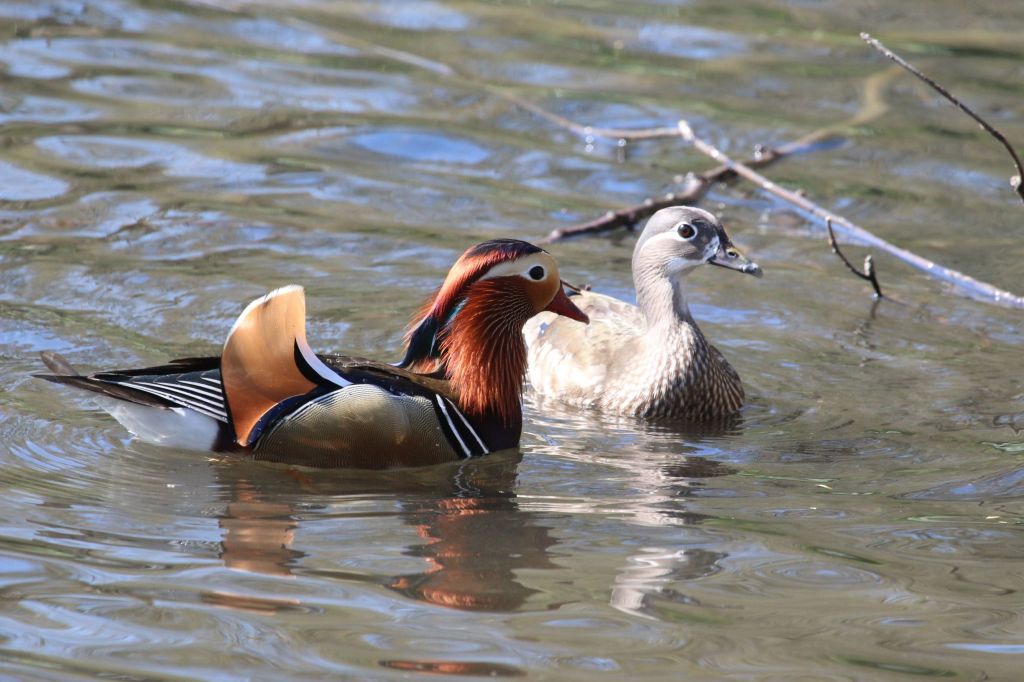
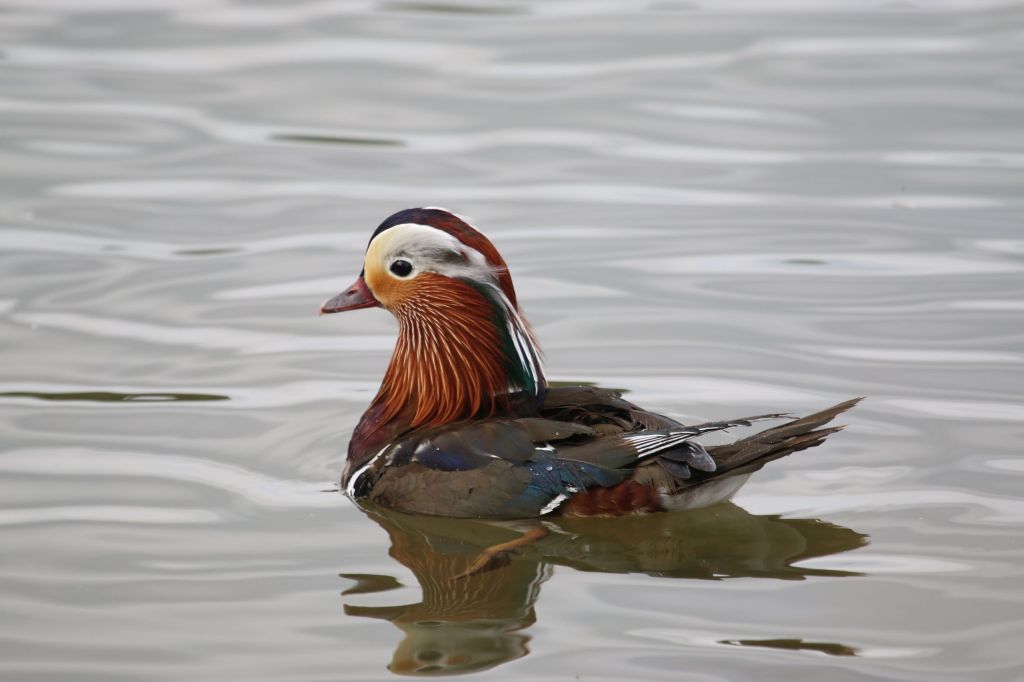
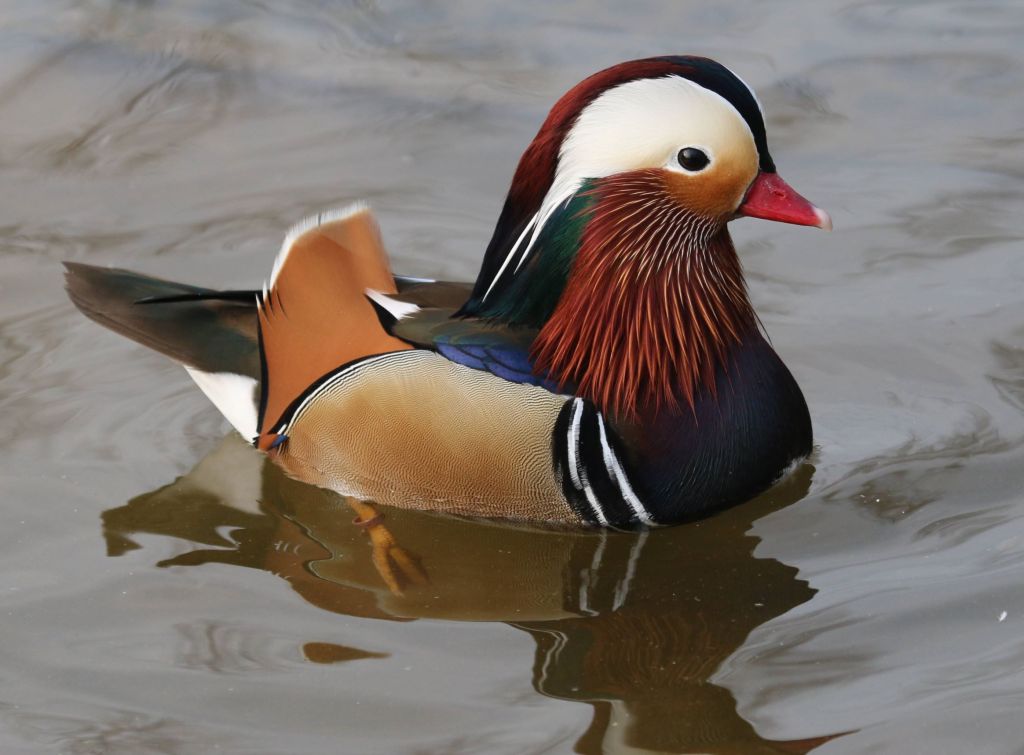
Mandarin ducks look far too exotic to be native British birds, and that’s absolutely right. They hail from East Asia – China, Japan and eastern Russia. The male sports a bright red bill, a reddish face with a large white crescent above the eye, a purple breast with two vertical white bars, and ruddy flanks. It also has two orange “sails” at the back. These comprise large feathers that stick up like the sails of a boat, and are perhaps the most eye-catching feature of what is a very elaborate bird.

The female, however, is drab, with a grey head, brown back and mottled flanks. Her white eye-ring and stripe can’t disguise the fact that, in common with the females of most duck species, she’s unremarkable.

Although the disparity in their looks might suggest otherwise, eastern folklore tells us that a pair of mandarins make the perfect couple. The birds are said to mate for life. In traditional Chinese and Japanese culture, mandarin ducks are therefore regarded as symbols of marital faithfulness. They are a favourite of artists, and also feature in Buddhist legends where they are said to represent compassion.

Male and female. No prizes for guessing which is which!

The supposed everlasting bond between mandarins is captured in a Japanese folktale, which begins with a great lord capturing a male bird so he can forever enjoy its beautiful plumage. Separated from its mate, the male is desperately lonely and begins to pine away. Seeing that the bird will soon die of a broken heart, the lord’s maidservant and her samurai lover decide to do the decent thing and reunite the lovelorn pair. However they get caught in the act and the furious lord condemns them to death for their treachery, proving beyond all doubt that for mankind and birdlife alike the course of true love does not always run smoothly!

* * *

It was in the mid-18th century when mandarins were first brought to Britain, with the intention of adding a bit of oriental glamour to the ornamental waterfowl collections of the idle rich. They escaped with monotonous regularity, and sometimes were deliberately released, but it wasn’t until the 1930s that a significant self-sustaining population of feral birds became established.

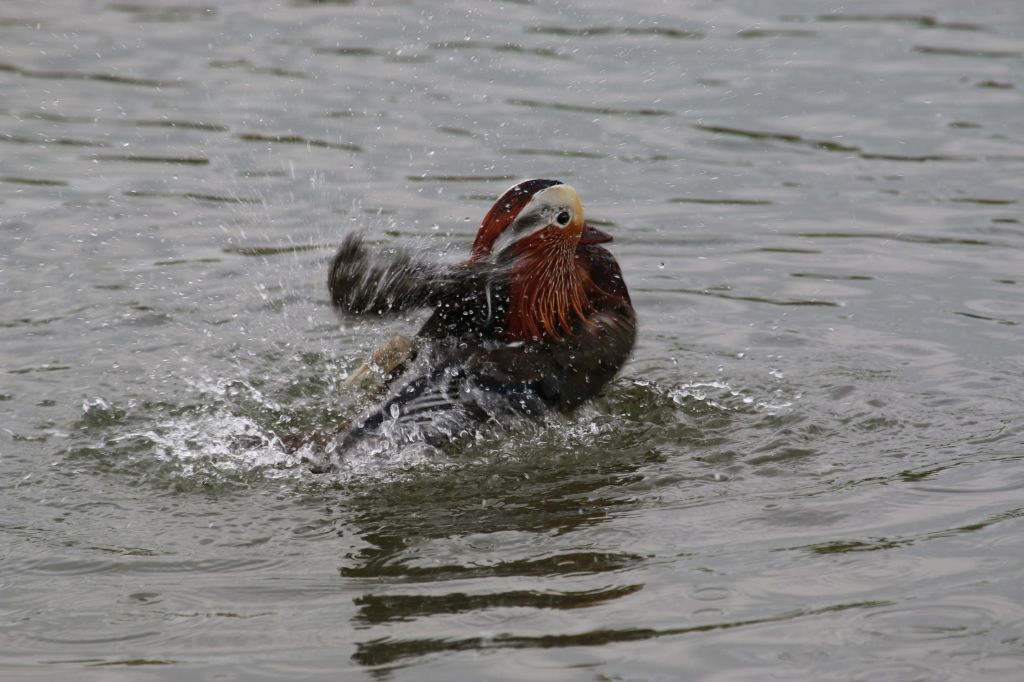
Juvenile mandarin

Since then numbers have grown rapidly, and there are now reckoned to be close to 8,000 mandarin ducks scattered widely throughout England. There are also feral populations in parts of continental Europe, as well as California and North Carolina in the US.

Spotting a lucrative gap in the market, China exported tens – or perhaps hundreds – of thousands of mandarins over several decades. Although the trade was banned in 1975 its impact, combined with widespread habitat loss, has resulted in a big fall in the wild Chinese population. Luckily mandarin ducks are reputed not to taste very good, otherwise pressures on the wild population would have been even greater in a country with over a billion mouths to feed.

Mandarins are notable for perching in trees, and the female invariably chooses a hole or cavity in a tree trunk in which to lay her eggs. After hatching, the ducklings jump to the ground and avoid injury thanks to the cushioning of their fluffy down. The mother swiftly gathers her brood together, and leads them to water. At Straws Bridge the female had plainly done a good job, and we got clear – although distant – views of some juveniles.

However, without doubt the male is the star of the mandarin show. What a looker!