This is Derbyshire: magnificent mansions and hidden hermitages!

My home county of Derbyshire is famed for its stately homes, magnificent mansions built centuries ago by the idle rich to show ordinary folk how well-bred, wealthy and successful they were. Chatsworth House, for example, ancestral home of the Dukes of Devonshire, dates from the 18th century and is reckoned to be one of the finest of England’s great houses.

Chatsworth House (rear view) dates from the 18th century. In the foreground is the “Emperor Fountain” built for the anticipated visit of Tsar Nicholas II (he never actually came!)

Then there’s Hardwick Hall, built between 1590 and 1597 for relentless social climber Bess of Hardwick. It was the wonder of its day, celebrated in the phrase “Hardwick Hall, more glass than wall” for its unprecedented number of windows – glass was prohibitively expensive in the 16th century! It still looks spectacular today.

And let’s not forget Kedleston Hall, a mid-18th century neo-classical masterpiece which the National Trust describes as “a show palace built to impress,” noting that it “was built to wow guests with lavish details and luxurious surroundings.” I’ve previously written about Kedleston Hall and the park in which it sits in this post.

Hardwick Hall, “more glass than wall”, was built in the 1590s

But I wouldn’t wish to mislead you into thinking that Derbyshire is all about grand mansions. Last year we visited the remains of two very different, but equally fascinating dwellings, the largely forgotten, hidden homes of long-dead hermits.

* * * * *

The Dale Abbey hermitage, hidden in woodland on the outskirts of the village of Dale Abbey, dates from the early 12th century. The story goes that one day around the year 1130, a baker called Cornelius living in the nearby town (now city) of Derby had a vision of the Virgin Mary. The Virgin told him to make his way some 7 miles (11km) to a place called Depedale, where he should devote the remainder of his life to God.

Dale Abbey hermitage dates from the 12th century

Upon arrival, Cornelius discovered Depedale to be uninhabited, simply an area of marshland in the bottom of the valley (dale). On its southern side was a steep sandstone bank, and here he excavated a cave in which he would live and worship in peaceful seclusion for around 20 years.

Nearly 900 years later, the results of the baker’s efforts are still plain to see. The simple cave has a sizeable interior, and boasts openings for a door and several large windows. Its construction by just one man using rudimentary 12th century tools must have required a huge amount of effort.

View from the inside of Dale Abbey hermitage

The interior walls of the cave-house are covered with countless graffiti etched into the rock. Amongst these, and now highlighted with a modern coat of fading yellow paint, is an engraved cross. Despite the thoughtless desecration by vandals, it feels as if the hermit Cornelius speaks to us across the centuries. Here, he seems to say, in a world unimaginably different from your own, lived a simple, holy man. Look around you, and see how I toiled to honour my God. Remember me!

Hidden amongst countless graffiti from across the ages, and highlighted with a modern coat of fading yellow paint, is an engraved cross

As stories of the hermit spread, Depedale became a place of growing religious significance. In the 13th century, perhaps attracted by accounts of Cornelius’s exploits, some Augustinian canons founded a monastery on land not far from his hermitage. This was Dale Abbey, which gave the surrounding area the name by which it is now known.

Once a grand and imposing building, Dale Abbey has now all but disappeared thanks to King Henry VIII’s Dissolution of the Monasteries in the 1530s. However the modest hermitage lovingly excavated by Cornelius the baker still survives, proof should anyone require it that big is not always best.

* * * * *

Derbyshire’s second hermitage can trace its origins back even further back, and may have royal connections.

The Anchor Church cave in South Derbyshire, around 14 miles (22km) from Dale Abbey, is hollowed out of a sandstone outcrop close to the River Trent. Although the hermitage may have started life as a small cave carved out naturally by the action of the river, human intervention has made it what it is today. It comprises a series of impressive internal spaces (“rooms”?) and pillars, all accessed by a large doorway and lit by several substantial window openings.

The Anchor Church cave dates from the 9th century, and is one of the oldest intact domestic structures ever found in the UK

Astonishingly, research published in 2021 indicates that the cave-house can be dated back to the Saxon period, making it one of the oldest intact domestic interiors ever found in the UK. More intriguing still are suggestions that it may have been the home of Eardwulf, who was deposed as king of Northumbria in AD806 and died in exile around AD830.

Eardwulf, however, may not have lived in the cave voluntarily. Rather, it appears he was kept there by his enemies under some Saxon form of house arrest. His cave-dwelling lifestyle and spirituality set him apart from his fellows, and in due course he became known to history as Saint Hardulph.

In the 18th century the Anchor Church cave was re-purposed as a summerhouse, when its openings were widened to allow well-dressed ladies to pass through more easily!

The cave-house continued to be used long after Eardwulf’s death, and in the 18th century was re-purposed as a summerhouse by the Burdett family, the owners of the land in which it sits.

The Burdetts are also thought to have widened openings into and within the cave to allow well-dressed ladies to pass through more easily. They seem to have had scant regard for the cave’s history but, fortunately, their overall impact on the structure was slight, and with a little bit of imagination the visitor can still detect Eardwulf’s presence.

* * * * *

Neither the Anchor Church cave nor Dale Abbey hermitage are obvious 21st century visitor attractions. Neither is classically beautiful, or even quaintly pretty. Neither has a tea-room, or a gift shop, or even a car park – both must be reached via a short hike through the countryside.

Both, however, offer fascinating insights into lives that are totally alien to our own, comfortable 21st century existence. Magnificent mansions are an important part of Derbyshire’s “visitor offer”, but there’s so much more to our county’s history than the gilded mansions of the idle rich, if we only care to look.

Rear view of Kedleston Hall, a mid-18th century neo-classical masterpiece. Beautiful, but intrinsically no more interesting than Derbyshire’s hidden and largely forgotten hermitages.

Year of the (Amur) Tiger

According to the Chinese calendar, a few days ago the world transited from the Year of the Ox to the Year of the Tiger. At Yorkshire Wildlife Park (YWP), however, it’s always the year of the tiger. Or, to be more precise, the year of the Amur Tiger, three of which currently call the Park home.

The Amur Tiger, also known as the Siberian Tiger, is one of six tiger sub-species, and is the largest big cat in the world. Adult males may weigh up to an impressive 200kg (440lb). These are majestic, iconic animals, and YWP visitors can often be seen gazing in awe at Vladimir, Sayan and Tschuna as they prowl around their ample enclosure.

Our consciences may be troubled at seeing such magnificent beasts living behind a fence, but the sad truth is that those tigers are lucky to be alive at all. In the 1940s the Amur Tiger was teetering on the edge of extinction. Fewer than 50 individuals remained in the wild at that time, after decades of political instability that had seen Russia bloodily reborn as part of the Soviet Union.

The Soviet Union had a wretched reputation in the latter half of the 20th century. Those of us who lived through the Cold War, wondering anxiously when the Kremlin’s missiles might come a-calling, don’t have particularly fond memories of the Soviets. On the face of it, theirs was not a regime that would be expected to place much emphasis on wildlife conservation.

But when it came to saving the Amur Tiger, the Soviet Union certainly stepped up to the plate. In 1947 they gave full protection to the tigers living within their borders, the first country in the world ever to do so. Killing tigers was outlawed and hunting of their main prey species, boar and deer, was restricted.

Government intervention came just in time and numbers have recovered, albeit very slowly. By 2005, the population of wild Amur Tigers had reached 330, and according to a recent report in the Moscow Times is now estimated at over 600.

So successful has the recovery been in Russia that a few Amur Tigers have now crossed the border into north-east China. The Chinese government is encouraging the process through the creation of two new nature reserves, one of which (the Tiger and Leopard National Park, or TLNP) is 50% larger than the USA’s wonderful Yellowstone National Park.

Meanwhile zoos throughout Europe, including Yorkshire Wildlife Park, are participating in a European Breeding Programme which acts as an insurance policy potentially supporting numbers and genetic diversity in the wild population.

In 2015 one of YWP’s females (Tschuna) gave birth to three cubs called Harley, Hector and Hope. The youngsters are now grown up, and have been dispersed to zoos in other parts of the world as part of the ongoing species breeding programme. This all happened some time before I retired from work and so, sadly, Mrs P and I never got see them. But we’re regular visitors to Yorkshire Wildlife Park these days, and are hoping for another similarly “happy event” very soon.

One day, maybe, such captive breeding programmes will be unnecessary, and the encouraging news emerging from Russia and China offers some cause for optimism on this count. In the meantime, however, it’s good to know that places like Yorkshire Wildlife Park are doing their bit to protect the future of this magnificent species of big cat.

You can enjoy some film of YWP’s tigers by clicking on the link below to my short video on YouTube.

Birdwatching banishes the Blue Monday blues

The third Monday of January is known to some in the UK as Blue Monday, supposedly the most depressing day of the year. The theory was first espoused in 2005 by a “life coach,” which immediately raises a vitally important question: what the hell is a life coach? Stage coaches – definitely! Football coaches – maybe. But a life coach – really? Surely life’s complicated enough already without total strangers waltzing up to tell us how to do it better. Dear god, why do we insist on doing stuff like this to ourselves?

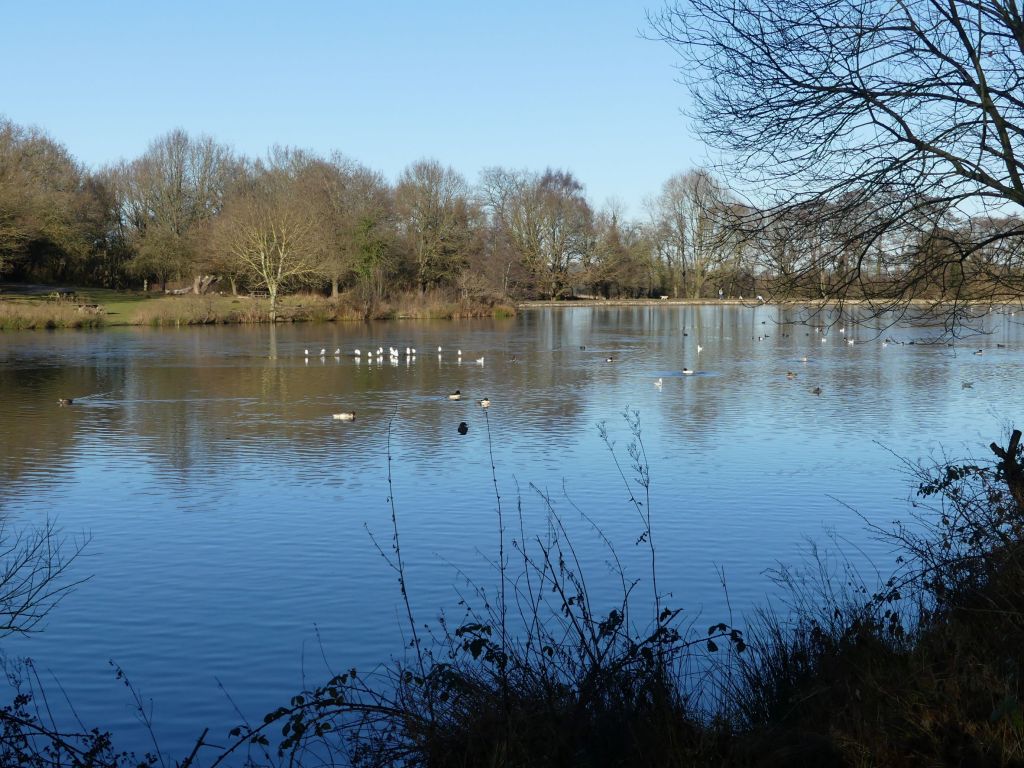
The larger of the Hardwick ponds, 15 January 2022

But I digress! According to believers in Blue Monday, on this particular day we’re likely to be regretting the impact of Christmas excesses on waistline and wallet, and will already have miserably failed to stick to our New Year Resolutions. Daylight hours will be short, the weather inclement and television schedules probably packed with unwatchable rubbish and unwanted repeats. And Mondays are, of course, loathed by anyone with a traditional Monday-to-Friday work pattern.

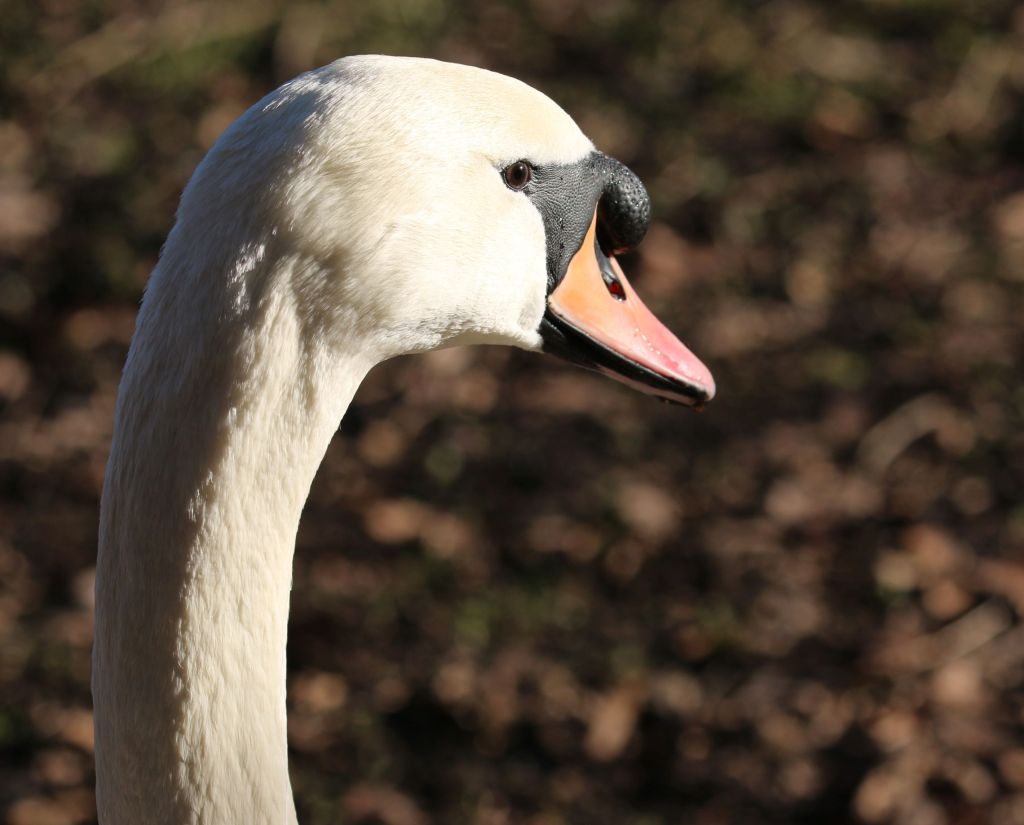
“Most of the usual suspects were there, including…Mute Swans”

It’s nonsense, of course, total bunkum. Even the guy who first came up with the notion is reported to have subsequently disavowed it, describing Blue Monday as a self-fulfilling prophecy that “is not particularly helpful”. But, just to be on the safe side, this year Mrs P and I decided to banish the Blue Monday blues from our lives by doing a spot of birdwatching.

The weather, as it turned out, was perfect, one of those crisp, cold and gloriously sunny midwinter days that make you feel glad to be alive. So we quickly got togged up in our thermals, grabbed cameras and binoculars, and headed off up the M1 to Hardwick ponds.

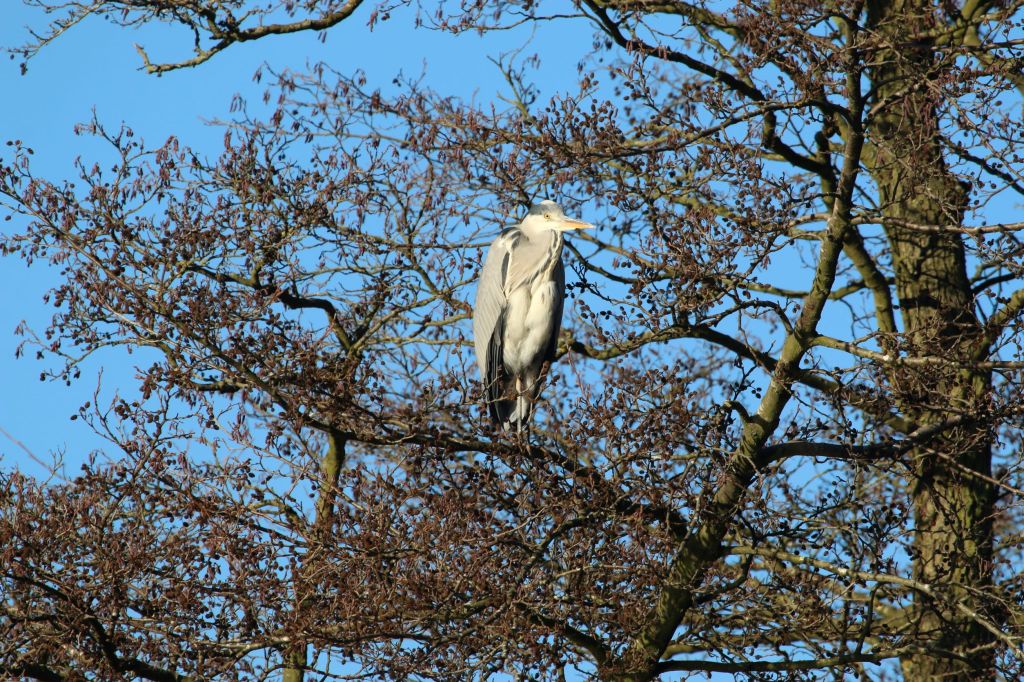
A single Grey Heron, perched high in a tree, surveyed events below with magisterial disdain

Hardwick Hall in Derbyshire is one of our home county’s most significant stately homes, and its impressive parkland includes several large bodies of water that are a haven for a variety of wildfowl. We try to visit Hardwick ponds several times each year, and are never disappointed.

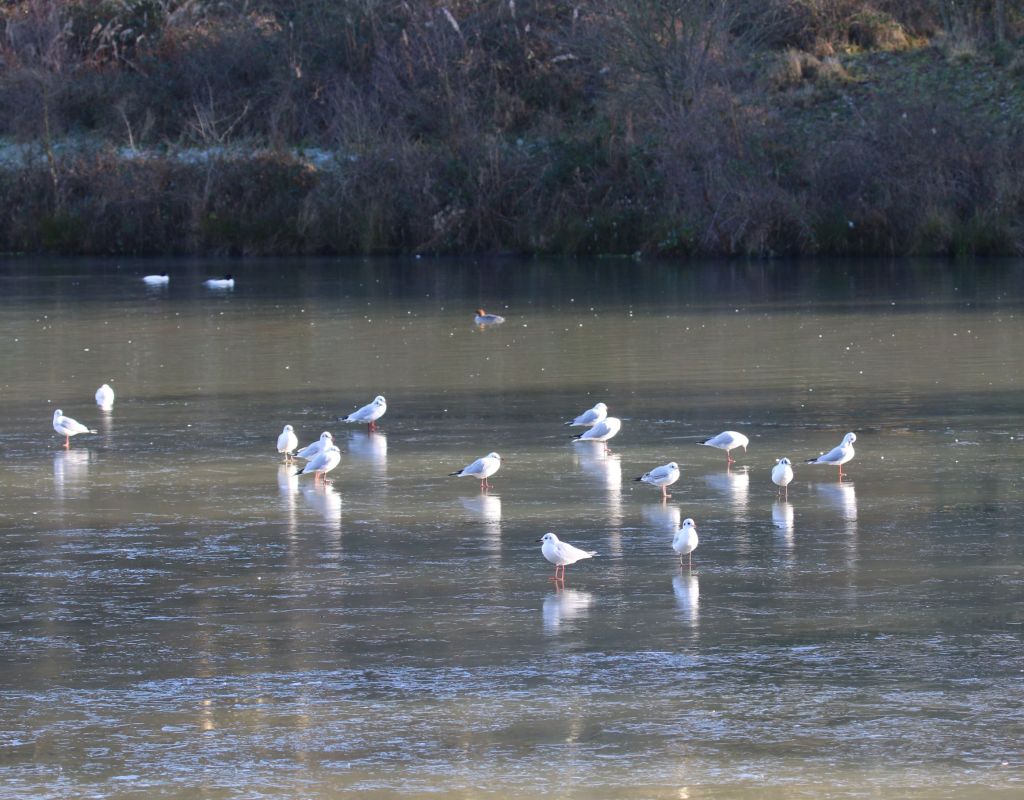
On this occasion both of the larger ponds were partially frozen. Black-headed gulls, wearing winter plumage and puzzled expressions, stood awkwardly on the ice contemplating this unexpected turn of events. The ducks and geese, however, were having none of it and instead sought out those areas of the ponds that remained ice-free.

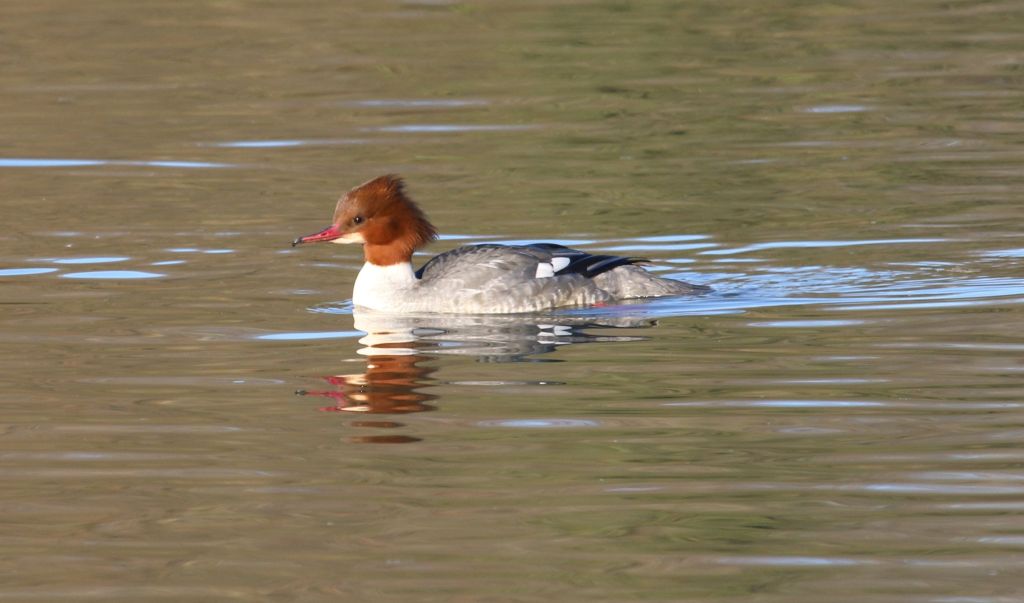
Female goosanders are largely grey, with a distinctive reddish-brown head, white chin, and white secondary feathers on the wings

Most of the usual suspects were there, including Canada Geese, Mute Swans and a Great Crested Grebe. A single Grey Heron, perched high in a tree, surveyed events below with magisterial disdain. Nothing remarkable in any of this, of course, but what really caught our eye was a gang of good-looking Goosanders.

Goosanders are streamlined diving ducks, fish-eaters that use their long, serrated bills to catch and hold on to their slippery prey. They are members of the sawbill family, which also includes the similar-looking Red-Breasted Merganser. To add to the confusion Goosanders can also be seen in the USA, but there they are known as Common Mergansers!

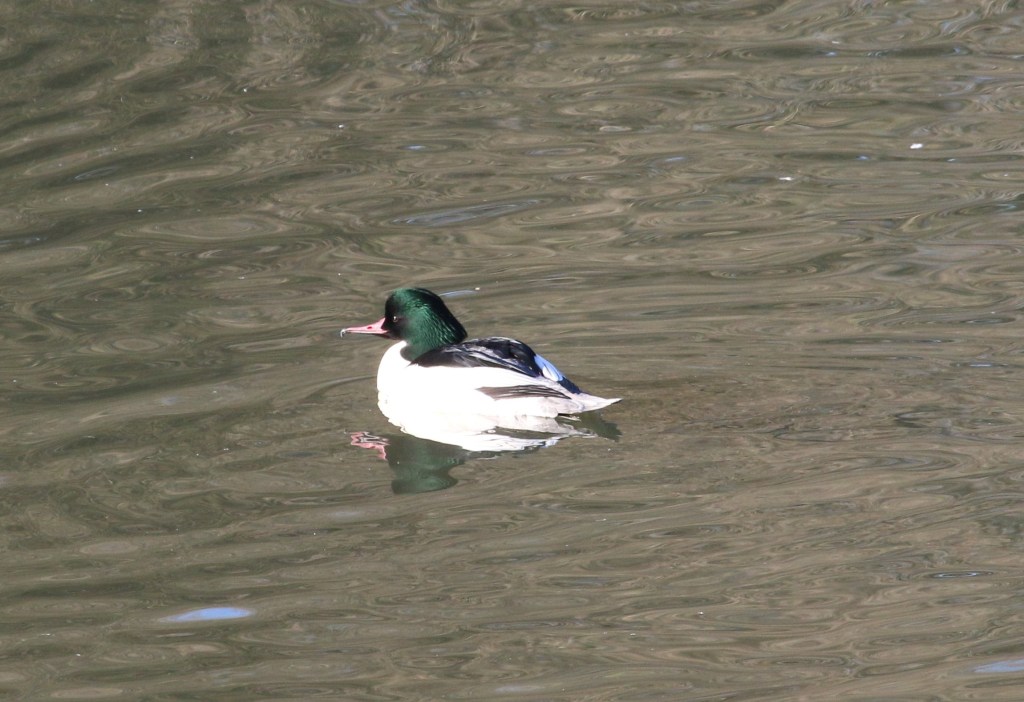
Male goosanders have a white body and a black head which sports an iridescent green gloss. They have a black back, and a grey rump and tail.

Whereas the Red-Breasted Merganser is most commonly seen around the UK’s coastline in winter, Goosanders favour freshwater. Their summer habitat is the fast-flowing upland rivers of Northern England, Scotland and Wales, where they nest in holes in riverbank trees. In winter they move to gravel pits and reservoirs, as well as lakes or large ponds such as those at Hardwick.

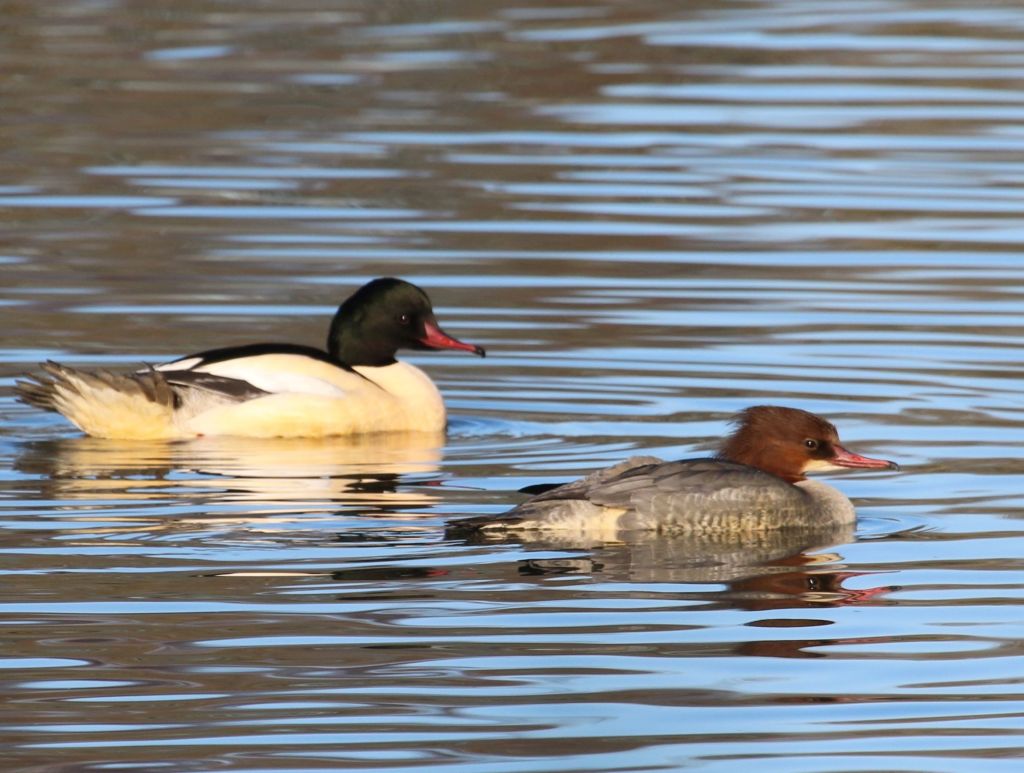
In common with most species of duck, the Goosander displays a high degree of sexual dimorphism. Adult males have a white body and a black head which sports an iridescent green gloss. The have a black back, and a grey rump and tail. Females are largely grey, with a distinctive reddish-brown head, white chin, and white secondary feathers on the wing.

A graphic lesson in sexual dimorphism: male on the left, female on the right, but both the same species!

The Goosander is a relatively new arrival in the UK, having first bred in Scotland in 1871. Its numbers slowly built up there for a century, until in 1970 the species crossed the border to begin colonising England and Wales. There are now thought to be close to 4,000 breeding pairs across the UK as a whole, with the wintering population numbering around 12,000 birds.

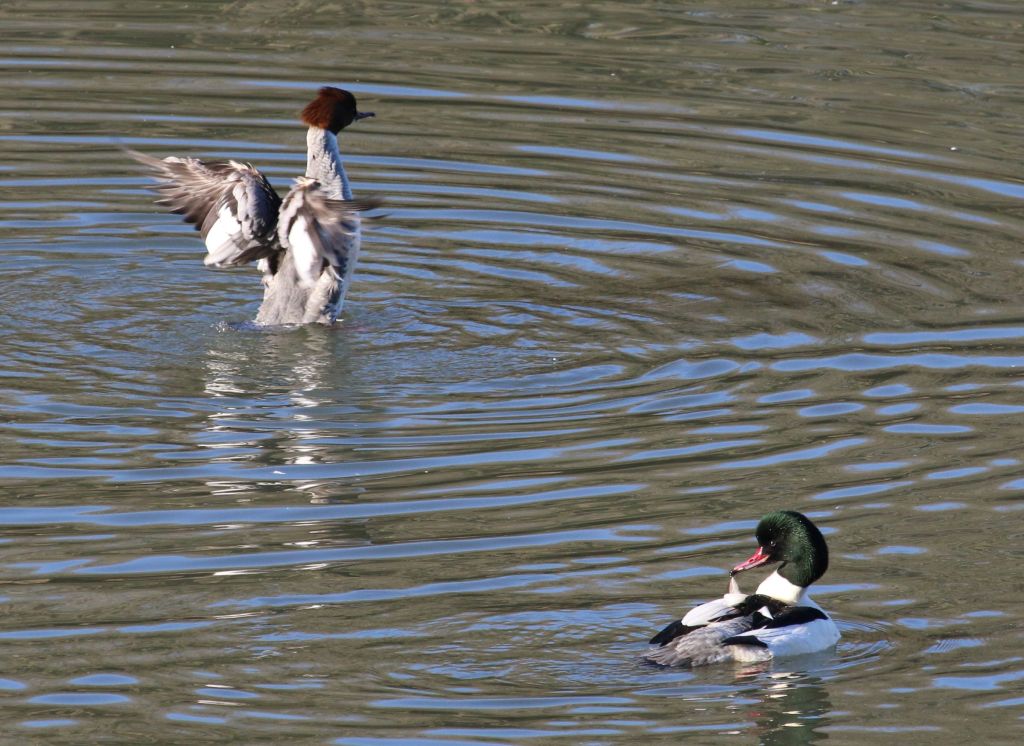
Female goosander having a flap, observed by a preening male

At least a dozen members of that wintering population were present at Hardwick ponds on 15 January, many more than we’ve ever encountered before at a single viewing. It was a delight to see them, and all the other birds that were strutting their stuff that morning. You can catch a glimpse of the Goosanders – and some of Hardwick’s other avian residents too – by clicking on the link below to my short YouTube video.

Blue Monday may have come calling for us last week, but I’m pleased to report that we were very much not at home!

“Black-headed gulls, wearing winter plumage and puzzled expressions, stood awkwardly on the ice”. See also one female and two male Goosanders in the open water to the rear of the gulls.

Yorkshire Wildlife Park: Saving the Warty Pig

Yorkshire Wildlife Park has plenty of iconic critters that are certain to impress visitors. The black rhinos, polar bears and Amur tigers, for example, are guaranteed to provoke appreciative oohs and ahs from delighted punters. But there’s other stuff too, animals that are pretty much unknown to all but the most dedicated wildlife geeks, animals that are maybe a bit more difficult to love. Warty Pigs, for example. I mean, whoever heard of a Warty Pig? And who cares?

I care! It’s true that Visayan Warty Pigs aren’t obviously cute or charismatic, but so what? All living things are intrinsically valuable, worthy of our respect and protection regardless of their looks or lifestyle. And there’s a reason why we’ve never heard of them: they’re all but extinct in the wild, and hail from the Philippines, a little known and unglamorous part of the globe that few of my fellow citizens could locate on a world atlas even if they’ve heard of the place at all.

The Visayan Warty Pig is classified as “critically endangered.” It is endemic to six of the Visayas Islands in the central Philippines, but is believed to be extinct on four of these. Their natural habitat is the rainforest, but between 95% to 98% of it has been lost to commercial forestry and slash-and-burn farming. With their natural food sources severely depleted, the pigs have resorted to raiding cultivated land, and are consequently persecuted as agricultural pests. They are also hunted for bushmeat.

There seems little doubt that, without a major conservation effort and captive breeding, the Visayan Warty Pig is doomed to extinction. Fortunately, there are many programmes, both in the Philippines and in zoos across the world, that are dedicated to saving the species.

And here’s where Yorkshire Wildlife Park is doing its bit. We’ve visited YWP several times over the last couple of years, and have been pleased to see a decent-sized group of adult females and youngsters going about their business in the ample, wooded Warty Pig enclosure. They are feisty, entertaining animals and you can enjoy some of their antics by clicking on the link below to my short video on YouTube.

The adult male – which boasts impressive facial warts, as well as a stiff, spiky crest of hair – lives next door to the main family group, replicating behaviour in the wild where males live apart from the females most of the time.

The male plainly knows his stuff, and his managed encounters with the females have produced multiple, humbug-striped piglets. My brief research on the internet confirms that other zoos are having similar breeding success, suggesting that Visayan Warty Pigs can thrive in captivity. Hopefully, one day, some of their descendants can be reintroduced to the wild, where they rightly belong.

A colourful evening at Yorkshire Wildlife Park

We first visited Yorkshire Wildlife Park (YWP) a few months after I retired, and have returned several times since I have some reservations about keeping wild creatures in captivity (don’t we all?), but the place seems OK. The animals are plainly well cared for, with plenty of space to roam. Importantly, the Park supports a number of conservation initiatives to breed highly endangered species in captivity, and seeks to educate visitors about their plight. I’ll write more about some of these conservation projects later in the year.

To help raise the money needed to care for its animals YWP is always looking for new ways to encourage visitors. Last year we’d planned to visit the Park’s Light and Lantern Festival held around Christmas, but Covid restrictions got in the way. This year the restrictions have been, well, less restrictive…but the weather was miserable throughout December, so we gave it a miss.

Finally, last week, conditions improved and we made the decision to hot-foot it 45 miles (72km) up the M1 to the outskirts of Doncaster to catch the Festival before it ends in mid-January. It was definitely worth the trip, as Mrs P’s photos show. With the exception of one hyena, which was racing madly around its spacious enclosure like Usain Bolt in his prime, living animals were notable by their absence. I suspect they were all sleeping peacefully in their dens and nests, blissfully unaware of the numerous visitors trekking round the Park, ooh-ing and aah-ing at the spectacular illuminations.

The lanterns celebrate many of the animals living at the Park – including lions, leopards and okapi – and some that don’t. A T-Rex and sundry other dinosaurs paid homage to animals that none of us will ever see in the flesh. Let’s hope that the conservation initiatives supported by YWP, and similar bodies throughout the UK and beyond, mean that the species currently living there won’t suffer a similar fate to that of the dearly departed dinos.

Folk song favourites: The January Man

So, it’s January again. We’ve been here before, right? You know what I mean, January’s the time for new beginnings. It’s out with the old, in with the new. The time to finally do the things we’ve always dreamed of doing, and to stop doing the other stuff, the stuff that no longer fulfils and leaves us instead with that sad, damp feeling of regret. This year, we tell ourselves, things will be different.

Only they won’t, will they?

Time is simultaneously both linear and cyclical. My receding hairline and aching joints testify to time’s linear incarnation. They are all in worse shape than they were 12 months ago, and the downward spiral will inevitably continue.

Milky Bar in January, waiting patiently for the return of the insects

But time is also cyclical, Our seasons come and go, predictable and reassuring. I don’t much like winter, but at least I know what to expect. Winters in my part of the UK are cool and dull. Often windy, sometimes foggy-damp, occasionally snowy, invariably miserable. The days are too short, the nights way, way too long. But the best thing about winter is that it doesn’t last forever. Even when conditions are at their bleakest we know for sure that better times are just around the corner, when there will once again be insects for Milky Bar to chase.

Folk music has its origins in the pre-industrial age, when rural populations were closer to the changing of the seasons than most of us are today. The seasons could not be escaped, and had to be respected. Traditional folk singers, and their more contemporary successors, therefore frequently reflected on the seasons in their lyrics.

Which brings me, finally, to The January Man. This contemporary folk song was written in the traditional style by Dave Goulder (b. 1939) who was, coincidentally, born in my home county of Derbyshire. Dave’s song captures perfectly and poignantly the way in which the seasons shape our lives. It is a magnificent piece, and exemplifies the folk music genre at its very best. You can read the lyrics here.

Like all the best folk songs, The January Man has been covered by numerous performers, including Christy Moore, Martin Carthy, Bert Jansch, Rachel Unthank, Siobhan Miller and Mike Harding. You can track them all down on YouTube.

This one is by Steeleye Span, an English folk rock band formed in 1969 and still performing today with a rather different line-up. The link below is to a version recorded on the band’s 50th anniversary tour in 2019! Steeleye were an important part of the British folk revival. Their early albums graced the record collections of many wistful, long-haired, wannabe hippies…including the Platypus Man, way back in the days when he still had hair. So, to celebrate the New Year, why not treat yourself to 4 minutes and 47 seconds of magical folk music by clicking on the link below. Happy New Year, everyone!

Postscript

The final paragraphs of this post have been re-drafted following a tip-off a few hours after publication from my blogging buddy Laurie Graves of Notes from the Hinterland. Laurie advised me that the YouTube track to which I was linking does not appear to be available overseas. Hopefully the new link, to the version by Steeleye Span, works a little better. However, I’ve also found an alternative link the version I originally wrote about, an a capella masterpiece by Martin Carthy (b. 1941). Martin is one of the most influential performers of British traditional music, and The January Man shows him at his very best.

Folk song favourites: Wayfaring Stranger

My interest in folk music was inherited from my father. He was no great expert (and no great singer either!), but he knew just what he liked. Two of his favourite performers of folk and traditional songs were Joan Baez and Burl Ives. My last post touched briefly on a memorable track by Baez, so today I’ll say a few words about one of my favourite Burl Ives ballads.

The Wayfaring Stranger is a well-known American folk song, probably dating from the early 19th century. The lyrics were first set down in Joseph Bever’s Christian Songster, published in 1858. They tell the story of a man’s arduous journey through life, and his belief that his lot will improve after death when he will leave his troubles behind him and be reunited with his loved ones.

Folk song lyrics are like the Covid virus, constantly mutating, forever evading capture and control. So what follows isn’t a definitive version, but is nevertheless a reliable guide to The Wayfaring Stranger’s tone and major themes:

I am a poor wayfaring stranger
I'm travelling through this world of woe
Yet there's no sickness, toil, nor danger
In that bright land to which I go

I'm going there to see my father
I'm going there, no more to roam
I'm only going over Jordan*
I'm only going over home

I know dark clouds will gather 'round me
I know my way is rough and steep
But golden fields lie just before me
Where God's redeemed shall ever sleep

I'm going home to see my mother
And all my loved ones who've gone on
I'm only going over Jordan
I'm only going over home

I am a poor wayfaring stranger
I'm travelling through this world of woe
Yet there's no sickness, toil, nor danger
In that bright land to which I go

I'm going there to see my father
I'm going there, no more to roam
I'm only going over Jordan
I'm only going over home

Beautiful, and deeply moving! One day – but not any time soon, I hope – a recording of The Wayfaring Stranger will be played at my funeral, as I embark upon my own final journey.

Burl Ives (1909-95) had a long association with this song. Having stormed out of his Illinois teacher training college in a fit of pique in 1929, Ives became an itinerant singer and musician who travelled across the US scratching a living by performing at small venues and doing odd jobs on the side.

Ives’s success and reputation grew, until in 1942 he was given his own radio show on CBS, playing traditional folk ballads. But the rootless, wandering lifestyle that characterised his early career obviously made a deep impression on the young man, and in memory of those times his show was titled The Wayfaring Stranger. Two years later he released a recording of the song on his album of the same name.

Countless artists have since recorded The Wayfaring Stranger, including Emmylou Harris, Johnny Cash, Ed Sheeran and Rhiannon Giddens, as well as Jack White, whose character Georgie sings it in the 2003 movie Cold Mountain. You can track down all of these covers on YouTube

Perhaps the most surprising interpretation I’ve come across was recorded by a bunch of Norwegians, the Hayde Bluegrass Orchestra. Scandinavia is not a part of the world that anyone might reasonably expect to spawn a memorable version of a classic American folk ballad, but their recording proves beyond doubt that musical talent is blind to national boundaries.

While Hayde’s rendition balances perfectly Rebekka Nilsson’s plaintive vocals with some superbly atmospheric Appalachian instrumentation, Jos Slovick demonstrates that The Wayfaring Stranger works just as well when sung unaccompanied. His a cappella version, recorded for the 2019 movie 1917 is mournful, and gut-wrenchingly haunting. Definitely one of my favourites.

Great folk songs are capable of endless reinterpretation, each new version adding subtly different dimensions to the core narrative and melody. The Wayfaring Stranger is, in my mind anyway, one of the greatest of them all.

* note: “going over Jordan” = dying and going to heaven / paradise

2021: Making the Best of It

This will probably be my last post of 2021. Planning it, I thought I’d write a retrospective piece, focussing on the highlights of the last 12 months. Well that wouldn’t take long, would it, given that there haven’t been any highlights. It’s true that 2021 hasn’t been quite as bad as 2020, but not by much. On balance it’s another year I’d rather forget. But, thankfully, there have been a few compensations along the way.

Without the company of visiting cats Malteser (above) and Milky Bar, our 2021 would have been a whole lot bleaker

That was the year that was (all jabbed up, with nowhere to go!)

When I left work in 2018 the plan was that we’d do a lot of travelling, see more of the world and the UK too. And for the first 18 months it worked out just fine, with big trips to the USA – centred on Yellowstone National Park – and New Zealand, as well as shorter stays in various corners of our own country. But since Covid struck nearly two years ago we’ve spent just a couple of nights away from home, in the nearby county of Rutland. Retirement wasn’t meant to be like this!

We enjoyed visiting a few historic buildings in Derbyshire and surrounding counties. In the 19th century, Shibden Hall (above) was home to the extraordinary Anne Lister, aka ‘Gentleman Jack’

But at least we’ve had our jabs. Two doses each during the spring, and more recently booster doses to counteract the threat of the omicron variant. We remain healthy and feel safe, but the restrictions and continuing uncertainty surrounding the pandemic have so far deterred us from planning any trips next year. Seems like we’re all jabbed up, with nowhere to go.

A canal-side stroll at Bugsworth Basin allowed us to escape briefly from our everyday suburban existence

So, with our passports gathering dust all year and our UK horizons severely restricted, we’ve had to resort to simple pleasures.

Simple pleasures

One of the few bonuses of Covid has been that, with long distance travel out of the question, we have found ourselves exploring much closer to home. We’ve finally visited some places that have been on our list for years – decades, even – but never made it to the top. And others that we were totally unaware of, even though they’re in our own backyard. So it’s not been a wasted year, but not at all what I would have predicted when I started drawing my pension in 2018.

Yorkshire Wildlife Park is part of a European conservation initiative to protect the endangered Amur Tiger. Early next year I’ll write a post about our multiple visits to the Park during 2021.

The internet has made lockdown life much more tolerable than it would have been had Covid struck before the world went online. During 2021 I’ve spent a lot of time on the web listening to folk music, an interest that dates back to my childhood. We’ve also attended several online gigs on Zoom, and every week I’ve listened to several regional folk music shows via online catch-up radio. We even plucked up the courage to attend one day of the Derby Folk Festival in person, and enjoyed seeing Ninebarrow – a folk duo we discovered online during the first lockdown – perform live.

All manner of surprises were on offer in the sculpture garden at Burghley House. I’ll share some more of these in 2022.

But more than anything else the thing that has made this year bearable has been the company of our visiting cats, Milky Bar and Malteser. Being at home just about all the time has allowed us to get to know them much better than before, and they’ve repaid us by spending lots of quality time here, sleeping, playing, making mischief and eating any treat we’ve put in front of them. Our Covid experience would have been a whole lot bleaker without those two fabulous felines.

Visayan Pigs (aka Warty Pigs) are another of Yorkshire Wildlife Park’s impressive conservation projects. Post to follow in 2022.

So that’s it, that was the year that was. Of course, it could have been been much, much worse. But I can’t pretend it’s been a bundle of laughs either. Let’s all hope 2022 will be a whole lot better.

Christmas gifts

Christmas is a time for gift giving, and in that spirit I’d like to present you with this link to a recording on YouTube of Benjamin Zephaniah reading his wonderful Christmas poem that invites us all to Be Nice to Your Turkey this Christmas.

Benjamin was born and raised in Birmingham, England, and is a celebrated dub poet whose work “is strongly influenced by the music and poetry of Jamaica and what he calls ‘street politics’.” Many years ago Mrs P and I were thrilled to attend one of his gigs. It was nowhere near Christmas, but his performance of this poem still brought the house down. If you’re not familiar with his work do click on the link and listen to the man do his stuff – it may well be the best two minutes and eight seconds of your whole Christmas!

My second gift to you is Joan Baez singing The Cherry Tree Carol. I’ve already observed that my interest in folk music dates back to my childhood. My father loved Joan Baez’s singing, and had several vinyl albums of her work. I grew to love them too, and remember playing and re-playing her records on our ancient radiogram (anyone else remember radiograms?) until the grooves were worn away.

Although dating back in some form to the early 15th century, the Cherry Tree Carol as we now know it was collected by Francis James Child (1825-96) during the second half of the 19th century and included in his famous anthology of English and Scottish Popular Ballads. I am not a religious man, but the spirituality of this song moves me deeply. And who can possibly listen to Joan Baez’s fabulous folkie voice without getting a lump in their throat? Listen and enjoy!

And finally …

Thank you for reading my blog, and for sharing your comments with me from time to time. With Covid restrictions curtailing travel opportunities and limiting our social interactions, I’ve really appreciated exchanging ideas and experiences with WordPress pals from across the globe. You’ve helped make a difficult year more bearable.

I wish you all a happy, peaceful Christmas, and a healthy and fulfilling New Year.

The Festival of Christmas Trees in Chesterfield Parish Church helped us get into the festive spirit.

Call of the wild – starlings fly home to roost over our house

I hear them long before they become visible. Starlings are gathering over the hills to the south of the estate where we live. It begins as an avian whisper, barely audible above the ambient sounds of wind and distant traffic. And then it starts to build, unseen birds chattering excitedly with one another, shouting, squawking, screaming joyously. A wall of sound, the call of the wild.

The cacophony echoes all around me. I scan the sky in the direction from which I know they will appear. Still nothing. But it’s only a matter of time. They will be here. At this time of year they fly over our estate every day at around 4pm, heading towards their roosting site. Today will be no different.

At last they start to arrive. First a lone outrider, silent and determined, appears from behind the house at the rear of our garden. It passes over me and disappears into the distance. Then two others, calling to one another as they fly.

Seconds later the main flock arrives, hundreds of birds in close formation. A deafening, spellbinding squadron of starlings, known to science as a murmuration, fills the sky.

Although the birds clearly have a destination in mind, they briefly break off from their journey to swoop and swirl above my head, like a bunch of boastful aviators flaunting their skills at an air show. The murmuration takes on a life of its own, sketching ever more complex and beautiful patterns on the canvas of the evening sky. The noise is louder than ever, drowning out everything else.

And then, as suddenly as they arrived, they take their leave. The flock heads off to who-knows-where, and the sound of their relentless chitter-chatter fades. A few laggards appear from the south, flying swiftly in pursuit of the main flock, keen to catch up with their buddies before they roost for the night.

Seconds later they too have gone and I’m left alone with my thoughts, marvelling at the extraordinary event I have just witnessed.

* * * * *

In some parts of the country murmurations at this time of year can number several hundred thousand birds, occasionally more than a million. By these standards, the aerial display that takes place above our garden every winter’s afternoon is tiny. But to me it is far from insignificant.

What a privilege it is, to stand in our modest back garden on our boring suburban housing estate in the unremarkable, overpopulated East Midlands of England, and experience the call of the wild. It is a moving, mesmerising experience, and the wonder of it fills me with joy. Long may it continue.

The Festival of Christmas Trees at Chesterfield parish church

The Christmas season seems to have been with us forever. Pubs and restaurants have been promoting their festive menus for months. For several weeks shops have been cluttered with seasonal promotions. And Christmas trees are springing up all over the place, in public spaces, shops and windows all over town.

The tree on the far right is sponsored by a bridalwear business: brilliantly inventive!

The link between evergreen plants, including fir trees, and mid-winter festivals pre-dates Christianity. It reflects our ancestors’ conviction that, even on the darkest of days, better times and the green shoots of spring are just around the corner.

The Christmas tradition of bringing fir trees into the home and decorating them appears to have developed in the 16th century, in the area of Europe we now know as Germany. However it didn’t catch on in the UK until the middle of the 19th century.

The sudden rise in the popularity of Christmas trees here was down to the royal family, which had historic links with Germany. These were boosted in 1841 when Queen Victoria married her German cousin Prince Albert, who had fond memories of Christmas trees from his childhood.

In the centre a tree decorated by a local mortgage broker featuring “baubles” in the shape of houses, and a silver key (presumably the key to the home you might buy with the help of their services!)

In 1848 the Illustrated London News reported enthusiastically on the Christmas trees Victoria and Albert had put up at Windsor Castle. It also featured on its front cover an illustration of a cluster of happy royals admiring their biggest and best tree. The paper was widely read in well-to-do circles in and around London, and other newspapers also picked up on its story.

It soon became widely known just what the royals were up to, and at a time when it was fashionable amongst the wealthier classes to copy the lifestyle and habits of royalty, Christmas trees became all the rage. But only, of course, amongst those sections of the population with money to acquire them and the space to display them.

Centre left is a tree by a business selling intruder alarms (the “baubles” are actually Passive Infra-Red [PIR] detectors!) The centre right tree is from a local jeweller.

In time the fashion trickled down through the social hierarchy until just about everyone in the country aspired to celebrate Our Lord’s birthday by chopping down a poor, defenceless little fir tree and disfiguring it with gaudily tasteless decorations. Bah, humbug!

* * *

Please forgive the previous paragraph… I jest, of course. In fact, Mrs P and I do rather like Christmas trees, although at Platypus Towers we make do with an artificial one to avoid the carpet being knee-deep in pine needles before Twelfth Night. So to get into the Christmas spirit, a couple of weeks ago we took a trip to the north of our home county of Derbyshire to visit the Festival of Christmas Trees at the parish church of St Mary and All Saints in Chesterfield.

Not all trees are from businesses. Second from the left is a tree presented by BANA (British Acoustic Neuroma Association) and second from the right is one from Chesterfield Panthers Rugby Club.

We discovered that the church was playing host to around 120 Christmas trees donated and decorated by local businesses, community organisations, service providers and sports clubs. Of course, the motivation of those providing the trees wasn’t entirely selfless: promotion of their products, services and causes appeared to be the name of the game in most cases.

But it doesn’t pay to be churlish. Plenty of folk just like us were also wandering happily through the church that Thursday morning, admiring the imagination and inventiveness of the people behind the various Christmas tree creations. It’s been a difficult year for most of us, although perhaps not quite as grim as 2020, and the Festival of Christmas Trees felt like a good attempt to raise community spirits, to bring people together and to encourage everyone to look forward to more cheerful times ahead. I’m pleased we made the effort to attend.

A local timber merchant celebrates the crooked spire of St Mary and All Saints church