This is Derbyshire: magnificent mansions and hidden hermitages!

My home county of Derbyshire is famed for its stately homes, magnificent mansions built centuries ago by the idle rich to show ordinary folk how well-bred, wealthy and successful they were. Chatsworth House, for example, ancestral home of the Dukes of Devonshire, dates from the 18th century and is reckoned to be one of the finest of England’s great houses.

Chatsworth House (rear view) dates from the 18th century. In the foreground is the “Emperor Fountain” built for the anticipated visit of Tsar Nicholas II (he never actually came!)

Then there’s Hardwick Hall, built between 1590 and 1597 for relentless social climber Bess of Hardwick. It was the wonder of its day, celebrated in the phrase “Hardwick Hall, more glass than wall” for its unprecedented number of windows – glass was prohibitively expensive in the 16th century! It still looks spectacular today.

And let’s not forget Kedleston Hall, a mid-18th century neo-classical masterpiece which the National Trust describes as “a show palace built to impress,” noting that it “was built to wow guests with lavish details and luxurious surroundings.” I’ve previously written about Kedleston Hall and the park in which it sits in this post.

Hardwick Hall, “more glass than wall”, was built in the 1590s

But I wouldn’t wish to mislead you into thinking that Derbyshire is all about grand mansions. Last year we visited the remains of two very different, but equally fascinating dwellings, the largely forgotten, hidden homes of long-dead hermits.

* * * * *

The Dale Abbey hermitage, hidden in woodland on the outskirts of the village of Dale Abbey, dates from the early 12th century. The story goes that one day around the year 1130, a baker called Cornelius living in the nearby town (now city) of Derby had a vision of the Virgin Mary. The Virgin told him to make his way some 7 miles (11km) to a place called Depedale, where he should devote the remainder of his life to God.

Dale Abbey hermitage dates from the 12th century

Upon arrival, Cornelius discovered Depedale to be uninhabited, simply an area of marshland in the bottom of the valley (dale). On its southern side was a steep sandstone bank, and here he excavated a cave in which he would live and worship in peaceful seclusion for around 20 years.

Nearly 900 years later, the results of the baker’s efforts are still plain to see. The simple cave has a sizeable interior, and boasts openings for a door and several large windows. Its construction by just one man using rudimentary 12th century tools must have required a huge amount of effort.

View from the inside of Dale Abbey hermitage

The interior walls of the cave-house are covered with countless graffiti etched into the rock. Amongst these, and now highlighted with a modern coat of fading yellow paint, is an engraved cross. Despite the thoughtless desecration by vandals, it feels as if the hermit Cornelius speaks to us across the centuries. Here, he seems to say, in a world unimaginably different from your own, lived a simple, holy man. Look around you, and see how I toiled to honour my God. Remember me!

Hidden amongst countless graffiti from across the ages, and highlighted with a modern coat of fading yellow paint, is an engraved cross

As stories of the hermit spread, Depedale became a place of growing religious significance. In the 13th century, perhaps attracted by accounts of Cornelius’s exploits, some Augustinian canons founded a monastery on land not far from his hermitage. This was Dale Abbey, which gave the surrounding area the name by which it is now known.

Once a grand and imposing building, Dale Abbey has now all but disappeared thanks to King Henry VIII’s Dissolution of the Monasteries in the 1530s. However the modest hermitage lovingly excavated by Cornelius the baker still survives, proof should anyone require it that big is not always best.

* * * * *

Derbyshire’s second hermitage can trace its origins back even further back, and may have royal connections.

The Anchor Church cave in South Derbyshire, around 14 miles (22km) from Dale Abbey, is hollowed out of a sandstone outcrop close to the River Trent. Although the hermitage may have started life as a small cave carved out naturally by the action of the river, human intervention has made it what it is today. It comprises a series of impressive internal spaces (“rooms”?) and pillars, all accessed by a large doorway and lit by several substantial window openings.

The Anchor Church cave dates from the 9th century, and is one of the oldest intact domestic structures ever found in the UK

Astonishingly, research published in 2021 indicates that the cave-house can be dated back to the Saxon period, making it one of the oldest intact domestic interiors ever found in the UK. More intriguing still are suggestions that it may have been the home of Eardwulf, who was deposed as king of Northumbria in AD806 and died in exile around AD830.

Eardwulf, however, may not have lived in the cave voluntarily. Rather, it appears he was kept there by his enemies under some Saxon form of house arrest. His cave-dwelling lifestyle and spirituality set him apart from his fellows, and in due course he became known to history as Saint Hardulph.

In the 18th century the Anchor Church cave was re-purposed as a summerhouse, when its openings were widened to allow well-dressed ladies to pass through more easily!

The cave-house continued to be used long after Eardwulf’s death, and in the 18th century was re-purposed as a summerhouse by the Burdett family, the owners of the land in which it sits.

The Burdetts are also thought to have widened openings into and within the cave to allow well-dressed ladies to pass through more easily. They seem to have had scant regard for the cave’s history but, fortunately, their overall impact on the structure was slight, and with a little bit of imagination the visitor can still detect Eardwulf’s presence.

* * * * *

Neither the Anchor Church cave nor Dale Abbey hermitage are obvious 21st century visitor attractions. Neither is classically beautiful, or even quaintly pretty. Neither has a tea-room, or a gift shop, or even a car park – both must be reached via a short hike through the countryside.

Both, however, offer fascinating insights into lives that are totally alien to our own, comfortable 21st century existence. Magnificent mansions are an important part of Derbyshire’s “visitor offer”, but there’s so much more to our county’s history than the gilded mansions of the idle rich, if we only care to look.

Rear view of Kedleston Hall, a mid-18th century neo-classical masterpiece. Beautiful, but intrinsically no more interesting than Derbyshire’s hidden and largely forgotten hermitages.

Year of the (Amur) Tiger

According to the Chinese calendar, a few days ago the world transited from the Year of the Ox to the Year of the Tiger. At Yorkshire Wildlife Park (YWP), however, it’s always the year of the tiger. Or, to be more precise, the year of the Amur Tiger, three of which currently call the Park home.

The Amur Tiger, also known as the Siberian Tiger, is one of six tiger sub-species, and is the largest big cat in the world. Adult males may weigh up to an impressive 200kg (440lb). These are majestic, iconic animals, and YWP visitors can often be seen gazing in awe at Vladimir, Sayan and Tschuna as they prowl around their ample enclosure.

Our consciences may be troubled at seeing such magnificent beasts living behind a fence, but the sad truth is that those tigers are lucky to be alive at all. In the 1940s the Amur Tiger was teetering on the edge of extinction. Fewer than 50 individuals remained in the wild at that time, after decades of political instability that had seen Russia bloodily reborn as part of the Soviet Union.

The Soviet Union had a wretched reputation in the latter half of the 20th century. Those of us who lived through the Cold War, wondering anxiously when the Kremlin’s missiles might come a-calling, don’t have particularly fond memories of the Soviets. On the face of it, theirs was not a regime that would be expected to place much emphasis on wildlife conservation.

But when it came to saving the Amur Tiger, the Soviet Union certainly stepped up to the plate. In 1947 they gave full protection to the tigers living within their borders, the first country in the world ever to do so. Killing tigers was outlawed and hunting of their main prey species, boar and deer, was restricted.

Government intervention came just in time and numbers have recovered, albeit very slowly. By 2005, the population of wild Amur Tigers had reached 330, and according to a recent report in the Moscow Times is now estimated at over 600.

So successful has the recovery been in Russia that a few Amur Tigers have now crossed the border into north-east China. The Chinese government is encouraging the process through the creation of two new nature reserves, one of which (the Tiger and Leopard National Park, or TLNP) is 50% larger than the USA’s wonderful Yellowstone National Park.

Meanwhile zoos throughout Europe, including Yorkshire Wildlife Park, are participating in a European Breeding Programme which acts as an insurance policy potentially supporting numbers and genetic diversity in the wild population.

In 2015 one of YWP’s females (Tschuna) gave birth to three cubs called Harley, Hector and Hope. The youngsters are now grown up, and have been dispersed to zoos in other parts of the world as part of the ongoing species breeding programme. This all happened some time before I retired from work and so, sadly, Mrs P and I never got see them. But we’re regular visitors to Yorkshire Wildlife Park these days, and are hoping for another similarly “happy event” very soon.

One day, maybe, such captive breeding programmes will be unnecessary, and the encouraging news emerging from Russia and China offers some cause for optimism on this count. In the meantime, however, it’s good to know that places like Yorkshire Wildlife Park are doing their bit to protect the future of this magnificent species of big cat.

You can enjoy some film of YWP’s tigers by clicking on the link below to my short video on YouTube.

Birdwatching banishes the Blue Monday blues

The third Monday of January is known to some in the UK as Blue Monday, supposedly the most depressing day of the year. The theory was first espoused in 2005 by a “life coach,” which immediately raises a vitally important question: what the hell is a life coach? Stage coaches – definitely! Football coaches – maybe. But a life coach – really? Surely life’s complicated enough already without total strangers waltzing up to tell us how to do it better. Dear god, why do we insist on doing stuff like this to ourselves?

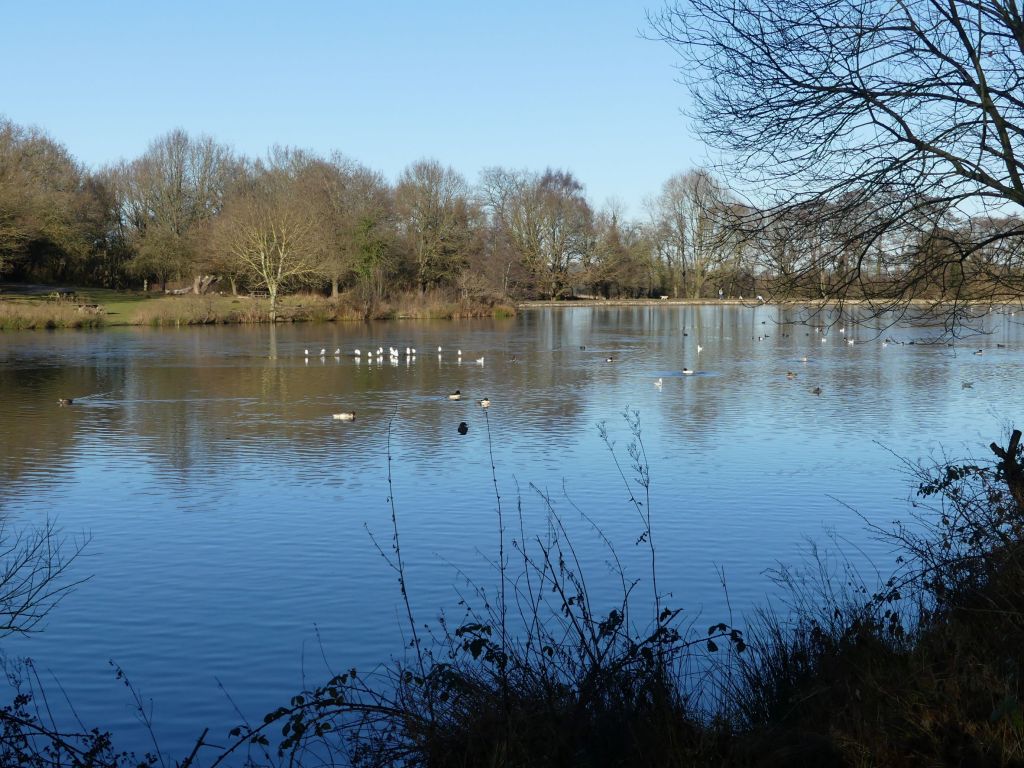
The larger of the Hardwick ponds, 15 January 2022

But I digress! According to believers in Blue Monday, on this particular day we’re likely to be regretting the impact of Christmas excesses on waistline and wallet, and will already have miserably failed to stick to our New Year Resolutions. Daylight hours will be short, the weather inclement and television schedules probably packed with unwatchable rubbish and unwanted repeats. And Mondays are, of course, loathed by anyone with a traditional Monday-to-Friday work pattern.

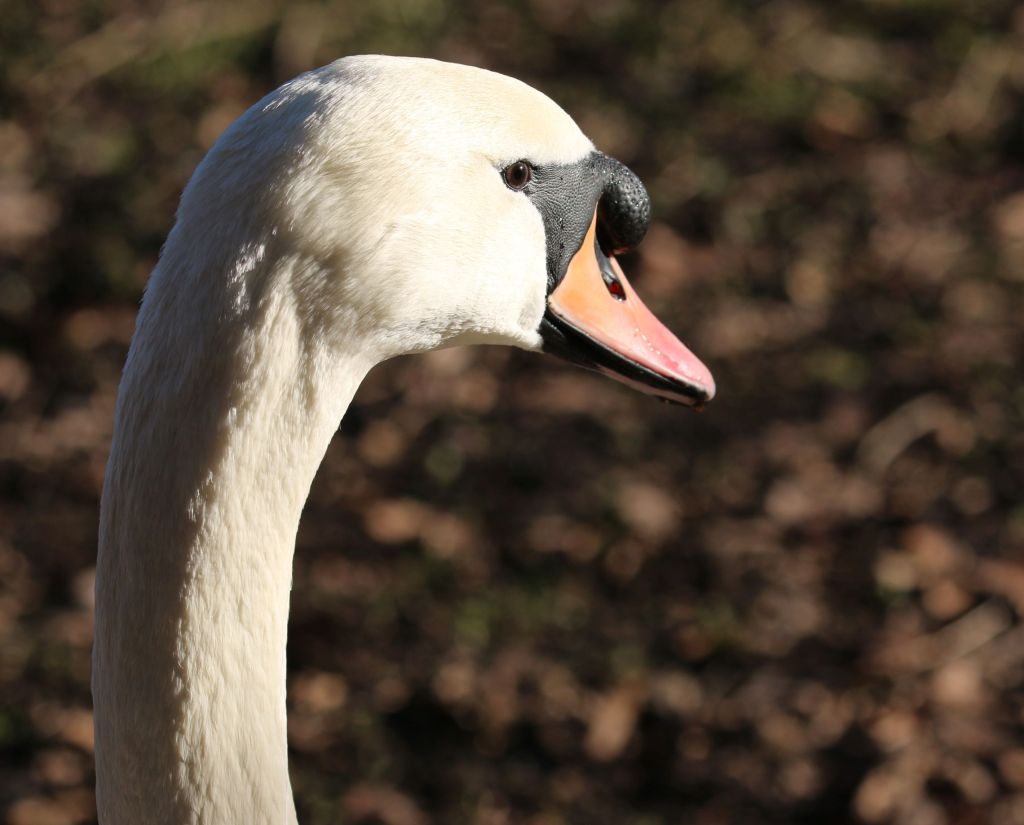
“Most of the usual suspects were there, including…Mute Swans”

It’s nonsense, of course, total bunkum. Even the guy who first came up with the notion is reported to have subsequently disavowed it, describing Blue Monday as a self-fulfilling prophecy that “is not particularly helpful”. But, just to be on the safe side, this year Mrs P and I decided to banish the Blue Monday blues from our lives by doing a spot of birdwatching.

The weather, as it turned out, was perfect, one of those crisp, cold and gloriously sunny midwinter days that make you feel glad to be alive. So we quickly got togged up in our thermals, grabbed cameras and binoculars, and headed off up the M1 to Hardwick ponds.

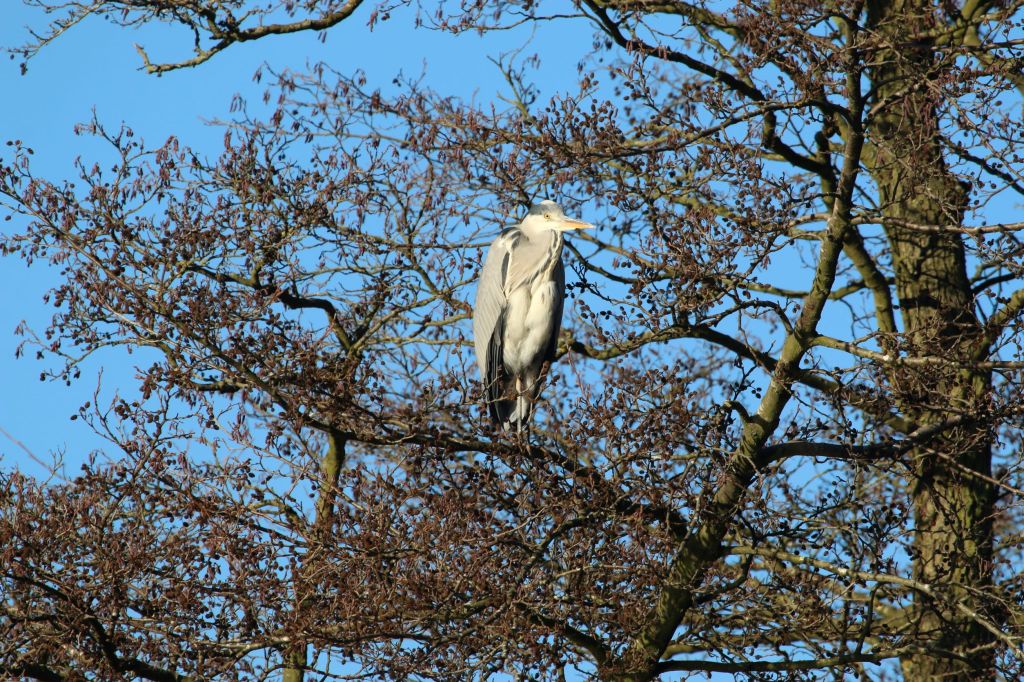
A single Grey Heron, perched high in a tree, surveyed events below with magisterial disdain

Hardwick Hall in Derbyshire is one of our home county’s most significant stately homes, and its impressive parkland includes several large bodies of water that are a haven for a variety of wildfowl. We try to visit Hardwick ponds several times each year, and are never disappointed.

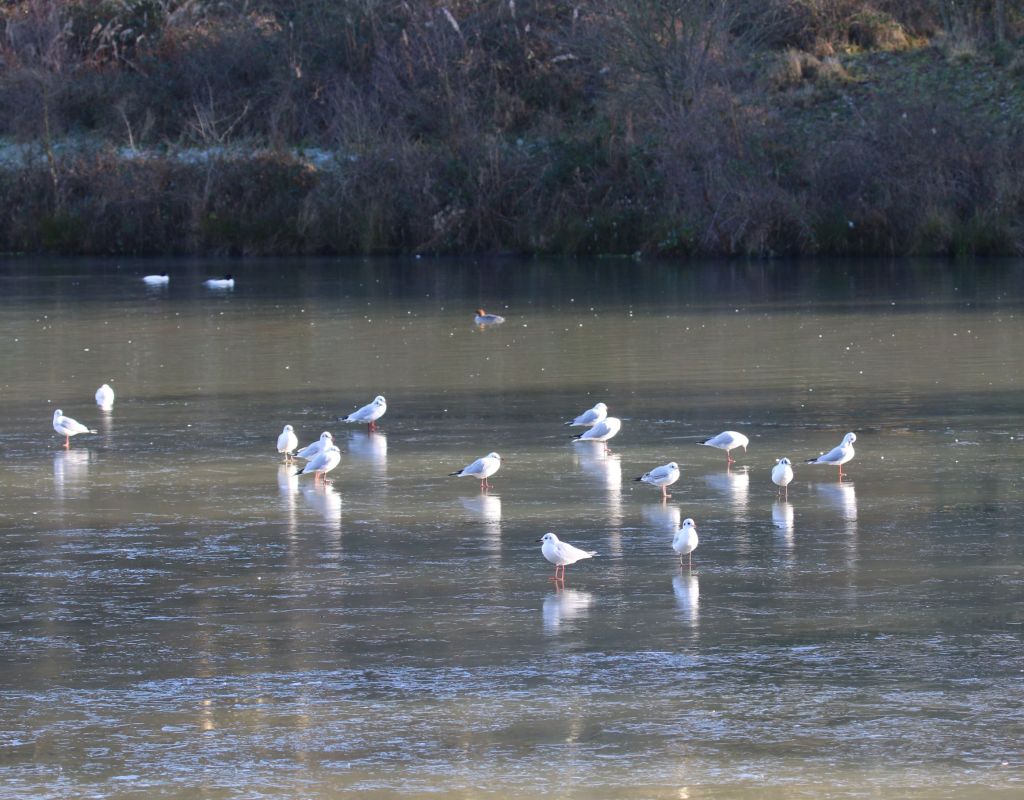
On this occasion both of the larger ponds were partially frozen. Black-headed gulls, wearing winter plumage and puzzled expressions, stood awkwardly on the ice contemplating this unexpected turn of events. The ducks and geese, however, were having none of it and instead sought out those areas of the ponds that remained ice-free.

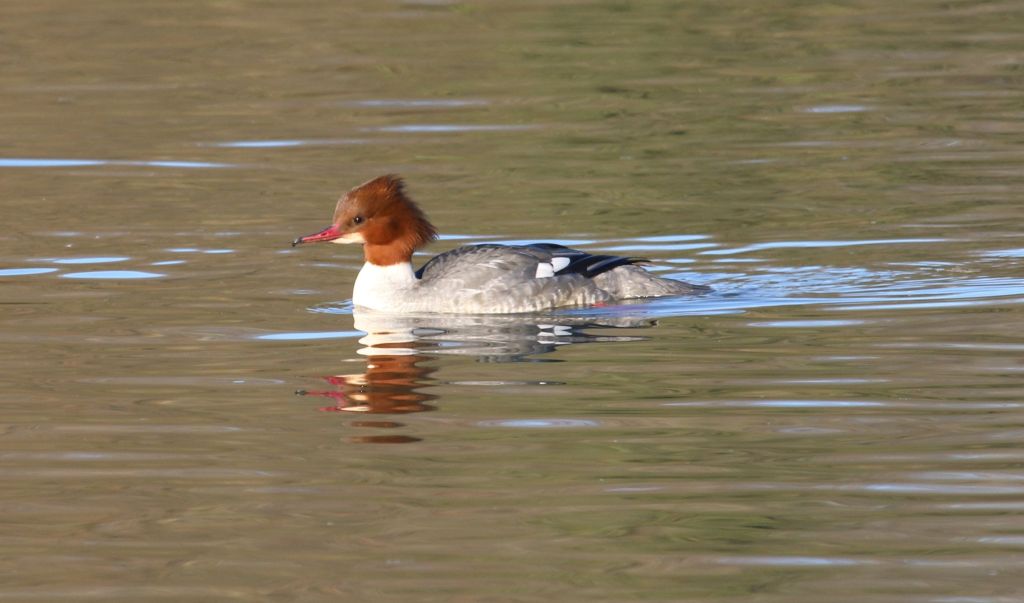
Female goosanders are largely grey, with a distinctive reddish-brown head, white chin, and white secondary feathers on the wings

Most of the usual suspects were there, including Canada Geese, Mute Swans and a Great Crested Grebe. A single Grey Heron, perched high in a tree, surveyed events below with magisterial disdain. Nothing remarkable in any of this, of course, but what really caught our eye was a gang of good-looking Goosanders.

Goosanders are streamlined diving ducks, fish-eaters that use their long, serrated bills to catch and hold on to their slippery prey. They are members of the sawbill family, which also includes the similar-looking Red-Breasted Merganser. To add to the confusion Goosanders can also be seen in the USA, but there they are known as Common Mergansers!

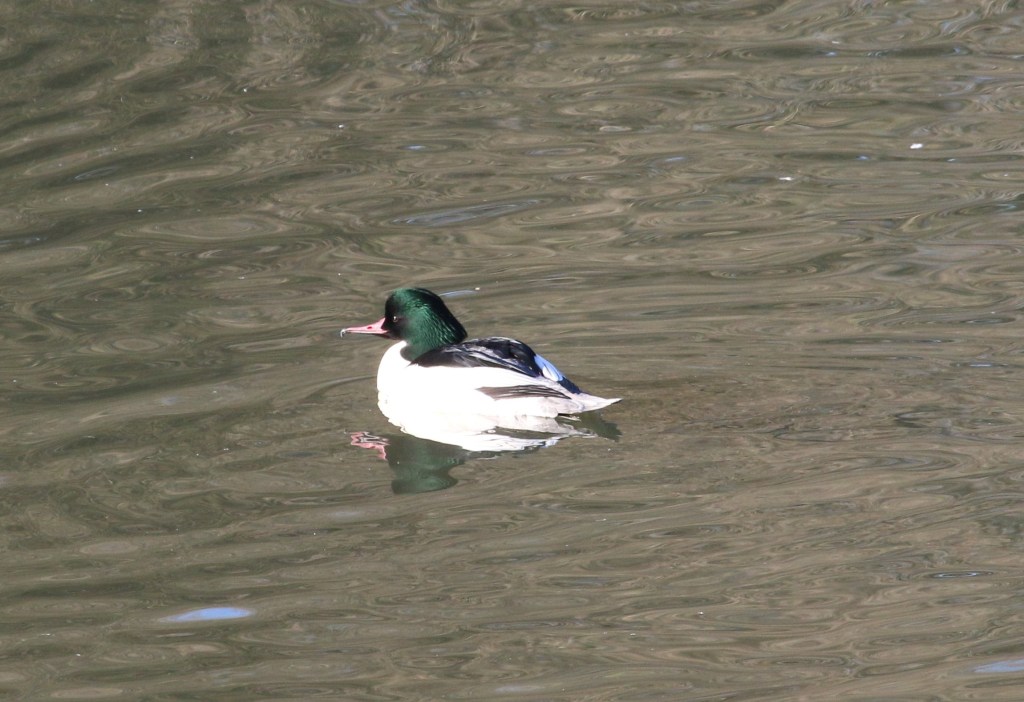
Male goosanders have a white body and a black head which sports an iridescent green gloss. They have a black back, and a grey rump and tail.

Whereas the Red-Breasted Merganser is most commonly seen around the UK’s coastline in winter, Goosanders favour freshwater. Their summer habitat is the fast-flowing upland rivers of Northern England, Scotland and Wales, where they nest in holes in riverbank trees. In winter they move to gravel pits and reservoirs, as well as lakes or large ponds such as those at Hardwick.

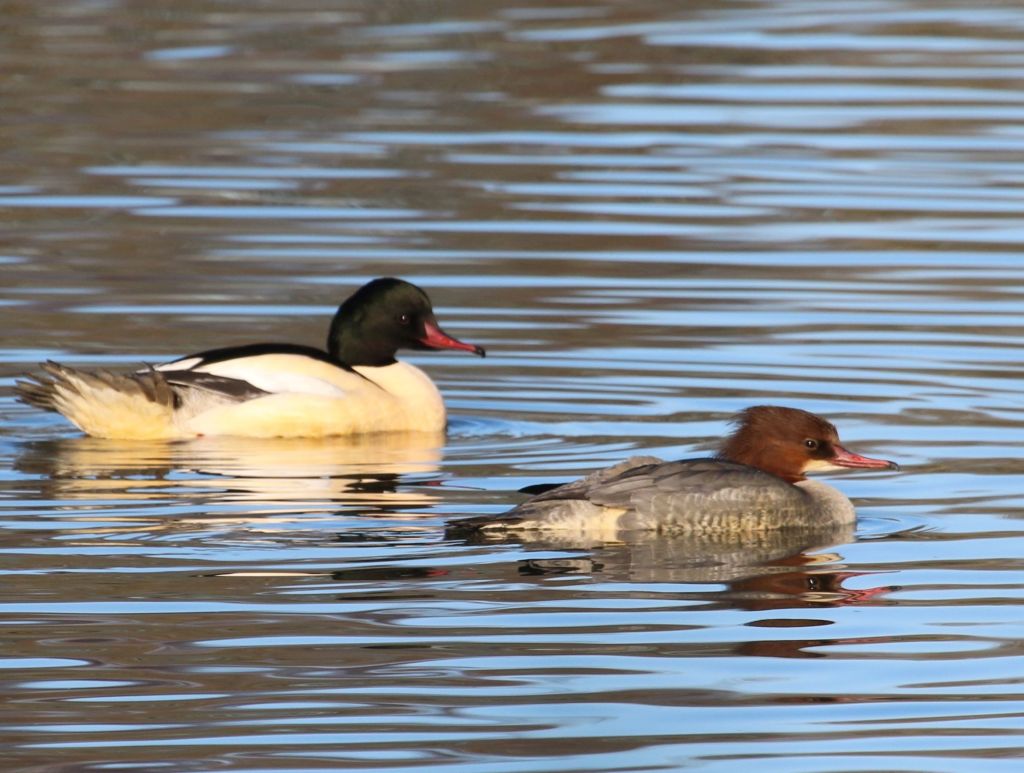
In common with most species of duck, the Goosander displays a high degree of sexual dimorphism. Adult males have a white body and a black head which sports an iridescent green gloss. The have a black back, and a grey rump and tail. Females are largely grey, with a distinctive reddish-brown head, white chin, and white secondary feathers on the wing.

A graphic lesson in sexual dimorphism: male on the left, female on the right, but both the same species!

The Goosander is a relatively new arrival in the UK, having first bred in Scotland in 1871. Its numbers slowly built up there for a century, until in 1970 the species crossed the border to begin colonising England and Wales. There are now thought to be close to 4,000 breeding pairs across the UK as a whole, with the wintering population numbering around 12,000 birds.

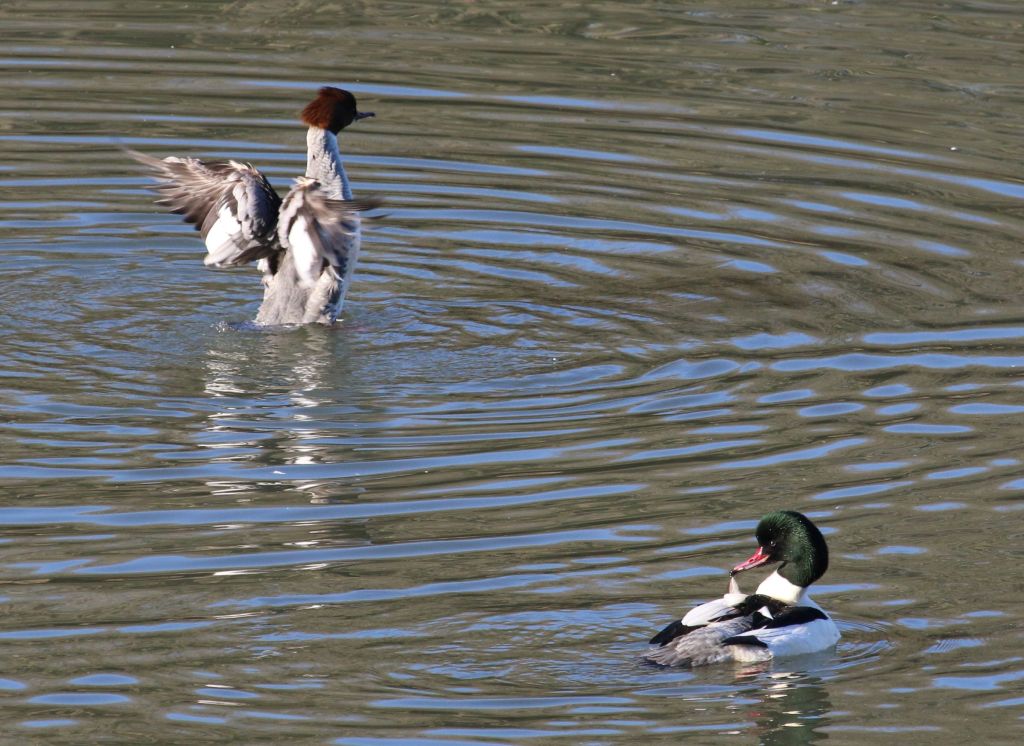
Female goosander having a flap, observed by a preening male

At least a dozen members of that wintering population were present at Hardwick ponds on 15 January, many more than we’ve ever encountered before at a single viewing. It was a delight to see them, and all the other birds that were strutting their stuff that morning. You can catch a glimpse of the Goosanders – and some of Hardwick’s other avian residents too – by clicking on the link below to my short YouTube video.

Blue Monday may have come calling for us last week, but I’m pleased to report that we were very much not at home!

“Black-headed gulls, wearing winter plumage and puzzled expressions, stood awkwardly on the ice”. See also one female and two male Goosanders in the open water to the rear of the gulls.

Yorkshire Wildlife Park: Saving the Warty Pig

Yorkshire Wildlife Park has plenty of iconic critters that are certain to impress visitors. The black rhinos, polar bears and Amur tigers, for example, are guaranteed to provoke appreciative oohs and ahs from delighted punters. But there’s other stuff too, animals that are pretty much unknown to all but the most dedicated wildlife geeks, animals that are maybe a bit more difficult to love. Warty Pigs, for example. I mean, whoever heard of a Warty Pig? And who cares?

I care! It’s true that Visayan Warty Pigs aren’t obviously cute or charismatic, but so what? All living things are intrinsically valuable, worthy of our respect and protection regardless of their looks or lifestyle. And there’s a reason why we’ve never heard of them: they’re all but extinct in the wild, and hail from the Philippines, a little known and unglamorous part of the globe that few of my fellow citizens could locate on a world atlas even if they’ve heard of the place at all.

The Visayan Warty Pig is classified as “critically endangered.” It is endemic to six of the Visayas Islands in the central Philippines, but is believed to be extinct on four of these. Their natural habitat is the rainforest, but between 95% to 98% of it has been lost to commercial forestry and slash-and-burn farming. With their natural food sources severely depleted, the pigs have resorted to raiding cultivated land, and are consequently persecuted as agricultural pests. They are also hunted for bushmeat.

There seems little doubt that, without a major conservation effort and captive breeding, the Visayan Warty Pig is doomed to extinction. Fortunately, there are many programmes, both in the Philippines and in zoos across the world, that are dedicated to saving the species.

And here’s where Yorkshire Wildlife Park is doing its bit. We’ve visited YWP several times over the last couple of years, and have been pleased to see a decent-sized group of adult females and youngsters going about their business in the ample, wooded Warty Pig enclosure. They are feisty, entertaining animals and you can enjoy some of their antics by clicking on the link below to my short video on YouTube.

The adult male – which boasts impressive facial warts, as well as a stiff, spiky crest of hair – lives next door to the main family group, replicating behaviour in the wild where males live apart from the females most of the time.

The male plainly knows his stuff, and his managed encounters with the females have produced multiple, humbug-striped piglets. My brief research on the internet confirms that other zoos are having similar breeding success, suggesting that Visayan Warty Pigs can thrive in captivity. Hopefully, one day, some of their descendants can be reintroduced to the wild, where they rightly belong.

A colourful evening at Yorkshire Wildlife Park

We first visited Yorkshire Wildlife Park (YWP) a few months after I retired, and have returned several times since I have some reservations about keeping wild creatures in captivity (don’t we all?), but the place seems OK. The animals are plainly well cared for, with plenty of space to roam. Importantly, the Park supports a number of conservation initiatives to breed highly endangered species in captivity, and seeks to educate visitors about their plight. I’ll write more about some of these conservation projects later in the year.

To help raise the money needed to care for its animals YWP is always looking for new ways to encourage visitors. Last year we’d planned to visit the Park’s Light and Lantern Festival held around Christmas, but Covid restrictions got in the way. This year the restrictions have been, well, less restrictive…but the weather was miserable throughout December, so we gave it a miss.

Finally, last week, conditions improved and we made the decision to hot-foot it 45 miles (72km) up the M1 to the outskirts of Doncaster to catch the Festival before it ends in mid-January. It was definitely worth the trip, as Mrs P’s photos show. With the exception of one hyena, which was racing madly around its spacious enclosure like Usain Bolt in his prime, living animals were notable by their absence. I suspect they were all sleeping peacefully in their dens and nests, blissfully unaware of the numerous visitors trekking round the Park, ooh-ing and aah-ing at the spectacular illuminations.

The lanterns celebrate many of the animals living at the Park – including lions, leopards and okapi – and some that don’t. A T-Rex and sundry other dinosaurs paid homage to animals that none of us will ever see in the flesh. Let’s hope that the conservation initiatives supported by YWP, and similar bodies throughout the UK and beyond, mean that the species currently living there won’t suffer a similar fate to that of the dearly departed dinos.

The Festival of Christmas Trees at Chesterfield parish church

The Christmas season seems to have been with us forever. Pubs and restaurants have been promoting their festive menus for months. For several weeks shops have been cluttered with seasonal promotions. And Christmas trees are springing up all over the place, in public spaces, shops and windows all over town.

The tree on the far right is sponsored by a bridalwear business: brilliantly inventive!

The link between evergreen plants, including fir trees, and mid-winter festivals pre-dates Christianity. It reflects our ancestors’ conviction that, even on the darkest of days, better times and the green shoots of spring are just around the corner.

The Christmas tradition of bringing fir trees into the home and decorating them appears to have developed in the 16th century, in the area of Europe we now know as Germany. However it didn’t catch on in the UK until the middle of the 19th century.

The sudden rise in the popularity of Christmas trees here was down to the royal family, which had historic links with Germany. These were boosted in 1841 when Queen Victoria married her German cousin Prince Albert, who had fond memories of Christmas trees from his childhood.

In the centre a tree decorated by a local mortgage broker featuring “baubles” in the shape of houses, and a silver key (presumably the key to the home you might buy with the help of their services!)

In 1848 the Illustrated London News reported enthusiastically on the Christmas trees Victoria and Albert had put up at Windsor Castle. It also featured on its front cover an illustration of a cluster of happy royals admiring their biggest and best tree. The paper was widely read in well-to-do circles in and around London, and other newspapers also picked up on its story.

It soon became widely known just what the royals were up to, and at a time when it was fashionable amongst the wealthier classes to copy the lifestyle and habits of royalty, Christmas trees became all the rage. But only, of course, amongst those sections of the population with money to acquire them and the space to display them.

Centre left is a tree by a business selling intruder alarms (the “baubles” are actually Passive Infra-Red [PIR] detectors!) The centre right tree is from a local jeweller.

In time the fashion trickled down through the social hierarchy until just about everyone in the country aspired to celebrate Our Lord’s birthday by chopping down a poor, defenceless little fir tree and disfiguring it with gaudily tasteless decorations. Bah, humbug!

* * *

Please forgive the previous paragraph… I jest, of course. In fact, Mrs P and I do rather like Christmas trees, although at Platypus Towers we make do with an artificial one to avoid the carpet being knee-deep in pine needles before Twelfth Night. So to get into the Christmas spirit, a couple of weeks ago we took a trip to the north of our home county of Derbyshire to visit the Festival of Christmas Trees at the parish church of St Mary and All Saints in Chesterfield.

Not all trees are from businesses. Second from the left is a tree presented by BANA (British Acoustic Neuroma Association) and second from the right is one from Chesterfield Panthers Rugby Club.

We discovered that the church was playing host to around 120 Christmas trees donated and decorated by local businesses, community organisations, service providers and sports clubs. Of course, the motivation of those providing the trees wasn’t entirely selfless: promotion of their products, services and causes appeared to be the name of the game in most cases.

But it doesn’t pay to be churlish. Plenty of folk just like us were also wandering happily through the church that Thursday morning, admiring the imagination and inventiveness of the people behind the various Christmas tree creations. It’s been a difficult year for most of us, although perhaps not quite as grim as 2020, and the Festival of Christmas Trees felt like a good attempt to raise community spirits, to bring people together and to encourage everyone to look forward to more cheerful times ahead. I’m pleased we made the effort to attend.

A local timber merchant celebrates the crooked spire of St Mary and All Saints church

Andy Warhol, the Devil and unexpected virgins: the story of Chesterfield’s crooked spire

Andy Warhol is said to have observed that in the future everyone will be famous for 15 minutes.  By extension it might be argued that everywhere will be famous too, that each and every place under the sun will become well-known for something, albeit in most cases something rather insignificant. Chesterfield, for example, is famous for the crooked spire that graces its medieval church, but for little else.

Chesterfield, for the uninitiated, is a town in the north of my home county of Derbyshire. Home to around 100,000 people, for the most part it’s a pleasant though unremarkable place. The coal industry that once dominated the landscape and economy of this part of Derbyshire is all gone now, and today Chesterfield’s role is primarily as a service centre for the surrounding area.

Bizarrely, just as I was about to start writing this post, a news report popped up in my inbox declaring that, according to a recent survey, Chesterfield is the happiest place to live in the whole of the English East Midlands. Really? I worked there for a couple of years in the late 1980s and don’t recall it being unusually joyful. But maybe the outbreak of local happiness coincided with my departure? Sounds plausible!

Reading the newspaper report more closely, I see that even some of the local residents query the accuracy of this accolade. Objectively, I suspect most unbiased observers would regard Chesterfield as memorably unmemorable, were it not for the iconic architectural imperfection otherwise known as the parish church of St Mary and All Saints.

Completed around the year 1360, St Mary’s and All Saints is Derbyshire’s largest church. It’s famed for its unusual crooked spire, which leans 9 feet 5 inches (nearly 3 metres) from true.  To be clear, this is not an eccentrically flamboyant design statement…the spire is meant to point straight up, like every other church spire in the known universe.

So what went wrong? The traditional explanation is that it was built with green, unseasoned timbers, which warped over time. But that can’t be it. Builders in the Middle Ages were accustomed to using used green timber, and would have made allowances to cope with it.

A more convincing explanation is that the spire’s 32 tonnes of lead tiles were simply too heavy. According to this theory the sheer weight of the tiles, combined with the failure to use cross-bracing, caused the spire to twist and lean alarmingly.

The omission of cross-bracing has been blamed on the Black Death, a plague that swept through the country between 1348 and 1350. If the experienced craftsmen working on the new Chesterfield church were killed by the disease, the spire may have been finished by unskilled builders to whom the concept of cross-bracing was totally unknown.

Accurate though this explanation may be, it’s disappointingly boring. Unsurprisingly, local folklore offers some more entertaining possibilities. One of these tells that the Devil was resting on the spire, where he was able to keep his balance only by wrapping his tail around it. However the smell of holy incense from inside the church offended him so much that he sneezed violently, jerking his tail in the process and causing the spire to twist.

A second explanation also blames the Devil. Old Nick was resting up on the church spire, his tail tightly wrapped around it while planning mischief and mayhem. In fear for the souls of his fellow townsfolk, one brave man rushed to the church, determined to warn everyone by ringing the church bells. The din was cacophonous. Taken totally by surprise, a shocked Devil lost his balance and toppled from the spire, twisting it as he plunged to the ground.

A third local legend once again points the finger of suspicion at the Devil According to this story, Satan was resting on the spire, tail wrapped round it in the now familiar manner. Looking below, he noticed a wedding about to take place in the church. On closer inspection he realised that the bride was a virgin, an occurrence so surprising in Chesterfield that he fainted from shock. As the unconscious Devil hurtled towards the ground his tail, still wrapped around the spire, twisted it into its current shape.

The fourth theory lets the Devil off the hook, and instead puts the blame squarely on the healthy sexual appetite of Chesterfield residents. According to this version, a virgin got married in St Mary’s, and the church itself was so surprised that its spire turned around to get a better look at such a rare specimen. The legend continues that if another virgin ever marries in the church, the spire will return to its original form again. Don’t hold your breath, folks!

Further explanations for the origin of Chesterfield’s crooked spire are available if you care to look, most of them involving the Devil or unexpected virgins. A definitive, agreed version, doesn’t seem likely to emerge any time soon. However, one thing is beyond dispute: the locals have taken this quirky architectural blunder to their hearts.

For example the local professional soccer team, Chesterfield Town FC, are known to fans as the Spireites, while over the years various local businesses have referred to the crooked spire in their branding and promotions. And who can blame them? Chesterfield’s crooked spire is a spectacular sight, and ensures that an otherwise rather unexceptional town enjoys its 15 minutes of fame. Andy Warhol would be impressed.

Rutland’s horseshoes: a tale of superstition and obsession

Popular culture tells us that horseshoes bring good luck. If this is so, then Rutland should be the luckiest county in all of England. A tradition dating back hundreds of years requires nobles visiting Oakham, Rutland’s biggest town, to present the local Lord of the Manor with a horseshoe. All horseshoes thus gifted to the Lord are displayed on the wall of his Great Hall at Oakham castle. As we discovered when we visited Oakham earlier this year, the horseshoe collection numbers over 200 and continues to grow.

Ornate horseshoes big and small adorn the walls of the Great Hall of Oakham Castle

But in a cruel twist of fate, Rutland’s horseshoes may not be lucky after all. Traditionally, British people believe that horseshoes can only be lucky if they are hung with the closed cup at the bottom, and the two open ends pointing skyward. But in Rutland they do it the other way round. Are these people crazy, or have they got a point? Read on, and I’ll tell you more.

Why are horseshoes considered lucky?

To begin, however, let’s explore why horseshoes are considered to be lucky. In times past the blacksmith was regarded as something of a benevolent magician. Here was a man who could, with only fire and brute strength to assist him, conjure from useless rock a valuable metal with a thousand useful applications. If blacksmiths were magicians, then iron and the wares they fashioned from it, such as horseshoes, must be imbued with good fortune too.

Added to this was the fact that horseshoes were traditionally secured with seven nails. Within our culture seven is regarded as the luckiest number, and this – combined with the good fortune attached to blacksmith magicians – confirmed the association between horseshoes and good luck.

The horseshoes quickly became status symbols, intended to show off the wealth, good taste and fine breeding of the people presenting them.

There’s also a religious dimension, dating from the 10th century. Before becoming Archbishop of Canterbury, Saint Dunstan worked as a blacksmith. One day the Devil appeared before him and asked the future Archbishop to shoe his horse. Although recognising his visitor, blacksmith Dunstan said nothing, while secretly hatching a cunning plan.

Instead of fixing the shoe to the horse’s hoof he nailed it to the Devil’s own foot. The Devil howled with pain and rage. He probably swore a bit too, and demanded to be released. However Dunstan stood firm, and only agreed to remove the shoe after receiving Satan’s solemn promise that he would never enter a dwelling with a horseshoe nailed to the door. And so, according to the story, horseshoes are so imbued with good fortune they can even keep the Devil at bay.

The traditional British way of hanging horseshoes, with the cup nearest the floor, is said to ensure that the good luck will be safely stored there, and will not spill out to be wasted. Rutland folk, however, believe that nailing a horseshoe to the wall with the open end at the bottom will ensure that good luck falls onto those passing beneath it. This way of hanging it is also said to prevent the Devil hiding in the cup of the horseshoe, from where he might otherwise orchestrate mischief and mayhem.

Horseshoes presented by two members of the family of wartime Prime Minister Winston Churchill

So which way of hanging up a horseshoe is correct? Who knows?…I certainly don’t, but anyone of a superstitious disposition may be wise to have two horseshoes, one hanging with the cup at the bottom and the other with it at the top. It’s called risk management, guys!

Rutland’s historic obsession with horseshoes

Anyway, moving swiftly on to Rutland’s obsession with horseshoes, which dates back many hundreds of years. At the time of the Norman Conquest, one Henry de Ferrers was Master of Horse to the man who became known to history as William the Conqueror. Henry’s coat of arms featured six black horseshoes (with the closed, or cup, end at the top!) on a silver background. Later, as a token of his gratitude, William rewarded Henry with many grants of land, including the manor of Oakham, where the de Ferrers family later built a castle with a Great Hall.

Prince Charles and the Duchess of York have both presented horseshoes

The de Ferrers family name is a corruption of the word French word ferrier (farrier – a person who shoes horses – in English), and therefore hints at the family’s long association with the iron industry. So at some time in past, probably after too much ale had been consumed, some bright spark in the family came up with the crazy notion of demanding that all noble visitors be required, on their first trip to Oakham, to acknowledge their host’s heritage by presenting the Lord of the Manor with a horseshoe.

It tells us something about the power of the de Ferrers family that visitors went along with this daft demand. But typical of the aristocracy, before long they’d turned it into a contest, visitors trying to outdo one another with the size and extravagance of the horseshoes they presented.

The oldest horseshoe remaining in the castle collection was given by King Edward IV in the late 15th century, and is decorated with the royal coat of arms. From the late 18th century onwards the practice emerged of donors decorating their horseshoes with coronets to signify their rank within the British peerage system. In a stroke, therefore, the horseshoes were turned into status symbols, showing off how wealthy and “well-bred” the donors were.

Oakham castle’s Great Hall dates from 1190. It is believed to be the earliest and best preserved aisled hall in northern Europe

Although there are approaching 250 horseshoes on display in Oakham castle’s Great Hall, this is only a fraction of the number that have been presented over the centuries. In the early days of the tradition, horseshoes were displayed on the castle gates rather than the inside wall of the Great Hall, making them vulnerable to theft. Also, over the years, some of the less impressive donations have been quietly “mislaid” and forgotten. And in the early 20th century great numbers of horseshoes were melted down as scrap metal to help the war effort during the First World War.

Despite all of the losses, the collection remains mightily impressive. The internal walls of the Great Hall are festooned with the good, the bad and the ugly of the horseshoe world. And yet it’s still possible to find room for a new one when a member of the Royal Family comes calling: in 2003 Prince Charles, heir to the British throne, presented a horseshoe. Eleven years later his wife Camilla, Duchess of Cornwall, followed suit.

Rutland’s horseshoes come in all shapes and sizes!

Rutland’s obsession with horseshoes is quintessential British quirkiness. You couldn’t make it up. But it’s also strangely endearing, a bit of harmless fun. I just wish they’d hang their horseshoes the correct way up. In these troubled days of pandemics and wars, climate crises and mass extinctions, mankind needs all the good luck it can muster. Carelessly allowing good fortune to leak out and blow away by hanging your horseshoes upside down just isn’t good enough, Rutland!

After a gap of 800 years…there are beavers in Derbyshire again!

The UK has one of the worst records of any country in the world for protecting its historic biodiversity. This should come as no surprise to those of us who live on this crazy, crowded island where caring for the natural world has traditionally played second fiddle to making a quick buck. But the tide is beginning to turn: up and down the country many of us are fighting back, seeking to look after what we still have and, where possible, to reintroduce what we have lost. Which brings me to the inspiring story of Derbyshire’s beavers.

If the experts are to be believed, beavers were wiped out in my home county around 800 years ago. Now I’m not sure quite how they know that, I can’t quite believe that one of the local lords recorded the event for posterity in his diary, writing something like “Great news, just exterminated the last beaver in Derbyshire, so now our trees will be safe forever…until, that is, we want to chop them down for firewood, or to make floorboards or beer barrels or whatever.

To be honest, the exact date doesn’t really matter. The incontestable fact is that, following the end of the last Ice Age, beavers were common hereabouts for many thousand of years, before becoming extinct in the Middle Ages.

VIDEO CREDIT: Derbyshire Wildlife Trust. Film of the first beaver being released at Willington Wetland Nature Reserve on a blustery day in late September 2021

On one level, the extinction of the beaver can be seen simply as the regrettable loss of one of this island’s few cuddly mammals, a mammal guaranteed to elicit sighs of “Ah, so cute” from ordinary folk encountering them going about their daily business in the wild. But there’s more to it than that. Beavers are landscape engineers, a keystone species that shapes environmental conditions in a manner beneficial to countless other species.

By digging canal systems and damming water courses, beavers create diverse wetland areas, places where fish can safely spawn and other animals such as otters, water voles and water shrews can make their homes. Insects thrive in the waterways constructed and maintained by beavers, and these in turn nourish a range of bird species. In creating suitable habitats for themselves, therefore, beavers help create robust ecosystems in which a whole range of species can flourish.

But it’s not just wildlife that benefits from these hefty rodents beavering away in the countryside – there’s a payoff for humans too. It is argued that beaver dams improve water-quality by acting as filters which trap soil and other pollutants washed into rivers from surrounding farmland.  The ponds created by beaver dams also impact on the flow of rivers, and can help mitigate downstream flooding after periods of heavy rain.

VIDEO CREDIT: (c) Helen Birkinshaw via Derbyshire Wildlife Trust. On Friday 8th October, the day after the second pair of beavers were released, the male was spotted swimming near the release site

Given these credentials it’s no surprise that environmental organisations have long been keen to see beavers reintroduced to the UK. Scotland led the way, and there are spots there where animals reintroduced from continental Europe are already thriving. In England the first major reintroduction initiative was in Devon, led by Devon Wildlife Trust in partnership with a range of other interested parties.

Having watched for several years the success of beaver reintroductions in other parts of the country, Mrs P and I were thrilled when our local conservation organisation – Derbyshire Wildlife Trust – announced its own plans for a project at the Willington Wetlands Nature Reserve in the south of the county. When the Trust appealed for donations to help fund the initiative we were pleased to help.

Progress stalled for a while due to disruption caused by the Covid pandemic. But at last, a few weeks ago, we got an email from the Trust inviting us to sign up to attend an online event at which a pair of beavers would be released into their new Derbyshire home. The animals had been captured on the River Tay in Scotland, where the species is now doing very well. After a period of quarantine and some health checks the beavers were transported to Derbyshire in special wooden crates on the back of a pick up truck.

VIDEO CREDIT: Derbyshire Wildlife Trust. Camera trap footage of one of the beavers snacking on a branch. Plainly the beavers have already begun to modify the local landscape!

The release of the two animals went perfectly. We’d feared they would dash for the water the second the doors of their crates were opened, and immediately dive to disappear from view. Instead they took their time, seemingly untroubled by the stress of their long road journey, and put on a bit of a show for their adoring online fans. Huddled around our laptop at home, it was a privilege to watch the images of history being made just a few short miles away. At last, after an absence of some 800 years, beavers were back in Derbyshire!

A couple of weeks later the Trust released a second pair of beavers into their enclosure at the Willington Wetlands Nature Reserve, The enclosure is surrounded by a specially designed beaver-proof fence and large enough at 40 hectares, or just shy of 100 acres, to allow the animals to live entirely natural lives. The brook flowing through the enclosure guarantees a suitable wetland habitat, and a wide range of native plants and trees will offer the beavers all the food they need to live long and happy lives.

With a bit of luck, next year we will be celebrating the first beavers to be born in Derbyshire since the Middle Ages!

VIDEO CREDIT: Derbyshire Wildlife Trust. More camera trap footage. The Willington Reserve’s newest residents seem relaxed, and are making themselves at home!

* * * * *

For further information on the reintroduction of beavers in the UK see the following links

Ford Green Hall: a snapshot in time

We really enjoyed our visit to Ford Green Hall, a fine example of a timber-framed farmhouse built in 1624 on the outskirts of Stoke-on-Trent in the county of Staffordshire. Who wouldn’t appreciate such an iconic building, positively dripping with atmosphere, creaking at the seams with nearly 400 years of history? Such places are strangely comforting, aren’t they, islands of calm and stability amidst a raging ocean of rapid change. They seem timeless, as perfect and wonderful as the day they were first conceived all those centuries ago.

Rear view. The half-timbered black and white core of the building dates from 1624. The brick-built extensions to left and right were added about 100 years later.

But look a bit closer and you’ll quickly realise that it ain’t necessarily so.

When approaching Ford Green Hall the visitor’s attention is drawn to the picturesque timber-framed parts, which are plainly very old. And that’s why we’re here, isn’t it, to see some old stuff. We conveniently block out from our minds the fact that to either side of the building’s black-and-white core are two rather more modern and less attractive brick-built extensions.

Front view. The black and white projection towards the right of the hall is a gabled two-storeyed porch, added just a few years after the hall was first built. This extension is early evidence of the building’s dynamic history.

The plain fact is that by the early 18th century Ford Green Hall wasn’t meeting its owner’s needs, so around 1734 he added two new wings. To our modern eyes these wings are somewhat unsightly – perhaps even a little ugly – and serve only to disfigure the majesty of the half-timbered building to which they’ve been attached. Back in the day, however, the owner will have felt very pleased with himself for modernising an inadequate building that appeared to be stuck in the past.

Worse was to follow – from our modern, sentimental perspective – in the years that followed. Half-timbered buildings fell out of fashion to such a degree that the external timbers were covered up altogether, coated in stucco to disguise the hall’s 17th century origins. The name of the game was modernisation: out with the old and in with the new, and if you can’t get rid of the old altogether at least do the decent thing and hide it from view.

The Hall Chamber (first floor) was originally used as a bedroom, and at the time of Hugh Ford’s death in 1712 it contained 3 beds.

In the nineteenth century the long term owners of the hall – the Ford family – moved away, prompting a further decline in its fortunes. Divided first into three and later four cottages, which housed local coal miners, the building’s glory days appeared over until the local council stepped in.

Stoke-on-Trent City Council purchased the hall in 1946 and, following a major restoration – including removal of all the hideous stucco – opened it as a museum in 1952. They furnished is sumptuously, in the style of a 17th-century yeoman farmer’s house.

The Hall (ground floor) was the most important room of the house. Originally much of the cooking would have been carried out over the hearth in this room, and the family would also have eaten their meals here.

When the Council ran into financial difficulties (don’t they all, sooner or later?) in 2011, the museum faced closure. At this point the voluntary sector came to the rescue, with a charitable trust taking over its running. And they’ve done a good job: as far as we could see, when we visited a few weeks ago. Ford Green Hall is thriving once again despite the best efforts of local government and the Covid virus to throw spanners into the works.

This restoration project has done a great job of preserving a historic structure that would otherwise have perished. However it’s important to remember that what exists today doesn’t reflect the vision of the man who commissioned the building in the early 17th century, and gives few hints as to its varied history.

The Parlour (ground floor) was originally used as both principal bedroom and sitting-room.

When we visit Ford Green Hall, or any other historic building that has been restored for its heritage value, we are simply being treated to a snapshot in time. The true history of such places is always much more dynamic and complex than is apparent to the casual observer.