Kedleston Hall – a masterpiece that lasts all year

Kedleston Hall is yet another of our local stately homes that gets dressed up for Christmas, so one morning a couple of weeks ago we decided to check out its latest festive makeover. Poor Kedleston, Derbyshire’s forgotten treasure, is forever in the shadow of the local legend that is Chatsworth House. However, in my view anyway, the place is a seriously under-appreciated masterpiece that’s worth visiting at any time of the year, not just at Christmas.

Chatsworth, ancestral home of the Dukes of Devonshire, has a national profile and is beloved by locals and tourists alike. And very fine it is too, if bling is your thing. I like Chatsworth well enough, of course, but if given the choice I’d prefer to potter around Kedleston any day.

The Marble Hall

Kedleston Hall is an 18th century Palladian and Neoclassical wonder. To build it, local bigwig landowner Nathaniel Curzon, 1st Baron Scarsdale (1726-1804) flattened an entire village of the same name, thus ensuring that he wouldn’t have to endure unwanted encounters with the local peasantry while wandering his estate.

The Drawing Room

Behaviour like this was typical of men of his ilk at the time, and from a 21st century perspective is totally inexcusable. The only mitigation one might offer is that Curzon built a damned fine house on the land he so rapaciously reclaimed from his tenants, though I doubt that this was much of a comfort at the time to the poor people he made homeless.

The Library

Although the Curzon family still lives in part of the Hall, the property and surrounding parkland is now owned on behalf of the nation by the National Trust. Here’s what the Trust’s website has to say about Kedleston:

“Kedleston Hall is an extravagant temple to the arts designed by the architect Robert Adam…The house is framed by historic parkland and boasts opulent interiors intended to impress. Designed for lavish entertaining, Kedleston Hall displays an extensive collection of paintings, sculpture and original furnishings, reflecting both the tastes of its creators and their fascination with the classical world of the Roman Empire.”

Source: National Trust website, retrieved 13 December 2022

Neo-classicism may not be to everyone’s taste, but it works for me, The elegance and sheer beauty of Robert Adam’s work is breath-taking, and while I was looking forward to a bit of Christmas cheer at Kedleston I was concerned that it might detract from the majesty of the Hall’s state rooms. But I need not have worried: the Christmas decorations were tastefully restrained, and the Adam’s interiors remained the stars of the show.

The Saloon

Entrance to the mansion is via the grand Marble Hall. With walls boasting multiple niches that display statues in the classical Roman style, and lined by 20 soaring, fluted alabaster columns topped with elaborate Corinthian capitals, the Marble Hall is clearly a statement piece. It is designed to overawe visitors, to advise them that they have entered the home of someone richer, more cultured, and more powerful than they can ever hope to be. Know your place! it proclaims.

The Music Room

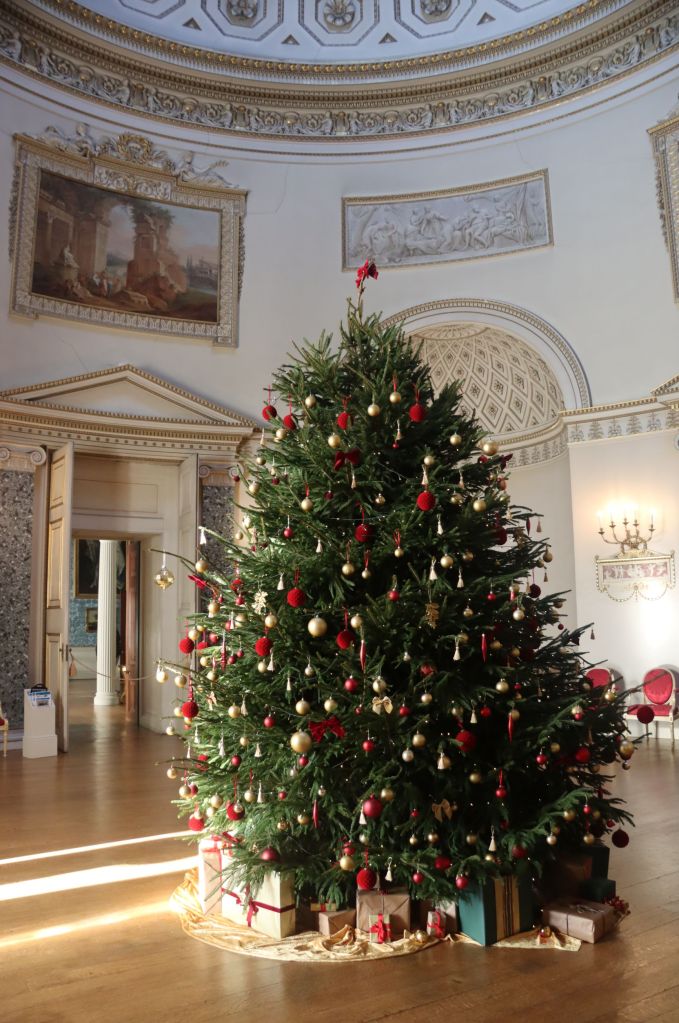
Equally impressive is the Saloon, a circular room rising 62 feet (19m) to a grand glass skylight. It was designed as a sculpture gallery, the style being based on the temples of a Roman Forum. The modest Christmas tree at its centre did little to distract our attention the sheer elegance of the room’s design.

Clockwise from Top left: The Library. Top right: Ante Room / Dressing Room. Bottom Right: The Saloon. Bottom Left: View through Ante Room / Dressing Room to the Christmas tree in the Saloon. Middle (bottom): The Dining Room. Middle (top): The Family Room

The other state rooms, including the Library, Drawing Room and the Dining Room, are equally impressive. And that’s the point. This place was built to impress, and it does just that. More than Chatsworth House, and more than just about every other stately home I’ve ever visited, it positively exudes the wow factor. I love Kedleston Hall just as much as I’m sure I would have disliked Nathaniel Curzon, the guy who commissioned this spectacular mansion…anyone with an ego that big must have been seriously bad news!

In the Deep Midwinter: Christmas at Chatsworth House

Chatsworth House, ancestral home of the Dukes of Devonshire, is one of England’s foremost stately homes. It’s run as a business, depending for its survival largely on the income it generates by welcoming paying members of the public to explore the stunning house and massive ornamental gardens. As with so many visitor attractions, the Christmas season is vitally important for the health of the enterprise. This is even more true in 2022, as Chatsworth seeks to recover from the damage inflicted upon the business by Covid.

Chatsworth’s famous Cascade, which dates from around 1708, flanked here by rows of eerily lit trees

And when we visited a couple of weeks ago visitors were out in force to experience this year’s Christmas extravaganza. Here’s what the website told us to expect:

Deep Midwinter: A Nordic Christmas at Chatsworth brings to life the Christmas folklore and traditions of the Arctic and Nordic regions through a series of themed roomscapes. Sculpted ‘ice’ walls, tranquil pine forests, lanterns, traditional Nordic Christmas decorations and foliage foraged from woodlands and hedgerows across the estate evoke the sights, sounds and scents of the natural world at wintertime…

Our Nordic theme continues into the garden with an enchanting Christmas light trail. Experience our ‘northern lights’ over the Canal Pond, let colour guide you along Broad Walk into a glade of glowing lights and, for the first time, see the Maze illuminated and filled with festive music.

Sounds great, doesn’t it? But sadly, it didn’t live up to expectations. In 2019, the last time we visited Chatsworth at Christmas, we were blown away by decorations on the theme of “a land far, far away.” This year, however, we were distinctly underwhelmed: the Nordic associations pretty much passed us by, and the decorations lacked impact. Worse still, we paid nearly £30 (USD 37) per head for the privilege.

Some grand stately homes in other parts of the country charge quite a bit more for their Christmas celebration – Blenheim Palace, for example – but, if recent television coverage is to be believed, they offer a lot more too. Clearly, £30 per head isn’t a fortune, but that’s not the point. The question is, does it represent value for money, particularly as we are currently in the midst of a nationwide “cost of living crisis”? I don’t think so.

One of the more attractive features of the “enchanting lights trail” in the garden.

Don’t get me wrong, our visit wasn’t a total waste of time. Parts of the garden lights trail were pretty good, while the best of the decorated rooms of the House were very well done. And if you’d never been to Chatsworth before the whole show probably made a good, although very crowded, introduction to the House’s splendours. But we know the place well and – based on what we saw in 2019, and what we paid for our tickets this time – we expected rather more. The photos I’ve used to illustrate this piece feature the highlights, but the majority of “the experience” was a lot more mundane.

Maybe they had a limited budget in 2022, as a result of Covid’s impact on revenue streams? Or did they spread their resources too thinly, by having “an enchanting lights trail” in the gardens as well as decorating the House (in 2019, the Christmas extravaganza was limited just to the House, and didn’t extend into the gardens). But I can’t help worrying that Chatsworth’s trading on its name, making a calculated underinvestment in this seasonal attraction on the assumption that people will turn up anyway, just because it’s Chatsworth?

Top left: The Painted Hall. Top right: Another room, another group of trees, and a stray speaker playing Christmas music! Middle right: The Library. Bottom: The Chapel. The golden statue between the trees is by the notorious contemporary British sculptor Damien Hirst.

If so, I fear that may be a bit short-sighted, as there are plenty of other stately homes around here that also put on a show at Christmas. People who shared our disappointment with Chatsworth’s efforts this time may well choose next year to get their seasonal cheer somewhere else, somewhere offering the prospect of seeing more while paying less.

Hopefully, this is a one off, and Chatsworth will be back on form in time for Christmas 2023. Until this year they’ve had a good track record, so we’ll probably give them another chance. I’ll report back 12 months from now!

Burton Agnes celebrates Christmas

Although Burton Agnes may sound like the upper crust villain of an Agatha Christie novel, the reality is altogether more interesting. Built between 1598 and 1610 near the village of Driffield in the East Riding of Yorkshire, Burton Agnes is a magnificent Elizabethan mansion that’s been associated with the same family for over 400 years.

Although the Hall is now managed by a charitable trust, the family still lives there. To help cover the cost of its upkeep, paying visitors are invited to have a poke around this Grade I Listed architectural masterpiece. And, inevitably, the period before Christmas is a great time to pep up the income stream.

The Great Hall

This, of course, is nothing unusual. Up and down the land the good, the bad and the ugly of British stately homes open their doors to the Great British Public at this time of year, anxious to milk the cash cow that is Christmas.

Some do a great job, investing heavily to decorate their mansions with festive frivolities that are sure to get their visitors into the mood for Christmas and, hopefully, will encourage them to return the next year. Others, I suspect, do the absolute minimum that they calculate is necessary to prevent the paying public demanding its money back.

Burton Agnes, which we visited a couple of weeks ago, felt like good value for money. The place was tastefully, but not excessively decked out in seasonal finery. They say that “less is more”, and whoever planned the Christmas decorations here clearly understands the benefits of measured restraint in such matters. The seasonal adornments seemed in tune with their setting rather than simply overwhelming it, which has been the case in some of the places we’ve visited over the years

To be honest, I would normally find it difficult to feel festive in mid-November, but by the time we left Burton Agnes I could happily have polished off a plateful of mince pies and knocked out a verse or two of God Rest Ye Merry Gentlemen. Roll on Christmas, I’m ready for you now!

The White Drawing Room

And, just as important, our visit to see the Christmas decorations also served as an introduction to a truly spectacular building. The Great Hall is just that, a masterpiece of plasterwork and panelling. The Long Gallery, with its barrelled ceiling, is light, airy, elegant (and very, very long!), while the White Drawing Room is comfortably tasteful. Although the decorations were great to see, the quality of the building itself shone through clearly.

Above: The Red Drawing Room. Below: The Long Gallery

Burton Agnes has been described by the author Simon Jenkins as ‘the perfect English house’ and as one of the twenty best English houses. I’m not sure about that, but I do know that there’s lot to admire in it. Mrs P and I have agreed that we’ll make a return visit at another time of year when the Christmas decorations have been removed, so we can get to know it a bit better.

In the entrance hall

Art’s Not Meant to be Easy

A few months ago, while we were spending a couple of days in Birmingham, we stumbled across a piece of public art that is as controversial as it is unusual. A Real Birmingham Family, by sculptor Gillian Wearing, depicts two local sisters – each single mothers, one of them heavily pregnant – with their two children. Cast in bronze, the sculpture was erected in Centenary Square, prominently positioned in front of the Library of Birmingham, in 2014. A storm’s been raging around it ever since.

Most of the figurative public art found in cities and towns across the UK features folk who might loosely described as representatives of ‘the great and the good‘, although, to be blunt, a number of them were neither great nor good, but simply had an effective PR machine behind them!

Representations of past and present royalty, politicians, war heroes, cultural and sporting icons, and sundry local bigwigs clutter our public footways. Their subjects are predominantly male and overwhelmingly White, and the statues seemingly yell “look at me, look at me, aren’t I important!” to anyone glancing in their direction. Diversity is in short supply, and the sculptures mostly seem detached from the realities of everyday life. So I’m left wondering, what about ordinary folk? Where are the statues depicting people like me and you? Don’t we count too? What about our lives?

Similar thoughts may have crossed the mind of managers at Birmingham’s Ikon Gallery of contemporary art in 2011, when they initiated a process to find a “real” Birmingham family to model for the sculpture. Nominations were invited, but what constitutes a “real” family was not specified. From the nominations received four families were shortlisted, with the eventual winners being selected by a panel of community, cultural and religious figures. Here’s what the curator of the Ikon Gallery had to say about the winners:

“Their story is compelling and says much about contemporary Birmingham. Two mixed-race sisters, both single-parents with happy, lively young boys, who identify themselves strongly with the city of their birth. The variety of nominations to ‘A Real Birmingham Family’ has shown us that while the traditional, nuclear family may no longer be the norm, the ties that bind us together are as strong as ever.”

Stuart Tulloch, quoted in the Birmingham Mail 28 August 2013, retrieved 17 November 2022

It’s evident from Tulloch’s statement that A Real Birmingham Family is a million miles away from the typical statue found on the UK’s streets. They are not drawn from the dubious ranks of ‘the great and the good’. Rather, in the nicest possible way, the Jones sisters and their kids are just ordinary people, a loving family supporting one another and living the best lives they can, even though the path they have taken does not conform with long-standing societal norms. Surely this something worthy of celebration?

And yet the sculpture has drawn stinging criticism from some quarters because, as one commentator has claimed, it is “a sad betrayal of the traditional values that held great communities like Birmingham together…[and] a totem for extreme feminists who more and more argue that women don’t need men at all.”

Anyone who knows me will not be surprised to learn that I don’t see it that way!

If the artist’s intention was to propose that single parent arrangements are inevitably superior to traditional, nuclear family set-ups, then there might be cause for complaint. But surely that isn’t what Wearing’s work is telling us? What she seems to be saying is that while most of us – I suspect – have been raised in a nuclear family, alternative family models can also be successful. Her piece is a commentary, an observation of one way in which families can function effectively in the 21st century. Other options are also available!

I fully understand that this piece of public art may be uncomfortable for anyone wedded to tradition, for anyone who instinctively believes that the old ways are inevitably the best ways, or indeed the only acceptable ways. But by seeking to challenge careless stereotypes and preconceptions, Wearing is doing one the jobs that it is an artist’s duty to perform: she is making us reflect, making us debate, making us think critically about the world in which we live, even if the process is painful. Art’s not meant to be easy.

Birmingham, the Venice of the North. Really?

In some circles Birmingham, a city in the English Midlands just 50 miles / 80km from Platypus Towers, is referred to as The Venice of the North. Really? Venice, a UNESCO World Heritage Site, is one of the premier jewels in Europe’s cultural crown, “an extraordinary architectural masterpiece in which even the smallest building contains works by some of the world’s greatest artists such as Giorgione, Titian, Tintoretto, Veronese and others.” Birmingham, however…

Difficult to believe this was taken in the very centre of Birmingham, the UK’s “second city”, population 1.15 million

Although its origins are much older, Birmingham owes its prominent position to the Industrial Revolution. Central to the city’s growth was the production of metal-based goods. It became known as “the city of a thousand trades”, where a myriad of small workshops employed skilled craftsmen to manufacture high quality finished products. It was dynamic and prosperous, but it was no Venice!

Comparisons with Venice are woefully wide of the mark, except in one particular regard: canals. Venice is a city of canals, and Birmingham too has a web of waterways dating from the 18th and 19th centuries. These were excavated to bring in the raw materials needed by local workshops, and to carry away the finished goods they produced to markets throughout the country.

Pretty soon, Birmingham was at the heart of the national canal network. The city thrived, and the nation’s canals bustled with activity. But the development of railways in the mid-19th century heralded a change in fortunes for the canal network locally and nationally. Rail transport – and later, transport by road – proved quicker and therefore cheaper than the carriage of materials and goods by water. Birmingham’s canal network declined, and by 1980 all commercial traffic had stopped.

Once the lifeblood of the city, Birmingham’s canals morphed into fetid rubbish dumps and the warehouses lining them became neglected eyesores, derelict and anachronistic. They served no real purpose, and it’s easy to imagine that some bright spark might have thought it would be a good idea to fill in the waterways and bulldoze the associated buildings.

But fortunately, the City Council recognised that if they were sensitively restored, Birmingham’s canals could help drive the city’s regeneration. Work began in the late 1980s, and when we visited a few months ago we were able to see how this far-sighted vision has been put into practice.

Historic toll house, where users of the canal once paid for the privilege

Gas Street Basin is the hub of the city’s canal network, located in what is today the heart of Birmingham’s cosmopolitan nightlife and shopping districts. Here we walked along towpaths lined with vibrant cafés, bars, restaurants and modern buildings, and were also pleased to spot some fine examples of historic canal architecture. Several narrowboats were moored in the basin, adding to the area’s quaint charm.

As we continued our stroll along the towpath, past modern developments that included the International Conference Centre, the National Indoor Arena and the National Sea Life Centre, we encountered plenty of pedestrians and dog-walkers, and some cyclists and joggers too. All were taking the opportunity to get some fresh air, away from the noise and mayhem of the frantic city centre streets.

Gas Street Basin

Meanwhile, colourful narrowboats chugged slowly along the waterways, offering holidaymakers and tourists an unexpected perspective on what is known as the UK’s “second city” (after London, of course!).

Along the way we stopped off for a drink at one of Birmingham’s most distinctive historic buildings. The Roundhouse was built in 1874 as a giant stable complex where 50 horses that worked on the canal could be housed. The need for the facility is long-gone (none of the narrowboats now using the canals are drawn by horses), and for some time the future of the building was in doubt.

However, creative minds have come up with a way forward: now run by a charitable trust, the Roundhouse has been repurposed as a visitor centre, café, display space and offices. It also acts “as a launchpad to explore Birmingham’s brilliant stories and place…[offering] canal-based kayaking, city walking tours, [and] boat trips.”

The Roundhouse, which once provided stabling for 50 working canal horses

As we enjoyed our mochas there was time to reflect on what a good job the city authorities have done in revitalising Birmingham’s canal network and infrastructure. While Birmingham is clearly nothing like Venice, the canals give the city a distinctive character that reflects its unique heritage. A canal network dating back over two hundred years could have become a serious burden to the city and its people in the 21st century, but visionary, enterprising developments have turned it into a genuine asset. Well done, Birmingham, I salute you!

_ _ _ _ _

Postscript: Venice of the North

Birmingham is not the only place that has been labelled the Venice of the North. Other nominees include Saint Petersburg (Russia); Amsterdam (Netherlands); Giethoorn (Netherlands); Bruges (Belgium); Stockholm (Sweden); Copenhagen (Denmark); and Alesund (Norway). To which I can only say, get a grip, guys. Each of these places has its own merits, and should stand or fall by those merits rather resorting to spurious comparisons with another, very different place!

.

Catching up with Chesterfield’s must-see snail!

We’d been meaning for ages to go visit the famed Chesterfield snail, but Covid got in the way and it wasn’t until a few months ago that we finally caught up with it. Not that there was much chance of it getting away. Snails are notoriously slow at the best of times, and this one’s chances of making a run for it are hampered by the fact that it’s 5 metres / 16 feet tall and fashioned from sheets of brushed stainless steel.

Mollusc sits in a small area of parkland at the edge of a housing estate, on land that was once home to the Markham Engineering Works. Why, we wondered, would anyone choose to erect an enormous steel snail here…or anywhere else, for that matter? The reason, it seems, is that ancient fossil gastropods have been found in the coal measures that are widely distributed around this area of Derbyshire. Sculptor Liz Lemon has made sure that none of the locals will ever forget this obscure piece of trivia.

Lemon also took inspiration from the industrial history of the site: the form of the Mollusc echoes the casings of huge turbines that were once manufactured at the Markham works before being shipped to hydro-electric power plants around the world. This chapter of Chesterfield’s industrial history is further honoured by inscriptions in the base of the sculpture bearing the replica signatures of former Markham employees.

Although the setting is incongruous, as a piece of artwork Mollusc is undeniably eye-catching. The gleaming shell’s spiral design is decorated with a series of “portholes” that reduce in size towards its centre. These, I understand, are lit up at night by blue and green fibre optic lights, but as we visited during daylight hours this intriguing feature was invisible to us.

Installed in 2003, the Mollusc is part of Chesterfield’s Art Trail. It, and more than 70 other pieces of public art, was funded from the local council’s “Percent for Art” scheme. Developers of schemes costing over one million pounds (USD 1.15m) are encouraged to include a work of art to the value of 1% of the total cost of the project, with a view to help “create a sense of place and add character to the built environment.”

I hope that the current financial crisis engulfing the UK doesn’t undermine the Percent for Art scheme. If the Mollusc is anything to go by, this is an enlightened initiative that can only enhance the character of Chesterfield’s urban landscape. Mrs P and I look forward to exploring other hidden gems on the Chesterfield Art Trail in 2023.

Sanitising history? Abbeydale Industrial Hamlet

Abbeydale Industrial Hamlet, which is located close to Sheffield in the northern English county of Yorkshire, is one of the most complete early manufacturing sites in the world. From 1697 to 1933, scythes and other edged tools were made there. In its heyday this was a place of intense activity, where generations of skilled and unskilled people spent their entire working lives. Furnaces belched out heat and smoke, while forges and grindstones powered by four waterwheels – fed by the nearby River Sheaf – were used to pound and sculpt the steel into shape.

Workshops to the left. Beyond them, the Counting House, and beyond it some workers’ cottages

At its peak, in the middle of the 19th century, Abbeydale produced thousands of high-quality edged tools every year. The scythes made by its workforce were an essential tool of farm labourers, used to clear the land and harvest the crops grown on it. Many of the scythes were sold in the UK, while others were exported to the far-flung corners of the British Empire, including Australia, India and Canada.

Early in the 20th century the demand for hand tools began to fall as mechanised alternatives became available. The Abbeydale works finally closed in 1933. Restoration of the site began in 1960, and the Abbeydale Industial Hamlet Museum opened ten years later.

Closer view of the Counting House (left) and workers’ cottages (right), dating from the late 18th century

The Museum comprises a range of preserved buildings arranged around a grassed courtyard. The doors to these buildings are invitingly open, and in some of them the visitor can learn about the process for making a scythe. There were several distinct elements, starting with the making of blister steel. This would then be converted into crucible steel, which was later forged into blades. Finally, the blades would be sharpened on large grindstones, and then chemically treated to prevent rust.

Grinding wheels, once used to sharpen the blades manufactured on site

The workshop buildings boast various tools and pieces of machinery, some modest in size, others large and imposing, all unfamiliar and vaguely threatening to this impractical 21st century Platypus Man. Who knew that making an item apparently so basic as a steel blade could be quite so complicated?

A stack of used clay pots (crucibles), in which crucible steel was made. Crucibles were made on site and had to be discarded after being used twice.

Another door off the courtyard leads us into a worker’s cottage, immaculately dressed to give a glimpse of life in the mid-19th century. Somewhat grander, and set out as it might have been towards the end of the 19th century, is the Master’s House. There is also a Counting House, dressed as it might have been in the 1920s, the office where the works foreman and his clerk carried out administrative tasks essential to the running of the enterprise.

The Tilt Forge, where steel was shaped into the required size and shape of blade

Abbeydale is a fascinating, informative place to visit, offering glimpses of a way of life that feels very alien today. But I can’t help thinking it’s a somewhat sanitised account of how it was “back in the day”. Although on special occasions some of the machinery is still operated by volunteers, during our visit it lay silent. Surely, Abbeydale was never silent? And what about the heat of the furnaces, and the stink and the smoke and the filth, all of which were part and parcel of everyday life when this place was in business? None of this was evident or even hinted at when we were there.

One of four waterwheels on site. These powered various pieces of machinery used in the scythe-making process.

And the neatly grassed courtyard that sits at the heart of Abbeydale looks totally incongruous. Grassy green lawns in the middle of a chaotic industrial 19th century industrial site? I don’t think so! Clearly the courtyard, as well as the tools, bits of machinery and buildings lovingly preserved on site, tell only half the story.

Interior of one of the three workers’ cottages on site. Built in 1793, these housed keyworkers such as the grinder and forge man. Labourers would have lived elsewhere, somewhere less comfortable!

There must be at least a hundred reasons why it would not be possible or desirable, nor even legal, to faithfully recreate the realities of the day-to-day life of Abbeydale in its prime. That’s OK, the Museum still serves an important purpose as a learning aid for young and old alike. But we must never allow excellent museums like this – and for sure, Abbeydale is an excellent museum – to tempt us into becoming nostalgic for the world we have lost.

Interior of the Manager’s House, built 1838-42. Definitely a step up from the workers’ cottages.

Today, Abbeydale looks quaint. It’s well ordered, clean, immaculately presented and eerily attractive. It seems like a rewarding and comfortable place to earn a daily wage, and to live. But have no doubt, life was a living hell for the people who once worked there, engaged in hard and dangerous manual labour every day while earning a pittance. Never forget this, please, if you ever get the chance to visit Abbeydale, or any similar industrial or living history museum. Exhibits like these tell the truth, but never the whole truth.

The lovely bones of sculptor Wilfred Pritchard

One of the highlights of our recent trip “down south” was a day spent at The Sculpture Park on the outskirts of Farnham in the Surrey Hills. Home to several hundred sculptures for sale (or could it be thousands…who really knows?) dotted around ten acres / four hectares of scenic woodland and lakes, it’s a mind-blowing place to spend a day. I’ll write about it again in future posts, but with Halloween just around the corner I thought I’d focus on Wilfred Pritchard’s lovely bones.

You see, sculptor Wilfred Pritchard appears obsessed with skeletons, and good fun they are too!

“Extraordinary”

A number of Pritchard’s works can be found at The Park, which is probably not surprising as he owns the place under his real name of Eddie Powell! And who can blame him for displaying plenty of his own wares? Born in 1950, the Welshman clearly has a prodigious talent as well as a fertile and somewhat macabre sense of humour.

Cast in bronze, Pritchard’s skeletons are to be seen enjoying themselves in a variety of ways, dancing, performing gymnastic routines, riding a penny-farthing bicycle, playing a tuba and pulling a garden roller. They seem to be having a great time, although the same can’t been said for the poor skeleton whose leg is caught in the jaws of a man-trap!

“Celebration”

Pritchard’s skeletons might be seen as emblematic of Halloween, the time of year when some believe the boundary between this world and the next becomes especially thin. They offer us a benign, stress-free encounter with our own mortality: as they are now, so shall we one day become, living the good life in the after-life.

There’s no great depth of meaning here but the lovely bones are, quite simply, a load of fun. I found it impossible not chuckle at their antics, nor to marvel at the imagination of the man who created them.

Top Left: “Hard Labour”. Top Middle: “Brassed Away”. Top Right: “Man Trap”. Bottom Left: “Back Flip”. Bottom Right: “Acrobats”.

If money were no object, I’d invest in one of Pritchard’s works. I’d display it outside Platypus Towers over Halloween, giving the neighbours both a cheap thrill and a rare opportunity to get up close and personal with a piece of genuine high-quality art. However, these skeletal masterpieces cost anywhere between about £10,000 and £30,000 (USD 12,000 – 35,000) plus tax, so maybe I’ll give it a miss for now. But if my number ever comes up on the lottery, who knows…

Saving the Raging Bull

Art comes in all shapes and sizes. Sometimes it’s very surprising, occasionally awe-inspiring. Take Raging Bull, for example, the 10 metres high sculpture that starred in the Commonwealth Games opening ceremony earlier in the year. Weighing in at 2.5 tonnes the armoured bull has a massive wow factor, so when we visited Birmingham a few weeks ago to see Chris de Burgh in concert we were determined to spend a spare morning tracking down this modern masterpiece of mechanical public art.

The sculpture is made mostly out of machinery sourced from factories in and around Birmingham, and is intended as a symbol of the city’s journey through a turbulent past to the present day. It was designed, built, and mechanised by a team of around 60 people from UK-based special effects company Artem. The head, legs and tail can be manoeuvred by a crew of puppeteers and technicians, aided by a tractor unit cunningly concealed beneath the body. It can also breathe smoke and flash its eyes red. It is, as today’s kids would probably tell you, proper awesome!

Towering over Birmingham’s Centenary Square

As the following video shows, Raging Bull made a huge impression when he entered the arena at the opening of the Commonwealth Games, striding majestically across the running track towards the centre of the stadium.

But what is surprising, however, is how those in positions of power totally failed to predict the likely public impact of this colossal mechanical sculpture. No provision was made to put it on permanent display after the Games had ended, and Raging Bull was destined for the scrapyard.

Looking down on Raging Bull from one of the upper floors of the Library of Birmingham

However, when Brummies – that is, the people of Birmingham – learned of his intended fate there was an outpouring of protest, in part no doubt because the city has a long association with bulls. Birmingham’s primary retail complex, the Bullring, is built on land where – between the 16th and late 18th centuries – bulls were baited prior to slaughter in the erroneous belief that this would tenderise their meat. Thankfully this barbaric practice is now outlawed, but echoes of it survive in the name of the modern shopping centre (mall) and in the bronze bull statue that was erected there in 2003.

Not the Raging Bull! This bronze bull statue in the Bullring Shopping Centre is by Laurence Broderick. Although splendid, it’s just modest in size when compared with Raging Bull! IMAGE CREDIT: “Bullie – the Bullring bull – The Guardian – towards the West Mall” by ell brown is licensed under CC BY 2.0.

In addition, Raging Bull was widely seen by locals as a positive symbol of their – and, indeed their city’s – qualities of determination, persistence and strength. Brummies felt they could relate to him and perceived him as something to be proud of, to treasure even. So, when more than 10,000 people signed up to a campaign to save him, it became clear that a rescue mission was required.

To buy a bit of time while a plan was worked out, after the Games ended he was moved temporarily to Centenary Square. This was where Mrs P and I were able to see him, albeit as a static work of art rather than a walking, smoking, glowing monster. Never mind, he was magnificent just the same.

Behind Raging Bull is the Hall of Memory, a war memorial completed in 1925 that commemorates the 12,320 Birmingham citizens who died in World War 1

At the time of writing a final decision on just where Raging Bull will spend the rest of his days has yet to be made. It appears that his huge bulk, as well as the need to protect him from inclement weather, is presenting a few challenges! An indoor home of generous proportions is clearly required.

Raging Bull gazes out across Centenary Square towards the magnificent Library of Birmingham, the largest public library in England. It opened in 2013.

Raging Bull was removed from Centenary Square at the end of September, and for now languishes in an abandoned carpark next to a portable toilet, under the watchful eye of a security guard! Things may currently look bleak, but the city authorities are adamant that his future is assured. They’d better be true to their word. Although a bit unconventional, Raging Bull is a wonderful work of art, an inspiring creation that we simply cannot afford to lose.

UPDATE – 27 July 2023

Great news! We saw it on the BBC news last night…the Raging Bull has a new home. Now known as Ozzy, in tribute to Ozzy Osbourne (of Black Sabbath fame) who was born and raised in Birmingham, this magnificent piece has been moved to New Street station. He lives on, hopefully for decades to come!

The cathedral cat

We spot him first in the monastic cloisters that are attached to the Cathedral, rolling on his back and wantonly flashing his belly at anyone who will look in his direction. I hurry towards him, camera in hand, hoping to capture some cute video action. But he’s in no mood to be filmed and disappears through a doorway into the main body of the Cathedral. Mrs P’s still taking photos of the cloisters, so I wait for her. By the time we’re ready to follow my new feline friend into the main body of the Cathedral, he’s nowhere to be seen.

Norwich Cathedral

Work began on the construction of Norwich Cathedral in 1096 and was completed in 1145. It is a magnificent building, regarded – its guidebook informs me – as one of the finest examples of Romanesque architecture in Europe. The monastic cloisters are the second largest in England, exceeded only by those at Salisbury Cathedral. Its cathedral close – that is, the area immediately around a cathedral comprising various properties that belong to it – is England’s largest.

Clerics and other Cathedral officers are housed or work in Norwich Cathedral’s close. And, as we are soon to learn, the close is also home to a cat who is famous the world over.

“Budge” the cathedral cat

Leaving the cloisters behind us, our minds are blown away as we enter the main body of the Cathedral. Stunning! Spectacular! Awe inspiring! The superlatives keep on coming, and we join other visitors in cricking our necks to admire the soaring roof. And yet, as we look around us, we see other visitors focussed on matters that are more grounded: the cat I spotted earlier in the cloisters is now sitting next to the pulpit, and has gathered a bevy of doting admirers.

Standing close by the cat is a member of Cathedral staff. Or maybe a volunteer, I’m not quite sure, but she clearly has an official role in this magnificent place. And she wears a slightly weary expression. I sense she’d rather be talking to us about the glory of God and the breath-taking building He has inspired. But instead she’s filling us in on the life and times of the Cathedral cat.

His name, we learn, is Budge, and he’s around five years old. He lives in one of the houses on the close, but spends most of his days in the Cathedral where he has become a bit of a celebrity. Budge has been known to gate-crash Cathedral events and make his presence known during morning prayers. He is popular with visitors, and the Dean is reported as saying that he brings comfort to those in torment:

“Sometimes people who come in are distressed, and we often find Budge sitting with them. I think some find him very therapeutic. Budge seems to bring people a lot of pleasure, and he is a very positive presence.”

Very Reverend Jane Hedges, Dean of Norwich Cathedral, quoted in this article on the BBC website, 25/12/2021

But like most cats his favourite hobby is snoozing, and it seems that there is nowhere in the Cathedral – including the altar – where he has not on occasion lain his sleepy head. A cat with a rare sense of style and a large helping of chutzpah, one Christmas he was even found sleeping in baby Jesus’s crib in the Nativity scene!

Having heard and enjoyed Budge’s story we bid him a fond farewell and continue our journey around Norwich Cathedral. Half an hour later we meet up with him again. He’s removed himself from his position by the pulpit, and is now curled up on a plush cushion that someone has thoughtfully placed on top of one of the choir stalls. He’s sleeping peacefully, seemingly unaware of his many admirers taking photos and selfies.

There’s no doubt about it – Budge is a superstar. Enter “Norwich cathedral cat” in the Google search box and the return is a massive 1.3 million hits! Like all superstars he has his own Twitter feed, and currently boasts 4,630 followers. At the top of his feed is this quote, which seems an appropriate tribute to a much-loved cat who spends most of his life in a Cathedral:

For I am possessed of a cat, surpassing in beauty, from whom I take occasion to bless Almighty God

Excerpt from Jubilate Agno, by Christopher Smart

Christmas card on sale from Norwich Cathedral shop, 2022

Budge’s superstar status is confirmed by the fact that the Cathedral shop sells Christmas cards featuring him. The illustration shows him in front of a large Christmas tree, stretched out on a heating vent that is pumping warmth into the Cathedral. This is, reputedly, one of his favourite spots for a quick nap! Although it’s a bit depressing to find Christmas cards on sale nearly four months before the big day, it’s great to see the affection in which Budge is held and to know that he’s doing his bit to raise funds for the maintenance of his magnificent second home.

St Julian, her calling and her cat

Although he’s the undoubted star of the show, Budge isn’t the only cat to be seen at Norwich Cathedral. One of its stained-glass windows is dedicated to St Julian of Norwich, and in the bottom left-hand corner is the image of a cat.

The remarkable woman featured in the window was born in Norwich in 1342. The name with which she was baptised is lost to history. In 1373 she contracted the plague and experienced several mystical visions as she fought her terrible illness. After a miraculous recovery she determined to devote the rest of her life to God, becoming an anchoress (hermit) at the church of St Julian in Norwich and adopting Julian as her name.

Julian, sometimes also known today as Juliana of Norwich, Dame Julian or Mother Julian, spent all her days and nights in a small cell measuring just over 9 square metres (100 square feet). The cell had a window into the church which allowed her to receive holy communion during Mass, and a window to the street to enable her to give guidance and spiritual support to anyone requesting it. There was also a small window through which a maidservant could pass her food and drink.

Although hers was a holy existence it must also have been very lonely, and Julian is believed to have developed a close relationship with the cat that she was allowed to keep in her cell to control rats and mice. It is this relationship that is referenced in the stained glass.

Julian was controversially ahead of her time in describing God as both mother and father, and in calling Jesus our “true Mother” from whom we receive our beginning, our true being, protection and love.

One of her core messages was “All shall be well, and all manner of things shall be well.” It’s an idea that we may all wish to cling to in these, the most turbulent of times.

Julian’s writings, the Revelations of Divine Love, are the earliest surviving works in the English language written by a woman. You can learn a little more about her by watching this short video that I tracked down on YouTube.

The video makes no mention of Julian’s relationship with her cat, understandably perhaps as this may be thought to trivialise a significant, holy life. Personally, however, I’m drawn to the idea that such an exceptional, mystical woman could develop a tender, caring relationship with a simple, furry hunter of rats and mice. In some circles Saint Julian is unofficially known as the patron saint of cats. I’m certain Budge would approve!