Here comes the sun – Helios and Diwali at Kedleston Hall

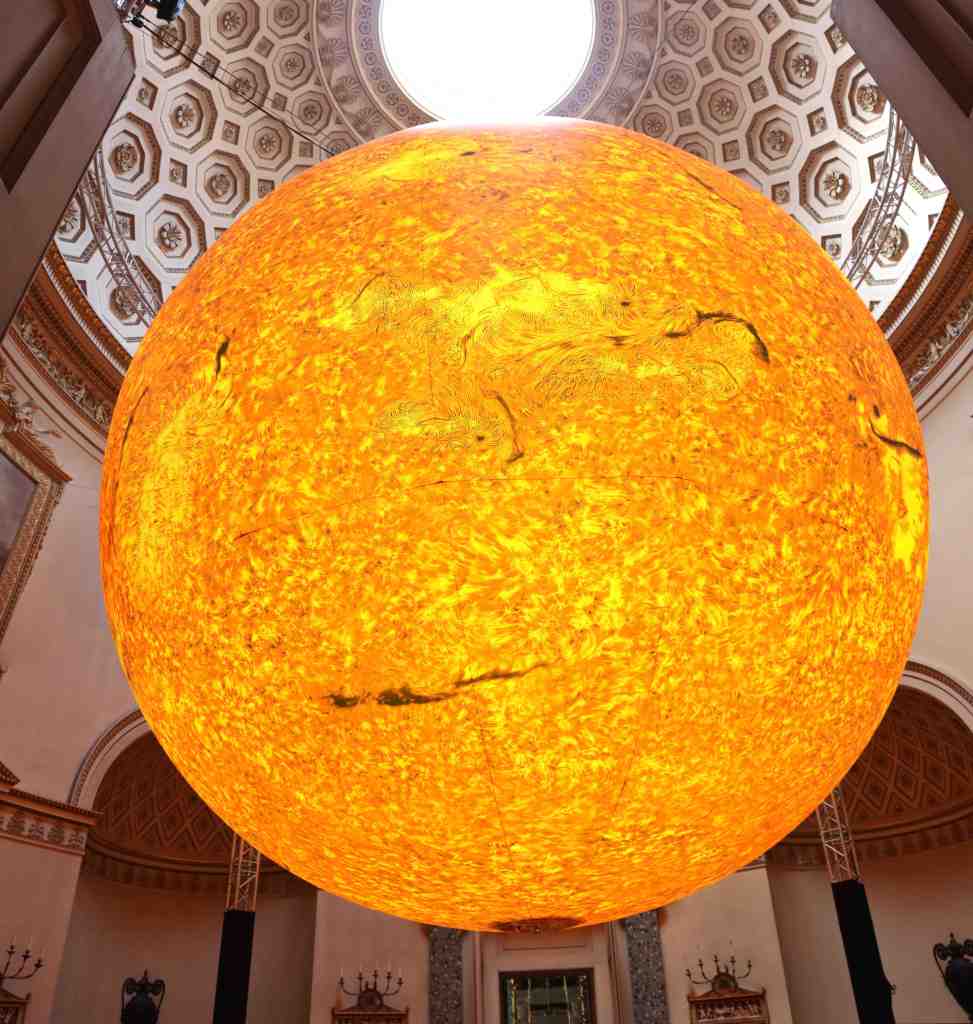
Last week we took a short trip to get up close and personal with the sun. Well not THE sun, obviously, but rather an art installation at nearby Kedleston Hall that portrays the surface of the sun in breathtaking detail, complete with sunspots and swirling solar winds. Helios is the work of artist Luke Jerram*, who based his creation on thousands of images of the sun collected by NASA and other astronomical organisations.

It’s easy to understand why Jerram was inspired to create Helios, which is named after the ancient Greek god of the sun. Did you know that our sun is 4.5 billion years old, and has about the same amount of time left until it runs out of gas? And it’s very, very hot! The surface of the sun is around 5,500°C, while its core has a mind boggling temperature of 15 million°C. Our sun has a diameter of 1.4 million kilometres (855,000 miles), but is just around average in size – some other stars are up to 100 times bigger. Wow!

Jerram’s brightly illuminated piece is 7 metres in diameter, and totally dominated the grand – 19 metres high – saloon hall in which it was suspended. The scale is mind-blowing, with one centimetre of the sculpture representing 2,000 kilometres of the real sun’s surface. Clearly, our sun is one really big dude. As if to make the point, displayed in an adjacent room and made to the same scale was a tiny model of the Earth. It really put us in our place; this planet, which to us seems impossibly huge, is a mere pimple when viewed from a cosmic perspective.

However, not everyone seemed convinced. Two other visitors, nerdy types – men, of course – were a bit agitated. They complained that although the representations of the Earth and the sun may have been made to the same scale, the distance between them had been miscalculated. According to their calculations, the model of the Earth should rightly have been positioned outside in the carpark, or maybe even half-way to the nearby city of Derby. I could barely stifle my yawns – why couldn’t they just appreciate Luke Jerram’s creativity, rather than droning on tediously about impenetrable mathematics? Life’s too short, guys!

Diwali Celebrations

Coinciding with the Helios exhibition at Kedleston Hall** was a celebration of Diwali, the Hindu festival of lights. This, I’m sure, was no coincidence. Diwali celebrates the victory of light over darkness, so programming an art installation with the sun at its very heart to run alongside a Diwali celebration was a stroke of genius.

This photo features Diwali decorations on the floor of the grand Marble Hall. Through the open door to the rear you can glimpse the lower part of Helios, suspended in the Saloon Hall.

This was the third consecutive year in which Kedleston has celebrated Diwali. Many Derby residents share a cultural heritage derived from the Indian sub-continent, and Diwali celebrations are therefore big in the city. Extending those celebrations a few miles north seems entirely appropriate, particularly in view of Kedleston’s historical links with India. Those links date back over a century to one of the stately home’s former owners – George Nathaniel Curzon, a.k.a. Lord Curzon (1859–1925) – who served as Viceroy of India between 1899 and 1905. Kedleston still displays many artefacts and artworks that Curzon brought back from his travels.

The Diwali celebrations introduced an unexpected splash of colour to Kedleston. At their heart were displays of hundreds of hand-crafted marigolds, which decorated several of the rooms. In Indian culture marigolds are used extensively in religious festivals, weddings and other ceremonies to symbolise purity, positivity and the divine, and they certainly brought a hint of the exotic to this traditionally English stately home. Other Diwali elements on display included clay oil lamps to light the way, and rangoli light projections.

Although fairly modest, Kedleston’s Diwali celebrations were good to see, and served as a potent reminder of the diverse population living within just a few miles of this grand building. I wonder what the old Viceroy would have made of them?

Remembering George Harrison

As we drove away from Kedleston Hall, having spent the afternoon in the company of the sun, and being inspired by the hope that is implicit in the Diwali festival, I found myself quietly singing a masterpiece by the late, sadly lamented George Harrison.

All four of the Beatles briefly embraced Indian culture following visits to that country in 1966 and 1968, but only George Harrison really got it. Much of George’s subsequent work was inspired directly or indirectly by Indian culture and religion, including I believe the wonderful “Here Comes the Sun” which appeared on the Beatles’ Abbey Road album in 1969. If you don’t know the song, or even if you do and would like to wallow in it one more time, listen to it here courtesy of YouTube.

* Postscript: Another work by Luke Jerram

A couple of years ago another work by Luke Jerram was exhibited at Derby Cathedral. On that occasion his chosen subject was the moon, suspended impressively above the nave. Clearly, he is fascinated by all things astronomical.

** Postscript: More on Kedleston Hall

My home county of Derbyshire is blessed with many grand stately homes. Kedleston is one of my favourites, and I have blogged about it before. You can read more about Kedleston Hall, and enjoy more of Mrs P’s photos, here and here.

Wordless Wednesday: Paddington

Wordless Wednesday is a simple blog post featuring a photo. It seeks to convey a message or tell a story, but speaks for itself without using words. Mrs P took this photo of a Paddington Bear tucking into a marmalade sandwich at John O’Groats (in the far north of Scotland) earlier this year.

The streets of Birmingham, starring Ozzy Osborne and the Floozie in the Jacuzzi

Wandering through the centre of Birmingham a few weeks ago, we were delighted to encounter The Floozie in the Jacuzzi flaunting her wares seductively in Victoria Square. More properly known as The River, the lovely lady is a bubbling fountain, a landmark popular both with local residents and with visitors to the city like me and Mrs P. She’s definitely a bit of an eyeful.

“The Floozie in the Jacuzzi” (aka “The River”) by Dhruva Mistry

Dhruva Mistry’s sculpture dates back to 1993. It’s said that his water goddess represents the life force, and was conceived as a vehicle for instilling a feeling of ‘peace and safety’ amongst people visiting this busy city centre. The good folk of Birmingham appear to have decided that this explanation is maybe a bit pretentious, and that the The Floozie in the Jacuzzi sums her up a lot better. Who am I to argue?

Another piece of Birmingham’s public art celebrates three men who made important contributions to the development of the steam engine in the late 18th century, and who were therefore key players in the early stages of the Industrial Revolution. James Watt (1736-1819) was an ideas man who came up with various improvements to the basic steam engine, while Matthew Boulton (1728-1809) was a wealthy businessman who provided the funding to put Watt’s ideas into practice. They went into partnership in Birmingham in 1775, and the highly practical William Murdoch (1754-1839) formally joined that partnership in 1810.

“The Golden Boys” (aka “The Carpet Salesmen”) by William Bloye and Raymond Forbes-Kings

The homage to the three princes of steam dates from 1956, and is the work of William Bloye (formerly head of sculpture at Birmingham School of Art) and sculptor Raymond Forbes-Kings. Unsurprisingly, it is known as The Golden Boys. More unexpectedly, however, locally the alternative name for the piece is The Carpet Salesmen, reflecting the fact that the plans for a steam engine that the three men are inspecting looks suspiciously like a bit of carpet. Oh, how I love the cheeky irreverence of Birmingham folk!

Another eye-catching piece of artwork in Birmingham city centre is A Real Birmingham Family, a cast bronze sculpture by award-winning artist Gillian Wearing. The subject matter is unconventional, and features two ordinary local women and their sons. The women are sisters, one of whom is pregnant – her second son was born shortly before the sculpture was unveiled in 2014.

“A Real Birmingham Family” by Gillian Wearing

No review of public art in Birmingham would be complete without reference to bulls. The city’s famous Bull Ring shopping centre is built on a site that was for centuries used for the brutal “sport” of bull-baiting. The practice was outlawed in 1835, but the name continues to be associated with that part of the city and is remembered through Laurence Broderick’s magnificent bronze sculpture. The Bull was installed in 2003, and in my eyes portrays the animal as a noble and powerful beast, rather than as the victim of an appalling blood sport.

“The Bull” by Laurence Broderick

There is of course another equally, if not more famous piece of public art celebrating Birmingham’s connection with bulls. I have written previously about the Raging Bull, which was commissioned to open the Commonwealth Games held in Birmingham in 2023. A couple of years after the games, Raging Bull was relocated to New Street Station, and renamed Ozzy in honour of local heavy metal music hero Ozzy Osborne. We were delighted to see Ozzy in his new location when we visited earlier in the summer, where he was continuing to draw in hordes of admirers.

Ozzy the Bull, star of the Commonwealth Games 2023, now residing at New Street Station

Ozzy Osborne was born in 1948, and grew up in the Aston area of Birmingham. He co-founded the pioneering heavy metal band Black Sabbath, and rose to prominence in the 1970s as their lead vocalist. After being fired by the band in 1979 due to his problems with alcohol and drugs, he began a solo music career and later became a reality television star. Ozzy died in late July 2025. He had remained for decades a much loved son of Birmingham, and it was clear during our visit there shortly after his death that the pain caused by his passing was still raw.

Mural featuring Black Sabbath. Ozzy Osborne is third from the left

Heavy metal music is not really my thing, but one song by Black Sabbath is etched into my memory. Released in 1970, Paranoid is a bitter, gut-wrenching exploration of depression and despair. The lyrics are as follows:

Finished with my woman ’cause
She couldn’t help me with my mind
People think I’m insane because
I am frowning all the time

All day long I think of things
But nothing seems to satisfy
Think I’ll lose my mind
If I don’t find something to pacify

Can you help me
Occupy my brain?
Oh yeah

I need someone to show me
The things in life that I can’t find
I can’t see the things that make
True happiness, I must be blind

Make a joke and I will sigh
And you will laugh and I will cry
Happiness I cannot feel
And love to me is so unreal

And so as you hear these words
Telling you now of my state
I tell you to enjoy life
I wish I could but it’s too late

Source: LyricFind

Ozzy didn’t write the lyrics Paranoid – they were the work of bandmate Geezer Butler – but did create the melody. His early years were very challenging, and Ozzy said later that as a teenager he attempted suicide on multiple occasions. Perhaps this is why his performance as lead vocalist on Paranoid is so powerful. You can listen to Ozzy doing his stuff by clicking on the following YouTube link.

Birmingham lost one of its favourite sons when Ozzy Osborne died on 22 July, just 17 days after what had been billed as his final live performance. He clearly remains close to the heart of the people of his home city, a genuine working class hero. Rest in Peace, Ozzy.

Detail from a poster promoting a summer 2025 exhibition in Birmingham about Ozzy’s solo career

On safari in deepest, darkest Norwich!

For readers unfamiliar with the place, Norwich is a historic city in the east of England that is famed for its magnificent medieval architecture and mustard! It’s not somewhere a visitor might reasonably expect to encounter giraffes, rhinos or elephants. But these critters, as well as some lions and the occasional gorilla, were all strutting their stuff in Norwich when we took a trip there a few weeks ago.

The reason for the invasion was the GoGo Safari, a temporary public art trail featuring around 50 sculptures decorated by professional artists, sponsored by local businesses and curated by Wild in Art. As well as adding some welcome splashes of colour to the local street-scene, the GoGo Safari project is raising funds to support Break, a local not-for-profit organisation that seeks to make life better for young people on the edge of care, in care and leaving care.

Various fundraising initiatives are linked to the Safari, the most significant being a public auction of the sculptures a few weeks after the trail closes. Based on experience at similar events elsewhere, the average price of the sculptures is predicted to be around £6k to £7k (USD 8k to 9.5k), meaning that the whole event should raise a sizeable sum for a very worthy cause.

Sadly, Mrs P and I won’t be bidding at the auction! Although many of the sculptures are fabulous, their expected price is way beyond what we’re able to spend on a decorative item for the garden. However, walking the streets of Norwich in search of random rhinos and sundry other colourful characters was a great way to spend a couple of days. The artworks were impressive, and it was interesting to meet and share ideas with other folk on a similar mission.

While the design of some of the sculptures is purely decorative, others feature local themes and places. All the Fun of the Fair (below), for example, takes whimsical inspiration from the nearby Thursford Steam Museum.

And the detail on some of the sculptures is very eye-catching. Just why the rhino sculpture (below) is called Andy remains a mystery to me, but the birds adorning his ample body were splendidly handsome.

Another positive aspect of the project is the opportunity for schools and community groups to contribute through decorating their own small giraffe. We were delighted to encounter this herd of “Mini G’s” (below) in the Chantry Place shopping centre.

Everyone, it seems, was having a good time on the GoGo Safari trail, and it was particularly encouraging to see the excitement on the faces of little children when they spotted another spectacularly decorated sculpture. The event closes in just a few days, but similar initiatives happen up and down the country every summer and occasionally abroad. They are definitely worth checking out if you ever get the chance.

Fans of Shaun the Sheep flock to Trentham Gardens

A couple of weeks ago, keen for a bit of light relief, we drove west to Trentham Gardens in Staffordshire in search of Shaun the Sheep. UK-based readers will doubtless be aware of Shaun, who first appeared in the Aardman stop-motion animated film A Close Shave in 1995, alongside madcap inventor Wallace and his canine sidekick Gromit.

Following rave reviews of his role in A Close Shave, in 2007 Shaun was offered his own BBC series. Six series later, he is as popular as ever with younger viewers. He’s even made it onto Netflix, so he now has fans just about everywhere. You might not think it to look at him, but Shaun’s world famous, maybe the best-known sheep on the planet.

So what was Shaun doing in the gardens at Trentham, on the outskirts of Stoke? Once the site of a grand country house set in a landscaped park, in recent years the Trentham Estate has been redeveloped as a leisure destination. Visitor numbers are the name of the game, so who can blame bosses at Trentham for inviting the woolly-coated global superstar along to lend his support this spring?

The Find the Flock Trail featured 12 supersized colourful Shaun the Sheep sculptures, painted by local and regional artists. We set out to track down as many of them as we could while also enjoying views of the award winning gardens, including an oriental-style bridge and several whimsical sculptures featuring fairies.

Standing 160cm tall and brightly coloured, the sculptures were easy to spot. In no sense does a sculpture trail like this count as fine art, but it’s a load of fun…and don’t we all need some of that these days, when every news bulletin on television and radio assails us with more grim news. In a further attempt to cheer up the visitors, each sculpture’s plinth featured a corny sheep joke. Here are just a few of them:

Q: Where do sheep like to watch videos?
A: Ewe-Tube.

Q: What’s a lamb’s favourite car?
A: A Lamborghini.

Q: What sport do sheep like to play?
A: Baadminton.

Q: What do you get if you cross a kangaroo and a sheep?
A: A woolly jumper

Ha ha ha (I think)! I guess those jokes tell you all you need to know. There was nothing sophisticated about the Find the Flock Trail, but who cares? A good time was had by all.

Snowmen and snowdogs

It snowed overnight on Saturday. No surprise there, the forecasters had been banging on about the possibility for days, but there was not nearly as much “white stuff” as they predicted. Certainly not enough to build a snowman, but who cares – we had our fill of snowmen a few weeks ago, and spotted some snowdogs too, when we explored a couple of local sculpture trails organised by Wild in Art.

Eight Maids a-Milking, by Donna Newman

Both trails were inspired by the work of Raymond Briggs (1934 – 2022), a notable illustrator of children’s books. The Snowman was first published in 1978, and remains his most celebrated work. It is a story told entirely without words, relying instead upon a sequence of simple pencil crayon illustrations.

The Snowman is a magical tale of a boy who builds a snowman in his garden and is astonished when his creation comes to life at the stroke of midnight. Boy and snowman play together happily, but without making a sound to avoid waking the boy’s parents. Later, after a shared candlelit feast, the loveable snowman flies through the air above the snowclad English countryside with the entranced boy held tightly under his arm.

When their flight is over the pair return home, the boy to his bed and the snowman to the garden. Upon waking the next morning the boy rushes into the garden to re-join his new best friend, but a thaw has set in and the snowman is little more than a pile of slush. It’s a sad end, a reminder that nothing is forever and that all things must pass, but the abiding memory is of the cheerful, chubby, larger-than-life character of the snowman.

Such was the impact of Briggs’ enchanting story that in 1982 it was adapted into a 30 minutes long animated film for television. The film caught viewers’ imagination and brought The Snowman story to a whole new audience. It has been repeated regularly ever since.

Today the loveable snowman is a Christmas icon, recognised by one and all, so it was no surprise to see Briggs’ creation starring in a sculpture trail at Clumber Park, Nottinghamshire, during the final weeks of 2024. The trail featured a series of sculptures of our hero, his ample body covered with designs inspired by the ever-popular festive song “The Twelve Days of Christmas”.

As I’ve written previously about similar Wild in Art sculpture trails that we’ve followed in recent years, this one wasn’t about sophisticated art or high culture. It was nevertheless a great way to get into the Christmas spirit, to throw off the miseries that Covid had inflicted upon us just a couple of weeks earlier, and to have some much-needed fun.

* * * * *

The impact of the original snowman film was so great that canny television executives craved a sequel. It duly came to pass in 2012. Raymond Briggs gave The Snowman and the Snowdog his blessing, although he was not personally involved in the project. The story introduces a brand new character, a snowdog, who enjoys a series of magical adventures alongside the snowman and the boy.

Ru Dog, by Donna Newman

The snowdog inspired his own sculpture trail in October 2024, in the elegant Derbyshire town of Buxton. If I’m honest, this one was not quite up to the standard of the snowman trail that we visited a few weeks later, with several of the designs seeming a little lacklustre. Nevertheless tracking down the snowdog sculptures was a good excuse for a day out, free entertainment in a part of Derbyshire that we really should try to visit more often. Later in the year, maybe…

Colourful elephants invade historic city

This summer a herd of 74 colourful elephants have been parading proudly through the Staffordshire city of Lichfield, as well as the nearby towns of Tamworth and Sutton Coldfield. And what a show they put on, bringing welcome colour to the urban landscape, supporting local businesses by boosting tourist numbers, and lifting the spirits of anyone spotting them.

“Fruity Frida” by Lucy Hebden, inspired by the markets of Lichfield, Tamworth and Sutton Coldfield.

But there’s more! Working in association with the events management company Wild in Art, a local Lichfield hospice – St Giles – has been instrumental in the organisation of the art trail. As a result of this collaboration, when autumn comes and the show is over, many of the sculptures will be auctioned off to raise funds that will help support local people who are living with a terminal illness. Everyone’s a winner when the elephants come to town.

Lichfield lies a few miles north of the city of Birmingham, and has a population of around 35,000. Although boasting a number of historic buildings, by the far the most famous is its medieval cathedral, the only three-spired cathedral in the UK. The organisers of the March of the Elephants public art trail were canny enough to place one of the sculptures in the grounds of the cathedral, enabling photographers like Mrs P to record this improbable sight for posterity.

“Staffie” by Anne-Marie Byrne, dwarfed by the majestic Lichfield Cathedral.

Sculptures along the trail come in two sizes. The larger elephants are designed and painted by professional artists, some local and others with a national profile. Without exception these are eye-catching creations, and it was great to see how both adults and children engaged with them.

In addition there are around 40 smaller sculptures designed by local schools and community groups, displayed in shops and venues like the local library. This aspect of the trail is particularly pleasing to see, an obvious attempt to make art inclusive and for everyone, rather than a minority, elitist pursuit.

Our day in Lichfield was a day well spent. It’s not a place I would ever have considered visiting were it not for the March of the Elephants. It plainly has a lot more to offer, including a scattering of historic buildings, a museum dedicated to the 18th century writer Samuel Johnson (“Dr Johnson”) who was born in the city, and a well maintained public park. But our visit to Lichfield was so crammed with elephants that we failed to do the rest of the city justice. Oh dear, we’ll just have to go back!

Pashley Manor Gardens and the ghost of Anne Boleyn

On its website, Pashley Manor Gardens in East Sussex claims to be “one of the finest gardens in England”. That may or may not be a bit of an exaggeration – I’m no expert on things horticultural! – but when we visited last autumn it seemed like a pleasant place to while away an afternoon. The flowers were colourful and the manor house was a picture of Tudor charm, but for my taste what raised Pashley to another level was the mix of modern sculptures scattered throughout the gardens. The most compelling of these depicts the tragic figure of Anne Boleyn.

“To the Show” by Helen Sinclair. The flower towering above her is Brugmansia or Angel’s Trumpets, a member of the nightshade family.

The current manor, which is not open to visitors, dates from 1550 and retains its classic Tudor half-timbered frontage. But this is not the estate’s original house, as prior to its construction there was a hunting lodge on another part of the grounds.

Pashley Manor House dates from 1550

The hunting lodge was owned by the Boleyn family, and it is believed that Anne Boleyn – King Henry VIII’s second wife, who was executed in 1536 – spent part of her childhood here. Appropriately, there is a sculpture of Anne near the spot where the hunting lodge once stood. This haunting work by local sculptor Philip Jackson is a moving tribute to a woman who married for love, and later died on the orders of her paranoid, brutal husband. The gardens that we see today bear little if any resemblance to what Anne would have witnessed 500 years ago, but clearly her ghost still walks the land.

Anne Boleyn by Philip Jackson

Following Anne’s execution, the fortunes of the entire Boleyn family went into freefall, and in 1540 the estate was sold to Sir Thomas May, who set about building the house that still stands today. In the centuries that followed the Pashley estate passed through the hands of several more families, who further developed it in accordance with the fashions of their age.

The manor house was unoccupied during the period 1922-45, and fell into disrepair. When the current owners, Mr and Mrs James Sellick, bought the property in 1981 the gardens had been long neglected, but the Sellicks were determined to restore them to their former glory. They opened Pashley Manor Gardens to the public for the first time in 1992. Just five years later the gardens won the Historic Houses Association / Christie’s Garden of the Year award, and in the decades since then work has continued to develop them further.

The Sellicks clearly spotted the growing popularity of sculpture parks and gardens, and calculated that a scattering of sculptures would enhance the Pashley offer. No doubt these sculptures, which range “from abstract to engagingly figurative” also generate a bit of extra income, as most of the pieces on display are for sale. The works on show are not as imposing or spectacular as those at, say, the Leonardslee Gardens and Sculpture Park, but the best of them are good fun.

Pashley Manor Gardens were definitely worth a visit. When we’re next in that part of the country I’d be pleased to call in again – perhaps earlier in the season, when a different range of flowers will be in bloom – to see how the Sellicks’ project is developing, and to spot some new sculptures. Hopefully the ghost of Anne Boleyn will still be in attendance.

Powerful messages at the National Memorial Arboretum

My last post reflected on just a few of more than 400 memorials dotted around UK’s National Memorial Arboretum, memorials commemorating individual units of the armed forces, specific wartime incidents and sundry other causes and organisations. Today, I want to focus on two further memorials to be found at the Arboretum, particularly powerful pieces designed to make us all think hard about the nature and consequences of warfare.

Commemorating 306 British Army and Commonwealth servicemen executed during the First World War, “Shot at Dawn” is perhaps the most surprising of all the memorials. At first glance a sculpture in memory of men executed for – amongst other things – desertion and cowardice maybe sits uncomfortably alongside memorials to soldiers who died bravely while fighting for their country. But, of course, these days we know much more about the workings of the human mind than they did when senior officers were making life-and-death decisions at court martials over a century ago.

Based on our understanding today, there is good reason to believe that the behaviours leading to many of these executions were a result of Post-Traumatic Stress Disorder (PTSD) or Combat Stress Reaction (CSR). If this is so, many of those shot at dawn were not bad men. Rather, they were guys who had been psychologically traumatised by the horrors of war.

The memorial statue portrays a young British soldier blindfolded and tied to a stake, hands bound behind his back, awaiting execution by firing squad. A small disc, hanging from a chain around his neck, marks the point at which his executioners have been ordered to aim. Arranged in a semi-circle behind the condemned man are stakes, each bearing the name of a man executed in this manner during the First World War.

Artist Andy DeComyn based his statue on a likeness of 17 year old Private Herbert Burden, who lied about his age to get into the army and was later executed for desertion. It is a poignant piece of work, a reminder that simple words like “coward” or “deserter” do not necessarily do justice to the realities of life – and death – on the battlefield.

As such, it also brings to mind Michael Morpurgo’s “Private Peaceful”, an insightful novel for young adults – later made into a stage play, concert and film – that featured at its heart a battlefield execution. In my view, Private Peaceful and Shot at Dawn should both be compulsory viewing for those who seek to portray warfare as a glorious or noble activity.

Poignant in a different way is “Every Which Way“, a memorial to the evacuation of children from cities to the relative safety of rural Britain during the Second World War. The memorial remembers the evacuation of millions of children separated from their families during the conflict. It also pays tribute to the adults who made this huge logistical operation a success, including train and coach drivers, teachers, nurses, billeting offices, and the foster parents who gave the evacuees temporary new homes.

The artist responsible for “Every Which Way” was Maurice Blik, who was commissioned by the British Evacuees Association (BEA). It is an outstanding, emotionally charged piece of work.

Here’s what Blik had to say about his sculpture when it was inaugurated in 2017:

The title of the memorial was inspired by one of the members of the BEA who on seeing my initial scale model of the sculpture, exclaimed ‘That’s it exactly – we were going every which way’…With the design I hope to convey some of the confusion and anxiety felt by the child evacuees. This is not a straight forward line of children about to set off on a journey; … items of clothing are back to front and luggage is split open to symbolise families being torn apart.”

Source: Maurice Blik, writing in his booklet about the memorial and quoted in the Volunteer London Blog

I leave you with this thought: Blik’s sculpture is a powerful, brilliantly executed reminder that innocent people, including children, inevitably get hurt in wars. We shouldn’t need reminding, but the daily reports of suffering, destruction and death in Ukraine and the Middle East suggest otherwise. Have we, as a species, learned nothing? In 1969, John Lennon urged us all to Give Peace a Chance, and today his words seem more relevant than ever.

Photo Credit: by Miha Rekar on Unsplash

Reflections on the UK’s National Memorial Arboretum

Next Sunday, 12 November, is Remembrance Sunday, when the UK reflects on the sacrifices made by men and women who have died in the service of their country. Services and ceremonies of remembrance will take place at locations up and down the country, including the National Memorial Arboretum in the county of Staffordshire.

The Arboretum opened in 2001, and exists to ensure that –

  • the unique contribution of those who have served and sacrificed is never forgotten
  • the baton of Remembrance is passed on through the generations
  • there is a year-round space to celebrate lives lived and commemorate lives lost.”

I am, at heart, a child of the sixties, brought up in the era of the peace movement to the sound of Edwin Star reminding us that “War can’t give life, it can only take it away,” and John Lennon pleading with us all to “Give peace a chance“. I accept that warfare might sometimes be necessary as a last resort, the lesser of two terrible evils, but any attempt to promote or glorify it is, and will always be, anathema to me.

I therefore visited the National Memorial Arboretum earlier this year with a degree of trepidation, fearing it would be little more than a shallow, macho glorification of armed conflict, a misguided homage to the notion that “might is right”. As it happens, I had nothing to fear: taken as a whole, the memorials are broader in scope, more sensitive and more thought provoking than I had imagined. Indeed, some have little or no direct link to the military services.

More than 25,000 trees have been planted on the site, which was reclaimed from old gravel workings and measures around 150 acres (60 hectares). It currently hosts around 400 memorials to individual units of the armed forces, to specific incidents and to sundry other causes and organisations. Memorials come in all shapes and sizes, and in various materials including steel and bronze, as well as glass and stone.

The Armed Forces Memorial

The centrepiece is the Armed Forces Memorial, an imposing Portland marble installation upon which are engraved the names of around 16,000 servicemen and women who have died in the line of duty or been killed by terrorists since 1945.  Inspired by monuments of prehistoric Britain, a 43 metres diameter stone structure sits atop an earth mound 6 metres high. Depressingly, there is space on the walls for another 15,000 names to be added.

The Polar Bear Memorial

The Polar Bear Memorial was the first memorial erected at the site, and was dedicated in 1998, three years before the official opening of the Arboretum. It’s a tribute to the 49th West Riding Infantry Division, who adopted their distinctive polar bear cap badge after service in Norway and Iceland in World War 2. Around its base are the badges of the regiments in the Division, and the towns liberated or defended by them. Inside the bear is a capsule carrying details of those who died, together with personal mementoes. Versions of the Polar Bear statue have been erected at towns liberated by them in World War 2.

Another thought-provoking memorial is that to the crews of submarines. The Submariner’s Memorial was designed by sculptor Paul Day. Its representation of a conning tower, through which a sailor gazes up longingly towards the sky, eerily conveys the sense of confinement that submarine crews must have felt every day.

Some memorials, including the Clapton Orient memorial, hint at a fascinating story. Why, the casual visitor might wonder, do a soccer ball and a pair of soccer boots flank an obelisk commemorating members of the 17th Battalion Middlesex Regiment? The inscription gives the answer, telling us that “Clapton Orient were the first football league club to enlist en masse to serve king and country during the Great War.”

The club’s players enlisted in December 1914, serving in what became known as the Footballers’ Battalion. The inscription goes on to tell us that “Many [of the footballers] sustained wounds, and three of the club’s players made the ultimate sacrifice during the Battle of the Somme.” The memorial is based on an original, paid for and unveiled by Orient fans in 2011 at Flers, in the heart of the Somme battlefield.

Memorial to the Royal Army Medical Corps

It is not just members of fighting units who are honoured at the National Memorial Arboretum. One of the most striking sculptural works on display is a bronze memorial commemorating the Royal Army Medical Corps (RAMC). Sculpted by Alan Beattie Herriot, it features a member of the RAMC carrying a wounded soldier over his shoulder. Since the foundation of the Corps in 1898, 29 medics have been awarded the Victoria Cross (VC), the highest and most prestigious decoration for military personnel in the British honours system.

Memorial recalling the Christmas Day truce, 1914

Another soccer-related memorial recalls the Christmas Day Truce in 2014, when British and German soldiers met in no man’s land to exchange gifts, take photographs and play impromptu games of football.  For one day only these men decided to give peace a chance, and although hostilities resumed soon after, their action remains one of the most famous and inspiring encounters of the First World War. The memorial is based on a design by 10 year old Spencer Turner for the Football Association’s “Football Remembers” competition, and depicts a British and a German soldier shaking hands. Simple, but symbolic and very moving.

The Aguila Memorial to 21 Wrens lost at sea in 1941

It was not only men who gave their lives in the service of their country. The Aguila Memorial, carved from wood on a stone base, commemorates 21 members of the the Women’s Royal Naval Service (aka the WRNS / the Wrens) who were lost at sea in August 1941 when their ship the Aguila was torpedoed by a U-Boat. The Aguila was en route to Gibraltar where 12 of the Wrens were due to take up duties as cypher officers, and the other nine as wireless operators.

“Free Spirit”, in memory of more than 1,000,000 horses and mules used by the British Army during WW1

“Free Spirit” takes a very different look at the victims of warfare. Animals can be in the firing line too, and this bronze statue of a horse designed by Georgie Welch commemorates more than 1,000,000 horses and mules used by the British Army during the First World War. Most did not survive the ordeal.

One of the notable features of the National Memorial Arboretum is that it recognises wars are fought and won on the home front, as well as on the battlefield. One memorial, for example, commemorates the Bevin Boys. These were young British men conscripted to work in coal mines between December 1943 and March 1948, to increase the rate of coal production, which had declined through the early years of the Second World War.

Another memorial marks the contribution of the Women’s Land Army and Timber Corps, and rightly so: over the course of the two World Wars over 240,000 “Land Girls” and “Lumber Jills” produced desperately needed food and timber for the war effort.

The National Memorial Arboretum is full of surprises, and gives the visitor lots to think about. Two of the most striking memorials commemorate soldiers who were executed on the battlefield during the First World War, and children evacuated from their city homes into the countryside to protect them from bombing during the Second World War. This post is already far too long, so I will write about these two very different, and very special, memorials next time.

*** *** *** *** ***

Musical postscript

Writing this post has inevitably led me to a period of sombre reflection. At such times I tend to find that music – particularly within the broad tradition of English folk music – is better able to capture the emotions engendered by the realities and consequences of armed conflict than mere words written on a page. With that in mind, I offer you links to two songs that mean a lot to me. I hope they speak to you too. Listen, and quietly weep.

And the band played Waltzing Matilda” was penned by Eric Bogle, a Scottish-born Australian singer-songwriter. It describes the grim realities and consequences of war, and the short-sightedness of those who seek to glorify it.  Here is Bogle singing his anti-war masterpiece:

As a noted apologist for the British Empire, Rudyard Kipling, the English poet, short story writer, journalist and novelist, is not the obvious composer of an anti-war song. Perhaps he didn’t regard “Soldier, soldier” as an anti-war song at all? I do, for it is a stark reminder not only of the brutal consequences of war for the combatants, but of the pain and suffering of those watching from afar as events unfold on the battlefield. Here Kipling’s words are sung by English folk singers Anni Fentiman and Brian Peters, to an arrangement by Peter Bellamy