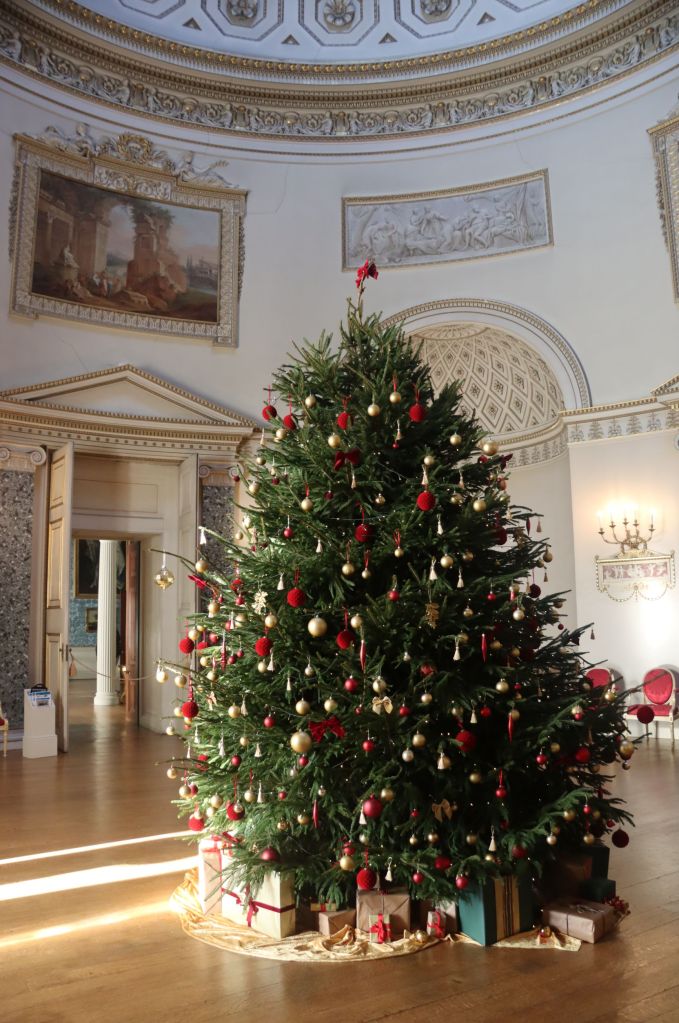
Christmas already! Harewood House lights up.

It’s that time of year again, when stately homes up and down the land get dressed up in Christmas finery, and members of the public pay handsomely for the privilege of seeing what they’ve been up to. The grouch in me says that mid-November is way too early for this kind of thing, but as we were passing nearby on our way back from a gig, Mrs P and I decided to call in at Harewood House to inspect its take on Christmas.

Located close to Leeds in the county of West Yorkshire, Harewood is a grand country mansion designed by architects John Carr and Robert Adam. It was built between 1759 and 1771 for Edwin Lascelles, the 1st Baron Harewood, a wealthy West Indian plantation and slave owner. As the Harewood website clearly acknowledges, the origins of the house are totally abhorrent, but the building itself is an outstanding example of Georgian architecture and design, and boasts a wealth of fine furniture and art.

The theme of Harewood’s Christmas in 2024 is Mischief at the Mansion. The website explains that “a troop of not-so-angelic cherubs have escaped from the Christmas tree and Harewood House sparkles into life with singing baubles, swirling ceilings and gossiping statues. Marvel as the House tells you festive tales of bygone times…”

There is much more to admire here than the standard Christmas fayre of extravagantly decorated fir trees and colourful flashing lights, including witty spoken dialogue between the cherubs and extensive use of projected, moving imagery.

The Christmas tree baubles were engaged in lively conversation!

The Christmas cakes also had a lot to say for themselves!

Unfortunately, much of this show – and it is a show – doesn’t lend itself well to photography, so you’ll have to believe me when I say that the result is spectacular. A lot of time and money was clearly spent to impress paying visitors, ensuring that the “wow factor” is alive and well at Harewood this Christmas.

Harewood House is open for visits all year round, and based on what we saw a couple of weeks ago I’d happily return at another time of year. This would enable us to better appreciate its fine architecture, furniture and art without the ongoing distractions of Christmas bling and cheeky cherubs! Next year, maybe?

Kedleston Hall – a masterpiece that lasts all year

Kedleston Hall is yet another of our local stately homes that gets dressed up for Christmas, so one morning a couple of weeks ago we decided to check out its latest festive makeover. Poor Kedleston, Derbyshire’s forgotten treasure, is forever in the shadow of the local legend that is Chatsworth House. However, in my view anyway, the place is a seriously under-appreciated masterpiece that’s worth visiting at any time of the year, not just at Christmas.

Chatsworth, ancestral home of the Dukes of Devonshire, has a national profile and is beloved by locals and tourists alike. And very fine it is too, if bling is your thing. I like Chatsworth well enough, of course, but if given the choice I’d prefer to potter around Kedleston any day.

The Marble Hall

Kedleston Hall is an 18th century Palladian and Neoclassical wonder. To build it, local bigwig landowner Nathaniel Curzon, 1st Baron Scarsdale (1726-1804) flattened an entire village of the same name, thus ensuring that he wouldn’t have to endure unwanted encounters with the local peasantry while wandering his estate.

The Drawing Room

Behaviour like this was typical of men of his ilk at the time, and from a 21st century perspective is totally inexcusable. The only mitigation one might offer is that Curzon built a damned fine house on the land he so rapaciously reclaimed from his tenants, though I doubt that this was much of a comfort at the time to the poor people he made homeless.

The Library

Although the Curzon family still lives in part of the Hall, the property and surrounding parkland is now owned on behalf of the nation by the National Trust. Here’s what the Trust’s website has to say about Kedleston:

“Kedleston Hall is an extravagant temple to the arts designed by the architect Robert Adam…The house is framed by historic parkland and boasts opulent interiors intended to impress. Designed for lavish entertaining, Kedleston Hall displays an extensive collection of paintings, sculpture and original furnishings, reflecting both the tastes of its creators and their fascination with the classical world of the Roman Empire.”

Source: National Trust website, retrieved 13 December 2022

Neo-classicism may not be to everyone’s taste, but it works for me, The elegance and sheer beauty of Robert Adam’s work is breath-taking, and while I was looking forward to a bit of Christmas cheer at Kedleston I was concerned that it might detract from the majesty of the Hall’s state rooms. But I need not have worried: the Christmas decorations were tastefully restrained, and the Adam’s interiors remained the stars of the show.

The Saloon

Entrance to the mansion is via the grand Marble Hall. With walls boasting multiple niches that display statues in the classical Roman style, and lined by 20 soaring, fluted alabaster columns topped with elaborate Corinthian capitals, the Marble Hall is clearly a statement piece. It is designed to overawe visitors, to advise them that they have entered the home of someone richer, more cultured, and more powerful than they can ever hope to be. Know your place! it proclaims.

The Music Room

Equally impressive is the Saloon, a circular room rising 62 feet (19m) to a grand glass skylight. It was designed as a sculpture gallery, the style being based on the temples of a Roman Forum. The modest Christmas tree at its centre did little to distract our attention the sheer elegance of the room’s design.

Clockwise from Top left: The Library. Top right: Ante Room / Dressing Room. Bottom Right: The Saloon. Bottom Left: View through Ante Room / Dressing Room to the Christmas tree in the Saloon. Middle (bottom): The Dining Room. Middle (top): The Family Room

The other state rooms, including the Library, Drawing Room and the Dining Room, are equally impressive. And that’s the point. This place was built to impress, and it does just that. More than Chatsworth House, and more than just about every other stately home I’ve ever visited, it positively exudes the wow factor. I love Kedleston Hall just as much as I’m sure I would have disliked Nathaniel Curzon, the guy who commissioned this spectacular mansion…anyone with an ego that big must have been seriously bad news!

Kedleston Hall – A walk in the park (no peasants allowed!)

Our county of Derbyshire has many exceptional stately homes, where ordinary folk like me can catch a glimpse of what life was like for the English super-rich before inheritance taxes prompted them to modify their extravagant lifestyles. Kedleston Hall, an 18th century Palladian and Neoclassical masterpiece now managed on behalf of us all by the National Trust, isn’t the most famous of these, but it’s definitely one of my favourites.

Rear of Kedleston Hall viewed from the Long Walk, with the C12th All Saints Church to the left. Note also the ha-ha, which is invisible from the Hall and stops wandering sheep getting too close.

Of course, when you’re obscenely rich, conspicuous consumption doesn’t have to end with your palatial mansion – when you’ve spent as much as bad taste will allow on alabaster, marble and gold leaf, you can always throw more of your wealth at the rest of the estate. Kedleston is a case in point. As you wander through the magnificent parkland in which the Hall sits, it’s easy to forget that this is an entirely man-made landscape.

Trees have been selected and positioned to add to the visual appeal of the parkland. The sheep help too!

Kedleston is the ancestral home of the Curzon family, who have lived in the area since the 12th century. Between 1759 and 1775, Nathaniel Curzon, 1st Baron Scarsdale (1726-1804) commissioned renowned Scottish architect Robert Adam (1728-1792) to design an opulent new mansion, flanked to the south and west by an elegant formal garden of trees and shrubs. Surrounding the Hall and garden, and separated from them by a ha ha – a sunken wall which was invisible from within and intended to keep livestock out – was a landscape comprising some 800 acres (324 hectares) of rolling, naturalised parkland.

Robert Adam’s fine three-arched bridge, one of the highlights of Kedleston’s parkland

Once there was a small village at the centre of the estate, clustered around the C12th All Saints Church. However in 1759, as was the custom of the time, the villagers were all evicted to ensure that Baron Scarsdale could go about his daily business on the estate without any danger of coming into contact with representatives of ‘the great unwashed.’

An idyllic landscape, now managed on behalf of the nation by the National Trust

The peasantry having been removed, it was time to set about taming the landscape. Adam put the stream that traverses the estate to good use, moving mountains of earth to create a series of scenic lakes and cascades. To cross the stream he built a fine three-arched bridge, and this remains one of Kedleston’s most impressive features. Other structures to adorn the parkland include a bath-house and a fishing pavilion, although several temples and follies proposed by Adam were never completed.

One of the civil engineering works required to create and manage Kedleston’s lakes

Robert Adam wanted his creation to be enjoyed from all angles, and to this end he designed the Long Walk, a winding three mile circuit through the estate, with views of the rear of the Hall and across the parkland.  It was this walk that Mrs P and I embarked upon a few weeks ago.

The bath-house, designed by Robert Adam

The sun was shining, the birds were singing, lambs frolicked playfully under the watchful eyes of their mothers, and the vistas offered by the Long Walk were uniformly pleasing. After long months confined to our own modest house and garden by the Covid restrictions it was great to escape its confines and to enjoy the wide open spaces that the Kedleston estate offers.

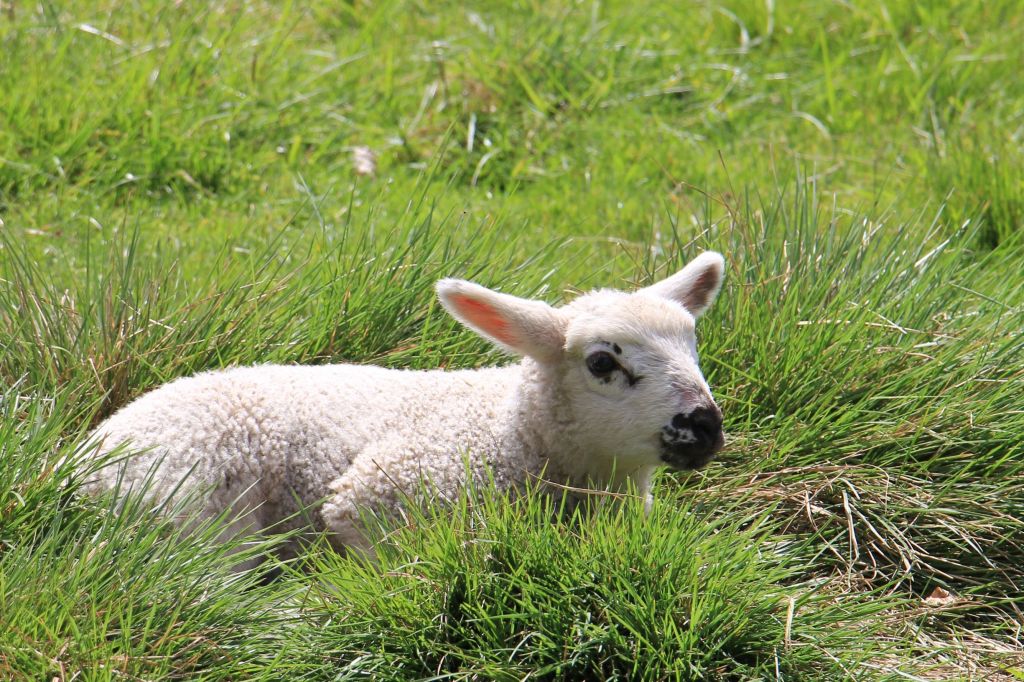
Aaah, cute!

Robert Adam was without doubt a genius: both the Hall (which I shall write about in a future post) and the parkland lift the spirits enormously. But if you ever visit Kedleston do spare a thought for the local peasantry, who lost their homes so that this magical place could be created as an exclusive pleasure ground for Baron Scarsdale and his idle-rich buddies!