Upriver on the Thames

In a previous post about our 2025 visit to London I described a journey downriver on the Thames from Westminster Bridge to Woolwich. On a different day we took another boat trip, this time heading upriver. The plan had been to visit the historic Hampton Court Palace, once the home of King Henry VIII. Sadly this proved impossible due to repair work being undertaken at Teddington lock, but nevertheless – despite the relentlessly gloomy weather – we decided to take the boat upriver to Kew to view this area of London from an unfamiliar angle.

The Vertrouwen is a Dutch barge dating from 1929. It is now moored at Dove Pier in Hammersmith.

In common with most cities, London is a mixture of the good, the bad and the ugly. Mostly ugly, of course, but the river journey did reveal a few interesting bridges, boats and buildings. Although I grew up in the capital, most of the sights were new to me, but a few – such as Hammersmith Bridge – were achingly familiar.

Hammersmith Bridge

An elegant suspension bridge that opened in 1827, Hammersmith Bridge is etched into my memory. Over half a century ago I attended school in this part of London, and can clearly remember our class being sent on “cross-country” runs – following a route that included crossing the bridge – by a teacher who was clearly allergic to teaching in the conventional sense. These days the bridge is closed to all motor traffic due to the appearance of cracks in its pedestals, but foot traffic (including, I imagine, cross-country runners!) can still cross here.

Hammersmith Bridge

One of the most recognisable buildings we saw during our trip upriver was Battersea Power Station. Built in two phases between 1929 and 1955, the coal-fired power station once produced a fifth of all the electricity used in London, keeping the lights on in buildings as illustrious as Buckingham Palace and the Houses of Parliament.

Battersea Power Station ceased operations in 1983, when the generating equipment began to wear out and oil, gas and nuclear fuels started to be preferred over coal for the generation of electricity. Demolition would have been the obvious next step, but the building’s iconic appearance on the London skyline resulted in it being given listed status in recognition its heritage value.

Battersea Power Station

For over 20 years the former power station remained unoccupied. It fell into disrepair, before plans were agreed to redevelop the site to include residential accommodation, bars, restaurants, offices, shops and entertainment spaces.  When viewed from the Thames there is little indication today of what now lies within, but it’s easy to see why such an imposing structure captured the imagination of several generations of Londoners.

We had been fully expecting and were looking forward to seeing Battersea Power Station, but another nearby building took us totally by surprise. Just a few hundred metres upriver from the power station is the Peace Pagoda, one of around 80 similar structures built across the world since the end of the Second World War. They owe their origin to the Japanese Buddhist monk Nichidatsu Fujii (1885-1985), who devoted his life to promoting non-violence after an inspirational meeting with Mahatma Gandhi in 1931.

The Peace Pagoda in Battersea Park

The first Peace Pagoda, which was intended as a focus for people of all races and creeds to help unite them in their search for world peace, was inaugurated in the Japanese city of Kumamoto in 1954. The Battersea Peace Pagoda dates from 1985, and was built by a group of 50 volunteers who were members of the Japanese Nipponzan-Myohoji Buddhist order that had been founded by Fujii.

Taking off from London Heliport

Journeying through London on the Thames proved to be the perfect way to escape the chaos of the capital’s road network for a while, but travel by boat does not suit everyone. If you’re in a hurry, filthy rich and don’t give a damn about noise pollution, you can travel to and from central London by helicopter. London Heliport’s website proclaims that it offers “ultimate comfort and convenience” by acting as “the vertical gateway to London for VIPs and the business community for over 50 years.” Plainly it’s not for the likes of me and Mrs P, but we were interested to watch a helicopter taking off as our boat passed the heliport. It reminded us – as if we needed reminding! – why we would hate to live in London.

Gloomy London, viewed from the River Thames

Our recent trip to London to watch a sumo tournament also gave us the opportunity to act like regular tourists for a while, ticking off a few things that have been on Mrs P’s list for many years. One of these was to take a boat trip along the River Thames, downriver from Westminster and through the Thames Barrier. Although I’m a Londoner by birth, I don’t usually enjoy the experience of re-visiting a city that I find crazily crowded and annoyingly noisy. Travelling through it by boat, however, offered the opportunity of a different perspective, more scenic and less frenetic, so although on our chosen day the weather was relentlessly gloomy I was keen to give it a try.

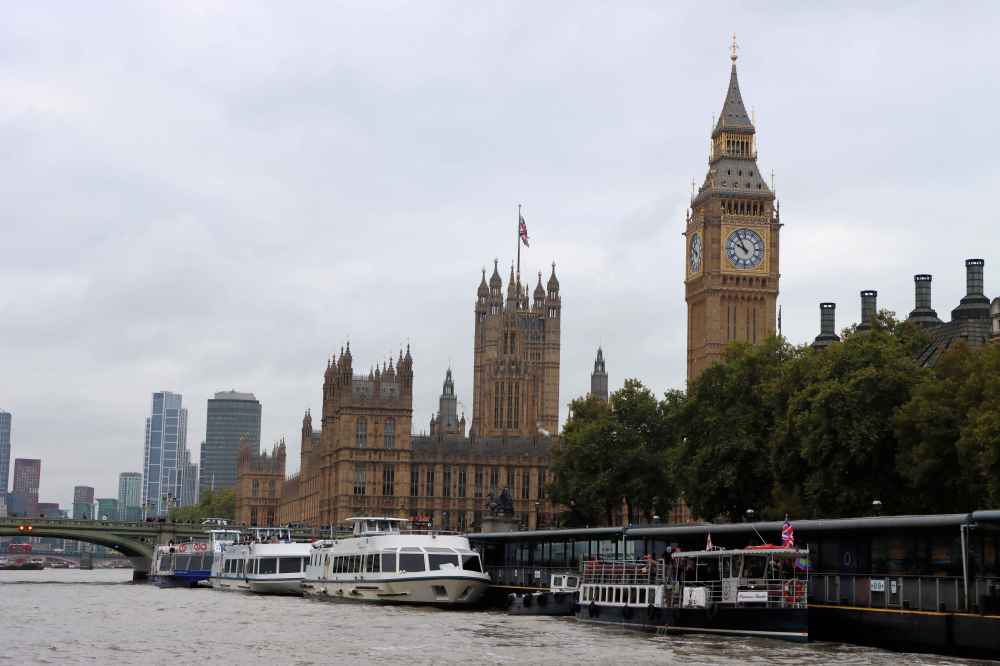
The Houses of Parliament, including Big Ben (aka Elizabeth Tower) as viewed from the Thames. In front of it are several boats that take tourists on trips along the Thames.

Boarding our Thames Clipper boat at Westminster, we were immediately able to admire the Palace of Westminster (aka the Houses of Parliament), including its unmistakeable clock tower. More properly known as the Elizabeth Tower, the clock tower is popularly referred to as Big Ben (in fact, Big Ben is the great bell housed within the tower, rather than the tower itself). These iconic symbols of British democracy date from the mid-19th century, when they replaced earlier buildings that were destroyed by fire in 1834.

The London Eye, and to its right County Hall, which once was the home of London’s local government. Today it houses various attractions, venues, and hotels.

Opposite the Houses of Parliament, on the south bank of the Thames, is the more frivolous but no less recognisable London Eye. Originally known as the Millennium Wheel, the London Eye was opened by Prime Minister Tony Blair on 31 December 1999. It was originally conceived as a temporary project that was due to remain standing for just five years, but it proved so popular that it was soon given permanent status. The Eye is the world’s tallest cantilevered observation wheel, and the UK’s most popular tourist attraction with over 3 million paying visitors per year.

Tower Bridge. To the left is the Shard, and to the right of the bridge is the Walkie-Talkie Building, aka 20 Fenchurch Street.

Heading downriver it was not long before our boat reached another of London’s “must-see” tourist destinations, Tower Bridge. Built in the neo-Gothic style and constructed between 1886 and 1894, the central sections of the road bridge lift to allow tall ships to pass though safely.

The Shard, and on the river in front of it the museum ship HMS Belfast. This cruiser was commissioned in August 1939. In June 1944 she took part in Operation Overlord, supporting the Normandy landings.

Other buildings visible from this section of the river showcase modern architecture, demonstrating that for all its historic attractions London is not stuck in the past. Located on the south bank of the Thames and standing just over 1,000 feet (309.6m) high, the pyramid-shaped Shard is a 72-storey mixed-use development built between 2009 and 2012. This iconic landmark is the tallest building in Western Europe, and the 7th tallest in Europe as a whole behind one in Poland and five more in Russia.

The Walkie-Talkie Building

On the opposite side of the river, the Walkie-Talkie building is equally recognisable, although it comes up short when compared with the Shard as it stands a mere 528 feet (160m) tall! More properly known as 20 Fenchurch Street, the Walkie Talkie’s highly distinctive top-heavy form appears to burst upward and outward. There are 34 storeys of office space, above which can be found a further 3 floors of bars and restaurants.

Metropolitan Wharf, Wapping

Londinium was founded by Roman invaders around AD 47-50. The site was selected because it would make an ideal port and commercial hub, being narrow and shallow enough to put a bridge across, and yet deep enough to welcome seagoing ships. The Thames remained key to the growth and development of the city long after the departure of the Romans, with the wharves and docks that lined its banks handling ever-growing volumes of imports and exports. Countless wharves still remain, although most have been converted to residential or office use.

The piers of the Thames Barrier straddle the Thames

As we neared the end of our boat trip downriver we passed through the Thames Barrier, which is one of the world’s largest movable flood defence barriers. Spanning 520 metres across the Thames, its purpose is to protect central London from flooding caused by tidal surges in the North Sea.  It is made up of 10 massive steel gates; the four main gates are 61 metres wide and, when raised, stand as high as a five-storey building. In normal conditions, only the piers that support the gates and the hydraulic mechanism are visible. The gates lie flat on the riverbed, allowing river traffic to pass freely. When a high tide and potential storm surge are forecast the hydraulic machinery is used to rotate the gates upward, forming a solid steel wall against the water.

Difficult to believe that massive steel plates lie on the river bed between these piers, steel plates that may one day save London from a catastrophic flood

The Thames Barrier was just one of several London landmarks that we were pleased to see during our boat trip. A boat trip along the Thames most definitely offers a new outlook on the UK’s capital. Maybe I’ll do it again one day, but hopefully when the sun is shining!