No ordinary apple tree – Isaac Newton was here!
At first glance it is just an ordinary apple tree, its sturdy branches heavy with delicious fruit waiting patiently to be plucked. Not an uncommon sight, the casual observer might reasonably conclude, hardly worthy of a second glance. But why, that observer wonders, is this apparently modest tree surrounded by a low, woven wicker fence. Perhaps the tree is a bit special after all? And indeed it is: the apple tree in the grounds of Woolsthorpe Manor in the English county of Lincolnshire is perhaps the most famous tree ever in the history of mathematics and science!
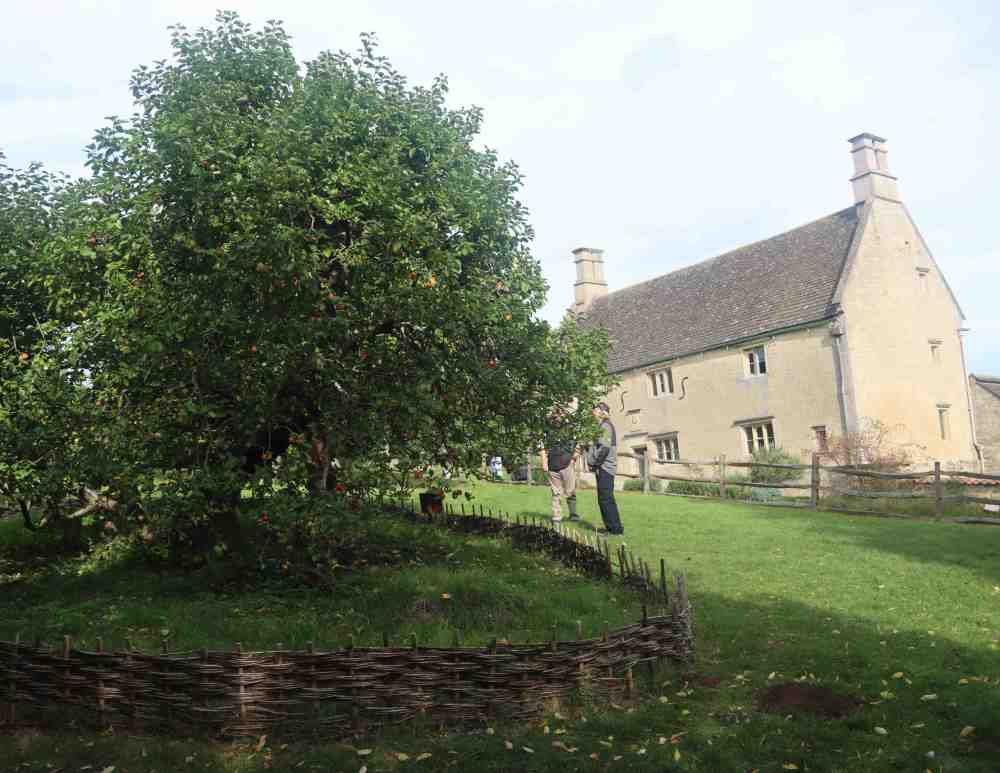
Isaac Newton’s apple tree, in the grounds of Woolsthorpe Manor
In the mid-17th century Woolsthorpe Manor was the childhood home of one Isaac Newton. He was a bright lad, so bright that in 1661 he was admitted to Cambridge University’s Trinity College. Four years later an outbreak of plague temporarily drove students away from the university, and Newton returned home to Woolsthorpe.
There, with time to kill, Newton lazed beneath an apple tree in the manor’s grounds, pondering whatever it was that students pondered before the advent of Instagram and TikTok. As he did so, he saw an apple fall from the tree. It may or may not have struck him on the head – the jury’s out on that one – but the incident definitely caused him to wonder why the apple fell downwards, rather than upwards or sideways.
To our sophisticated 21st century minds the reason seems blindingly obvious, but back in the day nobody had heard of gravity. Isaac Newton was about to change all that. Having given the apple’s behaviour due consideration he formulated his law of universal gravitation. This states that two objects are attracted to each other by a force which is proportional to the product of their masses and inversely proportional to the square of the distance between them!
Make any sense to you? No? Me neither! But the essence of it really isn’t so complicated. All you genuinely need to know about gravity is that if you throw yourself off the top of a tall building in a crazy attempt to fly like Superman, you’re gonna go straight down rather than upwards or sideways. You will fall quickly, hit the ground hard and almost certainly die. Clever guy, that Isaac Newton!


Dating from C17, Woolsthorpe Manor is as unremarkable as the trees in its grounds, and it is difficult to fully appreciate the significance of the mathematical and scientific discoveries to which house and garden once played host.
But never forget, dear reader, that without Newton’s apple tree, gravity would remain a total mystery to us all. Or maybe not, as doubtless another bright spark would eventually have figured it out, with or without the assistance of random pieces of falling fruit.
Newton’s apple tree prospered until 1820, when it was blown over in a violent storm (gravity strikes again!) However the roots clung dearly on to life, and in due course the tree sprouted from them again. Over two centuries later the born-again tree looks remarkably healthy, and seems likely to survive for many more years. And such is its fame amongst scientists that it lives on in another guise too. In 1954 a cutting from it was grafted onto the stock of another variety of apple, and planted in the garden of Trinity College, Newton’s Cambridge alma mater, to remind one and all that “Isaac Newton was here!”
More remarkably still, in 2015 a pip from Newton’s born-again tree was taken by British astronaut Major Tim Peake to be germinated on the International Space Station. Having been safely brought back to Earth, the germinated seed was planted at Woolsthorpe, where today it can be seen growing close to the original tree.
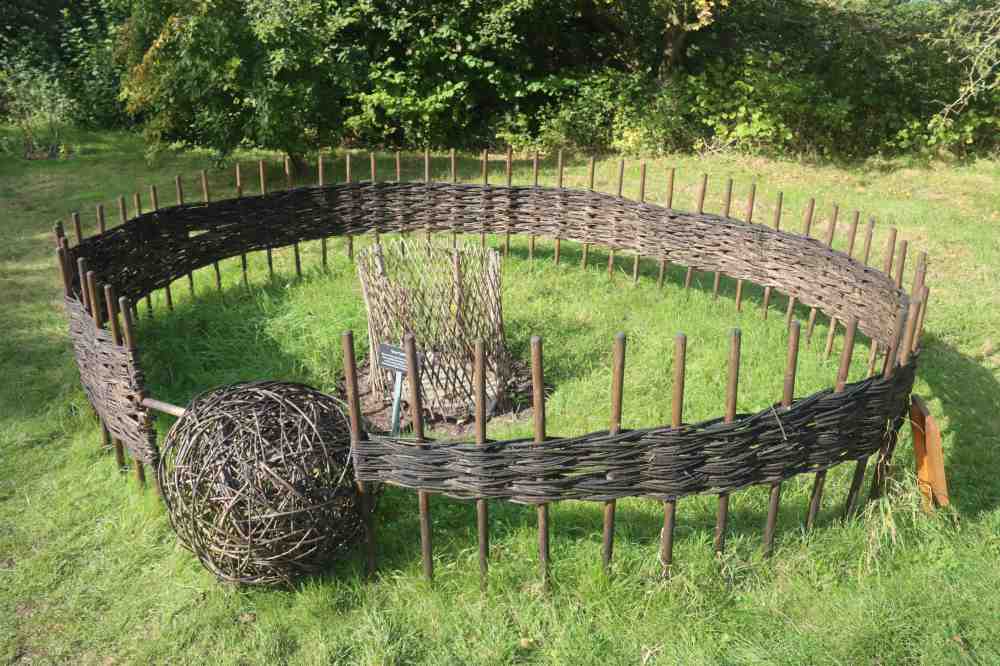
Heavily protected behind the fencing (and invisible on this photograph!) is the sapling apple tree that was germinated on the International Space Station. We may have to wait some time before it bears any fruit!
As well as viewing both trees, modern visitors to Woolsthorpe like Mrs P and I can also wander through the manor house itself, which has been restored and dressed by the National Trust to look how it was in Newton’s day. The building is as unremarkable as the trees in its grounds, and it is difficult for the ordinary visitor to fully appreciate the significance of the mathematical and scientific discoveries to which house and garden once played host. I would not for one minute pretend that I understand the complexities of those discoveries, but the quirky story of Newton’s apple tree renders his story more accessible to mere laymen like me. Long may it prosper.






 Now I'm 64