Swan Lake lives up to its name

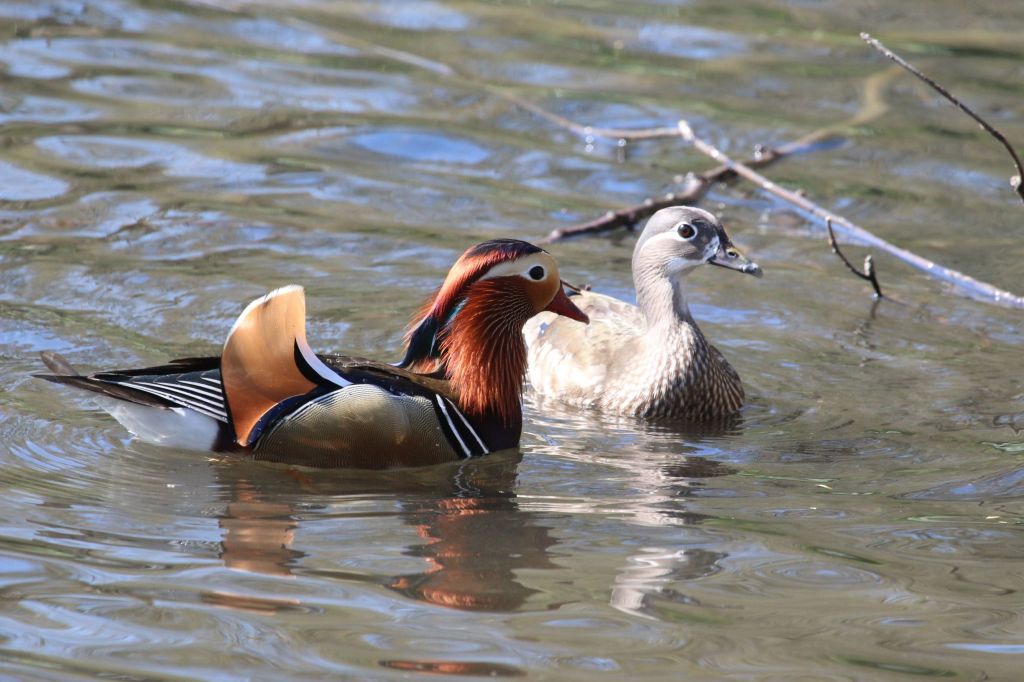
Straw’s Bridge Nature Reserve in Derbyshire is known to the locals as Swan Lake, and with good reason. Although both a Canada goose and a mute swan appear on its signage, there’s no question which is the top bird…and it’s not the goose! When we were last here the star attraction was a pair of mandarin ducks. Sadly they were nowhere to be seen this time, but mute swans were out and about in large numbers.

Families were also out in force, many clutching loaves of sliced bread to share with their feathered friends. I’ve got mixed feelings about this. Bread is not appropriate food for waterfowl and is definitely not recommended for swans (although the local brown rat population loves it!) On the other hand, it’s great to see people getting up close and personal with swans, and introducing their children to these magnificent creatures.

There are around 6,000 breeding pairs of mute swans in the UK, and numbers rise to around 70,000 individuals in the winter when migrants arrive from the continent in search of better weather. They are impressive birds. With a wingspan of up to 2.4 metres (nearly 8 feet) and weighing in at almost 12 kilos (26 pounds) they are the largest of the UK’s wildfowl, a formidable presence on rivers, lakes and ponds all over the country. But they come with a health warning: as a kid I was often on the receiving end of the dire predictions about what they would do to me given half a chance: don’t get too close, worried adults would caution, that swan’ll break your arm in an instant.

Of course I know now that this was a gross exaggeration, and a terrible slur on a wonderful bird. Sometimes they’d hiss a bit if I got too close to a nest of chicks, but the swans I encountered never resorted to violence. For the most part they seemed like improbable, gentle giants and I was a little bit in awe of them. I am still, I guess, and look forward to revisiting Swan Lake in a few weeks time when some newly hatched cygnets should be on show.

Footnote on the quirky history of English swans (aka Swan Upping)

In medieval England swans were a highly prized menu item at banquets hosted by the nobility, and as such were a valued status symbol for those able to serve them up. Reflecting this cherished position, every mute swan in England was deemed to be the property of a major local landowner, each of whom gave the swans in their ownership a unique pattern of marks on the beak.

Beginning in the 12th century, an annual Swan-Upping exercise was carried out to manage the ownership of wild, free-flying birds. Adult mute swans and their new cygnets would be captured. The adults’ beaks would be examined for marks of ownership, and their cygnets given similar marks.  Any unmarked adult swans would be claimed by the Crown.

Of course the monarch, as chief amongst the nobles, had a particular interest in the management of mute swans. This interest is illustrated by the royal Christmas festivities of 1251, when King Henry III served up 125 birds (around 1 ton, or 1,000 kilos, of swan flesh) to his cronies. To ensure a steady and sufficient supply of this avian delicacy the Crown claimed ownership of mute swans on certain stretches of the River Thames and its surrounding tributaries.

By the 15th century the monarch was sharing ownership of swans on ‘his’ stretch of the Thames with the Vintners’ and Dyers’ Companies, two London-based medieval trade organisations. During the Swan Upping ceremony the Worshipful Company of Dyers would mark their swans with a nick on one side of the beak, with the Worshipful Company of Vintners marking theirs with a nick on each side. The swans belonging to the Crown were unmarked. 

Although swans are now protected by law and eating them is strictly forbidden, the quaint and archaic ritual of Swan Upping has been reinvented to help support the conservation of swans. This fascinating YouTube video, featuring Her Majesty the Queen’s very own official Swan Marker, explains more. You just couldn’t make it up!
A touch of the exotic: the Mandarin Duck

As the UK’s first Covid lockdown began to ease last June, one of our earliest trips out was to Straws Bridge nature reserve close to the small Derbyshire town of Ilkeston. It’s known to locals as Swan Lake because … well, because it’s a lake that boasts several handsome swans amongst its residents. The swans were out in force when we visited, but were overshadowed in our eyes by the unexpected sight of a family of mandarin ducks.

Mandarins favour small wooded ponds and avoid large expanses of open water, so the Straws Bridge reserve is ideal for them. Comprising three modest bodies of water set in a landscape of mixed woodland and meadows, it’s one of those habitats that shows how nature can bounce back when man lends a helping hand. In the 1970s and 1980s the area was scarred by open cast coal mining, but when the company concerned got into financial difficulties the local council took it on and restored the site as a wildlife habitat and local amenity. 

We’ve visited this reserve many times over the years and have always found it busy with families out for a stroll, often with a loaf of bread in hand to feed the swans and ducks and – inadvertently – sustain the burgeoning rat population at the same time.

In June last year the place was heaving with visitors, all grateful to get into the open air after the relaxation of the government’s stay-at-home Covid restrictions. None of them, other than Mrs P and I, appeared to have a clue that they were in the presence of a bird that’s regarded by many as the world’s most beautiful duck.

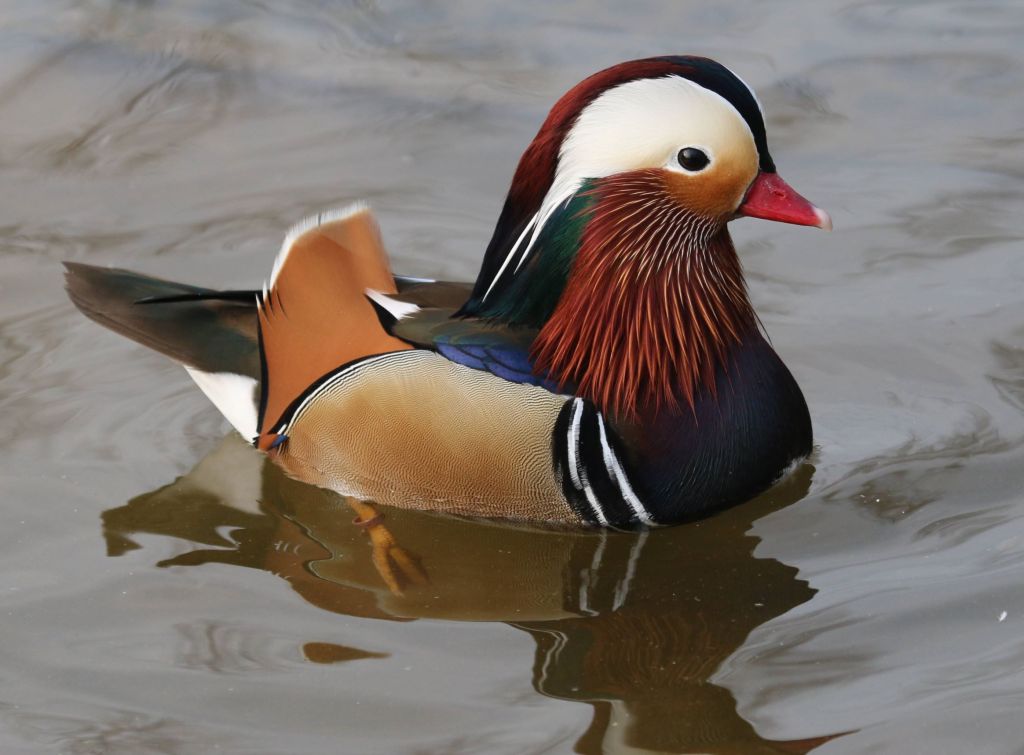
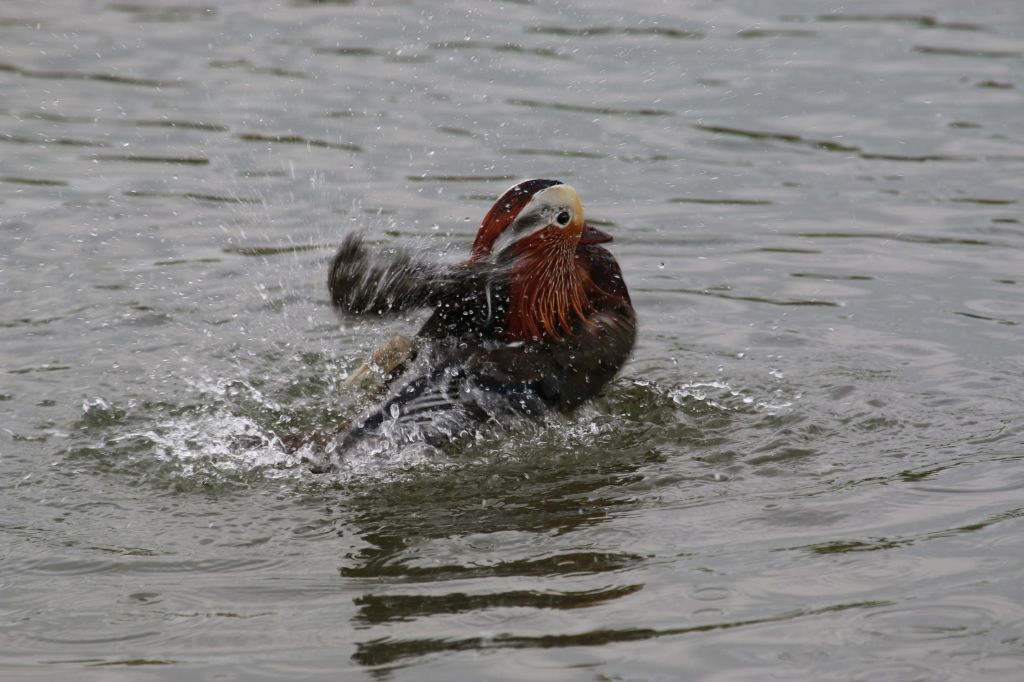
Mandarin ducks look far too exotic to be native British birds, and that’s absolutely right. They hail from East Asia – China, Japan and eastern Russia. The male sports a bright red bill, a reddish face with a large white crescent above the eye, a purple breast with two vertical white bars, and ruddy flanks. It also has two orange “sails” at the back. These comprise large feathers that stick up like the sails of a boat, and are perhaps the most eye-catching feature of what is a very elaborate bird.

The female, however, is drab, with a grey head, brown back and mottled flanks. Her white eye-ring and stripe can’t disguise the fact that, in common with the females of most duck species, she’s unremarkable.

Although the disparity in their looks might suggest otherwise, eastern folklore tells us that a pair of mandarins make the perfect couple. The birds are said to mate for life. In traditional Chinese and Japanese culture, mandarin ducks are therefore regarded as symbols of marital faithfulness. They are a favourite of artists, and also feature in Buddhist legends where they are said to represent compassion.

Male and female. No prizes for guessing which is which!

The supposed everlasting bond between mandarins is captured in a Japanese folktale, which begins with a great lord capturing a male bird so he can forever enjoy its beautiful plumage. Separated from its mate, the male is desperately lonely and begins to pine away. Seeing that the bird will soon die of a broken heart, the lord’s maidservant and her samurai lover decide to do the decent thing and reunite the lovelorn pair. However they get caught in the act and the furious lord condemns them to death for their treachery, proving beyond all doubt that for mankind and birdlife alike the course of true love does not always run smoothly!

* * *

It was in the mid-18th century when mandarins were first brought to Britain, with the intention of adding a bit of oriental glamour to the ornamental waterfowl collections of the idle rich. They escaped with monotonous regularity, and sometimes were deliberately released, but it wasn’t until the 1930s that a significant self-sustaining population of feral birds became established.

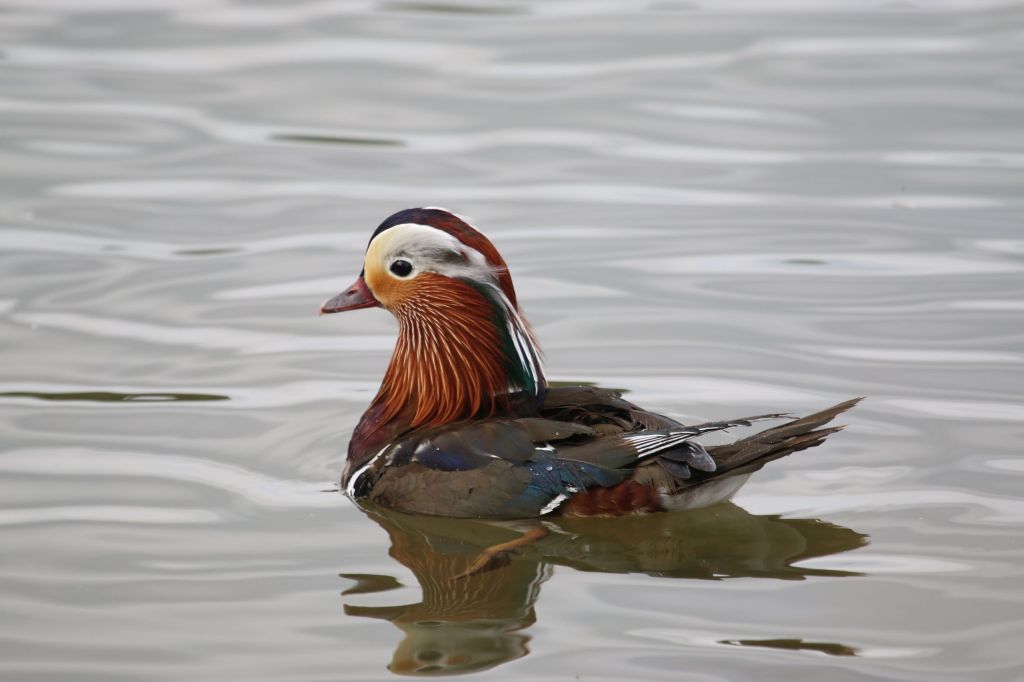
Juvenile mandarin

Since then numbers have grown rapidly, and there are now reckoned to be close to 8,000 mandarin ducks scattered widely throughout England. There are also feral populations in parts of continental Europe, as well as California and North Carolina in the US.

Spotting a lucrative gap in the market, China exported tens – or perhaps hundreds – of thousands of mandarins over several decades. Although the trade was banned in 1975 its impact, combined with widespread habitat loss, has resulted in a big fall in the wild Chinese population. Luckily mandarin ducks are reputed not to taste very good, otherwise pressures on the wild population would have been even greater in a country with over a billion mouths to feed.

Mandarins are notable for perching in trees, and the female invariably chooses a hole or cavity in a tree trunk in which to lay her eggs. After hatching, the ducklings jump to the ground and avoid injury thanks to the cushioning of their fluffy down. The mother swiftly gathers her brood together, and leads them to water. At Straws Bridge the female had plainly done a good job, and we got clear – although distant – views of some juveniles.

However, without doubt the male is the star of the mandarin show. What a looker!