In the Deep Midwinter: Christmas at Chatsworth House

Chatsworth House, ancestral home of the Dukes of Devonshire, is one of England’s foremost stately homes. It’s run as a business, depending for its survival largely on the income it generates by welcoming paying members of the public to explore the stunning house and massive ornamental gardens. As with so many visitor attractions, the Christmas season is vitally important for the health of the enterprise. This is even more true in 2022, as Chatsworth seeks to recover from the damage inflicted upon the business by Covid.

Chatsworth’s famous Cascade, which dates from around 1708, flanked here by rows of eerily lit trees

And when we visited a couple of weeks ago visitors were out in force to experience this year’s Christmas extravaganza. Here’s what the website told us to expect:

Deep Midwinter: A Nordic Christmas at Chatsworth brings to life the Christmas folklore and traditions of the Arctic and Nordic regions through a series of themed roomscapes. Sculpted ‘ice’ walls, tranquil pine forests, lanterns, traditional Nordic Christmas decorations and foliage foraged from woodlands and hedgerows across the estate evoke the sights, sounds and scents of the natural world at wintertime…

Our Nordic theme continues into the garden with an enchanting Christmas light trail. Experience our ‘northern lights’ over the Canal Pond, let colour guide you along Broad Walk into a glade of glowing lights and, for the first time, see the Maze illuminated and filled with festive music.

Sounds great, doesn’t it? But sadly, it didn’t live up to expectations. In 2019, the last time we visited Chatsworth at Christmas, we were blown away by decorations on the theme of “a land far, far away.” This year, however, we were distinctly underwhelmed: the Nordic associations pretty much passed us by, and the decorations lacked impact. Worse still, we paid nearly £30 (USD 37) per head for the privilege.

Some grand stately homes in other parts of the country charge quite a bit more for their Christmas celebration – Blenheim Palace, for example – but, if recent television coverage is to be believed, they offer a lot more too. Clearly, £30 per head isn’t a fortune, but that’s not the point. The question is, does it represent value for money, particularly as we are currently in the midst of a nationwide “cost of living crisis”? I don’t think so.

One of the more attractive features of the “enchanting lights trail” in the garden.

Don’t get me wrong, our visit wasn’t a total waste of time. Parts of the garden lights trail were pretty good, while the best of the decorated rooms of the House were very well done. And if you’d never been to Chatsworth before the whole show probably made a good, although very crowded, introduction to the House’s splendours. But we know the place well and – based on what we saw in 2019, and what we paid for our tickets this time – we expected rather more. The photos I’ve used to illustrate this piece feature the highlights, but the majority of “the experience” was a lot more mundane.

Maybe they had a limited budget in 2022, as a result of Covid’s impact on revenue streams? Or did they spread their resources too thinly, by having “an enchanting lights trail” in the gardens as well as decorating the House (in 2019, the Christmas extravaganza was limited just to the House, and didn’t extend into the gardens). But I can’t help worrying that Chatsworth’s trading on its name, making a calculated underinvestment in this seasonal attraction on the assumption that people will turn up anyway, just because it’s Chatsworth?

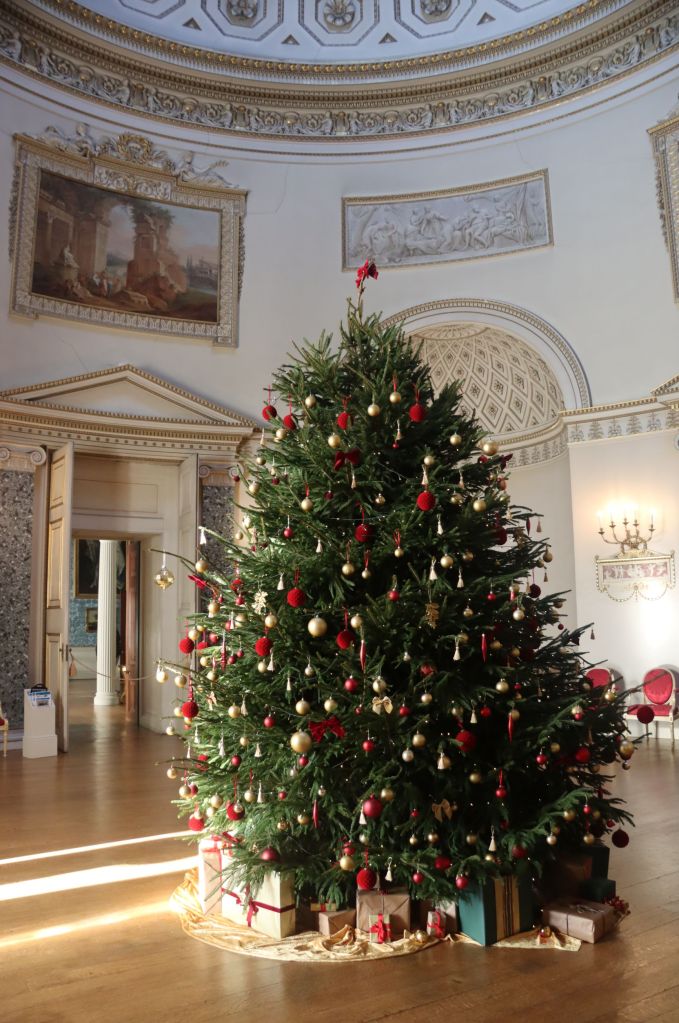
Top left: The Painted Hall. Top right: Another room, another group of trees, and a stray speaker playing Christmas music! Middle right: The Library. Bottom: The Chapel. The golden statue between the trees is by the notorious contemporary British sculptor Damien Hirst.

If so, I fear that may be a bit short-sighted, as there are plenty of other stately homes around here that also put on a show at Christmas. People who shared our disappointment with Chatsworth’s efforts this time may well choose next year to get their seasonal cheer somewhere else, somewhere offering the prospect of seeing more while paying less.

Hopefully, this is a one off, and Chatsworth will be back on form in time for Christmas 2023. Until this year they’ve had a good track record, so we’ll probably give them another chance. I’ll report back 12 months from now!

Burton Agnes celebrates Christmas

Although Burton Agnes may sound like the upper crust villain of an Agatha Christie novel, the reality is altogether more interesting. Built between 1598 and 1610 near the village of Driffield in the East Riding of Yorkshire, Burton Agnes is a magnificent Elizabethan mansion that’s been associated with the same family for over 400 years.

Although the Hall is now managed by a charitable trust, the family still lives there. To help cover the cost of its upkeep, paying visitors are invited to have a poke around this Grade I Listed architectural masterpiece. And, inevitably, the period before Christmas is a great time to pep up the income stream.

The Great Hall

This, of course, is nothing unusual. Up and down the land the good, the bad and the ugly of British stately homes open their doors to the Great British Public at this time of year, anxious to milk the cash cow that is Christmas.

Some do a great job, investing heavily to decorate their mansions with festive frivolities that are sure to get their visitors into the mood for Christmas and, hopefully, will encourage them to return the next year. Others, I suspect, do the absolute minimum that they calculate is necessary to prevent the paying public demanding its money back.

Burton Agnes, which we visited a couple of weeks ago, felt like good value for money. The place was tastefully, but not excessively decked out in seasonal finery. They say that “less is more”, and whoever planned the Christmas decorations here clearly understands the benefits of measured restraint in such matters. The seasonal adornments seemed in tune with their setting rather than simply overwhelming it, which has been the case in some of the places we’ve visited over the years

To be honest, I would normally find it difficult to feel festive in mid-November, but by the time we left Burton Agnes I could happily have polished off a plateful of mince pies and knocked out a verse or two of God Rest Ye Merry Gentlemen. Roll on Christmas, I’m ready for you now!

The White Drawing Room

And, just as important, our visit to see the Christmas decorations also served as an introduction to a truly spectacular building. The Great Hall is just that, a masterpiece of plasterwork and panelling. The Long Gallery, with its barrelled ceiling, is light, airy, elegant (and very, very long!), while the White Drawing Room is comfortably tasteful. Although the decorations were great to see, the quality of the building itself shone through clearly.

Above: The Red Drawing Room. Below: The Long Gallery

Burton Agnes has been described by the author Simon Jenkins as ‘the perfect English house’ and as one of the twenty best English houses. I’m not sure about that, but I do know that there’s lot to admire in it. Mrs P and I have agreed that we’ll make a return visit at another time of year when the Christmas decorations have been removed, so we can get to know it a bit better.

In the entrance hall

Birmingham, the Venice of the North. Really?

In some circles Birmingham, a city in the English Midlands just 50 miles / 80km from Platypus Towers, is referred to as The Venice of the North. Really? Venice, a UNESCO World Heritage Site, is one of the premier jewels in Europe’s cultural crown, “an extraordinary architectural masterpiece in which even the smallest building contains works by some of the world’s greatest artists such as Giorgione, Titian, Tintoretto, Veronese and others.” Birmingham, however…

Difficult to believe this was taken in the very centre of Birmingham, the UK’s “second city”, population 1.15 million

Although its origins are much older, Birmingham owes its prominent position to the Industrial Revolution. Central to the city’s growth was the production of metal-based goods. It became known as “the city of a thousand trades”, where a myriad of small workshops employed skilled craftsmen to manufacture high quality finished products. It was dynamic and prosperous, but it was no Venice!

Comparisons with Venice are woefully wide of the mark, except in one particular regard: canals. Venice is a city of canals, and Birmingham too has a web of waterways dating from the 18th and 19th centuries. These were excavated to bring in the raw materials needed by local workshops, and to carry away the finished goods they produced to markets throughout the country.

Pretty soon, Birmingham was at the heart of the national canal network. The city thrived, and the nation’s canals bustled with activity. But the development of railways in the mid-19th century heralded a change in fortunes for the canal network locally and nationally. Rail transport – and later, transport by road – proved quicker and therefore cheaper than the carriage of materials and goods by water. Birmingham’s canal network declined, and by 1980 all commercial traffic had stopped.

Once the lifeblood of the city, Birmingham’s canals morphed into fetid rubbish dumps and the warehouses lining them became neglected eyesores, derelict and anachronistic. They served no real purpose, and it’s easy to imagine that some bright spark might have thought it would be a good idea to fill in the waterways and bulldoze the associated buildings.

But fortunately, the City Council recognised that if they were sensitively restored, Birmingham’s canals could help drive the city’s regeneration. Work began in the late 1980s, and when we visited a few months ago we were able to see how this far-sighted vision has been put into practice.

Historic toll house, where users of the canal once paid for the privilege

Gas Street Basin is the hub of the city’s canal network, located in what is today the heart of Birmingham’s cosmopolitan nightlife and shopping districts. Here we walked along towpaths lined with vibrant cafés, bars, restaurants and modern buildings, and were also pleased to spot some fine examples of historic canal architecture. Several narrowboats were moored in the basin, adding to the area’s quaint charm.

As we continued our stroll along the towpath, past modern developments that included the International Conference Centre, the National Indoor Arena and the National Sea Life Centre, we encountered plenty of pedestrians and dog-walkers, and some cyclists and joggers too. All were taking the opportunity to get some fresh air, away from the noise and mayhem of the frantic city centre streets.

Gas Street Basin

Meanwhile, colourful narrowboats chugged slowly along the waterways, offering holidaymakers and tourists an unexpected perspective on what is known as the UK’s “second city” (after London, of course!).

Along the way we stopped off for a drink at one of Birmingham’s most distinctive historic buildings. The Roundhouse was built in 1874 as a giant stable complex where 50 horses that worked on the canal could be housed. The need for the facility is long-gone (none of the narrowboats now using the canals are drawn by horses), and for some time the future of the building was in doubt.

However, creative minds have come up with a way forward: now run by a charitable trust, the Roundhouse has been repurposed as a visitor centre, café, display space and offices. It also acts “as a launchpad to explore Birmingham’s brilliant stories and place…[offering] canal-based kayaking, city walking tours, [and] boat trips.”

The Roundhouse, which once provided stabling for 50 working canal horses

As we enjoyed our mochas there was time to reflect on what a good job the city authorities have done in revitalising Birmingham’s canal network and infrastructure. While Birmingham is clearly nothing like Venice, the canals give the city a distinctive character that reflects its unique heritage. A canal network dating back over two hundred years could have become a serious burden to the city and its people in the 21st century, but visionary, enterprising developments have turned it into a genuine asset. Well done, Birmingham, I salute you!

_ _ _ _ _

Postscript: Venice of the North

Birmingham is not the only place that has been labelled the Venice of the North. Other nominees include Saint Petersburg (Russia); Amsterdam (Netherlands); Giethoorn (Netherlands); Bruges (Belgium); Stockholm (Sweden); Copenhagen (Denmark); and Alesund (Norway). To which I can only say, get a grip, guys. Each of these places has its own merits, and should stand or fall by those merits rather resorting to spurious comparisons with another, very different place!

.

Sanitising history? Abbeydale Industrial Hamlet

Abbeydale Industrial Hamlet, which is located close to Sheffield in the northern English county of Yorkshire, is one of the most complete early manufacturing sites in the world. From 1697 to 1933, scythes and other edged tools were made there. In its heyday this was a place of intense activity, where generations of skilled and unskilled people spent their entire working lives. Furnaces belched out heat and smoke, while forges and grindstones powered by four waterwheels – fed by the nearby River Sheaf – were used to pound and sculpt the steel into shape.

Workshops to the left. Beyond them, the Counting House, and beyond it some workers’ cottages

At its peak, in the middle of the 19th century, Abbeydale produced thousands of high-quality edged tools every year. The scythes made by its workforce were an essential tool of farm labourers, used to clear the land and harvest the crops grown on it. Many of the scythes were sold in the UK, while others were exported to the far-flung corners of the British Empire, including Australia, India and Canada.

Early in the 20th century the demand for hand tools began to fall as mechanised alternatives became available. The Abbeydale works finally closed in 1933. Restoration of the site began in 1960, and the Abbeydale Industial Hamlet Museum opened ten years later.

Closer view of the Counting House (left) and workers’ cottages (right), dating from the late 18th century

The Museum comprises a range of preserved buildings arranged around a grassed courtyard. The doors to these buildings are invitingly open, and in some of them the visitor can learn about the process for making a scythe. There were several distinct elements, starting with the making of blister steel. This would then be converted into crucible steel, which was later forged into blades. Finally, the blades would be sharpened on large grindstones, and then chemically treated to prevent rust.

Grinding wheels, once used to sharpen the blades manufactured on site

The workshop buildings boast various tools and pieces of machinery, some modest in size, others large and imposing, all unfamiliar and vaguely threatening to this impractical 21st century Platypus Man. Who knew that making an item apparently so basic as a steel blade could be quite so complicated?

A stack of used clay pots (crucibles), in which crucible steel was made. Crucibles were made on site and had to be discarded after being used twice.

Another door off the courtyard leads us into a worker’s cottage, immaculately dressed to give a glimpse of life in the mid-19th century. Somewhat grander, and set out as it might have been towards the end of the 19th century, is the Master’s House. There is also a Counting House, dressed as it might have been in the 1920s, the office where the works foreman and his clerk carried out administrative tasks essential to the running of the enterprise.

The Tilt Forge, where steel was shaped into the required size and shape of blade

Abbeydale is a fascinating, informative place to visit, offering glimpses of a way of life that feels very alien today. But I can’t help thinking it’s a somewhat sanitised account of how it was “back in the day”. Although on special occasions some of the machinery is still operated by volunteers, during our visit it lay silent. Surely, Abbeydale was never silent? And what about the heat of the furnaces, and the stink and the smoke and the filth, all of which were part and parcel of everyday life when this place was in business? None of this was evident or even hinted at when we were there.

One of four waterwheels on site. These powered various pieces of machinery used in the scythe-making process.

And the neatly grassed courtyard that sits at the heart of Abbeydale looks totally incongruous. Grassy green lawns in the middle of a chaotic industrial 19th century industrial site? I don’t think so! Clearly the courtyard, as well as the tools, bits of machinery and buildings lovingly preserved on site, tell only half the story.

Interior of one of the three workers’ cottages on site. Built in 1793, these housed keyworkers such as the grinder and forge man. Labourers would have lived elsewhere, somewhere less comfortable!

There must be at least a hundred reasons why it would not be possible or desirable, nor even legal, to faithfully recreate the realities of the day-to-day life of Abbeydale in its prime. That’s OK, the Museum still serves an important purpose as a learning aid for young and old alike. But we must never allow excellent museums like this – and for sure, Abbeydale is an excellent museum – to tempt us into becoming nostalgic for the world we have lost.

Interior of the Manager’s House, built 1838-42. Definitely a step up from the workers’ cottages.

Today, Abbeydale looks quaint. It’s well ordered, clean, immaculately presented and eerily attractive. It seems like a rewarding and comfortable place to earn a daily wage, and to live. But have no doubt, life was a living hell for the people who once worked there, engaged in hard and dangerous manual labour every day while earning a pittance. Never forget this, please, if you ever get the chance to visit Abbeydale, or any similar industrial or living history museum. Exhibits like these tell the truth, but never the whole truth.

An architect unchained: celebrating Augustus Pugin’s masterpiece

Architects have a frustrating life, don’t they, forever constrained by the briefs and the budgets of their paymasters, always wondering how much more they could achieve if their clients would only interfere a bit less and pay a bit more. But just occasionally, when the stars are in alignment and the gods smile benevolently upon him, an architect is given a free hand to express himself.

At 61m (200ft) Giles church is Cheadle’s tallest building

Augustus Pugin was one such architect, and when the chains were removed he built his masterpiece, St Giles church in the Staffordshire town of Cheadle. Otherwise known as Pugin’s Gem, St Giles is a Grade I listed Roman Catholic church built in the Gothic Revival style. With a spire standing 61m (200ft) high, it is by some way Cheadle’s tallest building, and is – in my humble opinion anyway – absolutely spectacular.

Looking down the nave towards the altar

If you’re not from the UK you almost certainly have never heard of Cheadle. I’m guessing most Brits aren’t familiar with it either. This is a humble West Midlands market town of around 11,000 people. For hundreds of years the main industry in the Cheadle area was coal mining, but the mines have all closed now and the town’s main employer (JCB) makes mechanical diggers and excavators. It’s a remarkably unremarkable little place, and would be instantly forgettable were it not for the efforts of Mr Pugin.

The arches, walls and pillars are covered in decorative stencilling

Augustus Welby Northmore Pugin (1812-1852), the son of a French draughtsman and designer, was a prodigiously talented and prolific architect whose output included the interior designs for the Palace of Westminster, and over one hundred churches and cathedrals. He also managed to find time to pen eight books on architecture and design before dying at the age of just 40, succumbing – it is believed – to the effects of syphilis that he first contracted in his late teens.

View across the nave towards the pulpit. To the right of the pulpit is the rood screen, intended to protect the altar from irreverent gaze! Above the rood screen is Christ on the cross, with figurines of Our Lady and St John on either side.

Pugin’s patron in the building of St Giles was John Talbot, the 16th Earl of Shrewsbury (1791-1852). In 1829, two years after Talbot succeeded to the title, Parliament passed the Catholic Relief Act, better known as the Catholic Emancipation Act, 1829. This important piece of legislation allowed Roman Catholics to become Members of Parliament and to occupy all but a handful of public offices at a stroke, overturning restrictions that had been in place for hundreds of years.

Shrewsbury’s principal residence was at Alton Abbey – which he renamed Alton Towers – just 6 miles (9km) from Cheadle. The Earl took a keen interest in the spiritual welfare of Catholics in the town, and, emboldened by the Catholic Emancipation Act, he engaged Pugin to build a church there. Pugin, himself a Catholic, had previously undertaken an architectural commission for Shrewsbury at Alton Towers, and had impressed the Earl with his contention that Christian (or gothic) art and architecture could be a powerful weapon in the re-conversion of England to the Catholic faith.

The pulpit is carved from a single block of stone and features images of four saints

It was a marriage seemingly made in heaven. The Earl had the money, Pugin had the creative talent and the pair of them shared a passionate commitment to the Roman Catholic faith. Cheadle’s Catholic population was modest in size, but Pugin’s design was the opposite: extravagant, exuberant and extraordinary.

When St Giles was consecrated in 1846, the service was attended by Bishops, Archbishops and overseas statesmen, as well as the great and the good from the world of architecture and design. Cheadle had never seen anything like it before, and probably never will again.

Between the arch and the roof is a Doom Painting, a representation of the Last Judgment.

When we visited St Giles last year, I didn’t know quite what to expect, but insofar as I had expectations, Pugin’s Gem exceeded them one hundred fold. It is a breath-taking creation, all the more so for being located in this small and otherwise insignificant Staffordshire town. To describe it as totally over the top does not adequately describe its impact on the visitor, but you probably get the general idea!

The altar and reredos are carved out of alabaster. On the front of the altar are angels playing musical instruments. On the reredos the angels hold torches and censers.

I can’t agree with Pugin that architecture alone is capable of inducing religious conversion: in the 21st century such views are either wishful thinking or a dangerous delusion, depending on your point of view. My own spiritual beliefs were utterly untroubled by his masterpiece, but St Giles church remains clear in my memory, monumental and magnificent, a vivid testament to what can be achieved by an architect unchained.

Caldon Canal – Short on length, big on history!

It’s easy to underestimate the impact canals had on the early part of the Industrial Revolution. Today, if they are not drained of water or choked by vegetation, they’re mostly used for leisure purposes only. It is hard to believe that, 200 years ago, they were central to the industrial miracle that transformed society beyond all recognition.

Smart, colourful barges show that the canal is now used for recreational purposes. But hidden amongst the trees to the far left of this shot are remains of limekilns, a legacy from the canal’s industrial past.

The Caldon Canal is a mere 18 miles (29km) long, and runs from Froghall in Staffordshire to Etruria in Stoke-on-Trent, where it joins the much larger Trent and Mersey Canal. Completed in 1779 it was built primarily to transport limestone, so it comes as no surprise that abandoned limekilns can still be found along its route.

Closer view of the remains of limekilns at Consall Forge

The kilns at Consall Forge, which stand 10m high and 50m long, are now clothed in vegetation. Back in the day, however, the view would have been very different. Raw limestone, quarried nearby, would be loaded at the top of the limekilns. Furnaces heated the rock and converted it into quicklime, an essential resource in the steelmaking process. The quicklime would then be removed at the bottom of the kiln and loaded onto barges for onward transportation to where it would be used.

“Bridge #50” across the Caldon Canal at Consall Forge, in the picturesque Churnet Valley. Built c1779.

The remains of more limekilns can still be seen at Froghall Wharf, and here too the serene surroundings make it difficult to fully appreciate how the place must have bustled with activity in its heyday. Froghall also boasts a handsome 19th century warehouse. This has been tastefully repurposed as a café catering for 21st century visitors who like nothing more than to replenish the calories they’ve burned off during their canal-side strolls with a hot drink and an enormous slab of cake!

Former canal-side warehouse at Froghall Wharf, now serving coffee and cake!

One of the undoubted highlights of the Caldon Canal, and perhaps more unexpected, is the Cheddleton Flint Mill Museum. There was a watermill on the site in 1253, and by the 1500s there were two, one to wash woollen cloth in a process known as fulling, and one to mill corn. When the canal was driven past the mills in late 18th century it opened up the possibility of new uses.

Limekilns at Froghall Wharf

The Caldon Canal passes through Etruria, which was – from 1769 – the home of Josiah Wedgwood’s ground-breaking pottery business. One of his highly successful products was “creamware”, which used ground, calcined flint to help achieve its distinctive light-coloured appearance. The mills at Cheddleton were converted to grind the flint Wedgwood needed, and the canal enabled its easy transportation to the potter’s Etruria factory.

Canal view next to Cheddleton Flint Mill

Now owned and run by the Cheddleton Flint Mill Preservation Trust, the site offers fascinating insights into a flint milling process that I was completely unaware of before our visit. It also preserves the miller’s cottage, which dates from the 1800s, shining light on a lifestyle so very different from our own.

Cheddleton Flint Mill

The cottage is dressed as a piece of living history. Recently washed laundry (sparkling white!) hangs drying in front of the range, which serves both as the cottage’s source of heat and a stove for cooking meals. Along the walls two dressers display cherished pieces of tableware, and the table in the middle of the room is laid ready for tea. The exhibit is totally convincing, and it’s easy to believe that the miller and his wife have just popped put for a few minutes, and will soon be back to carry on with their lives.

The miller’s cottage at Cheddleton Flint Mill

Cheddleton Flint Mill is just one of many fascinating points of interest along the 18 miles of the Caldon Canal which, although clearly short on length, is undoubtedly big on history. A visit (or two, or maybe even three) can be strongly recommended if you’re ever in the area!

The Barrow Hill Roundhouse and the romance of steam

What is it about steam locomotives that so captures the imaginations of young and old alike, both here in the UK and across the globe? Like Tyrannosaurus Rex and the Velociraptor they seem like monsters from another age, ill-suited to the modern world, and yet they hold their legions of fans enthralled.

Everyone loves a steam train, and Mrs P and I are no exception. We’ve experienced the romance of steam on several heritage railways (that’s railroads to you guys in North America!), but last year we decided to explore steam locomotives from a different angle when we took a trip to Barrow Hill Roundhouse in the north of our home county of Derbyshire.

The turntable sits at the heart of the roundhouse, here in the process of turning a small diesel shunter

Railway roundhouses were constructed to house and service steam locomotives. At the heart of most roundhouses was a turntable, where locomotives and other rolling stock could be turned around for the return journey. Radiating out from this central turntable – and thereby dictating the circular shape of roundhouses – were spokes of track where the locomotives could be serviced and stored.

Once roundhouses, and the turntables associated with them, were familiar sights up and down the UK’s rail network. But when, in the middle of the last century, steam locomotives were replaced with diesel and electric alternatives that could run equally well in either direction without the need to be physically turned around, turntables became surplus to requirements and most roundhouses were razed to the ground.

Barrow Hill Roundhouse was completed in 1870 and finally ceased operation in 1991. It quickly fell victim to vandalism and neglect, at which point a group of amateur train enthusiasts, the Barrow Hill Engine Shed Society, stepped in with a proposal to save it from demolition. Their vision won the backing of influential backers and charitable funders, and today Barrow Hill is said to be the last surviving railway roundhouse in the United Kingdom with an operational turntable. You can see the turntable in action, and soak up some of the atmosphere at the Barrow Hill Roundhouse, by clicking on the link below to my short YouTube video.

Visitors can see the turntable in action every day while also getting up close and personal with numerous steam and diesel locomotives, as well as a variety of other memorabilia in Barrow Hill’s impressive railway museum. The locomotives have been polished until they gleam, and standing next to them it’s easy to appreciate what magnificent, monstrous beasts they were.

Their time has passed and will never return – climate change and the need to control carbon emissions makes this a certainty – but they and their predecessors were at the heart of the industrial revolution in the 19th century. Steam locomotives boosted the economy by enabling easy cross-country transportation of goods and materials, and changed society beyond recognition when they made swift, affordable long distance travel available to the masses. The display at Barrow Hill offers a pleasurable opportunity to wallow in nostalgia for few hours, and is recommended to anyone with even a passing interest in the romance of steam.

This is Derbyshire: magnificent mansions and hidden hermitages!

My home county of Derbyshire is famed for its stately homes, magnificent mansions built centuries ago by the idle rich to show ordinary folk how well-bred, wealthy and successful they were. Chatsworth House, for example, ancestral home of the Dukes of Devonshire, dates from the 18th century and is reckoned to be one of the finest of England’s great houses.

Chatsworth House (rear view) dates from the 18th century. In the foreground is the “Emperor Fountain” built for the anticipated visit of Tsar Nicholas II (he never actually came!)

Then there’s Hardwick Hall, built between 1590 and 1597 for relentless social climber Bess of Hardwick. It was the wonder of its day, celebrated in the phrase “Hardwick Hall, more glass than wall” for its unprecedented number of windows – glass was prohibitively expensive in the 16th century! It still looks spectacular today.

And let’s not forget Kedleston Hall, a mid-18th century neo-classical masterpiece which the National Trust describes as “a show palace built to impress,” noting that it “was built to wow guests with lavish details and luxurious surroundings.” I’ve previously written about Kedleston Hall and the park in which it sits in this post.

Hardwick Hall, “more glass than wall”, was built in the 1590s

But I wouldn’t wish to mislead you into thinking that Derbyshire is all about grand mansions. Last year we visited the remains of two very different, but equally fascinating dwellings, the largely forgotten, hidden homes of long-dead hermits.

* * * * *

The Dale Abbey hermitage, hidden in woodland on the outskirts of the village of Dale Abbey, dates from the early 12th century. The story goes that one day around the year 1130, a baker called Cornelius living in the nearby town (now city) of Derby had a vision of the Virgin Mary. The Virgin told him to make his way some 7 miles (11km) to a place called Depedale, where he should devote the remainder of his life to God.

Dale Abbey hermitage dates from the 12th century

Upon arrival, Cornelius discovered Depedale to be uninhabited, simply an area of marshland in the bottom of the valley (dale). On its southern side was a steep sandstone bank, and here he excavated a cave in which he would live and worship in peaceful seclusion for around 20 years.

Nearly 900 years later, the results of the baker’s efforts are still plain to see. The simple cave has a sizeable interior, and boasts openings for a door and several large windows. Its construction by just one man using rudimentary 12th century tools must have required a huge amount of effort.

View from the inside of Dale Abbey hermitage

The interior walls of the cave-house are covered with countless graffiti etched into the rock. Amongst these, and now highlighted with a modern coat of fading yellow paint, is an engraved cross. Despite the thoughtless desecration by vandals, it feels as if the hermit Cornelius speaks to us across the centuries. Here, he seems to say, in a world unimaginably different from your own, lived a simple, holy man. Look around you, and see how I toiled to honour my God. Remember me!

Hidden amongst countless graffiti from across the ages, and highlighted with a modern coat of fading yellow paint, is an engraved cross

As stories of the hermit spread, Depedale became a place of growing religious significance. In the 13th century, perhaps attracted by accounts of Cornelius’s exploits, some Augustinian canons founded a monastery on land not far from his hermitage. This was Dale Abbey, which gave the surrounding area the name by which it is now known.

Once a grand and imposing building, Dale Abbey has now all but disappeared thanks to King Henry VIII’s Dissolution of the Monasteries in the 1530s. However the modest hermitage lovingly excavated by Cornelius the baker still survives, proof should anyone require it that big is not always best.

* * * * *

Derbyshire’s second hermitage can trace its origins back even further back, and may have royal connections.

The Anchor Church cave in South Derbyshire, around 14 miles (22km) from Dale Abbey, is hollowed out of a sandstone outcrop close to the River Trent. Although the hermitage may have started life as a small cave carved out naturally by the action of the river, human intervention has made it what it is today. It comprises a series of impressive internal spaces (“rooms”?) and pillars, all accessed by a large doorway and lit by several substantial window openings.

The Anchor Church cave dates from the 9th century, and is one of the oldest intact domestic structures ever found in the UK

Astonishingly, research published in 2021 indicates that the cave-house can be dated back to the Saxon period, making it one of the oldest intact domestic interiors ever found in the UK. More intriguing still are suggestions that it may have been the home of Eardwulf, who was deposed as king of Northumbria in AD806 and died in exile around AD830.

Eardwulf, however, may not have lived in the cave voluntarily. Rather, it appears he was kept there by his enemies under some Saxon form of house arrest. His cave-dwelling lifestyle and spirituality set him apart from his fellows, and in due course he became known to history as Saint Hardulph.

In the 18th century the Anchor Church cave was re-purposed as a summerhouse, when its openings were widened to allow well-dressed ladies to pass through more easily!

The cave-house continued to be used long after Eardwulf’s death, and in the 18th century was re-purposed as a summerhouse by the Burdett family, the owners of the land in which it sits.

The Burdetts are also thought to have widened openings into and within the cave to allow well-dressed ladies to pass through more easily. They seem to have had scant regard for the cave’s history but, fortunately, their overall impact on the structure was slight, and with a little bit of imagination the visitor can still detect Eardwulf’s presence.

* * * * *

Neither the Anchor Church cave nor Dale Abbey hermitage are obvious 21st century visitor attractions. Neither is classically beautiful, or even quaintly pretty. Neither has a tea-room, or a gift shop, or even a car park – both must be reached via a short hike through the countryside.

Both, however, offer fascinating insights into lives that are totally alien to our own, comfortable 21st century existence. Magnificent mansions are an important part of Derbyshire’s “visitor offer”, but there’s so much more to our county’s history than the gilded mansions of the idle rich, if we only care to look.

Rear view of Kedleston Hall, a mid-18th century neo-classical masterpiece. Beautiful, but intrinsically no more interesting than Derbyshire’s hidden and largely forgotten hermitages.

Ford Green Hall: a snapshot in time

We really enjoyed our visit to Ford Green Hall, a fine example of a timber-framed farmhouse built in 1624 on the outskirts of Stoke-on-Trent in the county of Staffordshire. Who wouldn’t appreciate such an iconic building, positively dripping with atmosphere, creaking at the seams with nearly 400 years of history? Such places are strangely comforting, aren’t they, islands of calm and stability amidst a raging ocean of rapid change. They seem timeless, as perfect and wonderful as the day they were first conceived all those centuries ago.

Rear view. The half-timbered black and white core of the building dates from 1624. The brick-built extensions to left and right were added about 100 years later.

But look a bit closer and you’ll quickly realise that it ain’t necessarily so.

When approaching Ford Green Hall the visitor’s attention is drawn to the picturesque timber-framed parts, which are plainly very old. And that’s why we’re here, isn’t it, to see some old stuff. We conveniently block out from our minds the fact that to either side of the building’s black-and-white core are two rather more modern and less attractive brick-built extensions.

Front view. The black and white projection towards the right of the hall is a gabled two-storeyed porch, added just a few years after the hall was first built. This extension is early evidence of the building’s dynamic history.

The plain fact is that by the early 18th century Ford Green Hall wasn’t meeting its owner’s needs, so around 1734 he added two new wings. To our modern eyes these wings are somewhat unsightly – perhaps even a little ugly – and serve only to disfigure the majesty of the half-timbered building to which they’ve been attached. Back in the day, however, the owner will have felt very pleased with himself for modernising an inadequate building that appeared to be stuck in the past.

Worse was to follow – from our modern, sentimental perspective – in the years that followed. Half-timbered buildings fell out of fashion to such a degree that the external timbers were covered up altogether, coated in stucco to disguise the hall’s 17th century origins. The name of the game was modernisation: out with the old and in with the new, and if you can’t get rid of the old altogether at least do the decent thing and hide it from view.

The Hall Chamber (first floor) was originally used as a bedroom, and at the time of Hugh Ford’s death in 1712 it contained 3 beds.

In the nineteenth century the long term owners of the hall – the Ford family – moved away, prompting a further decline in its fortunes. Divided first into three and later four cottages, which housed local coal miners, the building’s glory days appeared over until the local council stepped in.

Stoke-on-Trent City Council purchased the hall in 1946 and, following a major restoration – including removal of all the hideous stucco – opened it as a museum in 1952. They furnished is sumptuously, in the style of a 17th-century yeoman farmer’s house.

The Hall (ground floor) was the most important room of the house. Originally much of the cooking would have been carried out over the hearth in this room, and the family would also have eaten their meals here.

When the Council ran into financial difficulties (don’t they all, sooner or later?) in 2011, the museum faced closure. At this point the voluntary sector came to the rescue, with a charitable trust taking over its running. And they’ve done a good job: as far as we could see, when we visited a few weeks ago. Ford Green Hall is thriving once again despite the best efforts of local government and the Covid virus to throw spanners into the works.

This restoration project has done a great job of preserving a historic structure that would otherwise have perished. However it’s important to remember that what exists today doesn’t reflect the vision of the man who commissioned the building in the early 17th century, and gives few hints as to its varied history.

The Parlour (ground floor) was originally used as both principal bedroom and sitting-room.

When we visit Ford Green Hall, or any other historic building that has been restored for its heritage value, we are simply being treated to a snapshot in time. The true history of such places is always much more dynamic and complex than is apparent to the casual observer.

King Cotton’s legacy: Exploring the Torrs Riverside Park in New Mills

My home county of Derbyshire is famed for its catalytic role in the Industrial Revolution. The world’s first factory – Derby’s Silk Mill – was constructed here in 1721, on the banks of the River Derwent. The scale of this enterprise, in terms of its output and the size of the workforce, was unprecedented. But silk was never going to be more than a niche product targeted at the super-rich. The big money was to be made through the mass production of cotton.

The old and the new in Torrs Riverside Park: Torr Vale Mill on the left, Millennium Walkway on the right.

Exactly 50 years later, in 1771, entrepreneur Richard Arkwright constructed a large-scale water-powered spinning mill at Cromford, also on the Derwent, some 16 miles (25km) north of Derby. Starting in 1772 with some 200 workers, Arkwright’s Mills operated 24 hours a day, in two twelve-hour shifts.

Torr Vale Mill. A cotton mill for over 200 years, it has now being re-purposed.

Soon a number of other cotton mills sprang up along the Derwent Valley, and with them the factory age was born. To celebrate these seismic developments the area, including parts of my home town of Belper, has been designated a UNESCO World Heritage site. History is all around us here in the Derwent Valley, but the cotton industry quickly established itself in other areas of Derbyshire too as budding entrepreneurs set out to make their fortunes.

A second part of Derbyshire into which Arkwright’s factory system was to be swiftly introduced was the small town of New Mills, located on the Goyt River around 32 miles (51km) north-west of Cromford. The town takes its name from a corn mill built there in the late 14th century, but 400 years later King Cotton ruled the roost.

Millennium Walkway passing next to one of weirs built to control water that once powered Torr Vale Mill

The climate, local availability of good construction stone and the raw power of the fast-flowing River Goyt made this an ideal spot for large-scale cotton spinning. By 1810, New Mills boasted nine spinning mills, as well as three mills weaving cotton and three factories producing dyed and printed calico.

Two hundred years ago the town was a hub of righteous industrial endeavour, buzzing and throbbing energetically to the relentless clatter of the cotton mills. Those days are now long gone, but it’s still possible to catch glimpses of the past preserved in the Torrs Riverside Park.

Union Bridge, 1884

Looming over the Park is an imposing complex of buildings that once housed Torr Vale Mill. When it closed in 2000, having operated continuously for more than 200 years, it had been in business longer than any other mill in the country. After laying abandoned and falling victim to vandalism for ten years, the site is being re-purposed. Torr Vale Mill’s 21st century offer now includes an exclusive wedding venue, offices, retail spaces, holiday accommodation and a “dog friendly boutique bar.” It remains a hugely impressive structure, dominating the gritstone gorge in which it stands.

The River Goyt was a boon to the mill owners who needed the power of its waters to drive their machinery, but for ordinary folk its gorge – which is seriously deep and steep – was a big inconvenience, impeding the movement of people and goods between the communities living on either side. However, as the local population grew the need for efficient communications between the two sides became more acute. Solutions were demanded, and in due course sturdy bridges were built.

Here the Millennium Walkway clings precariously to a massive railway embankment above the tumbling River Goyt. Torr Vale Mill to the left.

Today Queens Bridge (1835) and the Union Road Bridge (1884) are picturesque reminders of a time when textile industries dominated New Mills, and were at the heart of its development and prosperity. The town was thriving then, and it must have seemed that King Cotton would reign forever.

But all things pass in the fullness of time, and New Mills’ cotton industry is now no more. Were it not for Torr Vale Mill, and the scattered archaeological remains of other mills that perished before it, today it would scarcely be remembered at all.

Queens Bridge (1835)

However, time moves on, and it’s good to see New Mills looking forward as well as back. Perhaps the most surprising feature of the Riverside Park is the spectacular Torrs Millennium Walkway, built in 1999. This long, shining sweep of steel stands on stilts high above the River Goyt, in parts cantilevered from a sheer stone railway embankment. It offers great views of Torr Vale Mill, and of a weir built two centuries ago to enable the mill owner to harness the power of the Goyt.

A second unexpected feature of the Riverside Park is Torrs Hydro, the UK’s first community owned and funded hydro-electric scheme. Here some of the water flowing down the River Goyt is directed through a huge Reverse Archimedes Screw, nicknamed Archie by the locals. It drives a turbine generating electricity. It’s not a pretty sight but, peering through the protective wire that encases the mechanism, the giant metal screw – which spins relentlessly, powered by the rushing, roaring water – is strangely hypnotic.

Torrs Hydro in the foreground (Archimedes Screw hidden beneath protective wire screen), with the Queens Bridge behind. Not a pretty sight, but strangely hypnotic!

OK, this tiny initiative isn’t going to end our reliance on fossil fuels, let alone solve the global climate crisis, but what a brilliant way to showcase how communities can respond creatively to the biggest problem the world faces today. And profits from selling the power Torrs Hydro generates are used to fund local projects, thus helping to ensure ongoing community buy-in to this ground-breaking venture

To be honest, before our visit to New Mills last month my expectations were quite limited. New Mills has had its day, I thought, and it wasn’t much of a day even at its best. Give me the world-beating Derwent Valley any day, I said to myself. Which just goes to show how wrong I was! The natural beauty of the gorge and the scattered relics of New Mills’ industrial past, as well as other more recent projects, make Torrs Riverside Park a fascinating place in which to spend a couple of hours. I thoroughly recommend a visit if ever you’re in the area.