Mrs P and I enjoy a colourful sculpture trail. They are plainly not high art, but they’re good fun and raise the spirits at a time when events – both international and here in the UK – are profoundly depressing. We have travelled to various parts of the country in pursuit of these trails, so it was a pleasant surprise when we discovered that our local area was to host its very own trail under the title of Ay Up Me Duck.
“Sunset over Amber Valley” by Rachel &Phillipa Corcutt (on display in Alfreton)
For those who don’t know – and I guess that’s almost everyone who’s never lived in the East Midlands region of the UK – “ay up me duck” is a traditional, casual way of greeting men and women who are your friends, or to whom you feel well disposed. I suppose it’s a bit like saying “hi, how’re you doing”, but it’s unique to this part of the country, and as such is a way of celebrating a shared local identity. Organising a sculpture trail that references this phrase is therefore a good way of reinforcing a positive community spirit, while the body shape of a duck gives ample opportunity for artists to show off their talents.
TOP LEFT: “Ay up, Belper” by Carla Dee (on display in Belper); TOP CENTRE: “Duk n Love” by Oliver Jamin (in Alfreton); TOP RIGHT: “Amber Sun” by Rebecca Grantham (in Ripley); BOTTOM: “Bee-ky” by Lynne Hollingsworth (in Heanor)
The Ay Up Me Duck trail features eight large, colourful ducks prominently displayed in the towns of Belper, Alfreton, Ripley and Heanor (two ducks per town) as well as a host of mini-ducks in shop windows. The large ducks are mostly decorated with images of notable landmarks to be seen in our corner of Derbyshire, as well as some of the wildlife that can be found here. The mini-ducks are more quirky and include one sporting a ceremonial guardsman’s uniform, another that appears to be a strange hybrid of duck and kangaroo, and third dressed up as a pirate. Weird, eh!
Mini-ducks, just a few centimetres tall, seen in shop windows. LEFT: “Guardsman Duck”; CENTRE: “Kangaroo Duck”; RIGHT: “Pirate Duck”.
All the ducks are located in, or very close to, retail areas of the towns involved. As well as boosting civic pride the aim of projects like this is, in part, to encourage more visits to the area in which the sculpture trail is located. This is no bad thing given that all local town centres – except Belper’s – are looking increasingly rundown, thanks to competition from online shopping and out-of-town retail parks.
“Derwent Duck” by Rebecca Mortledge (on display in Belper)
To some degree the trail seemed to be paying dividends, as we saw numerous families ticking off the ducks they’d successfully tracked down on their trail guides. It even persuaded Mrs P and I to visit a couple of places within just a few miles of our home that we’ve not seen for many years. Whether we, or those other families, will go back again after the ducks have been removed is doubtful, but for a few short weeks the Ay Up Me Duck trail is creating a bit of a buzz – or do I mean a quack? – around the Amber Valley district of Derbyshire. It is, I think, a most welcome initiative in these difficult times.
During a recent trip to London our ambition to escape the familiar tourist treadmill led us to visit Leighton House, the former home of a prominent 19th century artist and lord of the realm. Frederic Leighton (1830-1896), the artist son of a Yorkshire doctor, was successful, well-travelled and wealthy, and in the mid-1860s he started work on a new house in the Holland Park area of the city. The result was spectacular.
The Arab Hall
Leighton’s intention was to build a house that would function as his artist’s studio, while also serving as a work of art in its own right. In so doing he was able to channel his creativity, to indulge his passions and to show off some of the more exotic items in his personal collection.
The Arab Hall
The undoubted star of the show at Leighton House is the Arab Hall, a space that was inspired by the architecture and gardens the artist had seen on his travels in North Africa, the Middle East and Sicily. The Arab Hall displays Leighton’s collection of tiles, most of which were made in Damascus between the late 16th and early 17th centuries, as well as works by contemporary artists he commissioned to help bring his vision to life.
The Arab Hall. In the bottom photo the Arab Hall is viewed from the Narcissus Hall. The statue is of Narcissus, who plainly fancies himself!
The Arab Hall was part of an extension added to the house in the 1870s. It was completed in 1882, and is said to have cost more than the whole of the original building. Money well spent, I think! Leighton is reported to have said of the Arab Hall that he wanted to create “something beautiful to look at”. Well, he succeeded, that’s for sure. It is simply stunning, all the more so for being so totally unlike anything you would ever expect to see in London.
Top Left: In the garden “A Moment of Peril”, a sculpture by Sir Thomas Brock created in 1881. Bottom Left: Rear view of Leighton House, from the garden. Right: View of Leighton House from the street; you would never guess what lurks within, would you?
Leighton was an eminent figure in the English arts scene in the latter half of the 19th century. He painted both portraits and landscapes, dabbled in sculpture and was a big player in the Aesthetic Movement, which championed “art for art’s sake,” prioritising beauty, sensuality, and visual pleasure over practical considerations.
The Silk Room was used to display paintings by artists who Leighton admired.
Frederic Leighton was highly respected in the artistic community, as demonstrated by the fact that in 1878 he became President of the Royal Academy of Arts, the prestigious, London-based institution that was founded in 1768 to promote visual arts through education and exhibitions.
Two paintings by Frederic Leighton.
Such was the esteem in which Leighton was held that on January 24th 1896 he was made a Lord, becoming Baron Leighton. It was a record-breaking elevation to the nobility as he was the first painter ever to have received a peerage. He probably felt pleased with himself, but sadly that did not last long. Just one day later, on 25 January 1896, Baron Leighton died, enabling Frederic to break another – and altogether more unwelcome record: nobody in the history of English nobility has ever held a peerage for less time than poor old Fred!
The Dining Room was mainly used for the display of pottery.
Baron Leighton therefore had no time in which build a reputation in the House of Lords as a formidable debater and champion of the arts. From that perspective he was – through no fault of his own, of course – a complete nonentity. But who really cares about that? The building of Leighton House, and particularly the creation of its Arab Hall, has secured Frederic, Baron Leighton’s legacy for all time.
When we visited London a few months ago we made a conscious decision to avoid the tourist hotspots and instead have a look at some of the lesser known attractions. London definitely has a lot to offer, but St. Sophia’s Cathedral – more properly known as the Greek Orthodox Cathedral of the Divine Wisdom – was certainly not what I expected.
Surprisingly the first Greek Orthodox church in London opened way back in 1681, to serve a growing community of Greek origin. This influx was driven in part by the persecution of Christians under the Ottoman Empire, which ruled Greece at the time. In addition, some wealthy Greeks relocated to London to escape the political instability of their homeland, while others who worked in the shipping industry moved there to set up businesses moving goods between England and the eastern Mediterranean. The small Greek community thrived, and today the area of Soho in which they first settled is still known as Greek Street.
Although London’s Greek community prospered and grew, their original church did not. By the mid-19th century, demand amongst its members for an appropriate place of worship intensified, and it was this that ultimately led to the construction of a building large and grand enough to meet the spiritual needs of a community that was now numbered in the thousands. Work began on the construction of the Greek Orthodox Church of the Divine Wisdom in 1877, and it was formally consecrated in 1882. In 1922 it was designated as a Cathedral serving the needs of all Orthodox Christians in the British Isles and Malta.
Arriving at the Cathedral, the view from the street is unremarkable, and at first I wondered if our visit was worth the effort we’d made to get there. Crossing the threshold, however, I quickly learned that the ornate Byzantine interior boasts an impressive array of intricate mosaics and other beguiling features. This riot of gold leaf, multi-coloured marble and elaborately carved wood seemed strangely exotic, very un-British, not at all what I expected to see in London – nor, indeed, anywhere in the UK – and was all the more pleasing for that very reason.
The Greek Orthodox Cathedral of the Divine Wisdom in Bayswater, London, most definitely possesses the “wow factor”, and is a clear illustration of why visitors to London should occasionally break away from the well trodden tourist trail and seek out some of the capital’s less known architectural gems. Well worth a visit!
Wordless Wednesday is a simple blog post featuring a photo. It seeks to convey a message or tell a story, but speaks for itself without using words. Mrs P took this photo of a fishing hut at Prospect Bay in Nova Scotia, Canada in 2015
In a previous post about our 2025 visit to London I described a journey downriver on the Thames from Westminster Bridge to Woolwich. On a different day we took another boat trip, this time heading upriver. The plan had been to visit the historic Hampton Court Palace, once the home of King Henry VIII. Sadly this proved impossible due to repair work being undertaken at Teddington lock, but nevertheless – despite the relentlessly gloomy weather – we decided to take the boat upriver to Kew to view this area of London from an unfamiliar angle.
The Vertrouwen is a Dutch barge dating from 1929. It is now moored at Dove Pier in Hammersmith.
In common with most cities, London is a mixture of the good, the bad and the ugly. Mostly ugly, of course, but the river journey did reveal a few interesting bridges, boats and buildings. Although I grew up in the capital, most of the sights were new to me, but a few – such as Hammersmith Bridge – were achingly familiar.
Hammersmith Bridge
An elegant suspension bridge that opened in 1827, Hammersmith Bridge is etched into my memory. Over half a century ago I attended school in this part of London, and can clearly remember our class being sent on “cross-country” runs – following a route that included crossing the bridge – by a teacher who was clearly allergic to teaching in the conventional sense. These days the bridge is closed to all motor traffic due to the appearance of cracks in its pedestals, but foot traffic (including, I imagine, cross-country runners!) can still cross here.
Hammersmith Bridge
One of the most recognisable buildings we saw during our trip upriver was Battersea Power Station. Built in two phases between 1929 and 1955, the coal-fired power station once produced a fifth of all the electricity used in London, keeping the lights on in buildings as illustrious as Buckingham Palace and the Houses of Parliament.
Battersea Power Station ceased operations in 1983, when the generating equipment began to wear out and oil, gas and nuclear fuels started to be preferred over coal for the generation of electricity. Demolition would have been the obvious next step, but the building’s iconic appearance on the London skyline resulted in it being given listed status in recognition its heritage value.
Battersea Power Station
For over 20 years the former power station remained unoccupied. It fell into disrepair, before plans were agreed to redevelop the site to include residential accommodation, bars, restaurants, offices, shops and entertainment spaces. When viewed from the Thames there is little indication today of what now lies within, but it’s easy to see why such an imposing structure captured the imagination of several generations of Londoners.
We had been fully expecting and were looking forward to seeing Battersea Power Station, but another nearby building took us totally by surprise. Just a few hundred metres upriver from the power station is the Peace Pagoda, one of around 80 similar structures built across the world since the end of the Second World War. They owe their origin to the Japanese Buddhist monk Nichidatsu Fujii (1885-1985), who devoted his life to promoting non-violence after an inspirational meeting with Mahatma Gandhi in 1931.
The Peace Pagoda in Battersea Park
The first Peace Pagoda, which was intended as a focus for people of all races and creeds to help unite them in their search for world peace, was inaugurated in the Japanese city of Kumamoto in 1954. The Battersea Peace Pagoda dates from 1985, and was built by a group of 50 volunteers who were members of the Japanese Nipponzan-Myohoji Buddhist order that had been founded by Fujii.
Taking off from London Heliport
Journeying through London on the Thames proved to be the perfect way to escape the chaos of the capital’s road network for a while, but travel by boat does not suit everyone. If you’re in a hurry, filthy rich and don’t give a damn about noise pollution, you can travel to and from central London by helicopter. London Heliport’s website proclaims that it offers “ultimate comfort and convenience” by acting as “the vertical gateway to London for VIPs and the business community for over 50 years.” Plainly it’s not for the likes of me and Mrs P, but we were interested to watch a helicopter taking off as our boat passed the heliport. It reminded us – as if we needed reminding! – why we would hate to live in London.
These images show a few of the other sights we witnessed during our upriver excursion. Top Left: “The Powerhouse”, a former power station converted into luxury apartments. Top Right: former Dutch barge the “Amethyst Atoll”, now moored at Dover Pier, Hammersmith. Middle Right (top): Kew Bridge. Middle Right (bottom): Unidentified boat moored at Chiswick. Bottom Right: Lambeth Bridge. Bottom Left: “Houses on the Strand” at Kew. All very interesting, but I definitely wouldn’t want to live here!
Our recent trip to London to watch a sumo tournament also gave us the opportunity to act like regular tourists for a while, ticking off a few things that have been on Mrs P’s list for many years. One of these was to take a boat trip along the River Thames, downriver from Westminster and through the Thames Barrier. Although I’m a Londoner by birth, I don’t usually enjoy the experience of re-visiting a city that I find crazily crowded and annoyingly noisy. Travelling through it by boat, however, offered the opportunity of a different perspective, more scenic and less frenetic, so although on our chosen day the weather was relentlessly gloomy I was keen to give it a try.
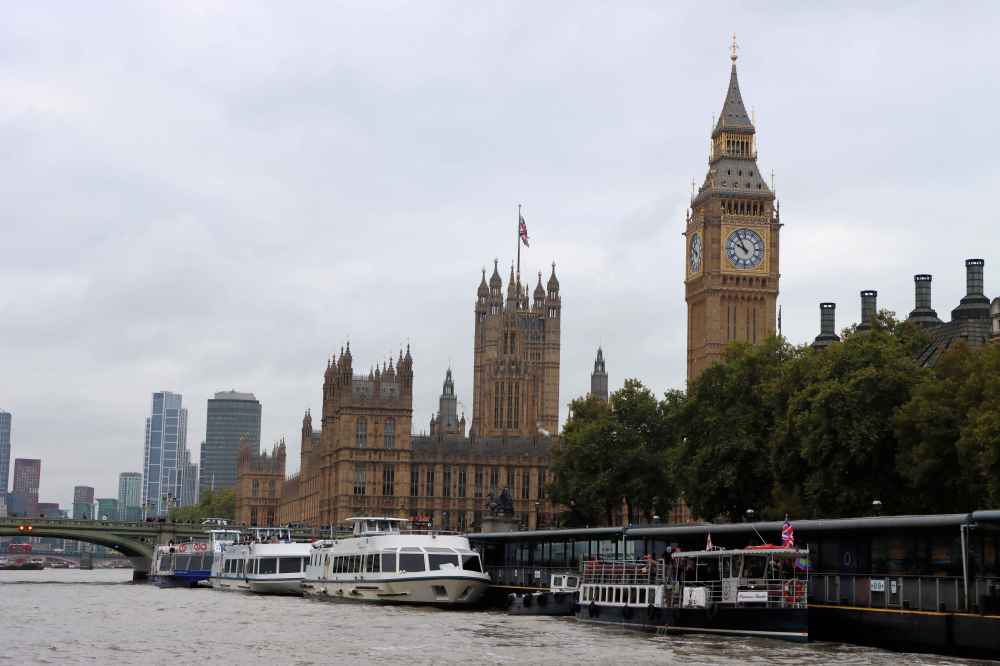
The Houses of Parliament, including Big Ben (aka Elizabeth Tower) as viewed from the Thames. In front of it are several boats that take tourists on trips along the Thames.
Boarding our Thames Clipper boat at Westminster, we were immediately able to admire the Palace of Westminster (aka the Houses of Parliament), including its unmistakeable clock tower. More properly known as the Elizabeth Tower, the clock tower is popularly referred to as Big Ben (in fact, Big Ben is the great bell housed within the tower, rather than the tower itself). These iconic symbols of British democracy date from the mid-19th century, when they replaced earlier buildings that were destroyed by fire in 1834.
The London Eye, and to its right County Hall, which once was the home of London’s local government. Today it houses various attractions, venues, and hotels.
Opposite the Houses of Parliament, on the south bank of the Thames, is the more frivolous but no less recognisable London Eye. Originally known as the Millennium Wheel, the London Eye was opened by Prime Minister Tony Blair on 31 December 1999. It was originally conceived as a temporary project that was due to remain standing for just five years, but it proved so popular that it was soon given permanent status. The Eye is the world’s tallest cantilevered observation wheel, and the UK’s most popular tourist attraction with over 3 million paying visitors per year.
Tower Bridge. To the left is the Shard, and to the right of the bridge is the Walkie-Talkie Building, aka 20 Fenchurch Street.
Heading downriver it was not long before our boat reached another of London’s “must-see” tourist destinations, Tower Bridge. Built in the neo-Gothic style and constructed between 1886 and 1894, the central sections of the road bridge lift to allow tall ships to pass though safely.
The Shard, and on the river in front of it the museum ship HMS Belfast. This cruiser was commissioned in August 1939. In June 1944 she took part in Operation Overlord, supporting the Normandy landings.
Other buildings visible from this section of the river showcase modern architecture, demonstrating that for all its historic attractions London is not stuck in the past. Located on the south bank of the Thames and standing just over 1,000 feet (309.6m) high, the pyramid-shaped Shard is a 72-storey mixed-use development built between 2009 and 2012. This iconic landmark is the tallest building in Western Europe, and the 7th tallest in Europe as a whole behind one in Poland and five more in Russia.
The Walkie-Talkie Building
On the opposite side of the river, the Walkie-Talkie building is equally recognisable, although it comes up short when compared with the Shard as it stands a mere 528 feet (160m) tall! More properly known as 20 Fenchurch Street, the Walkie Talkie’s highly distinctive top-heavy form appears to burst upward and outward. There are 34 storeys of office space, above which can be found a further 3 floors of bars and restaurants.
Metropolitan Wharf, Wapping
Londinium was founded by Roman invaders around AD 47-50. The site was selected because it would make an ideal port and commercial hub, being narrow and shallow enough to put a bridge across, and yet deep enough to welcome seagoing ships. The Thames remained key to the growth and development of the city long after the departure of the Romans, with the wharves and docks that lined its banks handling ever-growing volumes of imports and exports. Countless wharves still remain, although most have been converted to residential or office use.
The piers of the Thames Barrier straddle the Thames
As we neared the end of our boat trip downriver we passed through the Thames Barrier, which is one of the world’s largest movable flood defence barriers. Spanning 520 metres across the Thames, its purpose is to protect central London from flooding caused by tidal surges in the North Sea. It is made up of 10 massive steel gates; the four main gates are 61 metres wide and, when raised, stand as high as a five-storey building. In normal conditions, only the piers that support the gates and the hydraulic mechanism are visible. The gates lie flat on the riverbed, allowing river traffic to pass freely. When a high tide and potential storm surge are forecast the hydraulic machinery is used to rotate the gates upward, forming a solid steel wall against the water.
Difficult to believe that massive steel plates lie on the river bed between these piers, steel plates that may one day save London from a catastrophic flood
The Thames Barrier was just one of several London landmarks that we were pleased to see during our boat trip. A boat trip along the Thames most definitely offers a new outlook on the UK’s capital. Maybe I’ll do it again one day, but hopefully when the sun is shining!
A couple of weeks ago Mrs P and I took ourselves off to London for a few days to attend a sumo tournament. Almost without exception the people we told about our plans thought we’d gone crazy. You could see it in their eyes – “Why?” they wondered, “why would anyone pay good money to watch a load of semi-naked fat guys trying to beat each other up?” To which my response is this: please don’t criticise what you don’t understand.
Our connections with sumo
Mrs P and I first encountered sumo in the mid-1980s, when we were able to watch parts of a tournament on television during a vacation visit to Japan. We were intrigued, quickly spotting that this apparently crude and brutal sport is more subtle than it first appears, being rooted in at least 2,000 years of Japanese history and culture. We realised very quicky that if ever the opportunity arose we would like to get to know more about this unfamiliar, but strangely fascinating activity.
A few years later in 1991 the Japan Festival, which was held in London and across the UK, included the first-ever official sumo tournament to be held outside Japan. We managed to get tickets for one day of that event, which was held at the Royal Albert Hall, and so managed to watch sumo live and in the flesh for the first time.
Eight years later we returned for a second visit to Japan. We were staying with a friend who worked at the British Embassy, and through his connections were able to get tickets for one day of the September sumo tournament at the Kokugikan in Tokyo, the country’s foremost sumo arena. It was a wonderful, strangely exotic experience that we have never forgotten.
Although in recent years we have been able to follow sumo on television courtesy of broadcasts by NHK World, we assumed that we would never again get the chance to experience it first-hand. So, when we learned that Grand Sumo was to return to the Royal Albert Hall in October 2025, we were desperate to get tickets.
On the day that tickets went on sale Mrs P logged onto the ticket line the moment it went live, and found that there were already more than 1,000 people in the queue ahead of her! It was evident that the tournament was going to be a big success, and luckily, after a long wait and a lot of anxiety, she was able to bag tickets for the first two days of the five-day event.
Sumo’s history, rituals and rules
Sumo wrestling has an extraordinarilylong history. Prehistoric wall paintings suggest that it evolved out of a ritual agricultural dance that was performed to pray for a good harvest. The earliest written references date from the early 8th century, and tell the story of a bout fought between two warlords – in the presence of the Emperor – in 23BCE.
Before the day’s sumo begins the wrestlers parade in all their finery
From the 8th century, ritual sumo was carried out at the imperial court to predict the year’s harvest and to pray for abundance and prosperity. Beginning in the 12th century, it evolved into a form of combat training for samurai warriors. A few hundred years later, Japan embarked upon a long period of isolation from the outside world. Peace reigned supreme, and because samurai warriors no longer needed to fight, sumo wrestling began to develop into a form of entertainment, often as a way to raise money for the repair of shrines and temples. Thus was sumo professionalised.
In the mid-nineteenth century Japan opened up again to foreign contacts and sumo was perceived to be old fashioned, a relic of the past that needed to be relegated to the pages of history. However, in 1884 the Emperor organised a tournament which proved to be a turning point for the sport. Instead of appearing old fashioned, sumo was now seen as a national symbol, part of a shared heritage in which all Japanese people could take pride. And so it remains today.
Grand champion Hoshoryu performs a traditional ring-entering ceremony. He went on to win the tournament (“basho” in Jananese) .
Rituals and ceremonies abound in sumo, and help make it like no other sport I’ve ever seen. These include (1) the ring-entering ceremonies at the beginning of each tournament day, in which the wrestlers (called rikishi in Japanese) parade into the ring wearing elaborate aprons over their belts (mawashi); (2) the tossing of salt into the ring (dohyo) by the wrestlers to symbolically clean it; (3) the rinsing of the mouth with “power water” (chikara-mizu) before a fight, which is similar to the ritual carried out before entering a Shinto shrine; (4) the stomping of the feet by rikishi before a bout begins, which is a ritual to scare away demons; (5) the bow-twirling ceremony (yumitori-shiki), which is performed at the end of each day’s wrestling. Dating back to the 1700s, it symbolises both the winner’s dance and a spiritual cleansing; (6) the ceremonial clothing worn by the referee (gyoji), which resembles that of a Shinto priest.
The bow-twirling ceremony marks the end of the day’s sumo
.
The basic rules of sumo are very, very simple: it is a form of wrestling in which a contestant loses if he is forced out of the ring first, or if any part of his body except the soles of his feet touch the ground. Having said that, there are no fewer than 82 recognised techniques (kimarite) that can be deployed to achieve a winning outcome. Sumo is a lot more complex and subtle than it appears at first glance.
Unlike other fighting sports, sumo does not have weight classes; so long as he stands over 167cm tall and weighs over 67kg any man can participate. One of the most exciting aspects of watching sumo is the “David versus Goliath” battles, fights between two wrestlers with vastly different builds. In sumo, strength and power are important, obviously, but so too are technique and speed. The Davids of the sumo world often deploy their own special skills to defeat their Goliath opponents, much to the delight of most neutral onlookers.
The Grand Sumo Tournament, October 2025
Mrs P and I attended the first two days of the Grand Sumo tournament, and had a truly memorable time. The Royal Albert Hall was packed with spectators, and the atmosphere was electric. While some audience members may have attended out of idle curiosity, it was clear that most knew and understood sumo. It was great to finally be able to sit alongside and to speak with a few people who share our interest in a sport that clearly baffles most Brits.
Outside the Royal Albert Hall, traditional Japanese banners advised passers-by that something special is happening inside.
The tournament attracted a good deal of coverage in the media and online. Wrestling took place in the evening, and earlier in the day the wrestlers – 40 of them, in total – got out and about visiting some of London’s tourist hotspots. If media reports are to be believed the wrestlers made quite an impression on the locals, and were widely perceived as “gentle giants”.
Big screens suspended from the roof of the Royal Albert Hall offered close-ups of the action if required.
And the wrestlers could turn up – unannounced, of course – just about anywhere, so you can imagine how thrilled Mrs P and I were when we bumped into two of them one afternoon in the Natural History Museum. Shodai (one of our favourite wrestlers!) and Mitakeumi even agreed for a hastily snapped photo.
Ura is our #1 favourite sumo wrestler. He seems like a really nice guy! Other sumo fans clearly agree, as he won the “audience favourite” vote that was run for spectators at the tournament!
Sadly, we couldn’t get tickets for the final three days of the tournament, but fortunately it was televised by the BBC so we managed to see every single match (there were 100 bouts spread across the five days). It was great to be able to watch the conclusion of the tournament on television, but so much better to watch the first two days live and in person in the Royal Albert Hall. It was a surreal experience to be present at an event that is so quintessentially Japanese in a venue that is so very British. Surreal, but wonderful too!
I do understand why, when it is casually viewed without any background knowledge, sumo may be difficult to appreciate. The culture shock must be palpable. But I do wish more Brits would give sumo a chance – they might even get to like it!
And the opportunity to watch this sport here in the UK may arise again quite soon. There is a lot of speculation in the media right now that, following the undoubted success of the October 2025 tournament, sumo may return to London in the near future. I do hope so, I really do.
Wordless Wednesday is a simple blog post featuring a photo. It seeks to convey a message or tell a story, but speaks for itself without using words. Mrs P took this photo of a lonely bridge on the Old Military Road, near Braemar in the Scottish Highlands, in 2019.
Wordless Wednesday is a simple blog post featuring a photo. It seeks to convey a message, but speaks for itself without using words. Mrs P took this photo at Peggy’s Cove, Nova Scotia in June 2015.
I guess that, to the uninitiated, Skara Brae looks to be nothing special, little more than a few stone walls and apparently random piles of rock partially buried in tussock-topped coastal sand dunes. Boring, I hear you mutter. But what if I told you that these are the preserved remains of a stone age village that is older than the Egyptian pyramids, a place that has been described as one of the most important prehistoric sites in Europe? There’s much more to Skara Brae than first meets the eye.
The Orkney Isles, lying off the windswept northern tip of mainland Scotland, are crammed full of important archaeological remains, of which Skara Brae is the most significant. The village is around 5,200 years old, and is therefore from a period classified as the Neolithic or new stone age. It is believed to have once been home for up to 100 people.
The site comprises a grouping of ten structures, including eight “phase 2” stone houses partially sunk into the ground. Their roofs have mostly disappeared over time, allowing the modern visitor to look down from the surrounding banks and see clearly the internal arrangement of the dwellings.
The houses were connected by covered passageways which allowed villagers to move easily between them, while still being sheltered from the worst of Orkney’s weather. This arrangement hints at the challenging existence of Skara Brae’s inhabitants, who scratched a living through a combination of fishing, gathering shellfish and wild plants, cultivating a few crops and raising livestock.
What makes Skara Brae particularly remarkable is its state of preservation. The site was buried under sand for thousands of years, and was only rediscovered in 1850 after a violent storm helped strip that sand away. This revealed the 8 domestic dwellings, each house comprising a single room about 40 square metres in area. In addition the houses each boasted several pieces of stone furniture, including an eye-catching “dresser” – which was perhaps used to display highly valued possessions – two box beds and a central hearth.
Archaeological excavations have also revealed a range of artefacts and adornments scattered throughout the village, including tools, pottery, jewellery, and carved stone objects. There were even some gaming dice, which must have helped keep the villagers occupied at times when the foul Orkney weather prevented activities that were more productive.
Skara Brae was abandoned around 2,500 years ago. The reason is unclear; possibly a single, violent sandstorm made it uninhabitable, or perhaps it was as a result of a more gradual process of migration to another location that offered the prospect of an easier life. We’ll never know for sure, but what the villagers left behind gives modern day visitors like me and Mrs P a tantalising glimpse of day-to-day life in Orkney several thousand years ago, a life that was totally different but no less remarkable than that of Tutankhamun, Cleopatra and their Egyptian pals




 Now I'm 64