Wordless Wednesday is a simple blog post featuring a photo. It seeks to convey a message or tell a story, but speaks for itself without using words. Mrs P took this photo of Mount Ngauruhoe in the North Island of New Zealand in 2019.
Last Monday, 2 February, was World Wetlands Day. A wetland is a transitional area between land and water, an area where water covers the soil – or is present at or near the surface – either permanently or seasonally. Mrs P and I love a good wetland: it’s a distinct ecosystem that is a great place for a spot of birdwatching, and is notable as the favoured habitat of the handsome heron family
Grey Herons were my Mum’s favourite bird. This one has just caught itself a tasty snack.
When my father died over 30 years ago we bought my mother a set of binoculars and started taking her out on our birdwatching expeditions. She soon declared the heron to be her favourite bird, attracted I suspect by its large size and a distinctive appearance that includes a dagger-like bill, long spindly legs and an improbably bendy neck. I imagine she was also intrigued by the birds’ hunting style, in which they stand motionless for lengthy periods before stabbing explosively at any prey item foolish enough to venture too close to them. Spotting a heron quickly became Mum’s ambition whenever we took her out, and because we chose our birdwatching sites carefully she was rarely disappointed.
The Grey Heron is the UK’s most common species of heron. As these images show, Mrs P’s been photographing them for many years.
The species that Mum got to know and love is the Grey Heron, by a long way the most common member of the heron family in the UK, with over 60,000 birds overwintering here. Standing nearly 1m high and with a wingspan approaching 2m, it is an impressive bird. It feeds primarily on fish, but also eats amphibians, ducklings and other small birds, and tiny mammals such as voles. Interestingly, Grey Herons sometimes temporarily leave their wetland habitats in favour of nearby agricultural fields which they scour for rodents in the immediate aftermath of the harvest.
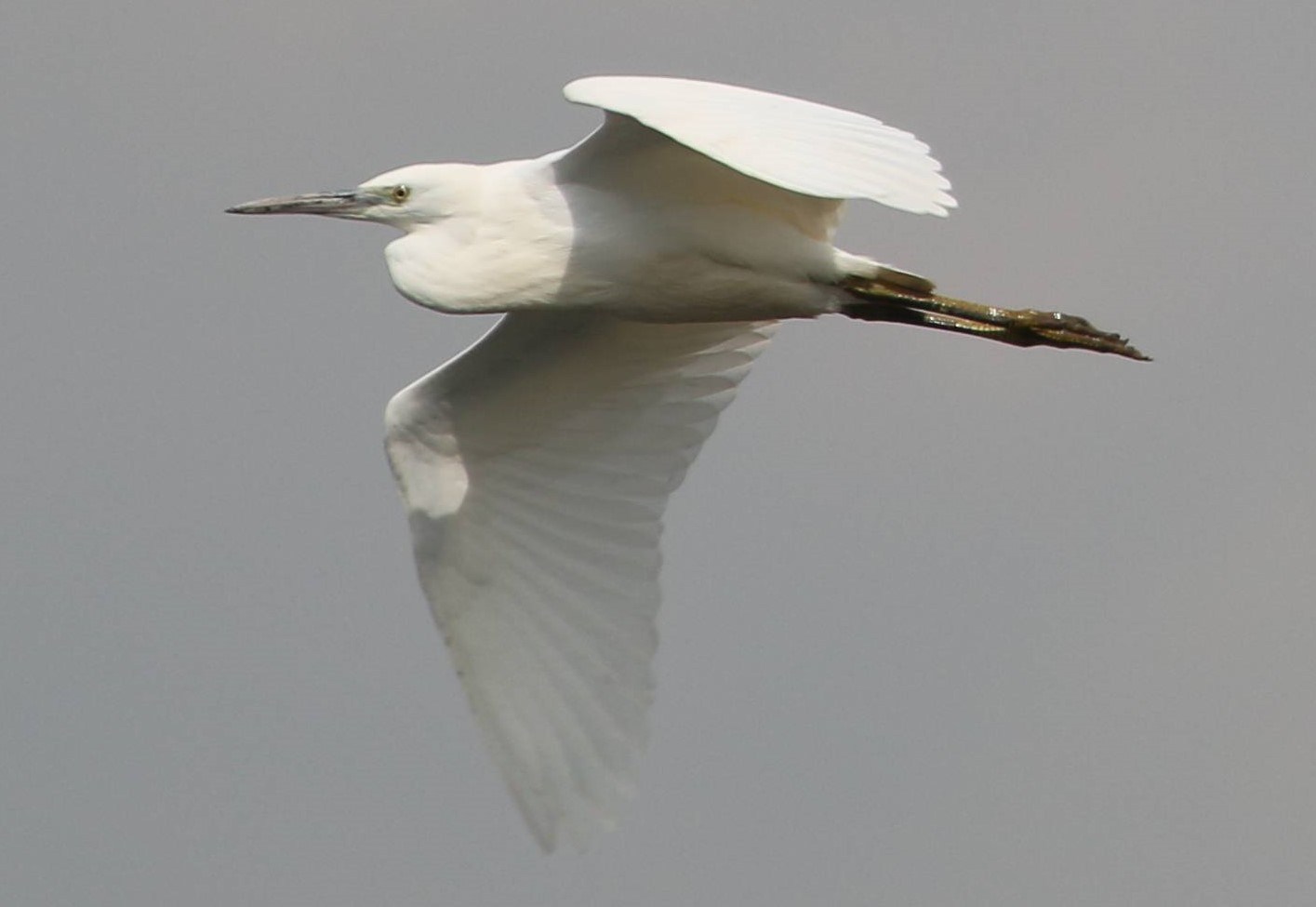
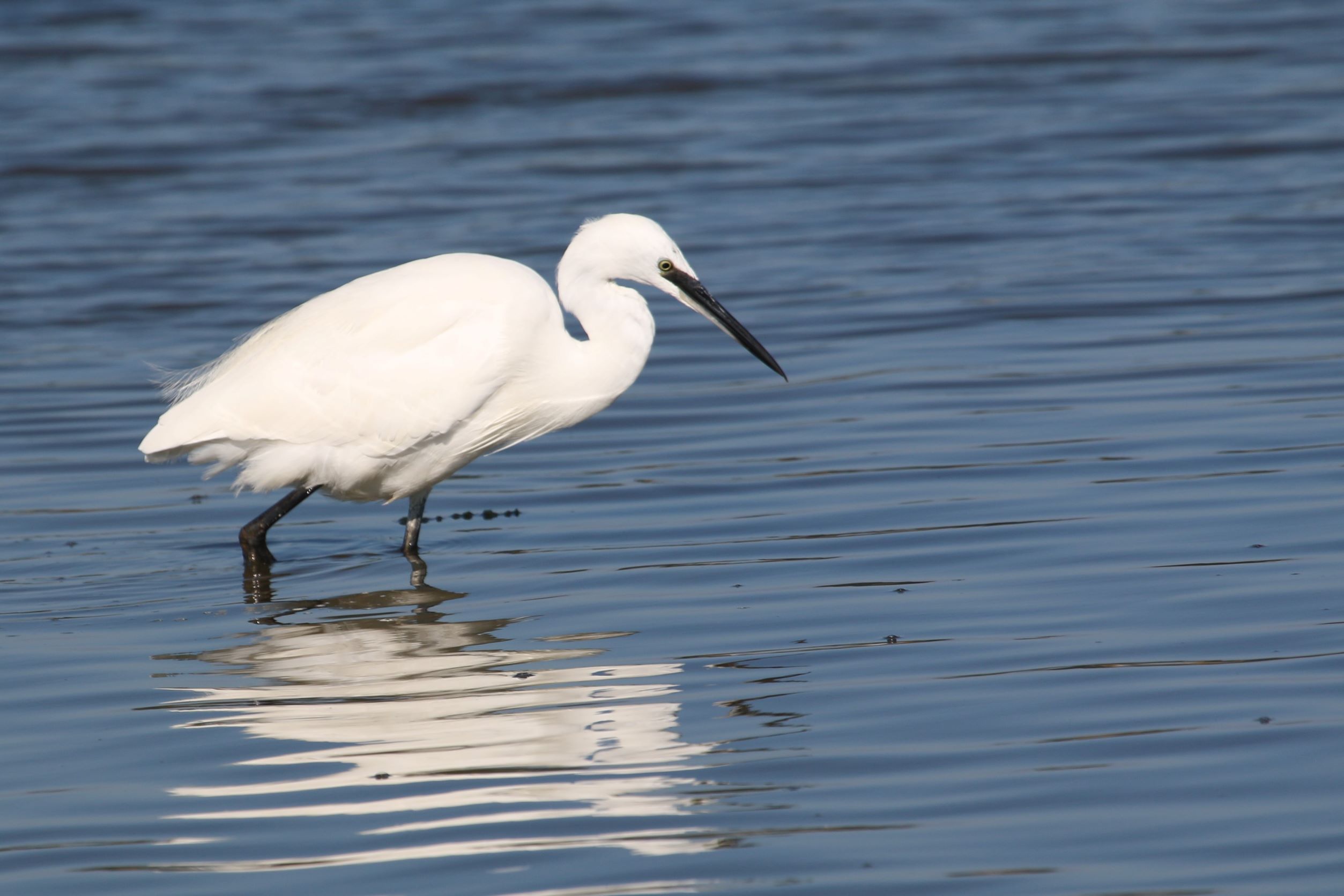
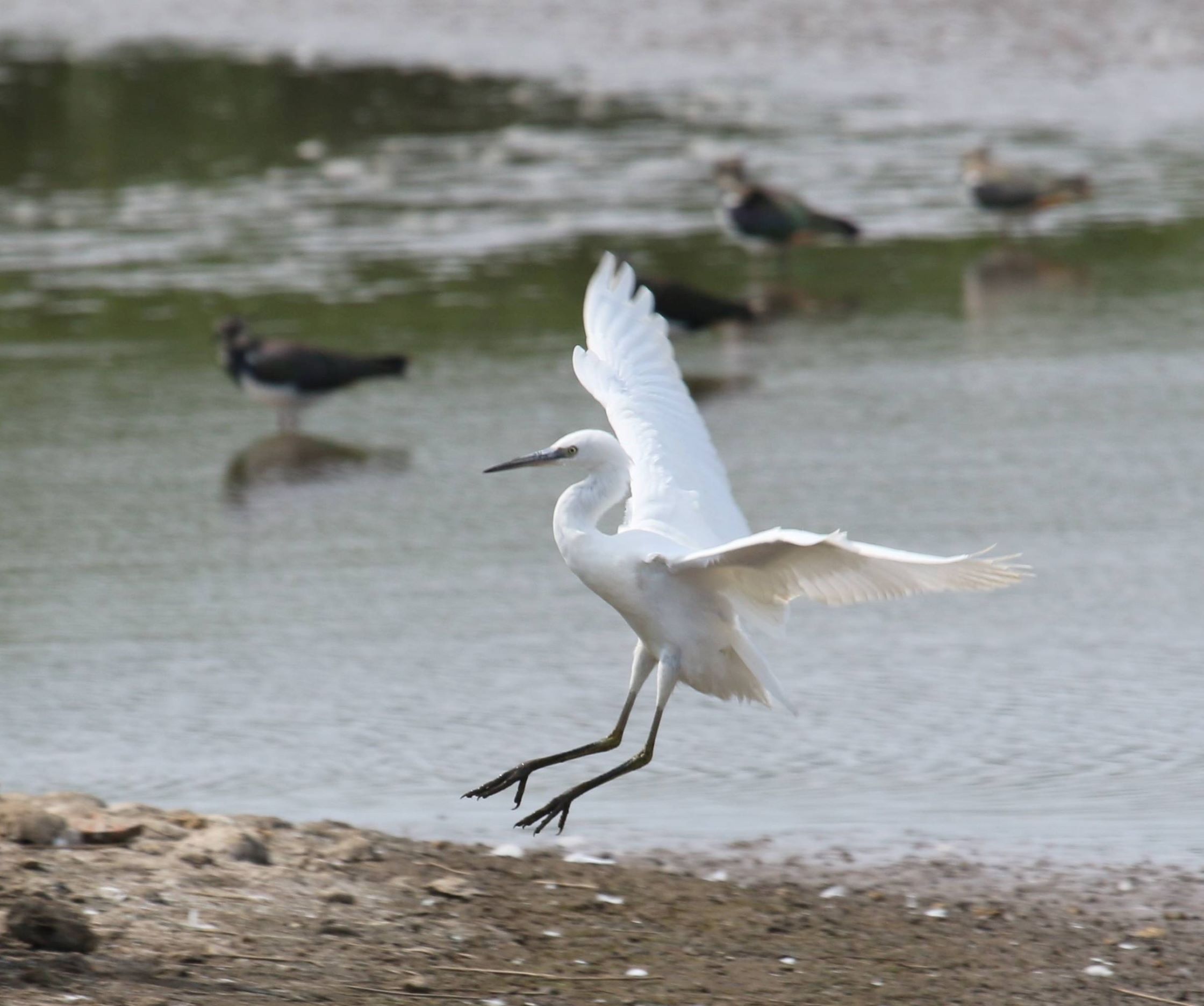
Little Egret.
The UK boasts several other members of the heron family, although none is very common. The Bittern is vanishingly rare; Mrs P and I have rarely seen one, and have never got a decent photograph. Little Egrets were once common here, but were wiped out over 100 years ago thanks to the insatiable demand of the fashion industry for the birds’ elegant feathers. I wrote about the decline and fall of the Little Egret, and the important consequences this had on bird conservation in the UK, in a post I wrote in 2024.
Great White Egret.
Little Egrets began recolonising the UK in the late 20th century, and these days we see them quite often. Sadly their return came too late for my Mum, as did the more recent arrival of the Great White Egret. She would have been thrilled, I’m sure, to see both egret species, though I suspect neither would have supplanted the Grey Heron in her affections.
Clockwise from Top Left: Green Heron (seen on Tobago in 2006); Great Blue Heron (Canada, 2014); Little Blue Heron (Costa Rica, 2008); White-Faced Heron (Tasmania, 2016); Galapagos Heron (Galapagos Islands, 1989); Bare-Throated Tiger Heron (Costa Rica, 2008); Great Blue Heron (Canada, 2015).
Across the whole world there are reckoned to be 75 separate species within the heron family, although some go under the names of egret or bittern. Herons’ solitary nature and their motionless hunting style have captured the imagination of cultures everywhere, often making them figures of mystery and deep spiritual significance as well as symbols of patience and wisdom. Every continent except Antarctica boasts resident species of heron, and as Mrs P’s photos show we’ve been privileged to see a number of these during our travels.
Clockwise from Top Left: Bare-Throated Tiger Heron (Costa Rica, 2008); Green Heron (Costa Rica, 2008); Bare-Throated Tiger Heron (Costa Rica, 2008); Indian Pond Heron (India, 2013); Little Blue Heron (USA, 2012); Great Blue Heron (Canada, 2012).
Almost all species of heron are closely associated with water, living and feeding as they mostly do on the margins of lakes, rivers, and swamps. They need wetlands, as do so many other species of birds, mammal and invertebrate, and it has been a pleasure to celebrate World Wetlands Day by featuring these magnificent birds here. My Mum, a heron lover until the very end, would definitely have approved!
Wordless Wednesday is a simple blog post featuring a photo. It seeks to convey a message or tell a story, but speaks for itself without using words. Mrs P was clearly seeing double when she took this photo at Yellowstone National Park in September 2018.
Wordless Wednesday is a simple blog post featuring a photo. It seeks to convey a message or tell a story, but speaks for itself without using words. Mrs P took this photo of a lonesome willow tree, located at the southern end of Lake Wānaka in the Otago region of New Zealand, in 2019.
Wordless Wednesday is a simple blog post featuring a photo. It seeks to convey a message or tell a story, but speaks for itself without using words. Mrs P took this photo of a lonely bridge on the Old Military Road, near Braemar in the Scottish Highlands, in 2019.
Wordless Wednesday is a simple blog post featuring a photo. It seeks to convey a message, but speaks for itself without using words. Mrs P took this photo of a new moon at sunset during a visit to Yorkshire Wildlife Park in January 2022.
We broke our long journey to Orkney by calling in on the Lady of the North. She promised so much, a naked, voluptuous goddess sprawling erotically across the Northumbrian landscape. You don’t see one of those every day, do you? But, if I’m honest, there’s much less to the Lady than meets the eye.
The Lady, who is also known as Northumberlandia after the county in which she resides, is the work of American landscape designer Charles Jencks (1939 -2019). He created this effigy of a recumbent naked woman, 400 metres long with grassy breasts 34 metres high, between 2010 and 2012.
To achieve his goal Jencks used spoil from a nearby opencast coal mine – some 1.5 million tonnes of rock, clay and soil – shaping it carefully into the improbable form we see today. Most spoil heaps are an ugly blot on the landscape, so it was good to come across an example of one being put to creative use.
The Lady is the centrepiece of a freely accessible Community Park. Criss-crossed by around 6km of paths, the park is good as a place for a countryside stroll, somewhere to listen to birdsong, to walk the dog or to let the kids run wild. It’s clearly an asset to local people, but for me is doesn’t quite work as a piece of public art.
A view from the Lady’s forehead, down along her nose towards her breasts
The problem with Northumberlandia is that it’s just too big to appreciate from ground level. From the right angle the Lady’s head, which sports a prominent nose, is unmistakeable. Her breasts are also stand-out features, but would you know what they’re supposed to be if you hadn’t seen the site plan? And as for the rest of the body – the arms, the torso and the legs – Mrs P and I strode happily over them, but to be honest we could have been anywhere.
Northumberlandia is an ambitious project, but really needs to be viewed from the air to be fully appreciated. If only we’d had access to a helicopter for an hour or two. Or better still wouldn’t it be great to be able to grow some wings and fly, and so enjoy a birds-eye view of the lovely Lady!
At last, as the weather starts to improve, we take out first tentative steps back into nature. Poolsbrook Country Park, just a few miles from where we live, is a good place to start. Created on the site of a colliery that closed down in 1986, today Poolsbrook boasts a mosaic of habitats including lakes, wet grassland, wildflower hay meadows, woodland and hedgerows, all carefully managed for the benefit of wildlife. I have written previously about the Country Park’s history and key features.
We go to Poolsbrook quite often, and know what to expect. Our first visit of 2025 does not disappoint. All the usual suspects are on show, including Coot, Mallard, Great Crested Grebe and the inevitable Canada Geese. There are no rarities, but who cares – it’s just good to be out watching birds again after a long, miserable winter.
But what’s that? Cruising on the lake alongside a flotilla of Mallards is a duck we’ve never seen before. The head and neck are an iridescent blue-green colour, while the cheeks are white and the bill is bluish grey with a black tip. The breast is barred white and black, the flanks are orange-brown and the back is dark grey with white streaks.
We spend a lot of time watching birds in wetland habitats, and can readily identify most that we encounter. But this guy is a total mystery. Somehow it looks like a mixture of several other species, and we debate whether it’s some sort of weird hybrid. More research is clearly required, so as soon as we get back home we consult Professor Google.
The good professor reveals the truth. Our mystery bird is neither a natural hybrid nor the result of an unfortunate accident in a bio-lab. Instead, our investigation reveals it to be a Chiloé Wigeon. We learn that it is a very long way from home. Also known as the Southern Wigeon, the Chiloé Wigeon is native to southern parts of South America, its name coming from an archipelago lying off the coast of Chile.
Being relatively easy to care for, it appears that the Chiloé Wigeon is a popular bird in exotic wildfowl collections. The bird at Poolsbrook must be an escapee from one of these collections – it plainly has not arrived in this country naturally.
Further research reveals that the Poolsbrook bird has been in residence for well over a year. How did we miss it during all our previous visits, we wonder?
On reflection, I don’t know how I feel about seeing this unexpected bird on one of our local reserves. On the one hand, it is of course exciting to encounter a species that we will never see on its home territory, particularly as it is clearly thriving at the Country Park.
On the other hand, I can’t help thinking the bird might be better off back in South America, where it would be amongst its own kind and have the opportunity to breed. That, sadly, will not happen here and our Chiloé Wigeon will be unable to pass on its genes. Hopefully, however, it will continue to do well alongside its Mallard cousins at Poolsbrook. We’ll be sure to look out for it next time we visit.
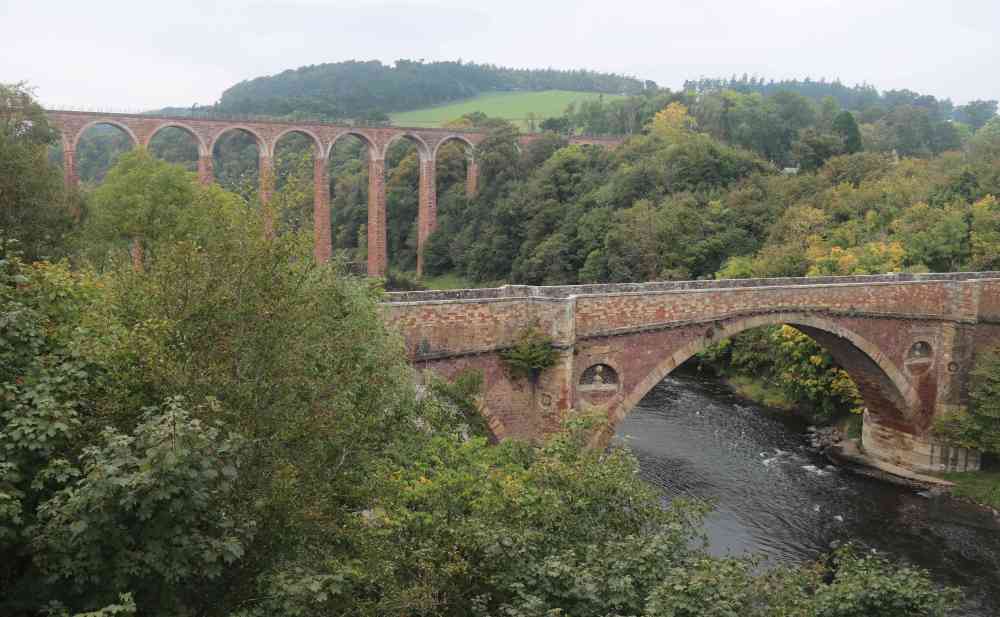
Wordless Wednesday is a simple blog post featuring a photo. It seeks to convey a message, but speaks for itself without using words. This photo shows Drygrange Bridge (foreground) and Leaderfoot Viaduct (behind) crossing the River Tweed near Melrose in the Scottish Borders, was taken by Mrs P in September 2024.
Rats have always had a bad press. When, around 60 years ago, our pet cat gifted my mother a dead rat and expected to be praised for his hunting skills, mum lost it completely, freaking out in a way that I never witnessed at any other point in her life. And when, in the 1932 film Taxi, James Cagney famously addressed Buck Gerrard as “you dirty yellow-bellied rat”, it was not a term of endearment! No one, it seems, thinks highly of rats.
This branch is just a metre above a bird table. Within seconds of this photo being taken, the rat was down and snacking enthusiastically.
Just why is it that rats are so widely loathed and feared? Their perceived connection with disease has a lot to do with it. Rats have long been associated with plague, their fleas being held responsible for the spread of the Black Death that wiped out one third of Europe’s population in the mid-14th century. Except it’s not true, as recent research has shown. The Black Death was mostly spread by human lice and fleas. So if any species deserves to be loathed and feared because of the ravages of the plague, it is presumably us and not the poor old rat!
Rats are also associated with filth – witness Cagney’s reference to a dirty rat. Wrong again! The rat is by instinct a clean critter, and will immediately start to groom itself if its fur gets dirty. Of course, some of the places in which rats hang out are themselves dirty – sewers, rubbish dumps and so on. But hey, we’ve all got to live somewhere, and at least – just like cats – rats work hard to keep themselves clean.
The James Cagney quote also implies that rats are mean, callous animals. But this too is a misconception: research has shown that rats demonstrate emotional intelligence, and are strongly supportive of one another within their social groups.
Historically, rats have also been feared for the threat they pose to human food stocks, particularly grain stores. In the famous German folk-tale, the Pied Piper of Hamelin was hired to deal with just this problem. It is a conflict of interests that is probably less of an issue today thanks to modern bio-secure storage systems, although admittedly that may well not be true in the developing world.
And if rats move on from our grain stores to dine out instead on the take-away food that our species carelessly throws away in the streets, so be it. The solution is simple: don’t buy what you can’t eat, but if you get this wrong then at least dispose of your unwanted fries or burger or kebab somewhere that wandering rats can’t get at it. Scavenging behaviour amongst rats is for them a matter of survival; thoughtless littering by members of our own species is simply a matter of lazy selfishness.
With human food stores no longer available to them, some rats now turn to bird food. The only rats I ever see are grazing on or around bird tables and feeders, nibbling enthusiastically upon the food people have left out for their avian friends. Mrs P’s photos clearly illustrate this behaviour. It upsets some birders, but I regard it as a privilege to be able briefly study an animal that is otherwise largely hidden from me. The rats don’t hang around for long, and the birds are soon back. Everyone’s a winner.
Away from the bird table it is true that rats can be a threat to birds, disturbing nests, driving away parent birds and predating eggs and chicks. The problem is most serious on islands with no history of rodents. On such islands, if rats arrive and become established – normally thanks to the folly of humankind – the effect on seabird colonies can be devastating. In such circumstances the only way to save the birds is to eradicate the rats, a project that is lengthy, laborious and expensive. It can be done, however, as was demonstrated when invasive rats – which had arrived as stowaways on ships – were finally eradicated from Lundy, a small island off the Devon coast in the south of England.
Although their effect on bird colonies cannot be denied, rats can also be beneficial to wildlife. The African Giant Pouched Rat, which is native to the savannahs of southern Africa, can be trained to assist in the prevention of wildlife crime by using its acute sense of smell to detect smuggled ivory, rhino horn and pangolin scales. Cheaper to train than sniffer dogs, and able to operate in spaces that are inaccessible to canines, these so-called “hero rats” are an important new weapon in the war for wildlife. They have also been used elsewhere in other innovative ways, including the detection of landmines and tuberculosis pathogens.
Rats are intelligent animals, more complex than they appear at first glance. They will always be controversial. I hate the devastation they cause in some island seabirds colonies, and accept that their presence in our well-ordered 21st century lives may sometimes be unsettling. But the rats are only doing what comes naturally for them, and from an evolutionary perspective they are doing it rather well. Overall, I would suggest, they are not nearly as bad as popular culture and urban myth would have us believe. And so, ladies and gentlemen, let’s hear it for rats!






 Now I'm 64