February was foul. It was the wettest February the UK has ever seen, and the fifth wettest UK month, of any month on record, ever. Large areas of the country experienced unprecedented floods, and although Platypus Towers escaped this particular fate – living halfway up a hill helps! – it was pretty damned miserable. But as George Harrison famously reminded us, all things must pass, and around 6 March the sun finally shows up, giving it large in a dazzling, clear blue sky.
To celebrate our change in fortunes, I decide to treat Attila the Bun to an enormous carrot. I’m standing at the door to his hutch, fondling his ears while he tucks in greedily, and out of the corner of my eye I catch sight of my first butterfly of the year.
The symbolism isn’t lost on me. The transformation of caterpillar into butterfly is one of Nature’s most dazzling tricks. It speaks of redemption, the possibility of change, and the enormous potential that lies within the most unpromising of subjects. Nothing is so ugly that it cannot re-fashion itself into a thing of beauty, nothing is so damaged that it cannot be made whole again, nothing is so stained that metamorphosis cannot restore it to purity.
The butterfly in question is a Small Tortoiseshell. She sits atop some pure white heather blossom, sucking up the nectar, soaking up the rays. Intent upon her business, she allows me to approach and stand so close I could reach out and touch her. The predominant colour of her wings is a foxy reddish-orange, decorated with a scatter of black and yellow splodges and an edging of tiny, bright blue spots. She is so delicate, so beautiful.
My butterfly has overwintered as an adult, hunkered down somewhere sheltered, perhaps a garden shed or a farm outbuilding. For months her metabolism has barely ticked over, but today she’s awake and has a job to do. Now is her time, and with temperatures rising and the days growing longer she must find a mate, and a patch of stinging nettles on which to lay her eggs.
Her children will take to the wing in June and July, and they in turn will produce another generation in late summer. It is that generation, the grandkids of the butterfly before me, that will emulate her by seeking out a sheltered hiding place in which to hibernate through the winter.
As with pretty much every species of butterfly in the UK, Small Tortoiseshells have declined massively in recent decades. Growing up in suburban London half a century ago I used to see them in abundance, and although not rare these days I wouldn’t describe them as plentiful. I don’t think I’ve ever seen one this early in the year so today’s sighting is definitely a bonus, as well as being a welcome indication that spring is waking from its slumber at last.
Eventually, my butterfly decides it’s time to share her ethereal beauty with another lucky soul. Sorrowfully I watch her leave, and wish her well on her journey. I will miss her. Butterflies are a symbol of hope, and god knows we need hope in these, the darkest of days.
Bleary eyed, I stagger into the kitchen shortly after sunrise to make the first of around seven mugs of tea I will drink today. While the kettle’s boiling I stand at the window, scanning the garden for signs of life. Attila the Bun dozes peacefully in his hutch, and elsewhere things appear equally tranquil. And then I spot a commotion in the pond. In one corner the water’s churning madly, wavelets rippling out from the boiling epicentre to the edge of the pool. This can mean only one thing: the mating frenzy of the frogs has begun.
This is an unexpected development. Croaking is a sure sign that the mating game is about to begin, but so far this year I’ve not heard any. However, after a wretched few weeks the weather’s got milder over the last couple of days, and maybe this has persuaded my amphibian friends that it’s time to do the business.
On closer inspection there’s already one clump of spawn floating listlessly at the edge of the pond, and several frogs are clearly intent on making more. There are at least two pairs, the males clinging on tightly to the backs of their chosen ladies – a condition known as amplexus – as they paddle and skitter around. Both parties are waiting for just the right moment.
However, the right moment can be a long time coming – amplexus has been known to last up to 24 hours – and to help them maintain their grip, male frogs grow special nuptial pads on their forelegs during the mating season. It locks the lovers together like organic Velcro. Inseparable, insatiable, their lust renders them oblivious to the world around them. I watch, transfixed, like a punter at a seedy porn show.
Finally the female is ready and expels her eggs, which the male swiftly fertilises. When spawn is laid it absorbs water rapidly, causing it to swell. In its expanded state spawn is 99.7 water, which helps regulate temperature and oxygen supply to the embryos.
Having laid and fertilised the spawn, the frogs’ work is over for the year and they can start enjoying the good things in life, like snacking on worms, slugs and sundry creepy-crawlies. My work, however, has just begun. We have two ponds in our garden. The larger of the two – where the spawn has been laid, and further spawning is imminent – is home to shoals of goldfish and golden rudd, which will make short work of the tadpoles when they emerge.
The smaller pond was put in with the specific intention of serving as a tadpole nursery every spring. However the “taddy pool,” as we like to call it, has attracted a population of Common Newts. While it’s thrilling to have these critters in our garden, they too will make mincemeat of tadpoles in the confined space of the taddy pool. So, if the spawn is going to produce any frogs, I will have to remove it to raise in a place of safety.
In a corner of the garage is a large fish tank, half buried under a pile of rubbish that I really should take to the local tip before Mrs P starts giving me grief. I fight my way through the detritus of 21st century living, retrieve the tank, dust it down, then fill it with water and assorted vegetation from the pond. Within minutes it is transformed into a safe haven where the tadpoles can hatch and grow, happily out of the reach of the predators that patrol our ponds.
When their legs start to develop and they’re able to look after themselves I’ll release the froglets back into the taddy pool and let them take their chance. Hopefully some will survive long enough to join the mating frenzy in future years.
I’ve always been fascinated by frogs, and have become increasingly dismayed by their plight. Frogs are currently in big trouble, thanks to a combination of climate change, habitat loss, pollution and a fungal disease known as red-leg. They need all the help they can get and I’m pleased that, within the limitations of our modest suburban garden, we’re doing our bit to ensure the survival of these wonderful little creatures.
November 1976 saw the Sex Pistols – the dark princes of English punk rock – release their debut single, Anarchy in the UK. The Pistols were wild and wayward, and maybe just a little bit bonkers, but even in their maddest dreams they cannot possibly have imagined the crazy world of Ashbourne Shrovetide football. Like the Pistols themselves, Shrovetide football isn’t for the faint-hearted. Anarchy rules, OK.
Unless you’re English you’ve probably never heard of Ashbourne. To be fair, even if you are, the chances are that this quaint little market town of around 8,000 souls nestling in the Derbyshire Peak District has passed you by. It oozes bucolic charm, and is therefore memorably forgettable.
A few years ago a former Ashbourne resident, writing on the student website The Tab, described it as “the most backwards town in the country“. Seems a bit harsh to me, but it has to be said that unless you’re very easily excited, the place won’t set your pulse racing. Except, that is, on Shrove Tuesday and Ash Wednesday, when football comes to town.
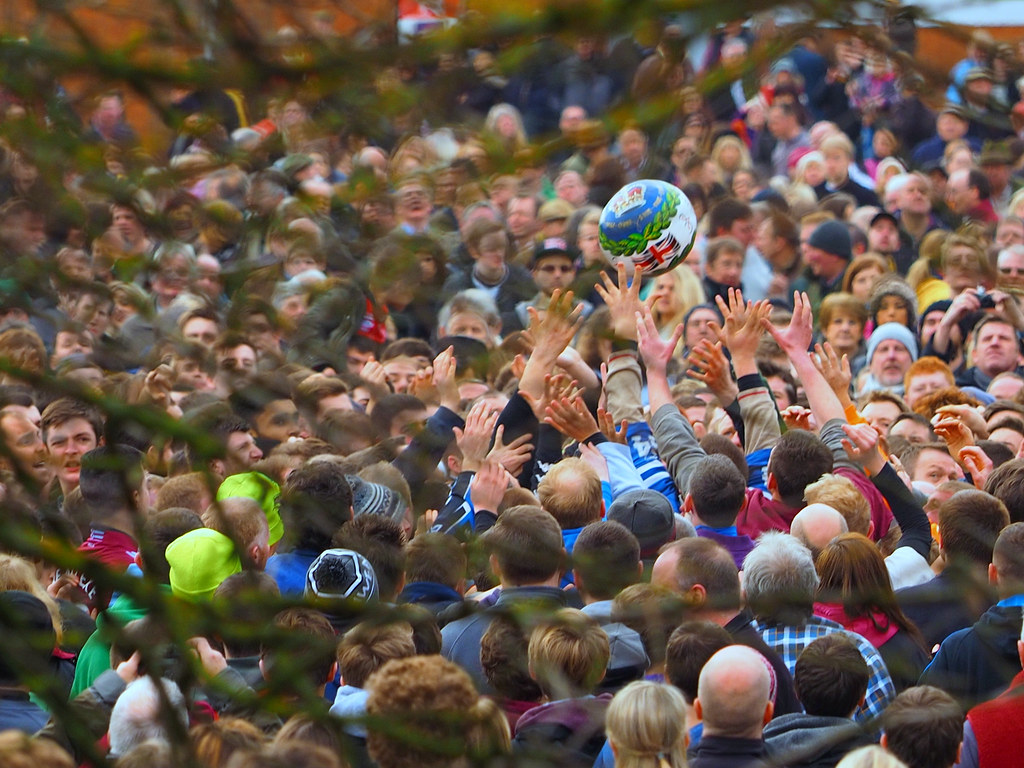
Shrovetide football bears scant resemblance to any other form of football. The Ashbourne game comprises two teams – the Up’Ards, born north of the local River Henmore, and the Down’Ards, born to its south. The number of players is unlimited, and can exceed a thousand on each side. The goals, where the ball must be touched down to register a score, are three miles (five kilometres) apart.
The game begins in the Shawcroft car park in the centre of Ashbourne, where an eager crowd of thousands gathers. They belt out the national anthem as if their lives depend on it. Then silence falls and the excitement builds, everyone waiting impatiently for the fun to begin.
At last, with the tension close to unbearable, an invited dignitary or celebrity standing on a brick-built podium “turns up” the ball – lavishly painted, filled with cork for added buoyancy and about the size of a Halloween pumpkin – into the expectant horde of pumped-up masculinity. Testosterone hangs heavy in the air, so thick you could butter toast with it. No rules prevent women from participating, but good sense persuades most to take a back-seat and let their menfolk do the hard graft and risk the consequences.
The objective of the game is straightforward. The Up’Ards must carry the ball to Sturston Mill, south of Ashbourne, and “goal” by tapping it three times against a millstone. Sounds simple, doesn’t it? The only problem they face is the thousand or so Down’Ards who are blocking the way and baying for blood.
Meanwhile, the aim of the Down’Ards is to carry the ball to Clifton Mill, north of the town, where they also must “goal it”. Inevitably, they find their passage blocked by at least a thousand incensed Up’Ards, whose ambition is to prevent this happening by means both cunning and brutal.
As you will have worked out by now, Shrovetide football has no designated pitch or playing field. The game is played through the streets of the town, and the sprawling farmland beyond, occasionally spilling into the freezing river. It is the original “game without borders.”
Proceedings are boisterous, chaotic and occasionally violent. Shopkeepers close their businesses and protect their premises with wooden boards and shutters, car owners move their vehicles out of harm’s way and paramedics are on standby. Schools close for the day, lest students get caught up in the mayhem. Injuries are common, although fatalities are mercifully very rare.
Play begins at 2pm on Shrove Tuesday (Mardi Gras) and finishes eight hours later. Battered, bruised and bloodied, the players limp off home to lick their wounds, only to assemble the following day at 2pm to do it all again. Despite 16 hours of play, it is rare for more than two goals to be scored in any year. Sometimes, the result is a nil-nil draw, and every year the broken limbs, bruises, sprains and strains outnumber the goals scored.
You can count the rules on the fingers of one hand. Players must not enter churchyards or cemeteries, and must refrain from hiding the ball or attempting to carry it on a motor vehicle. In addition, murder is frowned upon. But with these few exceptions, pretty much anything goes.
“Mob football”, as the Ashbourne game is classified, has a long history – dating back at least to the 13th century – and was once widespread in rural England. Inevitably the mayhem it caused was resented by the wealthier and more refined types, those who had the most to lose from mass outbreaks of anarchic behaviour.
Eventually these elite groups got their way, and mob football went into serious decline in the nineteenth century after the 1835 Highway Act banned the playing of football on public highways. But it clung on in Ashbourne, and a few other places including Workington and Sedgefield in northern England, and Kirkwall in the Orkney Islands of Scotland.
Shrovetide football remains a much-loved tradition amongst Ashbourne people, a demanding endurance test for all the participants, and also a rite of passage for lads wishing to follow in the hallowed footsteps of previous generations of men in their families. Many former residents return to the town every year to take part or watch from the side-lines, and tourists visit in droves to see what all the fuss is about. For two days every year, Shrovetide football ensures that Ashbourne has a national – and even international – profile.
And now to the question that’s been on your mind as you’ve read this post – has the Platypus Man ever played Shrovetide football? The answer is an emphatic ‘no,’ and although Ashbourne lies just a few miles from Platypus Towers I’ve never attended as a spectator either. Frankly, life’s too short and my body is way too fragile to risk the frenzy of the mob. Have a look at this short video, on the Guardian’s website, and you’ll understand everything!
Don’t get me wrong, I’m delighted that this relic from our country’s medieval past hangs on in deepest, darkest Derbyshire. But I’m glad too that, thanks to the wonders of the Internet, I can read about it and watch YouTube videos of the highlights in own home, secure in the knowledge that there are several miles and a very sturdy brick wall between me and the madness.
A little bit of Anarchy in the UK isn’t without its appeal, but only when viewed from a safe distance.
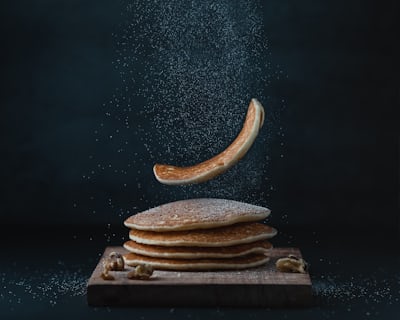
Yesterday was Pancake Day. Mrs P and I share the cooking duties at Platypus Towers, but when it comes to pancakes I know my place: I’m a scoffer, not a tosser. Unsurprisingly Mrs P’s pancakes were faultless, and we made short work of them. But now the party’s over it will be months – and quite possibly a whole year – before we have pancakes again. And that’s the problem, isn’t it, with designating just one day per year as Pancake Day? It implies that on the following 364 days (or 365 in 2020, and other leap years) pancakes should be regarded as strictly off-limits.
PHOTO CREDIT: Sidney Troxell via Pexels
For the uninitiated, in England a pancake is a thin, flat cake, made from batter and fried in a frying pan. When one side is cooked the pancake is tossed with a deft flick of the wrist. If the cook is lucky it will land back in the pan, uncooked side down; however if fortune is not smiling, the pancake will end up on the floor, or stuck to the ceiling. A traditional English pancake is very thin and is served coated with lemon or orange juice and caster sugar, or maybe golden syrup.
*
The origin of Pancake Day is religious. The day in question is Shrove Tuesday, immediately preceding the start of Lent on Ash Wednesday. In the Christian calendar Lent is a 40 day period of abstinence, when believers are required to give up some of life’s pleasures. Eggs, butter and fat were all on the hit list, and turning them into mouth-watering pancakes on the day before Lent began ensured they did not go to waste.
There is also said to be religious significance in the key ingredients of pancakes. The white milk that loosens the pancake’s batter is seen by some to symbolise purity, while the eggs represent creation and salt stands for wholesomeness. According to this reading the flour symbolises the staff of life, the dietary staple upon which we all rely.
In the USA, France and Germany the day before the start of Lent is known as Mardi Gras. This translates as “Fat Tuesday”, an allusion to the excesses and festivities that are enjoyed on this particular day, before the deprivations of Lent take hold.
PHOTO CREDIT: Mae Mu via Unsplash
Today the connection between Christianity and Pancake Day is rarely acknowledged, and the practice of giving things up for Lent has largely disappeared. However the advance of secularism has done nothing to undermine the habit of bingeing on pancakes one Tuesday in either February or March, exactly 47 days before Easter Sunday.
In a few places in the UK, Pancake Day is celebrated by the holding of a pancake race, which involves herds of eccentrics dashing frantically through the streets, each of them clutching a frying pan in which they toss a cooked pancake. The tradition is said to date from 1445, and results in the lanes of some English villages briefly becoming clogged with more than the usual number of lycra-clad tossers. However the disruption is tolerated with good humour as everyone knows that afterwards pancakes will be off the menu for around 12 months.
*
In the USA, however, they do it differently. Pancakes are a big deal in the Big Apple, and everywhere else too. Every day is Pancake Day in the good old US of A.
In the same way that American and Brits are no more than distant cousins these days, their pancakes are also very different. The version from the other side of The Pond is fluffy rather than flat, using self-raising flour or baking power to get a rise from the batter. In the USA pancakes are traditionally served in a stack, accompanied by a little jug of maple syrup and, if it takes your fancy, with a few rashers of crispy bacon on the side.
And, joy of joys, Americans have pancakes for breakfast.
I remember vividly our first encounter with a “short stack” of American pancakes. The previous evening we’d flown into Rapid City via Minneapolis, and had spent the night in a grotty motel that numbered cockroaches amongst its other guests. The next morning we staggered into the adjacent diner, with expectations at an all time low.
PHOTO CREDIT: Luke Pennystan via Unsplash
It was a modest diner, as befitting its location on the outskirts of a memorably unmemorable city. And yet, to our amazement, they were serving pancakes. Now at the time I was just an innocent English guy, a first time visitor to the States, and the prospect of eating something so deliciously, decadently sweet that early in the day had me transfixed. America is amazing, I thought to myself. Americans are amazing. They play by different rules here. I love this country.
The menu sported a fabulous photo of a stack of pancakes, topped off with summer fruits and wallowing in an ocean of maple syrup. They looked irresistible, so I did the honourable thing and resolutely refused to resist them.
And thus began my love affair with pancakes for breakfast. In the years that followed I’ve visited the USA more than 20 times, and have rarely been tempted to try anything else. OK, I will confess that once or twice I’ve fallen under the spell of the sultry southern temptress that is biscuits and gravy, but pancakes are my first love, my only true love in the crazy world of American breakfasts.
So here’s my question, the big one, the puzzle that’s got me beat. If the USA can do it, why the hell can’t we? Here, in England, why can’t every day be Pancake Day?
“Well,” demands Mrs P testily, “am I getting flowers on Valentines Day or not?” Discomfited, I hastily review my options. Do I try schmoozing her, something like my darling, there aren’t enough flowers in the world to convey the depth of my love for you? Or should I try appealing to her environmental conscience, pointing out the horrendous carbon footprint that inevitably results from the sale of masses of fresh cut flowers in England in the middle of February? Or do I simply tell it as it is, that while I love her more than anything and am quite fond of roses too, the grossly inflated prices around Valentine’s Day are an affront to common decency and my sense of fair play?
I’m weighing up which response will give me the best chance of still being alive at Easter when my wonderful wife lets me off the hook. “If you are,” she says, “then don’t bother. I suggest we go out for Afternoon Tea instead. I’ve spotted a patisserie on King Street that looks promising.”
So there we have it: I get to live another day and to fill my face with delicious cakes. I’d like to put it on record here that Mrs P is a very special person.
*
Afternoon Tea is also very special. We Brits have invented all kinds of brilliant stuff over the years: the steam locomotive, television, stiff upper lips, penicillin and orderly queuing in line to name just a few. To this list I’m proud to add the quintessentially English tradition of Afternoon Tea, a plate stand of dainty sandwiches, pastries, scones with lashings of jam (preserves) and clotted cream, and assorted cakes, all served in the mid to late afternoon with a steaming pot of Indian or Sri Lankan tea.
All traditions have to begin at some point, and Afternoon Tea can be dated to around 1840. Wealthy English folk had been drinking tea since the 1660s when the habit was popularised by King Charles II, who probably needed regular caffeine hits to help him keep up with his numerous comely mistresses. However it wasn’t until early in Queen Victoria’s reign that the idea of Afternoon Tea reared its head.
Unsurprisingly the practice can be traced back to members of the aristocracy, who had plenty of time on their hands, money to burn and servants to do all the hard graft.
Anna, the seventh Duchess of Bedford, lived in a household where the evening meal was traditionally served at 8pm. Finding herself feeling inconveniently peckish during the late afternoon, our Anna instructed her staff to prepare a tray of tea, bread and butter, and cake, at around 4pm every day. The good Duchess was well pleased with her initiative, and invited her friends round so she could show off her new domestic routine.
Pretty soon Afternoon Tea was all the rage amongst the upper classes. Amazingly, in the days before Facebook, people networked by physically spending time in one another’s company (strange but true!), and what could be better than to combine meeting with eating?
Ordinary people, in other words the very men and women whose hard graft made, heated and maintained the scented bubble baths in which the likes of the Duchess and her cronies wallowed, were untouched by the new fad. In Victorian England everyone knew their place, and the common folk knew that Afternoon Tea wasn’t for the likes of them.
Fortunately times have changed, and the once sturdy walls of the British class system have begun to crumble. It therefore feels like poetic justice that while the Duke of Bedford now finds it necessary to open up his estate to tours by the Great Unwashed, anyone in England can now enjoy a fabulous Afternoon Tea regardless of their ancestry or social standing.
Indeed in recent years there’s been a noticeable revival in this quaint tradition. All manner of catering establishments and hostelries now offer Afternoon Tea to anyone with a few pounds and an hour or two to spare.
*
Of course the content of Afternoon Tea has evolved over time, but a reincarnated Duchess Anna would doubtless recognise and hopefully approve of most modern re-workings of her early Victorian innovation. Beaurepaire Patisserie has certainly taken the concept to the next level, and we opted for the full works, starting with a plate stand of savouries which comprised a tiny glass of delicious soup, a filled baby Yorkshire pud and some quiche as well as the inevitable sandwiches.
When the savouries had been demolished it was on to the sweetmeats, a plate stand groaning under the weight of cakes, scones and pastries. There was also a glass of Eton Mess, a glorious confection of strawberries, meringue, and whipped Chantilly cream. We were in heaven, but also in danger of exploding. So, stuffed to the gunnels and awash with countless cups of tea, we called for a box to take home the remainder of our fare, to be consumed later in the day once space became available.
Afternoon Tea proved to be a terrific way to celebrate Valentines Day. It may not last as long as flowers, but who needs daffodils and dahlias when you can instead spend a couple of hours being divinely decadent?
So, wherever you are now, step forward and take a bow Anna, seventh Duchess of Bedford. We, and other lovers of Afternoon Tea from up and down this sceptered isle, are forever in your debt.
Nearly two years have passed since I retired from work. People still ask me how I’m coping, and the truthful answer is that it’s going rather well. Actually, you can’t beat it: I have a good pension and a fairly modest lifestyle, so fortunately money’s not an issue. Yes, I do miss the company of some of the people I used to work with, and also the sense of purpose that comes with a responsible job. You know what I mean, those feel-good moments that result from being needed. But life moves on, and so have I.
No, the main problem with retiring is that I no longer have a bloody clue what day of the week it is.
You see, work imposed a structure on my life, mapping out my week in a meaningful way. And when it was gone it felt like I was at sea without a compass.
Before I retired my week was shaped by routines. To start with there was the framework of five days on – Monday to Friday – followed by two days off. The regular milestones of the working week added depth to the pattern: my boss Teflon Sal’s management team meetings on Tuesdays, my own team meetings every Wednesday, the Friday afternoon all-user email in which the great and the good desperately tried to convince the poor bloody infantry how well things were going while simultaneously demanding that we cut the crap and do better.
All of these things, and many more besides, were anchor points during the week. Routines keep me grounded, helping me make sense of the world around me. And when I retired these anchor points were ripped away overnight, leaving me drifting aimlessly.
But nature abhors a vacuum, and so it’s no surprise that new patterns have emerged. One of these is that on Sunday afternoons Mrs P and I play Scrabble, while keeping a close eye on the garden for a visit from Milky Bar and listening to a Newfoundland folk music radio show on the Internet.
Scrabble helps keep the brain active, which is a good thing now that I no longer have reports to write, managers to please or politicians to persuade. I should be good at it too: words have always been my currency of choice, my friends in adversity. I love them for their power and their beauty, which, I suppose, is one of the reasons for writing this blog.
All that counts for naught, however, in our weekly Scrabble games. We always get through four games over a period of around two and a half hours, and Mrs P always beats me by three games to one. Unless I’m having a really bad day, in which case I get thrashed four games to nil. Mrs P is very good at Scrabble, ruthless in fact!
And I love it, this weekly drubbing. It brings some welcome certainty to my confused post-working world, giving me a much needed anchor point in my otherwise shapeless existence.
If I’m getting thrashed again at Scrabble, at least I can be absolutely certain that it’s Sunday afternoon. Even more important, it reminds me that, the following morning, I won’t have go into the office to sort out the latest crisis and negotiate with a bunch of impossible politicians.
We stand at the window. Watching. Waiting. It’s been the same story for around 20 years, taking part in the RSPB’s Big Garden Birdwatch. Every year, on the last weekend in January, faithfully recording the birds that visit our garden. Our findings, and the records of tens of thousands of other participants up and down the country, are combined by the boffins at the Royal Society for the Protection of Birds. They use the data to work out which species are doing well and which are doing badly, and then look for the reasons why. It’s said to be one of the largest “citizen science” exercises in the world, and it’s always been a pleasure to be part of it.
Robin: MISSING from our garden during the 2020 Birdwatch
But this year it’s different. You see, birds don’t come here any more.
Of course, birds have never flocked to our garden in large numbers. We live on a suburban estate, several hundred metres from open country. Our garden is small, although a well-stocked bird table and a bird bath are provided to attract visitors, and several large bushes offer them security and shelter.
Despite the limitations of our garden, in the past we have logged a number of species during the allotted Birdwatch hour. They include house sparrow, dunnock, blackbird, robin, wren, starling, magpie, blue tit and woodpigeon. One year – our very own annus mirabilis – a grey wagtail dropped in to say hi.
Male blackbird: the ONLY BIRD SEEN in our garden during the 2020 Birdwatch
This year, in two full days of monitoring the garden, we seejust one bird! A solitary male blackbird comes to the bird table a couple of times, but doesn’t stay long. Other than him, our garden is an avian desert throughout the entire Birdwatch weekend.
I am reminded of the seminal 1962 book, Silent Spring, in which Rachel Carson wrote of the impact of the indiscriminate use of pesticides – in particular DDT – on bird numbers in the US. I don’t know what impact – if any – pesticides in the local environment may have had on the disappearance of birds from our garden. There are a number of other possible culprits also in the frame, including habitat loss, new agricultural practices, environmental pollution and human-generated climate change.
Woodpigeon:MISSING from our garden during the 2020 Birdwatch
Yes, it’s complex, but there’s no excuse for inaction. Carson was writing nearly 50 years ago and society is now much better placed to understand the environmental impact of its actions. Yet the birds continue to disappear, from our back garden and from towns and countryside throughout the UK.
It cannot – must not – be allowed to continue.
The solutions will not be simple. That much is certain. Also certain is the fact that we – humans – are at the root of this. If we are the problem then we must also become the solution. The clock is ticking, the birds are dying.
Rachel Carson put it like this:
We stand now where two roads diverge. But unlike the roads in Robert Frost’s familiar poem, they are not equally fair. The road we have long been traveling is deceptively easy, a smooth superhighway on which we progress with great speed, but at its end lies disaster. The other fork of the road — the one less traveled by — offers our last, our only chance to reach a destination that assures the preservation of the earth.
Rachel Carson: Silent Spring
In January 2021 the RSPB will doubtless run another Big Garden Birdwatch, but I don’t know if we’ll take part again. You see, birds don’t come here any more.
When will we see you again? Blue tit, MISSING from our garden during the 2020 Birdwatch
He spends his days, and nights too, with all the other dead things in the natural history gallery. In a desperate attempt to fashion a silk purse from a sow’s ear Derby Museum’s curators call it the “Notice Nature Feel Joy Gallery”, but there’s precious little joy for me in display cabinets full of sad, stuffed things. It’s a bizarre collection, an unholy mixture of long dead creatures that certainly lived here or hereabouts – foxes, badgers and the like – and others that most definitely did not.
Hands up anyone who knows why Derby Museum finds it desirable or expedient to display a pair of stuffed penguins.
But don’t mock and be sure to behave yourselves, after all we’re in the presence of royalty. Over there, in that unassuming showcase on the back wall, sits the King of Rome. And here’s the thing, he really does belong in the heart of the English East Midlands: the King of Rome lived out his days in Derby.
Before you think I’ve completely lost my marbles, or conclude that Derby folk make a habit of inflicting taxidermy upon exiled European monarchs, let me reassure you that the King of Rome is a racing pigeon. Deceased, obviously, otherwise the RSPCA would have something to say regarding his incarceration in a museum showcase.
And not just any racing pigeon. I mean, this guy’s a record breaker who found his most famous exploit celebrated in song.
*
Even setting aside matters of gastronomy, man and pigeon have been in a longstanding relationship. A record exists from around 1200BC of messenger pigeons being used in ancient Egypt to enable cities to communicate with one another about Nile River floodwaters. More than a millennium later they were passing messages through the Greek and Roman worlds, and pigeon racing is known to have taken place as long ago as the third century AD.
Modern European pigeon racing began in Belgium in the 1850s, from where it spread to Britain. The first formal pigeon race in the UK took place in 1881, and five years later King Leopold II of the Belgians presented racing pigeons to Queen Victoria as a gift. To this day the monarch retains a royal pigeon loft at her Sandringham estate in Norfolk.
In the early 20th century poor working men in some areas of the UK took up pigeon racing. For them the sport became a means of escape, personal exploration and self-expression at a time when working class lives were hard. Selectively breeding pigeons to increase their chances, then rearing and caring for them to ensure they were in top condition on race days, became an all-consuming passion for the sport’s devotees.
It’s now that our hero, and his owner – one Charlie Hudson – take the stage. Charlie lived on Brook Street, in a poor area of Derby known as the West End. His interest in pigeon racing is said to have begun in 1904, and in 1913 he showed the world that he’d produced a champion.
In 1913 Charlie entered his best bird into a race from Rome to Derby, a colossal distance of 1,611km (1,001 miles). It won, and in so doing set a new long-distance record for an English racing pigeon, while over one thousand other birds competing in the race perished on the journey home.
The winning bird became famous in pigeon racing circles. When it died in 1946 after a long and celebrated life, Charlie presented the corpse to Derby Museum to be stuffed for posterity and the common good.
*
Charlie Hudson died in 1958. Three decades later the story of this simple working class hero and his indomitable bird caught the imagination of Derbyshire folk singer-songwriter Dave Sudbury. “The King of Rome” tells the story of the race, and, more importantly perhaps, shows how pigeon racing allowed Charlie to escape the confines of his birth and upbringing. Through the medium of Dave Sudbury’s song, Charlie says:
… “I can’t fly but my pigeons can. And when I set them free, It’s just like part of me Gets lifted up on shining wings.”
The song, which has since become a classic in the folk world, was initially made famous by the brilliant June Tabor on her 1988 album Aqaba. You can hear her version on YouTube by clicking here. The complete lyrics are here.
Countless others have recorded the King of Rome. Dave Sudbury’s original version of the song is also available on YouTube: raw, authentic and very moving.
However my favourite of them all is sung by the incomparable Lucy Ward. Lucy’s a Derby girl, so it seems only appropriate that she should sing about another great character from that city. Click here to listen and watch her singing the song live and unaccompanied at Jurassic Folk, Seaton, East Devon, England in 2012.
*
In 2013 the 100th anniversary of the great race was celebrated in a 45 minutes-long radio drama, demonstrating that the story continues to capture imaginations. Dreams really can come true.
What a pity, therefore, that Derby Museum makes so little out of this heart-warming tale. True, it displays the stuffed King in a neat little showcase, while a small adjacent card describes the bird’s achievement and mentions the folk song in a few meagre sentences.
But the story, as Dave Sudbury so ably captures, is much bigger than that. It offers a way into the social history of Derby, in particular the inadequately told history of working class leisure pursuits in the 20th century. Surely these are the stories that English regional museums should be telling, rather than cluttering up their galleries with superfluous penguins?
Last Friday I said goodbye to a dear friend, my constant companion for the last few months. My life feels empty without her. She’d been with me day in and day out, and in the darkness of the night I’d lie awake thinking about her. We shared so many stories, through the good times and the bad. Together we laughed a lot, and even cried a little when the news came through about White Island. But now we’re finished, and I need to move on.
She wasn’t my first, of course. There were three others before her, and today – as you must know, because you are reading this – I’m with someone else. But for a few brief months we were inseparable.
She was a harsh mistress, always wanting more. Every day she expected me to perform, even when I didn’t feel up to it. I totted it up, and in total we got it together 89 times. Sometimes she let me have a day off, but the next day I had to make amends, to come up with the goods twice in just a few hours.
There were moments when I hated her for her insatiable demands, but mostly I loved her for believing in me and for driving me on to do things I didn’t know I could do. She got under my skin, seduced me, cajoled me and always encouraged me to be the best I could be.
I’m sure most of my friends wondered why I bothered with her at all. I could see it in their eyes, sense the unasked question in their emails, what’s the bloody point, why waste your time locked up with her, glued to your laptop when you could be outside soaking up the rays, or maybe getting rat-arsed in a pub?
And my answer is simple. I wrote a blow-by-blow blog of our visit to New Zealand to prove that I could, to show that there’s still life in this old dog, to demonstrate that intellectual and creative atrophy is not an inevitable consequence of retirement.
Writing a travel blog also allows me – forces me, in fact – to experience things differently. Regardless of the blog I would still have seen the parrots on our porch. But without the imperative to write something that family, friends and followers could relate to it would have been just a fleeting, casual acquaintance, soon to be forgotten. Without my blog I would never have met Lady Kaka. Here’s part of what I wrote about her in early December 2019:
*
She’s perched on the railing that guards the edge of our veranda, or porch as they call it in North America, staring into our room through the full length glass sliding door. I’m looking back out at her, captivated by her audacity. We’re separated by no more than a couple of metres and a sheet of glass. The kaka can see me but is totally un-phased.
Even when I slide the door open and step closer she’s untroubled, and simply watches me calmly. She doesn’t need reassurance but I offer it anyway, whispering to her, telling her that I find her beautiful and won’t ever harm her. She tips her head to one side quizzically, weighing me up.
I can read her mind. Are you for real? she’s asking. Why do you people always act so weird around me? She’s plainly in charge of this encounter, which is like a thousand other meetings she’s had before with guests occupying our room.
I, however, haven’t read the script. I’m lost for words, unsure what to do next. Wild birds aren’t meant to be like this. Is she ill? Or mad? Or am I the crazy one, standing here in awe of this kaka, this big parrot with olive grey plumage, yellow sideburns and a bloody enormous bill?
I watch her intently, and she watches me back. It’s a Mexican standoff, and neither of us wants to make the first move. Finally she gets bored – I’ve obviously buggered up the audition – and utters a piercing, eardrum-exploding squawk as she flies off into a nearby tree. Lady Kaka has left the building
*
The Platypus Man in New Zealand was my fourth and most ambitious road-trip travel blog. It runs to over 61,000 words spread across 89 posts. Designing it, researching it, writing it, editing it and responding to comments about it has dominated my life for several months. It’s been a deep and meaningful relationship that has changed and developed me in all sorts of ways. But in the manner of most relationships it’s run its course, and now I have someone new in my life.
Now I’m 64 is my new Best Friend Forever, a fresh challenge to keep the brain active and the pulse racing.
So, farewell Lady Kaka, my dear old friend, and thank you for the good times. I promise I won’t ever forget you.
Any man with social ambition in medieval England wanted his own deer park. Put simply, a deer park was an enclosed area of land designed to keep the noble owner’s deer in and the common people out. Possessing a deer park was a very public proclamation of one’s wealth and privilege: royal permission (a “licence to empark”) was normally required to create one, and the process of enclosure through the digging of ditches, the raising of banks and the erection of palisades was massively expensive.
Fallow deer in the River Lin at Bradgate Park
Deer parks facilitated the aristocratic pastime of hunting, thereby demonstrating the wealth of their owners. And, of course, where there were deer there was also venison. There was no legal way in which the common man could obtain and eat venison. Being able to dine on it and to invite your friends to share in this exclusive bounty was therefore another public declaration of one’s wealth and social status. Put simply, deer parks were the embodiment of medieval one-upmanship.
Stag relaxing in the autumn sunshine at Bradgate Park
However, deer parks were about more than simply the deer and the social status that possessing them conferred. They also enabled the noble owner to supplement his diet through other extravagances, for example by maintaining fishponds and rabbit warrens. And he would never need to feel the cold in winter, with all those trees that he could harvest for fuel. There’s no question that a man who owned a deer park was someone to be reckoned with.
In late September the fallow deer browse on fallen acorns
Although there were a few deer parks in Anglo-Saxon England, it was the Norman Conquest in 1066 that led to their proliferation. Deer parks quickly became a craze among the new nobility, and while the Domesday Book in 1086 only recorded 37, by around 1300 there may have been as many as 3,000. One of them was Bradgate Park.
A male “bugles” in the rutting season, issuing a challenge to other male
Mrs P and I like to visit Bradgate Park at least once a year. It’s situated in the heart of England, close to Leicester in the county of Leicestershire. For readers unfamiliar with peculiarities of English pronunciation, these are pronounced “Lester” and “Lester-shire” respectively.
Bradgate, like other deer parks, is home to some ancient trees
Bradgate Park was enclosed in 1241, and greatly extended in the late 15th century. It now covers an area of 340 hectares (850 acres) of rocky moorland clothed in coarse grass and bracken, and interspersed with several woodland spinneys.
Tranquil waters. It’s difficult to believe that Leicester (population 330,000) is just a few kms away
Running through the park is the River Lin, the shortest river in Leicestershire. A picturesque cascade was created on the river during the Victorian period, to clear silt from the water before it emptied into the nearby Cropston reservoir.
Man-made cascade on the River Lin in Bradgate Park
A significant landmark within the park is the ruined Bradgate House, construction of which began in the 1490s and was largely complete by 1501. Brick was an expensive and high-status building material at this time, and its use here tells us that the commissioner of Bradgate House – Thomas Grey, first Marquis of Dorset – was a man of substance. He must have been relaxed about the state of the nation and his place within it, given that this was one of the first large houses to be built in England without fortifications.
The most famous resident of Bradgate House was Lady Jane Grey, grand-daughter of the first Marquis. She was brought up and lived there before her marriage to Lord Guildford Dudley in 1553, the year in which she became the “Nine Days Queen”. In February 1554, and still only a teenager, she and her husband lost their heads, victims of the religious and political factionalism that was rife at the time.
Bradgate House dates from late 15th / very early 16th centuries
Despite the uproar around the supposed misdeeds of Lady Jane, the Greys retained ownership of Bradgate Park and House. With money to burn and too much time on their hands, in the 1780s the family commissioned the building of a Gothic-style folly on the highest point in the park.
Old John Tower, Bradgate Park’s late 18th century folly
During the 19th century Old John Tower was used as a lookout giving good views over a horse-racing practice circuit, laid out by the Greys’ descendant the seventh Earl of Stamford. It’s reassuring to note here yet another example of our great English aristocracy making good use of their wealth, rather than frittering it away on needless fripperies (in case you’re wondering, irony is alive and well at Platypus Towers!)
In Bradgate Park the deer are unconcerned by the presence of people
In fairness to the Grey family, they began allowing limited public access to Bradgate Park in the nineteenth century. In 1928 it was bought by a local philanthropist and given, as a plaque in the park describes, “to be preserved in its natural state for the quiet enjoyment of the people of Leicestershire”.
Relaxing with a coffee at the Bradgate Park café
And enjoy it they most certainly do. Whenever Mrs P and I go there we’re struck by the number and variety of people who’ve also made the journey to Bradgate Park, including countless dog walkers, mums with babes in buggies and toddlers at their heels, power-walkers burning off the calories, and old fogeys like me who want nothing more than gentle stroll followed by a slab of cake at the park café. The peaceful surroundings, the deer and the birdlife make a perfect backdrop for such activities.
Dogwalkers by the dozen enjoy Bradgate Park
There are several hundred deer in the park. The most common, and most easily seen, are fallow deer. These are not native to the UK, but were introduced by William the Conqueror and his cronies. It seems that the Normans, not content with wiping out thousands of native Anglo-Saxons, felt the need to maintain their slaughtering skills by ensuring a regular supply of four-footed victims. But that was long ago, and today in Bradgate Park the fallow deer seem completely unconcerned by the presence of people, whom they tend to ignore.
The pride of Bradgate Park – a magnificent fallow deer stag
Close views of fallow deer are easy. Indeed, they’re somewhat difficult to avoid when their chosen path takes them within a few metres of members of the public. These animals are particularly entertaining during the rutting season, when their hormones send them slightly crazy. The native British red deer can also be seen, but are less easy to find.
Raven at Bradgate Park
Bradgate Park is also home to a variety of bird species. We always have our binoculars to hand when we visit, and as well as the predictable favourites like the mute swans, less common birds put in an appearance from time to time, including green woodpeckers, ravens and even a red kite.
Green Woodpecker at Bradgate Park
Free to enter and now run by the Bradgate Park Trust, the park is a superb resource for locals as well as visitors from further afield. It’s the perfect place to relax, chill out and unwind from the stresses of 21st century life. It may have started life as the private domain of a wealthy elite, but today Bradgate is very much a deer park for the common people.






 Now I'm 64


