It’s a jungle out there. Living in a secure property on a comfortable middle class estate in a quiet Derbyshire town, it’s easy to forget the dangers of gun and knife crime. But only if you throw your television, radio, mobile phone and laptop out into the street, and lock yourself away from modern Britain. The news media revels in crime stories, even in the festive season, so its no surprise that the recent murders of Elle Edwards (shot in a pub in Wallasey on Christmas Eve) and Cody Fisher (stabbed in a Birmingham nightclub on Boxing Day) got massive coverage.
The Manchester Anti-Violence Bee Monument – parked up for the day outside a local filling station and café
Don’t get me wrong, it could be much worse. The murder rate per 100,000 people in the US is more than four times that in the UK (2018, extrapolated from data quoted in the World Population Review). Maybe that reflects, in part, the fact that in this country there is no constitutional right to bear arms (of course, we have no written constitution at all, but that’s another story altogether!) Our laws surrounding the carrying of weapons are strict, and I for one am enormously grateful for that.
But the law isn’t much of a deterrent or an obstacle to those who don’t respect it in the first place. There’s no shortage of weapons to be had in this country, so long as you know where to look. We urgently need to get them off our streets. With this in mind, Greater Manchester Police have committed to an ongoing amnesty project. It seeks to encourage holders of such weapons to surrender them voluntarily.
Some of the weapons collected have been used to create an anti-violence monument for the city. The monument takes the form of a giant bee, and is made out of literally hundreds of knives and firearms surrendered during the “Forever Amnesty” project. The artwork visited a local town near us a few weeks ago, so Mrs P and I popped along to where it was parked up to take a look.
The artists behind the Bee Monument are from the British Ironworks Centre, where the stunning Knife Angel was also created. It’s hard not to find the Monument both enormously impressive and seriously alarming. On the one hand it is magically eye-catching, bristling with glinting knives and glowing with well-oiled firearms. But on the other hand, I would never have believed there were so many deadly weapons in Manchester…which I guess shows just how innocent I am! And I wonder how many more are still out there, primed and ready for use by people with malice in their minds?
Seriously alarming…or a symbol of hope?
The Bee Monument is a splendid sculpture which does a decent job in raising awareness about the scale of the problem. But maybe, also, it’s a symbol of hope, showing that – with commitment and creativity – objects so profoundly ugly as weapons of death can be re-cast into a thing of beauty.
While Brits will know it only too well, overseas readers may be unaware that – due to the knock-on effects of Russia’s invasion of Ukraine – the UK is in the middle of an energy crisis. Prices have gone through the roof, and we are warned that energy rationing, through a rolling programme of power cuts, is a real possibility if there is a prolonged cold snap later this winter.
Everyone is being urged to be energy aware, and to cut down on power consumption if at all possible. But you’d never know that there was any problem at all, if you were basing your opinion on the Festival of Lights and Lanterns at Yorkshire Wildlife Park (YWP).
As I’ve written before, I have some reservations about keeping wild creatures in captivity (don’t we all?), but YWP seems OK. The animals are plainly well cared for, with plenty of space to roam. Importantly, the Park supports a number of conservation initiatives to breed highly endangered species in captivity, and seeks to educate visitors about their plight. But conservation costs money, so managers are happy to embrace initiatives that will attract paying members of the public through the gates. And what better way, at this festive time of year, than to flood the place with countless coloured lights?
We went to last year’s Festival of Lights and Lanterns, and had a great evening. It’s not the most obvious way to celebrate Christmas, but it worked for me and countless others too. Giant, glowing coloured lanterns were distributed throughout the Park, representing some of the critters living there, including polar bears, tigers, giraffes and okapi, and a few others that just wouldn’t feel quite at home, such as whales! There were even a few dinosaurs, poignant reminders of the world we have lost.
The regular critters – tigers, giraffes and the like – were back in force for this winter’s Festival. It was good to see these old friends, and also pleasing to note that last year’s favourites had been recycled and not simply trashed. But the big change, for the 2022/23 season, was in the population of dinosaurs, which seems to have exploded over the last few months!
And don’t the visitors love them, T-Rex and Triceratops, and all their brutish buddies? Children looked on in awe, and adults lapped it up too, a welcome opportunity to escape – if only for an hour or two – the stresses and strains of life in the UK at the end of 2022. Just for a short while it was possible to forget the energy crisis, and bathe irresponsibly in the light of a thousand colourful lanterns. But spare a thought, if you will, for YWP’s Director of Finance…he may be in for a few sleepless night when the Park’s next electricity bill arrives!
It’s been a tough year. While catching Covid was the worst thing that happened to us personally in 2022, from a national and international perspective it’s been unrelentingly grim. In a year in which the UK lost its queen after 70 years on the throne, political turmoil and financial crisis have stalked the land, the National Health Service is in meltdown, social care is collapsing and many folk can no longer afford to heat their homes or buy enough food to feed their families. Misery rules, OK! And overseas, events in the Ukraine reinforce the sense of instability and imminent jeopardy.
Malteser (aka Pudrow). Here he’s relaxing on the sofa (“HIS” sofa!) which lives in our Library Room
Are we downhearted? Well, to be honest, from time to time I am! But one of the things that has brought me a degree of comfort and solace in the dark times has been the company of cats. Two cats in particular, Milky Bar and his buddy Malteser.
Regular readers of this blog will know that although Mrs P and I have no cat of our own, Milky Bar and Malteser, who live somewhere on our street, regard our garden as part of their territory. And Malteser also lays claim to our house, although he graciously allows us to continue living here so long as we allow him access whenever he feels the need!
Milky Bar (aka EmBee). On the bridge over the pond, struggling to keep his eyes open.
We see Milky Bar most days in summer, but rather less often at this time of year. He’s a beautiful chap, although getting on a bit in years and growing stouter around the tummy. His hobby is snoozing, and he’s pleased to indulge in it at every opportunity. He regularly beds down in a nest he has built for himself under an azalea bush, but when he craves sun rather than shade he stretches out on the little wooden bridge that crosses the narrowest part of our garden pond. Here he can soak up the rays while keeping one eye open to watch out for dragonflies, which he’ll catch and eat if the fancy takes him.
Milky Bar’s favourite hobby is snoozing. He practises regularly!
Milky Bar is an aloof and somewhat cautious cat, but clearly trusts us to respect his personal space. Occasionally he will approach, softly miaowing and offering himself up to be stroked But mostly he keeps his distance, happily observing what is going on all around him. He watches with interest whenever he sees me doing the gardening (or is he in shock? I don’t do much gardening!), and allows me to approach within inches of him without stirring. We enjoy one another’s company, both understanding that there are boundaries between us that must be respected.
Occasionally Milky Bar approaches us, miaowing softly and offering himself up to be stroked. Here, he’s half way through the kitchen door.
Of course there are times when I wish Milky Bar were more affectionate, more gratuitously friendly. But that’s not his style, and his mere presence in the garden is always enough to raise my spirits.
Milky Bar doing what he does best, asleep on the bridge over the pond.
Malteser, however, is altogether more forward. He visits every day, and is normally to be found waiting outside the door when I go downstairs to make an early morning cup of tea at around 6:30am. I open up, and he dashes in. We greet one another in the time-honoured fashion, but pretty soon he gets on with business, sitting himself down in the kitchen and waiting to be fed.
The cat treats we buy are called Pawsome Pockets, “crunchy pillow treats with a soft centre.” Available in beef, chicken and salmon flavours, Pawsome Pockets are evidently very tasty, and Malteser loves them. But his meal is invariably interrupted by Mrs P, who comes downstairs to join us. Malteser breaks off and strides across the kitchen, greeting her with loud purrs and fond nuzzling. Mrs P takes over feeding duties, and the purring gets even louder. Malteser’s in heaven, and Mrs P looks pretty damned happy with life too!
Personal grooming is an activity that Malteser clearly enjoys.
When his breakfast treat is over, Malteser throws himself on to the kitchen floor, rolling on his back and inviting me to rub his belly and fondle his ears. I’m happy to oblige. As soon as I’ve done my duty he dashes upstairs to the Study. We follow, and spend the next 10 minutes entertaining him, playing “chase the ball” or “pounce on the piece of paper.” By this time his purrs are so loud that the windows almost rattle in sympathy.
Malteser loves to play. I spend more time on my hands and knees indulging him than is good for a man of my advanced years!
And then suddenly, and for no obvious reason, he evidently decides that enough is enough. He trots downstairs and waits beside the door to be let out. We are in no doubt that within a few minutes he will be visiting another of our neighbours, demanding attention and treats from them too. He’s that sort of cat.
One of Malteser’s favourite places to sit is on this blue plastic bag, which we left lying in a corner of the Study one day. He’s a somewhat eccentric cat!
Malteser may return two or three time during the day, for treats, belly rubs, playtime and lots of attention. Sometimes he simply uses us as a convenient short cut, entering by the back door then marching immediately through the house to the front door, where he demands to be let out again. And we, being desperate to please him, do just that.
When Malteser gazes up at me like this I’m powerless to resist him!
While he is with us, Malteser brightens up our lives. So thank you, Malteser, and Milky Bar too, for making a difficult year a little less difficult. And come again guys, as often as you like, in 2023: the company of cats will always be welcome here.
Malteser is almost as skilled at snoozing as Milky Bar!
And while we’re on subject of thanks, I’d also like to thank anyone out there who ever reads or comments on this blog. Your continuing interest has certainly helped keep my spirits up throughout this miserable year. How can I ever thank you? I don’t think you’d like Pawsome Pockets, and I guess it would be inappropriate – and maybe a bit creepy – to offer you a belly rub, but it’s my absolute pleasure to wish you a Merry Christmas, and Happy & Healthy New Year. Have a great time, guys!
Kedleston Hall is yet another of our local stately homes that gets dressed up for Christmas, so one morning a couple of weeks ago we decided to check out its latest festive makeover. Poor Kedleston, Derbyshire’s forgotten treasure, is forever in the shadow of the local legend that is Chatsworth House. However, in my view anyway, the place is a seriously under-appreciated masterpiece that’s worth visiting at any time of the year, not just at Christmas.
Chatsworth, ancestral home of the Dukes of Devonshire, has a national profile and is beloved by locals and tourists alike. And very fine it is too, if bling is your thing. I like Chatsworth well enough, of course, but if given the choice I’d prefer to potter around Kedleston any day.
The Marble Hall
Kedleston Hall is an 18th century Palladian and Neoclassical wonder. To build it, local bigwig landowner Nathaniel Curzon, 1st Baron Scarsdale(1726-1804) flattened an entire village of the same name, thus ensuring that he wouldn’t have to endure unwanted encounters with the local peasantry while wandering his estate.
The Drawing Room
Behaviour like this was typical of men of his ilk at the time, and from a 21st century perspective is totally inexcusable. The only mitigation one might offer is that Curzon built a damned fine house on the land he so rapaciously reclaimed from his tenants, though I doubt that this was much of a comfort at the time to the poor people he made homeless.
The Library
Although the Curzon family still lives in part of the Hall, the property and surrounding parkland is now owned on behalf of the nation by the National Trust. Here’s what the Trust’s website has to say about Kedleston:
“Kedleston Hall is an extravagant temple to the arts designed by the architect Robert Adam…The house is framed by historic parkland and boasts opulent interiors intended to impress. Designed for lavish entertaining, Kedleston Hall displays an extensive collection of paintings, sculpture and original furnishings, reflecting both the tastes of its creators and their fascination with the classical world of the Roman Empire.”
Neo-classicism may not be to everyone’s taste, but it works for me, The elegance and sheer beauty of Robert Adam’s work is breath-taking, and while I was looking forward to a bit of Christmas cheer at Kedleston I was concerned that it might detract from the majesty of the Hall’s state rooms. But I need not have worried: the Christmas decorations were tastefully restrained, and the Adam’s interiors remained the stars of the show.
The Saloon
Entrance to the mansion is via the grand Marble Hall. With walls boasting multiple niches that display statues in the classical Roman style, and lined by 20 soaring, fluted alabaster columns topped with elaborate Corinthian capitals, the Marble Hall is clearly a statement piece. It is designed to overawe visitors, to advise them that they have entered the home of someone richer, more cultured, and more powerful than they can ever hope to be. Know your place! it proclaims.
The Music Room
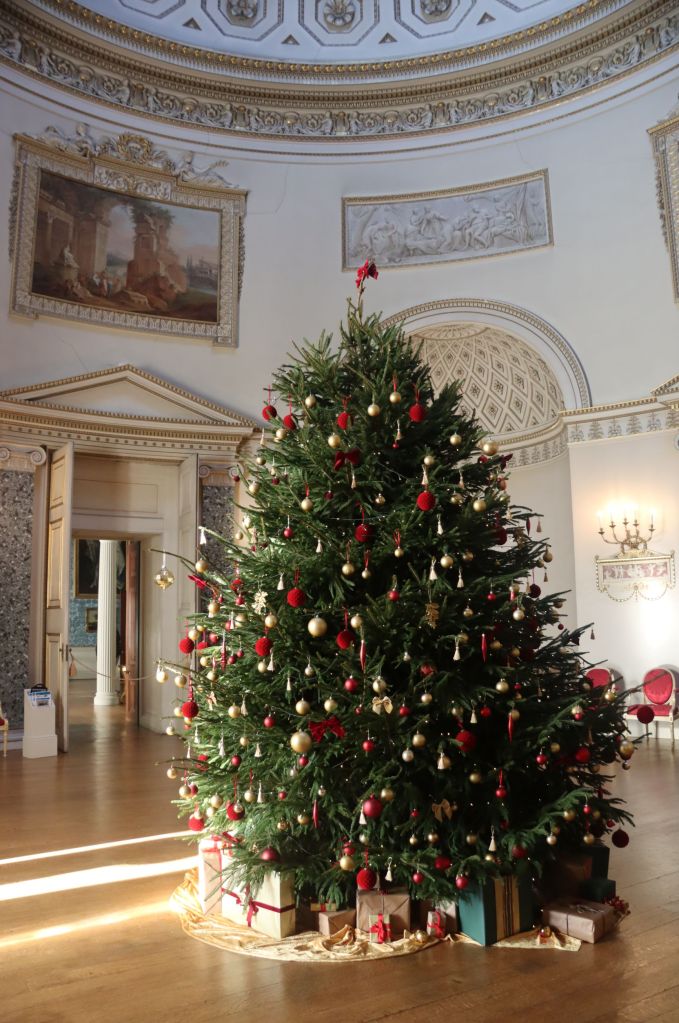
Equally impressive is the Saloon, a circular room rising 62 feet (19m) to a grand glass skylight. It was designed as a sculpture gallery, the style being based on the temples of a Roman Forum. The modest Christmas tree at its centre did little to distract our attention the sheer elegance of the room’s design.
Clockwise fromTop left: The Library. Top right: Ante Room / Dressing Room. Bottom Right: The Saloon. Bottom Left: View through Ante Room / Dressing Room to the Christmas tree in the Saloon. Middle (bottom): The Dining Room. Middle (top): The Family Room
The other state rooms, including the Library, Drawing Room and the Dining Room, are equally impressive. And that’s the point. This place was built to impress, and it does just that. More than Chatsworth House, and more than just about every other stately home I’ve ever visited, it positively exudes the wow factor. I love Kedleston Hall just as much as I’m sure I would have disliked Nathaniel Curzon, the guy who commissioned this spectacular mansion…anyone with an ego that big must have been seriously bad news!
Chatsworth House, ancestral home of the Dukes of Devonshire, is one of England’s foremost stately homes. It’s run as a business, depending for its survival largely on the income it generates by welcoming paying members of the public to explore the stunning house and massive ornamental gardens. As with so many visitor attractions, the Christmas season is vitally important for the health of the enterprise. This is even more true in 2022, as Chatsworth seeks to recover from the damage inflicted upon the business by Covid.
Chatsworth’s famous Cascade, which dates from around 1708, flanked here by rows of eerily lit trees
And when we visited a couple of weeks ago visitors were out in force to experience this year’s Christmas extravaganza. Here’s what the website told us to expect:
Deep Midwinter: A Nordic Christmas at Chatsworth brings to life the Christmas folklore and traditions of the Arctic and Nordic regions through a series of themed roomscapes. Sculpted ‘ice’ walls, tranquil pine forests, lanterns, traditional Nordic Christmas decorations and foliage foraged from woodlands and hedgerows across the estate evoke the sights, sounds and scents of the natural world at wintertime…
Our Nordic theme continues into the garden with an enchanting Christmas light trail. Experience our ‘northern lights’ over the Canal Pond, let colour guide you along Broad Walk into a glade of glowing lights and, for the first time, see the Maze illuminated and filled with festive music.
Sounds great, doesn’t it? But sadly, it didn’t live up to expectations. In 2019, the last time we visited Chatsworth at Christmas, we were blown away by decorations on the theme of “a land far, far away.” This year, however, we were distinctly underwhelmed: the Nordic associations pretty much passed us by, and the decorations lacked impact. Worse still, we paid nearly £30 (USD 37) per head for the privilege.
Some grand stately homes in other parts of the country charge quite a bit more for their Christmas celebration – Blenheim Palace, for example – but, if recent television coverage is to be believed, they offer a lot more too. Clearly, £30 per head isn’t a fortune, but that’s not the point. The question is, does it represent value for money, particularly as we are currently in the midst of a nationwide “cost of living crisis”? I don’t think so.
One of the more attractive features of the “enchanting lights trail” in the garden.
Don’t get me wrong, our visit wasn’t a total waste of time. Parts of the garden lights trail were pretty good, while the best of the decorated rooms of the House were very well done. And if you’d never been to Chatsworth before the whole show probably made a good, although very crowded, introduction to the House’s splendours. But we know the place well and – based on what we saw in 2019, and what we paid for our tickets this time – we expected rather more. The photos I’ve used to illustrate this piece feature the highlights, but the majority of “the experience” was a lot more mundane.
Maybe they had a limited budget in 2022, as a result of Covid’s impact on revenue streams? Or did they spread their resources too thinly, by having “an enchanting lights trail” in the gardens as well as decorating the House (in 2019, the Christmas extravaganza was limited just to the House, and didn’t extend into the gardens). But I can’t help worrying that Chatsworth’s trading on its name, making a calculated underinvestment in this seasonal attraction on the assumption that people will turn up anyway, just because it’s Chatsworth?
Top left: The Painted Hall. Top right: Another room, another group of trees, and a stray speaker playing Christmas music! Middle right: The Library. Bottom: The Chapel.The golden statue between the trees is by the notorious contemporary British sculptor Damien Hirst.
If so, I fear that may be a bit short-sighted, as there are plenty of other stately homes around here that also put on a show at Christmas. People who shared our disappointment with Chatsworth’s efforts this time may well choose next year to get their seasonal cheer somewhere else, somewhere offering the prospect of seeing more while paying less.
Hopefully, this is a one off, and Chatsworth will be back on form in time for Christmas 2023. Until this year they’ve had a good track record, so we’ll probably give them another chance. I’ll report back 12 months from now!
Although Burton Agnes may sound like the upper crust villain of an Agatha Christie novel, the reality is altogether more interesting. Built between 1598 and 1610 near the village of Driffield in the East Riding of Yorkshire, Burton Agnes is a magnificent Elizabethan mansion that’s been associated with the same family for over 400 years.
Although the Hall is now managed by a charitable trust, the family still lives there. To help cover the cost of its upkeep, paying visitors are invited to have a poke around this Grade I Listed architectural masterpiece. And, inevitably, the period before Christmas is a great time to pep up the income stream.
The Great Hall
This, of course, is nothing unusual. Up and down the land the good, the bad and the ugly of British stately homes open their doors to the Great British Public at this time of year, anxious to milk the cash cow that is Christmas.
Some do a great job, investing heavily to decorate their mansions with festive frivolities that are sure to get their visitors into the mood for Christmas and, hopefully, will encourage them to return the next year. Others, I suspect, do the absolute minimum that they calculate is necessary to prevent the paying public demanding its money back.
Burton Agnes, which we visited a couple of weeks ago, felt like good value for money. The place was tastefully, but not excessively decked out in seasonal finery. They say that “less is more”, and whoever planned the Christmas decorations here clearly understands the benefits of measured restraint in such matters. The seasonal adornments seemed in tune with their setting rather than simply overwhelming it, which has been the case in some of the places we’ve visited over the years
To be honest, I would normally find it difficult to feel festive in mid-November, but by the time we left Burton Agnes I could happily have polished off a plateful of mince pies and knocked out a verse or two of God Rest Ye Merry Gentlemen. Roll on Christmas, I’m ready for you now!
The White Drawing Room
And, just as important, our visit to see the Christmas decorations also served as an introduction to a truly spectacular building. The Great Hall is just that, a masterpiece of plasterwork and panelling. The Long Gallery, with its barrelled ceiling, is light, airy, elegant (and very, very long!), while the White Drawing Room is comfortably tasteful. Although the decorations were great to see, the quality of the building itself shone through clearly.
Above: The Red Drawing Room. Below: The Long Gallery
Burton Agnes has been described by the author Simon Jenkins as ‘the perfect English house’ and as one of the twenty best English houses. I’m not sure about that, but I do know that there’s lot to admire in it. Mrs P and I have agreed that we’ll make a return visit at another time of year when the Christmas decorations have been removed, so we can get to know it a bit better.
Here in the UK autumn ends today, 30th November. Unless, that is, you subscribe to the notion that the seasons are astronomically determined, in which case you’ll need to wait until around 22nd December for the official start of winter. But as a cold wind whistles around the house and I look out at naked trees, a garden littered with fallen leaves and sullen skies devoid of swooping swallows, I know that autumn’s over. Sigh!
“Release“, cast in bronze by sculptor Leonie Gibbs, is flanked here by glorious autumnal foliage. We saw it at The Sculpture Park in Surrey.
After a difficult few months in which we found ourselves mostly confined to the house by wardrobe woes, the horrible heatwave and the Covid blues, autumn’s been a welcome opportunity to spread our wings a bit. When we visited Surrey and Sussex in October, a few trees were just beginning to turn. They made a perfect backdrop for the artworks at two sculpture parks we visited, and also for Arundel Castle and the Polesden Lacey Garden Cottage.
Left: “Release” and reflection in the lake. Top right: Arundel Castle in Sussex, viewed from its grounds. Middle right: Autumn foliage at the Hannah Peschar Sculpture Garden in Surrey. Bottom right: The gardens at Polesden Lacey Garden Cottage in Surrey.
Fungi were also much in evidence, a sure sign of the changing seasons.
In terms of its symbolism, autumn is ambiguous, a season of immense joy and unbearable sadness. On the one hand it is a time of plenty, ripening, harvest, and abundance. And yet, on the other hand, it represents decline, decay, old age, and the imminence of death. The colours of autumn are glorious, a celebration of life, but we know it won’t last. The golden leaves will inevitably fall and perish, and greyness will prevail. Autumn is the ultimate proof that All Things Must Pass.
Hidden amongst the autumn trees is “Inca” a one-off sculpture, hand forged from iron by sculptor Nimrod Messeg. We saw it at the Hannah Peschar Sculpture Garden.
But even though All Things Must Pass may sound depressing, it is, for me, a message of hope. Although hard times will soon be upon us, they too shall pass. Nothing is forever, and, in the fulness of time, spring’s awakening will be with us once more.
_ _ _ _ _ _ _
Musical postscript
Forever Autumn, written by Jeff Wayne, Gary Osborne and Paul Vigrass, and sung here by Justin Hayward, is a plaintively beautiful love song in which autumn serves as a metaphor for despair and loss. The song features in Jeff Wayne’s musical adaptation of H G Wells’ War of the Worlds. Here’s a selection from the lyrics:
The summer sun is fading as the year grows old
And darker days are drawing near
The winter winds will be much colderNow you're not here
...Through autumn's gown we used to kick our way
You always loved his time of year
Those fallen leaves lie undisturbed now
'Cos you're not here
...
A gentle rain falls softly on my weary eyeAs if to hide a lonely tearMy life will be forever autumn
'Cos you're not here
Listen here, and gently weep for the loves you have lost…
A few months ago, while we were spending a couple of days in Birmingham, we stumbled across a piece of public art that is as controversial as it is unusual. A Real Birmingham Family, by sculptor Gillian Wearing, depicts two local sisters – each single mothers, one of them heavily pregnant – with their two children. Cast in bronze, the sculpture was erected in Centenary Square, prominently positioned in front of the Library of Birmingham, in 2014. A storm’s been raging around it ever since.
Most of the figurative public art found in cities and towns across the UK features folk who might loosely described as representatives of ‘the great and the good‘, although, to be blunt, a number of them were neither great nor good, but simply had an effective PR machine behind them!
Representations of past and present royalty, politicians, war heroes, cultural and sporting icons, and sundry local bigwigs clutter our public footways. Their subjects are predominantly male and overwhelmingly White, and the statues seemingly yell “look at me, look at me, aren’t I important!” to anyone glancing in their direction. Diversity is in short supply, and the sculptures mostly seem detached from the realities of everyday life. So I’m left wondering, what about ordinary folk? Where are the statues depicting people like me and you? Don’t we count too? What about our lives?
Similar thoughts may have crossed the mind of managers at Birmingham’s Ikon Gallery of contemporary art in 2011, when they initiated a process to find a “real” Birmingham family to model for the sculpture. Nominations were invited, but what constitutes a “real” family was not specified. From the nominations received four families were shortlisted, with the eventual winners being selected by a panel of community, cultural and religious figures. Here’s what the curator of the Ikon Gallery had to say about the winners:
“Their story is compelling and says much about contemporary Birmingham. Two mixed-race sisters, both single-parents with happy, lively young boys, who identify themselves strongly with the city of their birth. The variety of nominations to ‘A Real Birmingham Family’ has shown us that while the traditional, nuclear family may no longer be the norm, the ties that bind us together are as strong as ever.”
It’s evident from Tulloch’s statement that A Real Birmingham Family is a million miles away from the typical statue found on the UK’s streets. They are not drawn from the dubious ranks of ‘the great and the good’. Rather, in the nicest possible way, the Jones sisters and their kids are just ordinary people, a loving family supporting one another and living the best lives they can, even though the path they have taken does not conform with long-standing societal norms. Surely this something worthy of celebration?
And yet the sculpture has drawn stinging criticism from some quarters because, as one commentator has claimed, it is “a sad betrayal of the traditional values that held great communities like Birmingham together…[and] a totem for extreme feminists who more and more argue that women don’t need men at all.”
Anyone who knows me will not be surprised to learn that I don’t see it that way!
If the artist’s intention was to propose that single parent arrangements are inevitably superior to traditional, nuclear family set-ups, then there might be cause for complaint. But surely that isn’t what Wearing’s work is telling us? What she seems to be saying is that while most of us – I suspect – have been raised in a nuclear family, alternative family models can also be successful. Her piece is a commentary, an observation of one way in which families can function effectively in the 21st century. Other options are also available!
I fully understand that this piece of public art may be uncomfortable for anyone wedded to tradition, for anyone who instinctively believes that the old ways are inevitably the best ways, or indeed the only acceptable ways. But by seeking to challenge careless stereotypes and preconceptions, Wearing is doing one the jobs that it is an artist’s duty to perform: she is making us reflect, making us debate, making us think critically about the world in which we live, even if the process is painful. Art’s not meant to be easy.
In some circles Birmingham, a city in the English Midlands just 50 miles / 80km from Platypus Towers, is referred to as The Venice of the North. Really? Venice, a UNESCO World Heritage Site, is one of the premier jewels in Europe’s cultural crown, “an extraordinary architectural masterpiece in which even the smallest building contains works by some of the world’s greatest artists such as Giorgione, Titian, Tintoretto, Veronese and others.” Birmingham, however…
Difficult to believe this was taken in the very centre of Birmingham, the UK’s “second city”, population 1.15 million
Although its origins are much older, Birmingham owes its prominent position to the Industrial Revolution. Central to the city’s growth was the production of metal-based goods. It became known as “the city of a thousand trades”, where a myriad of small workshops employed skilled craftsmen to manufacture high quality finished products. It was dynamic and prosperous, but it was no Venice!
Comparisons with Venice are woefully wide of the mark, except in one particular regard: canals. Venice is a city of canals, and Birmingham too has a web of waterways dating from the 18th and 19th centuries. These were excavated to bring in the raw materials needed by local workshops, and to carry away the finished goods they produced to markets throughout the country.
Pretty soon, Birmingham was at the heart of the national canal network. The city thrived, and the nation’s canals bustled with activity. But the development of railways in the mid-19th century heralded a change in fortunes for the canal network locally and nationally. Rail transport – and later, transport by road – proved quicker and therefore cheaper than the carriage of materials and goods by water. Birmingham’s canal network declined, and by 1980 all commercial traffic had stopped.
Once the lifeblood of the city, Birmingham’s canals morphed into fetid rubbish dumps and the warehouses lining them became neglected eyesores, derelict and anachronistic. They served no real purpose, and it’s easy to imagine that some bright spark might have thought it would be a good idea to fill in the waterways and bulldoze the associated buildings.
But fortunately, the City Council recognised that if they were sensitively restored, Birmingham’s canals could help drive the city’s regeneration. Work began in the late 1980s, and when we visited a few months ago we were able to see how this far-sighted vision has been put into practice.
Historic toll house, where users of the canal once paid for the privilege
Gas Street Basin is the hub of the city’s canal network, located in what is today the heart of Birmingham’s cosmopolitan nightlife and shopping districts. Here we walked along towpaths lined with vibrant cafés, bars, restaurants and modern buildings, and were also pleased to spot some fine examples of historic canal architecture. Several narrowboats were moored in the basin, adding to the area’s quaint charm.
As we continued our stroll along the towpath, past modern developments that included the International Conference Centre, the National Indoor Arena and the National Sea Life Centre, we encountered plenty of pedestrians and dog-walkers, and some cyclists and joggers too. All were taking the opportunity to get some fresh air, away from the noise and mayhem of the frantic city centre streets.
Gas Street Basin
Meanwhile, colourful narrowboats chugged slowly along the waterways, offering holidaymakers and tourists an unexpected perspective on what is known as the UK’s “second city” (after London, of course!).
Along the way we stopped off for a drink at one of Birmingham’s most distinctive historic buildings. The Roundhouse was built in 1874 as a giant stable complex where 50 horses that worked on the canal could be housed. The need for the facility is long-gone (none of the narrowboats now using the canals are drawn by horses), and for some time the future of the building was in doubt.
However, creative minds have come up with a way forward: now run by a charitable trust, the Roundhouse has been repurposed as a visitor centre, café, display space and offices. It also acts “as a launchpad to explore Birmingham’s brilliant stories and place…[offering] canal-based kayaking, city walking tours, [and] boat trips.”
The Roundhouse, which once provided stabling for 50 working canal horses
As we enjoyed our mochas there was time to reflect on what a good job the city authorities have done in revitalising Birmingham’s canal network and infrastructure. While Birmingham is clearly nothing like Venice, the canals give the city a distinctive character that reflects its unique heritage. A canal network dating back over two hundred years could have become a serious burden to the city and its people in the 21st century, but visionary, enterprising developments have turned it into a genuine asset. Well done, Birmingham, I salute you!
_ _ _ _ _
Postscript: Venice of the North
Birmingham is not the only place that has been labelled the Venice of the North. Other nominees include Saint Petersburg (Russia); Amsterdam (Netherlands); Giethoorn (Netherlands); Bruges (Belgium); Stockholm (Sweden); Copenhagen (Denmark); and Alesund (Norway). To which I can only say, get a grip, guys. Each of these places has its own merits, and should stand or fall by those merits rather resorting to spurious comparisons with another, very different place!
We’d been meaning for ages to go visit the famed Chesterfield snail, but Covid got in the way and it wasn’t until a few months ago that we finally caught up with it. Not that there was much chance of it getting away. Snails are notoriously slow at the best of times, and this one’s chances of making a run for it are hampered by the fact that it’s 5 metres / 16 feet tall and fashioned from sheets of brushed stainless steel.
Mollusc sits in a small area of parkland at the edge of a housing estate, on land that was once home to the Markham Engineering Works. Why, we wondered, would anyone choose to erect an enormous steel snail here…or anywhere else, for that matter? The reason, it seems, is that ancient fossil gastropods have been found in the coal measures that are widely distributed around this area of Derbyshire. Sculptor Liz Lemon has made sure that none of the locals will ever forget this obscure piece of trivia.
Lemon also took inspiration from the industrial history of the site: the form of the Mollusc echoes the casings of huge turbines that were once manufactured at the Markham works before being shipped to hydro-electric power plants around the world. This chapter of Chesterfield’s industrial history is further honoured by inscriptions in the base of the sculpture bearing the replica signatures of former Markham employees.
Although the setting is incongruous, as a piece of artwork Mollusc is undeniably eye-catching. The gleaming shell’s spiral design is decorated with a series of “portholes” that reduce in size towards its centre. These, I understand, are lit up at night by blue and green fibre optic lights, but as we visited during daylight hours this intriguing feature was invisible to us.
Installed in 2003, the Mollusc is part of Chesterfield’s Art Trail. It, and more than 70 other pieces of public art, was funded from the local council’s “Percent for Art” scheme. Developers of schemes costing over one million pounds (USD 1.15m) are encouraged to include a work of art to the value of 1% of the total cost of the project, with a view to help “create a sense of place and add character to the built environment.”
I hope that the current financial crisis engulfing the UK doesn’t undermine the Percent for Art scheme. If the Mollusc is anything to go by, this is an enlightened initiative that can only enhance the character of Chesterfield’s urban landscape. Mrs P and I look forward to exploring other hidden gems on the Chesterfield Art Trail in 2023.