The Western Isles of Scotland are home to many more sheep than people, and are therefore officially my kind of place. We were last there 30 years ago and a return visit was long overdue, so earlier this year we booked tickets for the ferry, packed plenty of warm, water-proof clothing and set off on our travels. The islands themselves didn’t disappoint, though sadly the weather did.
No people. Several sheep. My kind of place!
Also known as the Outer Hebrides, the Western Isles lie at the extreme North-West edge of Scotland. By British standards they are very remote. Head due west from one of the beautiful beaches and your next landfall will somewhere on the northern tip of Labrador, Canada.
The string of islands that together make up the Western Isles stretches for over 100 miles (160 km). They are connected to one another by a series of causeways and ferries which allow tourists like Mrs P and I to island-hop along their entire length, passing scenic sea lochs, dramatic cliffs, rugged hills, sandy beaches, moody moorland and gloopy peat bogs on the way.
Water, water everywhere. You’re never far from the sea in the Western Isles.
You’re never far from the sea on the Western Isles. For tourists the sea’s scenic value is enormous; for many islanders its fish and shellfish have long been an important source of sustenance and income. And when the fishing boats are too old and broken to be safely used, they are left to slowly decay on the shoreline where they give endless pleasure to Mrs P and her fellow photographers.
The fishing industry has left its mark on the Western Isles, much to the delight of photographers.
The islands echo to the sound of bird calls, while gangs of red deer patrol the hills and clusters of seals chill out on the shoreline. We were thrilled to catch a glimpse of a White-tailed Sea Eagle, although it refused to pose for a photo. So too did the Short-Eared Owls, which hunted audaciously along the roadside in broad daylight. Other birds were more accommodating, including a handsome Red-throated Diver. But perhaps the most memorable wildlife experience of our trip was to be able to stand at the kitchen window in our holiday cottage and watch Red Deer in the garden, grazing on shrubs and grasses.
For us, wildlife is one of big attractions of the Western Isles. Here we see Red Deer, a Buzzard, Whooper Swans and a Red-throated Diver.
Glimpses of the islands’ rich history are everywhere. The Western Isles were first settled by humans as the climate slowly warmed up after the last Ice Age, around 8,500 BCE. Some 5,000 years ago their descendants erected one of the most extraordinary prehistoric structures in Britain. Calanais (Calanish) is a cross-shaped setting of standing stones, the tallest of which is 16 feet (4.8m) tall. It was an important place for ritual activity for at least 2,000 years, and is believed to have been a rudimentary astronomical observatory.
At over 5,000 years old the Calanais (Calanish) standing stones predate the famous prehistoric monument at Stonehenge in the south of England.
Another picturesque feature of the Western Isles is the scattering of traditionally designed domestic buildings. Thick stone walls and tiny windows are a reminder of the inhospitable climate that local people have had to contend with over the centuries, while the thatched roofs conjure up (somewhat misplaced!) romantic notions of a cosy lost world.
On the Western Isles, some traditional domestic buildings have been restored, conjuring up romantic notions of a lost world.
With a resident population of just 22,000, peace and tranquillity are never far away on the Western Isles: these are indeed roads less travelled. It’s a truly magical place in which to escape the stresses and strains of 21st century urban life, even if the weather is sometimes a bit challenging!
For most travellers, the airport’s just a staging post on the way to their holiday destination. However, in the Western Isles of Scotland, Barra airport is a destination in its own right, thanks to its unique runways. Barra is believed to be the only airport in the world where scheduled flights land and take-off from a tidal beach, and every day spectators gather to watch the drama unfold.
Landing at Barra Airport. The tide had recently gone out and there was still plenty of standing water on the “runway”.
Barra is a small island at the southern tip of the Western Isles, which are also known as the Outer Hebrides. The resident population is only slightly above 1,000, but numbers are boosted during the summer by visitors hoping to experience the island’s famed beauty and tranquillity. Most tourists arrive by boat, but a few opt for the alternative, a plane that lands at low tide on the beach at Tràigh Mhòr (which appropriately, when translated from Scottish Gaelic, means “Big Beach”).
This is the airport. Honest!Spectators are warned to be sensible.
The first plane to land on Tràigh Mhòr touched down in 1933. At the time the search was on for places where an air ambulance service might be able to land when there was a local medical emergency. Barra postmaster John MacPherson suggested that the compact sand of the beach, popular then and now with cockle pickers, might also be suitable for aircraft.
On 14 June, 1933, Captain Jimmy Orrell tried it out, and confirmed that the beach would indeed pass muster as a landing strip, albeit only when the tide was out!
Coming in to land. On the left, spot the control tower and, a little further to the right, the arrivals/departures lounge!
Three years after Captain Orrell’s touch down, the Air Ministry officially licensed the site as an airport. The first scheduled flight landed on the beach on 7 August, 1936.
And today, 88 years later, they still do. Although Barra has no fewer than three “runways”, laid out in a triangular configuration to enable services to operate regardless of wind direction, the airport is, of course, a small scale operation.
Touch down! Note the windsock visible of the far left of this shot.
Unsurprisingly, there are no international flights. Indeed, the only scheduled route is between Barra and Glasgow, and passenger numbers are tiny: just 13,102 people passed through in 2022. Scheduled flights are confined to daylight hours, but in an emergency situation the airport can operate at night. When landing in the dark, pilots safely find their way with the help of vehicle headlights and reflective strips laid on the beach.
When Mrs P and I first visited the Western Isles 30 years ago, Barra’s quirky little airport was one of the must-see destinations of our trip. And so it was again this year. The word “unique” is overused and misused (you should hear Mrs P rant about that whenever she hears someone on television getting it wrong!), but in this case it is entirely appropriate.
There’s nothing quite like Barra airport, anywhere in the world. I was born and grew up in West London, within a couple of miles of Heathrow, one of the world’s busiest airports, but believe me when I say that the tiny, incongruous airport on the beach at Barra is infinitely more interesting.
We’ll soon be heading north to Scotland on our annual pilgrimage. The Scottish landscape and natural scenery are fabulous, but some of the little fishing villages are quaintly picturesque too. To me, born in London and resident for nearly 50 years in landlocked Derbyshire, the seaside seems like another world, so it’s always a treat whenever we go there.
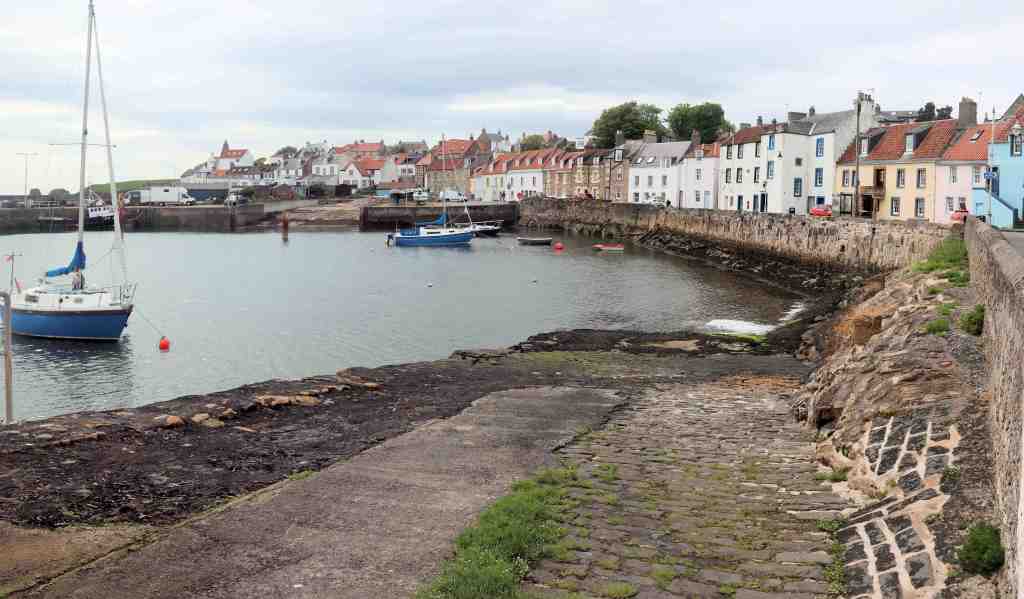
The picturesque harbour at St Monans
One of the fishing villages that caught our eye during our last trip to Scotland was St Monans in the county of Fife. The village is named for the eponymous 6th century saint who came from Ireland to Scotland to spread the teachings of Christianity. At its heart is the harbour, overlooked by traditional fishermen’s cottages, some with white walls, others colourfully painted. They date predominantly from the 18th and 19th centuries, and although most have since been significantly altered, their origins are clear if you know how to read the signs.
More harbour views…seems like another world born in London and resident for nearly 50 years in landlocked Derbyshire!
Many of the cottages are roofed with distinctive red pantiles. This style, which is found widely in villages on the east coast of Scotland, originated across the North Sea in the Low Countries (the Netherlands and Belgium). The pantiles were used as ballast on trading ships returning from mainland Europe, and were then adopted as roofing materials when the ships were unloaded at St Monans.
Pantiles can be seen on several of these cottages. Note also, on some of the roofs, the “crow-stepped” gables that are believed to have been developed to break up the airflow and protect the tiles from being blown off in a gale.
To my eyes, the most striking feature of some of these cottages is the forestairs, an outdoor staircase leading to a door on the first floor. Fewer than ten examples survive today, but in the past they would have been much more common. They hark back to the heydays of the fishing industry, when living accommodation would often have been on the first floor, above a boat store, workshop and sail store on the ground floor.
The outdoor staircases (forestairs) leading to doors on the first floor are an echo of the time when the residents of these cottages were fishermen.
Although it is the historic residential buildings that give St Monans its character, the church is also worthy of comment. It dates from 1369, and was originally founded by King David II of Scotland in gratitude for his having survived a shipwreck on the coast nearby. Originally built as a small house of Dominican friars, it was restored in the early 19th century and now serves as the local parish church. When viewed from most angles the church has the sea as its background. It is widely claimed to be the nearest to the sea of any church in Scotland.
A little further outside St Monans is the last remaining windmill in Fife, a relic of the salt industry. Large scale salt production began here in the late 18th century, and the windmill was used to pump seawater into the saltpans where it would be evaporated to reveal the finished product. The industry lasted only a few decades before closing down in 1825. The remains of the saltpans are unimpressive, little more than a few grassy mounds and depressions close to the shoreline. The windmill, however, has been restored and acts as a reminder of an industry that is unknown to most people today.
The (reconstructed) windmill, and the (barely visible) humps and bumps in the grass between it and the sea, are all that remains of a salt production industry that closed down 200 years ago.
By no stretch of the imagination could St Monans be described as spectacular. But there’s lots to admire there, including glimpses of a world and a lifestyle that is a total mystery to those of us who live our lives a very long way from the sea. Definitely worth a visit, if you’re ever in that part of Scotland.
Today is NOT World Oystercatcher Day! Why not, I wonder? Just about every other worthy cause – and a few other causes too – have a day set aside to celebrate them. World Elephant Day, International Day for the Abolition of Slavery, World Breast Cancer Research Day, International Red Panda Day and International Talk Like a Pirate Day, to name just a few. So why not a World Oystercatcher Day?
OK, it’s confession time. I’ve been a keen birder for nearly 40 years, and the oystercatcher is my all time favourite bird. Now, not a lot of birdwatchers would ever admit that. Most would select as their favourite either a species that is exquisitely beautiful, or one that is vanishingly rare. Oystercatchers are neither of these things, but what the hell, I love ’em anyway.
Part of the attraction is that they’re unmistakeable. When you first take up birdwatching as a hobby, it can be very daunting to identify what’s right in front of you. Warblers in the UK, for example, are a bit of a nightmare – they all look pretty much the same unless you get up close and very personal with them – and US birders will know only too well the misery that is inherent in trying to distinguish between North America’s multiple species of sparrows. It’s all very confusing.
Not so with oystercatchers. It’s impossible to confuse a Eurasian Oystercatcher (aka the Common Pied Oystercatcher, or the Palaearctic Oystercatcher) with any other UK bird. A large, stocky, black and white wader with a long, orange-red bill and reddish-pink legs, its identity is beyond doubt.
But what I like most about these handsome birds is that they are unashamedly loud and proud. Oystercatchers boast an eardrum shattering ‘peep-ing’ call that is impossible to ignore. “Shy” and “self-effacing” are adjectives never used to describe an oystercatcher.
Of course, such vocal boisterousness isn’t popular with everyone. Mrs P doesn’t much like oystercatchers, and probably believes they should all be jailed for disturbing the peace. One day earlier this year, when we were birding in Orkney, I excitedly told her that in the small bay we were staking out I had just counted no fewer than 38 oystercatchers foraging for shellfish along the strandline. Mrs P observed dryly that, in her view, this was at least 37 too many. Huh!
New Zealand’s South Island Pied Oystercatcher looks remarkably similar to our own Eurasian Oystercatcher
In all, there are 12 separate species of oystercatcher across the world. They all look very similar, being either pied or plain black, with a red bill and pink legs. We’ve been lucky to see a few of these species over the years, and every encounter felt like a real privilege. New Zealand was particularly productive, enabling us to enjoy both the South Island Pied Oystercatcher, and the aptly named Variable Oystercatcher. What great birds they are (sorry Mrs P, but you’ve got to admit it, I’m right for once!)
New Zealand’s Variable Oystercatcher may be black all over, but may also have some white feathers too. Its plumage is indeed variable!
In my view, every day should be World Oystercatcher Day!
Orkney boasts various attractions both large and small, but none smaller than the Primula Scotica. Also known as the Scottish Primrose, this tiny flower can be found nowhere else in the world other than a few places on the north east coast of Scotland, including a handful of scattered locations on the Orkney Islands.
At the centre of Primula Scotica’s vivid purple petals is a white eye, with a bright yellow “pupil” at its heart. The photo above might suggest that these colourful blossoms are easy to spot in the landscape. Wrong! The flower is a mere 8 millimetres (0.31 in) in diameter, at the top of a stem that is itself just 4 centimetres (1.57 in) tall. It is more easily trodden upon than seen.
Primula Scotica is found only amongst coastal heath and grassland, normally within a few hundred metres of the sea where strong winds trim back taller plants that might otherwise out-compete it. Although it grows in areas of short turf, it’s so tiny that it is easily overlooked.
The biggest picture in the group above shows the view at Yesnaby, a coastal location on Mainland Orkney where Scottish Primroses are known to grow. We went there earlier this year hoping to see them, but struggled at first to “tune in” to precisely what we were searching for. We must have unknowingly walked right by countless specimens until, at last, we started to spot them lurking amongst the coastal turf. The other pictures in this group show just how small these flowers are. A cluster of four flowerheads would barely cover the nail on my index finger, and the blossoms are dwarfed by a British 50 pence coin. Never has the description “perfection in miniature” been more fitting!
Two of the features that have drawn us back to the Orkney islands again and again are the picturesque coastal scenery, and the magnificent birdlife. Marwick Head Nature Reserve, which comprises rugged sea cliffs 87m (285 ft) high, ticks both these boxes. And there is no better time to visit them than in spring, when the seabirds are nesting on the cliffs and the narrow fringe of coastal grassland is ablaze with flowers.
Marwick Head, with carpets of sea thrift in the foreground and the Kitchener Memorial to the rear
We returned to Marwick Head a few weeks ago, full of trepidation. Last year avian flu wreaked havoc on bird populations across the country, and we were anxious that its impact would still be apparent. As it happens, the number of birds on the cliffs remains high, although the seabird city was perhaps not quite as spectacular as we remember it. Avian flu could be responsible for the change, but perhaps climate change is also an issue?
One of the most common breeding birds at Marwick Head is the guillemot. They’re also known as murres in North America because of the murmuring sounds they make when nesting together.
Guillemots (aka murres in North America)
Guillemots belong to the auk family, and lay their eggs on bare rock ledges. Millennia of evolution has rendered these eggs pear-shaped to minimise the likelihood of them rolling off into the sea! Both male and female birds take turns incubating the eggs, and about three weeks after hatching, the chick takes the plunge into the sea. It won’t return to dry land until it’s ready to raise its own chick.
Another common bird at Marwick Head during the breeding season is the fulmar. It was not always so. Just 250 years ago this species was absent from the whole of the UK, but since then its distribution has expanded enormously. Once the season is over, however, fulmars make their way out to sea and will not return until the following spring. This is common amongst seabirds, which is why we prefer to visit Orkney some time between early May and late June.
Fulmar, also sometimes know (for obvious reasons) as the tubenose
The name “fulmar” comes from two Old Norse words – fúll meaning “foul” and már which means “gull.” This refers to a kind of stinking stomach oil, a defensive weapon that fulmars spit out to gum up the wings of predatory birds, causing them to plunge to their deaths. Perhaps it is for this reason that wild fulmars have an average life expectancy of at least 40 years. The lesson is clear: never, ever annoy a fulmar!
Razorbills are superficially similar in appearance to guillemots and breed alongside them, but – at Marwick Head, anyway – in much smaller numbers. They can be distinguished from guillemots by the thick black beak with a white stripe, which contrasts clearly with the thinner bill of the guillemot.
Razorbill, like the guillemot a member of the auk family
It was no great surprise to see a few razorbills at Marwick Head, but the close view of some gannets gliding past the headland was unexpected. Although gannets are not uncommon around Orkney we normally only spot them with binoculars, patrolling far out to sea.
The Northern Gannet may soon be breeding at Marwick Head?
This time we were treated to much better views, and one of the birds appeared to be carrying nesting material in its bill. Maybe a new breeding colony is establishing itself on Marwick Head? We’ll have to check it out when we return, as we surely will, in a couple of years time.
Man and moustache – Kitchener’s iconic recruitment poster *
If watching birds is your thing, Marwick Head is a fabulous place to visit. For students of 20th century British history it has an additional significance, as the location of the Kitchener Memorial. Field Marshall Lord Kitchener was once a national hero in England (but hated by many in Ireland, Sudan and South Africa), boasting a military career that extended far beyond his image in an iconic WW1 recruiting poster. In 1916 Kitchener – then a minister of war – was a passenger on the HMS Hampshire when she sank in mysterious circumstances off Marwick Head.
The tower visible in the central and right-hand images is the Kitchener Memorial
The Kitchener Memorial, an unremarkable stone tower on the clifftop at Marwick Head, was erected in 1926. It commemorates those who died after the Hampshire sank, including Kitchener himself. The Memorial is without doubt the most recognisable single feature on Marwick Head, but for me it is the wonderful seabirds that make this a must-visit destination whenever we are in Orkney.
* Lord Kitchener image credit: Alfred Leete, Public domain, via Wikimedia Commons
At last, after a gap of six years, we’re on our way back to Orkney for our 11th visit over a period of around 30 years. We were due to come here in 2020 but the pandemic got in the way, so it’s a relief finally to be back on the ferry for the 90 minutes long crossing from Scrabster on the Scottish mainland to the Orcadian port of Stromness. As the ferry passes the iconic Old Man of Hoy, we know we’re nearly there. It’s good to be back!
The Old Man of Hoy, a 137m (449ft) high sea stack, formed from Old Red Sandstone.
For the uninitiated, Orkney is an archipelago around 16km (10 miles) off the north east tip of mainland Scotland. There are around 70 islands, of which some 20 are inhabited. Orkney’s total population is around 22,000, meaning there are more sheep than people, and many more birds than sheep – both signs of the perfect place to spend time, in my view!
Orkney’s attractions include some magical coastal scenery and a wealth of wildlife, particularly seabirds. It also boasts numerous important archaeological sites, including stone circles, standing stones and Skara Brae, the best-preserved Neolithic settlement in Western Europe.
More recently, beginning in the late 8th century, the islands were invaded and colonised by Norse raiders. For several centuries they were ruled by Denmark and Norway, and did not come under Scottish control until 1472. The Norsemen thus left an indelible mark on Orkney, and today’s Orcadians remain intensely proud of their Viking heritage.
The Ring of Brodgar is a prehistoric stone circle dating back to the 3rd century BC.
Unsurprisingly tourism plays a big part in the local economy, alongside the more traditional pursuits of agriculture and fishing. A growing number of cruise ships visit during the season, something that is regarded as a mixed blessing by locals and “regular” tourists alike. But it’s easy to see why they come: Orkney simply has so much to offer.
For many years Mrs P and I harboured a secret dream of relocating to Orkney and building a new life here in this wonderful sea of tranquillity, which is light years away from the stresses and strains of our 21st century suburban lives. Sadly this was not to be, due to our family responsibilities back home. So, for as long as we are able (and always assuming the world is not struck by another pandemic!) we will continue to visit this great place regularly.
Meanwhile, over the next few months, I will publish several more posts about Orkney, sharing some of its many highlights and demonstrating why this is, without doubt, our favourite place in the whole world.
I have been in reflective mood this week, looking back on a road-trip around Newfoundland, Canada exactly five years ago. We were there a month, covering the length and breadth of what the locals fondly refer to simply as “The Island,” driving around 6,500 km (4,000 miles) in the process.
The icebergs were impressive
I wish I could tell you it was the best holiday we’ve ever had, but sadly it wasn’t. Although the icebergs were impressive and most of the people were friendly, many of the roads were cratered with pot-holes that wouldn’t have looked out of place on the moon. The food was largely uninspiring, and while there were some undeniable scenic highlights, we had to drive past one hell of a lot of tedious fir trees to find them. And, to make matters worse, I got a spectacular (positively Vesuvian!) dose of food poisoning.
There’s a lot about our visit to Newfoundland that I’d rather forget, but reading back over my blog of the trip there was plenty of good stuff too, much of it quirky and some of it pretty damned memorable. So today I thought I’d share some of the better moments with you, the readers of Now I’m 64.
Quirky Newfoundland (1): Bilbo Baggins and the Warhol Prophecy
Andy Warhol famously suggested that in the future everyone will be famous for 15 minutes. By extension it might be argued that everywhere will be famous too, that each and every place under the sun will become known for something, albeit most probably something rather insignificant.
A case in point is Huntsville, Alabama. Passing through the city a few years ago we were surprised to discover that Huntsville is, according to the people who decide these things, the Watercress Capital of the World. Now, pleasant enough as watercress may be in a mixed-leaf salad, it seems rather desperate of the city elders to fly their colours from this particular mast, not least because the same city boasts an outstanding space museum, including a genuine Saturn 5 rocket.
Elliston doesn’t ‘do’ modesty
Huntsville’s dubious claim to fame came to mind again yesterday when we drove into the small town of Elliston, which, as signage at the side of the road indicates, styles itself as the Root Cellar Capital of the World.
For the uninitiated, and I guess that’s just about everyone other than the good burghers of Elliston, a root cellar is an underground vault in the garden in which you can keep your root vegetables, and other produce, cool and fresh. The British aristocracy had their ice houses and, not to be outdone, Elliston folk built rutabaga (turnip) larders that work on a broadly similar principle. It is a must-have garden accessory around these parts; every home should have one and indeed, in days gone by, most of them did.
There are hundreds of root cellars dotted about the town
There were hundreds of root cellars in this area of Newfoundland at one time, and although most have fallen into disrepair some are lovingly maintained. The best look as if they’ve come straight off the set of a Lord of the Rings movie, giving the impression that at any moment the door will open and a hobbit will emerge, puffing contentedly on his pipe. ‘Hello’, he says, ‘my name’s Bilbo Baggins, pleased to meet you I’m sure.’
‘Well, hi there,’ replies Andy Warhol, ‘that’s a fine root cellar you have there. I’m pleased to tell you, Mr Baggins, that one day you’re going to be famous. But only for 15 minutes.’
Quirky Newfoundland (2): When did you last see a vegetable?
You’ll be familiar with the painting. A small boy dressed in blue stands in the centre of the picture facing to the right, where his inquisitors are seated at a table. His family look on, anxiously. The canvas depicts an imaginary scene from the English Civil War, and was painted by British artist W. F. Yeames in 1878. Its title is “When did you last see your father?”
“When did you last see your father?”, by William Frederick Yeames, (Public domain, via Wikimedia Commons)
Skip to Newfoundland, July 2017, where a new interpretation of the painting has been commissioned. The venerable Platypus Man stands in the centre of the picture, facing his inquisitors. His head is bowed, his shoulders hunched. Tears flow from sunken eyes, cascading down his deathly-pale cheeks. Mrs P watches, her face contorted with pain and suffering. The title of the painting is “When did you last see a vegetable?”
You see, vegetables are in short supply around here. To be fair, we’ve eaten up-market two or three times during the trip, and on these occasions veggies have been available. Although at those prices I should bloody well think so.
Mostly, however, we’ve eaten “cheap and cheerful.” Until yesterday this meant that just about the only vegetables we’ve eaten have been potatoes of the chipped persuasion. Newfies apparently feel the same about healthy eating as Roman Catholic bishops feel about contraception – they’re vaguely aware of the concept, but have decided it’s not for them.
Yesterday, however, we experienced a bona fide miracle. We ate “cheap and cheerful” again, and got both broccoli and carrots. Now you have to understand that I’m not a big fan of broccoli. I once heard a comedian on television refer to it as Satan’s Fart-weed, but didn’t even crack a smile – I mean, what’s funny about the patently obvious? But yesterday, so grateful was I for something – anything – green, that I ignored the ghastly intestinal consequences and wolfed it down ravenously.
And as for carrots (also not my favourite veggies, on the grounds of being too orange to be taken seriously … a bit like Chris Evans and Ed Sheeran, I suppose), Peter Rabbit himself couldn’t have made quicker work of them.
However, we’ve discovered in northern Newfoundland over the last couple of days that some locals have seen the light and taken matters into their own hands. They’ve fenced off areas of land by the side of the road, miles from the nearest town or village, and planted veggies there.
Around here settlements are invariably on the coast, where neither climate nor soil are conducive to the growing of vegetables. But by moving inland along the main roads, conditions for horticulture are improved. Every weekend the “owners” drive out to tend their little allotments, lavishing love and care on them that would put celebrity gardener Alan Titchmarsh to shame.
Apparently anyone living here can, quite legally, drive a few miles out of town, put up a bit of fencing to keep out the moose, and claim a parcel of land to set up a vegetable patch. Ownership of the roadside gardens is respected – no Newfie would dream of nicking his neighbour’s carrots – and nobody pays rent or tax on the land that has been thus acquired.
This all sounds wonderfully progressive, and could work well in the UK. I think I’ll drop Keir Starmer an email and suggest it for inclusion in the Labour Party’s next election manifesto. I have my eye on a nice patch of ground next to the A38, slightly north of Derby, that’s just crying out to have vegetables grown on it. I won’t even have to worry about the moose.
I will, however, definitely give broccoli a miss when sowing my crop. After all, a man should follow his gut instinct.
Quirky Newfoundland (3): Ticklish names and monstrous squid
With apologies to Lewis Carroll ("The Walrus and the Carpenter")
Today we ventured to the coastal village of Leading Tickles. Yes, that really is a place, not a dubious seduction technique that I once employed in my pursuit of Mrs P! In these parts a tickle is a narrow strait, so narrow in fact that it tickles the sides of your boat as you sail along it. There are plenty of other tickles to be had in this neck of the woods, including Dark Tickle and Thimble Tickle. Boringly, the latter is now known as Glover’s Harbour. Less boringly, it’s a place of world renown…if cephalopods are your thing, that is.
In 1878, the world’s biggest known squid, weighing in at two tons, 17m (55 feet) in length and with an eye that had a diameter of nearly 41cm (16 inches), was washed up here. It has received the official stamp of approval from the Guinness Book of Records, so we can be sure it’s kosher. Given that there is absolutely nothing else that a tiny, isolated place like Glover’s Harbour is going to become known for, the locals have latched on to it. The squid has achieved celebrity status; there is a decent interpretation centre, and a life size model which really does bring home what a monster it was. Although, sadly, climbing on it is strictly forbidden!
On the way to visit Squiddly Diddly we took time out to visit the Grand Fall Salmon Interpretation Centre, and view the salmon ladder. Historically, salmon were unable to progress upstream beyond the 30m (100 feet) high waterfall located here, meaning that less than 10% of the entire watershed was available for breeding. However a fish ladder comprising 35 steps has now been constructed, enabling them to by-pass the falls and continue their journey upstream to the spawning grounds.
Watching the fish leap up the steps was mesmerising; some got it right first time, others failed multiple times before finally perfecting their technique and progressing to the next level. We were also able to watch from a glass-walled underwater viewing deck, enabling us to see them from side-on at very close quarters. Some carried flesh wounds caused by mishaps on their journey upstream, though others were unblemished and beautifully marked.
While some of the salmon were modest in size, others were huge. These have probably done the journey multiple times before. Unlike Pacific Salmon, the Atlantic Salmon does not die after breeding, so most of the fish we saw today will return to the sea after mating, and will hopefully make the same intrepid journey again next year. Here’s wishing them a safe journey.
Memorable Newfoundland: Picturesque places, beautiful birds and wonderful whales
For the past week we’ve been in the far west of Newfoundland, but this evening at 4.30pm, we’re booked on a whale watching trip departing from the town of Bay Bulls on the east coast. We therefore have a hard day’s driving ahead of us, hundreds of mind-numbing kilometres in which to contemplate the majesty of the fir trees lining our route. We can hardly contain our excitement [overseas readers please note that the English are famed for their ironic sense of humour! A man can see too many fir trees, and today this man will.]
The pretty fishing village of Salvage
At least it’s no hardship to leave our current accommodation. We suspect the innkeepers received their training from the Basil Fawlty school of hotel management, from which they were evidently expelled for failing to meet the required standard. They don’t say goodbye when we leave, but this isn’t really a surprise as they didn’t say hello when we arrived either (although they did get their assistant to collect our money pretty damned quick).
As soon as breakfast is eaten we’re on our way, whistling the theme tune from The Great Escape as we drive out of the car park. Within a couple of minutes we’re on the Trans Canada Highway (TCH), Newfoundland’s equivalent of the M1. Joy of joys, just like our own M1, the TCH is being widened and chaos is therefore in the air, which doesn’t improve my mood. It’s a nightmare, but after much misery we finally leave the mayhem behind us. I slip the car into cruise, settle back and prepare to watch the kilometres sail past.
A couple of hours later I’m going stir crazy. We decide to leave the TCH for an impromptu side-trip to the coastal village of Salvage. It’s an inspired decision. Salvage turns out to be one of the most picturesque places we’ve visited all trip. The fishing shacks and associated paraphernalia are particularly fine, hinting at a way of life that it is completely alien to us. Mrs P loves photographing them, and snaps away happily until it’s time to hit the road again.
Puffins are unmistakeable, and understandably popular with everyone who spots them
Suitably refreshed by our unscheduled visit to Salvage I put my foot down, and we reach Bay Bulls in good time for our whale watching trip. The boat takes us first to a small offshore island where seabirds nest in their thousands. The skipper brings us in close to the shore, giving us great views of the birds on the cliffs and rocky outcrops. Gull Island boasts a colony of handsome guillemots. There are also some puffins to be seen on the island, while others swim past our boat or fly overhead with beaks full of little fish with which to feed their chicks.
Bird watching over, we move on to Witless Bay, reputedly the best place in Newfoundland to get up close and personal with humpback whales. For once the hype is fully justified, and within a few minutes we find ourselves surrounded by a group of between 15 and 20 humpbacks, all gorging themselves on fish that congregate here to breed.
The skipper kills the engine and we sit still in the water, mesmerised by the whales all around us. The humpbacks patrol the bay, breaking the surface as they swim sedately along, then diving suddenly in pursuit of their quarry, then surfacing again with a loud “blow” of exhaled air and water-droplets.
Squadrons of gulls feed on fish scraps left by the humpbacks
A couple of times we see them lunge-feeding, exploding from the deep with huge gaping mouths that have, in this single manoeuvre, made short work of thousands of tiny fish. Occasionally we spot one spy-hopping, raising his head slightly above the water’s surface to watch what we’re up to. They approach within metres of the boat, sometimes lying motionless at the surface like floating logs, as if winded by the sheer volume of fish they’ve just swallowed. Encrustations of barnacles are clearly visible on their skin. The humpbacks are compelling, awesome creatures, and time seems to stand still as we revel in their majesty.
Today could have been a pretty miserable day, but it turns out to be one of the best we’ve had in Newfoundland. Yet this is a strange place, and Newfies march to the beat of a different drum. After the whale watching is over we retire to a nearby restaurant that specialises in fish. The waitress welcomes us warmly, says we can sit anywhere we like and have anything on the menu…except fish. Unsurprisingly perhaps, in a part of Canada where Basil Fawlty sets standards that some locals find unattainable, it appears that the fish restaurant has completely run out of fish.
Farewell, my friend
* * * * *
POSTSCRIPT: If you’ve enjoyed these random memories of our trip around Newfoundland, why not check out my 2017 blog of our holiday. There are a few laughs, plenty of surprises and loads more excellent photos by Mrs P, like this one of picturesque Quidi Vidi harbour.
Next Sunday, 21 February, is World Whale Day. The origin of World Whale Day can be traced back to 1980, when it was declared in Maui, Hawaii as part of the annual Maui Whale Festival. During our visit to Hawaii in 2014 whales were in short supply (it was the wrong time of year), but over the years we’ve been lucky enough to see them in the waters off Iceland, Madagascar, New Zealand and Alaska.
However our best encounters were around Newfoundland, Canada, in 2017, and to celebrate World Whale Day I thought I’d revisit some of the blog posts I wrote at the time. We spent around four weeks on The Island, as the locals call it, and without doubt the whales were the highlight of the trip. I wrote a blog of our Newfoundland journey at the time, but the following focuses on our magical, memorable meetings with some of the many humpbacks that spend the summer months around its shores.
Having a whale of a time
4 July 2017
The tell-tale spout of a whale announcing his presence
Today’s been a woolly hat day, courtesy of a bitter wind howling in from the high Arctic. It’s appropriate therefore that we should have seen our first iceberg this afternoon as we drove the coast road towards the bizarrely named township of Heart’s Content, which, as I’m sure you know, is just down the road from its sister settlements of Heart’s Desire and Heart’s Delight!
The cold has been made more bearable by the warm afterglow of yesterday evening’s brilliant whale-watching trip. Whale-watching is always a bit of a lottery, and sometimes you lose. But yesterday we hit the jackpot.
Pretty soon we are amongst them, surrounded by a pod of five or six humpbacks
St John’s sits in a sheltered harbour, connected to the sea by a narrow inlet unimaginatively referred to as “the narrows.” Passing through the narrows we were thrilled to spot the towering, tell-tale spouts of whales announcing their presence to the world. Hey guys, they seemed to say, we’re over here, why don’t you pop along and say hello. We took them at their word and pretty soon we were amongst them, surrounded by a pod of five or six humpbacks.
Best of all was when they arched their backs to make a deep dive. This is the manoeuvre that causes the whale’s huge, fluked tail to lift clear of the water, a clown’s battered, white-gloved hand waving goodbye to his adoring fans before the animal plunges into the murky depths in search of lunch.
A clown’s white-gloved hand waving farewell to his adoring fans
I struggle to explain why I find whale-watching such an emotional experience. Partly, maybe, it has something to do with the fairy tale notion of a gentle giant. But also, mixed in with this, is a sense of shame at mankind’s persecution of this majestic, harmless creature in the pursuit of a quick profit. Hunted to the brink of extinction humpbacks are, thankfully, now on the way back. They are awe inspiring animals, and it’s a joy to see them. Yesterday was a memorable day; yesterday was a great day.
In the thick of it: the whales of Witless Bay
27 July 2017
Our evening whale-watching trip out of the harbour at Bay Bulls starts with a visit to Gull Island. Unsurprisingly, it’s generously endowed with gulls and other seabirds, including the ever-popular puffin. But birdwatching isn’t the purpose of our journey today, and we quickly move on to Witless Bay, reputedly the best place in Newfoundland to get up close and personal with humpback whales. For once the hype is fully justified, and within a few minutes we find ourselves surrounded by a group of between 15 and 20 humpbacks, all gorging themselves on fish (capelin) that congregate here to breed.
Surfacing with a loud, fishy-smelling blow of exhaled air and tiny water droplets
The skipper kills the engine and we sit still in the water, mesmerised by the whales circling all around us. The humpbacks patrol the bay, breaking the surface as they swim sedately along, then diving suddenly in pursuit of their quarry, then surfacing again with a loud “blow” of exhaled air and water-droplets.
A couple of times we see them lunge-feeding, exploding from the deep with huge gaping mouths that have, in this single manoeuvre, made short work of thousands of tiny fish. Occasionally we spot one spy-hopping, raising his head above the water’s surface to watch what we’re up to. They approach within metres of the boat, so close was can see barnacles growing on their skin. Sometimes they simply lie at the surface like floating logs, as if winded by the sheer volume of fish they’ve just swallowed.
They approach so close we can see barnacles growing on their skin
Today could have been a pretty miserable day, but it turns out to be one of the best we’ve had in Newfoundland. Yet this is a strange place, and Newfies march to the beat of a different drum. After the whale watching is over we retire to a nearby restaurant that specialises in fish. The waitress welcomes us warmly, says we can sit anywhere we like and have anything on the menu … except fish. Unsurprisingly perhaps in a part of Canada where Basil Fawlty sets standards that some locals find unattainable, it appears that the fish restaurant has completely run out of fish.
Relaxed, unafraid, at peace in their world: the whales of Witless Bay
31 July 2017
Our last day on The Island. We decide to end the adventure in style by taking another whale-watching trip to the Witless Bay Ecological Reserve, hardly daring to believe it can be as successful as the first.
Whales to the left, whales to the right, whales in front and whales behind
This time we know the ropes, arriving at the dock and joining the line early. This means we can be amongst the first to board, which allows us to choose a prime position. We head for the top deck and station ourselves at the pointy (bow) end, which offers good views both left and right of the boat. The weather is warm and sunny, the sea swell rolling our boat gently as we ease our way out of the harbour and past the low cliffs lining its entrance.
Again we call at Gull Island on the way, enjoying the sight of the puffins and smiling at the excitement of our fellow travellers when they spot their first “sea parrot”. There are thousands of puffins sitting on the rocks watching the world go by, while a few others venture out on to the sea and swim past our boat.
We quickly leave the clownish birds behind us and head towards the spouts that tell us the humpbacks are still here. Soon we are amongst them, whales to the left, whales to the right, whales in front and whales behind, while seabirds wheel overhead, seeking out the same fish that have drawn the humpbacks to this spot.
Little and Large (Notice the puffin in the bottom left corner of this shot!)
There must be two dozen whales at least, and some of them come so close we can almost touch them, can smell their fishy breath. A few swim alongside us, keeping pace with the boat as if out for a stroll with a group of friends. Others cross casually in front of us at the surface of the water, relaxed, unafraid, at peace in their world.
But then, somewhere deep within them, instinct kicks in. With an arch of their backs they dive deep, seeking out capelin beyond counting, fish needed in huge quantities to accumulate the thick layers of fat that will sustain them in the waters off Dominica, until they return to these cold northern shores next year. And as they dive they wave their tails, bidding farewell to their spellbound acolytes.
As they dive they wave their tales, bidding farewell to their spellbound acolytes
It is a truly extraordinary hour, one of the best wildlife watching experiences of our lives. In several respects The Island hasn’t quite lived up to our expectations, but the whale watching has surpassed anything we had imagined. This, above all else, is the memory of Newfoundland that will stay with us.
Whale song
Reflections on the fate of the whale, UK, August 2017
One of the unexpected delights of Newfoundland is its thriving folk music tradition. Much of this has a Celtic flavour, reflecting the strong connection between The Island and Ireland. Interestingly many of the locals have a slight Irish lilt to their accents, though in some cases it’s much more pronounced than this and you could believe you were in Dublin or Cork or Kilkenny or wherever.
Some come so close we can almost touch them
We picked up a few CDs during the trip, but couldn’t play them until we got home. Our car, a Chevy Cruze, was great to drive with lots of high tech features, but despite this (or perhaps because of it) there was no CD player! The first CD I tried when we got home was by a well-known Newfoundland folk band, The Irish Descendants. The lyrics of one of the songs, the Last of the Great Whales, brought a lump to the throat, not least because of all brilliant humpback encounters we enjoyed during our trip. The song is written by Andy Barnes, from Milton Keynes in the UK, and goes as follows:
My soul has been torn from me and I am bleedingMy heart it has been rent and I am cryingAll the beauty around me fades and I am screamingI am the last of the great whales and I am dyingLast night I heard the cry of my last companionThe roar of the harpoon gun and then I was aloneI thought of the days gone by when we were thousandsBut I know that I soon must die the last leviathanThis morning the sun did rise Crimson in the skyThe ice was the colour of blood and the winds they did sighI rose for to take a breath it was my last oneFrom a gun came the roar of death and now I am doneOh now that we are all gone there's no more huntingThe big fellow is no more it's no use lamentingWhat race will be next in line? All for the slaughterThe elephant or the cod or your sons and daughtersMy soul has been torn from me and I am bleedingMy heart it has been rent and I am cryingAll the beauty around me fades and I am screamingI am the last of the great whales and I am dying
Poignant, n’est pas? I can’t trace on YouTube a recording of the Irish Descendants singing this song, but here’s a link to an excellent version performed by Celtic Crossroads. Though the whale has been saved for now, for me the lyrics capture with devastating clarity the nature and scale of the wrong that has been done to these gentle creatures throughout the ages. Let’s hope that Andy Barnes will be proved incorrect in his gloomy prophecy.
The whale watching surpassed anything we had imagined. This, above all else, is the memory of Newfoundland that will stay with us
The Black Guillemot isn’t a rare bird. Many thousands breed in the British Isles – the RSPB estimates 19,000 pairs in the UK – scattered along the coast in pairs or small groups. And ours is just a small part of the world population, which is estimated at between 260,000 and 410,000 pairs: these striking seabirds are also found around the coasts of the North Atlantic and Arctic Oceans, across Siberia to eastern Russia and Alaska. The species is rated as Least Concern by BirdLife International.
We’ve previously encountered Black Guillemots at various locations in Scotland, where they are relatively common, particularly in Orkney and Shetland. Here the bird is known as the Tystie, a name derived from Norse, the language of the Vikings who settled in the Scottish islands many centuries ago. A similar name is still applied to the bird in Iceland and Norway.
Black Guillemots are also found around much of Ireland, on the Anglesey coast in north Wales and at a few spots in northern England. Around 300 pairs breed on the Isle of Man, where you’d be hard pressed to find a better place to watch them than at Peel Harbour.
The hustle and bustle of fishing and recreational vessels at Mann’s busiest port makes Peel Harbour an unlikely place for these distinctive seabirds to thrive. But thrive they do. Away from human settlement they breed among rocks at the base of cliffs, or in the shelter of boulders on rocky islets, but at Peel, gaps in the harbour wall offer an attractive alternative. They appear completely at home here.
During our visit in June 2018, the Black Guillemots at Peel Harbour were displaying their distinctive breeding plumage: black all over, with a large, white oval patch on each wing. The bill matches the black plumage, but when the bird opens its mouth a bright red gape is revealed. The legs are also a vivid red. However, outside the breeding season the Black Guillemot loses its good looks, turning white, with black barring on its back, and black wings.
Peel Harbour gave us our best ever views of these splendid birds, and it was fascinating to watch them strutting their stuff, resting up and posing on the fishing boats in the harbour. They were clearly oblivious to the human activity all around them, not to mention the admiring looks of birders like us! You can enjoy a glimpse of their antics on my YouTube video:




 Now I'm 64
