Wordless Wednesday: Paddington

Wordless Wednesday is a simple blog post featuring a photo. It seeks to convey a message or tell a story, but speaks for itself without using words. Mrs P took this photo of a Paddington Bear tucking into a marmalade sandwich at John O’Groats (in the far north of Scotland) earlier this year.

Older that the Pyramids

I guess that, to the uninitiated, Skara Brae looks to be nothing special, little more than a few stone walls and apparently random piles of rock partially buried in tussock-topped coastal sand dunes. Boring, I hear you mutter. But what if I told you that these are the preserved remains of a stone age village that is older than the Egyptian pyramids, a place that has been described as one of the most important prehistoric sites in Europe? There’s much more to Skara Brae than first meets the eye.

The Orkney Isles, lying off the windswept northern tip of mainland Scotland, are crammed full of important archaeological remains, of which Skara Brae is the most significant. The village is around 5,200 years old, and is therefore from a period classified as the Neolithic or new stone age. It is believed to have once been home for up to 100 people.

The site comprises a grouping of ten structures, including eight “phase 2” stone houses partially sunk into the ground. Their roofs have mostly disappeared over time, allowing the modern visitor to look down from the surrounding banks and see clearly the internal arrangement of the dwellings.

The houses were connected by covered passageways which allowed villagers to move easily between them, while still being sheltered from the worst of Orkney’s weather. This arrangement hints at the challenging existence of Skara Brae’s inhabitants, who scratched a living through a combination of fishing, gathering shellfish and wild plants, cultivating a few crops and raising livestock.

What makes Skara Brae particularly remarkable is its state of preservation. The site was buried under sand for thousands of years, and was only rediscovered in 1850 after a violent storm helped strip that sand away. This revealed the 8 domestic dwellings, each house comprising a single room about 40 square metres in area. In addition the houses each boasted several pieces of stone furniture, including an eye-catching “dresser” – which was perhaps used to display highly valued possessions – two box beds and a central hearth.

Archaeological excavations have also revealed a range of artefacts and adornments scattered throughout the village, including tools, pottery, jewellery, and carved stone objects. There were even some gaming dice, which must have helped keep the villagers occupied at times when the foul Orkney weather prevented activities that were more productive.

Skara Brae was abandoned around 2,500 years ago. The reason is unclear; possibly a single, violent sandstorm made it uninhabitable, or perhaps it was as a result of a more gradual process of migration to another location that offered the prospect of an easier life. We’ll never know for sure, but what the villagers left behind gives modern day visitors like me and Mrs P a tantalising glimpse of day-to-day life in Orkney several thousand years ago, a life that was totally different but no less remarkable than that of Tutankhamun, Cleopatra and their Egyptian pals

Roads less travelled – the Western Isles of Scotland

The Western Isles of Scotland are home to many more sheep than people, and are therefore officially my kind of place. We were last there 30 years ago and a return visit was long overdue, so earlier this year we booked tickets for the ferry, packed plenty of warm, water-proof clothing and set off on our travels. The islands themselves didn’t disappoint, though sadly the weather did.

No people. Several sheep. My kind of place!

Also known as the Outer Hebrides, the Western Isles lie at the extreme North-West edge of Scotland. By British standards they are very remote. Head due west from one of the beautiful beaches and your next landfall will somewhere on the northern tip of Labrador, Canada.

The string of islands that together make up the Western Isles stretches for over 100 miles (160 km). They are connected to one another by a series of causeways and ferries which allow tourists like Mrs P and I to island-hop along their entire length, passing scenic sea lochs, dramatic cliffs, rugged hills, sandy beaches, moody moorland and gloopy peat bogs on the way.

You’re never far from the sea on the Western Isles. For tourists the sea’s scenic value is enormous; for many islanders its fish and shellfish have long been an important source of sustenance and income. And when the fishing boats are too old and broken to be safely used, they are left to slowly decay on the shoreline where they give endless pleasure to Mrs P and her fellow photographers.

The islands echo to the sound of bird calls, while gangs of red deer patrol the hills and clusters of seals chill out on the shoreline. We were thrilled to catch a glimpse of a White-tailed Sea Eagle, although it refused to pose for a photo. So too did the Short-Eared Owls, which hunted audaciously along the roadside in broad daylight. Other birds were more accommodating, including a handsome Red-throated Diver. But perhaps the most memorable wildlife experience of our trip was to be able to stand at the kitchen window in our holiday cottage and watch Red Deer in the garden, grazing on shrubs and grasses.

Glimpses of the islands’ rich history are everywhere. The Western Isles were first settled by humans as the climate slowly warmed up after the last Ice Age, around 8,500 BCE. Some 5,000 years ago their descendants erected one of the most extraordinary prehistoric structures in Britain. Calanais (Calanish) is a cross-shaped setting of standing stones, the tallest of which is 16 feet (4.8m) tall. It was an important place for ritual activity for at least 2,000 years, and is believed to have been a rudimentary astronomical observatory.

Another picturesque feature of the Western Isles is the scattering of traditionally designed domestic buildings. Thick stone walls and tiny windows are a reminder of the inhospitable climate that local people have had to contend with over the centuries, while the thatched roofs conjure up (somewhat misplaced!) romantic notions of a cosy lost world.

With a resident population of just 22,000, peace and tranquillity are never far away on the Western Isles: these are indeed roads less travelled. It’s a truly magical place in which to escape the stresses and strains of 21st century urban life, even if the weather is sometimes a bit challenging!

An airport like no other – when the tide’s in, planes can’t land

For most travellers, the airport’s just a staging post on the way to their holiday destination. However, in the Western Isles of Scotland, Barra airport is a destination in its own right, thanks to its unique runways. Barra is believed to be the only airport in the world where scheduled flights land and take-off from a tidal beach, and every day spectators gather to watch the drama unfold.

Landing at Barra Airport. The tide had recently gone out and there was still plenty of standing water on the “runway”.

Barra is a small island at the southern tip of the Western Isles, which are also known as the Outer Hebrides. The resident population is only slightly above 1,000, but numbers are boosted during the summer by visitors hoping to experience the island’s famed beauty and tranquillity. Most tourists arrive by boat, but a few opt for the alternative, a plane that lands at low tide on the beach at Tràigh Mhòr (which appropriately, when translated from Scottish Gaelic, means “Big Beach”).

The first plane to land on Tràigh Mhòr touched down in 1933. At the time the search was on for places where an air ambulance service might be able to land when there was a local medical emergency. Barra postmaster John MacPherson suggested that the compact sand of the beach, popular then and now with cockle pickers, might also be suitable for aircraft.

On 14 June, 1933, Captain Jimmy Orrell tried it out, and confirmed that the beach would indeed pass muster as a landing strip, albeit only when the tide was out!

Coming in to land. On the left, spot the control tower and, a little further to the right, the arrivals/departures lounge!

Three years after Captain Orrell’s touch down, the Air Ministry officially licensed the site as an airport. The first scheduled flight landed on the beach on 7 August, 1936.

And today, 88 years later, they still do. Although Barra has no fewer than three “runways”, laid out in a triangular configuration to enable services to operate regardless of wind direction, the airport is, of course, a small scale operation.

Touch down! Note the windsock visible of the far left of this shot.

Unsurprisingly, there are no international flights. Indeed, the only scheduled route is between Barra and Glasgow, and passenger numbers are tiny: just 13,102 people passed through in 2022. Scheduled flights are confined to daylight hours, but in an emergency situation the airport can operate at night. When landing in the dark, pilots safely find their way with the help of vehicle headlights and reflective strips laid on the beach.

When Mrs P and I first visited the Western Isles 30 years ago, Barra’s quirky little airport was one of the must-see destinations of our trip. And so it was again this year. The word “unique” is overused and misused (you should hear Mrs P rant about that whenever she hears someone on television getting it wrong!), but in this case it is entirely appropriate.

There’s nothing quite like Barra airport, anywhere in the world. I was born and grew up in West London, within a couple of miles of Heathrow, one of the world’s busiest airports, but believe me when I say that the tiny, incongruous airport on the beach at Barra is infinitely more interesting.

Grumpiness personified? Or merely deep in thought?

Nearly 200 years ago a remarkable discovery was made on the beach at Uig in the Western Isles of Scotland; a hoard of 93 medieval artefacts that are today popularly known as the Lewis Chessmen. The hoard comprised 78 chess pieces, probably from five sets, 14 “tablemen” (pieces for backgammon or similar games) and one belt buckle.

Close-up of the queen. Grumpiness personified, or merely deep in thought?

The gaming pieces are carved from walrus and sperm whale ivory, and are just 60mm to 100mm (2.5 to 4 inches) tall. They were probably made in Trondheim (Norway) at some point in the 12th or 13th centuries, and their presence at Uig beach reflects the close relationship that existed between northern Scotland and Norway at the time.

Full view of the queen. She is around 100mm (4 inches) tall.

Mrs P and I were delighted to catch up with a few pieces from the hoard at the Lews Castle museum during our recent visit to the Western Isles (aka the Outer Hebrides). Controversially, most of the hoard is displayed 670 miles (1,080km) away at the British Museum in London, while a further 12 pieces are held at the National Museum of Scotland in Edinburgh. Just 6 chessmen can be seen at Lews Castle in Stornoway – the biggest town in the Western Isles – where they are now on permanent loan.

My favourite of all the Lewis Chessmen, is, in fact, no man at all. The expression on the queen’s face is priceless. To me it’s clear she’s irritated, cross and annoyed with someone or something. Grumpiness personified, in fact.

But some scholars disagree. In their view she’s not grumpy at all, merely deep in thought, as might reasonably be expected during a game of chess. They’re entitled to their expert opinions, obviously, but I reckon they’ve got it wrong. I’ve seen that expression countless times on Mrs P’s face when I’ve displeased her. I know grumpiness when I see it, and that’s it!

Clockwise from top left. Bishop (rear view); Queen (rear view); King (rear view); Knight (head-on view); Rook (warder); Pawn

Although the pawn is relatively plain, and is possibly intended to represent a boundary marker, all of the figurative pieces are full of character. And they all look quite miserable. Again, scholars take the view that the sculptor did not intend to suggest any emotion, but rather to portray seriousness and determination. Personally I prefer to think that they’re fed up because they’ve run out of beer.

As well as viewing a few of the original chessmen in the Lews Museum, visitors can also see modern sculptures inspired by them in various parts of the islands. This towering wooden version of one of the kings was particularly impressive. Without doubt, seeing some of the original Lewis Chessmen, as well as modern artworks they have inspired, was one of the highlights of our tour of the Western Isles.

A taste of Scotland by the sea – St Monans

We’ll soon be heading north to Scotland on our annual pilgrimage. The Scottish landscape and natural scenery are fabulous, but some of the little fishing villages are quaintly picturesque too. To me, born in London and resident for nearly 50 years in landlocked Derbyshire, the seaside seems like another world, so it’s always a treat whenever we go there.

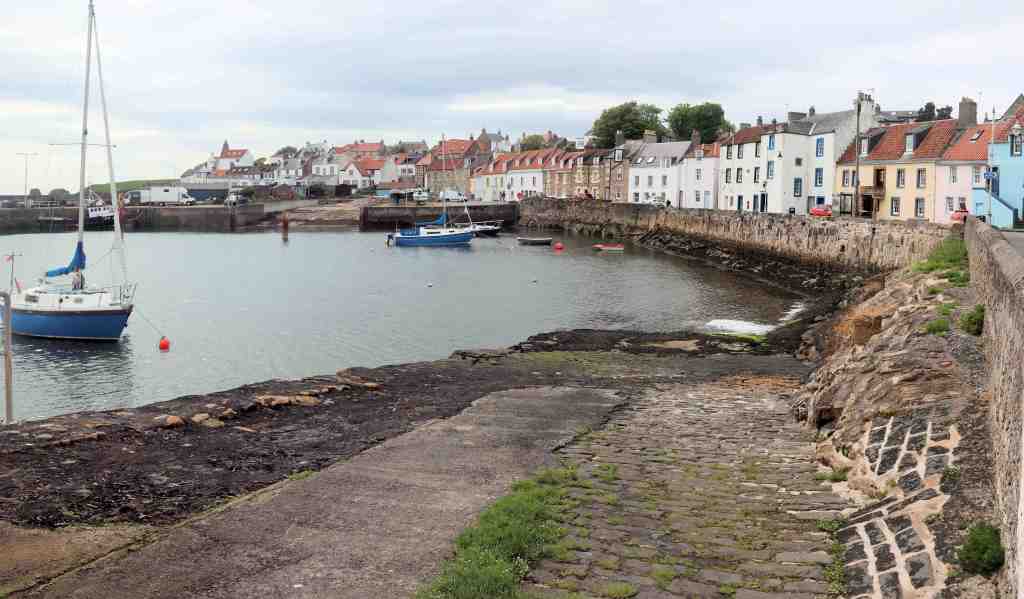
The picturesque harbour at St Monans

One of the fishing villages that caught our eye during our last trip to Scotland was St Monans in the county of Fife. The village is named for the eponymous 6th century saint who came from Ireland to Scotland to spread the teachings of Christianity.  At its heart is the harbour, overlooked by traditional fishermen’s cottages, some with white walls, others colourfully painted. They date predominantly from the 18th and 19th centuries, and although most have since been significantly altered, their origins are clear if you know how to read the signs.

Many of the cottages are roofed with distinctive red pantiles. This style, which is found widely in villages on the east coast of Scotland, originated across the North Sea in the Low Countries (the Netherlands and Belgium). The pantiles were used as ballast on trading ships returning from mainland Europe, and were then adopted as roofing materials when the ships were unloaded at St Monans.

To my eyes, the most striking feature of some of these cottages is the forestairs, an outdoor staircase leading to a door on the first floor. Fewer than ten examples survive today, but in the past they would have been much more common. They hark back to the heydays of the fishing industry, when living accommodation would often have been on the first floor, above a boat store, workshop and sail store on the ground floor.

Although it is the historic residential buildings that give St Monans its character, the church is also worthy of comment. It dates from 1369, and was originally founded by King David II of Scotland in gratitude for his having survived a shipwreck on the coast nearby. Originally built as a small house of Dominican friars, it was restored in the early 19th century and now serves as the local parish church. When viewed from most angles the church has the sea as its background. It is widely claimed to be the nearest to the sea of any church in Scotland.

Photo credit: By Jim Bain, CC BY-SA 2.0, https://commons.wikimedia.org/w/index.php?curid=9222537

A little further outside St Monans is the last remaining windmill in Fife, a relic of the salt industry. Large scale salt production began here in the late 18th century, and the windmill was used to pump seawater into the saltpans where it would be evaporated to reveal the finished product. The industry lasted only a few decades before closing down in 1825. The remains of the saltpans are unimpressive, little more than a few grassy mounds and depressions close to the shoreline. The windmill, however, has been restored and acts as a reminder of an industry that is unknown to most people today.

By no stretch of the imagination could St Monans be described as spectacular. But there’s lots to admire there, including glimpses of a world and a lifestyle that is a total mystery to those of us who live our lives a very long way from the sea. Definitely worth a visit, if you’re ever in that part of Scotland.

One of the good guys – Robert Owen at New Lanark

For most British people, the early decades of the Industrial Revolution were a grim time to be alive. Conditions were horrendous. Workers routinely had to labour for 12 to 14 hours per day in harshly managed and often dangerous factories, for which they received a pittance in pay that was barely enough to cover basic necessities. And when they got home from their workplaces things got no better, as these workers usually lived in cramped, cold and insanitary accommodation provided by bosses who were motivated solely by the pursuit of profit.

Mill 3 replaced an earlier mill destroyed by fire in 1819. It now houses the site’s main exhibitions, including working mill machinery.

Let’s be honest, some early captains of industry were monsters who cared nothing for the welfare of the men, women and children upon whose lives they impacted. But not all of them. New Lanark in Scotland was proof that there were workable alternatives to rampant, exploitative capitalism.

The “new buildings” were constructed by David Dale as millworker’s housing in 1798. Robert Owen enlarged them as the village size increased.

Founded in 1785, New Lanark is a village in southern Scotland clustered around several cotton mills that harnessed the power of the River Clyde. Under the direction of joint founder David Dale (1739 – 1806), this was an entirely new settlement, built as accommodation for the millworkers and their families. New Lanark thrived. Within a decade of its foundation the village was home to one of the largest and most important cotton mill complexes of its period, employing around 1,500 people.

Prior to his involvement with the New Lanark project, Dale was a prosperous Glasgow-based cloth merchant. He was also a man with a conscience, someone whose philanthropic tendencies tempered, to some degree, his capitalist instincts. This was evidenced by his treatment of the orphan apprentices who worked at his mills – Dale ensured they were taught to read and write, were well fed, and were provided with clothing and decent accommodation.

In 1799 Dale’s daughter Caroline married Robert Owen (1771 – 1858), a Welsh-born industrialist and social reformer. Soon after, David Dale sold New Lanark to his new son-in-law, who formally took over as mill manager in 1800. Owen was committed to continuing the philanthropic approach to industrial working that Dale had initiated, and under his management New Lanark became a model community, emphasizing social welfare and improved living conditions for workers.

Robert Owen was a Utopian social reformer, who aimed to create a perfect, harmonious society in which poverty and unemployment were eliminated. Owen’s abilities as a business manager were central to the success of his social experiment, for it was the profitability of the cotton mills that provided the cash needed to finance schemes designed to improve the lives of his workforce. A vibrant and resilient community was central to his thinking.

Robert Owen’s School for Children was completed in about 1818, providing spacious classrooms for its students. Punishment was not allowed, with strategies of encouragement and kindness being adopted instead.

Owen’s intentions can be discerned from the creation of the Institute for the Formation of Character. Opening in 1817, it was intended to provide educational and recreational facilities for the whole community. Amongst these were a library and reading room, classrooms and halls for concerts and dancing. It also accommodated what is thought to be the world’s first nursery school.

About a year after the opening of the Institute, work was completed on Robert Owen’s School for Children. Here’s what the New Lanark Trust has to say about this visionary initiative:

Owen spared no expense in building and equipping his school, and the curriculum included music, dancing and singing, as well as art, natural history, geography and world history. Punishment was not allowed. Instead, kindness, encouragement, and the fostering of children’s natural curiosity were deemed to be much more effective. [Source: New Lanark Heritage Trail – A guide to New Lanark’s Historic Buildings, 2008]

Owen’s idealism is also apparent from the way he set up his Village Store, which was completed in 1813. It effectively had a retail monopoly in the village, and many other industrialists used such arrangements to their financial advantage by providing poor quality goods at inflated prices. In contrast, Owen put the community’s welfare first, buying good quality food and household goods in bulk, and selling these to his workers at close to cost price. Any profits made were re-invested in the village, being put towards the running costs of the School.

Another view of Mill 3.

Robert Owen was clearly one of the good guys, and his enlightened methods attracted international attention. In 1824 he sold the New Lanark mills and moved to the USA, where where he planned to establish a Utopian Community or “Village of Unity and Mutual Cooperation” based upon the principles that had helped shape his grand Scottish project. However this experiment, based at the settlement of New Harmony in Indiana, proved largely unsuccessful and in 1828 he returned to the UK, financially much poorer but still optimistic that one day the rest of the world would come round to his way of thinking.

Owen’s legacy is now preserved by The New Lanark Trust, which was formed in 1974, six years after the final closure of the cotton mills. The village was one of the earliest examples of a planned settlement, where layout, housing design, and green spaces were carefully considered. Its architecture showcased a blend of practicality and aesthetics, emphasizing functionality while maintaining a pleasant environment. All of this can be enjoyed by visitors, who also have an opportunity to get up close to some of the machinery that drove the success of New Lanark’s cotton mills. Tourists can even visit Owen’s modest house, as well as examples of workers’ accommodation.

The Trust’s aim has been to restore the village as a living, working community, but one which also offers visitors tantalising glimpses of a lost world shaped by a remarkable man. A measure of its success was evident in 2001, when New Lanark was listed as a UNESCO World Heritage Site. The village and its cotton mills are now a major tourist attraction, and deserve to be visited by anyone with an interest in industrial history.