I hear them long before they become visible. Starlings are gathering over the hills to the south of the estate where we live. It begins as an avian whisper, barely audible above the ambient sounds of wind and distant traffic. And then it starts to build, unseen birds chattering excitedly with one another, shouting, squawking, screaming joyously. A wall of sound, the call of the wild.
The cacophony echoes all around me. I scan the sky in the direction from which I know they will appear. Still nothing. But it’s only a matter of time. They will be here. At this time of year they fly over our estate every day at around 4pm, heading towards their roosting site. Today will be no different.
At last they start to arrive. First a lone outrider, silent and determined, appears from behind the house at the rear of our garden. It passes over me and disappears into the distance. Then two others, calling to one another as they fly.
Seconds later the main flock arrives, hundreds of birds in close formation. A deafening, spellbinding squadron of starlings, known to science as a murmuration, fills the sky.
Although the birds clearly have a destination in mind, they briefly break off from their journey to swoop and swirl above my head, like a bunch of boastful aviators flaunting their skills at an air show. The murmuration takes on a life of its own, sketching ever more complex and beautiful patterns on the canvas of the evening sky. The noise is louder than ever, drowning out everything else.
And then, as suddenly as they arrived, they take their leave. The flock heads off to who-knows-where, and the sound of their relentless chitter-chatter fades. A few laggards appear from the south, flying swiftly in pursuit of the main flock, keen to catch up with their buddies before they roost for the night.
Seconds later they too have gone and I’m left alone with my thoughts, marvelling at the extraordinary event I have just witnessed.
* * * * *
In some parts of the country murmurations at this time of year can number several hundred thousand birds, occasionally more than a million. By these standards, the aerial display that takes place above our garden every winter’s afternoon is tiny. But to me it is far from insignificant.
What a privilege it is, to stand in our modest back garden on our boring suburban housing estate in the unremarkable, overpopulated East Midlands of England, and experience the call of the wild. It is a moving, mesmerising experience, and the wonder of it fills me with joy. Long may it continue.
Our birdwatching has been limited this year, as a result of the Covid restrictions and our continuing caution in the face of this frightening pandemic. We’ve seen no rarities during our occasional birding forays, but one bird we have been pleased to meet up with is the Little Egret. When we started birdwatching over three decades ago these elegant members of the heron family were almost entirely absent from the UK, but they can now routinely be seen in many parts of the country. Their return is a conservation success story.
* * *
Little Egrets were once present here in large numbers, but were wiped out by mankind’s greed. In 1465, for example, 1,000 egrets were served up at a banquet held to celebrate the enthronement of a new Archbishop of York. A century later they were becoming scarce and by the 19th century they’d all but disappeared.
Egrets in continental Europe fared little better, although here it was fashion rather than food that drove the decline. They had been a major component of the plume trade since at least the 17th century, but in the 19th century demand exploded for feathers, and other bird parts, to decorate the hats of wealthy upper- and middle-class women. We know, for example, that in the first three months of 1885, 750,000 egret skins were sold in London, while in 1887 one London dealer sold 2 million egret skins.
Seen from a modern perspective the wanton slaughter of any species to feed the vanity of shallow fashionistas is appalling. Fortunately, however, it also appalled some of the women at whom the plume trade was notionally directed, initiating a chain of events that led to the formation of the Royal Society for the Protection of Birds (RSPB). Today the RSPB is the UK’s largest nature conservation charity.
One of the women determined to stop the slaughter was Emily Williamson (1855-1936). At first she appealed to the all-male British Ornithologists’ Union to take a stand, but when they ignored her letters she realised this was a problem that women themselves could solve.
In 1889 Emily invited a group of like-minded women to her home in Didsbury on the outskirts of Manchester, to discuss how to the stop the vile plumage trade. The meeting established the Plumage League. Its rules were simple, and to the point:
‘That members shall discourage the wanton destruction of Birds, and interest themselves generally in their protection.’
‘That Lady-Members shall refrain from wearing the feathers of any bird not killed for the purposes of food.‘
Two years later, in 1891, the Plumage League joined forces with the Fur and Feather League. This was also an all-female group and had been set up in the south of England by Eliza Phillips (1823-1916), who shared Emily’s values and aspirations.
Their new organisation was called the Society for the Protection Birds. Led by Emily Williamson, Eliza Phillips and Etta Lemon (1860-1953), and with the Duchess of Portland Winifred Cavendish-Bentinck (1863-1954) as president, the Society grew rapidly. By 1893 it boasted 10,000 members. In 1904, just 13 years after it was founded, the Society received a Royal Charter from Edward VII, making it the Royal Society for the Protection of Birds (RSPB).
One hundred years ago, on 1 July 1921, after nearly 30 years of campaigning by the Society, Parliament finally passed the Importation of Plumage (Prohibition) Act. The Act banned the importation of exotic feathers, and thereby helped save many species from extinction.
Since then the RSPB has gone from strength to strength, campaigning to protect habitats and species both in the UK and across the globe. The RSPB’s nature reserves are also a valued resource for British birdwatchers, and Mrs P and I are proud supporters (Life Fellows, in fact) of this brilliant conservation organisation.
From small acorns do might oak trees grow, and Emily Williamson can never have imagined that her humble initiative in a Manchester suburb would have such profound consequences. She and her fellow founders of the Society were remarkable individuals, all the more so when we reflect on the degree to which women were marginalised in Victorian society.
Thankfully, Emily Williamson is finally starting to receive the recognition she deserves. In April 2023 a statue of Emily will be unveiled in Didsbury’s Fletcher Moss Park, close to her former home.
* * *
Needless to say, Emily Williamson was not at the forefront of our minds when we spotted our Little Egrets a few weeks ago. I’m sure, however, that she would have been thrilled to see them back in the UK and fully protected under the Wildlife and Countryside Act, 1981.
Little Egrets first returned to the UK in significant numbers in 1989. They arrived here naturally, following an expansion of their range into western and northern France during the previous decades. They first bred in 1996, in Dorset, and continue to thrive. There are now thought to be around 700 breeding pairs in the UK, while the over-wintering population is around 4,500 birds.
Little Egrets are handsome birds, and a welcome addition to any wetland habitat. It’s great to have them back here, where they belong.
* * *
Postscript: This essay on The History Press website provides further details on women’s role in the foundation of the RSPB
The UK has one of the worst records of any country in the world for protecting its historic biodiversity. This should come as no surprise to those of us who live on this crazy, crowded island where caring for the natural world has traditionally played second fiddle to making a quick buck. But the tide is beginning to turn: up and down the country many of us are fighting back, seeking to look after what we still have and, where possible, to reintroduce what we have lost. Which brings me to the inspiring story of Derbyshire’s beavers.
If the experts are to be believed, beavers were wiped out in my home county around 800 years ago. Now I’m not sure quite how they know that, I can’t quite believe that one of the local lords recorded the event for posterity in his diary, writing something like “Great news, just exterminated the last beaver in Derbyshire, so now our trees will be safe forever…until, that is, we want to chop them down for firewood, or to make floorboards or beer barrels or whatever.”
To be honest, the exact date doesn’t really matter. The incontestable fact is that, following the end of the last Ice Age, beavers were common hereabouts for many thousand of years, before becoming extinct in the Middle Ages.
VIDEO CREDIT: Derbyshire Wildlife Trust. Film of the first beaver being released at Willington Wetland Nature Reserve on a blustery day in late September 2021
On one level, the extinction of the beaver can be seen simply as the regrettable loss of one of this island’s few cuddly mammals, a mammal guaranteed to elicit sighs of “Ah, so cute” from ordinary folk encountering them going about their daily business in the wild. But there’s more to it than that. Beavers are landscape engineers, a keystone species that shapes environmental conditions in a manner beneficial to countless other species.
By digging canal systems and damming water courses, beavers create diverse wetland areas, places where fish can safely spawn and other animals such as otters, water voles and water shrews can make their homes. Insects thrive in the waterways constructed and maintained by beavers, and these in turn nourish a range of bird species. In creating suitable habitats for themselves, therefore, beavers help create robust ecosystems in which a whole range of species can flourish.
But it’s not just wildlife that benefits from these hefty rodents beavering away in the countryside – there’s a payoff for humans too. It is argued that beaver dams improve water-quality by acting as filters which trap soil and other pollutants washed into rivers from surrounding farmland. The ponds created by beaver dams also impact on the flow of rivers, and can help mitigate downstream flooding after periods of heavy rain.
VIDEO CREDIT: (c) Helen Birkinshaw via Derbyshire Wildlife Trust. On Friday 8th October, the day after the second pair of beavers were released, the male was spotted swimming near the release site
Given these credentials it’s no surprise that environmental organisations have long been keen to see beavers reintroduced to the UK. Scotland led the way, and there are spots there where animals reintroduced from continental Europe are already thriving. In England the first major reintroduction initiative was in Devon, led by Devon Wildlife Trust in partnership with a range of other interested parties.
Having watched for several years the success of beaver reintroductions in other parts of the country, Mrs P and I were thrilled when our local conservation organisation – Derbyshire Wildlife Trust – announced its own plans for a project at the Willington Wetlands Nature Reserve in the south of the county. When the Trust appealed for donations to help fund the initiative we were pleased to help.
Progress stalled for a while due to disruption caused by the Covid pandemic. But at last, a few weeks ago, we got an email from the Trust inviting us to sign up to attend an online event at which a pair of beavers would be released into their new Derbyshire home. The animals had been captured on the River Tay in Scotland, where the species is now doing very well. After a period of quarantine and some health checks the beavers were transported to Derbyshire in special wooden crates on the back of a pick up truck.
VIDEO CREDIT: Derbyshire Wildlife Trust. Camera trap footage of one of the beavers snacking on a branch. Plainly the beavers have already begun to modify the local landscape!
The release of the two animals went perfectly. We’d feared they would dash for the water the second the doors of their crates were opened, and immediately dive to disappear from view. Instead they took their time, seemingly untroubled by the stress of their long road journey, and put on a bit of a show for their adoring online fans. Huddled around our laptop at home, it was a privilege to watch the images of history being made just a few short miles away. At last, after an absence of some 800 years, beavers were back in Derbyshire!
A couple of weeks later the Trust released a second pair of beavers into their enclosure at the Willington Wetlands Nature Reserve, The enclosure is surrounded by a specially designed beaver-proof fence and large enough at 40 hectares, or just shy of 100 acres, to allow the animals to live entirely natural lives. The brook flowing through the enclosure guarantees a suitable wetland habitat, and a wide range of native plants and trees will offer the beavers all the food they need to live long and happy lives.
With a bit of luck, next year we will be celebrating the first beavers to be born in Derbyshire since the Middle Ages!
VIDEO CREDIT: Derbyshire Wildlife Trust. More camera trap footage. The Willington Reserve’s newest residents seem relaxed, and are making themselves at home!
* * * * *
For further information on the reintroduction of beavers in the UK see the following links
The Beaver Trust “is a nature restoration charity run by a small team of environmentalists and supported by a growing network of beaver believers, working to bring beavers back home to Britain and make space for nature in this time of ecological and climate crisis.”
Sherwood Forest once covered about a quarter of the historic county of Nottinghamshire, an area of around 7,800 hectares (19,000 acres). Today it’s a shadow of its former self, the Sherwood Forest National Nature Reserve weighing in at a measly 423 hectares (1,046 acres). And yet the magic lives on, courtesy of the legend of Robin Hood, hundreds of ancient oak trees and a few wandering nudists. Sounded like a fascinating place to visit, so we decided to give it a go.
Welcome to Sherwood, today just a fragment of a once vast forest in the English Midlands
In medieval times kings and their retinues of noble cronies hunted in Sherwood Forest, chasing down the buck and the boar and whatever else took their fancy. They lived the good life, with no regard for the pains and hardships of the poor. Ordinary people needed someone to fight their cause, and in Robin Hood they found just the man.
The Robin Hood story first emerged in the thirteenth century CE. Legend has it that Hood and his gang of outlaws hid out in Sherwood Forest, emerging from time to time to defend the rights of common folk, robbing from the rich and giving the proceeds to the poor, and all the while teaching the nobles a few much-needed lessons.
The Major Oak, the king of all Sherwood’s trees, is believed to be between 800 and 1,100 years old
As is inevitable with any oral tradition the legend of Robin Hood was embellished over the centuries, courtesy of the vivid imaginations of countless storytellers, poets and balladeers. Hard evidence of the famous folk hero’s actual existence is impossible to find, but that doesn’t really matter.
As a species, we humans call superheroes into existence because we need them to exist. The Robin Hood story emerged and flourished because our downtrodden ancestors desperately needed to believe that someone was looking out for them, and that their oppressors would be held to account.
Mrs P once hid in the Major Oak’s gnarled and fissured trunk. Sacrilege like that isn’t allowed these days!
Robin Hood is part of English national consciousness, a cultural icon. He’s been portrayed countless times on both the big and small screens, played by stars as diverse as Douglas Fairbanks, Errol Flynn, Kevin Costner and Kermit the Frog. The remakes and reinterpretations keep on coming, each generation retelling the story in its own way, and although there was no sign of him when we visited Sherwood Forest last month, Hood’s spirit lives on.
Also surviving in Sherwood Forest is a magnificent collection of ancient oak trees, many of them dating from the time when the Robin Hood legend first emerged. King of them all is the Major Oak, which is estimated at between 800 and 1,100 years old. Surprisingly the name doesn’t relate to its size and great age but instead references Major Heyman Rooke, who in 1790 wrote a book detailing his local oak trees.
When Mrs P was growing up (I’ll not say exactly when, but we’re talking several decades ago!) it was possible to walk right up to the Major Oak, to touch it and even to play hide-and-seek in and around it. Sadly those days are gone. Today admirers are kept at a respectful distance by picket fencing, thus preventing soil compaction which would damage the tree’s roots.
This magnificent Red Admiral brought a vibrant splash of colour to the greenwood
Since the 1970s the massive boughs of the Major Oak have been propped, another precautionary measure to help protect Sherwood Forest’s most venerable resident. Plainly the tree is in the twilight of its life, but looks in surprisingly good shape for its age. A bit like me, I suppose!
Some of the other trees are not faring so well. Rotten Roger has clearly seen better days, but a nearby notice (text reproduced below) wittily explains that decaying trees like this play a vital part in Sherwood’s ecosystem.
Rotten Roger has clearly seen better days
Oooh, I’m rotten to the core, just like my namesake. [Rotten Roger] was a nasty outlaw, a spy for the Sheriff, who was caught and locked inside my trunk by Robin Hood. Now I’m rotting from the inside out, but don’t be alarmed, it’s all part of my natural cycle. When a crack appears in an old tree like me, fungi creeps in and begins to rot away my heartwood. This rotting wood is great for beetles, flies and lots of other insects…not good for outlaws though. So although I may be a little heartless, I’m much loved by all these little creatures.
The leafy trails through the Sherwood Forest Nature Reserve are wonderfully atmospheric, not least for the symphony of birdsong that echoes all around, and the butterflies that bring extra colour to the greenwood. Birdsong and butterflies are not unexpected in a place like this, but nudists are. The official Sherwood Forest website warns that there is a long history of nudists – or naturists, as I believe they prefer to be called – wandering the forest trails.
Now I’m a broadminded soul and have no problem with my fellow citizens letting it all hang out wherever the fancy takes them, but common sense tells me this behaviour may be unwise. Thickets of briars and patches of stinging nettles hidden round every corner are an obvious hazard, to say nothing of columns of marching ants and the occasional random hedgehog lurking in the undergrowth. Nudism has its place, but I humbly submit that Sherwood Forest may not be it.
Its roots protected by fencing and its boughs supported by props, the Major Oak should still be here many years from now
When we visited the nudists were nowhere to be seen, or perhaps they were simply off somewhere nursing their injuries? Never mind, their presence or absence is of no consequence. Sherwood Forest is a majestic, tranquil haven where nature is protected and allowed to flourish, a place etched into our country’s folklore through the tales of Robin Hood and his merry band of outlaws. It’s well worth a visit if you’re ever in the area.
And finally, because it’s my ambition to share my taste in folk music with a wider audience, I invite you to listen to Barry Dransfield singing about Robin Hood and the Pedlar. The song, which can be traced back over 100 years, tells how our hero and his merry sidekick Little John encounter a pedlar, one Gamble Gold by name, and plot to rob him. A fight breaks out, but then it’s revealed that Mr Gold is in fact Robin Hood’s cousin. At this point they all adjourn to the nearest pub to sup some ale and get even merrier. Fanciful stuff, a bit cheesy I suppose. But nevertheless Robin Hood and the Pedlar is a lot of fun, and Dransfield puts in some lively guitar work for us to admire. Enjoy!
Postscript: If ancient trees are your thing you may be interested in this post about the Old Man of Calke, another majestic oak believed to be around 1,200 years old.
Straw’s Bridge Nature Reserve in Derbyshire is known to the locals as Swan Lake, and with good reason. Although both a Canada goose and a mute swan appear on its signage, there’s no question which is the top bird…and it’s not the goose! When we were last here the star attraction was a pair of mandarin ducks. Sadly they were nowhere to be seen this time, but mute swans were out and about in large numbers.
Families were also out in force, many clutching loaves of sliced bread to share with their feathered friends. I’ve got mixed feelings about this. Bread is not appropriate food for waterfowl and is definitely not recommended for swans (although the local brown rat population loves it!) On the other hand, it’s great to see people getting up close and personal with swans, and introducing their children to these magnificent creatures.
There are around 6,000 breeding pairs of mute swans in the UK, and numbers rise to around 70,000 individuals in the winter when migrants arrive from the continent in search of better weather. They are impressive birds. With a wingspan of up to 2.4 metres (nearly 8 feet) and weighing in at almost 12 kilos (26 pounds) they are the largest of the UK’s wildfowl, a formidable presence on rivers, lakes and ponds all over the country. But they come with a health warning: as a kid I was often on the receiving end of the dire predictions about what they would do to me given half a chance: don’t get too close, worried adults would caution, that swan’ll break your arm in an instant.
Of course I know now that this was a gross exaggeration, and a terrible slur on a wonderful bird. Sometimes they’d hiss a bit if I got too close to a nest of chicks, but the swans I encountered never resorted to violence. For the most part they seemed like improbable, gentle giants and I was a little bit in awe of them. I am still, I guess, and look forward to revisiting Swan Lake in a few weeks time when some newly hatched cygnets should be on show.
Footnote on the quirky history of English swans (aka Swan Upping)
In medieval England swans were a highly prized menu item at banquets hosted by the nobility, and as such were a valued status symbol for those able to serve them up. Reflecting this cherished position, every mute swan in England was deemed to be the property of a major local landowner, each of whom gave the swans in their ownership a unique pattern of marks on the beak.
Beginning in the 12th century, an annual Swan-Upping exercise was carried out to manage the ownership of wild, free-flying birds. Adult mute swans and their new cygnets would be captured. The adults’ beaks would be examined for marks of ownership, and their cygnets given similar marks. Any unmarked adult swans would be claimed by the Crown.
Of course the monarch, as chief amongst the nobles, had a particular interest in the management of mute swans. This interest is illustrated by the royal Christmas festivities of 1251, when King Henry III served up 125 birds (around 1 ton, or 1,000 kilos, of swan flesh) to his cronies. To ensure a steady and sufficient supply of this avian delicacy the Crown claimed ownership of mute swans on certain stretches of the River Thames and its surrounding tributaries.
By the 15th century the monarch was sharing ownership of swans on ‘his’ stretch of the Thames with the Vintners’ and Dyers’ Companies, two London-based medieval trade organisations. During the Swan Upping ceremony the Worshipful Company of Dyers would mark their swans with a nick on one side of the beak, with the Worshipful Company of Vintners marking theirs with a nick on each side. The swans belonging to the Crown were unmarked.
Although swans are now protected by law and eating them is strictly forbidden, the quaint and archaic ritual of Swan Upping has been reinvented to help support the conservation of swans. This fascinating YouTube video, featuring Her Majesty the Queen’s very own official Swan Marker, explains more. You just couldn’t make it up!
Last week, after three long, weary months, the government lifted its “Stay at Home” Covid instruction. We quickly decided to escape to the country for a few hours. The weather was unusually warm for the time of year and we expected to find the car parks at Carsington Water overflowing with ecstatic visitors making the most of their first day of freedom in 2021. As it happened numbers were modest, ensuring our visit was a good deal more tranquil than we’d feared.
Canada geese grazing next to the reservoir
Carsington Water is the ninth biggest reservoir in England. It was formally opened in 1992 after what can only be described as an eventful construction: in 1983 four workers tragically died, asphyxiated while working in a 16 foot (5 metre) surface drain, and a year later part of the dam wall collapsed. Nearly 30 years on, however, the reservoir has been seamlessly integrated into the Derbyshire landscape and is a popular centre for a range of recreational activities, including walking, cycling, fishing, sailing and canoeing. With a good proportion of Carsington Water designated as a nature reserve, it is also a favourite spot to watch birds.
Great tit
In our experience rarities are rare at Carsington! However this isn’t a problem for us: we are not twitchers and have never been motivated by the desire to “tick off” rarities. All birds, whether uncommon or not, are wonderful and worthy of attention. Even Canada geese!
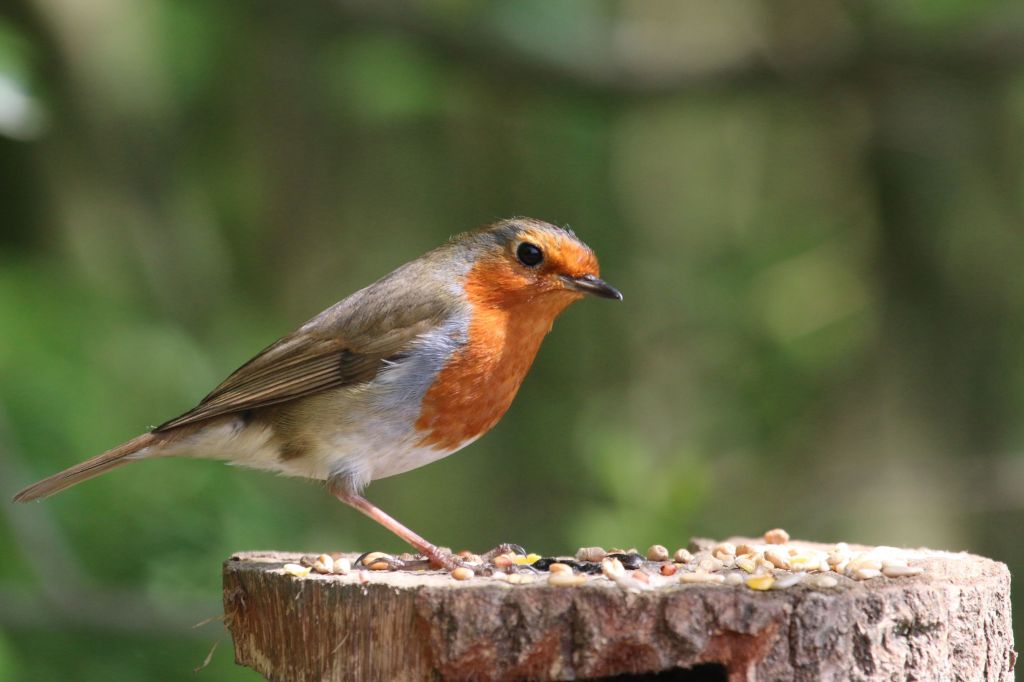
Robin
Inevitably, Canada geese were liberally scattered throughout the reserve last week, some floating serenely on the water, others grazing greedily on the meadows adjoining the reservoir, and a few honking noisily as they flew overhead in search of pastures new. You can be sure of getting your fill of Canada geese on any visit to Carsington. Not to mention mallards, coot and black-headed gulls!
An unexpected nuthatch
Although Carsington Water is an obvious spot for watching water birds, on this occasion some of the best action was on and around one of the feeding stations. Great tits and robins were the most frequent visitors, and a nuthatch the most unexpected.
Primulas prove that spring has sprung
The woodland in which the feeding station is situated was dotted with primulas, evidence that spring has well and truly sprung. And mindful, no doubt, that Easter was fast approaching a rabbit put in a brief appearance, while at one point a vole scurried across our path, way too fast to be photographed. Again, nothing exceptional here, but all such welcome sights after thirteen weeks of lockdown.
One of Carsington Water’s very own Easter bunnies
We’re fortunate that Carsington Water is just a few miles from our home town, and now Covid restrictions are being relaxed we’ll be escaping to this part of the country regularly to sample once again the joys of birding on our local patch. After all, a man just cannot see too many Canada geese!
* * *
POSTSCRIPT, Tuesday 6 April, 2pm. Having written this post over the weekend, this morning we made a return trip to Carsington Water and were thrilled to spot no fewer than 16 swallows, newly returned from Africa, wheeling and whizzing over the water. It’s official then, spring really is here!
Last Saturday, 20th March, was World Sparrow Day. Needless to say, no sparrows turned up in our garden to celebrate the occasion. When we moved in 35 years ago house sparrows were common here, squabbling noisily and boisterously on the bird table. Now, if we get half a dozen sightings over a 12 months period we class it as a good year for sparrows. Here, and throughout the UK, house sparrow numbers have been in serious decline for decades.
House sparrow
Growing up in West London half a century ago sparrows were the most familiar birds in our garden. Our name for them was spugs, or alternatively spadgers. They were very common, part of the wallpaper of our suburban lives, and we took them for granted. No one would have believed then that one day they would be “in trouble.”
TheState of the UK’s Birds 2020 report published by the RSPB suggests that there were 5.3 million breeding pairs in the UK in 2018, making the house sparrow our third most common breeding bird behind the wren (11m) and the robin (7.3m), and marginally ahead of the woodpigeon (5.2m). It adds that “In the late 1960s there were 10 times more house sparrows than woodpigeons. We have lost around 10.7 million pairs of house sparrows in that time, a loss greater than for any other species, and gained 3.5 million pairs of woodpigeons.” No surprise, therefore, that the house sparrow is on the UK’s Red List for birds of conservation concern.
The latest figures offer a glimmer of hope: numbers are now thought to be stable or increasing in Scotland, Wales and Northern Ireland. However this is little consolation to those of us in England, where numbers continue to fall.
House sparrow
The cause of the rapid decline, particularly in urban and suburban environments, is unclear, although a lack of invertebrate prey for chicks – perhaps resulting from pollution or increased used of pesticides by gardeners – is believed to be a factor. Other proposed but as yet unproven reasons include reduced opportunities for nesting in the modern urban environment, and predation by domestic cats. Declines in rural house sparrow populations are thought to be linked to seasonal food shortages resulting from changes in agricultural practices, particularly the move to sowing cereal crops in the autumn.
* * *
Although the decline of house sparrows in the UK has been dramatic, the declaration of the first World Sparrow Day wasn’t a British initiative. Instead it was the brainchild of Nature Forever (NFS), an Indian non-governmental, non-profit organization which aims to “involve citizens from all walks of life, diverse backgrounds and different parts of the country and the world” in conservation projects. Nature Forever’s championing of the house sparrow is a good indication of the bird’s global reach.
Ted Anderson, Emeritus Professor of Biology at McKendree College in Illinois has argued that the house sparrow is the most widely distributed wild bird on Earth. It is believed to have originated in the Middle East, but having developed a close association with humans, it extended its range across Eurasia in tandem with the spread of agriculture. More recently Europeans have deliberately introduced the house sparrow to other parts of the globe, either as a pest control initiative or to remind them of home, and accidentally taken them to other locations as stowaways on their ships.
In happier times. House sparrow at Platypus Towers
It’s perhaps no surprise therefore that, in recent years, Mrs P and I have seen many more house sparrows on our visits to North America, Australia and New Zealand than we ever manage to spot in our own backyard. If numbers here continue to fall the time may well come when we have to go cap in hand to our former colonies and beg to have some of our sparrows back. Oh, the humiliation!
* * *
In folklore and literature sparrows have an enduring reputation for sexual promiscuity. Geoffrey Chaucer reflects this in the Canterbury Tales when he writes “As hot, he was, and lecherous as a sparrow . . .” Two hundred years later, in 1604, William Shakespeare wrote in Measure for Measure that “Sparrows must not build in his house eaves, because they are lecherous . . .”
Tree sparrow. Note the diagnostic brown crown and black cheek spot
Amazingly, modern science shows that these seemingly outrageous accusations are not entirely inaccurate. DNA analysis has shown that 15% of the chicks produced by a settled pair of house sparrows are in fact the offspring of a third party, proving once again that truth is stranger than fiction.
* * *
The house sparrow is not the only species of sparrow found on these shores. Although the so-called hedge sparrow, also known as a dunnock, isn’t really a sparrow at all (it belongs to the family birds called accentors), the tree sparrow really is a sparrow.
While house sparrows are regularly seen in both urban and rural settings, the tree sparrow is very much a bird of the countryside, particularly hedgerows and woodland edges. Their distribution tends to be localised, and they are much less plentiful than house sparrows: the latest population estimate is 245,000 breeding pairs. We have not and would not expect to see tree sparrows in our suburban garden, but there is a nature reserve within a few miles of Platypus Towers where we can often spot them.
Tree sparrow
It’s always a pleasure to see tree sparrows since they, like house sparrows, have suffered a calamitous decline in numbers (around 90%) since 1970, although in the last few years that fall has slowed and may have started to reverse. Again, changes in agricultural practice are the likely cause, and with no prospect of these being reversed the tree sparrow remains on the UK’s Red List for birds of conservation concern.
* * *
And finally, to conclude my little celebration of World Sparrow Day, I commend to you Dolly Parton singing “Little Sparrow.” The songs begins with these words
Little sparrow, little sparrow
Precious, fragile little thing
Little sparrow, little sparrow
Flies so high and feels no pain
Of course, the song isn’t really about sparrows at all. For Dolly, the sparrow is a simply a metaphor for gentle innocence, and anyway the North American sparrows about which she sings (Emberizidae) aren’t in the same family as Old Word sparrows (Passeridae). But whatever, that second line has always haunted me. In four words it captures perfectly the magic of birds both great and small, and encapsulates my feelings for them. Birds are precious and fragile, and even relatively common birds like the sparrow need our help if they are to continue to fly high and feel no pain.
At my age birthdays are a mixed blessing. On the one hand they’re a cause for celebration (Yes, I’ve made it through another 12 months!). But they’re also a time for reflection on how your body has fared over the last year, which bits of it have started hurting, begun to misfire or even stopped working altogether. Spare a thought, then, for the Old Man of Calke, who’s still hanging on after 1,200 years.
The Old Man of Calke
The Old Man is one of many magnificent trees to be found in parkland at the Calke Abbey estate in the south of Derbyshire. Calke Park extends to around 600 acres (240 hectares), and is managed for the nation by the National Trust. Around one third is designated as a National Nature Reserve and Site of Special Scientific Interest.
After the Covid restrictions earlier in the year, our visit to Calke Park in October 2020 provided a welcome opportunity to get close to nature again, strolling past picturesque ponds and along shaded woodland paths. There’s lots to see during a walk around the park, but without doubt the ancient and veteran trees are the stars of the show.
Ancient and veteran trees are common at Calke Park
Calke is home to over 650 veteran trees, of which 350 are regarded as ancient trees. What’s the difference? I hear you asking. The Woodland Trust explains that “an ancient tree is one that has passed beyond maturity and is old, or aged, in comparison with other trees of the same species…A veteran tree is a survivor that has developed some of the features found on an ancient tree, not necessarily as a consequence of time, but of its life or environment. Ancient veterans are ancient trees, not all veterans are old enough to be ancient.” Clear as mud? Baffled? Absolutely!
The technical definitions may be more confusing than enlightening, but at an estimated age of around 1,200 years the Old Man of Calke must surely qualify as an ancient veteran. To put it into context, the Old Man was a sapling when the Vikings were rampaging across the country, and already had some 250 years under his belt when King Harold took one in the eye during the Norman invasion of England in 1066.
Mere Pond at Calke Park
The Old Man is an English Oak, and although not very tall, it boasts a girth of over 10 metres. The trunk is gnarled, split and holed in places, giving the tree a somewhat battered and time-worn appearance. Despite this it is a massively imposing presence in the Calke parkland and seems to wear its great age lightly.
Thanks to the National Trust’s careful management, the Old Man of Calke will hopefully survive long enough to give several more generations of visitors to the Park the thrill of getting up close and personal with a tree that was in its prime when William the Conqueror first set foot on these shores.
Flowering at a time when pretty much nothing else is in bloom, snowdrops inevitably capture the imagination of all who encounter them in the British countryside. The ‘Fair Maids of February’ reassure us that the bleak midwinter is passing, and more congenial times lie ahead. Poets heap praise upon these humble harbingers of spring’s awakening, while storytellers speculate about their origins. Who doesn’t love a snowdrop?
Dimminsdale Nature Reserve, 2019
Interestingly, although snowdrops are widely distributed and recognised throughout the UK, they aren’t native to these islands. They originated in the damp woodlands and meadows of continental Europe, and were brought here – probably in the sixteenth century – to grace the estates of the idle rich. However these private collections inevitably ‘leaked’ into the surrounding countryside, and by the late 18th century the flower was reported as growing wild. Now completely naturalised, snowdrops can be found in shady woodland, on country estates and along river banks all over the country.
Hodsock Priory, 2016
Snowdrops are also a common sight in graveyards, and this could be the reason why they’re sometimes associated with ill-fortune and even death. In Victorian times it was widely believed that you should avoid bringing snowdrops into your house. If you disobeyed this rule the consequences could range from your milk turning sour to a member of your family dropping dead within a year. Plainly the snowdrop isn’t a flower to be trifled with!
Although these days we happily dismiss such dire warnings as fanciful nonsense, it’s worth noting that snowdrops are poisonous due to high concentrations of phenanthridine alkaloids, particularly in the bulbs. Now, I haven’t a clue what a phenanthridine alkaloid is, but (just like the average beer-swilling Saturday night out during my student days) it’s known to cause confusion, poor coordination, drooling, abdominal pain, vomiting, diarrhoea and seizures. I humbly conclude that excessive student partying and eating snowdrops are both best avoided!
Hopton Hall, 2017
Paradoxically although some people make a connection between snowdrops and death, others view them as symbols of hope. The reason, I suppose, is that they show themselves just as winter’s drawing to a close, and their appearance is a sure sign that the days are getting both longer and warmer, and that spring will soon arrive.
It’s for just this reason that, around about now every year, Mrs P and I traditionally mark the changing of the seasons by taking a trip to one of our local snowdrop hotspots. These include the gardens of Hopton Hall, an 18th-century country house in Derbyshire, the Dimminsdale Nature Reserve on Derbyshire’s border with Leicestershire, and two estate gardens in Nottinghamshire, at Hodsock Priory and Felley Priory. Each boasts a fine display of snowdrops, and looks splendid on a crisp and sunny February day
Dimminsdale Nature Reserve, 2019
Sadly, to visit one of these snowdrop havens in 2021 would contravene the government’s strict Covid lockdown rules and invite a fine of £200 (each!) from the local constabulary. Instead, we’ve had to get our annual snowdrop fix from Mrs P’s excellent photos and a small clump that survives against all odds in our unkempt front garden. Ah well, there’s always next year I suppose, once Covid’s back in its box.
Next Sunday, 21 February, is World Whale Day. The origin of World Whale Day can be traced back to 1980, when it was declared in Maui, Hawaii as part of the annual Maui Whale Festival. During our visit to Hawaii in 2014 whales were in short supply (it was the wrong time of year), but over the years we’ve been lucky enough to see them in the waters off Iceland, Madagascar, New Zealand and Alaska.
However our best encounters were around Newfoundland, Canada, in 2017, and to celebrate World Whale Day I thought I’d revisit some of the blog posts I wrote at the time. We spent around four weeks on The Island, as the locals call it, and without doubt the whales were the highlight of the trip. I wrote a blog of our Newfoundland journey at the time, but the following focuses on our magical, memorable meetings with some of the many humpbacks that spend the summer months around its shores.
Having a whale of a time
4 July 2017
The tell-tale spout of a whale announcing his presence
Today’s been a woolly hat day, courtesy of a bitter wind howling in from the high Arctic. It’s appropriate therefore that we should have seen our first iceberg this afternoon as we drove the coast road towards the bizarrely named township of Heart’s Content, which, as I’m sure you know, is just down the road from its sister settlements of Heart’s Desire and Heart’s Delight!
The cold has been made more bearable by the warm afterglow of yesterday evening’s brilliant whale-watching trip. Whale-watching is always a bit of a lottery, and sometimes you lose. But yesterday we hit the jackpot.
Pretty soon we are amongst them, surrounded by a pod of five or six humpbacks
St John’s sits in a sheltered harbour, connected to the sea by a narrow inlet unimaginatively referred to as “the narrows.” Passing through the narrows we were thrilled to spot the towering, tell-tale spouts of whales announcing their presence to the world. Hey guys, they seemed to say, we’re over here, why don’t you pop along and say hello. We took them at their word and pretty soon we were amongst them, surrounded by a pod of five or six humpbacks.
Best of all was when they arched their backs to make a deep dive. This is the manoeuvre that causes the whale’s huge, fluked tail to lift clear of the water, a clown’s battered, white-gloved hand waving goodbye to his adoring fans before the animal plunges into the murky depths in search of lunch.
A clown’s white-gloved hand waving farewell to his adoring fans
I struggle to explain why I find whale-watching such an emotional experience. Partly, maybe, it has something to do with the fairy tale notion of a gentle giant. But also, mixed in with this, is a sense of shame at mankind’s persecution of this majestic, harmless creature in the pursuit of a quick profit. Hunted to the brink of extinction humpbacks are, thankfully, now on the way back. They are awe inspiring animals, and it’s a joy to see them. Yesterday was a memorable day; yesterday was a great day.
In the thick of it: the whales of Witless Bay
27 July 2017
Our evening whale-watching trip out of the harbour at Bay Bulls starts with a visit to Gull Island. Unsurprisingly, it’s generously endowed with gulls and other seabirds, including the ever-popular puffin. But birdwatching isn’t the purpose of our journey today, and we quickly move on to Witless Bay, reputedly the best place in Newfoundland to get up close and personal with humpback whales. For once the hype is fully justified, and within a few minutes we find ourselves surrounded by a group of between 15 and 20 humpbacks, all gorging themselves on fish (capelin) that congregate here to breed.
Surfacing with a loud, fishy-smelling blow of exhaled air and tiny water droplets
The skipper kills the engine and we sit still in the water, mesmerised by the whales circling all around us. The humpbacks patrol the bay, breaking the surface as they swim sedately along, then diving suddenly in pursuit of their quarry, then surfacing again with a loud “blow” of exhaled air and water-droplets.
A couple of times we see them lunge-feeding, exploding from the deep with huge gaping mouths that have, in this single manoeuvre, made short work of thousands of tiny fish. Occasionally we spot one spy-hopping, raising his head above the water’s surface to watch what we’re up to. They approach within metres of the boat, so close was can see barnacles growing on their skin. Sometimes they simply lie at the surface like floating logs, as if winded by the sheer volume of fish they’ve just swallowed.
They approach so close we can see barnacles growing on their skin
Today could have been a pretty miserable day, but it turns out to be one of the best we’ve had in Newfoundland. Yet this is a strange place, and Newfies march to the beat of a different drum. After the whale watching is over we retire to a nearby restaurant that specialises in fish. The waitress welcomes us warmly, says we can sit anywhere we like and have anything on the menu … except fish. Unsurprisingly perhaps in a part of Canada where Basil Fawlty sets standards that some locals find unattainable, it appears that the fish restaurant has completely run out of fish.
Relaxed, unafraid, at peace in their world: the whales of Witless Bay
31 July 2017
Our last day on The Island. We decide to end the adventure in style by taking another whale-watching trip to the Witless Bay Ecological Reserve, hardly daring to believe it can be as successful as the first.
Whales to the left, whales to the right, whales in front and whales behind
This time we know the ropes, arriving at the dock and joining the line early. This means we can be amongst the first to board, which allows us to choose a prime position. We head for the top deck and station ourselves at the pointy (bow) end, which offers good views both left and right of the boat. The weather is warm and sunny, the sea swell rolling our boat gently as we ease our way out of the harbour and past the low cliffs lining its entrance.
Again we call at Gull Island on the way, enjoying the sight of the puffins and smiling at the excitement of our fellow travellers when they spot their first “sea parrot”. There are thousands of puffins sitting on the rocks watching the world go by, while a few others venture out on to the sea and swim past our boat.
We quickly leave the clownish birds behind us and head towards the spouts that tell us the humpbacks are still here. Soon we are amongst them, whales to the left, whales to the right, whales in front and whales behind, while seabirds wheel overhead, seeking out the same fish that have drawn the humpbacks to this spot.
Little and Large (Notice the puffin in the bottom left corner of this shot!)
There must be two dozen whales at least, and some of them come so close we can almost touch them, can smell their fishy breath. A few swim alongside us, keeping pace with the boat as if out for a stroll with a group of friends. Others cross casually in front of us at the surface of the water, relaxed, unafraid, at peace in their world.
But then, somewhere deep within them, instinct kicks in. With an arch of their backs they dive deep, seeking out capelin beyond counting, fish needed in huge quantities to accumulate the thick layers of fat that will sustain them in the waters off Dominica, until they return to these cold northern shores next year. And as they dive they wave their tails, bidding farewell to their spellbound acolytes.
As they dive they wave their tales, bidding farewell to their spellbound acolytes
It is a truly extraordinary hour, one of the best wildlife watching experiences of our lives. In several respects The Island hasn’t quite lived up to our expectations, but the whale watching has surpassed anything we had imagined. This, above all else, is the memory of Newfoundland that will stay with us.
Whale song
Reflections on the fate of the whale, UK, August 2017
One of the unexpected delights of Newfoundland is its thriving folk music tradition. Much of this has a Celtic flavour, reflecting the strong connection between The Island and Ireland. Interestingly many of the locals have a slight Irish lilt to their accents, though in some cases it’s much more pronounced than this and you could believe you were in Dublin or Cork or Kilkenny or wherever.
Some come so close we can almost touch them
We picked up a few CDs during the trip, but couldn’t play them until we got home. Our car, a Chevy Cruze, was great to drive with lots of high tech features, but despite this (or perhaps because of it) there was no CD player! The first CD I tried when we got home was by a well-known Newfoundland folk band, The Irish Descendants. The lyrics of one of the songs, the Last of the Great Whales, brought a lump to the throat, not least because of all brilliant humpback encounters we enjoyed during our trip. The song is written by Andy Barnes, from Milton Keynes in the UK, and goes as follows:
My soul has been torn from me and I am bleedingMy heart it has been rent and I am cryingAll the beauty around me fades and I am screamingI am the last of the great whales and I am dyingLast night I heard the cry of my last companionThe roar of the harpoon gun and then I was aloneI thought of the days gone by when we were thousandsBut I know that I soon must die the last leviathanThis morning the sun did rise Crimson in the skyThe ice was the colour of blood and the winds they did sighI rose for to take a breath it was my last oneFrom a gun came the roar of death and now I am doneOh now that we are all gone there's no more huntingThe big fellow is no more it's no use lamentingWhat race will be next in line? All for the slaughterThe elephant or the cod or your sons and daughtersMy soul has been torn from me and I am bleedingMy heart it has been rent and I am cryingAll the beauty around me fades and I am screamingI am the last of the great whales and I am dying
Poignant, n’est pas? I can’t trace on YouTube a recording of the Irish Descendants singing this song, but here’s a link to an excellent version performed by Celtic Crossroads. Though the whale has been saved for now, for me the lyrics capture with devastating clarity the nature and scale of the wrong that has been done to these gentle creatures throughout the ages. Let’s hope that Andy Barnes will be proved incorrect in his gloomy prophecy.
The whale watching surpassed anything we had imagined. This, above all else, is the memory of Newfoundland that will stay with us




 Now I'm 64