Wordless Wednesday is a simple blog post featuring a photo. It seeks to convey a message or tell a story, but speaks for itself without using words. Mrs P took this photo of a handsome Bullfinch at Old Moor Nature Reserve in 2014.
Wordless Wednesday is a simple blog post featuring a photo. It seeks to convey a message, but speaks for itself without using words. Mrs P took this photo of a White-Bellied Sea Eagle on the Arthur River in Tasmania, Australia in 2016.
Wordless Wednesday is a simple blog post featuring a photo. It seeks to convey a message, but speaks for itself without using words. Mrs P photographed this Yellow-throated Euphonia in Costa Rica in 2015.
At last, as the weather starts to improve, we take out first tentative steps back into nature. Poolsbrook Country Park, just a few miles from where we live, is a good place to start. Created on the site of a colliery that closed down in 1986, today Poolsbrook boasts a mosaic of habitats including lakes, wet grassland, wildflower hay meadows, woodland and hedgerows, all carefully managed for the benefit of wildlife. I have written previously about the Country Park’s history and key features.
We go to Poolsbrook quite often, and know what to expect. Our first visit of 2025 does not disappoint. All the usual suspects are on show, including Coot, Mallard, Great Crested Grebe and the inevitable Canada Geese. There are no rarities, but who cares – it’s just good to be out watching birds again after a long, miserable winter.
But what’s that? Cruising on the lake alongside a flotilla of Mallards is a duck we’ve never seen before. The head and neck are an iridescent blue-green colour, while the cheeks are white and the bill is bluish grey with a black tip. The breast is barred white and black, the flanks are orange-brown and the back is dark grey with white streaks.
We spend a lot of time watching birds in wetland habitats, and can readily identify most that we encounter. But this guy is a total mystery. Somehow it looks like a mixture of several other species, and we debate whether it’s some sort of weird hybrid. More research is clearly required, so as soon as we get back home we consult Professor Google.
The good professor reveals the truth. Our mystery bird is neither a natural hybrid nor the result of an unfortunate accident in a bio-lab. Instead, our investigation reveals it to be a Chiloé Wigeon. We learn that it is a very long way from home. Also known as the Southern Wigeon, the Chiloé Wigeon is native to southern parts of South America, its name coming from an archipelago lying off the coast of Chile.
Being relatively easy to care for, it appears that the Chiloé Wigeon is a popular bird in exotic wildfowl collections. The bird at Poolsbrook must be an escapee from one of these collections – it plainly has not arrived in this country naturally.
Further research reveals that the Poolsbrook bird has been in residence for well over a year. How did we miss it during all our previous visits, we wonder?
On reflection, I don’t know how I feel about seeing this unexpected bird on one of our local reserves. On the one hand, it is of course exciting to encounter a species that we will never see on its home territory, particularly as it is clearly thriving at the Country Park.
On the other hand, I can’t help thinking the bird might be better off back in South America, where it would be amongst its own kind and have the opportunity to breed. That, sadly, will not happen here and our Chiloé Wigeon will be unable to pass on its genes. Hopefully, however, it will continue to do well alongside its Mallard cousins at Poolsbrook. We’ll be sure to look out for it next time we visit.
Watching wildlife is addictive. Over several decades Mrs P and I have travelled the world to get our fix of animals and birds that we had no hope of ever seeing in the UK. Take Great White Egrets, for example. When we started our quest, they were impossible to find here. We encountered them first in the USA and India, and were well pleased with our achievement. And yet today we see them regularly in wetland habitats across the UK. The Great White Egret is exotic no longer.
At Nalsarovar Bird Sanctuary, Gujarat, India, 2013
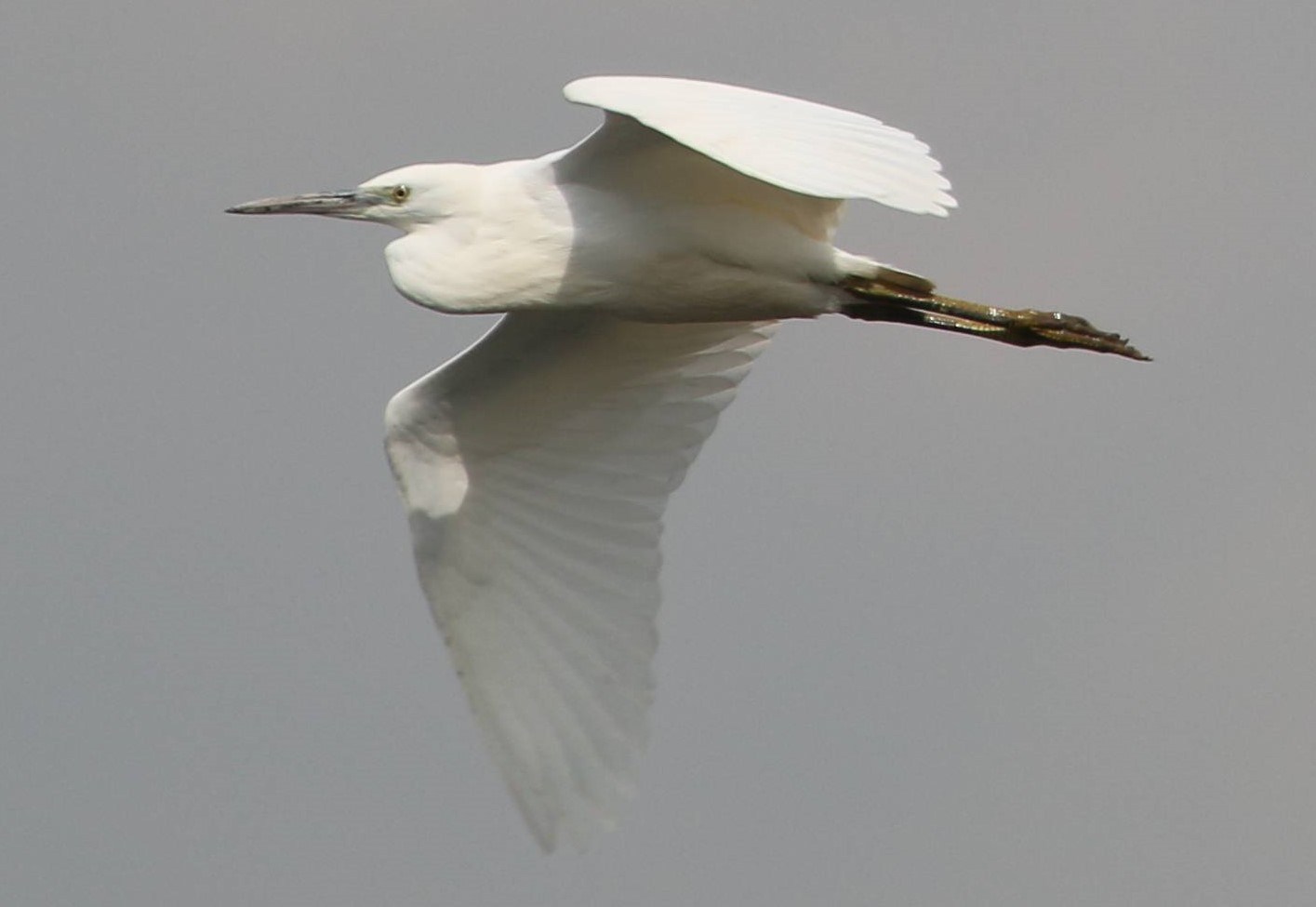
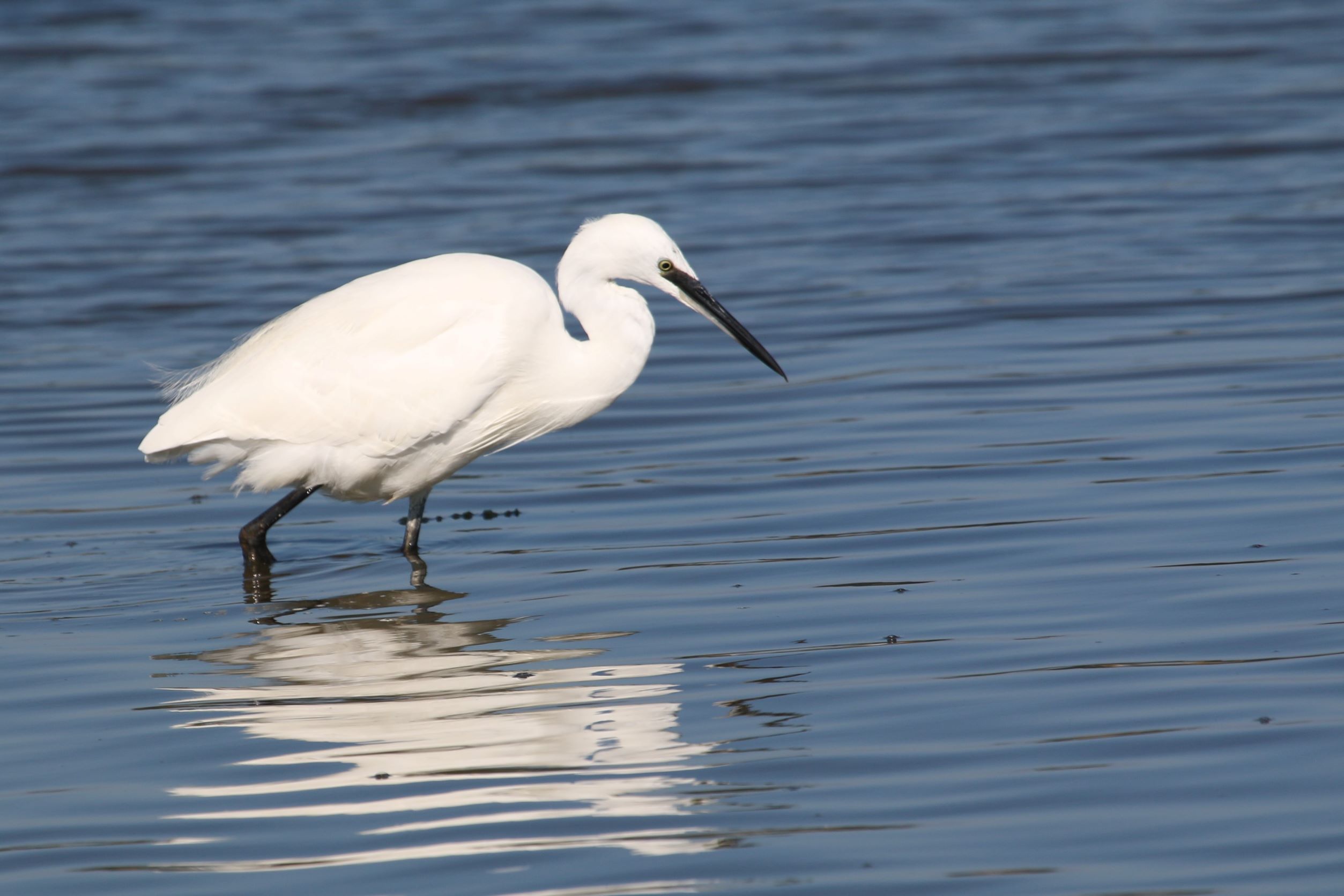
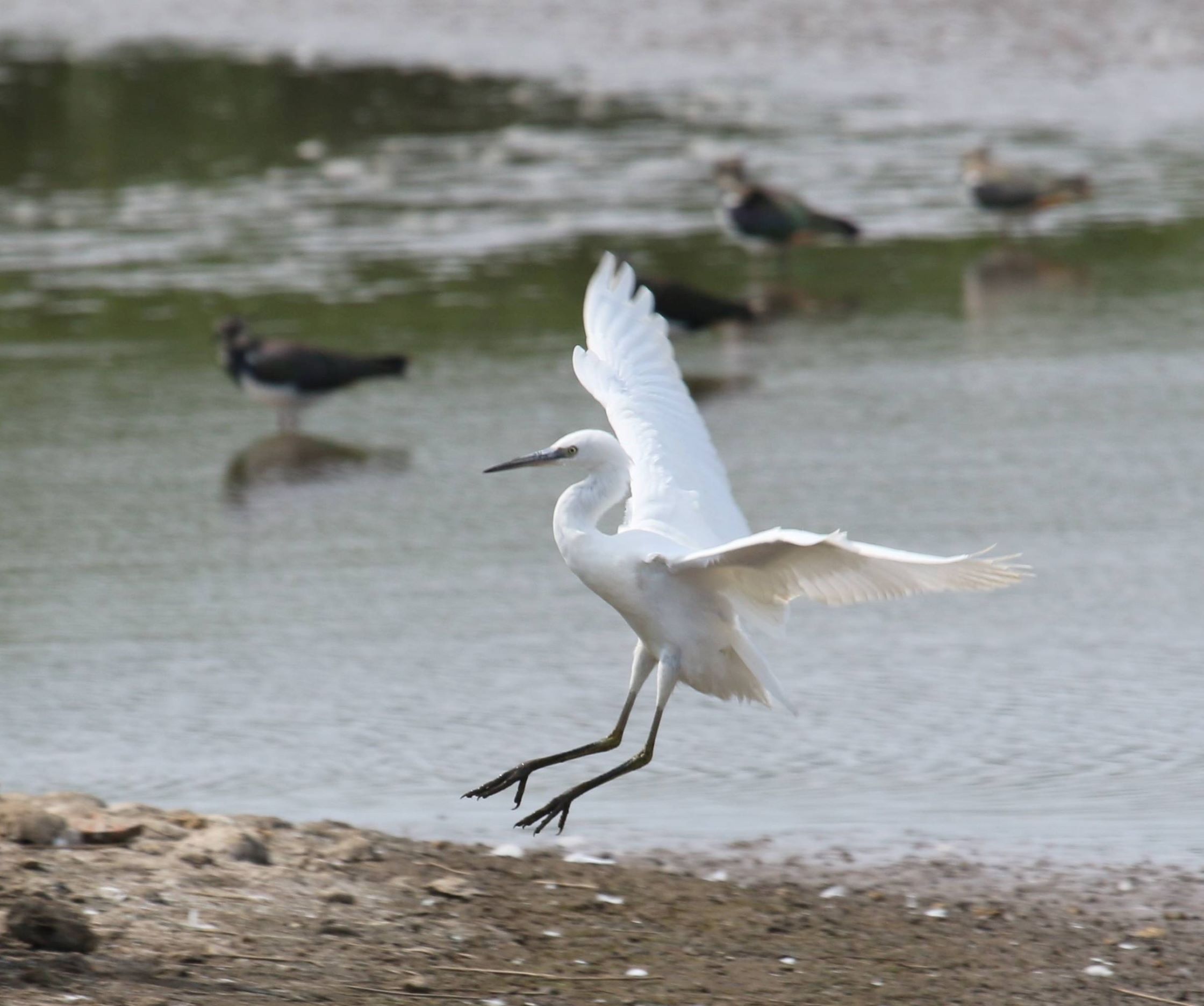
The Great White Egret is a large, white heron. It is easy to distinguish from the Grey Heron, a species familiar to birders throughout this country, but can be confused with Little Egrets. The Little Egret is, as its name suggests, a good deal smaller than the Great White Egret, and has yellow feet and a black bill – the Great White, meanwhile, has black feet and a yellow bill. Confused? Me too! Numbers of Little Egrets have surged in recent years, something I wrote about in this post from 2021.
Seen in Texas, USA, 2012
Until around 15 years ago, Great White Egrets were impossibly rare visitors to these shores, and few birders ever got to see them. All that has now changed. The bird had been slowly expanding its range northwards and westwards in Continental Europe for some time, and around 2010 finally began to make the flight across the English Channel to see what the British Isles had to offer.
Great White Egret alongside the more familiar Grey Heron, at RSPB Blacktoft Sands Nature Reserve, East Yorkshire, 2024
The key drivers behind the expansion in Continental Europe are unclear. Possible explanations include improvements to habitat, reduced persecution, and – inevitably – climate change.
At Attenborough Nature Reserve, Nottinghamshire, 2021
Whatever the reason, British birders are clearly beneficiaries. Accurate, up-to-date population data is difficult to track down, but it appears that overwintering Great White Egrets now number at least 100 individuals. They are most frequently found in south-east England and East Anglia, but are moving steadily northwards and can now also be seen in Scotland too.
At RSPB Welney Nature Reserve, Cambridgeshire, 2022
The species first bred in the UK in 2012, and there could now be more than 20 breeding pairs spread across the country. There is every likelihood that numbers will continue to grow for years to come, meaning that Mrs P and won’t be returning to the US or India when we feel the need to re-acquaint ourselves with this handsome heron!
Wordless Wednesday is a simple blog post featuring a photo. This photo of a colourful pheasant sitting atop a gravestone that must be several hundred years old was taken recently in a church graveyard in Norfolk. Life goes on.
Tufted Ducks are a familiar sight at wetland habitats in our part of the UK. Although less plentiful than Mallards and Canada Geese, they are nevertheless a bird that I would expect to see whenever we visit local reservoirs, lakes and ponds. For me they are a fixture in our birding landscape. But, as I recently discovered to my surprise, that’s not quite true: Tufted Ducks, or “Tufties” as Mrs P and I prefer to call them, first arrived in this country less than 200 years ago.
Records suggest that Tufties started to colonise the UK in 1849. A few decades earlier the Zebra Mussel Dreissena polymorpha had been accidentally introduced into the country, and as this invasive species began to thrive Tufted Ducks followed in pursuit of a much-favoured source of food.
The number of resident Tufted Ducks in the UK grew steadily until at least the early 2000s, and it now breeds in most of England, as well as parts of lowland Scotland and localised areas of Wales and Ireland. The breeding population is around 18,000 pairs. In winter, numbers swell with the arrival of around 100,000 migrant birds from as far away as central Russia.
MaleFemale
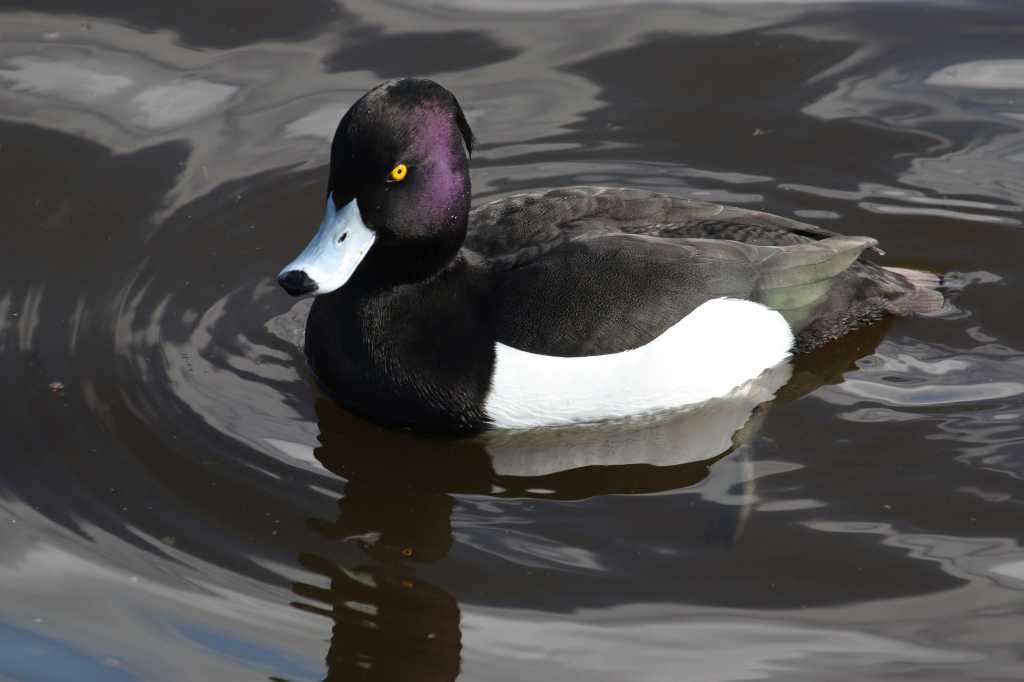
Male Tufties are handsome black-and-white birds, with a characteristic tuft and bright yellow eyes – totally memorable. Although the females also sport a tuft and yellow eyes, their drab buff-brown plumage renders them somewhat forgettable. Scouring Mrs P’s vast photographic archive, I discovered that nearly every photo that she’s ever taken of this species features the male. That, I think, tells you all you need to know about the differing visual appeal of male and female Tufted Ducks!
Tufties are fun to watch, busy little ducks that paddle swiftly across open stretches of water, before diving in pursuit of aquatic invertebrates and bivalve molluscs. It seems like they belong in this landscape and must therefore have been here forever, which makes it difficult to believe that British nature lovers at the start of Queen Victoria’s reign would have been denied the pleasure of their company.
The lesson to draw from this, I guess, is to remember that what we see today is just a snapshot in time. Species come and species go; it’s a natural process, although human activity speeds it up and can cause major instability. I wonder which birds species are entirely absent from the UK today, but will be taken for granted by British birders in the 22nd century?
Mrs P and I have been birdwatching for nearly 40 years. It’s a great way to pass the time, one that allows us to escape temporarily from the pressures of modern living and instead get up close and personal with nature. But it’s not without its frustrations, of which the most frustrating thing of all is the LBJ. And in case any Americans reading this are wondering, that has nothing at all to do with Lyndon Baines Johnson – aka LBJ – the 36th president of the US!
For the uninitiated, in the British birding community LBJ stands for “little brown job”, which Wikipedia tells us is “an informal name used by birdwatchers for any of the large number of species of small brown passerine birds, many of which are notoriously difficult to distinguish.” The problem is compounded by the fact that your average LBJ never sits still for long, instead flitting hither and thither between bushes, briars and other forms of cover. As a rule, you only get a fleeting glimpse of an LBJ before it goes back into hiding. LBJs are a birder’s worst nightmare.
An alternative approach to identifying LBJs is via their songs. Unfortunately Mrs P and I haven’t been listening carefully enough over the last four decades, with the result that the number of species we can identify by their song alone can be counted on the fingers of one hand. But – much to my amazement – modern technology has come to the rescue, in the form of an app on my mobile phone.
A casual discussion with a bird enthusiast last year first brought the Merlin Bird ID app to our attention. It’s dead simple, which is fortunate as mobile phones aren’t my thing. When a bird is singing just fire up the app, which will analyse the song against its database and tell you which bird you’re (most probably) listening to. Simple but effective, as we discovered last week, when it led us to identify our first ever Cetti’s Warbler.
The Cetti’s was heard – and briefly seen – just a few metres from this spot. Unfortunately Mrs P was unable photograph it, and I’m grateful to Mike Prince for the image of the illusive LBJ at the top of this post
Mrs P and I were at Straw’s Bridge – aka Swan Lake – a local nature reserve that I first wrote about nearly three years ago. We go there mainly to enjoy the wildfowl, but were intrigued this time by glimpses of an LBJ that we couldn’t identify, moving between a series of bushes by the edge of the lake. It proved typically illusive, but just when we were about to give up and move on the bird started to sing in short, loud bursts. I whipped out my phone, and in a just a few seconds we learned its identity.
For confirmation I cross-checked with other information provided by the app. Its photo of the Cetti’s clearly matched the brief glimpses we’d had of the bird, and the textual description of its appearance and behaviour was bang on: a “dumpy and broad-tailed warbler, warm brown above and pale grayish below, with a narrow eyebrow…favours tangled vegetation near water, including reedy marshes with bushes and scrub. Often heard but rarely seen. Explosive, rich staccato song often draws attention.” Follow the link below to hear the song of the Cetti’s Warbler’s.
I found this recording of a singing Cetti’s Warbler on YouTube, courtesy of Birdfun.
The species is a new arrival in the UK, first breeding here – in the south-eastern county of Kent – in the early 1970s. Since then its range has slowly expanded northwards, but until our LBJ encounter last week we’d no idea the Cetti’s warbler had reached our home county of Derbyshire. Without the help of the bird identification app we would probably never have known.
In principle, I would rather leave the modern world behind when I’m out in nature. Mobile phones have their place, but a birdwatching trip isn’t one of them…or so I thought until Merlin Bird ID helped us identify our first Cetti’s Warbler. Having seen that 21st century technology can help us vanquish one of birdwatching’s biggest frustrations – the LBJ – I guess I might need to revise my opinion.
It’s that time of year again, the time when the UK’s dedicated nature lovers take part in the RSPB’s (Royal Society for the Protection of Birds) Big Garden Birdwatch, a national survey that has been running annually in one form or another since 1979. It is also, sadly, the time when I have to confess that once again Mrs P and I have failed miserably in our attempt to attract a wealth of birdlife to our modest suburban back garden.
The Woodpigeon was one of just two species to visit our garden over the Birdwatch long weekend
The first event, in 1979, was aimed at children and was a good deal more popular than anticipated. For over two decades the Big Garden Birdwatch continued in this form. Eventually the RSPB must have realised that the buzz created by the Birdwatch every year would be even bigger if anyone could take part, so in 2001 participation was opened up to adults as well. It worked: last year over half a million people took part in the Big Garden Birdwatch, and between them they recorded a massive 9.1 million birds!
The RSPB is understandably very proud of its Big Garden Birdwatch, which it claims is “the world’s largest garden wildlife survey”. The benefits are wide-ranging: media coverage helps raise the profile of birds,- and environmental issues more generally – with a wider audience; those taking part get to focus their attention on nature for a while and enjoy consequential benefits for their mental health, and the RSPB collects a wealth of data on which species are thriving and which are struggling.
We were also visited by two male Blackbirds
Unhappily, the picture painted by the Big Garden Birdwatch is not encouraging, with the number of birds plummeting over the decades since it began. For example, House Sparrows are down 57% since 1979, while the number of Song Thrushes has collapsed by 80%.
Our own experience echoes these dismal findings: the results of this year’s count at Platypus Towers were, as expected, absolutely abysmal. The Big Garden Birdwatch 2024 ran over a period of three days, during which participants had to record the birds landing in their garden in a one hour period of their choice. In our garden, the number of birds seen throughout the whole three days – not just one hour! – was four.
NOT SEEN! – RobinNOT SEEN! –House Sparrow
Yes that’s right, we saw a measly four birds in our garden during the entire Birdwatch long weekend! OK, I admit that we weren’t watching every daylight minute of all three days, but the room where I work on my laptop overlooks the garden. In addition we spend every tea break in our “garden room”, watching what’s going on out there (and remember, we’re Brits so we have LOTS OF TEA BREAKS!) Not much passes us by, meaning the count of four birds is sure to be fairly accurate.
I’d been topping up the bird table for weeks to get the local birds in the mood for food, and on the first morning of the Birdwatch it was groaning under the weight of the goodies we’d provided. But they went largely ignored. The birds simply stayed away.
NOT SEEN! – Long-tailed TitNOT SEEN! – Wren
It wasn’t always like this. We’ve lived in this house nearly 40 years, and back in the day we welcomed a variety of avian visitors. Starlings, House Sparrows, Blue Tits, Long-tailed Tits, Robins, Wrens, Goldfinches and Dunnocks have all been seen. Memorably, for a few days one winter, a Pied Wagtail and a Grey Wagtail called our garden home. Once we spotted a Sparrowhawk sitting on the roof of the garden shed. A little later we found the remains of what we reckoned to be a Collared Dove on the path, and without doubt the Sparrowhawk was the guilty party. Even a Pheasant, hopelessly lost of course, once dropped in to say hi.
But in recent years, the number and variety of birds in our garden has fallen drastically. I last blogged about the Big Garden Birdwatch in 2020, under the title Birds Don’t Come Here Any More. That year, we saw just one male Blackbird! This year, between 26 and 28 January, the only birds to visit our garden were two woodpigeons and two male blackbirds.
OK, we did better in 2024 than in 2020, but there’s nothing here to celebrate. I wish I could believe it’s simply because all the local birds got a better offer, a garden with tastier food (Mrs P’s theory) and fewer visiting cats, but I fear it’s worse than that. All the evidence suggests that bird numbers are declining right across the country. It breaks my heart.
NOT SEEN! – Pied WagtailNOT SEEN! – Grey Wagtail
Next year, of course, we’ll do the Big Garden Birdwatch again. Maybe we’ll do better than this time. We could hardly do much worse.
_ _ _ _ _ _ _
Update, 5 February 2024
A week has passed since I wrote this post at the end of the Big Garden Birdwatch, and as expected the birds are back in numbers. As well as the Blackbirds and Woodpigeons, over the last seven days we’ve been visited by a Starling and a Dunnock, and three (yes, that’s right, THREE) Robins. It’s almost as if they know and are taunting us. Huh!
Updating the update!
No more than 20 minutes after writing the above update two Blue Tits arrived and started inspecting the nest box we’ve put up on the side of the shed. They seemed interested. Things are definitely looking up, and my broken heart is beginning to mend…for now at least.
One year on …
The 2025 Birdwatch was marginally more successful: Two Woodpigeons, two male Blackbirds, two Robins and a Magpie. Typically, however, the Wren didn’t turn up until 48 hours after the count had ended. It was ever thus …
Magpies are unmistakeable. Members of the crow family, seen from a distance they are long-tailed birds with distinctive black and white plumage. Up close, however, the colouration is more subtle. In the right light a Eurasian magpie’s wing feathers take on a purplish-blue iridescent sheen, while the tail bears hints of a subtle glossy green. It’s a handsome bird, and also – in some circles – a controversial one.
Some people dislike magpies because they are noisy, raucous birds that posture and strut around gardens, parkland and fields, apparently believing themselves to be top bird. Others object to their omnivorous lifestyle, which can include raiding the nests of smaller birds and carrying off their eggs and chicks. And their reputation for stealing jewellery and other bright, shiny objects wins magpies few friends amongst their human neighbours.
However, while their fondness for scavenging and their bully-boy tendencies on the bird table make them unpopular with squeamish bird lovers, it is their alleged association with Satan that upsets others. Yes, that’s right, folklore tells us that magpies are in league with the Devil. According to this tradition, magpies refused to join the other birds in mourning at Christ’s crucifixion, thus marking themselves out as the Devil’s own.
The magpie’s supposed indifference to Jesus’ crucifixion is just one of a huge number of tales and superstitions that surround this striking bird. In the UK, one of the first nursery rhymes many children hear is about magpies. The rhyme references the birds’ association with prophecy, and is found in countless variations up and down the country. Here is just one of them:
One for sorrow Two for joy Three for a girl Four for a boy Five for silver Six for gold Seven for a secret never to be told
So, according to this piece of folklore, the future that awaits you is indicated by the number of magpies you see. It’s a compelling part of our oral tradition, and I must confess that one day a little over a year ago – when a new baby was expected in our family – Mrs P and I happily counted the number of magpies we could see in order to predict the gender of the new-born. On the day in question we spotted three together in a field, and the baby, when born, was indeed a girl. Spooky!
The same nursery rhyme indicates that spotting a single magpie is a harbinger of bad luck. Again, this belief is deeply embedded within our culture. I clearly remember a former work colleague revealing that, when out for a drive in the countryside, he and his wife would wave vigorously to any lone magpies they spotted, because in so doing they were bidding farewell to ill-luck.
Alternatively, to dissipate the impending misfortune associated with seeing a single magpie, you should point it out to someone else, presumably on the basis that bad luck shared is bad luck halved. And if there’s nobody else around to take on the burden, the best course of action is to salute the magpie with a cheery ‘’Good morning Mr Magpie, how is your lady wife today?’ in the hope that he will take pity on you!
How did a single magpie become associated with bad luck? One theory is that, as magpies mate for life, seeing one by itself may suggest that its partner has perished. The surviving magpie has therefore suffered bad luck, and associating with it may cause its bad luck to transfer to the observer. However, by asking after the welfare of the lone magpie’s wife you demonstrate your belief that his partner is alive and well, which, if true, means no bad luck awaits you.
As well as waving to a lone magpie, or asking after the health of his wife, there are other ways in which the bad luck might be avoided. These include raising your hat to the bird, spitting three times over your shoulder, blinking rapidly to fool yourself into thinking you’ve seen two magpies rather than one, and flapping your arms about wildly and cawing loudly to mimic the magpie’s missing mate. But be warned: most of these activities, if undertaken in public, are likely to result in ridicule, arrest or an enforced appointment with a psychiatrist.
This post barely scratches the surface of the superstitions surrounding magpies. Variations on the theme include the following:
In Scotland, a single magpie seen near a window warns of an impending death. However, in the county of Sussex a magpie perched on a house roof is a good sign, indicating that the roof isn’t about to cave in.
In Wales, if you see a magpie moving from left to right when you set off on a journey, that journey will be hazardous.
Yorkshire folk associate magpies with witchcraft, and when seeing one (a magpie that is, not a native of Yorkshire!) you should make the sign of the cross to ward off evil spirits.
According to tradition in the county of Dorset, if a fisherman sees a magpie before he sets sail he won’t catch any fish that day.
In Somerset it is advised that you carry an onion with you at all times to protect you from the bad luck a magpie may bring. (As an aside, while I cannot testify as to the veracity of this advice I will readily admit that during my working life I sometimes kept a bulb of garlic in my office to ward off the accountants. I’m pleased to say it seemed to work!)
Regular readers of my blog will know I have a passion for folk music, and it’s therefore a pleasure to share with you below a link to a song about magpies. The harmonies may be challenging, but the story told is highly relevant to this post. It was written around 50 years ago by a guy called Davey Dodds. The story goes that one day Davey gave an old lady a lift in his new car. Davey was bemused, and probably a little horrified, when the lady insisted on shrieking “Devil, devil, I defy thee”, and spitting on the floor of his Jaguar every time she saw a magpie.
Intrigued, Davey looked into the mythology of magpies, and this song is the result. Its lyrics* reference some of the magpie superstitions I’ve written about in this post, and others that I haven’t had space to include. This version on YouTube was recorded in 2014 by a trio of singers called the BlueBirds.
At first glance, magpie mythology is totally out of place in our rational, comfortable, well ordered 21st century lives. I mean, it’s all a load of nonsense, isn’t it? Of course it is! But on the other hand, the mere fact that humans embraced these stories for millennia tells us a lot about our species. Our ancestors believed that magpies were the Devil’s disciples. Gullible, weren’t they?
Today, large sections of society enthusiastically embrace the conspiracy theories and other vile lies peddled relentlessly on the internet. Their need to feel good about themselves, their quest for certainty and their desperate desire for simple answers to complex questions leads them to believe stuff that is patently ridiculous, often downright dangerous and occasionally evil. Gullible, aren’t we?
* * * * * * *
* The complete lyrics to Davey Dodds’ song are as follows
Chorus (after every other verse) One for sorrow, two for joy, Three for a girl and for for a boy, Five for silver, six for gold, Seven for a secret never told, Devil, devil, I defy thee. Devil, devil, I defy thee. Devil, devil, I defy thee.
Oh, the magpie brings us tidings Of news both fair and foul; She's more cunning than the raven, More wise than any owl.
For she brings us news of the harvest Of the barley, wheat and corn. And she knows when we'll go to our graves And how we shall be born.
She brings us joy when from the right, Grief when from the left. Of all the news that's in the air We know to trust her best.
For she sees us at our labour, And mocks us at our work. And she steals the egg from out of the nest, And she can mob the hawk.
The priest, he says we're wicked To worship the devil's bird. Ah, but we respect the old ways And we disregard his word.
For we know they rest uneasy As we slumber in the night. And we'll always leave a little bit of meat For the bird that's black and white.