Here comes the sun – Helios and Diwali at Kedleston Hall

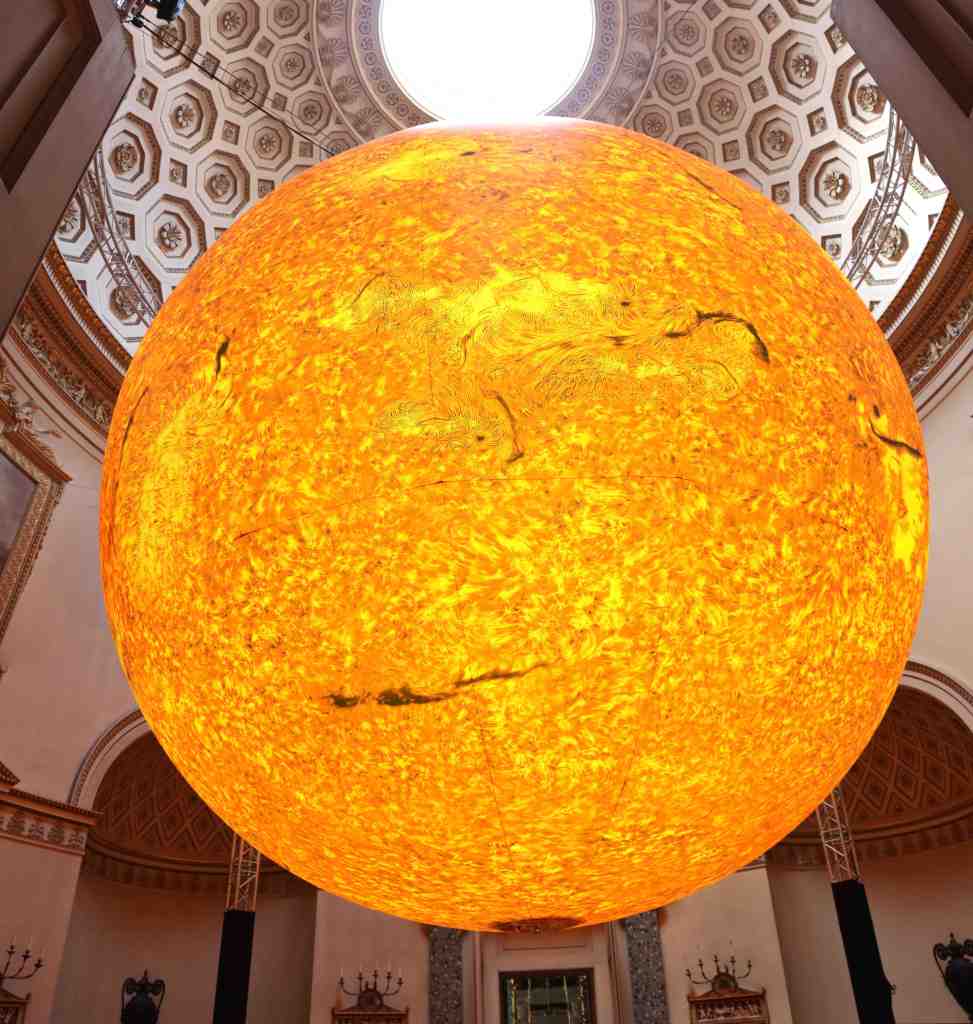
Last week we took a short trip to get up close and personal with the sun. Well not THE sun, obviously, but rather an art installation at nearby Kedleston Hall that portrays the surface of the sun in breathtaking detail, complete with sunspots and swirling solar winds. Helios is the work of artist Luke Jerram*, who based his creation on thousands of images of the sun collected by NASA and other astronomical organisations.

It’s easy to understand why Jerram was inspired to create Helios, which is named after the ancient Greek god of the sun. Did you know that our sun is 4.5 billion years old, and has about the same amount of time left until it runs out of gas? And it’s very, very hot! The surface of the sun is around 5,500°C, while its core has a mind boggling temperature of 15 million°C. Our sun has a diameter of 1.4 million kilometres (855,000 miles), but is just around average in size – some other stars are up to 100 times bigger. Wow!

Jerram’s brightly illuminated piece is 7 metres in diameter, and totally dominated the grand – 19 metres high – saloon hall in which it was suspended. The scale is mind-blowing, with one centimetre of the sculpture representing 2,000 kilometres of the real sun’s surface. Clearly, our sun is one really big dude. As if to make the point, displayed in an adjacent room and made to the same scale was a tiny model of the Earth. It really put us in our place; this planet, which to us seems impossibly huge, is a mere pimple when viewed from a cosmic perspective.

However, not everyone seemed convinced. Two other visitors, nerdy types – men, of course – were a bit agitated. They complained that although the representations of the Earth and the sun may have been made to the same scale, the distance between them had been miscalculated. According to their calculations, the model of the Earth should rightly have been positioned outside in the carpark, or maybe even half-way to the nearby city of Derby. I could barely stifle my yawns – why couldn’t they just appreciate Luke Jerram’s creativity, rather than droning on tediously about impenetrable mathematics? Life’s too short, guys!

Diwali Celebrations

Coinciding with the Helios exhibition at Kedleston Hall** was a celebration of Diwali, the Hindu festival of lights. This, I’m sure, was no coincidence. Diwali celebrates the victory of light over darkness, so programming an art installation with the sun at its very heart to run alongside a Diwali celebration was a stroke of genius.

This photo features Diwali decorations on the floor of the grand Marble Hall. Through the open door to the rear you can glimpse the lower part of Helios, suspended in the Saloon Hall.

This was the third consecutive year in which Kedleston has celebrated Diwali. Many Derby residents share a cultural heritage derived from the Indian sub-continent, and Diwali celebrations are therefore big in the city. Extending those celebrations a few miles north seems entirely appropriate, particularly in view of Kedleston’s historical links with India. Those links date back over a century to one of the stately home’s former owners – George Nathaniel Curzon, a.k.a. Lord Curzon (1859–1925) – who served as Viceroy of India between 1899 and 1905. Kedleston still displays many artefacts and artworks that Curzon brought back from his travels.

The Diwali celebrations introduced an unexpected splash of colour to Kedleston. At their heart were displays of hundreds of hand-crafted marigolds, which decorated several of the rooms. In Indian culture marigolds are used extensively in religious festivals, weddings and other ceremonies to symbolise purity, positivity and the divine, and they certainly brought a hint of the exotic to this traditionally English stately home. Other Diwali elements on display included clay oil lamps to light the way, and rangoli light projections.

Although fairly modest, Kedleston’s Diwali celebrations were good to see, and served as a potent reminder of the diverse population living within just a few miles of this grand building. I wonder what the old Viceroy would have made of them?

Remembering George Harrison

As we drove away from Kedleston Hall, having spent the afternoon in the company of the sun, and being inspired by the hope that is implicit in the Diwali festival, I found myself quietly singing a masterpiece by the late, sadly lamented George Harrison.

All four of the Beatles briefly embraced Indian culture following visits to that country in 1966 and 1968, but only George Harrison really got it. Much of George’s subsequent work was inspired directly or indirectly by Indian culture and religion, including I believe the wonderful “Here Comes the Sun” which appeared on the Beatles’ Abbey Road album in 1969. If you don’t know the song, or even if you do and would like to wallow in it one more time, listen to it here courtesy of YouTube.

* Postscript: Another work by Luke Jerram

A couple of years ago another work by Luke Jerram was exhibited at Derby Cathedral. On that occasion his chosen subject was the moon, suspended impressively above the nave. Clearly, he is fascinated by all things astronomical.

** Postscript: More on Kedleston Hall

My home county of Derbyshire is blessed with many grand stately homes. Kedleston is one of my favourites, and I have blogged about it before. You can read more about Kedleston Hall, and enjoy more of Mrs P’s photos, here and here.

Wordless Wednesday: Paddington

Wordless Wednesday is a simple blog post featuring a photo. It seeks to convey a message or tell a story, but speaks for itself without using words. Mrs P took this photo of a Paddington Bear tucking into a marmalade sandwich at John O’Groats (in the far north of Scotland) earlier this year.

The streets of Birmingham, starring Ozzy Osborne and the Floozie in the Jacuzzi

Wandering through the centre of Birmingham a few weeks ago, we were delighted to encounter The Floozie in the Jacuzzi flaunting her wares seductively in Victoria Square. More properly known as The River, the lovely lady is a bubbling fountain, a landmark popular both with local residents and with visitors to the city like me and Mrs P. She’s definitely a bit of an eyeful.

“The Floozie in the Jacuzzi” (aka “The River”) by Dhruva Mistry

Dhruva Mistry’s sculpture dates back to 1993. It’s said that his water goddess represents the life force, and was conceived as a vehicle for instilling a feeling of ‘peace and safety’ amongst people visiting this busy city centre. The good folk of Birmingham appear to have decided that this explanation is maybe a bit pretentious, and that the The Floozie in the Jacuzzi sums her up a lot better. Who am I to argue?

Another piece of Birmingham’s public art celebrates three men who made important contributions to the development of the steam engine in the late 18th century, and who were therefore key players in the early stages of the Industrial Revolution. James Watt (1736-1819) was an ideas man who came up with various improvements to the basic steam engine, while Matthew Boulton (1728-1809) was a wealthy businessman who provided the funding to put Watt’s ideas into practice. They went into partnership in Birmingham in 1775, and the highly practical William Murdoch (1754-1839) formally joined that partnership in 1810.

“The Golden Boys” (aka “The Carpet Salesmen”) by William Bloye and Raymond Forbes-Kings

The homage to the three princes of steam dates from 1956, and is the work of William Bloye (formerly head of sculpture at Birmingham School of Art) and sculptor Raymond Forbes-Kings. Unsurprisingly, it is known as The Golden Boys. More unexpectedly, however, locally the alternative name for the piece is The Carpet Salesmen, reflecting the fact that the plans for a steam engine that the three men are inspecting looks suspiciously like a bit of carpet. Oh, how I love the cheeky irreverence of Birmingham folk!

Another eye-catching piece of artwork in Birmingham city centre is A Real Birmingham Family, a cast bronze sculpture by award-winning artist Gillian Wearing. The subject matter is unconventional, and features two ordinary local women and their sons. The women are sisters, one of whom is pregnant – her second son was born shortly before the sculpture was unveiled in 2014.

“A Real Birmingham Family” by Gillian Wearing

No review of public art in Birmingham would be complete without reference to bulls. The city’s famous Bull Ring shopping centre is built on a site that was for centuries used for the brutal “sport” of bull-baiting. The practice was outlawed in 1835, but the name continues to be associated with that part of the city and is remembered through Laurence Broderick’s magnificent bronze sculpture. The Bull was installed in 2003, and in my eyes portrays the animal as a noble and powerful beast, rather than as the victim of an appalling blood sport.

“The Bull” by Laurence Broderick

There is of course another equally, if not more famous piece of public art celebrating Birmingham’s connection with bulls. I have written previously about the Raging Bull, which was commissioned to open the Commonwealth Games held in Birmingham in 2023. A couple of years after the games, Raging Bull was relocated to New Street Station, and renamed Ozzy in honour of local heavy metal music hero Ozzy Osborne. We were delighted to see Ozzy in his new location when we visited earlier in the summer, where he was continuing to draw in hordes of admirers.

Ozzy the Bull, star of the Commonwealth Games 2023, now residing at New Street Station

Ozzy Osborne was born in 1948, and grew up in the Aston area of Birmingham. He co-founded the pioneering heavy metal band Black Sabbath, and rose to prominence in the 1970s as their lead vocalist. After being fired by the band in 1979 due to his problems with alcohol and drugs, he began a solo music career and later became a reality television star. Ozzy died in late July 2025. He had remained for decades a much loved son of Birmingham, and it was clear during our visit there shortly after his death that the pain caused by his passing was still raw.

Mural featuring Black Sabbath. Ozzy Osborne is third from the left

Heavy metal music is not really my thing, but one song by Black Sabbath is etched into my memory. Released in 1970, Paranoid is a bitter, gut-wrenching exploration of depression and despair. The lyrics are as follows:

Finished with my woman ’cause
She couldn’t help me with my mind
People think I’m insane because
I am frowning all the time

All day long I think of things
But nothing seems to satisfy
Think I’ll lose my mind
If I don’t find something to pacify

Can you help me
Occupy my brain?
Oh yeah

I need someone to show me
The things in life that I can’t find
I can’t see the things that make
True happiness, I must be blind

Make a joke and I will sigh
And you will laugh and I will cry
Happiness I cannot feel
And love to me is so unreal

And so as you hear these words
Telling you now of my state
I tell you to enjoy life
I wish I could but it’s too late

Source: LyricFind

Ozzy didn’t write the lyrics Paranoid – they were the work of bandmate Geezer Butler – but did create the melody. His early years were very challenging, and Ozzy said later that as a teenager he attempted suicide on multiple occasions. Perhaps this is why his performance as lead vocalist on Paranoid is so powerful. You can listen to Ozzy doing his stuff by clicking on the following YouTube link.

Birmingham lost one of its favourite sons when Ozzy Osborne died on 22 July, just 17 days after what had been billed as his final live performance. He clearly remains close to the heart of the people of his home city, a genuine working class hero. Rest in Peace, Ozzy.

Detail from a poster promoting a summer 2025 exhibition in Birmingham about Ozzy’s solo career

On safari in deepest, darkest Norwich!

For readers unfamiliar with the place, Norwich is a historic city in the east of England that is famed for its magnificent medieval architecture and mustard! It’s not somewhere a visitor might reasonably expect to encounter giraffes, rhinos or elephants. But these critters, as well as some lions and the occasional gorilla, were all strutting their stuff in Norwich when we took a trip there a few weeks ago.

The reason for the invasion was the GoGo Safari, a temporary public art trail featuring around 50 sculptures decorated by professional artists, sponsored by local businesses and curated by Wild in Art. As well as adding some welcome splashes of colour to the local street-scene, the GoGo Safari project is raising funds to support Break, a local not-for-profit organisation that seeks to make life better for young people on the edge of care, in care and leaving care.

Various fundraising initiatives are linked to the Safari, the most significant being a public auction of the sculptures a few weeks after the trail closes. Based on experience at similar events elsewhere, the average price of the sculptures is predicted to be around £6k to £7k (USD 8k to 9.5k), meaning that the whole event should raise a sizeable sum for a very worthy cause.

Sadly, Mrs P and I won’t be bidding at the auction! Although many of the sculptures are fabulous, their expected price is way beyond what we’re able to spend on a decorative item for the garden. However, walking the streets of Norwich in search of random rhinos and sundry other colourful characters was a great way to spend a couple of days. The artworks were impressive, and it was interesting to meet and share ideas with other folk on a similar mission.

While the design of some of the sculptures is purely decorative, others feature local themes and places. All the Fun of the Fair (below), for example, takes whimsical inspiration from the nearby Thursford Steam Museum.

And the detail on some of the sculptures is very eye-catching. Just why the rhino sculpture (below) is called Andy remains a mystery to me, but the birds adorning his ample body were splendidly handsome.

Another positive aspect of the project is the opportunity for schools and community groups to contribute through decorating their own small giraffe. We were delighted to encounter this herd of “Mini G’s” (below) in the Chantry Place shopping centre.

Everyone, it seems, was having a good time on the GoGo Safari trail, and it was particularly encouraging to see the excitement on the faces of little children when they spotted another spectacularly decorated sculpture. The event closes in just a few days, but similar initiatives happen up and down the country every summer and occasionally abroad. They are definitely worth checking out if you ever get the chance.

The Lady of the North

We broke our long journey to Orkney by calling in on the Lady of the North. She promised so much, a naked, voluptuous goddess sprawling erotically across the Northumbrian landscape. You don’t see one of those every day, do you? But, if I’m honest, there’s much less to the Lady than meets the eye.

The Lady, who is also known as Northumberlandia after the county in which she resides, is the work of American landscape designer Charles Jencks (1939 -2019). He created this effigy of a recumbent naked woman, 400 metres long with grassy breasts 34 metres high, between 2010 and 2012.

To achieve his goal Jencks used spoil from a nearby opencast coal mine – some 1.5 million tonnes of rock, clay and soil – shaping it carefully into the improbable form we see today. Most spoil heaps are an ugly blot on the landscape, so it was good to come across an example of one being put to creative use.

The Lady is the centrepiece of a freely accessible Community Park. Criss-crossed by around 6km of paths, the park is good as a place for a countryside stroll, somewhere to listen to birdsong, to walk the dog or to let the kids run wild. It’s clearly an asset to local people, but for me is doesn’t quite work as a piece of public art.

A view from the Lady’s forehead, down along her nose towards her breasts

The problem with Northumberlandia is that it’s just too big to appreciate from ground level. From the right angle the Lady’s head, which sports a prominent nose, is unmistakeable. Her breasts are also stand-out features, but would you know what they’re supposed to be if you hadn’t seen the site plan? And as for the rest of the body – the arms, the torso and the legs – Mrs P and I strode happily over them, but to be honest we could have been anywhere.

Northumberlandia is an ambitious project, but really needs to be viewed from the air to be fully appreciated. If only we’d had access to a helicopter for an hour or two. Or better still wouldn’t it be great to be able to grow some wings and fly, and so enjoy a birds-eye view of the lovely Lady!

Fans of Shaun the Sheep flock to Trentham Gardens

A couple of weeks ago, keen for a bit of light relief, we drove west to Trentham Gardens in Staffordshire in search of Shaun the Sheep. UK-based readers will doubtless be aware of Shaun, who first appeared in the Aardman stop-motion animated film A Close Shave in 1995, alongside madcap inventor Wallace and his canine sidekick Gromit.

Following rave reviews of his role in A Close Shave, in 2007 Shaun was offered his own BBC series. Six series later, he is as popular as ever with younger viewers. He’s even made it onto Netflix, so he now has fans just about everywhere. You might not think it to look at him, but Shaun’s world famous, maybe the best-known sheep on the planet.

So what was Shaun doing in the gardens at Trentham, on the outskirts of Stoke? Once the site of a grand country house set in a landscaped park, in recent years the Trentham Estate has been redeveloped as a leisure destination. Visitor numbers are the name of the game, so who can blame bosses at Trentham for inviting the woolly-coated global superstar along to lend his support this spring?

The Find the Flock Trail featured 12 supersized colourful Shaun the Sheep sculptures, painted by local and regional artists. We set out to track down as many of them as we could while also enjoying views of the award winning gardens, including an oriental-style bridge and several whimsical sculptures featuring fairies.

Standing 160cm tall and brightly coloured, the sculptures were easy to spot. In no sense does a sculpture trail like this count as fine art, but it’s a load of fun…and don’t we all need some of that these days, when every news bulletin on television and radio assails us with more grim news. In a further attempt to cheer up the visitors, each sculpture’s plinth featured a corny sheep joke. Here are just a few of them:

Q: Where do sheep like to watch videos?
A: Ewe-Tube.

Q: What’s a lamb’s favourite car?
A: A Lamborghini.

Q: What sport do sheep like to play?
A: Baadminton.

Q: What do you get if you cross a kangaroo and a sheep?
A: A woolly jumper

Ha ha ha (I think)! I guess those jokes tell you all you need to know. There was nothing sophisticated about the Find the Flock Trail, but who cares? A good time was had by all.

The Lost World of Post-War Prefab Houses

Next Thursday (May 8) is VE (Victory in Europe) Day, when events will be held across the UK to mark the 80th anniversary of the end of World War 2 in Europe. The war dragged on in the Far East until August 1945, but from a domestic perspective, May 1945 was when the UK could begin to focus its attention on recovery from five and a half years of brutal conflict.

One of the main priorities at the time was to deal with a serious shortage of housing caused by German air raids, limited resources and adjusted priorities during the war years. Prefabs – prefabricated homes that are built in factories and then erected on site – were seen as an integral part of the solution.

The looming problem of post-war domestic housing was identified as early as 1942, with Prime Minister Winston Churchill declaring in a speech “The first attack must evidently be made upon houses which are damaged, but which can be reconditioned into proper dwellings…the second attack on the housing problem will be made by what are called the prefabricated, or emergency, houses.

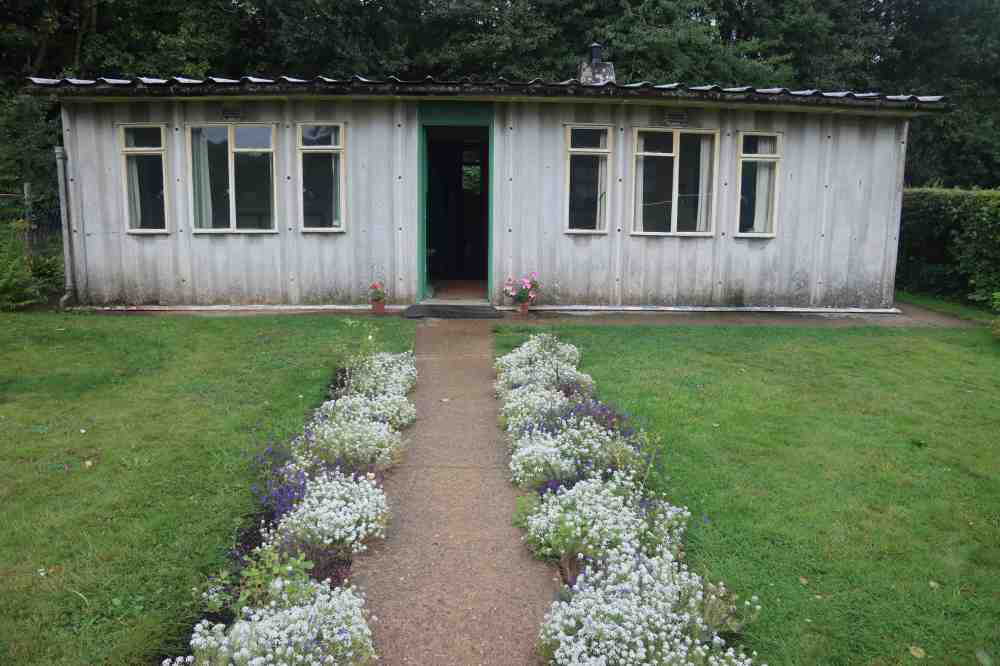
Although Churchill was no longer Prime Minister, around 156,00 prefab bungalows were erected between 1945 and 1949, spread across a mix of 18 different designs. The intention was that they should be a temporary solution, lasting around 10 years until they could be replaced with houses constructed in a more traditional way. However, many survived decades longer than this and a few are still lived in today. Others have found their way into museums, including the Chiltern Open Air Museum, where we were pleased to encounter one a few months ago.

The prefab on display at the museum dates from 1947. It was one of 46 erected on the Finch Lane Estate in the Buckinghamshire town of Amersham, a little way north of London. The bungalow is built from 26 asbestos cement panels bolted together on a wood and steel frame, all laid out on top of a concrete base. These days, of course, building with asbestos would be strenuously avoided, but back then asbestos cement offered a swift and affordable solution to a massive social problem.

The Finch Lane Estate was demolished in 1987. Recognising that the prefabs were an important part of local and social history, managers at the Chiltern Open Air Museum arranged for one to be dismantled and kept in storage. It was finally reconstructed at the museum in 1992/93 and fitted out as it might have looked in 1950, with furnishings appropriate to that period.

To our 21st century eyes they may appear small, drab, miserable buildings in which to live out one’s life, but the people who lived in prefabs often saw them very differently. They called them palaces!

Many prefab occupants had previously lived an uncomfortable existence in crowded cities like London, often in shared accommodation with outside toilets and no hot water system. Prefabs addressed these shortcomings, and came with a range of modern conveniences such as a refrigerator. There was even some garden space wrapped around the building in which kids could play and adults could grow fruit and vegetables to supplement whatever food they could afford to buy in the shops

They may have owed their origins to some of the darkest days in our modern history, but, ugly though they are from a modern perspective, prefab houses were an important step up for many ordinary folk. Visiting the museum’s prefab offers visitors a tantalising glimpse of a lost world, and an opportunity to reflect on our good fortune to live at a time when such buildings are reduced to simple museum curiosities.

A hidden jewel – Lady Waterford Hall

Viewed from the outside, Lady Waterford Hall in the tiny Northumberland estate village of Ford is unremarkable, pretty enough in its own way but easily forgotten. Take a look inside, however, and everything changes. The Hall’s interior is extraordinary, the walls lined with a series of outstanding watercolour murals featuring Biblical subjects. Perhaps even more surprisingly, this magnificent work of art was once the village schoolhouse.

The murals were painted in life-sized watercolour on paper stretched on wooden frames or panels, which were then washed with distemper to tighten them before being mounted on the walls. Louisa painted them in her studio at Ford Castle. .

The schoolhouse and its 16 massive murals were a decades-long project of Louisa Anne Beresford, Marchioness of Waterford (1818-1891). Her well-connected father was appointed British Ambassador to France in 1816, and Louisa spent much of her childhood in Paris. Given her high society background it was no surprise that she married well in 1842, when she got it together with Henry Beresford, 3rd Marquess of Waterford.

The exterior of Lady Waterford Hall offers no hint of the marvels to be found within

Louisa spent most of her married life at her husband’s family home in County Waterford, southern Ireland. When he died in a riding accident in 1859, he left Ford Castle and its estate in Northumberland to his widow. She was clearly a kind and caring person, and as such she wasted no time in turning the redevelopment of Ford village, and the welfare of her tenants, into her “great experiment”.

Jesus Midst the Doctors (Luke, ch.2, v.46)

Building a schoolhouse for the village children was one of Louisa’s priorities. Work began in 1860, but did not end with bricks and mortar, nor with desks and blackboards. She was an accomplished artist who had received some tuition from the Pre-Raphaelite master Dante Gabriel Rosetti, and she decided to use her talents to paint a series of magnificent murals to help decorate the school’s interior walls.

Left: Moses and Miriam (Hebrews, ch.11, v.23). Right: Samuel and his Parents (1 Samuel, ch.2)

As well as showcasing Louisa’s artistic abilities, the murals’ religious theme enabled her to shine a light on her deeply-held Christian beliefs. Her paintings were intended to act as a teaching aid, encouraging pupils at the school to learn from the moral lessons underpinning the Biblical stories she depicted. In an attempt to make these seem more relevant to their intended audience, she used local estate workers, villagers and children as models for the people featured in her paintings.

Joseph sent to his Brethren (Genesis, ch.1, v 14)

The murals took Louisa just over 20 years to complete, and one can only imagine the pupils’ wonder as they watched their school gradually morphing into a wondrous art gallery. The building continued to operate as the village school until 1957, meaning that several generations were able to benefit from her efforts.

The Child Saviour (Luke, ch.2, v51)

Today known as Lady Waterford Hall, the former schoolhouse is now managed by a charitable trust which aims to preserve the building and the collection housed within it.

Left: The Sacrifice of Cain and Abel (Genesis, ch.4, v.7). Right: Abraham and Isaac (Genesis, ch.22, v.7 & 8)

In addition to its current role as an accredited museum that celebrates Louisa’s artistic legacy and philanthropic endeavours, the building continues to serve the local community by acting as the local village hall. Until we visited a few months ago I had never heard of Louisa Beresford nor encountered any of her work; from what we witnessed and learned during our time there, she clearly deserves to be better known.

Snowmen and snowdogs

It snowed overnight on Saturday. No surprise there, the forecasters had been banging on about the possibility for days, but there was not nearly as much “white stuff” as they predicted. Certainly not enough to build a snowman, but who cares – we had our fill of snowmen a few weeks ago, and spotted some snowdogs too, when we explored a couple of local sculpture trails organised by Wild in Art.

Eight Maids a-Milking, by Donna Newman

Both trails were inspired by the work of Raymond Briggs (1934 – 2022), a notable illustrator of children’s books. The Snowman was first published in 1978, and remains his most celebrated work. It is a story told entirely without words, relying instead upon a sequence of simple pencil crayon illustrations.

The Snowman is a magical tale of a boy who builds a snowman in his garden and is astonished when his creation comes to life at the stroke of midnight. Boy and snowman play together happily, but without making a sound to avoid waking the boy’s parents. Later, after a shared candlelit feast, the loveable snowman flies through the air above the snowclad English countryside with the entranced boy held tightly under his arm.

When their flight is over the pair return home, the boy to his bed and the snowman to the garden. Upon waking the next morning the boy rushes into the garden to re-join his new best friend, but a thaw has set in and the snowman is little more than a pile of slush. It’s a sad end, a reminder that nothing is forever and that all things must pass, but the abiding memory is of the cheerful, chubby, larger-than-life character of the snowman.

Such was the impact of Briggs’ enchanting story that in 1982 it was adapted into a 30 minutes long animated film for television. The film caught viewers’ imagination and brought The Snowman story to a whole new audience. It has been repeated regularly ever since.

Today the loveable snowman is a Christmas icon, recognised by one and all, so it was no surprise to see Briggs’ creation starring in a sculpture trail at Clumber Park, Nottinghamshire, during the final weeks of 2024. The trail featured a series of sculptures of our hero, his ample body covered with designs inspired by the ever-popular festive song “The Twelve Days of Christmas”.

As I’ve written previously about similar Wild in Art sculpture trails that we’ve followed in recent years, this one wasn’t about sophisticated art or high culture. It was nevertheless a great way to get into the Christmas spirit, to throw off the miseries that Covid had inflicted upon us just a couple of weeks earlier, and to have some much-needed fun.

* * * * *

The impact of the original snowman film was so great that canny television executives craved a sequel. It duly came to pass in 2012. Raymond Briggs gave The Snowman and the Snowdog his blessing, although he was not personally involved in the project. The story introduces a brand new character, a snowdog, who enjoys a series of magical adventures alongside the snowman and the boy.

Ru Dog, by Donna Newman

The snowdog inspired his own sculpture trail in October 2024, in the elegant Derbyshire town of Buxton. If I’m honest, this one was not quite up to the standard of the snowman trail that we visited a few weeks later, with several of the designs seeming a little lacklustre. Nevertheless tracking down the snowdog sculptures was a good excuse for a day out, free entertainment in a part of Derbyshire that we really should try to visit more often. Later in the year, maybe…

The scariest thing about going to a museum

What’s the point of museums? Maybe they exist to remind us, as novelist L. P. Hartley explained in The Go Between, that “the past is a foreign country; they do things differently there”. Museums reveal the weird and wacky ways of our ancestors, and in so doing make us grateful we’ve not had to live like that. We don’t expect to see our own lives on display in a museum.

Street scene from Beamish 1950s Town

A couple of months ago Mrs P and I made a return visit to the Beamish Open Air Museum in County Durham, a “living, working museum that uses its collections to connect with people from all walks of life and tells the story of everyday life in the North East of England.” Since our last visit in 2019, they’ve opened a major new exhibit: The 1950s Town. And this was where Beamish Museum got spooky – I was born in the 50s, and many of the items on display seemed achingly familiar. I was home again, in a land I’d all but forgotten.

The 1950s Town comprises several houses dressed and furnished in the style prevalent at the time. Walking through them I feel as if I’m back in my dear old grandmother’s West London terrace, the living room with its tedious wallpaper, chunky brown furniture and a curvy clock ticking happily on the mantelpiece; the kitchen with its plain, glass-fronted cupboards, “Belfast sink” and shiny white enamelled cooker. I almost expect her to walk through the door and offer to make me a bread pudding, one of my childhood favourites. Yes please, nan!

There is also a reconstructed street comprising shops and similar outlets, done out in 1950s style. These include a music shop, displaying vinyl records and various electrical appliances that must have been state-of-the-art back in the day. There was no streaming back in the 50s, no Spotify, no Amazon! How did they ever manage, we wonder ironically?

The street also houses a toy shop stocked with items that were popular with mid-century kids, and here I stumble across an item that takes my breath away. It must be nearly 60 years since I last saw or thought about my Bayko Building Set, “the fascinating never failing diversion for Boys and Girls”, but here’s one, staring back at me from its friendly yellow box.

Bayko was a construction toy based on plastic and metal components, and could be used to build little houses of various designs. Other kids in my class had Lego, but I had Bayko and I loved it. For a few months it was my go-to toy, and as I stand in the shop at Beamish the memories come flooding back. Oh, happy days!

I never managed to build anything as grand as this. But I could dream!

But how odd it feels, to see part of my childhood behind glass in a museum display cabinet. I can just imagine kids born a few years ago dragging their attention away from their mobile phones for a few moments to inspect the exhibit, then saying “Mummy, did children really play with THAT sort of thing? Did they? Really?”

And that, I think, is the scariest things about going to the museum – finding your own treasured past put out there for everyone to inspect, and then dismissed as boring or quirky or quaint. A reminder, if ever we needed one, that all things pass, and that stuff which today seems so important will eventually be regarded as odd and inconsequential. Nothing is forever,