At my age birthdays are a mixed blessing. On the one hand they’re a cause for celebration (Yes, I’ve made it through another 12 months!). But they’re also a time for reflection on how your body has fared over the last year, which bits of it have started hurting, begun to misfire or even stopped working altogether. Spare a thought, then, for the Old Man of Calke, who’s still hanging on after 1,200 years.
The Old Man of Calke
The Old Man is one of many magnificent trees to be found in parkland at the Calke Abbey estate in the south of Derbyshire. Calke Park extends to around 600 acres (240 hectares), and is managed for the nation by the National Trust. Around one third is designated as a National Nature Reserve and Site of Special Scientific Interest.
After the Covid restrictions earlier in the year, our visit to Calke Park in October 2020 provided a welcome opportunity to get close to nature again, strolling past picturesque ponds and along shaded woodland paths. There’s lots to see during a walk around the park, but without doubt the ancient and veteran trees are the stars of the show.
Ancient and veteran trees are common at Calke Park
Calke is home to over 650 veteran trees, of which 350 are regarded as ancient trees. What’s the difference? I hear you asking. The Woodland Trust explains that “an ancient tree is one that has passed beyond maturity and is old, or aged, in comparison with other trees of the same species…A veteran tree is a survivor that has developed some of the features found on an ancient tree, not necessarily as a consequence of time, but of its life or environment. Ancient veterans are ancient trees, not all veterans are old enough to be ancient.” Clear as mud? Baffled? Absolutely!
The technical definitions may be more confusing than enlightening, but at an estimated age of around 1,200 years the Old Man of Calke must surely qualify as an ancient veteran. To put it into context, the Old Man was a sapling when the Vikings were rampaging across the country, and already had some 250 years under his belt when King Harold took one in the eye during the Norman invasion of England in 1066.
Mere Pond at Calke Park
The Old Man is an English Oak, and although not very tall, it boasts a girth of over 10 metres. The trunk is gnarled, split and holed in places, giving the tree a somewhat battered and time-worn appearance. Despite this it is a massively imposing presence in the Calke parkland and seems to wear its great age lightly.
Thanks to the National Trust’s careful management, the Old Man of Calke will hopefully survive long enough to give several more generations of visitors to the Park the thrill of getting up close and personal with a tree that was in its prime when William the Conqueror first set foot on these shores.
Next Sunday, 21 February, is World Whale Day. The origin of World Whale Day can be traced back to 1980, when it was declared in Maui, Hawaii as part of the annual Maui Whale Festival. During our visit to Hawaii in 2014 whales were in short supply (it was the wrong time of year), but over the years we’ve been lucky enough to see them in the waters off Iceland, Madagascar, New Zealand and Alaska.
However our best encounters were around Newfoundland, Canada, in 2017, and to celebrate World Whale Day I thought I’d revisit some of the blog posts I wrote at the time. We spent around four weeks on The Island, as the locals call it, and without doubt the whales were the highlight of the trip. I wrote a blog of our Newfoundland journey at the time, but the following focuses on our magical, memorable meetings with some of the many humpbacks that spend the summer months around its shores.
Having a whale of a time
4 July 2017
The tell-tale spout of a whale announcing his presence
Today’s been a woolly hat day, courtesy of a bitter wind howling in from the high Arctic. It’s appropriate therefore that we should have seen our first iceberg this afternoon as we drove the coast road towards the bizarrely named township of Heart’s Content, which, as I’m sure you know, is just down the road from its sister settlements of Heart’s Desire and Heart’s Delight!
The cold has been made more bearable by the warm afterglow of yesterday evening’s brilliant whale-watching trip. Whale-watching is always a bit of a lottery, and sometimes you lose. But yesterday we hit the jackpot.
Pretty soon we are amongst them, surrounded by a pod of five or six humpbacks
St John’s sits in a sheltered harbour, connected to the sea by a narrow inlet unimaginatively referred to as “the narrows.” Passing through the narrows we were thrilled to spot the towering, tell-tale spouts of whales announcing their presence to the world. Hey guys, they seemed to say, we’re over here, why don’t you pop along and say hello. We took them at their word and pretty soon we were amongst them, surrounded by a pod of five or six humpbacks.
Best of all was when they arched their backs to make a deep dive. This is the manoeuvre that causes the whale’s huge, fluked tail to lift clear of the water, a clown’s battered, white-gloved hand waving goodbye to his adoring fans before the animal plunges into the murky depths in search of lunch.
A clown’s white-gloved hand waving farewell to his adoring fans
I struggle to explain why I find whale-watching such an emotional experience. Partly, maybe, it has something to do with the fairy tale notion of a gentle giant. But also, mixed in with this, is a sense of shame at mankind’s persecution of this majestic, harmless creature in the pursuit of a quick profit. Hunted to the brink of extinction humpbacks are, thankfully, now on the way back. They are awe inspiring animals, and it’s a joy to see them. Yesterday was a memorable day; yesterday was a great day.
In the thick of it: the whales of Witless Bay
27 July 2017
Our evening whale-watching trip out of the harbour at Bay Bulls starts with a visit to Gull Island. Unsurprisingly, it’s generously endowed with gulls and other seabirds, including the ever-popular puffin. But birdwatching isn’t the purpose of our journey today, and we quickly move on to Witless Bay, reputedly the best place in Newfoundland to get up close and personal with humpback whales. For once the hype is fully justified, and within a few minutes we find ourselves surrounded by a group of between 15 and 20 humpbacks, all gorging themselves on fish (capelin) that congregate here to breed.
Surfacing with a loud, fishy-smelling blow of exhaled air and tiny water droplets
The skipper kills the engine and we sit still in the water, mesmerised by the whales circling all around us. The humpbacks patrol the bay, breaking the surface as they swim sedately along, then diving suddenly in pursuit of their quarry, then surfacing again with a loud “blow” of exhaled air and water-droplets.
A couple of times we see them lunge-feeding, exploding from the deep with huge gaping mouths that have, in this single manoeuvre, made short work of thousands of tiny fish. Occasionally we spot one spy-hopping, raising his head above the water’s surface to watch what we’re up to. They approach within metres of the boat, so close was can see barnacles growing on their skin. Sometimes they simply lie at the surface like floating logs, as if winded by the sheer volume of fish they’ve just swallowed.
They approach so close we can see barnacles growing on their skin
Today could have been a pretty miserable day, but it turns out to be one of the best we’ve had in Newfoundland. Yet this is a strange place, and Newfies march to the beat of a different drum. After the whale watching is over we retire to a nearby restaurant that specialises in fish. The waitress welcomes us warmly, says we can sit anywhere we like and have anything on the menu … except fish. Unsurprisingly perhaps in a part of Canada where Basil Fawlty sets standards that some locals find unattainable, it appears that the fish restaurant has completely run out of fish.
Relaxed, unafraid, at peace in their world: the whales of Witless Bay
31 July 2017
Our last day on The Island. We decide to end the adventure in style by taking another whale-watching trip to the Witless Bay Ecological Reserve, hardly daring to believe it can be as successful as the first.
Whales to the left, whales to the right, whales in front and whales behind
This time we know the ropes, arriving at the dock and joining the line early. This means we can be amongst the first to board, which allows us to choose a prime position. We head for the top deck and station ourselves at the pointy (bow) end, which offers good views both left and right of the boat. The weather is warm and sunny, the sea swell rolling our boat gently as we ease our way out of the harbour and past the low cliffs lining its entrance.
Again we call at Gull Island on the way, enjoying the sight of the puffins and smiling at the excitement of our fellow travellers when they spot their first “sea parrot”. There are thousands of puffins sitting on the rocks watching the world go by, while a few others venture out on to the sea and swim past our boat.
We quickly leave the clownish birds behind us and head towards the spouts that tell us the humpbacks are still here. Soon we are amongst them, whales to the left, whales to the right, whales in front and whales behind, while seabirds wheel overhead, seeking out the same fish that have drawn the humpbacks to this spot.
Little and Large (Notice the puffin in the bottom left corner of this shot!)
There must be two dozen whales at least, and some of them come so close we can almost touch them, can smell their fishy breath. A few swim alongside us, keeping pace with the boat as if out for a stroll with a group of friends. Others cross casually in front of us at the surface of the water, relaxed, unafraid, at peace in their world.
But then, somewhere deep within them, instinct kicks in. With an arch of their backs they dive deep, seeking out capelin beyond counting, fish needed in huge quantities to accumulate the thick layers of fat that will sustain them in the waters off Dominica, until they return to these cold northern shores next year. And as they dive they wave their tails, bidding farewell to their spellbound acolytes.
As they dive they wave their tales, bidding farewell to their spellbound acolytes
It is a truly extraordinary hour, one of the best wildlife watching experiences of our lives. In several respects The Island hasn’t quite lived up to our expectations, but the whale watching has surpassed anything we had imagined. This, above all else, is the memory of Newfoundland that will stay with us.
Whale song
Reflections on the fate of the whale, UK, August 2017
One of the unexpected delights of Newfoundland is its thriving folk music tradition. Much of this has a Celtic flavour, reflecting the strong connection between The Island and Ireland. Interestingly many of the locals have a slight Irish lilt to their accents, though in some cases it’s much more pronounced than this and you could believe you were in Dublin or Cork or Kilkenny or wherever.
Some come so close we can almost touch them
We picked up a few CDs during the trip, but couldn’t play them until we got home. Our car, a Chevy Cruze, was great to drive with lots of high tech features, but despite this (or perhaps because of it) there was no CD player! The first CD I tried when we got home was by a well-known Newfoundland folk band, The Irish Descendants. The lyrics of one of the songs, the Last of the Great Whales, brought a lump to the throat, not least because of all brilliant humpback encounters we enjoyed during our trip. The song is written by Andy Barnes, from Milton Keynes in the UK, and goes as follows:
My soul has been torn from me and I am bleedingMy heart it has been rent and I am cryingAll the beauty around me fades and I am screamingI am the last of the great whales and I am dyingLast night I heard the cry of my last companionThe roar of the harpoon gun and then I was aloneI thought of the days gone by when we were thousandsBut I know that I soon must die the last leviathanThis morning the sun did rise Crimson in the skyThe ice was the colour of blood and the winds they did sighI rose for to take a breath it was my last oneFrom a gun came the roar of death and now I am doneOh now that we are all gone there's no more huntingThe big fellow is no more it's no use lamentingWhat race will be next in line? All for the slaughterThe elephant or the cod or your sons and daughtersMy soul has been torn from me and I am bleedingMy heart it has been rent and I am cryingAll the beauty around me fades and I am screamingI am the last of the great whales and I am dying
Poignant, n’est pas? I can’t trace on YouTube a recording of the Irish Descendants singing this song, but here’s a link to an excellent version performed by Celtic Crossroads. Though the whale has been saved for now, for me the lyrics capture with devastating clarity the nature and scale of the wrong that has been done to these gentle creatures throughout the ages. Let’s hope that Andy Barnes will be proved incorrect in his gloomy prophecy.
The whale watching surpassed anything we had imagined. This, above all else, is the memory of Newfoundland that will stay with us
Winter always drags, but this year’s been worse than ever. Lockdown 3.0 was imposed just after Christmas, meaning that – other than a weekly trip to the supermarket and an occasional stroll around our suburban estate – we’re confined to Platypus Towers. No chance of a swift visit to a bird reserve on a fine day, and thanks to the regular visits of local cat Milky Bar, only birds with suicidal tendencies visit our garden. It’s a pretty miserable existence, and the lousy weather makes things worse.
But after several days of wintry conditions we wake up on 22 January to a dazzling morning, the sun blazing from a cloudless blue sky. We sit ourselves down in the garden room – which faces south – intent on making the most of this meteorological anomaly, when to our amazement a butterfly appears. It settles on the window ledge, just a metre away from us on the other side of the double glazing, and soaks up the rays for about 20 minutes before moving on again.
The Peacock is a spectacular and unmistakeable butterfly, and takes its name from the vivid pattern of eyespots that decorate all four wings. It’s one of just a handful of British butterflies that overwinter as dormant adults, hunkering down somewhere sheltered during the darkest months in readiness for an early start to the breeding season when spring arrives. However, as we discover today, even in the depths of winter a relatively warm day may rouse Peacocks and encourage them to take to the wing.
I’ve been interested in butterflies since I was a little kid, but have never spotted any this early in the year. And never have I been more grateful to see one of these magical insects: the last 12 months have been tough, and it’s good to be reminded that the beauty of nature will still be there for us to enjoy when the Covid restrictions are finally lifted.
* * * * *
In 2020 I saw my first butterfly around 6 March, and described it as a “symbol of hope in the darkest of days.” You can read my reflections about the symbolism of butterflies by clicking here.
Yesterday was World Wetlands Day. Held on 2 February every year since 1997, the Day aims to celebrate and raise global awareness about the vital role of wetlands for people and our planet. To the casual observer wetlands may not seem vital at all, but instead an inconvenient and undesirable quagmire of mud, mosquitoes and misery. The truth, however, is very different.
Wetlands take many forms, including rivers, lakes, ponds, marshes, fens, swamps, mangroves, estuaries, floodplains and lagoons. Why are they considered vital? To put it at its most basic, wetlands are all about water and so is life. The equation is very simple: no water equals no life. Whether we’re talking about drinking water, food production or storing carbon emissions, humankind needs healthy, thriving wetlands.
And so does the rest of life on Earth. Wetlands are vital for biodiversity: although freshwater wetlands cover less than 1% of the planet’s surface, 40% of all species rely on them.
But despite their importance, wetlands are in big trouble. The Wildfowl and Wetlands Trust (WWT) estimates that 87% of the world’s wetlands have been lost over the last 300 years, with vast swathes being drained for housing, industry and agriculture. Those wetlands that remain often suffer from serious pollution, and are also threatened by climate change.
Monty
The Ramsar Convention, which dates from 1971, seeks to secure international agreement and co-operation to protect wetlands. And yet, despite no fewer than 171 countries signing up to this intergovernmental treaty, the loss of – and damage to – wetlands across the globe continues unabated, with an impact on biodiversity that’s difficult to overstate. In this context, World Wetlands Day and similar initiatives – both large and small – are to be welcomed as a means of raising awareness of the continuing wetlands crisis.
* * *
Mrs P and I are big fans of wetlands, which offer superb opportunities for birdwatching. We are lifetime members of the WWT, a UK-based conservation trust which seeks to “conserve, restore and create wetlands, and inspire everyone to value the amazing things healthy wetlands can do for us.”
Sadly we live around 90 miles (145km) from the nearest WWT reserve, so our visits aren’t as frequent as we’d wish. But every visit we’re able to manage is worth the effort, none more so than our 2014 trip to the Slimbridge reserve in Gloucestershire. Here we were able to witness first hand the positive impact of the Great Crane Project.
Eurasian cranes are unmistakeable birds, standing more than four feet (1.2m) high, with slate-grey plumage, a red crown and a bold white streak extending from the eye to the upper back. They were once common in British wetlands, and countless place names – like Cranford in West London, close to where I grew up – include the element ‘cran’ to signify a locality where these majestic birds were known to congregate.
But loss of habitat due to the drainage of wetlands led to a decline in numbers, and hunting made things even worse. For example, in 1251 King Henry III served 115 cranes at his Christmas dinner, while in 1465 a feast to celebrate the enthronement of George Neville as Archbishop of York involved the consumption of 204 cranes. I can only hope these medieval displays of unrestrained gluttony were followed by unrelieved bouts of chronic indigestion…serve the buggers right, I say!
Unsurprisingly, by around the year 1600 cranes had become extinct throughout Britain. They remained absent from the British landscape for nearly 400 years.
In 1979 a small number of cranes crossed the sea from continental Europe to settle in the Norfolk Broads. They began to breed three years later, but the location was kept secret to avoid the unwelcome attention of egg collectors. The population survives, and has crept into other parts of East Anglia and a few other isolated spots in eastern Britain. But cranes mature slowly and typically have poor breeding success, with the result that after around 40 years the descendants of the Norfolk population remain pitifully small in number.
Chris(tine)
With the prospect of cranes naturally recolonising other parts of their ancestral range being remote, conservationists needed an alternative strategy if the bird was to spread in reasonable numbers to wetlands in the west of Britain. And thus was born the Great Crane Project, with the aim of establishing a self-sustaining breeding population of 20 pairs on the Somerset Levels by 2025.
The project saw a coalition of conservation organisations (WWT, RSPB, the Pensthorpe Conservation Trust and Viridor Credits) join forces to work on this highly ambitious, ground-breaking project. Each year between 2010 and 2014, around 20 Eurasian crane eggs were taken under licence from Brandenburg in Germany to be hatched in the UK. In all, 93 chicks were carefully raised in captivity. Dedicated “human parents” hand-reared the youngsters, educating them in the ways of the world at “crane school” before releasing them into the wild on the RSPB reserve at West Sedgemoor on the Somerset Levels. Simultaneously, work was undertaken at some sites to restore and improve the habitat for cranes.
* * *
When Mrs P and I visited Slimbridge WWT reserve in 2014, the prospect of seeing cranes never entered our heads. We’d previously enjoyed a couple of fleeting, distant views of cranes in East Anglia, but it seemed wildly improbable that any birds from the Great Crane Project would end up at Slimbridge, around 66 miles (106km) from where they were released.
And yet, amazingly, we were treated to fantastic views of a pair of cranes, strutting, preening and displaying just a few metres from where we were sitting. What a privilege, to spend an hour in such close proximity to majestic birds that once graced British wetlands in huge numbers, but which are now so scarce.
Monty
The coloured rings on the cranes’ legs make it possible to identify the individual birds we saw that day: the Great Crane Project website confirms them to be Monty and Chris(tine). Theirs was one of the first breeding attempts by any of the birds released as part of the Great Crane Project, but sadly they failed to raise any youngsters, either in 2014 or subsequent years.
The 2020 Annual Report, authored by Elizabeth Antliff-Clark and Damon Bridge from the RSPB, indicates that the cranes released between 2010 and 2014 have so far fledged 31 youngsters, of which 27 are still alive. Sadly 2020 was not a particularly good year for breeding success. The annual report tells us
“27 pairs of breeding age birds were observed in 2020 – two more than last year. Of these, all 27 pairs were thought to be holding territories. 15 pairs made confirmed or probable breeding attempts. Because monitoring activities were minimal on account of the Covid 19 restrictions, there were a higher proportion of pairs in the ‘possibly bred’ category than in previous years so it is likely that this confirmed/probable figure would have been higher in a ‘typical’ year. Nine of the 15 pairs successfully hatched chicks with four of these going on to fledge.
The 15 confirmed and probable nesting attempts this year were made on the Somerset Levels and Moors (7 prs); WWT Slimbridge Reserve Gloucestershire (5 prs); Oxfordshire (2 pr); Cambridgeshire (1 female).”
The report goes on to suggest that the explanation for 2020’s poor success rate lies in the near-drought conditions experienced at the time, which led to the drying-out of nest-sites and an increase in predation. If this is correct then last year’s poor performance may be regarded as a blip, and improved breeding success can reasonably be anticipated in 2021.
Let’s hope so. Cranes are a welcome addition to the biodiversity of British wetlands. If the Great Crane Project succeeds in its ambitions the species will continue its slow recovery from nearly 400 years of local extinction, allowing many more birders – and ordinary members of the public – to marvel at the sight of these magnificent birds. Wouldn’t that be an achievement for wetlands conservation!
* * *
STOP PRESS: Just as I was about schedule this post for publication I picked up a press release from the RSPB / Crane Working Group. It reports that “the latest common crane survey reveals a record-breaking 64 pairs of cranes in 2020, bringing the total population [across all of the UK] to over 200 birds.” This number includes the birds released as part of the Great Crane Project and their descendants, and the descendants of the birds that returned naturally to the Norfolk Broads in 1979. The 64 pairs produced a total of 23 chicks.
What brilliant, timely news! There are bound to be bumps along the road, such as the drought that coincided with the 2020 breeding season, but taken as a whole the prospects for cranes in the UK look better than at any time since the Middle Ages. Give Nature half a chance, and She WILL fight back.
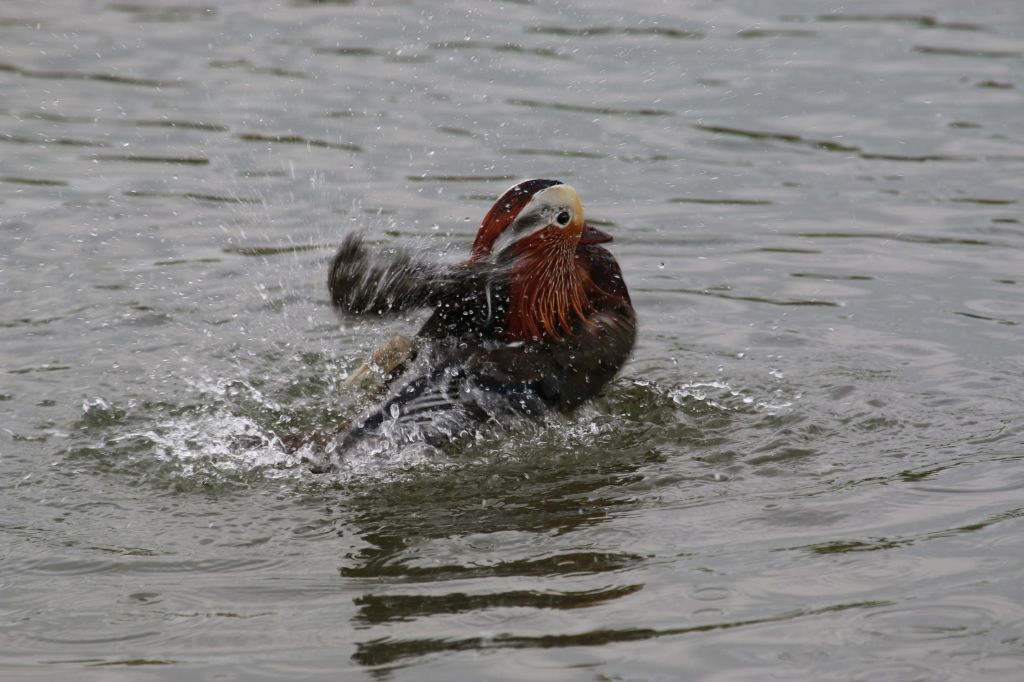
As the UK’s first Covid lockdown began to ease last June, one of our earliest trips out was to Straws Bridge nature reserve close to the small Derbyshire town of Ilkeston. It’s known to locals as Swan Lake because … well, because it’s a lake that boasts several handsome swans amongst its residents. The swans were out in force when we visited, but were overshadowed in our eyes by the unexpected sight of a family of mandarin ducks.
Mandarins favour small wooded ponds and avoid large expanses of open water, so the Straws Bridge reserve is ideal for them. Comprising three modest bodies of water set in a landscape of mixed woodland and meadows, it’s one of those habitats that shows how nature can bounce back when man lends a helping hand. In the 1970s and 1980s the area was scarred by open cast coal mining, but when the company concerned got into financial difficulties the local council took it on and restored the site as a wildlife habitat and local amenity.
We’ve visited this reserve many times over the years and have always found it busy with families out for a stroll, often with a loaf of bread in hand to feed the swans and ducks and – inadvertently – sustain the burgeoning rat population at the same time.
In June last year the place was heaving with visitors, all grateful to get into the open air after the relaxation of the government’s stay-at-home Covid restrictions. None of them, other than Mrs P and I, appeared to have a clue that they were in the presence of a bird that’s regarded by many as the world’s most beautiful duck.
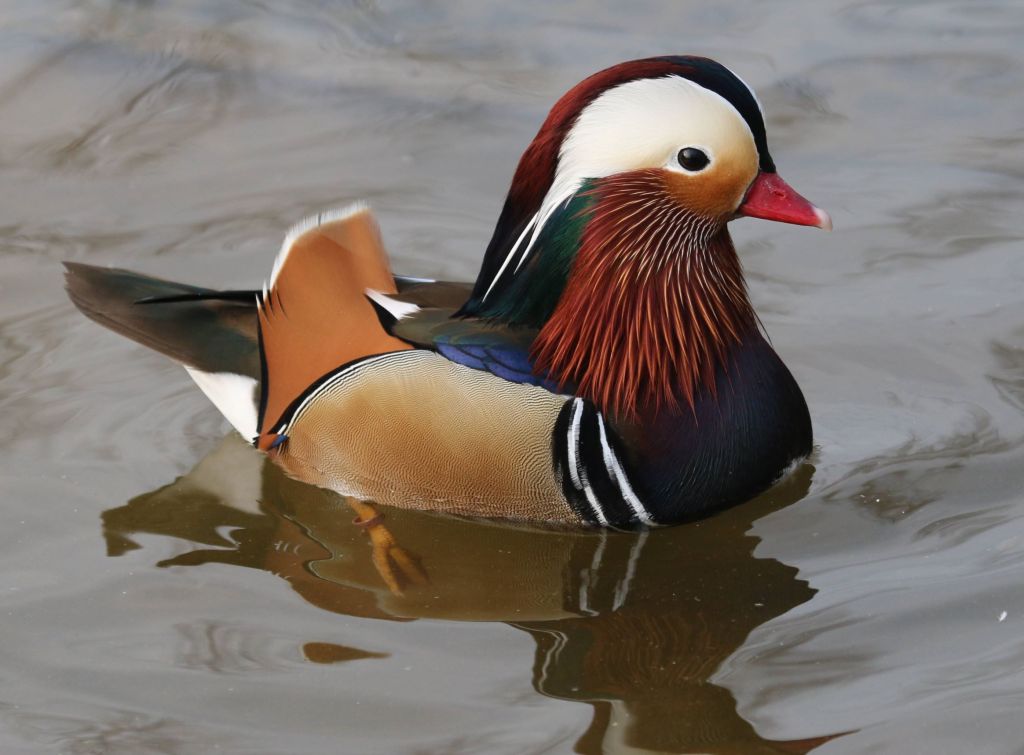
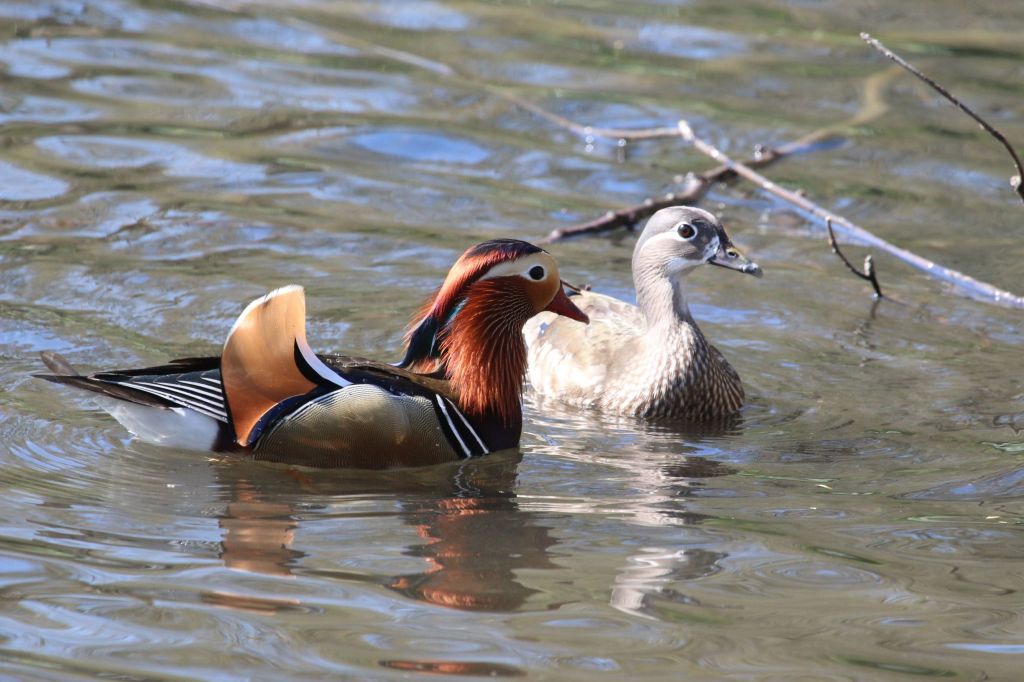
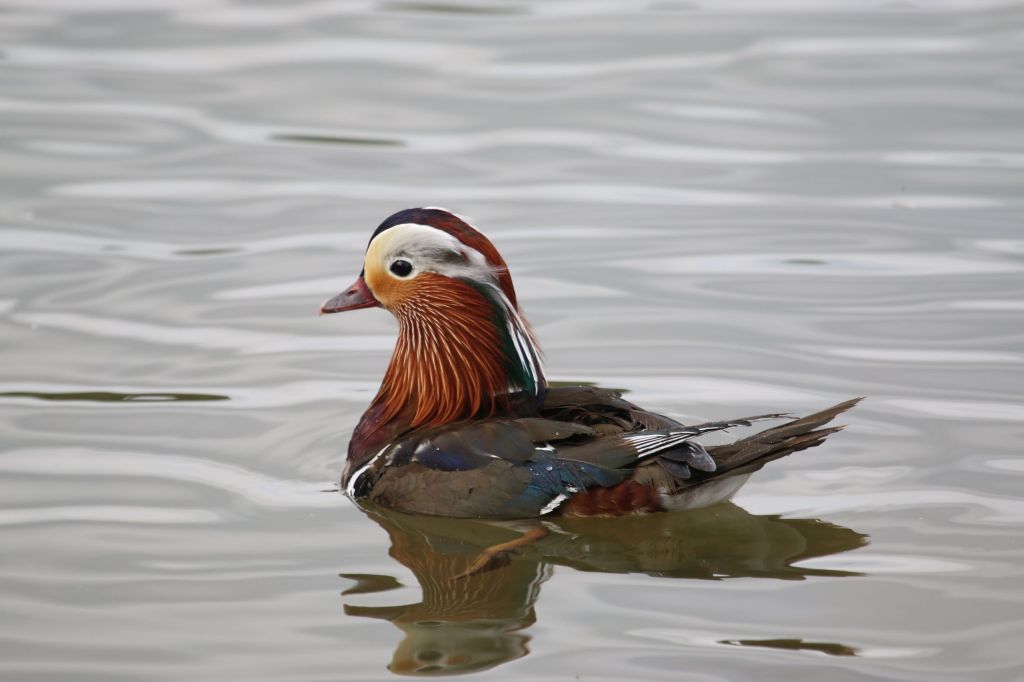
Mandarin ducks look far too exotic to be native British birds, and that’s absolutely right. They hail from East Asia – China, Japan and eastern Russia. The male sports a bright red bill, a reddish face with a large white crescent above the eye, a purple breast with two vertical white bars, and ruddy flanks. It also has two orange “sails” at the back. These comprise large feathers that stick up like the sails of a boat, and are perhaps the most eye-catching feature of what is a very elaborate bird.
The female, however, is drab, with a grey head, brown back and mottled flanks. Her white eye-ring and stripe can’t disguise the fact that, in common with the females of most duck species, she’s unremarkable.
Although the disparity in their looks might suggest otherwise, eastern folklore tells us that a pair of mandarins make the perfect couple. The birds are said to mate for life. In traditional Chinese and Japanese culture, mandarin ducks are therefore regarded as symbols of marital faithfulness. They are a favourite of artists, and also feature in Buddhist legends where they are said to represent compassion.
Male and female. No prizes for guessing which is which!
The supposed everlasting bond between mandarins is captured in a Japanese folktale, which begins with a great lord capturing a male bird so he can forever enjoy its beautiful plumage. Separated from its mate, the male is desperately lonely and begins to pine away. Seeing that the bird will soon die of a broken heart, the lord’s maidservant and her samurai lover decide to do the decent thing and reunite the lovelorn pair. However they get caught in the act and the furious lord condemns them to death for their treachery, proving beyond all doubt that for mankind and birdlife alike the course of true love does not always run smoothly!
* * *
It was in the mid-18th century when mandarins were first brought to Britain, with the intention of adding a bit of oriental glamour to the ornamental waterfowl collections of the idle rich. They escaped with monotonous regularity, and sometimes were deliberately released, but it wasn’t until the 1930s that a significant self-sustaining population of feral birds became established.
Juvenile mandarin
Since then numbers have grown rapidly, and there are now reckoned to be close to 8,000 mandarin ducks scattered widely throughout England. There are also feral populations in parts of continental Europe, as well as California and North Carolina in the US.
Spotting a lucrative gap in the market, China exported tens – or perhaps hundreds – of thousands of mandarins over several decades. Although the trade was banned in 1975 its impact, combined with widespread habitat loss, has resulted in a big fall in the wild Chinese population. Luckily mandarin ducks are reputed not to taste very good, otherwise pressures on the wild population would have been even greater in a country with over a billion mouths to feed.
Mandarins are notable for perching in trees, and the female invariably chooses a hole or cavity in a tree trunk in which to lay her eggs. After hatching, the ducklings jump to the ground and avoid injury thanks to the cushioning of their fluffy down. The mother swiftly gathers her brood together, and leads them to water. At Straws Bridge the female had plainly done a good job, and we got clear – although distant – views of some juveniles.
However, without doubt the male is the star of the mandarin show. What a looker!
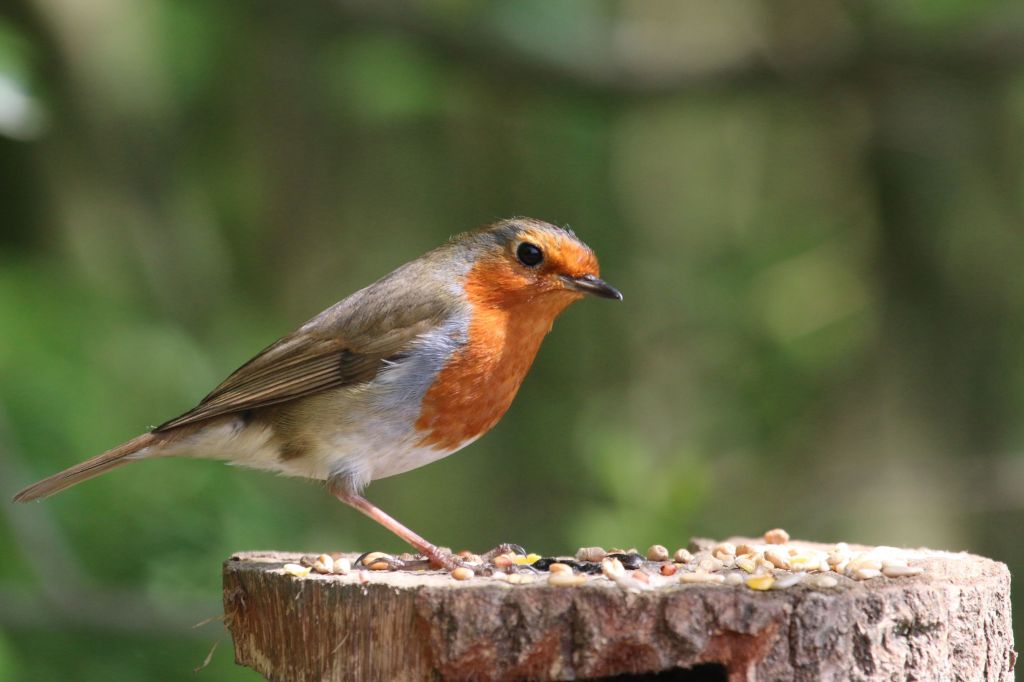
The good folk at SongBird Survival (SBS), an independent charity which funds research into the declining numbers of Britain’s songbirds, have declared next Monday – 21 December – to be National Robin Day. And who can blame them? The instantly recognisable robin has an appeal that extends way beyond dedicated birders, so celebrating this bird table superstar is an inspired way of gaining more publicity for their worthy cause. To mark the day, I thought I’d share some random facts and folklore about this iconic bird.
1 Robins are British Christmas card icons
It’s no accident that the SBS chose mid-December as the best time to celebrate National Robin Day. In Britain robins have been associated with Christmas since the 19th century, when postmen were dubbed robin redbreasts because of their red tunics. The mail they delivered at Christmas brought happiness to householders across the country, and the link was quickly made between redbreasts and seasonal merriment. Robins soon started appearing on Christmas cards, and they’ve been there ever since.
Worthy of a Christmas card
2 The naming of robins
The original English name for the robin was purely descriptive: our ancestors called it the redbreast. But they got it wrong. Even a cursory inspection in good light will reveal the bird’s breast to be orange, or perhaps an orangey-red, rather than pure red. The word orange, describing a colour, was unknown in English until the 16th century when it appeared as the name of the now-familiar citrus fruit. But by this time earlier generations had already adopted the next most appropriate word in the language – red – to describe the colour of the robin’s signature plumage.
The word robin, when applied to the bird, emerged in the 15th century when it became popular to give human names to familiar species. This new practice resulted in the birds becoming known as robin redbreast, which was eventually shortened to robin
3 The robin is Britain’s unofficial National Bird
In the 1960s the Times newspaper organised a poll of its readers to find Britain’s most popular bird, and the robin came out on top. Around half a century later, in 2015, popular birdwatcher and author David Lindo organised a similar survey. Over 200,000 people took part and the robin won again, having received 34% of votes cast, ahead of the barn owl (12%) and the blackbird (11%). Despite these public votes the UK government has remained on the fence and, for now at least, officially we don’t have a National Bird. Unofficially, however, the robin clearly takes the title.
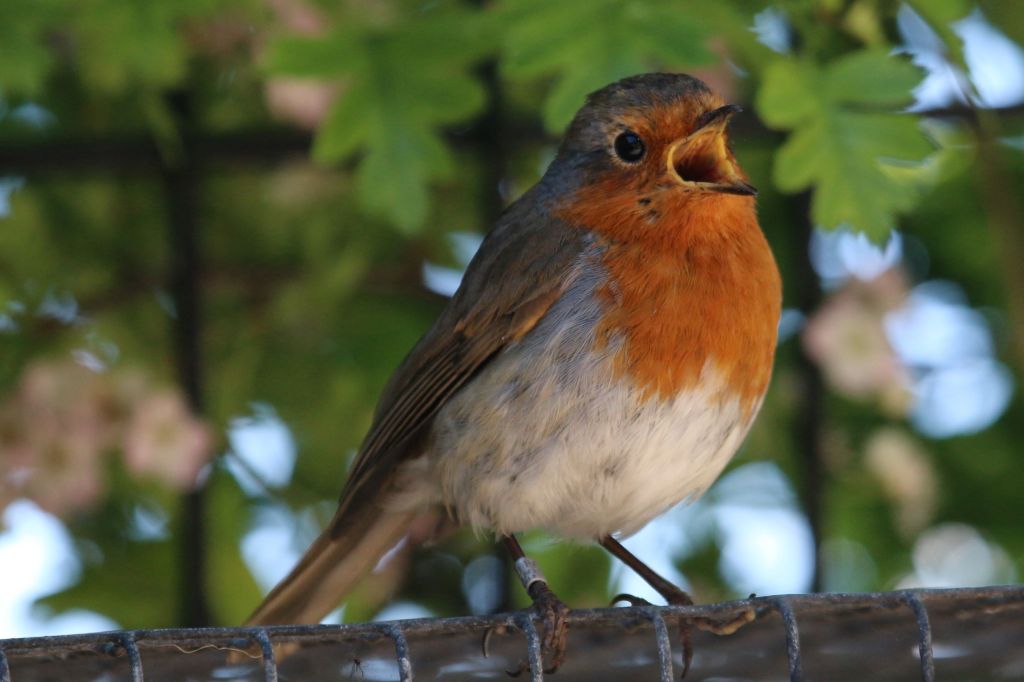
Britain’s unofficial National Bird sings out, warning others to keep clear of its territory
4 Robins are nestbuilding mavericks
When it comes to choosing a place to nest, robins aren’t fussy. Just about anywhere will do. Most commonly their nests can be found about two metres off the ground, within some kind of hollow or crevice and sheltered by vegetation. But others will nest on the ground, perhaps behind the overhang of a grassy tussock, or occasionally beneath fallen twigs covered by leaf litter.
However, radical freethinkers within the robin population choose to nest amongst the flotsam and jetsam of human life. Old teapots, discarded kettles, watering cans, coat pockets, wellington boots, farm machinery, flowerpots, hats, barbecues, an unmade bed and the body of a dead cat have all been selected by robins as a suitable place to bring up a family!
Although their nestbuilding strategy may seem bizarre, it delivers the goods. There are estimated to be 6,700,000 breeding territories in the UK. Since 1970 the robin population has increased by around 45 per cent.
5 Male and female robins both have vivid breast plumage
Robins are highly territorial, and – particularly in the breeding season – adult males like to show off their vividly coloured breasts in an attempt to intimidate other males. Although females are less competitive, they too have orangey-red breasts. The two sexes look very similar, and their brightly coloured breast plumage got them into trouble towards the end of the 19th century when robin skins were for a time a popular adornment for ladies’ hats.
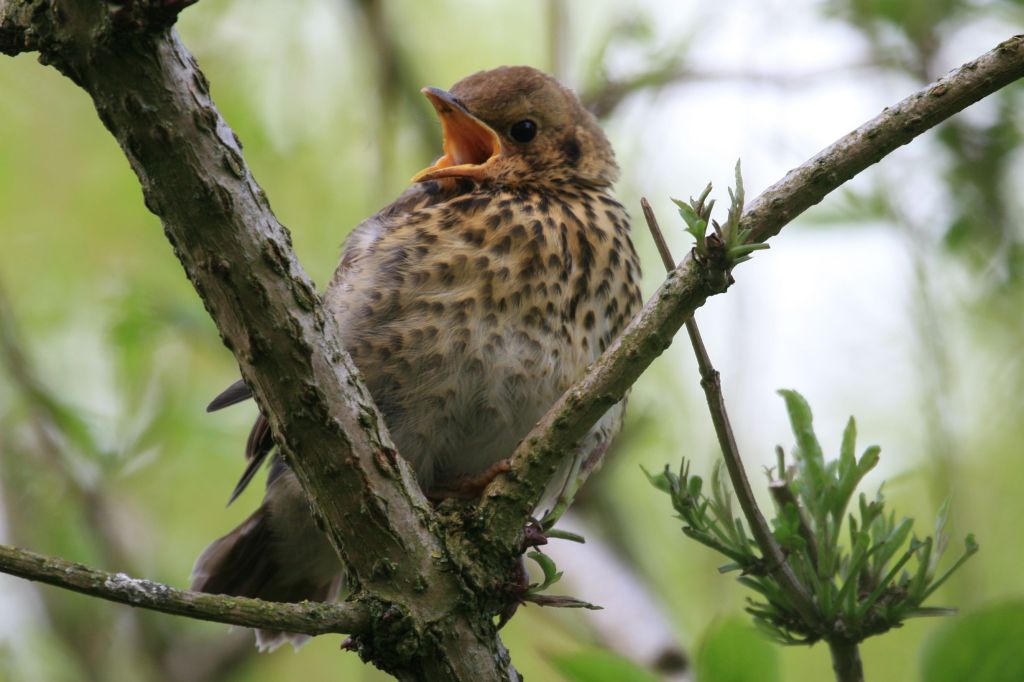
It’s worth noting that juvenile robins have a speckled brown breast and don’t develop the species’ distinctive plumage until after their first moult. The youngsters therefore belong to the group that is the nemesis of birders everywhere: they are Little Brown Jobs.
Juvenile robin (aka a Little Brown Job)
6 Robins sometimes fight to the death
You wouldn’t think it to look at them, but robins are aggressive little birds prone to acts of violence. It’s all about territory. It begins with a singing contest, males belting out their songs at one another while trying to get to a higher perch from which to flaunt their brightly coloured breasts. If one or the other doesn’t back down the dispute can become physical, resulting in injuries and even – on occasion – the death of one of the combatants. Shockingly, in some populations, up to 10 per cent of adult mortality is due to these avian turf wars.
7 Robins, friends to gardeners everywhere
Putting aside the connection with Christmas festivities, another reason for the robin’s popularity is its confiding nature. The robin presents as a friendly, trusting bird, more so than any other species that regularly visits British gardens.
Gardeners in particular often get up close and personal with robins. As ground feeders, robins enjoy nothing more than cheekily scavenging earthworms and other invertebrates dug up by gardeners going about their business. They’re also regular visitors to bird tables during the winter months, feisty feeders that aren’t shy about claiming their share of the feast.
Interestingly, robins are less confiding on continental Europe. This is thought to be because in many parts of the continent, particularly in the southern part of the robin’s range, the locals have the detestable habit of hunting small birds. It therefore pays the robin to keep its head down, skulking in the undergrowth, where hunters are less likely to find them. In Britain, where this horrible hunting tradition doesn’t exist, there is no evolutionary incentive for such caution.
The robin is a regular visitor to British bird tables
8 How the robin became
Unsurprisingly for a bird that associates so closely with humans, many stories have grown up to explain the robin’s distinctive colouring. One legend says that when Jesus was dying on the cross, a robin flew to his side and sang into his ear in order to comfort him. At this point the robin’s plumage was a dull, unremarkable brown colour. However the blood from Jesus’ wounds stained the robin’s breast. In that moment the world welcomed its first robin redbreast, and from that day onwards all robins bore the mark of Christ’s blood.
An alternative version of this tale tells us that one day an ordinary brown bird was flying high over Golgotha, near Jerusalem, when it looked at the ground below and spotted Christ suffering on the cross. Determined to ease Jesus’ torment it flew down and tried to remove His crown of thorns, but as it tugged in vain at the cruel affliction some of the Lord’s blood stained its breast. And this was how the robin became.
A third robin creation myth also makes a link between Jesus and the robin’s colouration. According to this story, shortly after Mary had given birth in the Bethlehem stable a small brown bird appeared and – in a noble attempt to keep the Christ Child warm – started to fan the flames of the dying fire. However, embers from the fire scorched its chest feathers, leaving the bird red-breasted. Mary saw what had happened and declared that the red breast was a sign of the bird’s devotion to the Lord. She went on to promise that the bird and all its descendants would forever onwards wear a red breast in memory of this selfless act of love.
9 Q: When is a robin not a robin? A: When it’s an American robin
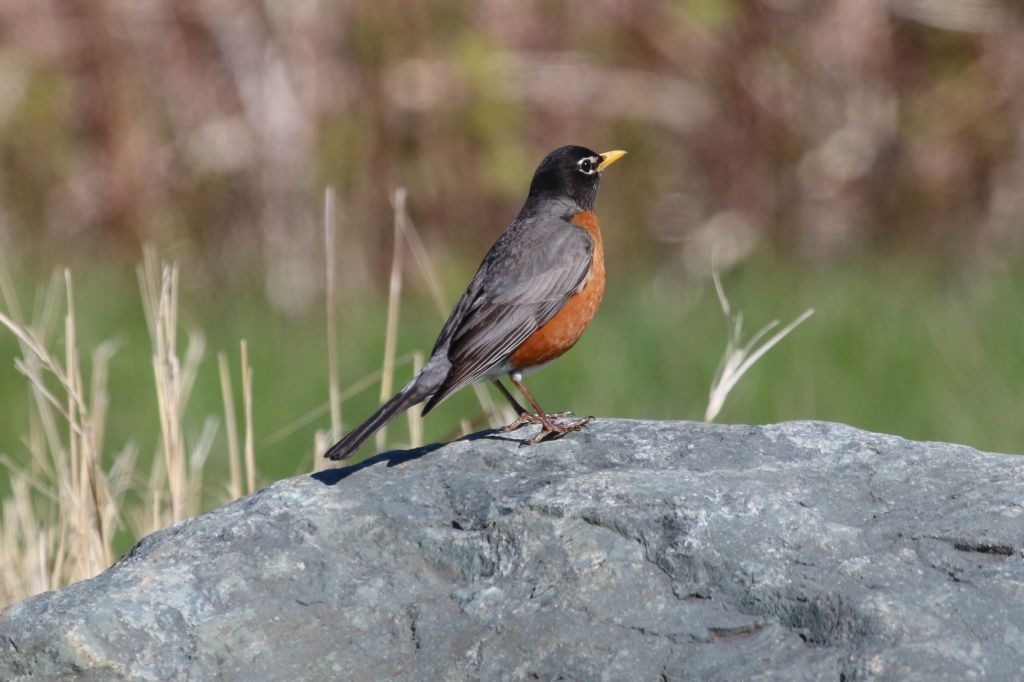
The species of robin seen in British gardens is found all over Europe, extending as far east as Western Siberia and south to North Africa. Robins are also found in North America…or are they? Well, no, actually they’re not. The American Robin isn’t really a robin at all, and belongs instead to the thrush family. Early European settlers in the Americas, desperate for reminders of home, noticed its reddish coloured breast and named it after the bird they knew from back home. Ornithology plainly wasn’t their strong point as, other than the colour of the breast, the two species bear little resemblance.
Interestingly, in the 1964 movie Mary Poppins starring Julie Andrews, the director got the wrong bird. Despite Dick van Dyke’s laughable attempt at a London accent, Mary Poppins is clearly set in England. However the bird that lands on Mary’s finger during the song A Spoonful of Sugar is an American Robin rather a European robin. Why am I not surprised by Hollywood’s cavalier relationship with factual accuracy?
The American Robin…is not really a robin at all!
10 Who killed cock robin?
The robin appears in the well-known English nursery rhyme Who Killed Cock Robin?, a gruesome tale describing the murder and the funeral of a robin. The unfortunate redbreast is shot by a sparrow, and subsequent verses reveal who organises his funeral, who digs his grave and who plays the role of chief mourner. The person who concluded that such a verse constitutes suitable entertainment for children was clearly in need of therapy.
The nursery rhyme first appeared in print in 1744, in a volume entitled Tommy Thumb’s Pretty Song Book. However the story appears already to have been an established part of England’s oral tradition. A stained glass window dating from the 15th century and showing a robin killed by an arrow can be seen Buckland Rectory (Gloucestershire), while in the early 1500s John Skelton wrote and published a similar story called “Phyllyp Sparowe.”
There are now multiple versions of the nursery rhyme, some of which have been put to music. My favourite is by the American folk-singing duo Dana and Susan Robinson. They are brilliant performers – we’ve seen them perform on a couple of occasions in the UK – and for us Who Killed Cock Robin? is always the highlight of their gigs.
So, dear reader, as you reach the end of this little post, please join me in celebrating our National Robin Day by listening to Dana and Sue’s rendition of the tragic tale of one robin’s untimely end, courtesy of the YouTube link below.
The Tasmanian Devil is the world’s largest surviving marsupial predator. Once common throughout Australia, for thousands of years these iconic animals have been confined to the island of Tasmania. But even there they are now in big trouble due to a killer cancer known as Devil Facial Tumour Disease (DFTD). Conservation groups have been working tirelessly to protect the species, and a few weeks ago news began to circulate of a ground-breaking reintroduction programme in mainland Australia. The Devil is back!
* * *
Exactly four years ago we were at the start of our first and only visit to Australia. At the heart of our adventure was a road trip through Tasmania, where we spent five blissful weeks feasting our eyes on magnificent scenery and feisty wildlife. And the wildlife doesn’t come any feistier than the Tasmanian Devil, the island’s iconic marsupial predator.
Tasmanian Devil at the Devils@Cradle Sanctuary, November 2016
We are back in our cabins when Len arrives with a bucket full of chopped up wallaby, roadkill that is about to be recycled. He spreads the meat about outside our cabin window. A light on the porch means that lumps of flesh are illuminated and clearly visible from the cabin. We settle down and wait for the action to begin.
And wait … and wait.
At midnight we reluctantly decide to give up. Our quarry isn’t going to show tonight and, disappointed, we stumble off to bed. However we leave the outside light on, and a floor-to-ceiling window means I can see the feeding area while laying in bed.
I’m soon asleep, but at 1.15am I wake up with a start. Rubbing the sleep from my eyes I peer outside, and to my amazement glimpse the unmistakeable sight a Devil tucking into chopped up roadkill.
I nudge Mrs P, who is snoring softly in my ear’ole. “Devil,” I whisper urgently, “Devil!”
She grunts, but otherwise doesn’t respond.
“No, I’m not joking, there’s a Devil outside,” I say again, nudging her harder this time.
At last, it sinks in. Now she’s awake, creeping from the bed, groping silently in the dark for her camera.The light outside the cabin isn’t great for taking photos and flash is out of the question, but Mrs P does the best she can:
Encounter with the Devil: 1:15am, 23 November 2016
We watch, captivated, for about 15 minutes as the Devil systematically works his way through about 20 pieces of chopped up wallaby. Devils can eat 40% of their own bodyweight in a single night, so this is no more than a light snack.
The window is closed, of course. It’s bloody cold outside, and for that matter we’re bloody cold inside, halfway up a mountain in an unheated log cabin, clad only in our nightwear! But we ignore the discomfort, transfixed by the action just outside our window. And as we listen we can clearly hear our diabolical guest crunching ravenously on the bones, which he gobbles down together with the gory lumps of wallaby
The next evening, the same thing happens. We go to bed at midnight and I’m woken shortly after 1:00am … only this time there are two Devils rather than just one. They bicker and snarl at one another, battling over the spoils.
The light’s not greatand flash is out of the question, but who cares? What an experience!
On the final evening of our stay at Mountain Valley three Devils turn up, thankfully a little earlier this time. We only ever see two at any one time, but we know there are three individuals as their size and white markings vary.
Again we relish watching the animals interact as they squabble, hurling abuse and grappling with one another over prime feeding rights. They are feisty little things, and it’s great to see them going about their business blissfully unaware that every snap and snarl is being scrutinised.
* * *
Devils disappeared from mainland Australia around 3,000 years ago. The reasons are thought to be the introduction of dingoes, as well as other human activity and an increasingly arid climate. However they hung on in Tasmania, where there are no dingoes and the climate is more temperate.
When Europeans arrived in Tasmania they encountered a healthy population of Devils, which they named for their unearthly screams, snarls and growls. But peaceful co-existence between settlers and the Devils quickly proved impossible.
Sheep farming was big business amongst the settlers, and – although scavenging is their preferred way of getting a meal – the Devils were identified as sheep killers. Persecution followed, and Devil numbers plummeted.
Tasmanian Devil at the Devils@Cradle Wildlife Sanctuary, November 2016
Devils became very rare, and were seemingly heading for extinction. But in June 1941 they were given legal protection, and for the next 55 years numbers gradually recovered.
However in 1996 it became evident that the animals were again under threat, this time from Devil Facial Tumour Disease. DFTD is characterised by cancers, generally around the mouth and head. It is invariably fatal, and has resulted in a huge decline in Devil numbers.
In recent years the Tasmanian government has invested heavily in its Save the Tasmanian Devil Program, which includes advocacy, annual monitoring, captive breeding and active management of wild, disease-free populations on Maria Island and the Forestier-Tasman Peninsula.
* * *
Meanwhile, back on mainland Australia the conservation organisation Aussie Ark has been building an “insurance population” of Devils. It says
To date, more than 390 devils have been born and raised at Aussie Ark in a way that fosters natural behaviour in the animals, preparing them for release into the wild. Aussie Arks ‘Rewild Australia’ strategy is a key component, alongside Species and habitat recovery, in returning Australia to it pre-European state.
During 2020 Aussie Ark have released 26 Devils into a 400-hectare (1,000-acre) sanctuary at Barrington Tops, around 120 miles north of Sydney in New South Wales. The animals won’t be living a completely wild existence: they will be confined within the boundaries of the sanctuary and receive supplementary feeding. Researchers will monitor them by remote cameras to learn more about how they adjust in their new environment.
However the long-term aim of the programme is to release Devils into targeted, non-protected areas in mainland Australia. Here it’s hoped they will contribute to keeping feral cat and fox populations under control, and thereby help protect native wildlife.
Tasmanian Devil at the Bonorong Wildlife Sanctuary, November 2016
This is a bold, ambitious programme, and has been compared with the project to return wolves to Yellowstone National Park in the USA. Over the past 12 months the wildlife news from Australia has been bleak, dominated by the huge losses that resulted from the devastating bushfires, so it was great to come across this inspiring good news story.
Having been privileged to see Tasmanian Devils in the wild, they will always have a special place in my heart. Let’s hope Aussie Ark’s project is successful, and they quickly make themselves at home on the mainland.
Grizzly bears are amongst Yellowstone National Park’s most iconic residents. With our wildlife watching in the UK and beyond currently limited by Covid-19, this post looks back on two grizzly encounters in September 2018.
The power and the glory
Americans have a complicated relationship with bears. On the one hand bears are the big, bad bogie beasts of the woods, creatures to be feared, shunned and if possible shot, stuffed and displayed somewhere prominent. On the other hand, the locals are in love with the power and the glory of these fearless beings, in awe of the magnificent apex predators with which they share the continent.
Most visitors to Yellowstone National Park want to see bears. Many – like the Platypus Man and Mrs P – are desperate to witness their undeniable majesty at close quarters. Bears are undoubtedly one of the most charismatic species living in the Park.
In the early days of Yellowstone National Park, the public’s desire to get up close and personal with both grizzly and black bears was fulfilled by allowing park visitors to feed them. While this satisfied the primeval urge for an ursine selfie, it did neither party much good. Bears that are fed quickly become dependent on man, and cease to be truly wild. They are also more likely to become aggressive towards humans if they expect to be fed but aren’t.
Above all, bears that are fed lose all caution in the presence of humans, which could easily become – quite literally – a fatal error for one side or the other. Equally, humans who see bears as reliant on their handouts fail to appreciate their true magnificence.
And to make matters worse, in the early days of the Park, waste food and other rubbish from the Park’s hotels was thrown into open garbage dumps. Naturally the bears were attracted to forage at these, and pretty soon watching them do so became a major visitor attraction in the Park. To avoid disappointment the dumps were topped up with tasty goodies, and an armed ranger was posted close to them to sort out any animal that became unacceptably arsey.
In all these ways the National Park was complicit in turning bears into performing animals in an open-air circus. For more on the history of bear feeding in Yellowstone, and some sickening photos, follow this link to the Yellowstone Insider website.
America as a society is built on the philosophy of giving the customer what he or she wants, so it was a brave decision by the National Park authorities exactly fifty years ago – in 1970 – to end the feeding of bears. In addition, more appropriate means of rubbish disposal were introduced, including the now-familiar bear-proof trash can.
With these changes, bears and humans in the Park could at last enter into a more equal relationship with one another. Seeing bears in Yellowstone is more challenging these days than it previously was, but at least we can take comfort in the fact that any bear successfully spotted is living out a natural and dignified life.
Bears remain dangerous, and the Park authorities are happy to remind visitors of this at every opportunity. It’s not, of course, good for business to have your customers mauled by the wildlife, and with this in mind the National Park has a rule that at least 100 yards (91 metres) must separate humans and bears at all times. As well as protecting the tourists, this also protects bears from unnecessary disturbance. Park rangers – bless ‘em all, I say – get very edgy if they see the 100 yards rule being broken, as we are soon to discover.
We’re way too close, but are we bothered?
It’s early morning. We’re driving though a forested area of the Park, pine trees huddled close to the road. We round a bend and see a number of cars stopped at the roadside with hazard lights flashing, and groups of people peering excitedly into the undergrowth. This can only mean one thing: wildlife, and probably something special.
I pull up, and Mrs P asks a guy what’s going on. Grizzlies, he replies breathlessly, grinning like a maniac. We’re out of the car in a flash, so quick that I forget to turn off the engine, something I don’t discover until we go to drive away more than half an hour later.
The road is built on a slight rise, and we go slip-sliding down the slope to join a couple of dozen other watchers spread out amongst the trees. Everyone’s trying to stay safe, crouching low and peering from behind reassuringly sturdy tree trunks to get a decent view.
A little way ahead is a small clearing littered with fallen trees. Rooting around in the grass, digging energetically, is a huge momma bear. Close by is a “teenage” cub, almost as big as her, and back to the right hidden at the edge of the tree-line, is its more nervous sibling.
Momma must know we’re here. Bears don’t have great eyesight but make up for this deficiency with an excellent sense of smell. All these frantic, sweaty bear-watchers must whiff a bit, affronting her super-sensitive nose. But even though we’re well inside the 100 yards exclusion zone, she’s not a bit bothered. She’s focussed completely on digging up her breakfast, although whether this is roots or grubs we can’t be sure .
The first cub also knows we’re here and is plainly a bit anxious, but hunger gets the better of him and he too digs like crazy. Only the second cub remains wary, watching from the safety of the trees, going hungry while momma and brother tuck in ravenously.
This is the best, closest view we’ve ever had of grizzly bears, and Mrs P’s camera is in overdrive, the shutter a blur as she takes shot after shot. It’s the chance of a lifetime, and she’s not going to miss it.
Suddenly there’s a commotion behind us. A ranger has arrived, glowing with self-importance. He does a quick calculation. “The bear is 41 yards from the road, and you’re all even closer to it than that. Therefore, you are all too close. GET BACK at once.”
He’s right of course. I reckon we are maybe 30 yards away from momma, and a number of folk are a bit closer than us. She’s not in the least bit worried, but rules are rules. After a brief pause the assembled bear-watchers start doing what they’ve been ordered to do…but very, very slowly and with as much bad grace as they can muster
By the time we get back to the road there’s a full-scale bear jam in progress, cars parked every which way, people milling around, desperately hoping the ranger will bugger off and annoy someone else instead. He doesn’t, and worse still, reinforcements have arrived, some of them armed with rifles “just in case.”
Another ranger is busily putting cones out on the road, making it abundantly clear that nobody is allowed to park in this vicinity for the foreseeable future. But we’re not bothered – we enjoyed half an hour of uninterrupted bear watching before the ranger rained on our parade, so we return to the car with a spring in our step. You can’t plan for an encounter like this, and it’s been brilliant.
You can enjoy the action highlights by following the link below to my short YouTube video (2 minutes).
A park ranger’s mission
Another day, another bear. Once again, as we’re driving along and minding our own business, we see cars parked where they shouldn’t be. It’s an obvious clue that something interesting is occurring in the neighbourhood.
I pull off the road where it’s safe, and we make our way down towards a parking lot a few hundred yards away where there’s a throng of people pointing cameras and scopes into an area of fallen logs and dead trees. Someone tells us that a female grizzly bear has been seen in this area over the last two or three days, and judging by all the activity she’s back again.
As we get closer we see that the people are all standing behind a line of traffic cones at the entrance to the parking lot which is, in effect, closed for business.
It’s a park ranger’s mission in life to ensure that no tourist ever gets closer than 100 yards to a bear, and they attack the task with gusto. When some brave soul tries to edge beyond the cones, a stern lady ranger warns him darkly about the dangers of crossing the line. He stays put, probably recognising that this young madam is a lot fiercer than any bear he’s likely to see today.
The rangers are out in force, and while madam is keeping the crowds under control, one of her colleagues is trying to locate the bear with his telescope. This place is a tree graveyard, charred trunks standing as silent witnesses to a forest fire that ripped through here a few years ago.
Finally, the ranger confirms that he has the grizzly in his sights and tells everyone which tree she’s hiding behind. She’s some distance away, and we never get a really clear view of her. However, we can see she’s in good condition. She has a large hump on her back which, in grizzlies, is the tell-tale sign of a well-fed animal.
Everyone is captivated as she works her way between the burnt and fallen trunks. She’s snuffling around carefully, presumably searching for food, and soon disappears into a gully which totally hides her from view. The show’s over, and the viewers walk happily back to their cars, pick-up trucks and RVs, content that they’ve seen one of Yellowstone’s iconic animals.
* * *
This post first appeared, in a slightly different form, in my 2018 blog describing a 24 days-long return road trip from Denver to Yellowstone National Park in 2018. During our adventure, which also took in – amongst other things – Glacier National Park, Utah’s Antelope State Park and an excursion on the Cumbres and Toltec Scenic Railroad, we saw lots of wonderful wildlife, including our first ever view of wolves. To read about our road trip, follow this link.
To learn a little more about grizzly bear conservation in the Lower 48, click here.
Last weekend should have been one of the highlights of our year, three whole days at the British Birdwatching Fair. Affectionately known as Birdfair, it’s an annual celebration of the natural world, not just birds but wildlife and conservation as a whole, in the UK and beyond. I blogged about it last year; you can read my post here. Birdfair is an important milestone in our calendar, marking the passing of another summer, and Mrs P and I were devastated – but not surprised – that Covid-19 played havoc with it in 2020.
Instead, Birdfair went virtual, with a range of lectures, workshops and other stuff presented online. “Entry” was free, but we were pleased to make a significant donation to support this year’s BirdLife International conservation project, which is to protect Borneo’s spectacular Helmeted Hornbill from the ravages of the illegal wildlife trade.
The virtual Birdfair was a good try, but inevitably lacked some of the magic that happens when thousands of people passionate about wildlife and conservation are physically gathered together. And that vague sense of disappointment just about sums up our 2020 birding year, which – courtesy of Covid-19 – has been a bit short on excitement.
Middleton Hall
Inevitably, therefore, our thoughts have turned to happier, pre-Covid days. The RSPB’s Middleton Lakes reserve lies on the Staffordshire / Warwickshire border, just up the road from historic Middleton Hall, an impressive Grade II listed building dating – in part – from the medieval period.
The reserve is managed as a refuge for wintering wildfowl, breeding wetland birds and passage migrants. Formerly a flourishing hub of the gravel extraction industry, the site covers 160 hectares (395 acres). It was acquired by the RSPB in 2007, and the conservation charity has been working hard ever since to return the ravaged landscape to nature.
When we visited in May 2019 it was the common woodland birds that were most evident, attracted by strategically distributed piles of seeds, nuts and other goodies. Some of the adults were wearing their breeding finery, but others looked bedraggled, worn down by the rigours of parenthood.
Robin
Blackbird
Juvenile robin
Nuthatch
Grey Squirrel
Some of the “usual suspects” seen at Middleton Lakes in May 2019
Meanwhile scruffy juveniles were doing their best to blend into the background, and yet simultaneously demanding to be fed again and again. Typical fledgling behaviour, of course, and rather endearing unless you happen to be the poor, harassed parent of said fledgling!
At one point a sneaky Grey Squirrel, unobserved by the birds, slipped in and stole food that was intended just for them. He looked in peak condition, and not at all ashamed of his blatant thievery.
As well as the “usual suspects” we encountered a few surprises as we wandered the reserve. In particular we were delighted to hear a cuckoo – so rare these days – and to glimpse a Small Copper butterfly, which is a colourful species we rarely come across. They, and all the more familiar birds and animals we spotted, made the day memorable.
Small Copper
Reserves like Middleton Lakes raise the spirits, demonstrating that if it’s given a chance nature will fight back and reclaim land that has been wrecked by man. When the Covid-19 madness is finally done with we’ll certainly return to see what else it has to offer.
The Hen Harrier is probably the most persecuted bird in the UK. To draw attention to its plight and encourage its conservation, campaigners at the charitable organisation Hen Harrier Action have declared a date in early August to be Hen Harrier Day. The timing is significant: on 12 August each year – the so-called Glorious 12th– the grouse shooting season begins, and it is this so-called “sport” that’s been at the heart of the Hen Harrier’s dreadful decline.
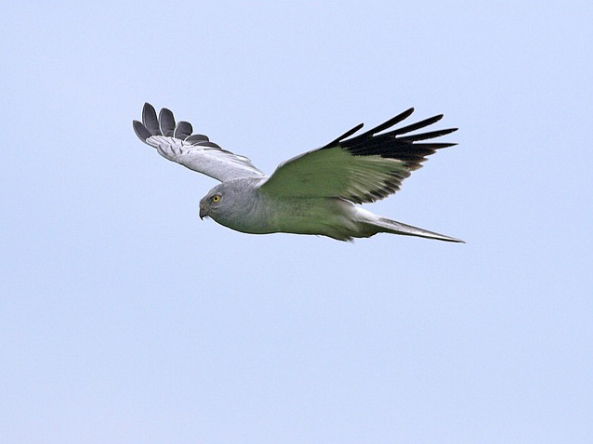
Hen Harriers are ground-nesting birds of upland moors. In winter they relocate further south to coastal areas, heathland and farmland. Males are blue-grey with a white rump, pale underside and black wing tips. Females are brown above and streaky below, with a white rump and a banded tail. The bird is almost identical to the Northern Harrier that’s found widely over the US and Canada – scientists are divided over whether they are essentially the same species, or just very close cousins.
To attract a mate the male Hen Harrier puts on a breath-taking display of aerial gymnastics, soaring, twisting, spiralling and plummeting above heather-clad moorland to catch the attention of the local ladies. It’s called sky-dancing, and is mesmerising to watch.
Later, after mating, the male will seek to strengthen the pair-bond and show off his spectacular agility by passing prey to his mate in mid-air, enabling the much less conspicuous female to return to the nest without attracting the attention of predators. The RSPB have posted a brilliant video on YouTube which perfectly captures both behaviours. It’s nearly five minutes long, but definitely worth a look:
From an international perspective, the Hen Harrier is not endangered: it’s spread very widely across northern Eurasia, and Birdlife International categorises it as a species of “Least Concern.” However, the picture is very different in the UK, where its classification is “Red.” Here, the species is fully protected under the Wildlife and Countryside Act, 1981.
The root cause of the Hen Harrier’s problems in the UK is its feeding preferences. Although its diet consists primarily of small mammals, it also takes some birds. It is this, and particularly its appetite for Red Grouse, that has brought it into conflict with gamekeepers.
The role of the gamekeeper is to serve his employers by ensuring that grouse shooters have sufficient quarry available to satisfy their vile blood-lust. Grouse moors are big business: a day spent blasting Red Grouse out of the sky can cost upwards of £1,500 (around $US 2,000), and fewer birds means reduced income for the moors’ owners. For this reason the pressure’s on gamekeepers – implicitly, if not explicitly – to eliminate any natural predators of the quarry species.
Lobbyists for the shooting industry protest their innocence: “it ain’t us guv’nor,” they plead, “we’d never hurt those cute harriers. We love the UK’s conservation laws. Honest!” But evidence to the contrary is overwhelming:
A 2019 government-commissioned study has shown that 72% of satellite-tagged hen harriers are likely to have been illegally killed on or next to grouse moors. Hen harriers are 10 times more likely to die or disappear in suspicious circumstances on or near a grouse moor than in any other habitat.
The case for the prosecution is clear, and although the shooting lobby comes up with a wealth of arguments in its defence these arguments are – to quote the immortal words of the great Douglas Adams – a load of dingo’s kidneys. The Hen Harrier Day website provides more details of the disinformation spread by those seeking to defend the status quo: you can read them by clicking here and turning to the section headed “six myths about driven grouse shooting.”
It’s reckoned that the UK as a whole has habitat to support 2,600 pairs of Hen Harriers, but in the last national survey (2016) there were only 545 territorial pairs. These are mostly in Scotland, where Mrs P and I have enjoyed watching them on numerous occasions swooping over the moors of the Orkney Islands. The views have invariably been at a distance, making successful photography an almost impossible challenge, but it always feels like a privilege simply to watch this rare and spectacular bird going about its business.
Scientists calculate that England alone has the potential to support over 300 pairs of breeding Hen Harriers. However in 2019 there were only 12 successful nests, and the fact that this is a record high for recent years reflects the seriousness of the situation. These dire numbers were the context in which annual Hen Harrier Days began in 2014:
Hen Harrier Days are community days of action, an opportunity for all of us to press for an end to wildlife crime and the wider abuse of our uplands…[They] are fun events for all the family and take many forms: in the countryside, in town, online, celebrity speakers, gigs, walks, picnics and more. Hen Harrier Days are normally organised locally by local people.
Sadly, although unsurprisingly, this year Covid-19 rendered impossible the type of event that had previously taken place. So in 2020 Hen Harrier Day moved online, hosted by popular broadcaster and campaigning naturalist Chris Packham, and up-and-coming young presenter Megan McCubbin. It worked well; key species information and hard-hitting conservation messages being mixed in with a variety of relevant music, art and literature, and the promotion of some fund-raising initiatives that will support Hen Harriers.
To be honest, some of it was difficult to take, particularly when Mark Thomas, head of the RSPB’s Investigations Team, spoke about the persecution of raptors – including Hen Harriers – in the Peak District. It was shocking and heart-breaking to hear details of the carnage taking place there, and as we live just a few miles from the Peak District National Park it feels personal.
Having heard from Mark Thomas and others on the day, it would be easy to give up in despair, to conclude that this is a battle conservationists cannot win. But Mark’s not giving up, and neither should we.
Hen Harrier Day helps raise the profile of the bird, draws attention to the criminal activity perpetrated by those who see the harrier as an obstacle to driven grouse shooting, and builds momentum in the political arena. As the experts pointed out on the day, we can all do something to help the cause, even if it’s just giving a bit of cash to practising conservationists who are working hard on the ground to combat raptor persecution.
Speaking of which, one of the initiatives linked to Hen Harrier Day 2020 has been an art auction run in conjunction with Derbyshire Wildlife Trust. Derbyshire is our county, and as Mark Thomas has pointed out its Peak District moors are a hotbed of raptor persecution. The Peak District should be home to several pairs of Hen Harriers, but sadly Mrs P and I have never seen one here on our “home turf.”
We are life members of the Derbyshire Wildlife Trust, and Mrs P decided to do her bit by getting creative to support the auction. Using her favourite papercraft technique – iris folding – she designed an image of two Hen Harriers sky-dancing, and sent it off for auction. You can see her creation below:
At the time of writing the bid for Mrs P’s iris-fold picture stands at £60 (around $US 80). In all, total bids for the 73 lots stand at over £3,000 (around US$ 4,000). Isn’t it great to see so many people – both the artists who produced the images for sale, and the bidders who are prepared to stump up some cash for them – getting involved to support the conservation of a bird that needs all the help it can muster?
The battle to save the UK’s population of Hen Harriers is far from lost. Well done to Hen Harrier Action for leading the campaign to protect them, for spreading the message, and for inspiring me to hope that – one day – I may see a Hen Harrier here in Derbyshire.








 Now I'm 64