Watching wildlife is addictive. Over several decades Mrs P and I have travelled the world to get our fix of animals and birds that we had no hope of ever seeing in the UK. Take Great White Egrets, for example. When we started our quest, they were impossible to find here. We encountered them first in the USA and India, and were well pleased with our achievement. And yet today we see them regularly in wetland habitats across the UK. The Great White Egret is exotic no longer.
At Nalsarovar Bird Sanctuary, Gujarat, India, 2013
The Great White Egret is a large, white heron. It is easy to distinguish from the Grey Heron, a species familiar to birders throughout this country, but can be confused with Little Egrets. The Little Egret is, as its name suggests, a good deal smaller than the Great White Egret, and has yellow feet and a black bill – the Great White, meanwhile, has black feet and a yellow bill. Confused? Me too! Numbers of Little Egrets have surged in recent years, something I wrote about in this post from 2021.
Seen in Texas, USA, 2012
Until around 15 years ago, Great White Egrets were impossibly rare visitors to these shores, and few birders ever got to see them. All that has now changed. The bird had been slowly expanding its range northwards and westwards in Continental Europe for some time, and around 2010 finally began to make the flight across the English Channel to see what the British Isles had to offer.
Great White Egret alongside the more familiar Grey Heron, at RSPB Blacktoft Sands Nature Reserve, East Yorkshire, 2024
The key drivers behind the expansion in Continental Europe are unclear. Possible explanations include improvements to habitat, reduced persecution, and – inevitably – climate change.
At Attenborough Nature Reserve, Nottinghamshire, 2021
Whatever the reason, British birders are clearly beneficiaries. Accurate, up-to-date population data is difficult to track down, but it appears that overwintering Great White Egrets now number at least 100 individuals. They are most frequently found in south-east England and East Anglia, but are moving steadily northwards and can now also be seen in Scotland too.
At RSPB Welney Nature Reserve, Cambridgeshire, 2022
The species first bred in the UK in 2012, and there could now be more than 20 breeding pairs spread across the country. There is every likelihood that numbers will continue to grow for years to come, meaning that Mrs P and won’t be returning to the US or India when we feel the need to re-acquaint ourselves with this handsome heron!
We recently spent a couple of days searching for seals. It’s not difficult if you know where to look, particularly at this time of year. There are a few UK beaches where grey seals haul out in large numbers, the females to give birth to new pups and the males to mate with those females as soon as they’re given the opportunity.
A mother’s love. Taken at Donna Nook, 27 November 2015.
The UK’s grey seals are a conservation success story. Back in the early 20th century just a few hundred made their home here. Today, the total stands at around 120,000, which accounts for roughly 40% of the entire world population.
Grey Seal at Horsey Gap, 4 November, 2024.
The recovery of these impressive marine mammals in the UK is thanks largely to a change in the law in 1970. Before that date the seals were heavily persecuted by fishing communities, which regarded them as pests. The new law gave them protection for the first time, allowing them to get on with their lives as nature intended.
Grey Seals on the beach. Horsey Gap, 4 November 2024.
The boom in grey seal numbers has made it easier for members of the public to get up close and personal with them. But improved access also increases the risk of disturbance, and to help mitigate this “seal wardens” are on hand at several beaches to watch over them and intervene when problems arise.
At the water’s edge. Grey Seals at Horsey Gap, 4 November 2024
One of these beaches is at Horsey Gap on the north-east coast of Norfolk. When we visited earlier in the month the wardens were doing a great job of telling people more about the seals under their protection. We learned that…
male grey seals (bulls) live up to 25 years, reaching sexual maturity at six years. Females (cows) can live up to 35 years, and start to breed at some point between the ages of three and five years.
grey seals can dive to depths of 300m, and stay under water for around 20 minutes.
grey seal milk contains up to 50-60 % fat, ten times more than a Jersey cow’s milk.
when they are born pups weigh around 13kg, but just three weeks later they weigh around 45kg.
female grey seals abandon their pups after suckling them for just 17 to 23 days. The pups stay behind on the beach, living off their fat reserves, for another three weeks while they moult off their white coats and grow a grey waterproof one.
adult cow seals weigh up to 250kg, while bulls weigh up to 350kg (to put this into context, former world heavyweight boxing champion Mike Tyson weighed in at a mere 103kg for his controversial fight with Jake Paul in Dallas on 15 November 2024!).
Little and large. Donna Nook, 14 November 2014
Our visit to Horsey Gap was towards the start of the pupping season, meaning that we saw fewer adult seals than we’d hoped, and just a couple of white-coated pups. In the winter 2021/21 season, 2,500 pups were born at Horsey and nearby Winterton, so clearly the best was yet to come. But although not the spectacular sight we’d expected, it was still a great experience to watch them squabbling in the waves and chilling out on the beach.
Adorable! Donna Nook, 27 November 2015
It was a similar story at Donna Nook, an area of Lincolnshire coastline that is well known for its grey seals. Unlike Horsey Gap, which was new to us, we have previously visited Donna Nook on a couple of occasions. When we were there in mid November 2014, and again in late November 2015, large numbers of adult seals were hauled out and many fine looking pups were on show, the epitome of adorable cuteness. Even better, the seals were lying at the very top of the sweeping sandy beach, almost within touching distance of fascinated onlookers who were gathered behind the wire fencing that kept the two parties apart.
Squabble on the beach. Donna Nook, 14 November 2014
This year, however, we visited very early in November 2024, and at the time of our visit only a few grey seals had so far arrived for the pupping season. More disappointing still, those that were there had settled down close to the water’s edge and were therefore a very long way from their human audience. The warden explained that it would take a high tide, and perhaps a day or two of stormy weather, to drive the animals further up the beach to a place where they would be easier to observe.
Messy pup. Donna Nook, 14 November 2014,
We left Donna Nook a little deflated. Our previous visits encouraged us to expect much more, but the experience is a clear reminder that, when you watch wildlife, timing is everything. We got it slightly wrong this year. Oh dear, we’ll just have to go back!
Bulls, cows and pups. A Donna Nook selection from November 2014, 2015 and 2024
Luckily, Mrs P took lots of great seal photos on our two previous visits to Donna Nook, and I have used some of them to help illustrate this post. They are a clear demonstration that, if you get the timing right, watching grey seals at pupping time is one of the UK’s great wildlife spectacles.
Tufted Ducks are a familiar sight at wetland habitats in our part of the UK. Although less plentiful than Mallards and Canada Geese, they are nevertheless a bird that I would expect to see whenever we visit local reservoirs, lakes and ponds. For me they are a fixture in our birding landscape. But, as I recently discovered to my surprise, that’s not quite true: Tufted Ducks, or “Tufties” as Mrs P and I prefer to call them, first arrived in this country less than 200 years ago.
Records suggest that Tufties started to colonise the UK in 1849. A few decades earlier the Zebra Mussel Dreissena polymorpha had been accidentally introduced into the country, and as this invasive species began to thrive Tufted Ducks followed in pursuit of a much-favoured source of food.
The number of resident Tufted Ducks in the UK grew steadily until at least the early 2000s, and it now breeds in most of England, as well as parts of lowland Scotland and localised areas of Wales and Ireland. The breeding population is around 18,000 pairs. In winter, numbers swell with the arrival of around 100,000 migrant birds from as far away as central Russia.
MaleFemale
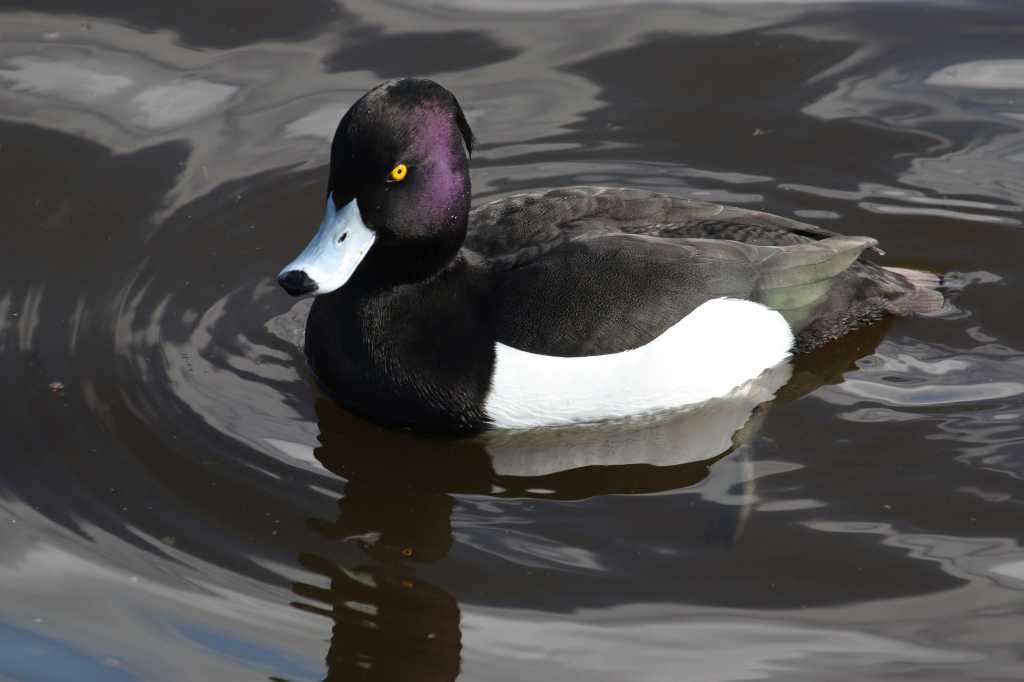
Male Tufties are handsome black-and-white birds, with a characteristic tuft and bright yellow eyes – totally memorable. Although the females also sport a tuft and yellow eyes, their drab buff-brown plumage renders them somewhat forgettable. Scouring Mrs P’s vast photographic archive, I discovered that nearly every photo that she’s ever taken of this species features the male. That, I think, tells you all you need to know about the differing visual appeal of male and female Tufted Ducks!
Tufties are fun to watch, busy little ducks that paddle swiftly across open stretches of water, before diving in pursuit of aquatic invertebrates and bivalve molluscs. It seems like they belong in this landscape and must therefore have been here forever, which makes it difficult to believe that British nature lovers at the start of Queen Victoria’s reign would have been denied the pleasure of their company.
The lesson to draw from this, I guess, is to remember that what we see today is just a snapshot in time. Species come and species go; it’s a natural process, although human activity speeds it up and can cause major instability. I wonder which birds species are entirely absent from the UK today, but will be taken for granted by British birders in the 22nd century?
Yorkshire Wildlife Park opened in 2009 on the site of a former riding school and petting zoo, and has grown steadily ever since. We aim to visit several times each year, to check up on old friends and to look out for new kids on the block. And I’m delighted to report that thanks to a couple of old friends getting it together there is indeed a new kid on the block, in the form of Carlos, a beautiful young Venezuelan Red Howler Monkey.
Carlos was born on 29 April 2023. He was exactly 5 months old when this photo was taken.
This species of howler monkey is native to the western Amazon basin, in parts of Venezuela, Colombia, Ecuador, Peru and Brazil, where they live in the tree canopy. Their diet consists largely of leaves, supplemented with a mixture of nuts, fruits, seeds, flowers and small animals. Howlers are named for the ear-splitting guttural roar that males produce to mark their territory and warn off potential intruders.
Venezuelan Red Howlers can live up to 20 years in the wild, but have become increasingly rare due to hunting and habitat destruction. Collections in zoos and conservation centres are therefore an important insurance policy helping to support the long-term future of the species. Yorkshire Wildlife Park is home to England’s only Venezuelan Red Howlers, and the good news is that the adult monkeys who live there have been doing their bit to boost numbers.
Carlos was born at the end of April 2023, the second child of mum Tila and dad Geronimo. Their first offspring was born in October 2021, and Yorkshire Wildlife Park was understandably proud that this ground-breaking birth of a Venezuelan Red Howler Monkey had taken place on their turf. Within a few days the Park was sharing Tila and Geronimo’s news with the world, telling anyone who cared to listen that their son was to be named Pablo.
Interestingly, Pablo is now called Pabla and is referred to as Carlos’s big sister. Oops! Media releases in the days following the birth of baby Carlos were quick to point out that “It’s still too early to tell the sex of the baby”, implying that keepers may have been a bit too eager to do just that when the first youngster was born. It wasn’t until nearly three months after his birth that Carlos’s gender and name were revealed on Facebook, accompanied by a piece of video footage clearly showing him to be a very well endowed young man – no mistakes this time!
The top left and middle left photos were taken on 6 July 2023, when Carlos was just 68 days old! He was almost 12 months old when he was pictured hanging upside down (top right). In the remaining two photos he is 5 months old.
The name Carlos was apparently chosen to reflect the monkey’s Hispanic heritage, while at the same time marking the fact he was born just a few days before the UK’s new king was crowned. But whether King Charles III is amused to have a red-haired, prehensile-tailed, ballsy baby monkey named after him must forever remain a mystery.
Mrs P and I first encountered Carlos in early July 2023, just a few days before his gender and name were announced to the world. Although he clearly wanted to remain close to his mum most of the time, he was already demonstrating an adventurous spirit when he set off to explore the trees growing in his enclosure. His agility was plain to see, as was his burgeoning manhood – check it out by following the link to my short video on YouTube.
When we visited Yorkshire Wildlife Park again two weeks ago Carlos had clearly grown in both size and confidence. As my video shows, he strutted arrogantly about the place like a teenager of our own species, fearlessly challenging himself to scuttle along – and dangle precariously from – ropes that are strung across the Red Howlers’ enclosure. What a great guy he’s become.
Watching Carlos’s performance, as well as the antics of his parents and sister, is a real joy. I wonder what new monkey business they’ll be up to when we next pay them a visit?
Mrs P and I have been birdwatching for nearly 40 years. It’s a great way to pass the time, one that allows us to escape temporarily from the pressures of modern living and instead get up close and personal with nature. But it’s not without its frustrations, of which the most frustrating thing of all is the LBJ. And in case any Americans reading this are wondering, that has nothing at all to do with Lyndon Baines Johnson – aka LBJ – the 36th president of the US!
For the uninitiated, in the British birding community LBJ stands for “little brown job”, which Wikipedia tells us is “an informal name used by birdwatchers for any of the large number of species of small brown passerine birds, many of which are notoriously difficult to distinguish.” The problem is compounded by the fact that your average LBJ never sits still for long, instead flitting hither and thither between bushes, briars and other forms of cover. As a rule, you only get a fleeting glimpse of an LBJ before it goes back into hiding. LBJs are a birder’s worst nightmare.
An alternative approach to identifying LBJs is via their songs. Unfortunately Mrs P and I haven’t been listening carefully enough over the last four decades, with the result that the number of species we can identify by their song alone can be counted on the fingers of one hand. But – much to my amazement – modern technology has come to the rescue, in the form of an app on my mobile phone.
A casual discussion with a bird enthusiast last year first brought the Merlin Bird ID app to our attention. It’s dead simple, which is fortunate as mobile phones aren’t my thing. When a bird is singing just fire up the app, which will analyse the song against its database and tell you which bird you’re (most probably) listening to. Simple but effective, as we discovered last week, when it led us to identify our first ever Cetti’s Warbler.
The Cetti’s was heard – and briefly seen – just a few metres from this spot. Unfortunately Mrs P was unable photograph it, and I’m grateful to Mike Prince for the image of the illusive LBJ at the top of this post
Mrs P and I were at Straw’s Bridge – aka Swan Lake – a local nature reserve that I first wrote about nearly three years ago. We go there mainly to enjoy the wildfowl, but were intrigued this time by glimpses of an LBJ that we couldn’t identify, moving between a series of bushes by the edge of the lake. It proved typically illusive, but just when we were about to give up and move on the bird started to sing in short, loud bursts. I whipped out my phone, and in a just a few seconds we learned its identity.
For confirmation I cross-checked with other information provided by the app. Its photo of the Cetti’s clearly matched the brief glimpses we’d had of the bird, and the textual description of its appearance and behaviour was bang on: a “dumpy and broad-tailed warbler, warm brown above and pale grayish below, with a narrow eyebrow…favours tangled vegetation near water, including reedy marshes with bushes and scrub. Often heard but rarely seen. Explosive, rich staccato song often draws attention.” Follow the link below to hear the song of the Cetti’s Warbler’s.
I found this recording of a singing Cetti’s Warbler on YouTube, courtesy of Birdfun.
The species is a new arrival in the UK, first breeding here – in the south-eastern county of Kent – in the early 1970s. Since then its range has slowly expanded northwards, but until our LBJ encounter last week we’d no idea the Cetti’s warbler had reached our home county of Derbyshire. Without the help of the bird identification app we would probably never have known.
In principle, I would rather leave the modern world behind when I’m out in nature. Mobile phones have their place, but a birdwatching trip isn’t one of them…or so I thought until Merlin Bird ID helped us identify our first Cetti’s Warbler. Having seen that 21st century technology can help us vanquish one of birdwatching’s biggest frustrations – the LBJ – I guess I might need to revise my opinion.
Today, 27 February, is International Polar Bear Day. Established by Polar Bears International, the day seeks to increase awareness of the plight of these iconic creatures and to raise funds to help with their conservation. The organisation was born in 1994, the brainchild of a group of wildlife enthusiasts who’d enjoyed great views of polar bears near Churchill in the far north of the Canadian province of Manitoba. Coincidentally, Churchill is also the place where Mrs P and I were thrilled by views of wild polar bears over a decade ago.
Churchill has been described as the Polar Bear Capital of the World. OK, it’s true that the ones saying it mostly have a vested interest in that they sell wildlife viewing tours to people like me and Mrs P, but they’ve got a point. If you’re determined to see a polar bear in the wild, the Churchill Wildlife Management Area is the place to go during “bear season,” which lasts for a period of five to six weeks each year. Polar Bears are big business in Churchill!
The signage leaves you in no doubt what to expect – or at least hope for – on a trip to the Churchill Wildlife Management Area.
The little town of Churchill, which has a resident population of fewer than 900, lies on the shores of Hudson Bay. To put it politely the place is bloody remote, being more than 1,000 miles north of the provincial capital of Winnipeg. Churchill is inaccessible by road; to get there you must travel by air or rail.
Its primary source of income is tourism, with thousands of visitors making the journey north every year to view the polar bears (in October and November), beluga whales on the Churchill River (in June and July) and the Northern Lights throughout the winter months.
During bear season the occasional polar bear will make it past the security cordon and end up wandering through downtown. For this reason, residents are said to leave their doors and cars unlocked at all times in case someone urgently needs to retreat to a place of safety. But for guaranteed – and safe – sightings, tourists take trips outside town on tundra buggies. These are big, bespoke vehicles with huge tyres, vehicles specially designed to cope with the challenging terrain of the Wildlife Management Area.
Our buggy was remarkably comfortable, bordering on luxurious. The cabin was heated, had an onboard loo (for any North Americans reading this, that’s a restroom!) and, most importantly of all, was totally bear proof.
To the rear of our tundra buggy was an open-air viewing platform, enabling great photographic opportunities without any windows to get in the way. The platform had a corrugated steel mesh floor through which we could watch bears as they passed beneath. One bear even stood on its hind legs to sniff curiously at the feet of the awe-struck passengers, with just a couple of inches / centimetres of perforated metal separating the two parties. That, my dear friends, is why there’s onboard loo!
The person standing on the rear viewing platform gives an indication of the size of this tundra buggy.
The views we enjoyed of polar bears during our tundra buggy rides were truly extraordinary, particularly when two of the bears were sparring with one another. These were, without doubt, some of the best – and closest – wildlife encounters of my life. We also took a helicopter trip out over the Wildlife Management Area one day, and saw several bears from an entirely different angle. In addition, helicopter vision helped give us a better appreciation of the bleak terrain that the polar bears inhabit.
Yes, the four white blobs are indeed polar bears, all chilling out in a bleak tundra landscape!
There was a range of other wildlife to be seen, but polar bears were the undoubted stars of the show. It was an absolute privilege to see them, and hopefully – if we, as a species, can get climate change control – similar opportunities will be available to future generations of wildlife enthusiasts.
Some of the other wildlife that we saw on the tundra around Churchill. Clockwise from top left: Red Fox; Snowy Owl; Arctic Hare: Rock Ptarmigan
Polar bears are magnificent, iconic creatures, and to lose them would be a tragedy. All power to the good folk at Polar Bears International for fighting the good fight on their behalf. Here’s wishing them, and anyone reading this, a wonderfully happy International Polar Bear Day.
It’s that time of year again, the time when the UK’s dedicated nature lovers take part in the RSPB’s (Royal Society for the Protection of Birds) Big Garden Birdwatch, a national survey that has been running annually in one form or another since 1979. It is also, sadly, the time when I have to confess that once again Mrs P and I have failed miserably in our attempt to attract a wealth of birdlife to our modest suburban back garden.
The Woodpigeon was one of just two species to visit our garden over the Birdwatch long weekend
The first event, in 1979, was aimed at children and was a good deal more popular than anticipated. For over two decades the Big Garden Birdwatch continued in this form. Eventually the RSPB must have realised that the buzz created by the Birdwatch every year would be even bigger if anyone could take part, so in 2001 participation was opened up to adults as well. It worked: last year over half a million people took part in the Big Garden Birdwatch, and between them they recorded a massive 9.1 million birds!
The RSPB is understandably very proud of its Big Garden Birdwatch, which it claims is “the world’s largest garden wildlife survey”. The benefits are wide-ranging: media coverage helps raise the profile of birds,- and environmental issues more generally – with a wider audience; those taking part get to focus their attention on nature for a while and enjoy consequential benefits for their mental health, and the RSPB collects a wealth of data on which species are thriving and which are struggling.
We were also visited by two male Blackbirds
Unhappily, the picture painted by the Big Garden Birdwatch is not encouraging, with the number of birds plummeting over the decades since it began. For example, House Sparrows are down 57% since 1979, while the number of Song Thrushes has collapsed by 80%.
Our own experience echoes these dismal findings: the results of this year’s count at Platypus Towers were, as expected, absolutely abysmal. The Big Garden Birdwatch 2024 ran over a period of three days, during which participants had to record the birds landing in their garden in a one hour period of their choice. In our garden, the number of birds seen throughout the whole three days – not just one hour! – was four.
NOT SEEN! – RobinNOT SEEN! –House Sparrow
Yes that’s right, we saw a measly four birds in our garden during the entire Birdwatch long weekend! OK, I admit that we weren’t watching every daylight minute of all three days, but the room where I work on my laptop overlooks the garden. In addition we spend every tea break in our “garden room”, watching what’s going on out there (and remember, we’re Brits so we have LOTS OF TEA BREAKS!) Not much passes us by, meaning the count of four birds is sure to be fairly accurate.
I’d been topping up the bird table for weeks to get the local birds in the mood for food, and on the first morning of the Birdwatch it was groaning under the weight of the goodies we’d provided. But they went largely ignored. The birds simply stayed away.
NOT SEEN! – Long-tailed TitNOT SEEN! – Wren
It wasn’t always like this. We’ve lived in this house nearly 40 years, and back in the day we welcomed a variety of avian visitors. Starlings, House Sparrows, Blue Tits, Long-tailed Tits, Robins, Wrens, Goldfinches and Dunnocks have all been seen. Memorably, for a few days one winter, a Pied Wagtail and a Grey Wagtail called our garden home. Once we spotted a Sparrowhawk sitting on the roof of the garden shed. A little later we found the remains of what we reckoned to be a Collared Dove on the path, and without doubt the Sparrowhawk was the guilty party. Even a Pheasant, hopelessly lost of course, once dropped in to say hi.
But in recent years, the number and variety of birds in our garden has fallen drastically. I last blogged about the Big Garden Birdwatch in 2020, under the title Birds Don’t Come Here Any More. That year, we saw just one male Blackbird! This year, between 26 and 28 January, the only birds to visit our garden were two woodpigeons and two male blackbirds.
OK, we did better in 2024 than in 2020, but there’s nothing here to celebrate. I wish I could believe it’s simply because all the local birds got a better offer, a garden with tastier food (Mrs P’s theory) and fewer visiting cats, but I fear it’s worse than that. All the evidence suggests that bird numbers are declining right across the country. It breaks my heart.
NOT SEEN! – Pied WagtailNOT SEEN! – Grey Wagtail
Next year, of course, we’ll do the Big Garden Birdwatch again. Maybe we’ll do better than this time. We could hardly do much worse.
_ _ _ _ _ _ _
Update, 5 February 2024
A week has passed since I wrote this post at the end of the Big Garden Birdwatch, and as expected the birds are back in numbers. As well as the Blackbirds and Woodpigeons, over the last seven days we’ve been visited by a Starling and a Dunnock, and three (yes, that’s right, THREE) Robins. It’s almost as if they know and are taunting us. Huh!
Updating the update!
No more than 20 minutes after writing the above update two Blue Tits arrived and started inspecting the nest box we’ve put up on the side of the shed. They seemed interested. Things are definitely looking up, and my broken heart is beginning to mend…for now at least.
One year on …
The 2025 Birdwatch was marginally more successful: Two Woodpigeons, two male Blackbirds, two Robins and a Magpie. Typically, however, the Wren didn’t turn up until 48 hours after the count had ended. It was ever thus …
For many years we had planned – but failed – to call in at the Highland Wildlife Park while driving north through Scotland on our way to visit the Orkney Islands, our favourite place in the whole world. At last, earlier this year, we finally got our act together and visited the Park for a few hours. And what a treat it turned out to be!
Red deer in the foreground, dwarfed by the landscape of the Cairngorms National Park
Highland Wildlife Park is located outside the town of Kincraig, in the Cairngorms National Park around 120 miles (193 km) north of Edinburgh, Scotland’s capital city. It was the brainchild of land-agent Neil Macpherson (1933-2017), who wanted to share the wildlife he encountered every working day in the north of Scotland with a wider audience.
The Scottish Wildcat (aka the “Highland Tiger”) is a unique sub-population of the European wildcat, on the brink of extinction after hundreds of years of persecution and habitat loss, followed by hybridisation with domestic cats. The Wildlife Park participates in a major captive breeding project.
Neil’s dream came to fruition in 1972, when the 260 acres (105 hectares) Park opened its gates to the paying public for the first time. It was a source of great pride and pleasure to him, but perhaps not as successful as he had hoped. In 1986 the ownership and operation of the Park passed to the Royal Zoological Society of Scotland, which also runs Edinburgh Zoo.
Przewalski’s Wild Horse is the only living true wild horse. It was once totally extinct in the wild, but captive breeding projects have enabled successful reintroduction programmes.
Controversially, in 2007 the Park’s theme was expanded from Scottish wildlife to focus instead on species from tundra and mountainous habitats around the world. So today, as well as animals from the local area – including Red Deer and the critically endangered Scottish Wildcat – visitors can enjoy views of a variety of more exotic fauna including Snow Leopards, Turkmenian Markhor, Przewalkski’s Horse and Vicuna.
There are estimated to be less than 2,500 Turkmenian Markhor remaining in the wild. Conservation initiatives in Pakistan are showing some signs of success.
The Royal Zoological Society of Scotland is a wildlife conservation charity whose vision is “a world where nature is protected, valued and loved.” Unsurprisingly, therefore, Highland Wildlife Park places a strong emphasis on education, as well as the captive breeding of endangered species.
Vicuna were hunted almost to extinction for their wool and meat until the 1960s, when Chile and Peru created protected national parks and stopped trade in vicuna wool. Since then, the population has steadily increased.
When we visited we were particularly pleased to get good views of the Park’s five Snow Leopards, parents Animesh and Koshi, and their cubs – born in May 2022 – Maya, Padme and Yashin. Being almost exactly 12 months old when we saw them, the cubs had lost much of their kittenish “cuteness”, having matured into impressive animals with exceptional appetites!
Several factors – including conflict with farmers, reduction in the population of prey species and the demands of traditional medicine – threaten the survival of Snow Leopard in the wild. Various conservation initiatives are being enacted to help reverse the decline.
In an ideal world the Highland Wildlife Park would be unnecessary. But our world is far from ideal, and it’s good to know that places like this exist to help protect species and spread positive messages about wildlife conservation. I’m sure we will call in again, next time we are on our way up to Orkney.
The eastern part of my home county of Derbyshire has a long association with coal mining. Limited production took place during the medieval period, but it wasn’t until the Industrial Revolution that large-scale mining began. When the coal industry was nationalised in 1947, there were 68 deep mines in Derbyshire. Now there are none, but their legacy lives on in a surprising way at Poolsbrook Country Park.
Great Crested Grebe
The area now occupied by the Park once consisted of farmland set in a rural landscape. Large-scale mining, which began in 1875, changed the place beyond recognition: mine shafts were sunk, massive colliery buildings were erected, and vast, ugly spoil heaps were dumped wherever seemed convenient at the time. When the Ireland Colliery finally closed for good in 1986, the whole area had been transformed into a bleak, dystopian eyesore that offered little of value either to local people or to the natural world.
Eurasian Bullfinch (male)
Luckily the local council had the vision to realise that with time, effort and resources, the site could be reborn as a valuable community amenity and wildlife habitat. Under its ambitious plans the mining infrastructure was dismantled and the old colliery spoil heaps were landscaped to mimic a natural lake/river valley, which was then planted with trees and wildflower seed.
Mute Swan
Today, the 165 acre (67 ha) site is home to a mosaic of habitats including lakes, wet grassland, wildflower hay meadows, woodland and hedgerows, all carefully managed for the benefit of wildlife. Good visitor facilities are also provided, encouraging local people to abandon the stresses and strains of urban life for a while and instead explore a small corner Derbyshire’s magnificent countryside.
Grey Heron
So, rather than simply return the land to its pre-mining status as an unremarkable piece of farmland, the planners and environmentalists have significantly enhanced it. In doing so they have created a big attraction for lovers of the natural world, particularly birders like Mrs P and I. The photographs that illustrate this short post show just a few of the birds we’ve spotted at Poolsbrook Country Park since the easing of the Covid lockdown.
Female mallard and chicksEurasian Coot
Casual visitors unfamiliar with its history would struggle to identify Poolsbrook Country Park as the site of a colliery that was in operation for over 100 years. This, in my view, is very encouraging, an illustration of just what can be achieved if we are ambitious about restoring our natural world. It offers real hope that with effort and resources we can put right at least some of the wrongs perpetrated by previous generations in the name of “progress.”
The UK doesn’t have many animals running wild through its countryside, and most of them are in any case rather difficult to see. While Grey Squirrels unashamedly flaunt their presence, most of our mammals keep their heads down. This, often combined with low numbers and a limited geographical distribution, means that few people in this country are well acquainted with the species that call these islands home. The British Wildlife Centre, located near to the village of Lingfield in the county of Surrey, is seeking to put this right.
The Centre was founded by former dairy farmer David Mills in 1997. At the age of 50 David reluctantly came to the realisation that he could no longer face the prospect of milking his herd twice a day, and decided to change the direction of his life by indulging his other great passion – British wildlife. His aim was to build an attraction specialising in UK animals, with the goal of educating ordinary members of the public about our native species and the challenges they face.
Although it strives to offer visitors a good time simply by allowing them to get up close and personal with British wildlife, education is at the heart of the Centre’s mission. Its website explains that
“In term time we specialise in school visits …We can then focus on teaching children to appreciate and respect Britain’s own wonderful native wild species, so that they may develop a life-long interest in their protection and survival. Our philosophy can be summed up as ‘Conservation through Education’.”
During our visit to the Centre a few months ago we were pleased to get good views of one of the resident polecats, an animal I’ve never seen in the wild. Once common throughout mainland Britain, they were driven to near extinction in the middle of the last century due to persecution by gamekeepers.
By the late 1930s all that remained of British polecats was a small population in north Wales. Thankfully, the species is now bouncing back, and polecats can be found throughout rural Wales, and growing areas of England including parts of the Midlands, the South and the South-East.
Another member of the weasel family to put on a show for us that day was a stoat. These animals are widely distributed across the UK, but unpredictable and difficult to spot. I have been lucky enough to see stoats in the wild, but only rarely and for just a few fleeting seconds before they hurry away into the undergrowth. At the Centre we were fortunate that one of the animals ceased its relentless dashing and posed for a couple of seconds, enabling Mrs P to capture its image for posterity.
Perhaps the most exciting encounter during our visit to the Centre was with a Scottish wildcat, which looks similar to the domestic tabby, but with more stripes and a bushier, blunt-ended tail that boasts several thick black rings We refer to these animals as Scottish wildcats, but in fact they were once widely distributed across the whole of the British mainland.
However, they disappeared from southern England around the 16th century, and the last one recorded in northern England was shot in 1849. They are now confined to parts of the Scottish highlands, but survival of this outlier population in the wild is threatened by interbreeding with feral cats.
The Centre has many other wildlife treats in store for the visitor, from foxes and badgers – which are invariably dead on the road whenever I see them – to pine martens and otters, animals I rarely see either dead or alive. The Centre’s guiding philosophy of “conservation through education”, the work it does to improve awareness of British wildlife, and its support for captive breeding programmes and scientific research, is to be applauded. I hope that, before too long, we’ll be able to make another visit.




 Now I'm 64