On safari in deepest, darkest Norwich!

For readers unfamiliar with the place, Norwich is a historic city in the east of England that is famed for its magnificent medieval architecture and mustard! It’s not somewhere a visitor might reasonably expect to encounter giraffes, rhinos or elephants. But these critters, as well as some lions and the occasional gorilla, were all strutting their stuff in Norwich when we took a trip there a few weeks ago.

The reason for the invasion was the GoGo Safari, a temporary public art trail featuring around 50 sculptures decorated by professional artists, sponsored by local businesses and curated by Wild in Art. As well as adding some welcome splashes of colour to the local street-scene, the GoGo Safari project is raising funds to support Break, a local not-for-profit organisation that seeks to make life better for young people on the edge of care, in care and leaving care.

Various fundraising initiatives are linked to the Safari, the most significant being a public auction of the sculptures a few weeks after the trail closes. Based on experience at similar events elsewhere, the average price of the sculptures is predicted to be around £6k to £7k (USD 8k to 9.5k), meaning that the whole event should raise a sizeable sum for a very worthy cause.

Sadly, Mrs P and I won’t be bidding at the auction! Although many of the sculptures are fabulous, their expected price is way beyond what we’re able to spend on a decorative item for the garden. However, walking the streets of Norwich in search of random rhinos and sundry other colourful characters was a great way to spend a couple of days. The artworks were impressive, and it was interesting to meet and share ideas with other folk on a similar mission.

While the design of some of the sculptures is purely decorative, others feature local themes and places. All the Fun of the Fair (below), for example, takes whimsical inspiration from the nearby Thursford Steam Museum.

And the detail on some of the sculptures is very eye-catching. Just why the rhino sculpture (below) is called Andy remains a mystery to me, but the birds adorning his ample body were splendidly handsome.

Another positive aspect of the project is the opportunity for schools and community groups to contribute through decorating their own small giraffe. We were delighted to encounter this herd of “Mini G’s” (below) in the Chantry Place shopping centre.

Everyone, it seems, was having a good time on the GoGo Safari trail, and it was particularly encouraging to see the excitement on the faces of little children when they spotted another spectacularly decorated sculpture. The event closes in just a few days, but similar initiatives happen up and down the country every summer and occasionally abroad. They are definitely worth checking out if you ever get the chance.

Norwich Cathedral’s very own outrageous superstar – Budge the Cat

I have written previously about Budge, the cat who spends his days prowling around one of the UK’s finest cathedrals. Built in the Romanesque style, Norwich Cathedral is a magnificent medieval building, so when Mrs P and I – clutching our cameras, of course – made a return visit a few weeks ago, the volunteers on “meet and greet” duty obviously assumed we were there to admire the architecture. They must therefore have been a bit put out by my opening questions, which were “Is Budge here?” and “How’s he doing these days?”

On top of the grand piano, close to the pulpit

Moving swiftly to hide their disappointment at our apparent lack of interest in things architectural or spiritual, the lovely ladies soon regain their composure and update us on the latest news about Budge. We are relieved to learn that the famous feline, who has been a daily visitor at the cathedral since 2018, is indeed prospering. And we’re told he has a new trick – leaping onto the pulpit, and drinking from the priest’s glass of water. Amazing, we say, without believing for a moment that we’ll soon be witnesses to this outrageous behaviour.

Trotting enthusiastically across the cloister

As we wander through the cathedral it doesn’t take us long to spot Budge, trotting enthusiastically across the cloister to greet a bunch of besotted admirers. Budge is a genuine superstar, who even has his own Instagram and X accounts. Lots of visitors to Norwich Cathedral (not just me and Mrs P!) actively seek him out, and like all good superstars he’s never too shy to put on a show.

Revelling in the attention of his besotted fans

After a while however, Budge decides that enough is enough and heads up an unimpressively modern staircase to find himself a bit of seclusion. Even superstars need down time, when they can relax and recharge their batteries before meeting up with their adoring fans once more! We therefore assume we’ve seen the last of him, and head off to the main body of the cathedral so Mrs P can take a few photos.

Taking his leave…time for a rest

And so it is that Mrs P is clicking away happily, wrapped up in her photography, when she lets out a little squeal. She’s spotted Budge, who’s sitting on the pulpit and casually watching the comings and goings of a busy cathedral at the height of the tourist season.

The view’s great from up here

As we watch him we spot a glass of water on a wooden ledge a short distance beneath the top of the pulpit. We’re not the only people who spot him. Pretty soon a small crowd has gathered, keeping a respectful distance while waiting patiently to see what happens next. Having reassured himself that he has the full attention of his audience Budge crouches down, reaches out and dips his paw into the priest’s glass of water, then brings the soggy paw back up to his mouth and starts licking it dry.

Ten seconds later he repeats the process, and then again and again until his thirst is fully quenched. It’s clearly something he’s accustomed to doing regularly. Hopefully the priest is also wise to Budge’s outrageous behaviour and changes the water before delivering his sermon.

Even superstars need a good scratch from time to time!

Having drunk his fill, Budge leaps down from the pulpit and moves away to a nearby grand piano, where he has a good scratch (we all need one from time to time, don’t we?) before settling down to snooze. It’s such a tiring life being a feline superstar. What a cat!

The Lady of the North

We broke our long journey to Orkney by calling in on the Lady of the North. She promised so much, a naked, voluptuous goddess sprawling erotically across the Northumbrian landscape. You don’t see one of those every day, do you? But, if I’m honest, there’s much less to the Lady than meets the eye.

The Lady, who is also known as Northumberlandia after the county in which she resides, is the work of American landscape designer Charles Jencks (1939 -2019). He created this effigy of a recumbent naked woman, 400 metres long with grassy breasts 34 metres high, between 2010 and 2012.

To achieve his goal Jencks used spoil from a nearby opencast coal mine – some 1.5 million tonnes of rock, clay and soil – shaping it carefully into the improbable form we see today. Most spoil heaps are an ugly blot on the landscape, so it was good to come across an example of one being put to creative use.

The Lady is the centrepiece of a freely accessible Community Park. Criss-crossed by around 6km of paths, the park is good as a place for a countryside stroll, somewhere to listen to birdsong, to walk the dog or to let the kids run wild. It’s clearly an asset to local people, but for me is doesn’t quite work as a piece of public art.

A view from the Lady’s forehead, down along her nose towards her breasts

The problem with Northumberlandia is that it’s just too big to appreciate from ground level. From the right angle the Lady’s head, which sports a prominent nose, is unmistakeable. Her breasts are also stand-out features, but would you know what they’re supposed to be if you hadn’t seen the site plan? And as for the rest of the body – the arms, the torso and the legs – Mrs P and I strode happily over them, but to be honest we could have been anywhere.

Northumberlandia is an ambitious project, but really needs to be viewed from the air to be fully appreciated. If only we’d had access to a helicopter for an hour or two. Or better still wouldn’t it be great to be able to grow some wings and fly, and so enjoy a birds-eye view of the lovely Lady!

Fans of Shaun the Sheep flock to Trentham Gardens

A couple of weeks ago, keen for a bit of light relief, we drove west to Trentham Gardens in Staffordshire in search of Shaun the Sheep. UK-based readers will doubtless be aware of Shaun, who first appeared in the Aardman stop-motion animated film A Close Shave in 1995, alongside madcap inventor Wallace and his canine sidekick Gromit.

Following rave reviews of his role in A Close Shave, in 2007 Shaun was offered his own BBC series. Six series later, he is as popular as ever with younger viewers. He’s even made it onto Netflix, so he now has fans just about everywhere. You might not think it to look at him, but Shaun’s world famous, maybe the best-known sheep on the planet.

So what was Shaun doing in the gardens at Trentham, on the outskirts of Stoke? Once the site of a grand country house set in a landscaped park, in recent years the Trentham Estate has been redeveloped as a leisure destination. Visitor numbers are the name of the game, so who can blame bosses at Trentham for inviting the woolly-coated global superstar along to lend his support this spring?

The Find the Flock Trail featured 12 supersized colourful Shaun the Sheep sculptures, painted by local and regional artists. We set out to track down as many of them as we could while also enjoying views of the award winning gardens, including an oriental-style bridge and several whimsical sculptures featuring fairies.

Standing 160cm tall and brightly coloured, the sculptures were easy to spot. In no sense does a sculpture trail like this count as fine art, but it’s a load of fun…and don’t we all need some of that these days, when every news bulletin on television and radio assails us with more grim news. In a further attempt to cheer up the visitors, each sculpture’s plinth featured a corny sheep joke. Here are just a few of them:

Q: Where do sheep like to watch videos?
A: Ewe-Tube.

Q: What’s a lamb’s favourite car?
A: A Lamborghini.

Q: What sport do sheep like to play?
A: Baadminton.

Q: What do you get if you cross a kangaroo and a sheep?
A: A woolly jumper

Ha ha ha (I think)! I guess those jokes tell you all you need to know. There was nothing sophisticated about the Find the Flock Trail, but who cares? A good time was had by all.

The Lost World of Post-War Prefab Houses

Next Thursday (May 8) is VE (Victory in Europe) Day, when events will be held across the UK to mark the 80th anniversary of the end of World War 2 in Europe. The war dragged on in the Far East until August 1945, but from a domestic perspective, May 1945 was when the UK could begin to focus its attention on recovery from five and a half years of brutal conflict.

One of the main priorities at the time was to deal with a serious shortage of housing caused by German air raids, limited resources and adjusted priorities during the war years. Prefabs – prefabricated homes that are built in factories and then erected on site – were seen as an integral part of the solution.

The looming problem of post-war domestic housing was identified as early as 1942, with Prime Minister Winston Churchill declaring in a speech “The first attack must evidently be made upon houses which are damaged, but which can be reconditioned into proper dwellings…the second attack on the housing problem will be made by what are called the prefabricated, or emergency, houses.

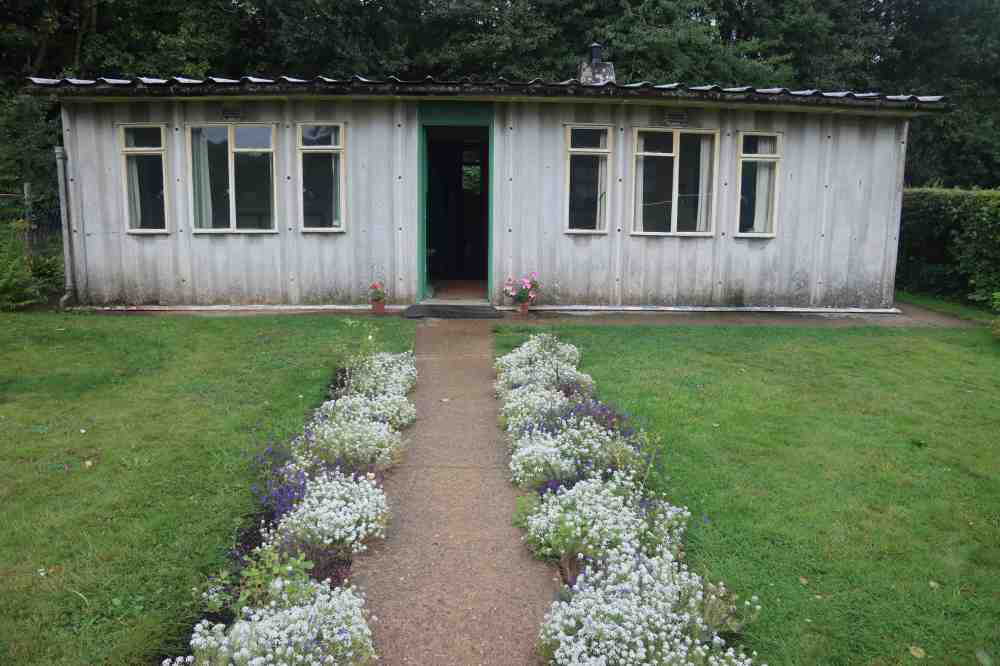
Although Churchill was no longer Prime Minister, around 156,00 prefab bungalows were erected between 1945 and 1949, spread across a mix of 18 different designs. The intention was that they should be a temporary solution, lasting around 10 years until they could be replaced with houses constructed in a more traditional way. However, many survived decades longer than this and a few are still lived in today. Others have found their way into museums, including the Chiltern Open Air Museum, where we were pleased to encounter one a few months ago.

The prefab on display at the museum dates from 1947. It was one of 46 erected on the Finch Lane Estate in the Buckinghamshire town of Amersham, a little way north of London. The bungalow is built from 26 asbestos cement panels bolted together on a wood and steel frame, all laid out on top of a concrete base. These days, of course, building with asbestos would be strenuously avoided, but back then asbestos cement offered a swift and affordable solution to a massive social problem.

The Finch Lane Estate was demolished in 1987. Recognising that the prefabs were an important part of local and social history, managers at the Chiltern Open Air Museum arranged for one to be dismantled and kept in storage. It was finally reconstructed at the museum in 1992/93 and fitted out as it might have looked in 1950, with furnishings appropriate to that period.

To our 21st century eyes they may appear small, drab, miserable buildings in which to live out one’s life, but the people who lived in prefabs often saw them very differently. They called them palaces!

Many prefab occupants had previously lived an uncomfortable existence in crowded cities like London, often in shared accommodation with outside toilets and no hot water system. Prefabs addressed these shortcomings, and came with a range of modern conveniences such as a refrigerator. There was even some garden space wrapped around the building in which kids could play and adults could grow fruit and vegetables to supplement whatever food they could afford to buy in the shops

They may have owed their origins to some of the darkest days in our modern history, but, ugly though they are from a modern perspective, prefab houses were an important step up for many ordinary folk. Visiting the museum’s prefab offers visitors a tantalising glimpse of a lost world, and an opportunity to reflect on our good fortune to live at a time when such buildings are reduced to simple museum curiosities.

A Miniature Marvel – Bekonscot Model Village and Railway

Almost 100 years ago, a despairing woman gave her husband an unwelcome ultimatum. I’ve had enough of your wretched model railway cluttering up the house, proclaimed Roland Callingham’s weary wife, either it goes or I go! Roland may have been an accountant, but he was no fool. He concluded that Mrs C had to be humoured, but no way was he willing to give up his much loved hobby.

The only solution was to compromise, so Roland determined that his model railway should be dismantled and relocated to the garden where it could blossom without spousal interference. And thus was born the mad but marvellous project that eventually became Bekonscot Model Village and Railway, residing in the market town of Beaconsfield a little way north of London.

Freed from the limitations imposed by the size of his house and the scrutiny of his wife, Roland Callingham let his imagination run wild. Assisted by his loyal gardener Mr W. A. Berry, he set about building a model village through which his 1:12 scale model railway could run; a fantasy village full of happy villagers living in picturesque cottages and drinking in typically English pubs; a fantasy village in which the streets were spotlessly clean, the roads had no pot-holes and the trains always ran on time!

The Bekonscot Model Village and Railway first opened to paying members of the public in August 1929. It quickly became popular with tourists. Roland did not need the money it generated – he was an accountant, after all! – so the entrance fees were donated to the Railway Benevolent Institution and the Queen’s Institute of District Nursing. Today the attraction is operated by the Roland Callingham Foundation Charity, which continues supporting local charities.  Its website proudly declares that, to date, it has raised over £21m (USD $28m) for various worthy causes.

In the early decades of its existence the attraction reflected changes in the world surrounding it, but in 1992 the decision was made to focus exclusively on life around the period that Bekonscot Model Village and Railway was originally created. Today Bekonscot is a snapshot in time, an ambitious representation of English life in the 1930s that includes several distinct villages linked by the railway, as well as a colliery, an airport, a zoo, a cathedral, a castle, a windmill, a horse race and a cricket match. The railway features no fewer than 12 stations, with colourful steam locomotives chugging happily between them.

I wonder what Mrs Callingham would have made of her husband’s legacy, almost a century after it all began? Would she have been annoyed that he had the last laugh, building an even bigger model railway – as well as several model villages – after she clearly instructed him to get rid of it altogether?

Maybe so, but I’d really like to think she would be proud that, in creating Bekonscot Model Village and Railway, her hubby successfully captured the essence of English eccentricity. It is a rare example of perfection in miniature, set in 6,000 square metres (1.5 acres) of garden. Mrs P and I spent a happy couple of hours there, but could easily have stayed much, much longer. Time for a return visit, I think.

A long way from home

At last, as the weather starts to improve, we take out first tentative steps back into nature. Poolsbrook Country Park, just a few miles from where we live, is a good place to start. Created on the site of a colliery that closed down in 1986, today Poolsbrook boasts a mosaic of habitats including lakes, wet grassland, wildflower hay meadows, woodland and hedgerows, all carefully managed for the benefit of wildlife. I have written previously about the Country Park’s history and key features.

We go to Poolsbrook quite often, and know what to expect. Our first visit of 2025 does not disappoint. All the usual suspects are on show, including Coot, Mallard, Great Crested Grebe and the inevitable Canada Geese. There are no rarities, but who cares – it’s just good to be out watching birds again after a long, miserable winter.

But what’s that? Cruising on the lake alongside a flotilla of Mallards is a duck we’ve never seen before. The head and neck are an iridescent blue-green colour, while the cheeks are white and the bill is bluish grey with a black tip. The breast is barred white and black, the flanks are orange-brown and the back is dark grey with white streaks.

We spend a lot of time watching birds in wetland habitats, and can readily identify most that we encounter. But this guy is a total mystery. Somehow it looks like a mixture of several other species, and we debate whether it’s some sort of weird hybrid. More research is clearly required, so as soon as we get back home we consult Professor Google.

The good professor reveals the truth. Our mystery bird is neither a natural hybrid nor the result of an unfortunate accident in a bio-lab. Instead, our investigation reveals it to be a Chiloé Wigeon. We learn that it is a very long way from home. Also known as the Southern Wigeon, the Chiloé Wigeon is native to southern parts of South America, its name coming from an archipelago lying off the coast of Chile.

Being relatively easy to care for, it appears that the Chiloé Wigeon is a popular bird in exotic wildfowl collections. The bird at Poolsbrook must be an escapee from one of these collections – it plainly has not arrived in this country naturally.

Further research reveals that the Poolsbrook bird has been in residence for well over a year. How did we miss it during all our previous visits, we wonder?

On reflection, I don’t know how I feel about seeing this unexpected bird on one of our local reserves. On the one hand, it is of course exciting to encounter a species that we will never see on its home territory, particularly as it is clearly thriving at the Country Park.

On the other hand, I can’t help thinking the bird might be better off back in South America, where it would be amongst its own kind and have the opportunity to breed. That, sadly, will not happen here and our Chiloé Wigeon will be unable to pass on its genes. Hopefully, however, it will continue to do well alongside its Mallard cousins at Poolsbrook. We’ll be sure to look out for it next time we visit.