It’s that time of year again, when stately homes up and down the land get dressed up in Christmas finery, and members of the public pay handsomely for the privilege of seeing what they’ve been up to. The grouch in me says that mid-November is way too early for this kind of thing, but as we were passing nearby on our way back from a gig, Mrs P and I decided to call in at Harewood House to inspect its take on Christmas.
Located close to Leeds in the county of West Yorkshire, Harewood is a grand country mansion designed by architects John Carr and Robert Adam. It was built between 1759 and 1771 for Edwin Lascelles, the 1st Baron Harewood, a wealthy West Indian plantation and slave owner. As the Harewood website clearly acknowledges, the origins of the house are totally abhorrent, but the building itself is an outstanding example of Georgian architecture and design, and boasts a wealth of fine furniture and art.
The theme of Harewood’s Christmas in 2024 is Mischief at the Mansion. The website explains that “a troop of not-so-angelic cherubs have escaped from the Christmas tree and Harewood House sparkles into life with singing baubles, swirling ceilings and gossiping statues. Marvel as the House tells you festive tales of bygone times…”
There is much more to admire here than the standard Christmas fayre of extravagantly decorated fir trees and colourful flashing lights, including witty spoken dialogue between the cherubs and extensive use of projected, moving imagery.
The Christmas tree baubles were engaged in lively conversation!
The Christmas cakes also had a lot to say for themselves!
Unfortunately, much of this show – and it is a show – doesn’t lend itself well to photography, so you’ll have to believe me when I say that the result is spectacular. A lot of time and money was clearly spent to impress paying visitors, ensuring that the “wow factor” is alive and well at Harewood this Christmas.
Harewood House is open for visits all year round, and based on what we saw a couple of weeks ago I’d happily return at another time of year. This would enable us to better appreciate its fine architecture, furniture and art without the ongoing distractions of Christmas bling and cheeky cherubs! Next year, maybe?
Wordless Wednesday is a simple blog post featuring a photo. It seeks to convey a message, but speaks for itself without using words. This photo features Horsey Windpump, which can be seen in the English county of Norfolk.
I instinctively expect churches to be grand, imposing buildings, fashioned from stone by craftsmen whose skills draw on centuries of tradition. Most of the churches Mrs P and I see on our travels around the UK do indeed fall into this category, but just occasionally we encounter one that challenges my conventional expectations. And as unconventional UK churches go, the tin tabernacle takes some beating.
Henton Mission Room Oxfordshire (now in the Chiltern Open Air Museum). Erected 1886.
Also known as “iron churches” or “iron chapels”, tin tabernacles emerged in the mid-19th century. Comprising a timber framed building externally clad in corrugated, galvanised iron and lined with boarding, they were basically prefabricated places of worship that were sold in kit form.
It was in the late 1820s that an English engineer came up with a way of mass-producing corrugated iron. By the early 1830s, it became apparent that his process made possible the production of a relatively cheap, lightweight system for cladding buildings. In 1837 the final piece of the jigsaw fell into place when another bright spark realised that galvanizing the iron with zinc would stop it rusting. The stage was therefore set for the development of tin tabernacles.
Henton Mission Room.
Demand for more churches and chapels was fuelled by the rapid population growth that accompanied the Industrial Revolution. Existing buildings were simply not large enough, or in the right place, to serve new and emerging communities. Those communities often had no access to the materials, skills or financial resources needed to build “traditional” places of worship, but off-site prefabrication of tin tabernacles offered a practical and affordable way forward.
Tin tabernacles were intended to be temporary and portable, usually providing short-term accommodation for their congregations until they raised the money to build permanent churches. Luckily for us today, some of them survived a lot longer than expected.
Inside the Henton Mission Room.
Many tin tabernacles were built to house non-conformist groups like Wesleyans, Baptists and Moravians whose numbers expanded considerably during the religious ‘revivals’ of the 19th century. However, they were also used to accommodate Anglican congregations during an era of rapid population growth. Pre-fabricated iron churches were also exported to the British colonies, including Australia, South Africa and Canada
The first tin tabernacle anywhere in the world is believed to have been constructed in 1855 in London. They became increasingly popular towards the end of the 19th century, and a few were still being built in the 1920s and 1930s. Today, there are still around 80 scattered around England, although some of these have been re-purposed and others have been moved to museums in order to preserve them.
St Margaret’s Mission Church, South Wonston, Hampshire (now in the Weald and Downland Open Air Museum). Erected 1908/09.
Mrs P and I were pleased to get up close and personal with a tin tabernacle during a recent visit to the Chiltern Open Air Museum. Henton Mission Room was erected in 1886 in Chinnor, a small village in the county of Oxfordshire. Here it served as a place of worship for the local community, who affectionately referred to it as their “little tin church”, until 1973.
Henton Mission Room was an intimate space, housing just 50 chairs arranged in rows either side of a central aisle. The altar was equally modest, just an ordinary table supporting a pair of humble brass candlesticks. In keeping with its modest design, the room boasted neither a sonorous organ nor a grand pulpit – a simple harmonium supplied the music, while the Rector of Chinnor’s monthly Sunday afternoon sermons were delivered from an unpretentious lectern.
St Margaret’s Mission Church.
Following its closure in 1973, the Mission Room remained unused for two decades, until in 1993 it was acquired by a far-sighted museum. Reversing the original process of assembly, the chapel was then carefully dismantled, loaded onto trucks and transported 20 miles for re-assembly at its new, permanent home, where it offers fascinating insights into social, religious and architectural history.
Another tin tabernacle is preserved for posterity at the Weald and Downland Open Air Museum. It originally stood in the Hampshire village of South Wonston. The village was created from scratch in 1892, but originally had no church. The Rector of Wonston determined that this was unsatisfactory, and so in 1908 paid £8 (USD 10) out of his own pocket for a plot of land with the intention of erecting a mission room upon it. Money for buying and fitting out a prefabricated building was raised largely through public donations. The total cost, including the laying of the foundations, was £102.50 (USD 133). The church, named St Margaret’s Mission Church, first opened for business on Sunday 7 February 1909.
St Felix Chapel, Babingley, Norfolk. Erected 1880.
Initially the tin tabernacle served its community well, but as the village of South Wonston continued to grow its small size (just 42 square metres) became an intractable problem. And so, in 1996, all services were transferred to the new church of St Margaret’s built in the centre of the village. Ten years later the tin tabernacle was offered to the Weald and Downland Museum by the Trustees of the St Margaret’s Mission Trust. It was dismantled the same year and opened as a permanent exhibit in 2011.
St Felix Chapel at Babingley in Norfolk is more unusual than the two tin tabernacles featured above in that it boasts a thatched roof and is cruciform in shape. It was erected in 1880 as a mission chapel, a response to the fact that Babingley old church was situated a mile from the nearest road and was in a poor state of repair. When the Church of England came to the conclusion that this pretty tin tabernacle was surplus to its requirements, ownership passed to the British Orthodox Church, which still holds services in the building today.
* * * * *
This short essay demonstrates, I hope, that tin tabernacles are a fascinating piece of our heritage. They are not grand or imposing, but they have real character. And each has its own story to tell. Hopefully Mrs P and I will be able to visit many more examples in years to come as we continue our travels around the UK.
It was the summer 2024 public art trail that prompted my first ever visit to Newark-on-Trent. Launched in July to coincide with the start of the Newark Book Festival, the trail features bench sculptures shaped like an open book, each decorated by artists from the East Midlands. The colourful designs showcase a range of themes from Newark’s rich history, the beauty of nature, cultural stories and nursery rhymes.
“Corporal Ciapek” by Nottingham artist Nicola Mills.
Some of the benches tell stories from the real world. Corporal Ciapek, for example, is inspired by the story of the artist’s grandfather, who was a member of the Polish Air Force. During WW2 her grandad was based in England, where he met his future wife. He was part of the Polish 305 bomber squadron, whose mascot dog – known as Corporal Ciapek – is shown in the design of the bench.
“Shimmer and Shine” by Carla Dee.
The design of several benches includes the River Trent, which runs through the centre of Newark. “Shimmer and Shine”, for example, references a poem that speaks of 30 tributaries of the Trent, and 30 types of fish found in its waters.
The book-benches were colourful, inventive and lots of fun, and wandering the streets in search of them proved to be a good introduction to the town’s other attractions. It turns out that Newark has a lot to offer.
Newark Castle and the River TrentSpot the book-bench in front of the castle!
Standing on the banks of the River Trent, the ruins of Newark Castle dominate the centre of the town. A castle was built on this site around 1068, shortly after the Norman conquest of England, but the current remains are of a building constructed at the start of the 12th century.
Newark Castle is notable as the place where King John died from dysentery in August 1216. John was incompetent, sadistic and deeply unpopular with his people, so much so that chronicler Matthew Parris was moved to observe that “”Foul as it is, Hell itself is made fouler by the presence of John.” I bet they were dancing in the streets of Newark the night he finally succumbed!
The River Trent was once a thriving hub for waterborne commerce
For centuries, the River Trent was the lifeblood of Newark, which grew into a thriving hub for waterborne commerce, particularly trade in wool. The river’s bank became home to numerous wharves, warehouses and mills, as well as maltings and breweries. Keeping the boats moving freely became a priority, so a lock was built in 1773 and extended in the 1830s.
A narrow boat passes through Newark Town Lock, towards the ruins of the castle beyond.
These days, of course, commercial use of the river is minimal, but it remains popular with people who like to spend their leisure time boating along inland waterways. We were delighted to watch one very handsome narrowboat pass through the lock to continue its journey along the Trent.
Chain Lane – delightfully quaint and picturesque.
Away from the river, Newark has many picturesque streets and handsome heritage properties that get historians and photographers excited. Chain Lane, for example, is lined with historic buildings, while the hanging baskets of flowers added to the charm of this oasis of calm.
It seemed as if, every time we turned a corner, we spotted more historic gems, like those shown in the photos above. And yet, rather than a tired museum piece, the town seemed lively and relatively prosperous. Although Newark’s history is clearly cherished, the town isn’t living in the past.
“The Little House” (centre of photo, above the arch). The Town Hall is to its right.
One unusually quirky building we encountered was the so-called “Little House”, which at just 6ft 9ins (2m) wide is one of the thinnest buildings in the UK. The origins of this three storey curiosity are unclear, but it is believed to be older than the Town Hall which it adjoins. Eventually, the Little House was knocked through into the Town Hall. Today, its sitting room on the first floor is used as a robing room, where the Mayor of Newark puts on his (or her) ceremonial costume before attending civic functions.
More bizarrely, perhaps, the Little House also contains a toilet specially installed for the visit of Princess Anne to the town in the 1970s. Strange, but true. Clearly royalty doesn’t “go” where the rest of us “go”! Well, who’s a lucky lady then?
The Governor’s House
We ended our day in Newark by treating ourselves to afternoon tea in the Governor’s House café. The half-timbered building dates from 1475, and is a glorious example of late-medieval architecture. Drinking tea and eating cream cakes in a room oozing with history gave us the chance to reflect on our visit to this small, underrated Nottinghamshire town. The public art trail was great*, but by the time you read this it will already have been dismantled. However, there are countless other reasons to visit this place, and Mrs P and I will undoubtedly return. Newark is so much more than a bunch of colourful book-benches!
_____ _____ _____ _____ _____
* Postscript: In case you’re bored with historic buildings and yearn instead for book-benches, here are a couple more examples
This summer a herd of 74 colourful elephants have been parading proudly through the Staffordshire city of Lichfield, as well as the nearby towns of Tamworth and Sutton Coldfield. And what a show they put on, bringing welcome colour to the urban landscape, supporting local businesses by boosting tourist numbers, and lifting the spirits of anyone spotting them.
“Fruity Frida” by Lucy Hebden, inspired by the markets of Lichfield, Tamworth and Sutton Coldfield.
But there’s more! Working in association with the events management company Wild in Art, a local Lichfield hospice – St Giles – has been instrumental in the organisation of the art trail. As a result of this collaboration, when autumn comes and the show is over, many of the sculptures will be auctioned off to raise funds that will help support local people who are living with a terminal illness. Everyone’s a winner when the elephants come to town.
“Mighty Oak” by Donna Newman. The design is a celebration of British wildlife and promotes the message of conservation.
Lichfield lies a few miles north of the city of Birmingham, and has a population of around 35,000. Although boasting a number of historic buildings, by the far the most famous is its medieval cathedral, the only three-spired cathedral in the UK. The organisers of the March of the Elephants public art trail were canny enough to place one of the sculptures in the grounds of the cathedral, enabling photographers like Mrs P to record this improbable sight for posterity.
“Staffie” by Anne-Marie Byrne, dwarfed by the majestic Lichfield Cathedral.
Sculptures along the trail come in two sizes. The larger elephants are designed and painted by professional artists, some local and others with a national profile. Without exception these are eye-catching creations, and it was great to see how both adults and children engaged with them.
Clockwise from top left: “Elovephant” by Reilly Creative; “Nellie” by Sophie li-Rocchi; “Tony” by the St Giles Hospice team; “Flora” by Becky Smith; “Henry the Elephant” by Donna Newman; “Trunkful of Memories” by Gayani Ariyaratne.
In addition there are around 40 smaller sculptures designed by local schools and community groups, displayed in shops and venues like the local library. This aspect of the trail is particularly pleasing to see, an obvious attempt to make art inclusive and for everyone, rather than a minority, elitist pursuit.
A selection of “mini-elephants”, the work of local schools and community groups.
Our day in Lichfield was a day well spent. It’s not a place I would ever have considered visiting were it not for the March of the Elephants. It plainly has a lot more to offer, including a scattering of historic buildings, a museum dedicated to the 18th century writer Samuel Johnson (“Dr Johnson”) who was born in the city, and a well maintained public park. But our visit to Lichfield was so crammed with elephants that we failed to do the rest of the city justice. Oh dear, we’ll just have to go back!
This may be difficult to believe, but dovecotes were once important status symbols. Yes, that’s right, dovecotes, those quirky structures that our ancestors built for pigeons. Back in the day, you could discern a man’s wealth and social status by the size of his pigeon house. Top guys had huge, sometimes ornate dovecotes, middling guys had plain, little dovecotes. Ordinary guys – a.k.a. commoners, like my ancestors – weren’t allowed to have a dovecote at all.
Sibthorpe Dovecote in Nottinghamshire is believed to date from the 14th century. It is 15 metres high by 10 metres in diameter and has 1,148 nesting chambers.
Why so much fuss about pigeons and the places in which they spent the night? Well, the thing about pigeons is that they were once an important source of meat. In the Middle Ages, before root vegetables were widely available and grown in Britain, keeping livestock such as pigs and cows alive over the winter months was a struggle.
Swainsley Dovecore, Staffordshire. Evidence here of human occupancy, as well as pigeons!
Pigeons, on the other hand, were much less of a challenge. Simply give them a safe place to roost overnight, to build nests and to raise their young, and they look after themselves. At daybreak the birds would fly off to forage for food, before returning to the dovecote as night began to fall. The owner therefore had ready access to fresh meat every day of the year, as well as a plentiful supply of guano with which to fertilise his fields, and even a few feathers if he felt the need to make an arrow or two.
Rendall Doocot is on one of the Orkney islands off the north coast of Scotland. It dates from the mid-1600s. The birds entered the doocot (dovecote) through a small hole in the roof and nested inside
Dovecotes were most probably introduced into Britain by the Norman invaders nearly 1,000 years ago. But the defeated Brits had to be kept in their place, so from the outset the right to keep doves was limited to the Norman aristocratic elite and their descendants. For this reason, early dovecotes were usually sited in or close to castles and great houses.
Tucked away in the far right of this photo, which features the 16th century Ford Green Hall in Staffordshire, is an early 18th-century brickwork dovecote. The windows suggest a later conversion for human occupancy.
Unsurprisingly, given our obsession with social status, dovecotes soon became a vehicle for one-upmanship. They were strategically located within estates, on approach roads or next to the main entrance, ensuring they could be seen easily by those whom the Lord wished to impress. And no expense was spared in the design of a dovecote – bigger was better, and hugely ornate was better still.
Dunster Dovecote in Somerset dates from the late 16th century
It is reckoned that, by the middle of the 17th century, there were over 25,000 dovecotes in England. At around that time a more relaxed attitude began to emerge; commoners, albeit commoners with a good deal of money, began to build modest pigeon dwellings of their own. This, in turn, destroyed the incentive for members of the elite to construct grand dovecotes – there was no longer any social status to be gained from pigeon houses if mere commoners were allowed to have one!
Kinwarton Dovecote in Warwickshire dates from the 14th century and has over 580 nesting chambers. It is the only remaining relic of a moated grange (country house with associated farm buildings) belonging to the nearby Abbey of Evesham.
The final nail in the coffin of dovecotes came in the early 18th century, when root vegetables were introduced into British agriculture. From that point, farmed livestock could be overwintered in large numbers, eliminating the need for alternative sources of meat during the colder months. Dovecotes were no longer needed. They swiftly fell out of fashion and into disrepair.
Wichenford Dovecote in Worcestershire is timber-framed and dates from the 17th century. IMAGE CREDIT: Wichenford Dovecote by Chris Allen, CC BY-SA 2.0 <https://creativecommons.org/licenses/by-sa/2.0>, via Wikimedia Commons
Today anyone can have a dovecote, but few of us bother. If you want it, fresh meat is available to buy in the shops all year round, and for those who care about such things social status is determined by the schools we attended, the jobs we do, the clothes we wear and the cars we drive.
A modern dovecote at Trent Lock, Nottinghamshire. Size clearly counts for less in the 21st century!
But as this post illustrates, over the years Mrs P and I have stumbled across numerous dovecotes scattered haphazardly across the British landscape. Some have been restored and adapted for modern use, while others stand abandoned in the countryside, memorials to a forgotten world in which size really mattered and pigeon pie helped keep the ruling elite well fed during the winter months.
Most old buildings have a story to tell: you just have to know where to look. Great Dixter, in the county of East Sussex, is a case in point. In its present form it dates from 1910-12, the work of celebrated architect Sir Edwin Lutyens (1869-1944). Lutyens was famous for imaginatively adapting traditional architectural styles to the requirements of his era, so it should probably come as no surprise that Great Dixter is in fact three buildings – two of them medieval – in one.
Great Dixter – three houses in one.
The original building on the site was a house known simply as Dixter, and dates from the mid-15th century. When businessman Nathaniel Lloyd (1867-1933) bought it in 1909, he quickly decided that it didn’t meet his 20th century needs. However he was a wealthy man, thanks to his colour printing business, wealthy enough to be able to buy his way out of the problem.
The oldest part of Great Dixter was built between 1440 and 1454.
Lloyd’s solution was to purchase a 16th century Yeoman’s Hall, built in a similar style, from the adjoining county of Kent. This new acquisition was swiftly dismantled, loaded onto trucks and brought to Dixter for re-assembly. Lutyens was hired to renovate both buildings, and to design and construct a third, linking the two older structures together. The result was a single house, much larger than its individual components, that was given the name Great Dixter.
The Great Dixter we see today is, in effect, an early 20th century, sanitised re-imagining of medieval life. Eat your heart out, Walt Disney!
Probably the most significant room is the Great Hall. At 40ft (12m) long by 31ft (9.5m) high, it is one of the largest surviving medieval timber frame halls in the country. It looks wonderfully, romantically comfortable. Wow, we think to ourselves, didn’t they live well in the Middle Ages! But don’t be fooled, back in the day the Great Hall was altogether less agreeable than today’s visitor to Great Dixter might assume.
Two views of the Great Hall, as modernised by Edwin Lutyens for comfortable 20th century living. In medieval times the Great Hall would have been a public space, open to the wider family and guests.
Originally the floor was nothing more than beaten earth, covered with rushes. The Great Hall was heated by an open fire in the centre of that floor, the smoke from which escaped through unglazed windows – which could only be closed off with wooden shutters – or via a louvre-capped hole in the roof. To this day the wooden roof beams are stained black, evidence of the smoky-choky environment the medieval occupants had to endure.
The Solar would have been the principal private apartment of the 15th century house.
Unsurprisingly, this was not a lifestyle that Lloyd intended to embrace. He and his family used the Great Hall as their living and dining room for around 20 years, and to give them a standard of living in line with their perceived position in society, they installed modern amenities, including electric lighting and central heating. Radiators are concealed beneath old oak chests specially adapted for the purpose, and there’s not a shuttered window or wisp of smoke in sight. Lloyd was in love with the romance of life in the Middle Ages, not its harsh realities.
In medieval times the Parlour was one of the other private room to which the family could escape.
Only four rooms at Great Dixter are open to the public, as most of the building is used as accommodation for international students of gardening who are based on the property. While none of the others is as special as the Great Hall, all are impressive. Courtesy of Edwin Lutyens, they conjure up cosy, sentimental notions of a lost medieval world. I’m sure the Lloyds must have been happy living in their Disneyesque fantasy world; I know I would.
This is part of the 16th century Yeoman’s Hall, which was dismantled and moved here from Kent. In the early 20th century Mr and Mrs Lloyd used it as their bedroom
But now I have a confession to make. Great Dixter is a fascinating building that simply oozes with history (real and imagined) and architectural charm (I just love those ancient timbers), but the thing I enjoyed seeing most of all during our visit was this delightfully witty little carving of a dachshund! Yes, I know, it seems like I’m trivialising an important, Grade I Listed piece of architecture. But that’s not the intention. Surely it’s no sin to make the most of an unexpected opportunity for a happy laugh in these troubled times?
Christopher Lloyd was clearly a dog lover with a mischievous sense of humour.
Christopher Lloyd, who was the youngest of Nathaniel Lloyd’s children and spent his whole life at Great Dixter, was mad-keen on dachshunds (aka wiener dogs or sausage dogs), and happily shared the property with these furry draft excluders. The presence of the carving hints at his love for these popular little dogs, and helps turn what could otherwise appear to be a sterile piece of architectural whimsy into a home lived in by a real person. Way to go, Christopher!
Once upon a time, the interior of the typical English church was a riot of colour. In the Middle Ages churchgoers were greeted by vibrant images on just about every available surface; images featuring great biblical events and stories from the gospels. At a time when most of the population were illiterate, wall paintings were an important teaching aid, communicating key messages of Christianity to the masses. And then the Reformation came along, and put a stop to all of that.
St Michael and All Angels Church, Berwick, dates from the Middle Ages, but the paintings are several hundred years younger.
The Protestants who found themselves empowered by the Reformation in the 16th century regarded painted murals as just one more example of Roman Catholic frivolity, a distraction from the deadly serious business of religion. Convinced that God was on their side, the Protestants ordered the whitewashing of church murals. Soon, church interiors were uniformly white. Boring!
The exterior of the church gives no hint of the artistic treasures that lie within.
Although some murals survived, hidden for centuries beneath successive layers of whitewash, most were destroyed when the whitewashed plaster was eventually hacked off prior to resurfacing. The newly applied plaster was equally white, and equally boring. But in just a few places, enlightened individuals speculated that the return of wall paintings would not provoke the wrath of God, but instead might serve to celebrate the glory of His creation. One such place was the village of Berwick, in the southern English county of East Sussex.
The chancel arch, depicting Christ in Glory, was painted by Duncan Grant – one of the Bloomsbury Group – in 1941.
The murals that now adorn St Michael and All Angels Church, Berwick, were the brainchild of Bishop George Bell of Chichester, in whose diocese the church is to be found. The Bishop had a personal interest in Modernist art, and was keen to forge links between the church and the arts. With his encouragement the project was undertaken at the height of World War II: it was commissioned in 1941, and a service of dedication to mark the completion of the murals was held in October 1943.
These paintings at the bottom of the chancel screen depict the Four Seasons. They were painted by Duncan Grantin 1944.
The Berwick murals were painted by renowned artists Duncan Grant, Vanessa Bell and Quentin Bell, who all happened to be living just a few miles away at the time. They were all part of the Bloomsbury Group, an informal circle of English writers, intellectuals, philosophers and artists active in the first half of the 20th century. Members of the Group also included Virginia Woolf, John Maynard Keynes, E. M. Forster and Lytton Strachey.
The reredos screen (behind the altar) was painted by Julian Bell in 2020. He is the grandson of Vanessa Bell.
Those associated with the Bloomsbury Group were regarded as unorthodox in terms of attitudes to aesthetics, fashion, gender, politics, sex and war, and it’s therefore no surprise that what the artists came up with at Berwick is unlike anything else to be found in an English church.
“The Supper at Emmaus” by Quentin Bell
Although the subject matter of the Berwick murals is religious, they have a distinctly modern feel. For example, the landscapes that form the background to the paintings are representations of the local South Downs area of Sussex, while many of the figures represented in them are based on local farmworkers, their families and children.
The three servicemen depicted here, to the left of the chancel arch, were from Berwick village. They are a reminder that the country was at war when the church’s murals were painted.
Given that the country was at war with Adolf Hitler and his henchmen, the murals celebrate a way of life that was then under threat. One of them, Christ in Glory, depicts three servicemen, representative of the countless soldiers, sailors and airmen who put their lives at risk to keep the people of Berwick, and all their compatriots, safe from the Nazi hordes.
The pulpit was originally painted by Vanessa Bell. It was vandalised in 1962. As she had died the previous year Duncan Grant repainted them to designs by her daughter Angelica Garnett (Bell), a painter and writer in her own right.
The aim of the artists was clearly to make Christianity more accessible and relevant to the local community. Bishop Bell (who, incidentally, was unrelated to either of the artists who shared his surname) put it this way:
“The pictures will bring home to you the real truth of the Bible story …help the pages of the New Testament speak to you – not as sacred personages living in a far-off land and time, but as human beings …with the same kind of human troubles, and faults, and goodness, and dangers, that we know in Sussex today.“
I’m not a religious man, nor do I have any artistic tendencies or abilities, but I have to say that I found Berwick Church to be extraordinary, quite unlike any other that I’ve visited before. Sir Nicholas Serota, Chair of Arts Council England since 2017, summed it up perfectly when he said:
“…the remarkable decorative scheme in Berwick church is of national and even international importance. It is, critically, the only example in the country of the complete decoration of the interior of an ancient rural parish church by twentieth century artists of repute.”
I can’t help thinking, however, that the Protestant zealots who whitewashed the walls of parish churches up and down the land in the 16th century wouldn’t have been nearly as impressed as either me or the estimable Mr Serota!
Left: The Annunciation, by Vanessa Bell (1941). Top Right: The Nativity, by Vanessa Bell (1941). Bottom Right: Christ in Glory, by Duncan Bell (1941).
We’ll soon be heading north to Scotland on our annual pilgrimage. The Scottish landscape and natural scenery are fabulous, but some of the little fishing villages are quaintly picturesque too. To me, born in London and resident for nearly 50 years in landlocked Derbyshire, the seaside seems like another world, so it’s always a treat whenever we go there.
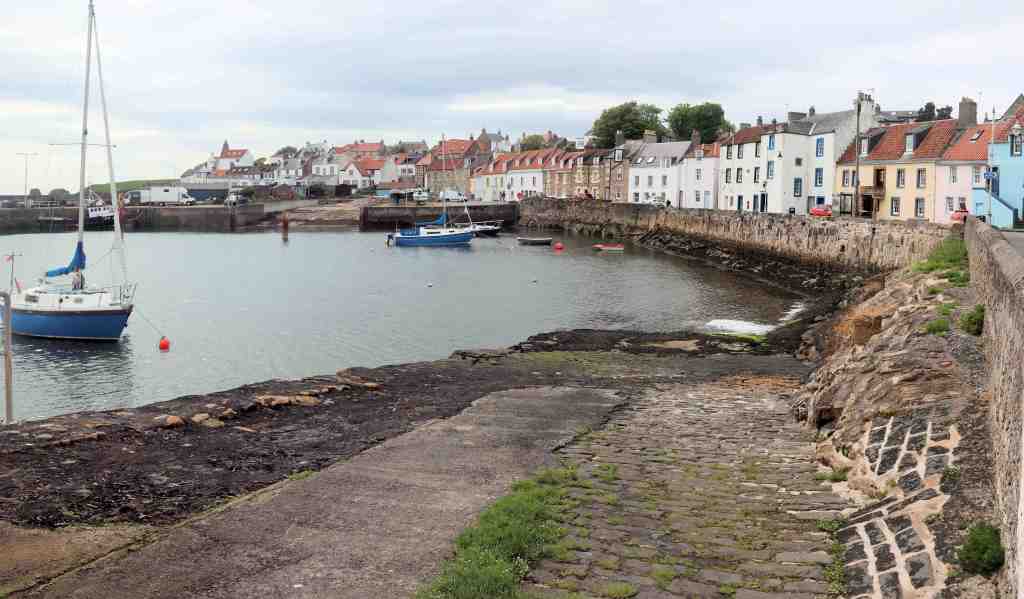
The picturesque harbour at St Monans
One of the fishing villages that caught our eye during our last trip to Scotland was St Monans in the county of Fife. The village is named for the eponymous 6th century saint who came from Ireland to Scotland to spread the teachings of Christianity. At its heart is the harbour, overlooked by traditional fishermen’s cottages, some with white walls, others colourfully painted. They date predominantly from the 18th and 19th centuries, and although most have since been significantly altered, their origins are clear if you know how to read the signs.
More harbour views…seems like another world born in London and resident for nearly 50 years in landlocked Derbyshire!
Many of the cottages are roofed with distinctive red pantiles. This style, which is found widely in villages on the east coast of Scotland, originated across the North Sea in the Low Countries (the Netherlands and Belgium). The pantiles were used as ballast on trading ships returning from mainland Europe, and were then adopted as roofing materials when the ships were unloaded at St Monans.
Pantiles can be seen on several of these cottages. Note also, on some of the roofs, the “crow-stepped” gables that are believed to have been developed to break up the airflow and protect the tiles from being blown off in a gale.
To my eyes, the most striking feature of some of these cottages is the forestairs, an outdoor staircase leading to a door on the first floor. Fewer than ten examples survive today, but in the past they would have been much more common. They hark back to the heydays of the fishing industry, when living accommodation would often have been on the first floor, above a boat store, workshop and sail store on the ground floor.
The outdoor staircases (forestairs) leading to doors on the first floor are an echo of the time when the residents of these cottages were fishermen.
Although it is the historic residential buildings that give St Monans its character, the church is also worthy of comment. It dates from 1369, and was originally founded by King David II of Scotland in gratitude for his having survived a shipwreck on the coast nearby. Originally built as a small house of Dominican friars, it was restored in the early 19th century and now serves as the local parish church. When viewed from most angles the church has the sea as its background. It is widely claimed to be the nearest to the sea of any church in Scotland.
A little further outside St Monans is the last remaining windmill in Fife, a relic of the salt industry. Large scale salt production began here in the late 18th century, and the windmill was used to pump seawater into the saltpans where it would be evaporated to reveal the finished product. The industry lasted only a few decades before closing down in 1825. The remains of the saltpans are unimpressive, little more than a few grassy mounds and depressions close to the shoreline. The windmill, however, has been restored and acts as a reminder of an industry that is unknown to most people today.
The (reconstructed) windmill, and the (barely visible) humps and bumps in the grass between it and the sea, are all that remains of a salt production industry that closed down 200 years ago.
By no stretch of the imagination could St Monans be described as spectacular. But there’s lots to admire there, including glimpses of a world and a lifestyle that is a total mystery to those of us who live our lives a very long way from the sea. Definitely worth a visit, if you’re ever in that part of Scotland.
For most British people, the early decades of the Industrial Revolution were a grim time to be alive. Conditions were horrendous. Workers routinely had to labour for 12 to 14 hours per day in harshly managed and often dangerous factories, for which they received a pittance in pay that was barely enough to cover basic necessities. And when they got home from their workplaces things got no better, as these workers usually lived in cramped, cold and insanitary accommodation provided by bosses who were motivated solely by the pursuit of profit.
Mill 3 replaced an earlier mill destroyed by fire in 1819. It now houses the site’s main exhibitions, including working mill machinery.
Let’s be honest, some early captains of industry were monsters who cared nothing for the welfare of the men, women and children upon whose lives they impacted. But not all of them. New Lanark in Scotland was proof that there were workable alternatives to rampant, exploitative capitalism.
The “new buildings” were constructed by David Dale as millworker’s housing in 1798. Robert Owen enlarged them as the village size increased.
Founded in 1785, New Lanark is a village in southern Scotland clustered around several cotton mills that harnessed the power of the River Clyde. Under the direction of joint founder David Dale (1739 – 1806), this was an entirely new settlement, built as accommodation for the millworkers and their families. New Lanark thrived. Within a decade of its foundation the village was home to one of the largest and most important cotton mill complexes of its period, employing around 1,500 people.
Prior to his involvement with the New Lanark project, Dale was a prosperous Glasgow-based cloth merchant. He was also a man with a conscience, someone whose philanthropic tendencies tempered, to some degree, his capitalist instincts. This was evidenced by his treatment of the orphan apprentices who worked at his mills – Dale ensured they were taught to read and write, were well fed, and were provided with clothing and decent accommodation.
Although the accommodation it provided was decent by the standards of the day, in the early years of New Lanark whole families lived in a single room.
In 1799 Dale’s daughter Caroline married Robert Owen (1771 – 1858), a Welsh-born industrialist and social reformer. Soon after, David Dale sold New Lanark to his new son-in-law, who formally took over as mill manager in 1800. Owen was committed to continuing the philanthropic approach to industrial working that Dale had initiated, and under his management New Lanark became a model community, emphasizing social welfare and improved living conditions for workers.
Robert Owen was a Utopian social reformer, who aimed to create a perfect, harmonious society in which poverty and unemployment were eliminated. Owen’s abilities as a business manager were central to the success of his social experiment, for it was the profitability of the cotton mills that provided the cash needed to finance schemes designed to improve the lives of his workforce. A vibrant and resilient community was central to his thinking.
Robert Owen’s School for Children was completed in about 1818, providing spacious classrooms for its students. Punishment was not allowed, with strategies of encouragement and kindness being adopted instead.
Owen’s intentions can be discerned from the creation of the Institute for the Formation of Character. Opening in 1817, it was intended to provide educational and recreational facilities for the whole community. Amongst these were a library and reading room, classrooms and halls for concerts and dancing. It also accommodated what is thought to be the world’s first nursery school.
These two photos offer a glimpse the types of mill machinery in use at New Lanark.
About a year after the opening of the Institute, work was completed on Robert Owen’s School for Children. Here’s what the New Lanark Trust has to say about this visionary initiative:
Owen spared no expense in building and equipping his school, and the curriculum included music, dancing and singing, as well as art, natural history, geography and world history. Punishment was not allowed. Instead, kindness, encouragement, and the fostering of children’s natural curiosity were deemed to be much more effective. [Source: New Lanark Heritage Trail – A guide to New Lanark’s Historic Buildings, 2008]
Owen’s idealism is also apparent from the way he set up his Village Store, which was completed in 1813. It effectively had a retail monopoly in the village, and many other industrialists used such arrangements to their financial advantage by providing poor quality goods at inflated prices. In contrast, Owen put the community’s welfare first, buying good quality food and household goods in bulk, and selling these to his workers at close to cost price. Any profits made were re-invested in the village, being put towards the running costs of the School.
Another view of Mill 3.
Robert Owen was clearly one of the good guys, and his enlightened methods attracted international attention. In 1824 he sold the New Lanark mills and moved to the USA, where where he planned to establish a Utopian Community or “Village of Unity and Mutual Cooperation” based upon the principles that had helped shape his grand Scottish project. However this experiment, based at the settlement of New Harmony in Indiana, proved largely unsuccessful and in 1828 he returned to the UK, financially much poorer but still optimistic that one day the rest of the world would come round to his way of thinking.
Owen’s legacy is now preserved by The New Lanark Trust, which was formed in 1974, six years after the final closure of the cotton mills. The village was one of the earliest examples of a planned settlement, where layout, housing design, and green spaces were carefully considered. Its architecture showcased a blend of practicality and aesthetics, emphasizing functionality while maintaining a pleasant environment. All of this can be enjoyed by visitors, who also have an opportunity to get up close to some of the machinery that drove the success of New Lanark’s cotton mills. Tourists can even visit Owen’s modest house, as well as examples of workers’ accommodation.
Although larger and grander than the homes of his workers, Robert Owen’s house is refreshingly modest for the owner of such a large and successful mill complex.
The Trust’s aim has been to restore the village as a living, working community, but one which also offers visitors tantalising glimpses of a lost world shaped by a remarkable man. A measure of its success was evident in 2001, when New Lanark was listed as a UNESCO World Heritage Site. The village and its cotton mills are now a major tourist attraction, and deserve to be visited by anyone with an interest in industrial history.




 Now I'm 64