Wordless Wednesday – Mellow yellow

Wordless Wednesday is a simple blog post featuring a photo. It seeks to convey a message, but speaks for itself without using words. Mrs P photographed this Yellow-throated Euphonia in Costa Rica in 2015.
Wordless Wednesday is a simple blog post featuring a photo. It seeks to convey a message, but speaks for itself without using words. Mrs P photographed this Yellow-throated Euphonia in Costa Rica in 2015.
A couple of weeks ago, keen for a bit of light relief, we drove west to Trentham Gardens in Staffordshire in search of Shaun the Sheep. UK-based readers will doubtless be aware of Shaun, who first appeared in the Aardman stop-motion animated film A Close Shave in 1995, alongside madcap inventor Wallace and his canine sidekick Gromit.

Following rave reviews of his role in A Close Shave, in 2007 Shaun was offered his own BBC series. Six series later, he is as popular as ever with younger viewers. He’s even made it onto Netflix, so he now has fans just about everywhere. You might not think it to look at him, but Shaun’s world famous, maybe the best-known sheep on the planet.

So what was Shaun doing in the gardens at Trentham, on the outskirts of Stoke? Once the site of a grand country house set in a landscaped park, in recent years the Trentham Estate has been redeveloped as a leisure destination. Visitor numbers are the name of the game, so who can blame bosses at Trentham for inviting the woolly-coated global superstar along to lend his support this spring?


The Find the Flock Trail featured 12 supersized colourful Shaun the Sheep sculptures, painted by local and regional artists. We set out to track down as many of them as we could while also enjoying views of the award winning gardens, including an oriental-style bridge and several whimsical sculptures featuring fairies.


Standing 160cm tall and brightly coloured, the sculptures were easy to spot. In no sense does a sculpture trail like this count as fine art, but it’s a load of fun…and don’t we all need some of that these days, when every news bulletin on television and radio assails us with more grim news. In a further attempt to cheer up the visitors, each sculpture’s plinth featured a corny sheep joke. Here are just a few of them:
Q: Where do sheep like to watch videos?
A: Ewe-Tube.
Q: What’s a lamb’s favourite car?
A: A Lamborghini.
Q: What sport do sheep like to play?
A: Baadminton.
Q: What do you get if you cross a kangaroo and a sheep?
A: A woolly jumper
Ha ha ha (I think)! I guess those jokes tell you all you need to know. There was nothing sophisticated about the Find the Flock Trail, but who cares? A good time was had by all.
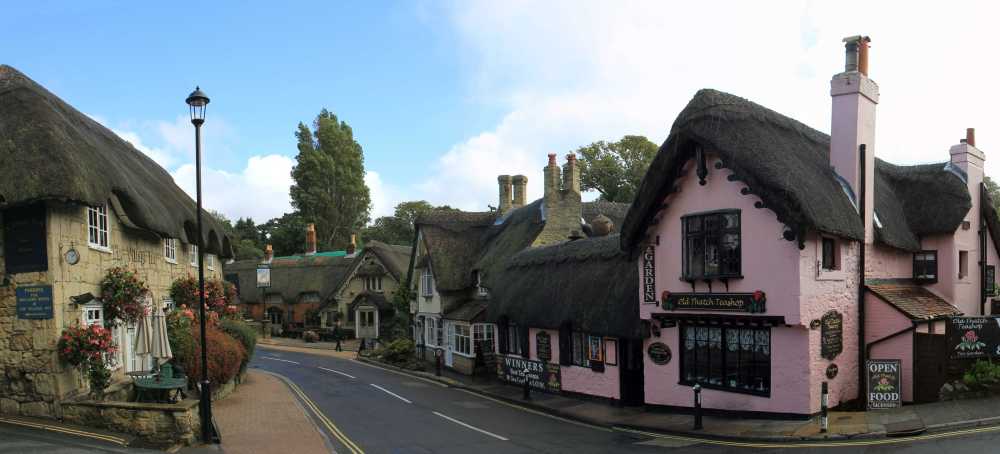
Wordless Wednesday is a simple blog post featuring a photo. It seeks to convey a message, but speaks for itself without using words. Mrs P photographed this improbably picturesque scene at Shanklin Old Village in 2015. The thatched buildings date from the early 19th century.

Wordless Wednesday is a simple blog post featuring a photo. It seeks to convey a message, but speaks for itself without using words. Mrs P photographed this grisly encounter between two iguanas in Costa Rica in January 2014.
Next Thursday (May 8) is VE (Victory in Europe) Day, when events will be held across the UK to mark the 80th anniversary of the end of World War 2 in Europe. The war dragged on in the Far East until August 1945, but from a domestic perspective, May 1945 was when the UK could begin to focus its attention on recovery from five and a half years of brutal conflict.
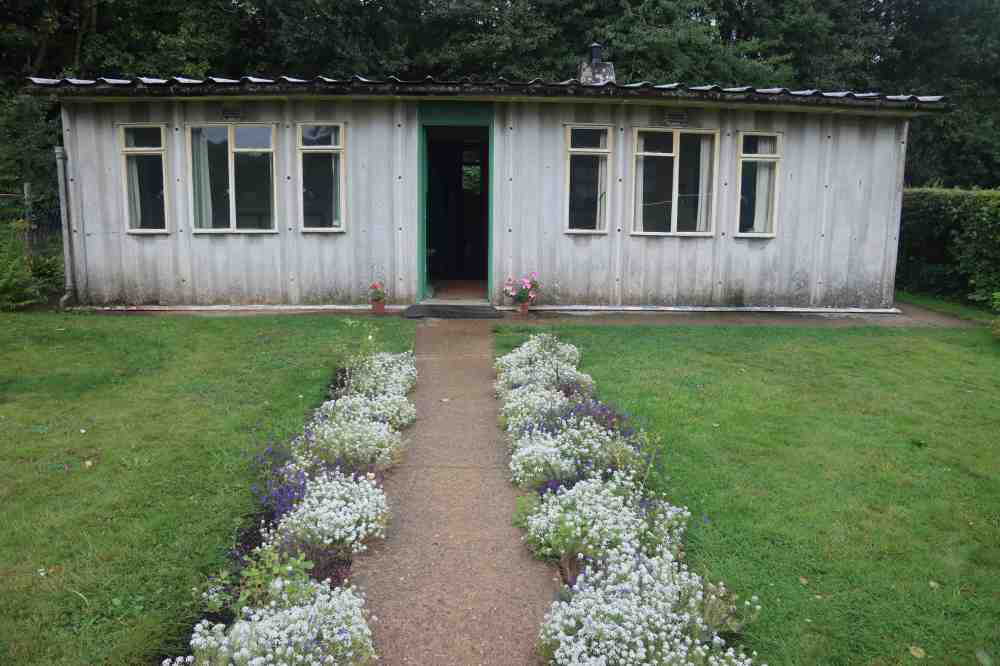
One of the main priorities at the time was to deal with a serious shortage of housing caused by German air raids, limited resources and adjusted priorities during the war years. Prefabs – prefabricated homes that are built in factories and then erected on site – were seen as an integral part of the solution.
The looming problem of post-war domestic housing was identified as early as 1942, with Prime Minister Winston Churchill declaring in a speech “The first attack must evidently be made upon houses which are damaged, but which can be reconditioned into proper dwellings…the second attack on the housing problem will be made by what are called the prefabricated, or emergency, houses.“

Although Churchill was no longer Prime Minister, around 156,00 prefab bungalows were erected between 1945 and 1949, spread across a mix of 18 different designs. The intention was that they should be a temporary solution, lasting around 10 years until they could be replaced with houses constructed in a more traditional way. However, many survived decades longer than this and a few are still lived in today. Others have found their way into museums, including the Chiltern Open Air Museum, where we were pleased to encounter one a few months ago.
The prefab on display at the museum dates from 1947. It was one of 46 erected on the Finch Lane Estate in the Buckinghamshire town of Amersham, a little way north of London. The bungalow is built from 26 asbestos cement panels bolted together on a wood and steel frame, all laid out on top of a concrete base. These days, of course, building with asbestos would be strenuously avoided, but back then asbestos cement offered a swift and affordable solution to a massive social problem.

The Finch Lane Estate was demolished in 1987. Recognising that the prefabs were an important part of local and social history, managers at the Chiltern Open Air Museum arranged for one to be dismantled and kept in storage. It was finally reconstructed at the museum in 1992/93 and fitted out as it might have looked in 1950, with furnishings appropriate to that period.

To our 21st century eyes they may appear small, drab, miserable buildings in which to live out one’s life, but the people who lived in prefabs often saw them very differently. They called them palaces!
Many prefab occupants had previously lived an uncomfortable existence in crowded cities like London, often in shared accommodation with outside toilets and no hot water system. Prefabs addressed these shortcomings, and came with a range of modern conveniences such as a refrigerator. There was even some garden space wrapped around the building in which kids could play and adults could grow fruit and vegetables to supplement whatever food they could afford to buy in the shops

They may have owed their origins to some of the darkest days in our modern history, but, ugly though they are from a modern perspective, prefab houses were an important step up for many ordinary folk. Visiting the museum’s prefab offers visitors a tantalising glimpse of a lost world, and an opportunity to reflect on our good fortune to live at a time when such buildings are reduced to simple museum curiosities.

Wordless Wednesday is a simple blog post featuring a photo. It seeks to convey a message, but speaks for itself without using words. We encountered this tiny Red-eyed Tree Frog in Costa Rica in January 2014.
I have written previously about Caramel, one of several neighbourhood cats who claim ownership of our garden. At that time he was still a little cautious, happy to take edible treats thrown towards him in the garden and pleased to have his ears fondled, but otherwise reluctant to get up close and personal with us. I’m delighted to report that our relationship has developed in recent months, and he is now a regular house guest at Platypus Towers.

Mrs P and I generally wake up shortly after 6am, and by 6:30 our need for the first cup of tea of the day is overwhelming. I make my way downstairs, flick on the kettle and make the necessary preparations. And then I glance through the kitchen window into the garden where, almost always, Caramel is waiting, peering up at me with a look that says “get your priorities right, man. Tea can wait but I can’t, so let me in NOW“.


I do my duty, and then call upstairs to advise Mrs P that her services are required. Caramel dashes into the house as soon as I open the door, meowing squeakily as he passes me, and leaps immediately onto one of the kitchen chairs. I grab a packet of Pawsome Pockets – “crunchy pillow treats with a soft centre” – and pass them to Mrs P, who is now sitting on the other kitchen chair directly opposite the ravenous feline. Her job is to feed him by hand, pillow by pillow. Caramel has no manners and gulps the treats down greedily, purring loudly in appreciation of his ill-gotten breakfast.

Eventually Mrs P decides that enough is enough, and explains this to her furry friend. He’s not pleased, but knows that his morning fun has only just begun. Jumping down from the chair he sprints into the hallway, then thunders upstairs towards the room that we call The Library.

I follow dutifully, grabbing Caramel’s ball on the way. It is about the size of a tennis ball, but soft and squishy. I throw it against the far wall of The Library, and Caramel chases madly after it. Having captured his quarry he does a flamboyant victory roll, flashing his undercarriage for all to see. I lower myself onto the floor next to him, ignoring the protests of my ageing knees, and rub his belly. Caramel is in ecstasy, and lets rip with purring so loud as to be totally out of place in any self-respecting library. But he’s not bothered, and keeps up the purring for as long as I keep up the rubbing.


Finally, he decides the floor is no place for a cat of his pedigree, so he gets to his feet and jumps up onto the sofa that is tucked into one corner of the room. I sit down next to him, and set about massaging his belly, his ears, his chin and his ego. This goes on for maybe 15 minutes before I decide that I really do need my breakfast. I tell Caramel he can wait for me, but he doesn’t like to be left alone as he suffers from a severe case of FOMO – Fear Of Missing Out! I head downstairs and he follows me back into the kitchen, where I dispense a few more Pawsome Pockets before persuading him that he really should nip back home and spend a few minutes with the people who believe they own him.
We’re sad to see him go, but the chances are he’ll be back again once or twice more during the course of the day. And if not, we know that we’re in for a repeat performance tomorrow morning. And the morning after that. And the one after that too…you know how it is with cats, when they recognise they’ve won!
* * * * *
Postscript – update on Malteser and Milky Bar

Malteser loves Pawsome Pockets, particularly if we hand-feed him
Regular readers of this blog will know that Caramel shares a house with two feline companions, known to us as Malteser and Milky Bar. I am pleased to report that they too are still doing well. Malteser visits most days, and also enjoys Pawsome Pockets and belly rubs. Sometimes he and Caramel come indoors together and Mrs P has to feed them both by hand, one treat for Malteser, then one for Caramel, then one for Malteser followed immediately by one for Caramel. And so on…

Milky Bar living his best life!
Milky Bar is more restrained, and never crosses the threshold into our house. He does, however, enjoy sunning himself in the garden and drinking from the watering can. He, Caramel and Malteser are wonderful characters, and their visits are amongst the highlights of our daily lives. Long may it continue!

Wordless Wednesday is a simple blog post featuring a photo. It seeks to convey a message, but speaks for itself without using words. Mrs P took this photo of punters on the River Cam, passing beneath the Bridge of Sighs (part of St John’s College at Cambridge University), in August 2019.
Almost 100 years ago, a despairing woman gave her husband an unwelcome ultimatum. I’ve had enough of your wretched model railway cluttering up the house, proclaimed Roland Callingham’s weary wife, either it goes or I go! Roland may have been an accountant, but he was no fool. He concluded that Mrs C had to be humoured, but no way was he willing to give up his much loved hobby.

The only solution was to compromise, so Roland determined that his model railway should be dismantled and relocated to the garden where it could blossom without spousal interference. And thus was born the mad but marvellous project that eventually became Bekonscot Model Village and Railway, residing in the market town of Beaconsfield a little way north of London.


Bekonscot Model Village and Railway occupies a garden covering 6,000 square metres (1.5 acres). These photographs show just small parts of it.
Freed from the limitations imposed by the size of his house and the scrutiny of his wife, Roland Callingham let his imagination run wild. Assisted by his loyal gardener Mr W. A. Berry, he set about building a model village through which his 1:12 scale model railway could run; a fantasy village full of happy villagers living in picturesque cottages and drinking in typically English pubs; a fantasy village in which the streets were spotlessly clean, the roads had no pot-holes and the trains always ran on time!


The Bekonscot Model Village and Railway first opened to paying members of the public in August 1929. It quickly became popular with tourists. Roland did not need the money it generated – he was an accountant, after all! – so the entrance fees were donated to the Railway Benevolent Institution and the Queen’s Institute of District Nursing. Today the attraction is operated by the Roland Callingham Foundation Charity, which continues supporting local charities. Its website proudly declares that, to date, it has raised over £21m (USD $28m) for various worthy causes.


In the early decades of its existence the attraction reflected changes in the world surrounding it, but in 1992 the decision was made to focus exclusively on life around the period that Bekonscot Model Village and Railway was originally created. Today Bekonscot is a snapshot in time, an ambitious representation of English life in the 1930s that includes several distinct villages linked by the railway, as well as a colliery, an airport, a zoo, a cathedral, a castle, a windmill, a horse race and a cricket match. The railway features no fewer than 12 stations, with colourful steam locomotives chugging happily between them.


I wonder what Mrs Callingham would have made of her husband’s legacy, almost a century after it all began? Would she have been annoyed that he had the last laugh, building an even bigger model railway – as well as several model villages – after she clearly instructed him to get rid of it altogether?


Maybe so, but I’d really like to think she would be proud that, in creating Bekonscot Model Village and Railway, her hubby successfully captured the essence of English eccentricity. It is a rare example of perfection in miniature, set in 6,000 square metres (1.5 acres) of garden. Mrs P and I spent a happy couple of hours there, but could easily have stayed much, much longer. Time for a return visit, I think.

Wordless Wednesday is a simple blog post featuring a photo. It seeks to convey a message, but speaks for itself without using words. Mrs P took this photo of the picturesque and peaceful Peggy’s Cove, Nova Scotia in June 2015.
 Now I'm 64