Wordless Wednesday is a simple blog post featuring a photo. It seeks to convey a message, but speaks for itself without using words. Mrs P took this photo of a Scottish Clydesdale horse on the Ford and Etal estate in Northumberland in 2024.
I was leafing through Mrs P’s immense back catalogue of photos, looking for something to post on Wordless Wednesday, when I happened across some images of what I like to think of as our Great Train Derailment. Travelling in Ecuador in the late 1980s was always going to be a bit of an adventure, but not for one minute did we expect that a train on which we were passengers would unilaterally decide to jump off the rails and continue its journey by bumping crazily down the track bed.
But first, a spoiler alert. Train derailments are a serious business; when they happen, passengers can get hurt. Sometimes people die. I’m pleased to confirm straight away that this was not the case when we were derailed in deepest, darkest Ecuador. No-one on that train suffered more than mild shock and temporary inconvenience due to the day’s events, and, as an unexpected bonus, passengers of a thoughtful disposition took away an important life lesson!
Our primary reason for visiting Ecuador was to take in the magnificent wildlife of the Galapagos Islands, but having made the effort to get to that distant South American land it would have been rude not to check out other parts of the country too. So we began by spending a few days in the Andean highlands admiring Spanish colonial architecture, visiting historic Inca ruins and wandering through colourful street markets, before taking a train bound for the coastal city of Guayaquil where we were due to catch a flight to the Galapagos.
The Ecuadorian railway system dates back to the latter half on the nineteenth century, and was devised to help unify the country by connecting the Andean highlands with the Pacific coast. This was a challenging project, a single track narrow gauge (1,067mm / 3 ft 6 in) railway covering 965km (600 miles) and reaching a maximum altitude of 3,609m (11,841 feet). The railway passes through huge tracts of wild, largely unpopulated country. As such it’s undoubtedly picturesque, but a long, long way from help if something goes wrong.
Sadly, also, the track was evidently not well maintained. Indeed today, most of the former Ecuadorian railway system is permanently closed due to severe flood damage caused by El Niño in 1997/98, and general neglect over many years as a result of the Pan American Highway attracting passengers away from rail to road. With the benefit of hindsight it’s probably no great surprise that, as our little train trundled through the remote Ecuadorian landscape, it jumped the tracks and ground to a shuddering halt, dragging its hapless coaches towards the same fate.
Having got over the initial shock, we passengers were dismayed. We were stuck in the middle of nowhere. It could be hours before anyone in Guayaquil even knew we had a problem, and getting help out to us would take much longer. It looked like we were in for a miserable few days.
The train crew, however, seemed a good deal less concerned. Indeed it quickly became clear that they were prepared for just such an eventuality as they retrieved various pieces of wood and metal from the cab, and positioned them around the wheels of the stranded locomotive. To these they added branches, sticks, rocks and grass collected from the surrounding area, and when they judged everything to be in place they began the delicate process of edging the locomotive back towards the rails, guided by their makeshift recovery kit. After a few centimetres, the wood, metal and branches needed to be re-positioned, at which point the locomotive was started up again.
This process went on for several hours, the crew displaying immense practical skill and enormous patience as they went about their challenging task. Eventually, astonishingly, without any assistance whatsoever from heavy lifting equipment or a rescue team, the locomotive and coaches were persuaded back onto the rails. The relieved and delighted passengers swiftly re-embarked, and our train continued its journey towards the coast.
What an adventure! And what an amazing bit of work by train’s crew. For me, there is a larger life lesson in the dramatic events of that day: life’s journey is rarely as straightforward as we would wish, and we will all get derailed from time to time. The important thing is not to feel sorry for ourselves and lament our ill luck, but rather to look for creative, practical solutions that will quickly put us back on track. Way to go, those guys!
.
Postscript – the photos
The photos accompanying this post are scanned from originals taken by Mrs P using a traditional 35mm film camera. You remember those days, the days when photography was a seriously expensive hobby, the days when – after you’d returned from your travels – you sent your precious rolls of film away to be developed and waited anxiously to see if the pictures you’d taken were any good. If our Great Train Derailment had happened yesterday, Mrs P would have taken hundreds of digital images during the recovery process and swiftly discarded 90% of them. But back then, with our financial resources somewhat constrained and the Galapagos still to be visited, she could spare only a few exposures to record this unanticipated episode in the Ecuadorian outback. Hopefully you’ll agree with me that they perfectly capture the drama of what unfolded that day.
Wordless Wednesday is a simple blog post featuring a photo. It seeks to convey a message, but speaks for itself without using words. Mrs P took these photos of meerkats at the Yorkshire Wildlife Park.
I guess that, to the uninitiated, Skara Brae looks to be nothing special, little more than a few stone walls and apparently random piles of rock partially buried in tussock-topped coastal sand dunes. Boring, I hear you mutter. But what if I told you that these are the preserved remains of a stone age village that is older than the Egyptian pyramids, a place that has been described as one of the most important prehistoric sites in Europe? There’s much more to Skara Brae than first meets the eye.
The Orkney Isles, lying off the windswept northern tip of mainland Scotland, are crammed full of important archaeological remains, of which Skara Brae is the most significant. The village is around 5,200 years old, and is therefore from a period classified as the Neolithic or new stone age. It is believed to have once been home for up to 100 people.
The site comprises a grouping of ten structures, including eight “phase 2” stone houses partially sunk into the ground. Their roofs have mostly disappeared over time, allowing the modern visitor to look down from the surrounding banks and see clearly the internal arrangement of the dwellings.
The houses were connected by covered passageways which allowed villagers to move easily between them, while still being sheltered from the worst of Orkney’s weather. This arrangement hints at the challenging existence of Skara Brae’s inhabitants, who scratched a living through a combination of fishing, gathering shellfish and wild plants, cultivating a few crops and raising livestock.
What makes Skara Brae particularly remarkable is its state of preservation. The site was buried under sand for thousands of years, and was only rediscovered in 1850 after a violent storm helped strip that sand away. This revealed the 8 domestic dwellings, each house comprising a single room about 40 square metres in area. In addition the houses each boasted several pieces of stone furniture, including an eye-catching “dresser” – which was perhaps used to display highly valued possessions – two box beds and a central hearth.
Archaeological excavations have also revealed a range of artefacts and adornments scattered throughout the village, including tools, pottery, jewellery, and carved stone objects. There were even some gaming dice, which must have helped keep the villagers occupied at times when the foul Orkney weather prevented activities that were more productive.
Skara Brae was abandoned around 2,500 years ago. The reason is unclear; possibly a single, violent sandstorm made it uninhabitable, or perhaps it was as a result of a more gradual process of migration to another location that offered the prospect of an easier life. We’ll never know for sure, but what the villagers left behind gives modern day visitors like me and Mrs P a tantalising glimpse of day-to-day life in Orkney several thousand years ago, a life that was totally different but no less remarkable than that of Tutankhamun, Cleopatra and their Egyptian pals
Wordless Wednesday is a simple blog post featuring a photo. It seeks to convey a message, but speaks for itself without using words. Mrs P took this photograph from the Bay of Skaill on the Mainland of Scotland’s Orkney Islands in 2023.
We have recently been travelling, spending nearly three weeks north of the border in Scotland. We had a good time there, visiting old haunts and exploring new ones, but although it’s great to be back home again our return is tinged with anxiety – will the cats forgive us for abandoning them?
Caramel, aka the Ginger Ninja
Regular readers of this blog will know that, although we have no cats of our own, Mrs P and I have a close relationship with several of the local neighbourhood felines. They all lay claim to our garden, though they graciously allow us to use it too, and the most brazen of them – Malteser and Caramel – also enjoy prowling through the house, demanding regular attention, edible treats and loving belly rubs. Our role is simply to attend to their needs, and they are certain to be unhappy that we have recently been neglecting our duties.
We arrive home late afternoon on Tuesday, and I scan the garden hopefully. It’s an overgrown mess – no surprise there, given my lack of enthusiasm or talent for gardening – but it’s also a cat-free zone. Tomorrow, maybe?
Milky Bar, handsome but aloof
But Wednesday comes and goes with minimal feline activity. Milky Bar passes through, eyeing me up as he does, but not bothering to say hi. He’s an aloof cat who rarely greets us these days, but I’d hoped he’d at least acknowledge our return with a few well-directed purrs.
Thursday brings an unexpected visitor, neighbourhood wide-boy Cadbury. Our other feline friends all live together, but Cadbury is a new arrival from the other end of the estate. When he encounters Milky Bar, Malteser or Caramel hackles are raised on both sides, and the air crackles to sounds of mutual hissing and yowling. We wish Cadbury no harm, of course, but our affections lie with his feline opponents, so we shed no tears when he leaves.
Cadbury, the neighbourhood wide-boy
At last, on Friday morning, Caramel arrives. I’m in the kitchen making an early morning cup of tea, and glance through the window to see the ginger ninja – as we sometimes refer to him – peering hopefully into the garden pond. He’s clearly hoping to have a goldfish for breakfast, but the netting I installed years ago frustrates him once again.
Looking up, Caramel spots me watching him. The reaction is immediate. He meows several times, leaps onto the garden seat that sits beneath the kitchen window, and from there onto the window ledge. With his nose pressed up against the glass he stares in at me intently, checking me out. I can read his mind: Is it really you? Really? After all this time?
I cross to the door, and the moment I open up he dashes in, meowing furiously while rubbing himself against my legs. Where have you been? he demands. Abandoning me like that is unforgiveable. However, if you were to give me a large helping of Pawsome Pockets, I just might let you off this time! And with that he hops up onto one of the kitchen chairs, gazes cutely into my eyes and waits to be hand-fed. Mrs P joins us and together we give Caramel the breakfast to end all breakfasts.
When he’s done feeding our feline pal exits the kitchen, runs upstairs and stretches out on the comfy sofa in our library room. I sit next to him, and spend the next 30 minutes cradling his head, massaging his ears and rubbing his belly. Caramel purrs loudly, eyes closed, ecstasy oozing out of him. It’s just like the old days, before the trip to Scotland. Plainly, we’re forgiven.
Malteser in heaven
Malteser, however, waits until Saturday to dispense forgiveness. I spot him in the garden, sitting on the fence and peering disconsolately into the house. As soon as he sees me he perks up. I open the door to let him in and greets me with a friendly meow. I reach for the packet of Pawsome Pockets and he begins to purr loudly, clearly delighted that normal service has been resumed after a gap of three weeks. When he’s done eating he presents his belly and I rub it tenderly, and then do the same to his ears. He’s in heaven, and Mrs P and I are officially forgiven.
In all, it has taken nearly four days to rebuild the relationship with all our visiting cats. The bad news for them is that we’ve got a busy summer ahead, and will be going away several more times. With luck they will take pity on us, and we will quickly be forgiven for abandoning them again and again. Hopefully…
Wordless Wednesday is a simple blog post featuring a photo. It seeks to convey a message, but speaks for itself without using words. Mrs P took this photograph at the Utah Golden Spike National Historical Park in 2018
Wordless Wednesday is a simple blog post featuring a photo. It seeks to convey a message, but speaks for itself without using words. Mrs P photographed this Yellow-throated Euphonia in Costa Rica in 2015.
A couple of weeks ago, keen for a bit of light relief, we drove west to Trentham Gardens in Staffordshire in search of Shaun the Sheep. UK-based readers will doubtless be aware of Shaun, who first appeared in the Aardman stop-motion animated film A Close Shave in 1995, alongside madcap inventor Wallace and his canine sidekick Gromit.
Following rave reviews of his role in A Close Shave, in 2007 Shaun was offered his own BBC series. Six series later, he is as popular as ever with younger viewers. He’s even made it onto Netflix, so he now has fans just about everywhere. You might not think it to look at him, but Shaun’s world famous, maybe the best-known sheep on the planet.
So what was Shaun doing in the gardens at Trentham, on the outskirts of Stoke? Once the site of a grand country house set in a landscaped park, in recent years the Trentham Estate has been redeveloped as a leisure destination. Visitor numbers are the name of the game, so who can blame bosses at Trentham for inviting the woolly-coated global superstar along to lend his support this spring?
The Find the Flock Trail featured 12 supersized colourful Shaun the Sheep sculptures, painted by local and regional artists. We set out to track down as many of them as we could while also enjoying views of the award winning gardens, including an oriental-style bridge and several whimsical sculptures featuring fairies.
Standing 160cm tall and brightly coloured, the sculptures were easy to spot. In no sense does a sculpture trail like this count as fine art, but it’s a load of fun…and don’t we all need some of that these days, when every news bulletin on television and radio assails us with more grim news. In a further attempt to cheer up the visitors, each sculpture’s plinth featured a corny sheep joke. Here are just a few of them:
Q: Where do sheep like to watch videos? A: Ewe-Tube.
Q: What’s a lamb’s favourite car? A: A Lamborghini.
Q: What sport do sheep like to play? A: Baadminton.
Q: What do you get if you cross a kangaroo and a sheep? A: A woolly jumper
Ha ha ha (I think)! I guess those jokes tell you all you need to know. There was nothing sophisticated about the Find the Flock Trail, but who cares? A good time was had by all.
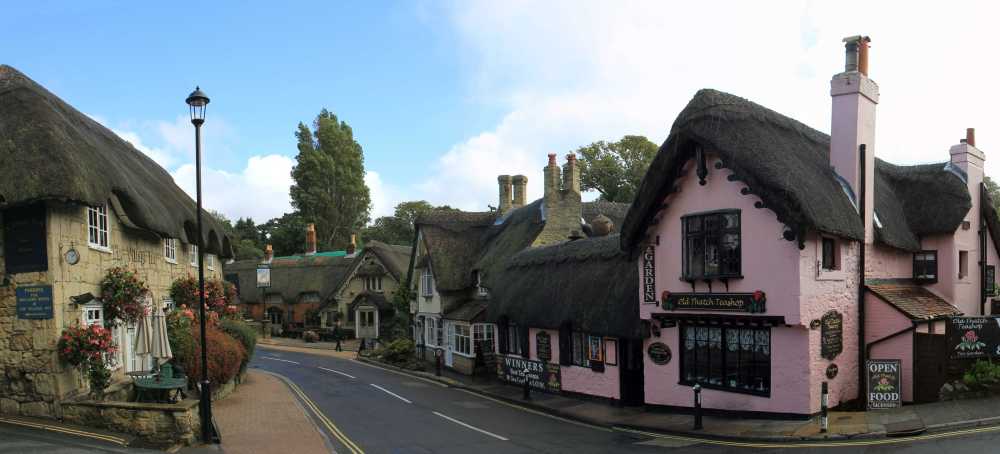
Wordless Wednesday is a simple blog post featuring a photo. It seeks to convey a message, but speaks for itself without using words. Mrs P photographed this improbably picturesque scene at Shanklin Old Village in 2015. The thatched buildings date from the early 19th century.


 Now I'm 64