Wordless Wednesday is a simple blog post featuring a photo. It seeks to convey a message or tell a story, but speaks for itself without using words. Mrs P took these photos of a colourful fishmarket in 2013, at the town of Diu in the Indian state of Gujarat.
In a previous post about our 2025 visit to London I described a journey downriver on the Thames from Westminster Bridge to Woolwich. On a different day we took another boat trip, this time heading upriver. The plan had been to visit the historic Hampton Court Palace, once the home of King Henry VIII. Sadly this proved impossible due to repair work being undertaken at Teddington lock, but nevertheless – despite the relentlessly gloomy weather – we decided to take the boat upriver to Kew to view this area of London from an unfamiliar angle.
The Vertrouwen is a Dutch barge dating from 1929. It is now moored at Dove Pier in Hammersmith.
In common with most cities, London is a mixture of the good, the bad and the ugly. Mostly ugly, of course, but the river journey did reveal a few interesting bridges, boats and buildings. Although I grew up in the capital, most of the sights were new to me, but a few – such as Hammersmith Bridge – were achingly familiar.
Hammersmith Bridge
An elegant suspension bridge that opened in 1827, Hammersmith Bridge is etched into my memory. Over half a century ago I attended school in this part of London, and can clearly remember our class being sent on “cross-country” runs – following a route that included crossing the bridge – by a teacher who was clearly allergic to teaching in the conventional sense. These days the bridge is closed to all motor traffic due to the appearance of cracks in its pedestals, but foot traffic (including, I imagine, cross-country runners!) can still cross here.
Hammersmith Bridge
One of the most recognisable buildings we saw during our trip upriver was Battersea Power Station. Built in two phases between 1929 and 1955, the coal-fired power station once produced a fifth of all the electricity used in London, keeping the lights on in buildings as illustrious as Buckingham Palace and the Houses of Parliament.
Battersea Power Station ceased operations in 1983, when the generating equipment began to wear out and oil, gas and nuclear fuels started to be preferred over coal for the generation of electricity. Demolition would have been the obvious next step, but the building’s iconic appearance on the London skyline resulted in it being given listed status in recognition its heritage value.
Battersea Power Station
For over 20 years the former power station remained unoccupied. It fell into disrepair, before plans were agreed to redevelop the site to include residential accommodation, bars, restaurants, offices, shops and entertainment spaces. When viewed from the Thames there is little indication today of what now lies within, but it’s easy to see why such an imposing structure captured the imagination of several generations of Londoners.
We had been fully expecting and were looking forward to seeing Battersea Power Station, but another nearby building took us totally by surprise. Just a few hundred metres upriver from the power station is the Peace Pagoda, one of around 80 similar structures built across the world since the end of the Second World War. They owe their origin to the Japanese Buddhist monk Nichidatsu Fujii (1885-1985), who devoted his life to promoting non-violence after an inspirational meeting with Mahatma Gandhi in 1931.
The Peace Pagoda in Battersea Park
The first Peace Pagoda, which was intended as a focus for people of all races and creeds to help unite them in their search for world peace, was inaugurated in the Japanese city of Kumamoto in 1954. The Battersea Peace Pagoda dates from 1985, and was built by a group of 50 volunteers who were members of the Japanese Nipponzan-Myohoji Buddhist order that had been founded by Fujii.
Taking off from London Heliport
Journeying through London on the Thames proved to be the perfect way to escape the chaos of the capital’s road network for a while, but travel by boat does not suit everyone. If you’re in a hurry, filthy rich and don’t give a damn about noise pollution, you can travel to and from central London by helicopter. London Heliport’s website proclaims that it offers “ultimate comfort and convenience” by acting as “the vertical gateway to London for VIPs and the business community for over 50 years.” Plainly it’s not for the likes of me and Mrs P, but we were interested to watch a helicopter taking off as our boat passed the heliport. It reminded us – as if we needed reminding! – why we would hate to live in London.
These images show a few of the other sights we witnessed during our upriver excursion. Top Left: “The Powerhouse”, a former power station converted into luxury apartments. Top Right: former Dutch barge the “Amethyst Atoll”, now moored at Dover Pier, Hammersmith. Middle Right (top): Kew Bridge. Middle Right (bottom): Unidentified boat moored at Chiswick. Bottom Right: Lambeth Bridge. Bottom Left: “Houses on the Strand” at Kew. All very interesting, but I definitely wouldn’t want to live here!
Wordless Wednesday is a simple blog post featuring a photo. It seeks to convey a message or tell a story, but speaks for itself without using words. Mrs P was clearly seeing double when she took this photo at Yellowstone National Park in September 2018.
The plan was simple – take a leisurely drive up to the west coast of Scotland, catch the ferry and then spend some quality time on the islands of Islay and Jura. We’d never visited either before, but they promised so much – beautiful scenery, bewitching wildlife, numerous whisky distilleries and, above all, a bit of peace and tranquillity, away from the hurly burly of our daily existence. Only it didn’t quite work out that way…
Red deer stag at Inverlussa, Jura – Such a handsome chap!
The drive north was uneventful, but things began to go wrong as soon as we arrived on Islay, the southernmost island of the Inner Hebrides. We had rented a cottage, and it didn’t live up to expectations. I’ll not bother you with the details, just believe me when I say we were not at all happy.
Kilchoman church, Islay – in the middle of nowhere!
But things were about to get a whole lot worse. After less than 48 hours on Islay a medical issue forced us to seek urgent advice. Our cottage was in a very remote location; there were no neighbours we could turn to for support, and we ended up speaking by phone to a doctor in Inverness, around 200 miles (320km) away. He diagnosed the problem, and referred us to the local hospital where we could pick up some medication. Up until this point I’d absolutely no idea there was a hospital on the tiny island of Islay!
Tarbert Bay, Jura
We set off after midnight, struggling to find our way in pitch darkness along roads that could have been in contention for the national “pothole of the year” award if such a thing existed. Eventually we found the hospital and picked up the medication.
The Paps of Jura
Fortunately the medication soon started to do its job. We took things fairly easy for the next couple of days while recovery was underway, and even managed a day trip to the nearby island of Jura. Islay and Jura were beginning to live up to their reputations, despite our discomfort.
Isla is famous for its distilleries that produce peaty, single-malt whisky. This is the Ardbeg Distillery
And then, just as we were picking up the pace again, we got a phone call. A family emergency had arisen, and we were needed back home as soon as possible. Frantic phone calls followed as we sought to cancel the other accommodation we had lined up for later in our trip, and to rearrange our ferry booking in order to get us back to the Scottish mainland as soon as possible. Luckily, everyone we spoke with was sympathetic and helpful. Although we needed to rise from our beds at 4.45am we did get safely back home to Derbyshire the next day, after around 17 hours travelling. What a nightmare!
Highland Cow at Sanaigmore Bay, Islay
Needless to say, in many ways it’s a holiday we’d rather forget. But having said that, both Islay and Jura appeared to have a lot to offer. They seemed like “our sort of place”, and in other circumstances our memories would doubtless be overwhelmingly positive. So we have tentatively agreed that we need to go back and to make some new memories, and thereby delete from our minds the nightmare that was Islay and Jura in 2025. Not this year, but probably before too much longer. Watch this space!
Wordless Wednesday is a simple blog post featuring a photo. It seeks to convey a message or tell a story, but speaks for itself without using words. In celebration of the New Year, and in the hope that 2026 will be more joyful and less depressing than 2025 (not difficult!), I share this image of sunrise over Canyon Village in Yellowstone National Park. Mrs P took the photo in September 2018.
A few days ago we took an evening trip to Twycross Zoo to spend a bit of time with the Gruffalo and his pals. The Zoo is highly regarded for its work on the protection and breeding of endangered species, particularly primates, but the Gruffalo is a recent addition to their collection! He will be staying at Twycross for just a few weeks, and so was attracting a lot of interest.
The Gruffalo eyes up the mouse, probably thinking “mmm, looks tasty!”
If you’re not familiar with it, The Gruffalo is a world famous children’s picture book written by English author Julia Donaldson and illustrated by German artist Axel Scheffler. First published in 1999, the book has been translated into over 100 languages and has sold over 13.5 million copies worldwide. The story was later made into a 30-minute animated film and has been adapted into several stage productions. A follow-up book, The Gruffalo’s Child, was published in 2004 and has also proved to be hugely popular. This much-admired youngster also made a guest appearance at Twycross, alongside his even more famous father.
The mouse fights for his life by telling the owl about his fierce protector, the Gruffalo.
The plot of The Gruffalo is simple: a mouse takes a walk through the woods in search of food, where he meets three animals – an owl, a fox and a snake – each of whom would like to eat him for dinner. In order to escape the mouse invents a scary story, telling each predator that he is on his way to meet the fierce and fearsome Gruffalo, who will be very very displeased if anything bad happens to him. And so the mouse is released unharmed, but is then shocked to meet a real, live Gruffalo who also fancies snacking on mouse.
Left: The Gruffalo’s child encounters the fox. Top Right: The Gruffalo and his child in earnest conversation. Bottom Right: The Gruffalo snuggles up to his child – maybe he’s not so fierce after all?
Can the little mouse survive the terrible tusks, claws, teeth, and jaws of the horrid Gruffalo? To find out what happens next, you’ll just have to track down a copy of the book! Maybe your local library will have one?
North American Wilds zone: salmon leap, while a beaver watches
It’s no surprise that the Gruffalo has become an iconic character in children’s literature, and so it is also no surprise that Twycross Zoo chose him to lead their special Lanterns of the Wild Christmas event. The mile (1.6km) long trail was lit by more than 2,000 vibrantly coloured lanterns, all carefully designed and deployed to dazzle the eyes and stimulate the imagination. But it wasn’t all about the Gruffalo. The trail also featured lantern dioramas of 10 environmental eco-zones, including lush rainforests, icy tundra and deep oceans.
North American Wilds zone: the carved presidents of Mount Rushmore watch over wildlife typical of the American Plains, including bison and elk, while a wolf howls from the mountain top.
Each eco-zone starred some of the wonderful wildlife found in that part of the world, making a clear link with the zoo’s primary mission. As well as being bright and cheerful, some of the dioramas were highly imaginative, such as the beaver dam in the North American Wilds zone, a dam over which salmon were attempting to leap while baffled beavers looked on. A second diorama of the North American Wilds featured the iconic carved heads of former US presidents at Mount Rushmore, complete with local wildlife including elk, bison and a wolf.
Tigers are the stars of the Asian Jungle zone
A third diorama that particularly caught my eye was the Asian Jungle eco-zone, in which majestic tigers were the stars of the show. Many years ago Mrs P and I were fortunate to visit India to watch wild tigers, and when I saw the lanterns at Twycross the memories came flooding back.
The Polar Realms zone
We were not alone as we walked the lantern trail. Visitors were there in huge numbers, all them seeking a bit of colourful pre-Christmas entertainment. Hopefully the event raised lots of additional, much needed income for Twycross, and maybe also raised its profile amongst people who previously knew little about the Zoo’s efforts to support wildlife conservation across the globe.
The lanterns featured colourful flowers as well as impressive wildlife.
Bodies like Twycross Zoo play a vital role in species conservation, and in educating the public on conservation issues. Well done to the management for coming up with this seasonal initiative to help get their message across; if the numbers and reaction of people on the night is any guide, Lanterns of the Wild was a big success. The word on the streets is that there will be another lantern trail next Christmas, although probably without the Gruffalo. If there is, Mrs P and I will be keen to support it, Gruffalo or no Gruffalo.
Christmas is fast approaching, and to mark the festive occasion enterprising folk up and down the land have been getting out their chainsaws to chop down fir trees. And other people have been coughing up good money to buy those trees, with a view to decorating them with twinkly lights, sparkly decorations and shiny tinsel. But in just a few weeks time it will all be over, the dead trees will be unceremoniously dumped and the lights, decorations and tinsel will be packed away until next year. So just why is it that we feel the need to celebrate Christmas by butchering fir trees, bringing them into our homes and festooning them with random gaudy embellishments?
Christmas trees seen in the State Dining Room at Harewood House, 2024
Christmas marks the birth of Christ the Lord, but Christmas trees have their origins in pre-Christian, pagan times. Long before the birth of Jesus numerous civilisations, including the Egyptians and the Romans, used branches of evergreen fir trees to decorate their homes, thereby celebrating the endurance of life through hard times. Doing so symbolised hope, resilience, and the promise of spring, presumably lifting people’s spirits during the dark winter months. The practice survived in various forms for many centuries.
Seen at Castle Howard in 2025. The tree is 28 feet high, dressed with 3,000 decorative baubles and a 1km string of twinkling lights
In the 16th century German Christians began decorating trees in their homes. Legend has it that the Protestant reformer Martin Luther was the first to place candles on an evergreen. Inspired by the stars shining through the trees on a winter’s night, he is said by some to have created humanity’s first “Christmas lights.” While attributing to Martin Luther such a pivotal role in the evolution of the Christmas tree seems to me a bit fanciful, there is no doubt that the idea took off in Germany at around this time. And it is from Germany that the tradition of Christmas trees arrived in the UK.
Christmas at Harewood House, 2024
The first Christmas trees here in the UK were thanks to Charlotte, the wife of King George III. Having been born and raised in Germany, Christmas trees were clearly close to her heart, so it is no surprise that Charlotte sought to introduce the tradition to the British royal court. The first recorded example in England was in December 1800, when she arranged for a large, decorated yew tree to be the centrepiece of a children’s party at Queen’s Lodge, Windsor.
Festival of Trees at St Mary and All Saints church, (better known as the Crooked Spire), Chesterfield, 2021. Over 100 Christmas trees were on display, created by local groups and organisations. The white tree in the middle is by a local jewellers shop, whilst to its left is one by an alarm company and is decorated with PIR sensors!
Despite Charlotte’s best efforts, however, Christmas trees did not catch on, and it was left to Queen Victoria – George III’s granddaughter – to succeed where she had failed. Victoria and her husband Prince Albert were big fans of Christmas, and having been born in Germany the Prince would have been steeped in the tradition of placing decorated fir trees at the heart of the festive celebrations.
Festival of Trees, Chesterfield, 2021, The tree nearest the right is cleverly made to look like a wedding dress, with a lace bodice on top and the greenery below forming the skirt. Needless to say, it was created by a bridal shop. The one next to it is by a greengrocer, and so is decorated with fruit.
Thanks to their efforts Christmas trees were enthusiastically accepted by high society, from whence the practice filtered down to the masses. Initially the trees were used as table decorations, as they were quite small. But when it became possible to source bigger trees from overseas, or to rear them here in the UK, the practice began of standing them on the floor and arranging presents beneath them. Gathering around the tree became a big thing, a time when families united and enjoyed one another’s company.
Festival of Trees at Dronfield, 2025. This tree is made by Oaks Community Church using egg boxes as the spokes of the tree, decorated with fruit and vegetables.
Today Christmas trees can be found in huge numbers in both private homes and public spaces, but these days it’s not necessary to kill a living tree in order to join in the fun. Wooden, candle-lit tree-shaped pyramids were used by German Moravian settlers in colonial America in the 1700s. But the move towards artificial trees really began in late 19th century Germany as a response to deforestation. These were initially created from dyed goose feathers, which was great news for fir trees but perhaps not so great for geese!
Festival of Christmas Trees, Chesterfield, 2025. Decorations were by made by Banner Jones solicitors from knitted woolly (beanie) hats which will be passed on to 4 local charities.
Another big step forward took place in the USA in the 1930s, when the Addis Brush Company (USA) predicted the principles of recycling – and demonstrated a good eye for a business opportunity! – by using leftover brush bristles to create trees. A little later aluminium trees became popular, but by the end of the 20th century PVC plastic trees were the market leaders. So there, in a nutshell, we have the great 21st century Christmas tree dilemma – do we chop down living fir trees and contribute to deforestation, or do we make artificial trees out of a material that will litter the planet for centuries to come? We are, as the saying goes, between a rock and a hard place when it comes to the future of Christmas trees.
Festival of Christmas Trees, Chesterfield, 2021. This tree was created by the church bellringers, and features both the bell pull and bells.
But for now, Christmas trees – artificial or “real” – remain hugely popular. In recent years we’ve noticed an increase in the number of Christmas tree festivals, community events featuring hundreds of trees that are the work of local groups and organisations. Some of these are clearly motivated by commercial considerations, local businesses calculating that this is a cheap and effective way to advertise themselves and their wares. Others are the work of volunteer-led community organisations and public services seeking to promote their activities to a wider audience.
Festival of Christmas Trees, Chesterfield, 2021. This tree was created by the local cricket club.
Almost without exception these trees are artificial, but what makes them stand out is their unusual construction and decoration. One of the joys of Christmas tree festivals is the wacky inventiveness of the people who create the trees, such as the upside-down tree that was the brainchild of Chesterfield’s branch of Specsavers opticians. The Chesterfield branch is part of a multinational optical retail chain with the slogan “should have gone to Specsavers”, a chain whose long-running marketing campaign is centred around illustrating what misfortunes might come your way if you don’t get your eyesight tested…such as failing to notice that your Christmas tree is upside-down!
Festival of Christmas Trees, Chesterfield 2021. “Should have gone to Specsavers!”
In other examples from the Chesterfield Festival of Trees we have seen a Christmas tree made from golf clubs (yes, you guessed it, the organisation responsible was the local golf club!), a Christmas tree made out of copper pipes (courtesy of the plumbing course at a local college) and a little Christmas tree made out of empty egg cartons loaded with colourful fruit and vegetables for decoration. And we’ve even seen Christmas trees decorated with woolly (beanie) hats, church bell pulls, and cricket balls. Crazy!
I’m tempted to say that you couldn’t make it up, but clearly someone has! It’s easy to be cynical about the commercial aspects of the 21st century Christmas, but Christmas tree festivals counteract this by spreading good cheer at a time when most folk are feeling hugely stressed. Happy Christmas, everyone!
It’s that time of year again, when stately homes up and down the land get dressed up in Christmas finery, and members of the public pay handsomely for the privilege of seeing what they’ve been up to. Some take a general, untargeted approach, and assume that a few brightly decorated trees and random reindeer, wise men and shepherds will be sufficient to get their visitors into the Christmas spirit.
Others take it a lot more seriously, spending a small fortune on themed light and sound installations that seem to have more to do with extravagant showmanship than with the spiritual origins of the festival. This year Castle Howard, a grand mansion in Yorkshire, has gone for it big time, playing host to no less than the Wizard of Oz over the festive period.
OK, it’s time for a confession: the Wizard of Oz is a total mystery to me. I’ve never read the book, nor have I seen the movies. The only Yellow Brick Road I’m familiar with is the one Elton John sings about, and neither tin men nor cowardly lions have ever crossed my path. But hey, it’s never too late to learn!
Dorothy’s House after the tornado
The tour began with a visit to Dorothy’s house after it has been trashed by the tornado. It looked surprisingly convincing, and puts me in mind of some of the near derelict buildings Mrs P and I occasionally encountered on road trips around remote corners of the US. Happy days!
Along the Yellow Brick Road to the Emerald City, lined with giant hand-made poppies.
And then we stepped out onto the yellow brick road, making our way to the Emerald City by way of a corridor that had been magnificently transformed by the Castle Howard team, who worked long and hard to create 64 giant handmade poppies and various other floral decorations. The coloured lighting added an extra dimension, and made the whole thing eerily attractive.
Christmas tree in the Great Hall, a.k.a. the Emerald City
Soon we were in the Great Hall, dominated by a Christmas tree that is 28 feet (8.5 metres) high, a tree that had been dressed with 3,000 decorative baubles as well as 1km string of twinkling lights. It took the dedicated team three days of hard work to decorate the tree, but it was clearly worth the effort. Most visitors took a selfie in front of it, so it is amazing that Mrs P managed to take her photo without a single person in view. She has the patience of a saint, does Mrs P, though it doesn’t stop her grumbling about people standing between her camera and her proposed subject!
A performance artist puts on a show in the Emerald City’s high street.
In an area of the castle that had been converted into the Emerald City’s High Street an exuberant performance artist engaged joyfully with visitors young and old, as well as performing some gymnastic exercises that made my eyes water. My body was never, ever even half that supple! I don’t know if this lady was portraying a character from the original Wizard of Oz, but in my book she was a superstar. Move over, Judy Garland!
The Cowardly Lion
And then, as we progressed through the rest of the castle, we met some other characters who were most definitely part of the original tale. The cowardly lion looked nervous, as might be expected given the huge numbers of visitors wandering past his bed, and the scarecrow seemed baffled by what was going on all around him. The tin man, however, seemed unconcerned by the suffering of his two colleagues; in fact he came across as totally heartless!
The Scarecrow
There was plenty more to enjoy as we explored Castle Howard’s take on the Wizard of Oz, including various spectacular sound and video creations. Overall, the installation proved to be a wonderful piece of escapist nonsense. On doing some research after our visit I’ve learned that some scholars believe the Wizard of Oz to be a work of great depth that contains within it important messages about life, the universe and everything. My gut feeling is that they’re overthinking it: surely Frank L Baum’s wacky story, originally written in 1900, is meant to entertain, and from what I saw during our visit it does just that. However I would add that, while I have absolutely no idea what Mr Baum was drinking when he wrote his novel, I would be delighted to get hold of a bottle (or two!).
Our recent trip to London to watch a sumo tournament also gave us the opportunity to act like regular tourists for a while, ticking off a few things that have been on Mrs P’s list for many years. One of these was to take a boat trip along the River Thames, downriver from Westminster and through the Thames Barrier. Although I’m a Londoner by birth, I don’t usually enjoy the experience of re-visiting a city that I find crazily crowded and annoyingly noisy. Travelling through it by boat, however, offered the opportunity of a different perspective, more scenic and less frenetic, so although on our chosen day the weather was relentlessly gloomy I was keen to give it a try.
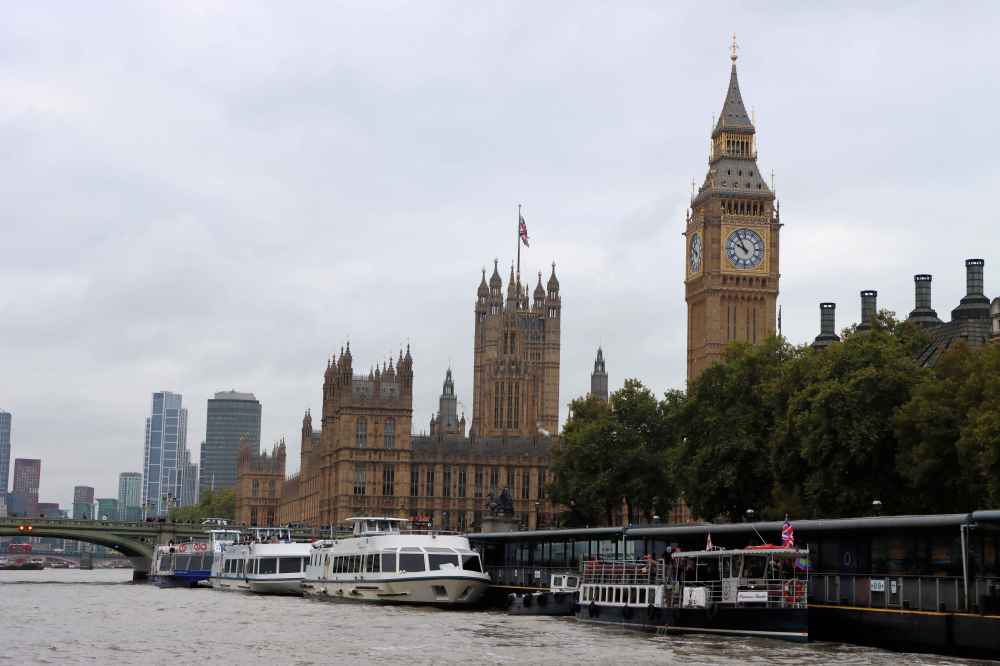
The Houses of Parliament, including Big Ben (aka Elizabeth Tower) as viewed from the Thames. In front of it are several boats that take tourists on trips along the Thames.
Boarding our Thames Clipper boat at Westminster, we were immediately able to admire the Palace of Westminster (aka the Houses of Parliament), including its unmistakeable clock tower. More properly known as the Elizabeth Tower, the clock tower is popularly referred to as Big Ben (in fact, Big Ben is the great bell housed within the tower, rather than the tower itself). These iconic symbols of British democracy date from the mid-19th century, when they replaced earlier buildings that were destroyed by fire in 1834.
The London Eye, and to its right County Hall, which once was the home of London’s local government. Today it houses various attractions, venues, and hotels.
Opposite the Houses of Parliament, on the south bank of the Thames, is the more frivolous but no less recognisable London Eye. Originally known as the Millennium Wheel, the London Eye was opened by Prime Minister Tony Blair on 31 December 1999. It was originally conceived as a temporary project that was due to remain standing for just five years, but it proved so popular that it was soon given permanent status. The Eye is the world’s tallest cantilevered observation wheel, and the UK’s most popular tourist attraction with over 3 million paying visitors per year.
Tower Bridge. To the left is the Shard, and to the right of the bridge is the Walkie-Talkie Building, aka 20 Fenchurch Street.
Heading downriver it was not long before our boat reached another of London’s “must-see” tourist destinations, Tower Bridge. Built in the neo-Gothic style and constructed between 1886 and 1894, the central sections of the road bridge lift to allow tall ships to pass though safely.
The Shard, and on the river in front of it the museum ship HMS Belfast. This cruiser was commissioned in August 1939. In June 1944 she took part in Operation Overlord, supporting the Normandy landings.
Other buildings visible from this section of the river showcase modern architecture, demonstrating that for all its historic attractions London is not stuck in the past. Located on the south bank of the Thames and standing just over 1,000 feet (309.6m) high, the pyramid-shaped Shard is a 72-storey mixed-use development built between 2009 and 2012. This iconic landmark is the tallest building in Western Europe, and the 7th tallest in Europe as a whole behind one in Poland and five more in Russia.
The Walkie-Talkie Building
On the opposite side of the river, the Walkie-Talkie building is equally recognisable, although it comes up short when compared with the Shard as it stands a mere 528 feet (160m) tall! More properly known as 20 Fenchurch Street, the Walkie Talkie’s highly distinctive top-heavy form appears to burst upward and outward. There are 34 storeys of office space, above which can be found a further 3 floors of bars and restaurants.
Metropolitan Wharf, Wapping
Londinium was founded by Roman invaders around AD 47-50. The site was selected because it would make an ideal port and commercial hub, being narrow and shallow enough to put a bridge across, and yet deep enough to welcome seagoing ships. The Thames remained key to the growth and development of the city long after the departure of the Romans, with the wharves and docks that lined its banks handling ever-growing volumes of imports and exports. Countless wharves still remain, although most have been converted to residential or office use.
The piers of the Thames Barrier straddle the Thames
As we neared the end of our boat trip downriver we passed through the Thames Barrier, which is one of the world’s largest movable flood defence barriers. Spanning 520 metres across the Thames, its purpose is to protect central London from flooding caused by tidal surges in the North Sea. It is made up of 10 massive steel gates; the four main gates are 61 metres wide and, when raised, stand as high as a five-storey building. In normal conditions, only the piers that support the gates and the hydraulic mechanism are visible. The gates lie flat on the riverbed, allowing river traffic to pass freely. When a high tide and potential storm surge are forecast the hydraulic machinery is used to rotate the gates upward, forming a solid steel wall against the water.
Difficult to believe that massive steel plates lie on the river bed between these piers, steel plates that may one day save London from a catastrophic flood
The Thames Barrier was just one of several London landmarks that we were pleased to see during our boat trip. A boat trip along the Thames most definitely offers a new outlook on the UK’s capital. Maybe I’ll do it again one day, but hopefully when the sun is shining!
Wordless Wednesday is a simple blog post featuring a photo. It seeks to convey a message or tell a story, but speaks for itself without using words. Mrs P took this photo of the Taftsville covered bridge in Vermont, USA, in 2007. Built in 1836, it is one of the oldest covered bridges in Vermont.




 Now I'm 64