With Easter just a couple of days away and the weather finally showing signs of improvement we decided to treat ourselves with a visit to a local nature reserve. To the uninitiated Straw’s Bridge Nature Reserve doesn’t sound very inviting: it was once home to coal mining and a sewage works, but in recent decades the local council has done a good job of restoring it as a wildlife habitat and local amenity. The locals call it Swan Lake, which gives a clue to just some of the treats we were anticipating. And we were not disappointed.
Swans, ducks and geese were much in evidence, all plainly gearing themselves up for the breeding season. And, much to our surprise, the sight of four fluffy ducklings suggested that one pair of mallards had got down to business some weeks earlier and now found their time consumed with parental duties.
Strolling around the lakes it soon became apparent that plenty of other people had the same idea as us, and were making the most of spring’s awakening. Dogs were out walking their owners, joggers worked up a sweat in painful pursuit of fitness, and cyclists hurtled along the paths, ringing their bells furiously at any pedestrian foolish enough to get in their way. We let them all get on with it, and did our best to enjoy the show Mother Nature was putting on for us.
We took particular pleasure in the flowers. The recent winter drained our world of colour, and we were pleased to see it bouncing back in the form of celandines and field maple. We even spotted a lone bluebell, a tantalising hint of the carpets of colour that will soon be clothing local woodlands.
But the most eye-catching blossom of all belonged to the blackthorn bushes. When the flowers have gone blackthorn is unremarkable, but for a few short weeks this shrub makes a startling impact in a landscape that is otherwise mostly quite ordinary. Straw’s Bridge has some fine blackthorn, and we were privileged to see it at its best. White may not be the most joyous of colours, but large splashes against an uninspiring backdrop definitely capture the attention.
Spring is the best time of the year to appreciate bulrushes, the time when the distinctive seed pods (resembling fat brown cigars!) split asunder to release their fluffy seeds. During our walk we were pleased to come across several beds of bulrushes where that process was underway, a sight that was all the more pleasing in the bright sunshine.
We were especially pleased to have a distant view of a heron striding purposefully in front of a towering bed of bulrushes, where it presumably hoped to track down a snack or two.
Meanwhile, a lone robin kept us under surveillance from a nearby bush …
… and waterfowl paddled effortlessly across the lakes:
We spent around two hours at Swan Lake that morning. We saw nothing spectacular, nothing unusual for this location at this time of year, but the experience was delightfully calming and uplifting. It was great to get away from the laptop for a while, to escape from the relentlessly bad news that overwhelms the airwaves these days, and instead to be out in Nature alongside the birds and the blossom and the bulrushes. Who doesn’t love spring’s awakening?
Last month I had a BIG birthday. You know the sort of birthday I mean, a birthday where the number of years you’ve clocked up is exactly divisible by 10 but your 50th is but a distant memory. While I’m pleased to have survived this long, old age is getting to be a bit of a pain – both figuratively and literally – so Mrs P did her best to take my mind off my advancing years by arranging our first ever visit to a cat café, in the nearby city of Nottingham.
Paul McCatney in the treehouse at Nottingham’s Kitty Café
For the uninitiated, here in the UK a cat café is a themed café where you can grab a cappuccino and a slice of cake, while (maybe!) getting up close and personal with the resident cats. Animal charities don’t much like them, arguing that feline welfare cannot be guaranteed in such establishments. These critics point to issues like overcrowding, lack of space and the excessive demands of customers who have paid for a cat encounter and expect to get one, even if the cats themselves would prefer to be left alone. Cats, they imply, are being exploited in pursuit of profits.
Mrs P is a lifelong animal lover, and takes these things very seriously. Before booking our visit she researched the Kitty Café in Nottingham to satisfy herself that cat welfare is their priority. Their website was reassuring, telling her that…
“The Kitty Café is designed with felines in mind, with wide open spaces and lots of kitty toys…[it] is a re-homing and care facility for cats and kittens from a range of backgrounds. From rescue cats, to strays, to cats which have had medical issues – we take them in and look after them until they find their forever home.”
Lily relaxes on the exercise wheel
Content that the establishment really does care about its resident cats, and delighted to know that it supports the welfare and rehoming of other local cats in need, Mrs P went ahead and booked us a table for an hour. We agreed before going in that if we had any concerns about what we saw we would leave immediately. But upon entering we were pleased to discover that the Kitty Café was every bit as responsible and caring as its website suggested.
Oreo, cute but alert
The very first thing we had to do upon entry was to read a set of house rules that visitors to the café must follow, which are prefaced by the reminder that “you are guests in the cat’s home so please be respectful!” The rules go on to make clear that while the cats can be petted, they must not be fed, picked up, woken up if asleep or pushed off a chair.
Lily poses for the camera
After we’d read the rules and signed to confirm that we would follow them, an assistant led us through to our comfy seats next to a small coffee table. Looking around us we were pleased to see the café is spacious, and designed with moggies in mind. As well as dedicated cat walkways attached to the walls there are places for them to sleep, to scratch, to play and to hide away from prying human eyes.
The little moggie enjoyed attacking the scratching posts
It was reassuring to note that if they wish to avoid all contact with human visitors the cats can retreat into a separate backroom which is, in effect, their own private space. And when we arrived that’s where they mostly seemed to be, as the area around our seats was a cat-free zone. Eventually a moggie emerged from the backroom, and proceeded to do what cats do best – it ignored us completely, striding past with purpose, but without so much as a glance in our direction. Soon a couple of others appeared, but they too seemed indifferent to our presence as they went about their own business.
Charlotte surveyed the café from a wall-mounted shelf
We ordered a pot of tea, and while waiting for it to arrive we set off to explore parts of the café not easily visible from our seats. We were pleased to spot several cats as we wandered around, including Paul McCatney (yes, that’s right, his name really is Paul McCATney!), a good-looking ginger guy who was attracting a lot of attention. And it was encouraging to see that all the visitors to the café were behaving impeccably, not hassling the moggies with unreasonable demands for attention and affection. There’s no doubt who was in charge of moggie/human relationships, and it wasn’t the humans!
Oreo snoozing on my chair!
When we returned to our seats, I discovered that mine had been taken by a handsome chap whose name, we discovered later, is Oreo. Oreo was pleased to receive some gentle fuss and attention – which is allowed under the house rules – but made it quite clear that my chair was now his chair, and would remain that way for the foreseeable future. Noticing my discomfort one of the café assistants brought me another chair, but when – a few minutes later – I got up to take some video of Paul McCatney in a treehouse, ownership of my seat was claimed by Pumpkin!
Pumpkin on my replacement chair, clearly displeased that Mrs P was taking photographic evidence of his misdemeanour
Once again, therefore, I found myself with nowhere to sit, but at least I knew I was performing a useful function by warming seats for the café’s cats to sit on. Being unable to sit down, I set off again on another tour of the café, keen to observe more of what its residents get up to. Without exception they appeared relaxed and content, mostly doing their own thing but just occasionally interacting with their adoring admirers and with one another. I witnessed a little bit of butt sniffing and one minor disagreement over the ownership of a prime snoozing spot, but there was absolutely no evidence that any moggie was stressed by the presence of the other moggies living alongside them, or by the humans ogling them. A good time was clearly being had by all, both cats and visitors.
Bambi outside the treehouse
The animal charities are right to warn that establishments like this could be bad news for cats, but I have no doubt that in this case their concerns are unfounded. Nottingham’s Kitty Café is plainly well run by staff who know the residents as individuals and care deeply about their welfare. The moggies showed no sign of being uncomfortable in their surroundings; in no sense were the furry furies being “exploited”. Their behaviour appeared entirely normal, if the behaviour of domestic cats can ever be described as “normal”! It was a pleasure and a privilege to spend an hour in their company, even if most of them spent that hour totally ignoring us.
Bambi poses on the back of my comfy chair.
We will doubtless return very soon to Nottingham’s Kitty Café. Thank you Mrs P, and thank you Paul McCatney, Oreo, Pumpkin and all your pals, for making sure my Big Birthday was one to remember!
Wordless Wednesday is a simple blog post featuring a photo. It seeks to convey a message or tell a story, but speaks for itself without using words. Mrs P took this photo of a New Holland Honeyeater in Tasmania in November 2016.
Mrs P and I enjoy a colourful sculpture trail. They are plainly not high art, but they’re good fun and raise the spirits at a time when events – both international and here in the UK – are profoundly depressing. We have travelled to various parts of the country in pursuit of these trails, so it was a pleasant surprise when we discovered that our local area was to host its very own trail under the title of Ay Up Me Duck.
“Sunset over Amber Valley” by Rachel &Phillipa Corcutt (on display in Alfreton)
For those who don’t know – and I guess that’s almost everyone who’s never lived in the East Midlands region of the UK – “ay up me duck” is a traditional, casual way of greeting men and women who are your friends, or to whom you feel well disposed. I suppose it’s a bit like saying “hi, how’re you doing”, but it’s unique to this part of the country, and as such is a way of celebrating a shared local identity. Organising a sculpture trail that references this phrase is therefore a good way of reinforcing a positive community spirit, while the body shape of a duck gives ample opportunity for artists to show off their talents.
TOP LEFT: “Ay up, Belper” by Carla Dee (on display in Belper); TOP CENTRE: “Duk n Love” by Oliver Jamin (in Alfreton); TOP RIGHT: “Amber Sun” by Rebecca Grantham (in Ripley); BOTTOM: “Bee-ky” by Lynne Hollingsworth (in Heanor)
The Ay Up Me Duck trail features eight large, colourful ducks prominently displayed in the towns of Belper, Alfreton, Ripley and Heanor (two ducks per town) as well as a host of mini-ducks in shop windows. The large ducks are mostly decorated with images of notable landmarks to be seen in our corner of Derbyshire, as well as some of the wildlife that can be found here. The mini-ducks are more quirky and include one sporting a ceremonial guardsman’s uniform, another that appears to be a strange hybrid of duck and kangaroo, and third dressed up as a pirate. Weird, eh!
Mini-ducks, just a few centimetres tall, seen in shop windows. LEFT: “Guardsman Duck”; CENTRE: “Kangaroo Duck”; RIGHT: “Pirate Duck”.
All the ducks are located in, or very close to, retail areas of the towns involved. As well as boosting civic pride the aim of projects like this is, in part, to encourage more visits to the area in which the sculpture trail is located. This is no bad thing given that all local town centres – except Belper’s – are looking increasingly rundown, thanks to competition from online shopping and out-of-town retail parks.
“Derwent Duck” by Rebecca Mortledge (on display in Belper)
To some degree the trail seemed to be paying dividends, as we saw numerous families ticking off the ducks they’d successfully tracked down on their trail guides. It even persuaded Mrs P and I to visit a couple of places within just a few miles of our home that we’ve not seen for many years. Whether we, or those other families, will go back again after the ducks have been removed is doubtful, but for a few short weeks the Ay Up Me Duck trail is creating a bit of a buzz – or do I mean a quack? – around the Amber Valley district of Derbyshire. It is, I think, a most welcome initiative in these difficult times.
Wordless Wednesday is a simple blog post featuring a photo. It seeks to convey a message or tell a story, but speaks for itself without using words. Mrs P took this photo of Polar Bears squabbling near Churchill in Manitoba, Canada in 2012.
During a recent trip to London our ambition to escape the familiar tourist treadmill led us to visit Leighton House, the former home of a prominent 19th century artist and lord of the realm. Frederic Leighton (1830-1896), the artist son of a Yorkshire doctor, was successful, well-travelled and wealthy, and in the mid-1860s he started work on a new house in the Holland Park area of the city. The result was spectacular.
The Arab Hall
Leighton’s intention was to build a house that would function as his artist’s studio, while also serving as a work of art in its own right. In so doing he was able to channel his creativity, to indulge his passions and to show off some of the more exotic items in his personal collection.
The Arab Hall
The undoubted star of the show at Leighton House is the Arab Hall, a space that was inspired by the architecture and gardens the artist had seen on his travels in North Africa, the Middle East and Sicily. The Arab Hall displays Leighton’s collection of tiles, most of which were made in Damascus between the late 16th and early 17th centuries, as well as works by contemporary artists he commissioned to help bring his vision to life.
The Arab Hall. In the bottom photo the Arab Hall is viewed from the Narcissus Hall. The statue is of Narcissus, who plainly fancies himself!
The Arab Hall was part of an extension added to the house in the 1870s. It was completed in 1882, and is said to have cost more than the whole of the original building. Money well spent, I think! Leighton is reported to have said of the Arab Hall that he wanted to create “something beautiful to look at”. Well, he succeeded, that’s for sure. It is simply stunning, all the more so for being so totally unlike anything you would ever expect to see in London.
Top Left: In the garden “A Moment of Peril”, a sculpture by Sir Thomas Brock created in 1881. Bottom Left: Rear view of Leighton House, from the garden. Right: View of Leighton House from the street; you would never guess what lurks within, would you?
Leighton was an eminent figure in the English arts scene in the latter half of the 19th century. He painted both portraits and landscapes, dabbled in sculpture and was a big player in the Aesthetic Movement, which championed “art for art’s sake,” prioritising beauty, sensuality, and visual pleasure over practical considerations.
The Silk Room was used to display paintings by artists who Leighton admired.
Frederic Leighton was highly respected in the artistic community, as demonstrated by the fact that in 1878 he became President of the Royal Academy of Arts, the prestigious, London-based institution that was founded in 1768 to promote visual arts through education and exhibitions.
Two paintings by Frederic Leighton.
Such was the esteem in which Leighton was held that on January 24th 1896 he was made a Lord, becoming Baron Leighton. It was a record-breaking elevation to the nobility as he was the first painter ever to have received a peerage. He probably felt pleased with himself, but sadly that did not last long. Just one day later, on 25 January 1896, Baron Leighton died, enabling Frederic to break another – and altogether more unwelcome record: nobody in the history of English nobility has ever held a peerage for less time than poor old Fred!
The Dining Room was mainly used for the display of pottery.
Baron Leighton therefore had no time in which build a reputation in the House of Lords as a formidable debater and champion of the arts. From that perspective he was – through no fault of his own, of course – a complete nonentity. But who really cares about that? The building of Leighton House, and particularly the creation of its Arab Hall, has secured Frederic, Baron Leighton’s legacy for all time.
Wordless Wednesday is a simple blog post featuring a photo. It seeks to convey a message or tell a story, but speaks for itself without using words. Mrs P took this photo of Mount Ngauruhoe in the North Island of New Zealand in 2019.
When we visited London a few months ago we made a conscious decision to avoid the tourist hotspots and instead have a look at some of the lesser known attractions. London definitely has a lot to offer, but St. Sophia’s Cathedral – more properly known as the Greek Orthodox Cathedral of the Divine Wisdom – was certainly not what I expected.
Surprisingly the first Greek Orthodox church in London opened way back in 1681, to serve a growing community of Greek origin. This influx was driven in part by the persecution of Christians under the Ottoman Empire, which ruled Greece at the time. In addition, some wealthy Greeks relocated to London to escape the political instability of their homeland, while others who worked in the shipping industry moved there to set up businesses moving goods between England and the eastern Mediterranean. The small Greek community thrived, and today the area of Soho in which they first settled is still known as Greek Street.
Although London’s Greek community prospered and grew, their original church did not. By the mid-19th century, demand amongst its members for an appropriate place of worship intensified, and it was this that ultimately led to the construction of a building large and grand enough to meet the spiritual needs of a community that was now numbered in the thousands. Work began on the construction of the Greek Orthodox Church of the Divine Wisdom in 1877, and it was formally consecrated in 1882. In 1922 it was designated as a Cathedral serving the needs of all Orthodox Christians in the British Isles and Malta.
Arriving at the Cathedral, the view from the street is unremarkable, and at first I wondered if our visit was worth the effort we’d made to get there. Crossing the threshold, however, I quickly learned that the ornate Byzantine interior boasts an impressive array of intricate mosaics and other beguiling features. This riot of gold leaf, multi-coloured marble and elaborately carved wood seemed strangely exotic, very un-British, not at all what I expected to see in London – nor, indeed, anywhere in the UK – and was all the more pleasing for that very reason.
The Greek Orthodox Cathedral of the Divine Wisdom in Bayswater, London, most definitely possesses the “wow factor”, and is a clear illustration of why visitors to London should occasionally break away from the well trodden tourist trail and seek out some of the capital’s less known architectural gems. Well worth a visit!
Wordless Wednesday is a simple blog post featuring a photo. It seeks to convey a message or tell a story, but speaks for itself without using words. Mrs P took this photo of a fishing hut at Prospect Bay in Nova Scotia, Canada in 2015
Last Monday, 2 February, was World Wetlands Day. A wetland is a transitional area between land and water, an area where water covers the soil – or is present at or near the surface – either permanently or seasonally. Mrs P and I love a good wetland: it’s a distinct ecosystem that is a great place for a spot of birdwatching, and is notable as the favoured habitat of the handsome heron family
Grey Herons were my Mum’s favourite bird. This one has just caught itself a tasty snack.
When my father died over 30 years ago we bought my mother a set of binoculars and started taking her out on our birdwatching expeditions. She soon declared the heron to be her favourite bird, attracted I suspect by its large size and a distinctive appearance that includes a dagger-like bill, long spindly legs and an improbably bendy neck. I imagine she was also intrigued by the birds’ hunting style, in which they stand motionless for lengthy periods before stabbing explosively at any prey item foolish enough to venture too close to them. Spotting a heron quickly became Mum’s ambition whenever we took her out, and because we chose our birdwatching sites carefully she was rarely disappointed.
The Grey Heron is the UK’s most common species of heron. As these images show, Mrs P’s been photographing them for many years.
The species that Mum got to know and love is the Grey Heron, by a long way the most common member of the heron family in the UK, with over 60,000 birds overwintering here. Standing nearly 1m high and with a wingspan approaching 2m, it is an impressive bird. It feeds primarily on fish, but also eats amphibians, ducklings and other small birds, and tiny mammals such as voles. Interestingly, Grey Herons sometimes temporarily leave their wetland habitats in favour of nearby agricultural fields which they scour for rodents in the immediate aftermath of the harvest.
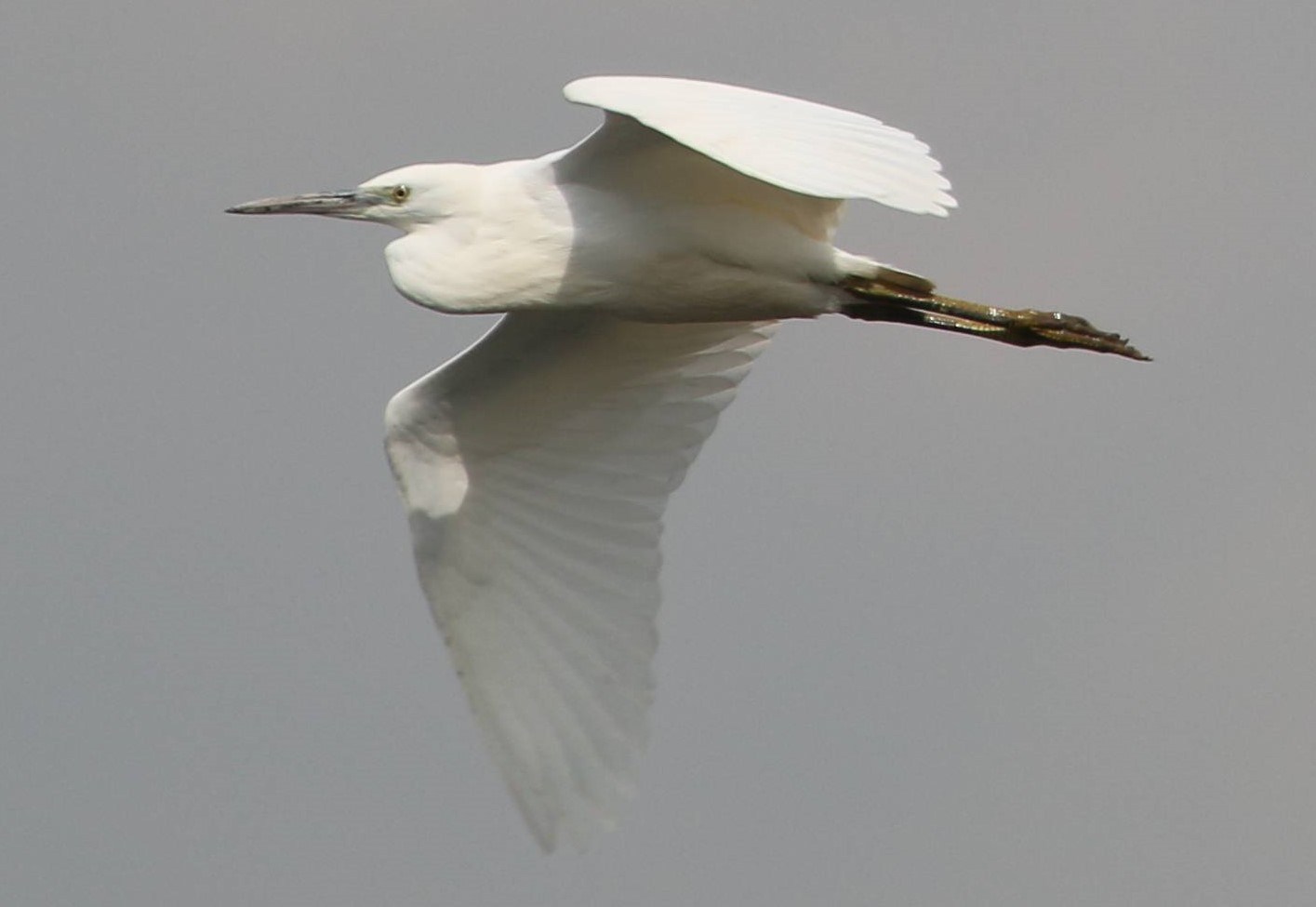
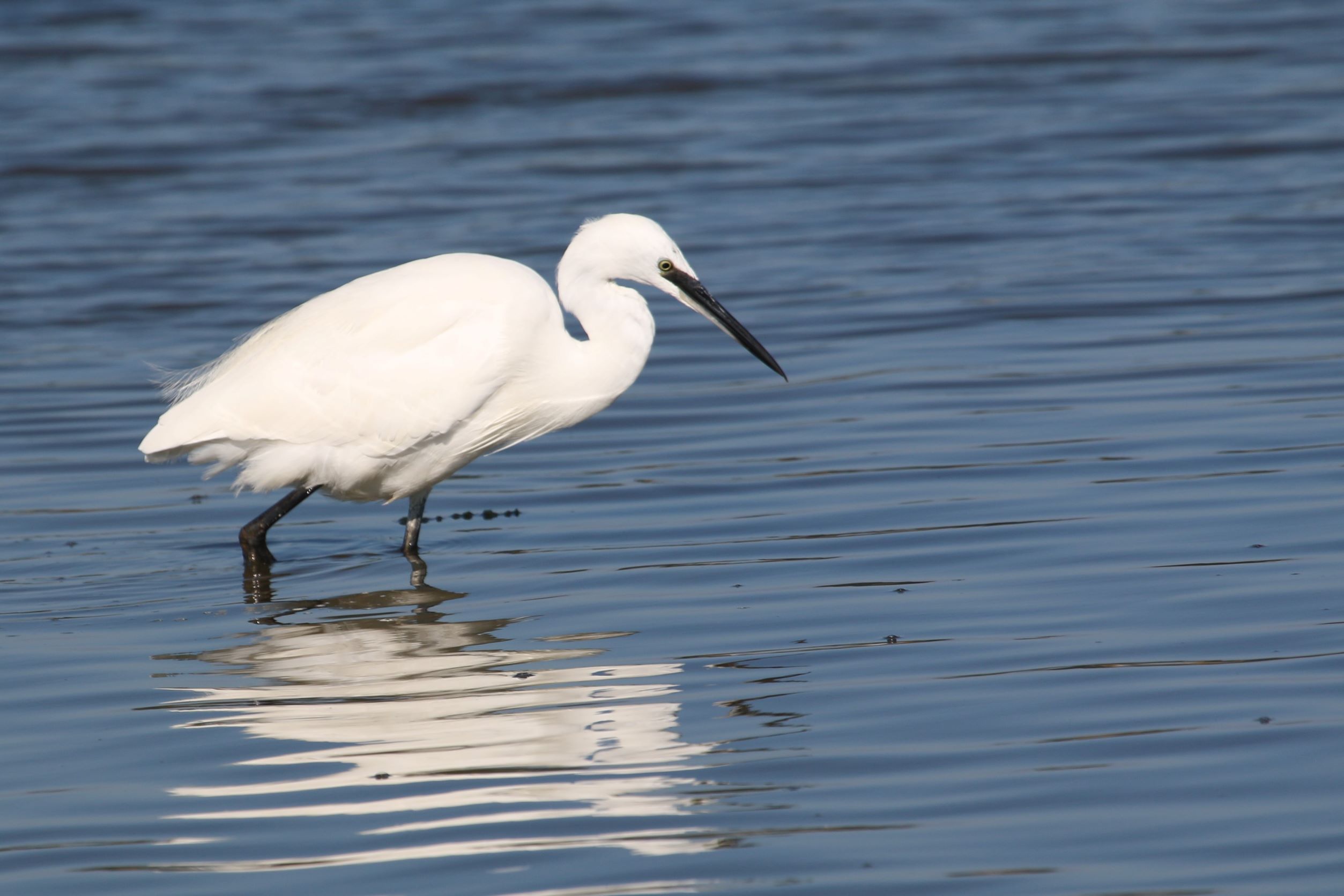
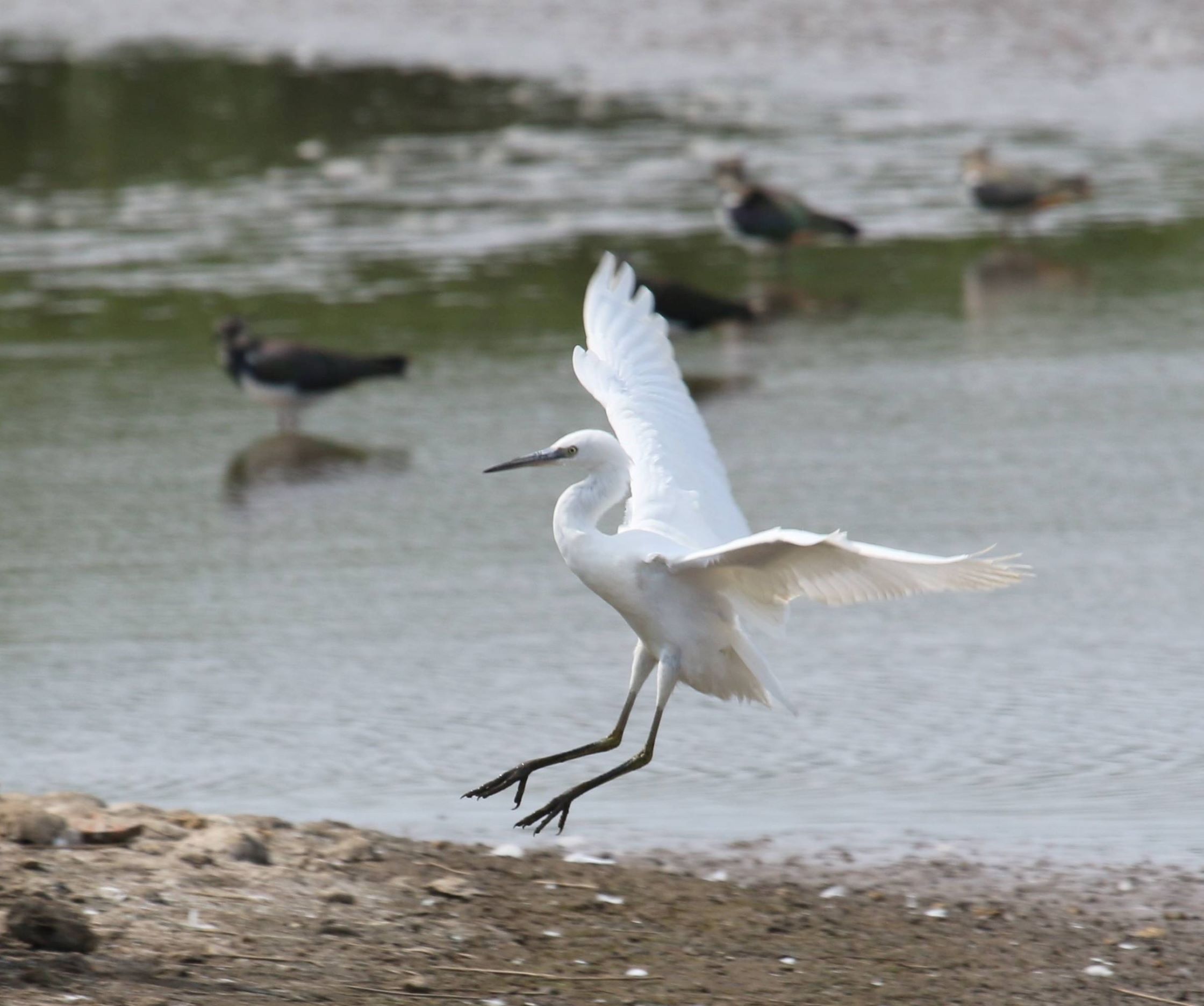
Little Egret.
The UK boasts several other members of the heron family, although none is very common. The Bittern is vanishingly rare; Mrs P and I have rarely seen one, and have never got a decent photograph. Little Egrets were once common here, but were wiped out over 100 years ago thanks to the insatiable demand of the fashion industry for the birds’ elegant feathers. I wrote about the decline and fall of the Little Egret, and the important consequences this had on bird conservation in the UK, in a post I wrote in 2024.
Great White Egret.
Little Egrets began recolonising the UK in the late 20th century, and these days we see them quite often. Sadly their return came too late for my Mum, as did the more recent arrival of the Great White Egret. She would have been thrilled, I’m sure, to see both egret species, though I suspect neither would have supplanted the Grey Heron in her affections.
Clockwise from Top Left: Green Heron (seen on Tobago in 2006); Great Blue Heron (Canada, 2014); Little Blue Heron (Costa Rica, 2008); White-Faced Heron (Tasmania, 2016); Galapagos Heron (Galapagos Islands, 1989); Bare-Throated Tiger Heron (Costa Rica, 2008); Great Blue Heron (Canada, 2015).
Across the whole world there are reckoned to be 75 separate species within the heron family, although some go under the names of egret or bittern. Herons’ solitary nature and their motionless hunting style have captured the imagination of cultures everywhere, often making them figures of mystery and deep spiritual significance as well as symbols of patience and wisdom. Every continent except Antarctica boasts resident species of heron, and as Mrs P’s photos show we’ve been privileged to see a number of these during our travels.
Clockwise from Top Left: Bare-Throated Tiger Heron (Costa Rica, 2008); Green Heron (Costa Rica, 2008); Bare-Throated Tiger Heron (Costa Rica, 2008); Indian Pond Heron (India, 2013); Little Blue Heron (USA, 2012); Great Blue Heron (Canada, 2012).
Almost all species of heron are closely associated with water, living and feeding as they mostly do on the margins of lakes, rivers, and swamps. They need wetlands, as do so many other species of birds, mammal and invertebrate, and it has been a pleasure to celebrate World Wetlands Day by featuring these magnificent birds here. My Mum, a heron lover until the very end, would definitely have approved!




 Now I'm 64